Jordan Hines on Growing a Lawn Doctor Franchise

Table of Contents
Jordan Hines and his wife own the Lawn Doctor franchise in Metro Grand Rapids, Michigan. Lawn Doctor is a nationwide franchise. Jordan’s dad bought this one in 2000 and kept it small, a one-man show on weekends with pen and paper and no CRM, while he worked as a grocery manager at Meijer. Jordan’s older brother is Kendall Hines, who has been on this podcast a couple of times, and Kendall is the one who connected us. We’re in the same market, and Jordan had just seen one of our vans. I like talking to people in my market, and so does he. “There’s enough work for everyone to go around,” he said.
Jordan started as a technician in 2016. Kendall bought the business from their parents in 2017, and Jordan moved up to ops manager. When Kendall went all in on Lawnbot, Jordan and his now wife bought the franchise from him in the fall of 2019. Their first season was 2020. When we recorded this in 2025, they were on pace for about $2.5 million that year. The biggest Lawn Doctor franchise is hovering around $11 or $12 million, he said, and Jordan wants to be the biggest one in the system.
This episode is part of the PCM Podcast. For another fertilization and weed control company, read Branden Rheinschmidt and Lindsey Johnston on merging two lawn companies.
The franchise brings the brand, not all the marketing
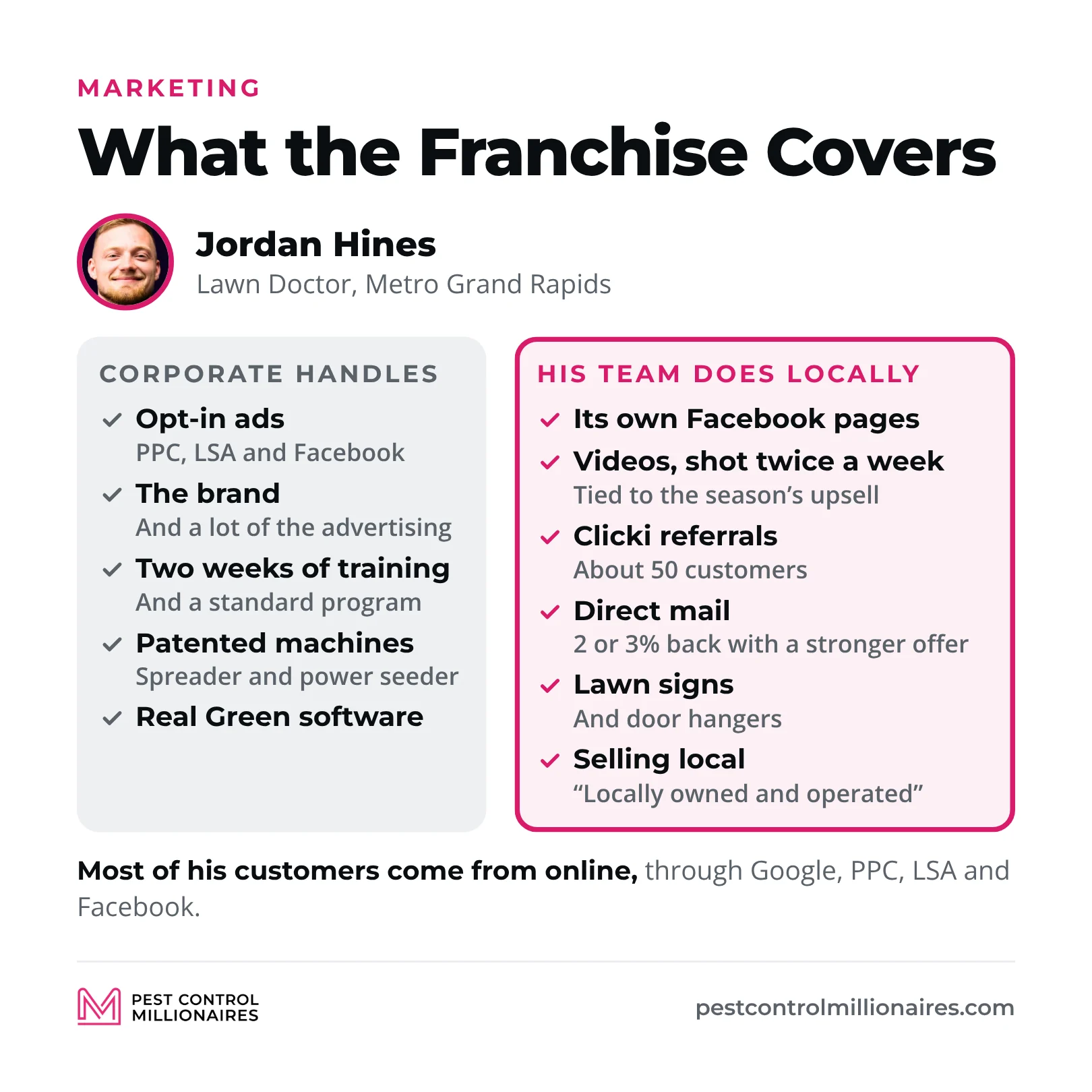
Jordan thinks his dad went the franchise route because he already had a career and wanted something established, with a blueprint and a national name. Here’s what that gets Jordan today. Corporate runs an opt-in program for PPC, LSA and Facebook ads, and it carries the brand and a lot of the advertising. New owners get two weeks of training and a standard program, though most Lawn Doctors can run their own programs as long as they follow the guidelines. Lawn Doctor patents its own granular spreader and power seeder and has all the parts for them. And almost every franchise runs on Real Green, he said.
But the long-tenured franchises over a million dollars are mostly self-sustaining, he said, and “you’re really steering the ship.” Most of Jordan’s customers come from online, through Google, PPC, LSA and Facebook. The local marketing is on him, from his own Facebook pages and videos to referrals, direct mail, door hangers and lawn signs.
One of the most helpful things corporate launched is a performance group. Lawn Doctor owners close to Jordan’s size or a little bigger get together a couple of times a year and compare everything, full P&Ls included. That showed him where to cut and where to add. “That’s been a really game changer for us,” he said. If your industry has a group like that, get in it.
Put a face on your company
Jordan started doing a lot more videos in 2025, on TikTok, Instagram and YouTube. Some are funny and some are education. “They get to kind of see a face and it’s not like we’re always selling something,” he said.
He hired someone to run social media. They plan the videos together, she films and edits, and they shoot about twice a week for a couple of hours. They tie the videos to whatever they’re upselling that season, like seeding season, grub season and mosquito season. He was really shy at first. “You get more confidence or maybe you just don’t really care anymore,” he said.
Go back and look at my first hundred videos or my first hundred podcasts. They sucked. But nobody’s watching at that point anyway, and nobody remembers what their lawn care guy posted three days ago. The more you do it, the easier it gets, until you can knock out a 30-second video in less than a minute. Just keep pumping out content. Our social media guide has the formats that work for us.
Old-school marketing still works
“Everybody’s kind of moving to digital and I feel like nobody’s really attacking that other side anymore,” Jordan said. So his team puts out a lot of lawn signs and door hangers and does direct mail, just to get the name and the brand out there.
A direct mail campaign they ran in 2024 didn’t get a good response, and Jordan thinks the offer was the problem. In 2025 they tried a stronger offer and got maybe 2 or 3% back on what they sent. I’d add one thing. Some people buy 10,000 flyers and send them all at once. I’d rather send 2,000 at a time, five times, and keep pounding the same neighborhoods you want to be in. If you’re building that offer, start with what makes a pest control offer work.
Then there are the doors. Kendall made Jordan knock doors back in the day, and Jordan wants to bring it back once he has something solid, not just guys sent out on a whim. He was introverted in high school with not a ton of confidence, and knocking taught him how to talk to people, read situations and ask for the sale. “I feel like most people nowadays it’s like they’re scared to ask for the sale or they’re scared to ask for the card number,” he said. I think every kid, boy or girl, should knock doors for a summer.
It all comes back to density. Jordan covers a pretty wide area, but being in the same neighborhoods is the goal. “That’s really where you make your money if you’re dense,” he said. I have a shirt that says route density on it. His techs are paid hourly, but they’re paid on performance when they hit it. In our experience, tighter routes mean less drive time, more production and more money for the techs.
Sell local inside a national brand
The brand helps. Lawn Doctor is recognizable. But some people lump Jordan in with TruGreen and Weed Man and think of him as a big corporate company, and there’s a company in his area marketing itself as “not a franchise.” Jordan was quick to say there are some really good TruGreen operators.
He fights it by being personal. He still goes out to do some lawn evaluations himself, and his team hits being “locally owned and operated” hard. “Family owned and operated 25 years. Like we’re in the community, we’re here to stay,” he said. Any issue, they take care of on their end.
Referrals help too. Jordan uses Clicki, and he was up about 50 customers from it when we recorded, with a lot of customers signing up to share their link. Kendall built Clicki, and we use it at Pest Badger too. Our referral guide covers how we run ours.
Keep your best guys through the winter
Lawn care stops in a Michigan winter, and Jordan takes a different approach than most. His wife bought a caramel apple business that runs in November and December, which helps keep the office staff busy. And they flip mobile homes. Jordan lived in one with his wife at 18, sold it, bought it back, painted it and sold it again, and figured they could do it on the side. One of his guys does flooring and another is good at electrical, so they fix up four or five each off season, nothing major, just floors, paint and drywall, and resell them.
Keeping the crew on all year can hurt, he admitted. But “to get experienced techs and go out that season and especially in the spring ready to go, there’s no value you can really put on that,” he said. Even if you only get through Q4 breaking even, you keep your guys.
It shows up in hiring. Most of his guys come back every year, and they add one or two a year plus a couple of part-time college guys. Since they built the business around their mission and core values, the new people come as referrals from current employees, and they keep a small waiting list. I call that building your bench. “If they find a good culture and they feel valued and part of the mission, then they’ll stay,” Jordan said, and they’ll refer other people to you. You’re always going to lose guys, so always be hiring. Here’s how we find technicians.
Know your numbers from an island
Somebody in Jordan’s performance group was reading Traction, so he and his wife read it too. The idea that stuck with him was the numbers. If you were on an island, what are the 10 numbers that would tell you how your business is doing? “That just kind of blew my mind that you could look at numbers being completely away from your business and kind of know how it’s doing,” he said.
They self-implemented EOS in 2024, went further in 2025 and run a weekly Level 10 meeting where they track retention, revenue in, revenue out, sales and cancels. We self-implemented too, years ago. I’ve read Traction five, six, maybe seven or eight times, and we run a short Level 10 with every branch on Thursdays. Here’s how we run our weekly meetings.
ChatGPT helps them write SOPs and customer responses, though it was about 50/50 on turf grass questions when we recorded. I’d uploaded lawn pictures the two days before, and it diagnosed the problem right both times. “Those businesses that learn how to implement it and use it within their business are going to go way farther than the ones that just try to shy away from it,” Jordan said.
The plan is to build out sales, marketing and operations teams, each with its own SOPs, so the whole thing is plug-and-play. Then if they ever open a territory outside their current one, the blueprint is already there. They had just expanded into the Muskegon and Lakeshore area when we recorded. His advice for owners starting out was the same idea. “Know your numbers,” he said, because there’s no point if you’re not making money.
Give every partner a clear seat
Their first year, 2020, was hell. COVID orders in Michigan held them back until late April or early May, their ops manager quit the week before the season started, and they were fighting crabgrass all year because they couldn’t get their pre-emergent down. Jordan and his wife almost broke up multiple times. It’s never really a question of whether the business makes it. It’s whether the two of you make it.
What helped was clear roles. Jordan runs operations. His wife came from managing a commercial cleaning company and was in the numbers, so she handles finance, HR and growth. Their integrator runs marketing and sales and says yes or no to the million ideas they both bring, and she breaks the tie when they disagree. Jordan calls it a three-legged stool. Rocket Fuel is a good book on the visionary and integrator split.
The hardest part for Jordan is letting go. “I almost feel like this business is like it is a part of me because it’s been in my family for so long,” he said. He knows he still thinks like the operator and the technician sometimes, and that he needs to think like an owner and guide the ship. If you don’t, you become the bottleneck. When I felt guilty stepping away as Pest Badger got bigger, my mentor told me that meant I built it the right way. It didn’t make me feel any better, but he was right.
His other piece of advice was discipline. Be willing to knock on any door and do the guerrilla work everybody forgets about. “If you can kind of keep that mindset, I don’t see why nobody could stop you,” he said.
Frequently Asked Questions
Who is Jordan Hines?
Jordan Hines and his wife own the Lawn Doctor franchise in Metro Grand Rapids, Michigan. His dad bought it in 2000, Jordan began as a technician in 2016, and he and his wife bought it from his brother, Kendall Hines, in the fall of 2019. When we recorded in 2025, they were on pace for about $2.5 million that year.
Does a Lawn Doctor franchise do your marketing for you?
Not all of it. Corporate runs an opt-in program for PPC, LSA and Facebook ads and carries the brand, and the franchise gets training, a standard program, patented machines and Real Green software. Jordan still markets locally with his own Facebook pages, videos, Clicki referrals, direct mail, door hangers and lawn signs.
How do you keep lawn care technicians busy in the winter?
Jordan’s crew flips four or five mobile homes each off season, doing floors, paint and drywall, and his wife’s caramel apple business keeps the office busy in November and December. Keeping experienced techs all year means they’re ready to go in the spring, and there’s no value you can really put on that.
How do you compete with TruGreen as a franchise?
People sometimes lump Lawn Doctor in with the big national companies, so Jordan leans on being local. He talks up locally owned and operated, family owned for 25 years and here to stay, and he still goes out to do some lawn evaluations himself.
Full transcript
Every word of the episode, from the video captions
All right, guys. Welcome back to another episode of Pest Control Millionaire. Got another one of my new friends on the podcast, which is pretty cool because we actually never met before today. So, it's just cool. But I do know his brother. He's been on the podcast a couple times.
Which is Kendall Hines. And today we have Jordan Hines, which is really cool because he's in the industry, too. Obviously it's kind of where, you know, Kendall made the relationship happen. I like, man, I got to reach out to your brother. I'd love to get connected with him, get to know him, get him on the podcast. So, Kendall did that for us last week. And, yeah, we got Jordan on today, which is pretty cool. And, Jordan, you actually own one of the Lawn Doctor franchises in is it was right in Grand Rapids or just outside of Grand Rapids?
Yeah. So, it's basically Metro Grand Rapids. And you just got done saying that you saw one of our vans recently. Yeah. Yeah, I did see your van. Yep. That's pretty cool. Over in the same market. I actually enjoy it. And it's like everyone's like, "Oh, you talk to people that are in your same market." I'm like, "Why wouldn't I?" Like, we're out there to help each other. We're all like we're making each other better, you know?
We're of the entire industry. Yeah. Exactly. Right. It's like there's always a lot of animosity I feel like towards like some industries with the same people, but like I think we're all out there together. We're all trying to do something, change industry for the better. And if we can do that, you know, by talking to each other and helping each other out, then why not, right?
Absolutely. And there's enough work for everyone to go around. You know what I mean?
Exactly. Yeah. So, I you know, I know you listened to the podcast before, so I'm going to go I'm going to take us back to high school days. If Jordan and I were, you know, sophomores and juniors in high school, who's Jordan in high school?
Yeah. So, I actually grew up with a twin brother. So like just Yeah. Yep. I have a fraternal twin. Super. So, who's older?
I am by 12 minutes. It's always a competition, right? Yeah. Right. So I grew up with a twin brother, so always competitive, right?
Big sports. I played baseball, soccer in high school, right? I was kind of like in the middle between like I guess I'd say like a athlete and like a nerd kind of, but not really. And I but I was very like introverted in high school, right?
I didn't really have a ton of confidence. I was like, you know, I was real like a buck 55 wet, right?
Like just skinny little guy, right? Nothing crazy. But, you know, I think it really transcended eventually once, you know, I kind of graduated high school, went to college, and then kind of started getting into the whole business world. It's kind of when something really changed, right?
And it's funny because I was going to play baseball at our local community college, too. But then like when I had to make that choice to either play baseball or kind of get or dive into the business I guess cuz it was growing I kind of chose to dive into the business and that's kind of where like I'd say my transformation really started.
That's really cool. So obviously ultra competitive brother which route did he take after high school?
So he was in college too. So and he and he did play baseball. It's funny he went that route to play baseball. I, you know, jumped in the business and today he's actually a police officer in Austin, Texas. So, yeah. So, he kind of took that route and Yeah. That's cool. Have you Did you go visit at all in Austin?
Yeah, I did a ride along with him the last time I went. Oh, really?
That's awesome. How was that? It was pretty crazy. Downtown Austin is insane. It's fun, though. I enjoy it down there. I actually like Austin a lot. Yep. It's a good area. So, did you go down any like Rainey Street, anything like that?
No, we his sector was just outside of downtown. But yeah, that's cool. And then so obviously you I know I kind of know a little bit of the backstory, but why don't you say why don't you tell the listeners how the business even started?
Yeah. Yep. So Lawn Doctor is a nationwide franchise, right? My dad bought that franchise or started, I guess, in 2000. And he kept it really small, you know, for a long time. He was a grocery manager at Meijer. He actually delivered papers, too. Wasn't wasn't like the first location of Meijer in Grand Rapids area?
I think it was actually I think it was Greenville I want to say was the very first one. Yeah. Gotcha. So, and he was doing that and just he did Lawn Doctor on the weekends, right?
Didn't I think he was prepping it for us. I think that was his ultimate plan. But obviously for all that time, you know, it stayed really small, just one man show, you know, pen and paper, no like software, no CRM basically, no records barely.
And then obviously my brother Kendall once he kind of gets of age, he kind of dives into it. Me and my brother are still in high school at that time. And then Kendall's about four years older than us, right?
So once he graduates, he kind of comes home, starts kind of diving into the sales and marketing of the business. Me and my brother in college and at that time once that business really starts accelerating it's like okay we need somebody to kind of jump in here and be a tech right and like I said before my brother Matt kind of took the baseball route and I was like well you know this has kind of been around me my whole life I've known it I've seen it and it's like it's probably time to about dive in start kind of learning like what it is and what it's all about. Yeah that's really cool. So, what like I'm kicking back to like summer number one. What was that like?
Is that something? Did you know summer one that you're going to do forever or is just like gonna be a summer thing?
I really thought it was just kind of a summer thing at first, right? Like I've always loved kind of grass and green spaces and stuff like that. Like mowing stripes, right?
Like everybody does. Yeah. And everybody thinks like people still think we mow. It's kind of funny. And I'm like, no, we do like turf healthcare, right?
All that stuff. So, I didn't know how in-depth it would be like licensing, all that stuff. I really thought it was kind of a summer deal and once I kind of dove in I kind of really fell in love with just transforming the lawns like solving customers issues just you know really caring about that customer and just seeing like the end result too was like really satisfying for me. Yeah, that's cool. What made do you know what made your dad buy the franchise route?
Go the franchise route? I don't. I think because he already had his career at Meijer, he kind of wanted something that was like established and kind of had a good like blueprint and kind of was nationally recognized. So, I think that really helps that really helped anyway keep it, you know, or made him make that choice. For sure. So, like now walk me through like the come up of like your first summer through like where you're at now, like your all the different roles that you've had in the business and, you know, where you're at today. Yeah. So, I basically so I want to say my first year actually in line was like 2016, right?
I was a technician from probably 2016 to like 17. 2017 is when Kendall kind of came in, really took over. Purchased it from my parents at that point, right?
Started kind of running it. I kind of moved up into like an ops manager role from 2017 to 2019. And then obviously Kendall kind of, you know, dove into the Lawnbot space or kind of started with that in like 2018, 2019.
And so once he kind of like really dove head first into that, we kind of made a deal and actually my wife, my now wife and I purchased that from him in 2019 and our first the fall of 2019.
So our first season was 2020. So you're 100% owner of your franchise now? Yeah, my wife and I. Yes. Oh, that's awesome. Congratulations. I didn't even know that. Yeah. Thank you. That's cool. So 2020 co, right?
Was your first year? Co was the first year. Was so was there like stuff coming down from corporate saying, "Hey, don't go out there." Walk us walk me through that. It was a weird time for everyone. So that's about the time you're going to hit lawns, right?
March 20th, March 16th, somewhere in there, right? And we're literally getting ready to go and like we're ready, right?
It's March like you're all systems go. Like my ops manager that or the ops manager we had quits like the week before we start, right?
And I'm like, "Okay, now we got to figure that out." Did he work all winter?
He did. Yeah, he did work over there and then it's kind of a blessing in disguise kind of co a little bit because you know it came down out of nowhere. It's just, you know, how it kind of started slow and then it just really really ramped up, right?
And then it's like by the time everything's happening, we're the only state that can't work outside, right?
Like it was just insane to me that we're I've said this on the podcast so many times like they no one really understands what it was like to live in Michigan at that time. Like it was so weird. Like we couldn't do anything.
Like they said that we could go plow snow. I'm like what? So, we can sit on a we can sit in a loader and go push snow, but we can't go on a like on a zeroturn or a ride on sprayer. Like, what's the difference?
Yeah. And it's like your our guy most of our guys are out there by themselves anyway, like no contact with anybody, right?
So, it was just crazy. But what was really was even more like confusing is like customers were calling us like all through that time signing up for service like saying, "When are you going to be out?" And I'm like, I don't know when I'm going to be out, right?
Like, I'm just trying to like figure this out, too. Like, we all are and we just don't know. And every time, you know, Whitmer would make a speech, we'd be really paying attention to see what we can do. And it was it was like a letown every time. Like, oh, two more weeks, two more weeks. Yeah. Every time she spoke, it was like getting pushed a couple weeks out, another month out.
It was like dangling the carrot, though. You know what I mean? Just enough for you to stick around. Yeah. I even had a state trooper that was like, "Dude, I don't care. Like I need you out here now. I'm like I'm not going to enforce this, right?
So, we actually like went out I guess I wouldn't say like legitimately, but we did go out and do some some apps, right?
You know, before allegedly you did allegedly. Yeah. Before things were like lifted. Yeah. But I mean it was a crazy time, right?
It was just Are you sick of paying marketing agencies and not getting results? Well, we are hosting the number one step-by-step class on how to attract and generate sales without paying market agency or having a huge budget. Most lawn care and pest control owners get stuck at a ceiling because they're dealing with outdated systems or relying on guesswork waiting for the phones to ring. Our upcoming class this Thursday provides proven strategies to generate hundreds of leads without a huge budget. We'll show you how to build a predictable system to grow past a million dollars. We show you how to automate your marketing. We'll also teach you how to delegate and build your team so you have more time. So, click the link in the description below. Trust me, you're not going to want to miss this. This is the one thing that I wish I had learned a lot sooner. Now, let's get back to the show. So, welcome welcome to business in 2020.
First year. Oh, and now you can't go and work. I mean, I'm assuming you have a ton of prepayments in the spring. Yeah. So, you're sending a little bit of cash, so not too crazy, but now you got to go get the work done. So, what do you remember what day you actually got to start?
I don't remember what day we started. I want to say we for sure didn't work in March. I want to say it was either late April or like early May, something like that. Yeah, I was thinking like Mayish, too.
But I mean, it's even hard to remember that time. It's like almost like I don't want to remember anything that has to do with that time, right?
Because it was just it was painful. It was a painful time for everybody. Yeah. Did you like because obviously you probably got in lawns late. Do you remember having like a bunch of crap grass that year or anything like that?
Oh, yeah. Yeah. That year was really bad. I mean, we were probably we were probably spraying crabgrass all all season from that point on because we couldn't get our pre out. So, it's like Yeah. Yeah. So, you bought the business in 2020. COVID hits and then now like now you got four years of experience almost five. Yeah. Going on your fifth year of experience.
How's it been so far? It's been like a it's been a journey. Like I feel like I hear a lot of people talk about like re recreating yourself, right?
Like I went from operator and I still sometimes that's one of my weak points is I still think or sometimes like I'm that operator. I'm that like technician, right?
And I like the background. I just I need to think more as an owner and kind of guide the ship instead of, you know, kind of working in the day-to-day stuff. And I think that's just been like a transcendent role. Every year I kind of realize like, okay, I can't really be in the field. I need to keep getting less out of the field and more on like the bigger issues, right?
Like where we're where things we need to avoid, things we need to do, just stuff like that to stay ahead of the game. Yeah, that's cool. I don't know that I know the franchise quite a bit, but not your particular is corporate very helpful to you. Like I'm not calling them out by any means. I'm just curious how how does that work?
Yeah, so I mean you know we were getting together like once a year, right, for like everybody and then we have like a regional business consultant that can come in and help us out. But a lot of like the long tenored franchises are the ones that like are above a million.
They're really a lot of them are self- sustaining. You know, corporate still helps out like with the marketing side and a lot of the advertising and the brand presence, but once you get to that to that point, it's like it's kind of like you're you're you're really steering the ship, right?
Obviously, we still have to fall under certain things and we kind of fall under their purview, right?
But one thing that's really been helpful that they launched is they launched like a performance group. So other other Lawn Doctor owners kind of close to our size or a little bigger than us, you know, we get together a couple times a year and kind of really just compare everything, you know, compare numbers like full P&L's out there for each other to look at, right?
And that's really kind of helped us kind of see where we had to cut or add something as well. So that's been a really game changer for us is doing that. Do they do they does corporate give you guys like the software stack that you guys use?
You have to use your own software. Yeah. So, we're with Real Green or WorkWave now, I guess. But, we've been with them. I think they have Yeah. A bit everybody's with them. So, that's like a deal we've had, you know.
So, all all franchises are with Real Green. Yep. I want to say most of them, almost all of them are unless they're just starting out, but I think even the new ones just starting out get put on Real Green right away just so they already have the software in place. Yeah, that's cool.
So you said corporate handles marketing. Are you doing anything outside of marketing that corporate doesn't do?
I'm sure they're doing like all your Yeah, I'll let you talk. Yeah. So there's like an opt-in program, right?
And they do like the PPC, LSA, you know, Facebook, some of those major things. We can still do stuff on the side, but primarily we focus like on our own Facebook pages, right?
A lot of that stuff. Videos like TikTok, Instagram, YouTube, we do all that stuff. Yeah. I actually started doing a lot more videos this year. Yeah. And that's been fun to kind of mess with and just do funny things or talk about it, right?
And that's I think that's really helped too because they get to kind of see a face and it's not like we're always selling something. We're just more so just kind of either entertaining or just Exactly. Education. That's cool. Are you doing the videos yourself?
Do you have someone following your own? Are you just holding your camera up? How you handling that?
Yep. So, I we hired a girl this year that kind of does our social media and then she kind of we kind of plan things and she goes out and kind of tapes and just does the videos and she has all the software to edit it and stuff. So, she's been really good to have. Yeah, that's cool. Sounds so fun with it. Yeah. Yeah, it's awesome. You know, I was really shy at first, but like kind of just doing the videos, you kind of I don't know, you get more confidence or maybe you just don't really care anymore. But yeah, for sure. I think like if you go back and look at my first, you know, 100 videos or even 100 podcasts, I feel like the hell sucked, you know?
So, just keep doing it, keep doing it, keep doing it. Eventually, you just get better. Like anything else, you know, pretty soon you just you can make a 30-se secondond video in like less than a minute. It's like, oh, this is way easier now. I know. I went and I've been doing a lot of content. So, but I went down to Florida a couple months ago and I was video doing some videos with my friends and he was he was filming me. He's like, I have never He's like, I filmed a lot. Amazing. I've never filmed with anyone like you. I'm like, I just I've done it so much that and I pat myself on the back. What I'm saying is like the more you do these types of things, the easier it get and the better you get at them, you know?
So, just keep doing it. Like, you're going to look back, god, those videos were terrible. But like no one's watching at that point. Zero people watch them. No one really cares. People have their own lives to do with anyway. So, not going to think about, oh, I think my lawn care guy 3 days ago. They're never going to think that.
So, just keep just keep pumping out content. It's fun. Like you said, do you have a do you have like a specific day of the week that you do content?
Couple hours. What are you doing like Yeah, like twice a week for two a couple hours usually or if we're in season or whatever upsell we're doing at that time, we'll kind of try to tie it together, right?
So like seeding season, grub season, mosquito season, just those kind of things. Yeah. Are the mosquitoes out down there?
Yeah. Oh, yeah. They're definitely out. Yep. Have you seen any grubs in the lawns?
You know, we had a really I know you're in Michigan, too. We had a really bad like grub year last year. Here. Yeah, just terrible. I mean, and there's been some damage this spring. They haven't been too bad, but yeah, we've definitely seen them. Yeah, for sure. Does I seen some already this spring, which is crazy.
I was surprised to see that. Does corporate do they design your program for you or can you kind of do whatever you want?
So, they have like a standard program, right? That they kind of like when you So, you go to like corporate training, I get like for two weeks, right?
Kind of learn the whole system, everything, right? And then they send you home with like a program or a packet that you can use. But like most Lawn Doctors can kind of just do really do what whatever they want to do with their programs and with their apps as long as like they're following like the spec like some of the guidelines, but like really kind of have like full free choice to throw what you want to throw or apply what you want to apply either way too granular liquid. That's my next question. Are you guys mostly granular, liquid, a little bit both?
What's your programming? So we're we tried the liquid route, but we have like our average lawn's like I think 15,000 square feet. So for us Yeah. We just It's cool. Lawn Doctor actually patent Yeah. And they patent their own machines, too. So we have like a granular spreader that's patented through them. And then our power cedar machines patented through them, too. So it's nice to have that as well, not to worry about, you know, some of the machine issues or other things like that. They really know their machines. They have all the parts for them, too. So that's kind of been nice to have that on our side. Yeah, that's pretty cool. They Yeah, obviously you just buy that through corporate or whatnot. And then so you did your average lots about 15,000 square feet. They're just big. So you drive pulling just do much work for your technicians or yourself. Yep. We tried and it's like we got the 300galon, right?
Trucks or skid sprayers in the back of the truck and it just like you're only able to do 15,000 square feet. Yeah. Which you're done by 2:00. Yeah. Then you have technicians pissed off connecting the hours. Been there, done that. I learned the hard way, too. Yeah. We still like in some markets we still run all liquid, too. Then other markets we have a hybrid program like down in GR we do a hybrid program too and then yeah like up here we've always been like all liquid and so we're running like 500gallon tanks 200 250,000 square feet a day which is like a full day for the guys you know and they and they love it and our average our average square foot size here is like 10 to 12,000 so it's nothing crazy and we have a lot of hills up here unfort machines just didn't do great on the hills so that was tough to yeah but outside of any video.
Are you doing any any marketing like that? And I know you said that your spring's been pretty crazy busy. Lots of new customers sign up. Where are the most your customers coming from now?
So, they're majority of customers are coming from online, right? Google, PPC, LSA, Facebook, stuff like that. Then obviously like you know, we're with we did the Clicki thing. So, that's been good. You know, we are seeing you did the Clicki thing.
Yeah. So, that's been really cool for customers. Well, bravo. We just I just start we just got on that, so we'll see. I It's not active yet, but yeah, I'm starting that. We did do some direct mail.
We're doing some door hanging. I did door knock myself back in the day, and I do want to I Yeah, Kendall made us go out and door knock, but I do want to implement that again. So, we just haven't had the time. I just really want to put together like something solid, you know, not just kind of send guys out on a whim. So, we just didn't have the time to do it this year, but I think next year we'll probably, you know, do something like that, too. So, Kendall made you go knock outdoors when he when he owned it.
Yeah. Yeah. Nice. How'd that go? It was good. You know, we were, you know, it's cool to work under that like a person that's like, you know, sales and marketing hungry because it kind of teaches you how to like really sell or ask for the sale, right?
I feel like most people nowadays it's like they're scared to ask for the sale or they're scared to ask for the card number. But if you're doing that in people's face or just talking to them, you know, you kind of get that experience and that confidence.
Especially with COVID too, it kind of turned a lot of people off from talking to face to face, right?
So we have so many like younger not sometimes younger people that are just kind of scared to even talk to somebody, right?
And they'd rather do everything through online. Well, you look at just kids in general these days. They're all like, not that I'm not on my phone a lot, but they're just they're stuck on their phone and you watch them in between classes, like they have AirPods in between classes, they have their head down on their phone, they're just walking like they've never talked to anyone like not all of them, but a lot of the young kids just have zero communication skills in general. So then to like try to go knock someone's door, like a cold door, and like that's just unheard of, you know?
But it's just I honestly think that every single kid, boy or girl, should go knock doors for a summer. It changed their life forever, you know, because he said you were like pretty quiet, pretty shy, and then but you're out there knocking doors.
Yeah. I mean, that that really helped me. You know, we did cold calling, too, but knocking the doors will kind of really teach you how to talk to people, kind of read situations, even just ask for the sale and just kind of build a reputation with somebody. For sure. So, why do you want to bring door knocking back?
So I was we were really big on like the gorilla marketing tactics. I think just like do a bunch of favorite. Yeah. Everybody forgets that, right?
Like that's like tried to Yeah. Like so your dad probably started and it still works. Exactly. It's like everybody's kind of moving to digital and I feel like nobody's really attacking that other side anymore. So it's like we do a lot of lawn signs. We do a bunch of like marketing stuff like just trying to get the name and the brand out there and I think the door knocking will kind of coincide with everything else we're doing. Yeah, I agree.
I don't know if you remember u but when you did your EDDM what was the response rate of that?
Do you remember? So, we did one last year that we didn't get a very good response rate on. And I think it was really the offer and this year we tried a different one with a with a more aggressive offer and that one's been a lot better. I'd say like maybe two or 3% on what we sent out. I love that. That's really cool. I get a lot of people just don't do it and I say the same thing. It's like some people buy like 10,000 flyers and send them all at once. I'm like, "Yeah, I get it. But I would just rather like I'd rather take that same 10,000 and hit them with 2,000 10 like five times a You know what I mean?
And just keep pounding the same pounding those neighborhoods. Pounding those neighborhoods. Make sure you get your name relevant in those communities that you want to be in. Exactly. Yeah. I mean, for us too, we found like we have a pretty widespread area, but like if we can do neighbors or we can be dense or be in the same neighborhood. Like it's just like that's really where you make your money if you're dense. It's all about route density. I actually have a shirt that says route density on it because that's what we talk about. That's awesome. Yeah. Because that's what we that's how we make our living you know like technicians too. Are you guys doing pay for performance or you guys pay hourly right now?
So we are they make an hourly but if they do have like performance they are paid on performance if they hit it. If not it reverts to like their hourly. So yeah for sure that's cool. So like for us like they're more rout they're more dense their routes are there less travel time so they're making more production and so they're making more money and everyone's happy. Technicians are happy we're happy everyone's happy. The customers are usually happy too because everyone's happy, you know. Exactly. Yeah. Outside of that, you got Facebook, door hangers, postcards, anything. Now you're doing video, which is really cool. Anything outside that's been working for you guys?
I said Pay-per-click's doing good. Online's doing good. Sure. How's Clicki doing? Referrals, how's that going?
Click is doing good. I think we're up like 50 customers just from Clicki, I would say. So, it's been it's been really good. And we get a lot of people signing up too to be like to have their the to share the link and that's been cool to see like how many people sign up for that and see. Yeah. So it's cool. And you guys have a big I mean you guys are one of the biggest brands in the world probably such a such a big brand.
How impactful do you think that's been? I think it's been really impactful. I think it does help to have that brand presence. You know because it's pretty recognizable. There are some downsides to it though. Like a lot of people lump us in with with you know the TruGreens and like the Weed Mans and it's like they almost look at us like we're a TruGreen sometimes and you know it can be unfortunate because they're like and not to throw under the bus because there are some really good TruGreen operators. There really is.
Yeah. Yep. But I can understand what you're saying like they just lump you in because you're such a big company. They don't want to deal with it. They don't realize that you're local, you know?
They just see you as a big corporate and so like you're fighting that. So, how do you fight that?
Yeah. So, we fight that by just really being personal with the customers. I mean, I'll go out sometimes and even do lawn evals or talk to some people. There's actually a company in our area marketing like not a franchise, you know, and it's like, okay, but like we're locally owned and operated. We just really hit on that like that family owned and operated 25 years. Like we're in the community, we're here to stay, right?
We're gonna take care of you and you like any issues obviously we always take care of on our end. So yeah. Yeah, for sure. Which kind of I'm just spitballing here, but how do you get through Q4?
Like I know you guys aren't working. Is there anything you guys do in Q4 to stay busy?
Yeah, so I mean we're probably one of the only ones that do this. We take a weird a really different approach. My wife Angelica, she runs the business with me, but she bought actually a caramel apple business. So that gets done in like November, December, and so that kind of sometimes helps keep some of the office girls busy. Interesting. Isn't Kendall's wife an entrepreneur too?
Masha? Yeah. Yep. She has like a lash studio. Yeah. You guys are killers over there. It's a family of entrepreneurs down in Grand Rapids. And then another interesting thing too is we flip mobile homes actually. I used to live in one I want to say like when I was 18, right?
And with my wife and we sold it and then we bought it back and just painted it and then sold it again and we're like well we can actually maybe do this on the side or something, you know, for some extra money.
And then like one of my guys does flooring, one of them is good at electrical. So, it kind of just works out to where we find these homes, kind of rehab them. Do don't do anything major, you know, floors, paint, drywall, stuff like that, and then kind of just resell them. And it's kind of helped keep the guys busy. During that time, we do like four or five an off season. That's pretty cool. Totally approach.
You're not out there plowing snow. Yeah. Yeah. I get that all the time. It's like, you guys don't plow. It's like, no. But I can tell you like from keeping those guys on all year, it may hurt sometimes, but like to get to get experienced texts and go out that season and especially in the spring ready to go like you can't really there's no value you can really put on that. For sure. Even if you can get through Q4 breaking even, right?
Yeah. Yep. Exactly. Keep your guys busy. This is already start the beginning of the year. How's how's hiring techs been down there?
Yeah, so we've been lucky. I've had all my guys come back mostly every year and then we pick up like one or two a year or have like a couple part-time college guys. What I found though is that we've really kind of built a business around like, you know, our mission and our core values. And ever since we've done that really we've been blessed to where like we just get referrals from our current employees is what's happened. And so, you know, we kind of have like a small waiting list, I guess. But building out your bench.
Yeah. Kind of just building out the bench, keeping guys in the queue in case anything happens. Yeah, I love that because I mean one of that's I see it all the time in all the forums constantly is like they lost their guy, the first technician, they lost their first second. Constantly going to lose guys. That's just part of the game. Like just like customers are going to turn, so are so are technicians. They're just going to turn out. So you always have to like always always be hiring.
Yep. Yep. And it's like yeah, they're bad apples. Yeah. But it's like if they find a good culture and like they feel like valued and part of the mission, then you know they'll stay and they'll obviously reciprocate that by referring other people to you as well. Yeah. And just because I brought it up too with retention.
Are you guys watching retention closely for your customers too? Yep. So we are on EOS, right?
I hear you talk about that sometimes. So we self-implement. We started last year even more so this year. So we got our weekly level 10, right?
That's really changed things too because yeah, we're we're tracking retention. We're tracking, you know, revenue in, revenue out, sales, cancels, all that stuff. So, yeah, we're definitely watching those. You say that about a year ago. What made you start that?
Where did you hear it? Where' you come across it? You know, I think I got somebody in our performance group, I think, kind of was reading one of the books. I think it's like EOS or what the heck is traction. And I think we Angelica and myself both read the book and we're like, "Hey, like this really is gonna help us. We're going to read numbers like because it's all about right if you're on like an island what are like the 10 numbers or whatever you can look at and to know how your business is doing and that just kind of blew my mind that you could look at numbers being completely away from your business and kind of know how it's doing I'm like that's amazing and so we kind of really started diving in read all the books and kind of started implementing it yeah I agree yeah we started traction I think it's been like five six seven years I don't know it's been a since we and we self-lemitted too, but only because we didn't have an implementer back then.
There wasn't even one close and there's still not one close. I think the closest one flies into Milwaukee, so they're willing to like meet us halfway. I'm like, nah, no. But we've been doing it so long at this point. And so we have, you know, we have our level 10, then we have like a shorter level 10 on Thursdays with every single branch that's like 15 minutes long. Kind of like do the high level things like you just talked about, just see if we can't catch anything right out of the gate, like something's off, you know what I mean?
And that's been again, it's been a huge game changer for us, too. And I could never I couldn't imagine the business without at this point. So all the people who have never read Traction, I've said on this podcast a million times, I've read the book probably I'm not even joking, five, six, maybe seven, eight times.
And I think it's one of those things you almost got to reread every year. Yeah. Oh, for sure. I mean, it's been invaluable to the business. Even if we had to pay for an imple totally worth their cost. For sure. And then the second book to that one is really good that I love is Rocket Fuel. When you get to size like you work with someone probably which is probably our next topic about working with your wife but figuring out you know who's the visionary who's implement type thing like that so that's a good question that ties us into that like what is your role for your wife what is the role for you and then what do you see that look like in the future and then tell me how it's been working with her I think you might know that question so it's you know it's been it you know 2020 was hell I mean you know we almost broke up multiple times right it's just we said this on the podcast last week it's if the business is ever going to make it.
It was like whether you two are going to make it. Exactly. Right. And it's like when it's like almost a different relationship in and outside of the business, but then it's like your entire lives everything's writing on it. Right.
So we've definitely had like this long drawn out like just really fight really what is what happened. But eventually, I think once we realized our roles, so I'm kind of more in the operations all pretty much on the operations side, right?
She comes from a she was a manager at a commercial cleaning company. So, but she was she was dealt in like the numbers. So, she kind of does HR, finance, all that stuff. And then we have our integrator, I guess you could say, Kristen.
She's been like a lifesaver for both of us cuz I have a million ideas. Because she has a million ideas and then Kristen's kind of like yes and no on the ideas, right?
And so it's kind of helped to have her like almost between both of us to where like even if me and her disagree, Kristen's kind of like that tiebreaker, right?
That kind of keeps things in sync. So as it currently sits, you know, I'm in charge of the operations side, Angelica's kind of finance, HR, growth, and then Kristen kind of does like our marketing and sales, I guess. So it's kind of like a three-legged stool.
And then we both I know you're not supposed to have like two people in one seat, but I think when you first start out, you're you're always gonna have multiple multiple seats, right?
You're just gonna own them as you start, for sure. And we both have vision, right?
So, we're always both going with crazy ideas and then Kristen's like, "Yeah, yay or nay basically on the ideas, right?" So, yeah. I mean, it's been great. And I think really this year we established like we're starting to kind of take jobs away from her and myself to kind of slowly creep more and more out of the day-to-day. And it's been really hard to let go of like some of those things for me, right?
Because it's like I almost feel like this business is like it is a part of me because it's been in my family for so long, but it's like really tough for me to let go and I've like it I've just really struggled with letting go and trusting somebody else to do it. But I in the long run I see that like that's what's best for the business, right?
Yeah. Because you'll just be the bottleneck, right? And the business the business growth will just slow down because you'll get in the way and want to be have your hands and everything. But I trust me, I've been there. Like I had the same same thing you're going through. Like I felt like as soon as I stepped away I almost felt guilty like and then all a sudden it started getting bigger and bigger and bigger and I was less and less involved to a point like and so I had asked my mentor I'm like I've been struggling with this is how I feel and this is why he's like well that means you just built it the right way. I'm like, touche. Doesn't make me feel any better. But I mean, that's supposed to happen.
But it is hard and so I understand. But just like you said early on, like you know, you constantly have to recreate yourself in the next version of Jordan, you know what I mean?
And Angelica, you constantly recreate yourself like this year, next year, 6 months from now. And like Patrick Bet-David always says, like constantly have to recreate yourself every six months just to keep up. And with everything changing so fast with AI and all this craziness that we're going through, it's a crazy time we live in, honestly.
Have you guys implemented any AI tools yet? What's that looking like? Yeah. So, you know, we do a little bit of AI. We use it for kind of a writing some of our SOPs actually has been really helpful. Very like we had this conversation a couple weeks ago like someone asked me like, "How would I write SOPs?" I'm like, "ChatGPT is like my best friend.
Yeah. Yeah. I mean, we pay for like the higherend model of it, right?
And so, whenever we Yep. So, whenever we need an SOP or change something or even like a customer response, like sometimes we'll just run through ChatGPT quickly, right?
And it's like I know chat it's getting stronger, right? It's getting smarter. But like I've tried to ask it turf grass questions and like it's like 5050 on turf grass questions right now, but it will eventually probably be there to where you may not even need somebody to come out and diagnose an issue anymore. So that's funny that you said that because I swear to God the last two days I've taken pictures of lawns, uploaded them into ChatGPT and it was accurate both times of what to diagnose the problem.
Pretty amazing. Then it gives you the whole way how to fix it. So, it's like taking that report, copy and paste, put in the customer notes and send it off, you know, upsell the current customer. Yeah. And it's like I think a lot of people are scared of it, but I think it's important and those businesses that learn how to implement it and use it within their business are going to go way farther than the ones that just try to like shy away from it. For sure.
And this is obviously Kendall's arena big time. So, do you do you leverage that relationship at all with Kendall?
I think so. Yeah, a little bit. You know, he's really big on that site obviously and you know, we do talk like once or twice a week. So, I do kind of get, you know, input from him on like the AI aspect or what's going on or, you know, some of the different apps that are out there and what to use. So, yeah. What about business in general?
Yeah, definitely. Because, you know, he's seen multiple businesses. He works with a bunch of businesses, you know, was with Real Green. So, he's definitely seen a lot of different things, what's working, what's not working. So, yeah, he definitely does help me out for sure. And then going back to your the husband wife dynamic, is there do you guys separate it when you get home or is it just too hard to shut it off?
Man, we like go out, you know, on date night and it's like, okay, we can't talk about our our baby boy or the business and it's like it's like we always go back to it, right?
It's just so it's our life, right? And it's just so tough. We try to separate it. We try really try and it's like it always goes back to that conversation somehow. So, we need to do better definitely because it's like we're the foundation and when the foundation or when we can't get away from it, then our relationship can our personal relationship can struggle, right?
And so, we just need to be better at kind of building that foundation away from it and then yeah, just moving forward. You said you guys have a baby boy. Yeah, he was born 2023, so he's about one and a half right now. Dan, how's that going?
Brand new business. Now you got a new Now you got a new baby. I know, right?
It was a It was a definitely a life change, right? First- time dad and just, you know, crazy experience. We actually planned it like in the off season, right?
Can't you can't do that in the spring. So, he was like born in September almost per he came a month early, so he was born like end of September, you know, so we were gone for part of seating season, but yeah, I mean it's been definitely like a huge life change, but I wouldn't I wouldn't change being a dad. I mean, it's a whole different experience and it's an amazing journey.
Yeah, for sure. I love that. So you had him what month did you have him?
Like he was end of September. Okay. So you missed So you guys are doing aation overseating. Yeah, he was due at like late October, but he came like four weeks early. So Gotcha. Yeah, it was funny. You guys couldn't plan for that, I suppose. Hey.
Yeah, that was smart to plan cuz like one of my guys had one of my main guys had a baby like right dead smack in the middle of like May. Was like that was the worst time ever. That's what happens when you have a bunch of guys who are in the service industry. They're bored in the winter. You know what I mean?
Yeah. Yeah. That's really cool. Well, obviously work with with your wife a lot. What are you guys' goals?
Like do you have separate goals? Are your goals aligned? Where do you want to get?
Where do you want to take this thing? Yeah, I mean I think we really have kind of keyed in on that, you know?
I mean the biggest the biggest franch law doctor franchise I think is hovering around 11 or 12 mil right now and like revenue right everybody says revenue but yeah and right now we're you know we're on pace to hit like 25 this year I want to say so you know we definitely have huge goals I mean we want to be like the biggest one in the system even even bigger or something a great market yeah I mean we have a great very strong market you know we have very strong areas territories so I think we can definitely do that.
You know, we want to be like 10 years, we want to be somewhere in like the 15, 16, 17 area, you know, just keep pushing. I think what's really driving that is our team. You know, I just really want to create a good environment and experience and, you know, a career for my team because those guys are the truly the ones that, you know, they work their ass off every day for us, right?
And I just want to be able to provide for them and like have them buy a house, right?
Or buy a car or whatever they want to do, complete all of their life's goals while also kind of, you know, falling under our mission. I really want to do that for them. Yeah. The one thing that I like about you guys starting right up in the franchise, like you most people like they took the mowing route first and they all went mowed for years and then they're like, "This sucks." And then they did fertilizing on the side and it's like most of those guys left mowing got into fertilizing or you got to skip that curve which is smart.
Did you guys try to like add any ancillary services or try to do anything different or just been main focus been weed and fur the entire time?
I mean, we really focus on weed and fur. You know, we do I know you're like big on pest. We do a little bit of like mosquito, you know, perimeter pest. So, we haven't really dove into like the entirety of pest like exterior like or you know like rat control stuff like that. We just do like pretty much mosquito perimeter pest. That's pretty cool. Did you have any mentors or do you have any mentors now that you talk with a lot?
I said you have like your regional group or whatever, but outside of that, do you have any people that you follow?
Anything like that? I'm in like the Arete Syndicate like Andy Frisella, Ed Mylett. So, we do that like call weekly. So, they both really help us out too. And then I just listen to like a lot of the green industry podcasts, right?
Like you, Green Grind, and some of those other guys out there as well. Yeah, that's cool. Tell me about the Arete Syndicate. How's that been?
That's been like I, you know, it was at first I was like, hm, that seems like a lot of money, but I've always followed Andy Frisella. Me, too. I listen to I don't think I've missed a podcast in I don't know, years at this point.
Yeah. So, I've always been big on him. And then Angelica really loves Ed Mylett. So, it's like a perfect like Ed kind of comes in a little different than a little softer. Yeah. Yeah. As like a little more pulling at your heartstrings, right?
And she I think she really appreciates that from Ed and Andy's just kind of like, you know, it very intense, right?
And it's like you always get something from every call and it's like they're both great and like they do meetups and stuff sometimes like during the year. So what's been as I say, what's been the what's is it do you think it's more implementation or do you think it's more mindset focused with that?
So with with them, like they're usually talking about way bigger issues, but it's mostly about like implementation and like and like you just have to basically implement what they're talking about. But a lot of it really is discipline. I mean, if you look back on anything, if you could stay disciplined, right, like 75 hard, if you can just stay disciplined. That was my next question. Like, have you done have you done 75 hard yet?
I have not done 75 hard. I've kind of stayed like on it, but not truly on it, right?
Like I'm on a healthy diet. I work out every day, drink water, stuff like that. But I do want to do 75 hard just to kind of like really hold myself to that like extra tier, right?
And hold myself accountable. As you know, it's hard, especially in the springtime. It's also hard doing 75 hard in winter. But that's one of the things that I've talked about the podcast a lot too. But one of the things that helps me get through winter is I do 75 hard every winter and it's brutal. Which Michigan's cold 30 below zero and the winds are ripping. You come back and your eyes are like can barely open them because they're ice shut. Like 75 hard and up here is different. I think I just finished my eighth time doing it. I've done it 10 times total, failed twice, and I just finished my eighth like last week. So, I would highly re recommend doing it. It's a game changer. It keeps me super focused with work. My health is super important, too. But just yeah, now it's like lifestyle like it really is at this point.
Outside like what like what is like number one thing that you've gotten from being in that group?
I think really something I've really taken away is like it's like you have yourself at the end of the day, but if you can like build a team and build a strong team like and really rely on those people, those are the people that are going to kind of get you to where you want to go, right?
Because at the end of the day, we're only just one person or we can only steer the ship, right?
We have to trust in other people and it's all about kind of just finding those right people and it goes back to EOS too, but it goes back to really finding the right people in the right seats, right?
And just kind of plugging them in and then kind of making, you know, minor modifications here and there, right, based off what's happening. For sure. I love that. Super smart, too. And I like what you said too is like they're solving a lot bigger problems which maybe they're too big for you to understand right now which even my mentor too like he would tell me all these things that were happening and I was like I have no idea what you're talking about and then like you go back and listen you're like ah now I get it cuz you get bigger. So it's cool because at least it has your eyes open to what's to come. You know what I mean?
And you can you'll be like oh yeah I've heard this before. Cool. I know what to do here. Or go back and rewatch that video that you watched previously. You know exactly. You're like, "If I'm having a bad day, I'll just go listen to like one of their bad days, right?" And it's like, "Does it even compare, right?" Like, Yeah. Yeah. I mean, it's like all those things that like Yeah.
We definitely like we all have bad days, right? But like 10% of our days across a month, you know?
So, we're going to have like three to four bad days per month, which I get, but it's like compared to what you listen to other people's stories or listen to like what people are going through. I'm like, man, like knock on wood, we live a pretty good life, you know?
Yeah. Exactly. So just like it's and you want to try to stay grateful at all times and I understand it's hard you know it's like you get so like caught up in the moment but at the end of the day just like you have to be grateful for what we have too cuz like there's so many people like even you like probably when you first started like I can't wait to be 2 and a.5 million like this my dream come true and then you're there you're like okay this is not my dream anymore I'm going to go to the next big I'm trying to get to 15 16 17 million like I said so but most people like we fortunately we live a pretty good life you Yeah, exactly.
Just to wrap this thing up because it's going on an hour. I know you said you want to get to 15 16 million, but what's like the next year goal for you?
Like what do you want to accomplish this year? What do you want to accomplish next year?
Not even just in with work, but maybe work and then personal life too. You got any trips planned?
What do you like do for fun? Yeah, I think a lot of it too is like maybe planning like a family trip once a year because we have not been good at like vacations at all. Yeah, I started doing that about four years ago.
Yeah. So that's a big thing is implement like a family vacation or just some time off really kind of recharge. With the business it's more so just kind of continue to build out those implementations and systems and then kind of build out like our different divisions and teams right so like our sales team our marketing team and our operations team and really kind of dive into each one of those and kind of really all of them with their SOPs and so it can kind of be like a plug-and-play system as well. So eventually if we ever get outside of like our current territory, we could just start a new territory somewhere else and kind of have that whole system down, right?
Like have the whole blueprint really this is what you need to do. This is how you do it. Cool. So you were saying that potentially there's multiple offices saying potentially. Yeah. Yeah. Eventually. Cool. I love it. Any any other place in mind that you're thinking somewhere warmer or you stick to Michigan?
That'd be nice. Somewhere warm would be nice. I think Michigan might be the first one just to test it out. Keep it close for sure. But then it'd be cool to have like a one in Florida or like you know somewhere south, right?
Sure. It would be. With Lawn Doctor, I know they have like other areas open. Is there anything available in your area that you can go to?
We did just expand like this year actually we expanded into like Muskegon more like Lakeshore area. There is that, but I know currently there's a I think there's a little bit of space in Detroit or like outside of Detroit. And then I think like Traverse City is also like another potential somewhere in there. One of those two. Yeah. Off the top of your head, do you know how many locations that Lawn Doctor has?
I know I looked this up before, but it's been a minute. I want to say there's likeund and maybe there's more than that. I was like I think it's I think it's above like 220 now. 225 because they have like I know they do like 10 to 20 locations a year. Something like that as well. So yeah. How are those regional events that you go to?
They're pretty fun. Like you do once a year or whatever the corporate thing. Yeah. Yeah. Those are awesome because we do like a night out and then there's like a class the next day. But really I find a lot of value in like the networking with just other owners, right?
That's when you really kind of get those nuggets and talking to them and seeing, you know, their perspective and their mindset and, you know, what they're struggling with, too. Yeah. Love it. Last question for you. Is there any piece of advice that you would like to give, you know, the listeners that maybe are just starting out, too?
We have a lot of those. You know, a lot of pest control lawn care operators are just starting out that, you know, 100 250,000 like we've all been through that. Any advice for those guys you'd like to give?
I would say I have two things. One of them is like know your numbers, right?
Like because there's no point in doing this if you're like, you know, you're not making money. The second one would be just like be disciplined, right?
Like be willing to do whatever it takes, right? Have that mindset of like I'm willing to knock on any door, be an I meetings, like just do that like gorilla work that everybody kind of forgets about, right?
And if you can kind of keep that mindset like I don't see why nobody could stop you. Awesome. Well, we're going to end it there. That was fire. So, dude, I appreciate it. I can't wait to watch the journey going forward.
I know we just got to meet for the first time today in person, but it's going to be a great good friendship going forward. We'll definitely have you back on next year, see where you guys are at, and know keep in touch. Awesome, man. For sure. Thank you. You too. See you, man. Hey guys, thanks for listening to another episode of Pest Control Millionaire. We don't charge any money for the show, but the podcast isn't free. Please like and subscribe and give us a five-star review in your favorite podcast app. This makes a huge difference for us. If you have any specific questions about your business or your personal life that you'd like answered by me or any of my podcast guests, please send an email to info at pestcontrolmillionaire.com.
And if you want to get in touch with me about our marketing class, we do a live version every Thursday night. Check out our website at pestcontrolmillionaires.com. Thank you guys for listening. And I'll see you guys in the next one.
Watch the PCM Podcast on YouTube