Branden Rheinschmidt and Lindsey Johnston on Merging Two Lawn Companies

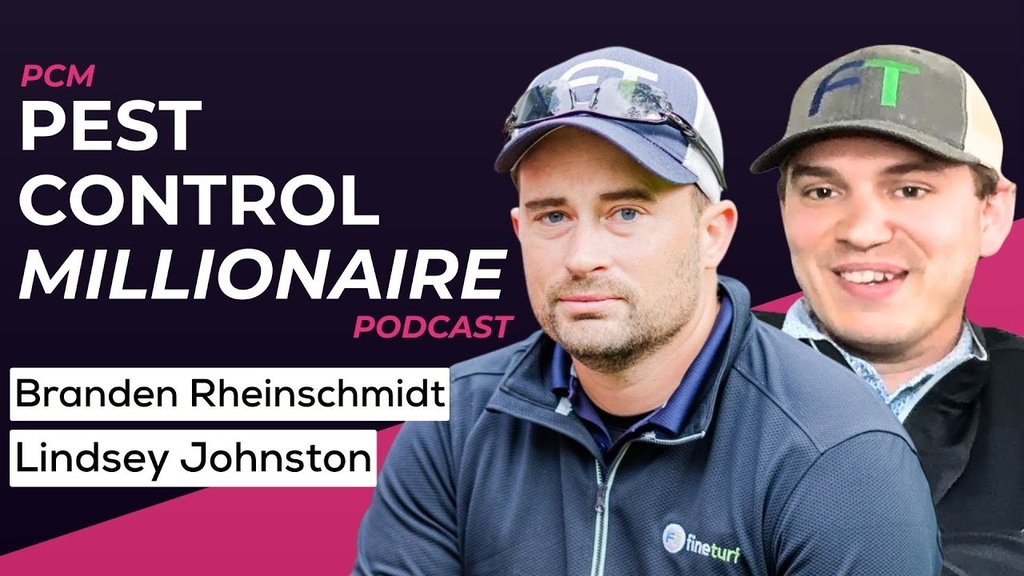
Table of Contents
- It started with a Facebook post
- Split the roles by what each partner is good at
- A merger doubles your problems overnight
- Sell the division that eats your team’s time
- You’re one connection away
- Make the salesperson the account manager
- Grow on growth plus profit
- The part they’re proudest of
- Frequently Asked Questions
Branden Rheinschmidt and Lindsey Johnston own FineTurf Lawn Care in Charlotte, North Carolina. Today it’s almost all fertilization and weed control, but it started as two companies, one mowing and landscaping and one spraying lawns, that merged and doubled overnight. I’d known them for close to three years when we recorded this, and they have been absolutely crushing it.
They aren’t a pest control company, but almost everything they’ve been through applies to us, from merging with another owner and getting out of a service that eats your team’s time to keeping customers and opening a second branch without burning cash. Here’s what stuck with me.
This episode is part of the PCM Podcast. For how mowing, fertilization and pest control compare as businesses, read lawn care vs. fertilization vs. pest control.
It started with a Facebook post
Lindsey grew up in Augusta, Georgia, and moved to Charlotte at 21 to work for landscapers. By 22 or 23 he was pretty much running one of their companies, quoting jobs, ordering material and dropping checks at the bank. He figured if he could do it for that guy, he could do it for himself, so he quit and started a mowing and landscaping business with a partner.
In his first year or so, on a miserable hot day, he was spraying broadleaf weeds with a steel backpack sprayer that leaked down his back, using whatever a rep had told him to mix. “This is a really nice yard, really nice house, and I’m about to wreck this,” he remembers thinking. If he did, he’d lose the mowing and mulch, the work he actually knew how to make money on. So he posted in a Facebook group asking if anyone sprayed yards and wanted to spray his maintenance properties.
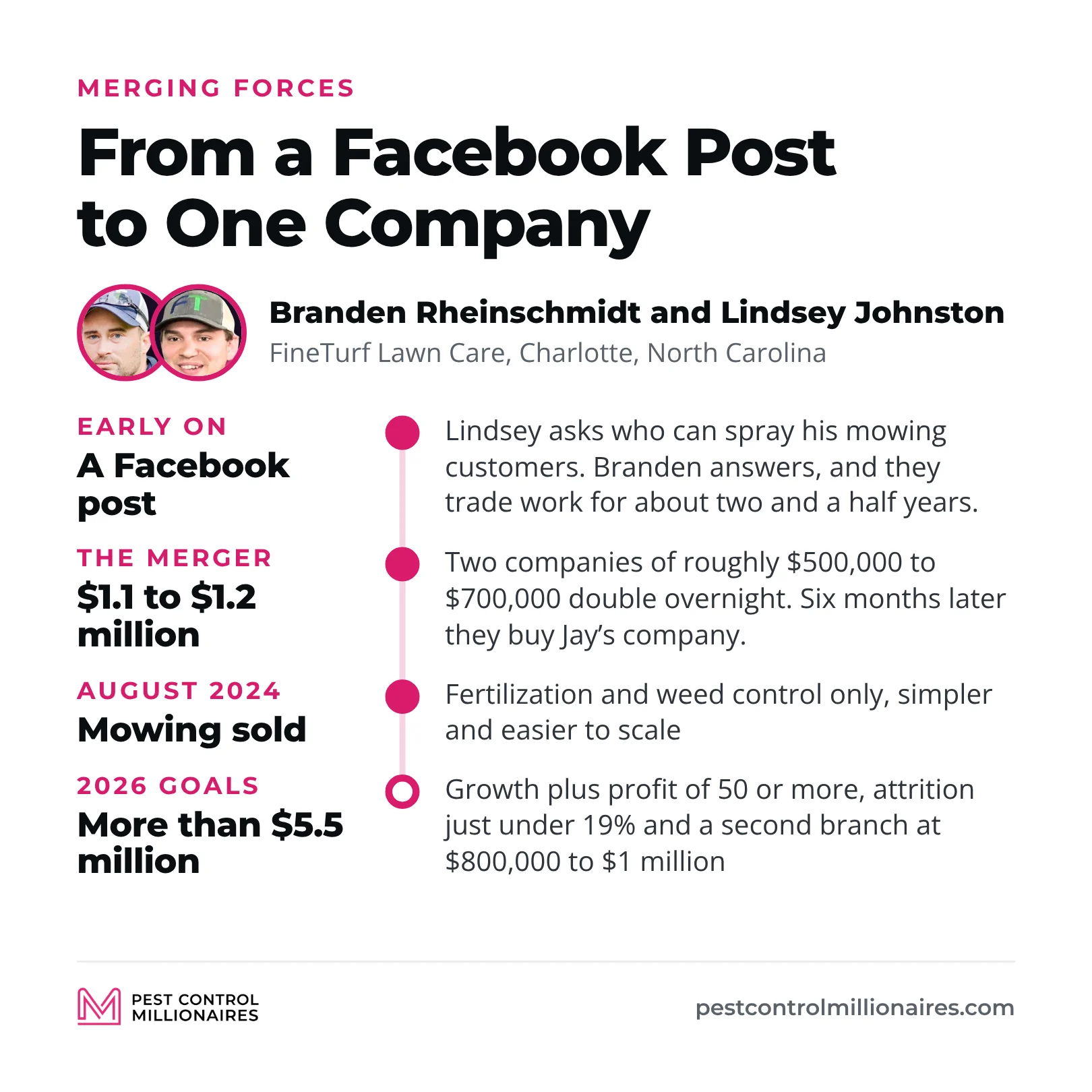
Branden answered. He had a University of Florida degree, years on golf courses and Penn State’s online turf program behind him, and he’d worked as a spray tech at one of the national chains while building his own company with door hangers in his neighborhood. He was doing some mowing but didn’t want to. So they traded. Lindsey took the mowing, Branden took the spraying, and they sent business back and forth for about two and a half years before they merged. Six months after that, they bought the company of Jay, the other owner who answered the post.
Your best partner might be the lawn company down the street. Jake Sheldon wrote a whole guide on strategic partnerships for pest control.
Split the roles by what each partner is good at
Lindsey brought it up. His partner at the time didn’t want to grow the business much more, and Lindsey needed to grow it. He knew Branden had the skills he didn’t.
Deciding who did what was the easy part. Branden does the finance, projections and budgets, and he enjoys it. Lindsey prefers sales. Branden knew he’d never want to manage a sales team. “I didn’t mind selling when it was just me, but I knew I did not want to run a sales team,” he said. Their skill sets are dramatically different, which made them a good pairing.
They were still small, though, so both of them wore a lot of hats until they could afford managers. Lindsey ran the landscape installs himself, which he calls “such a terrible business and super unscalable.”
A merger doubles your problems overnight
Merging was hard in more ways than they expected. They were on different software, so Lindsey had to learn Real Green on a setup he wasn’t there for. Two companies of roughly $500,000 to $700,000 became a $1.1 to $1.2 million company overnight, and Lindsey suddenly had five new team members he’d never met. “There’s not many things that are easy about it,” he said.
For Branden, the hardest part was communication. “Definitely one of my worst skill sets is communication,” he said. When you run a small company alone, you make every decision yourself. When you first join together, you don’t know what the other person is thinking about a problem, and if you don’t talk it through, it takes longer to solve than it should.
It took about a year before they felt in sync. What helped most was building a leadership team and org charts, so more than just the two of them were making decisions. If you’re buying a company instead of merging with one, here’s my acquisition integration checklist.
Sell the division that eats your team’s time
After about two years as a full-service company, they sold the mowing division at the end of August 2024. Mowing was profitable. “We were doing really good at it,” Lindsey said. But it was all-consuming. Problems that weren’t driving the business were taking 10% to 30% of the time of five or six people, and mowing was about to need a full-time manager, because their operations manager couldn’t handle it on top of everything else. They had to decide whether to build out a real mowing division or get rid of it.
Their mowing was high-end residential in a tight area, while they sprayed lawns across a good part of Charlotte, so the two never fed each other. Those high-end customers buy on word of mouth and referrals, the equipment is expensive and the labor costs more. A really good high-end mowing company in their market has 500 or 600 mowing customers after 40 years. That isn’t scale.
It’s the squeaky wheel. The thing growing quietly over here is where your profit comes from, and the thing over there gets all the attention. I went through the same thing.
The sale came together fast. On a fishing trip, a lawn care friend in Texas spent the whole time telling them to get out of mowing. Lindsey texted a local owner who mowed but didn’t spray, someone they already traded work with, and asked if he wanted to buy their mowing division. He named a number they couldn’t turn down. He made a down payment and they financed the rest. When he later ran into financial trouble, Lindsey connected him with another mowing partner who took it over at a discount, which kept FineTurf whole. They’re honest that without that offer, “there’s probably a pretty high likelihood we’d still be mowing today.”
Running fewer services has made the whole company simpler, and that just makes them want to simplify even more. Their fertilization program runs eight rounds a year, three granular rounds for most of the nutrition and five for weed control in between, and in North Carolina they can work almost year-round. When we recorded this, they had just taken the holidays off for the first time, finishing before Christmas Eve and starting the year with a week of training.
You’re one connection away
The morning we recorded this, I told my team they’re one connection away from doubling the company. Get to know the other lawn and pest control companies in your area and become friends with them, because you never know what could happen.
Lindsey learned that the embarrassing way. When the National Association of Landscape Professionals brought its Elevate conference to Charlotte, a big out-of-town company that wanted to expand into their market hosted a happy hour, and that’s where Lindsey met a bunch of his own local competitors for the first time. “That’s embarrassing,” he said. So he made it a mission to meet everyone. He called every new yard sign he saw, asked his vendors and tried to get lunch with a different person every week. “It worked,” he said. That network is also how he found a second buyer when the mowing sale wobbled.
Make the salesperson the account manager
Their big retention change was in sales. Their salespeople used to just sell. Once they had the credit card number, they never talked to that customer again. “That can be good for sales, it’s not great for retention,” Lindsey said. Now the salespeople handle the entire client journey, like account managers. They still sell 100% over the phone, but if you buy today and call three weeks after your first application because there’s still a weed in your yard, it’s pretty likely the person who sold you answers. Their pay is tied to sales, to preventing cancellations and to preventing skipped services.
On the production side, the same technicians stay on the same yards all year, technicians knock on the door, and customers get emails before and after each service. For years the technician training was all about doing the perfect application. Now it includes role-playing the common questions customers ask, so technicians can actually help people. Their pay structure changed too, and they make more money because of it.
Lawn care has an advantage here. Quarterly pest control sees a customer four times a year, and they probably show up seven or eight times or more. But the lesson works for us too. When your salespeople, CSRs, technicians and leadership all speak the same language, the customer’s whole journey feels like one company. Their goal for 2026 was to get attrition just under 19%.
Grow on growth plus profit
Their 2026 goal was more than $5.5 million in revenue. Internally they track growth plus profit and aim for 50 or more, like 35% growth with a 15% net margin, or 30% growth and 20% net. They want as much growth as they can get, but they’re self-funded, so the profit is what pays for marketing every spring. Growing 50% on a 3% margin wouldn’t leave them anything to grow with the year after.
Marketing has changed for them. When you’re small, it’s Google Ads and LSA, but your cost per lead goes up and the return diminishes fast. You can’t spend an infinite amount with Google. So now marketing means better blogs, newsletters, upselling and door hangers. They ran Facebook ads for the first time in 2025 and planned targeted Every Door Direct Mail, but only one or two new things a year. You don’t want to be terrible at five different things.
Their second branch, about three hours away, started with commercial work. Lindsey met with larger commercial companies and property managers there. It’s lower margin, but it brings enough revenue in year one to support a manager and a technician and be profitable, instead of sinking marketing money into a new market for two or three years. Once the branch manager has his feet under him, they’ll go after residential customers in 2027. They expected the branch to do $800,000 pretty easily in its first year, and the big scary goal was a million. Our seventh branch hit a million in under 12 months, so it can be done.
The part they’re proudest of
Branden is proudest that they’ve refined what they’re good at into a scalable business where people enjoy their jobs and nobody is overworked, and that their leadership team’s communication has grown five times. For Lindsey, it’s the people. Brian was his first employee, and he’s now their operations manager. They go to team members’ weddings and watch them buy houses and hit their savings goals.
Not long before we recorded, both of them had to step away without notice for family reasons. “The business took care of us,” Lindsey said. “You just get to be a part of really cool things.”
Frequently Asked Questions
Who owns FineTurf Lawn Care?
Branden Rheinschmidt and Lindsey Johnston own FineTurf Lawn Care in Charlotte, North Carolina. Lindsey started out in mowing and landscaping and Branden in fertilization and weed control, and after about two and a half years of trading work they merged. They sold the mowing division in August 2024.
What is the hardest part of merging two lawn or pest control companies?
Communication. FineTurf also had two software systems, five new team members and a business that doubled overnight to $1.1 to $1.2 million. It took about a year, plus a leadership team and org charts, before the partners felt in sync.
When should you drop a service line?
FineTurf sold its mowing division even though it was profitable, because it was about to need a full-time manager and was eating 10% to 30% of five or six people’s time. Running fewer services made the whole business simpler and easier to scale.
How does FineTurf keep customers from canceling?
Its salespeople now work as account managers who own the customer’s whole journey, with pay tied to sales, saved cancellations and prevented skipped services. Technicians stay on the same yards all year, knock on the door and practice answering common customer questions.
Full transcript
Every word of the episode, from the video captions
Welcome back to another episode of Pest Control Millionaire. Got a really exciting podcast for you guys today. Got a couple of studs out of North Carolina. We have Branden and Lindsey with FineTurf. I met these guys. What has it been two years now? Probably close to three.
Mhm. Pretty close.
Yeah, it's been it's been a minute and they have just absolutely been crushing it. They do a lot of fertiliz pretty much all fertilization weed control, but we'll get to the chat about what they got going on in North Carolina. But, guys, it's been a pleasure getting to know you guys. Love what you guys are doing. You guys are absolutely murdering out there. And, welcome to the show.
Thank you. Yeah, thanks for having us.
Of course. So real quick, we'll take each one of you. Let's go with Lindsey first because that's who's on my list first. Kind of just tell us here, you know, you and I are high school, like your junior, senior. Who was Lindsey in high school?
So, I grew up in Augusta, Georgia for the most part. Right around the corner from the Masters.
Where that nice southern accent comes...
Yeah. But it's a lot bigger than it was back then now, but it's it was pretty small. Went to Westside, played some sports in high school, didn't really love school very much. You know, I liked history, but that was that was kind of where it stopped. After high school, I just started working for landscapers, different residential guys around town, one commercial company, but there's not, you know, there's not a ton going on in Augusta. And I got into some pretty good trouble pretty quick after high school, just terrible decision- making and left Augusta when I was 21. So, a few months after my 21st birthday, moved to Charlotte. But that whole time from like 16, 17 years old to 21 is kind of a blur of poor decisions. Moved to Charlotte at 21 and just was working for a couple local landscapers here doing mostly just like mowing and hardscape and landscape install and stuff like that when I first moved up here. Did you always want to be an entrepreneur as a young age or was that foreign to you or were you were you side hustling? What were you doing?
Well, I think like you know I look back on it now and it's like it's hard to say whatever like what really you know I was thinking at the time but you know I moved up here. I was 21. I was working for other landscapers. You know, I was probably somewhere around 22, almost 23. And, you know, all my friends I went to high school with were like graduating college and getting married and were like what appeared to be like way further along in life, you know, and so you get that feeling of like left behind or, you know, not as good as or not good enough. And I was like working for a guy and I was pretty much running his company like he had a different job and like I was the guy there in the morning. I was quoting jobs. I was ordering material, dropping checks off at the bank, you know, starting to learn some of the books. Like I was like, I mean, I would see them like once every, you know, two weeks or so, other than like a phone call every couple days.
And I wasn't making very good money. I was making pretty good money for like I guess my experience in age, but...
I saw the money that was coming in or at least I thought I did cuz I didn't really know much about an expense line at the time. But I just remember thinking like well if I can do this for him then I could I could do this for myself. So I did I quit and had a partner who was working with me there and we started a just a mowing and landscaping business. Didn't know anything about fert weed control absolutely nothing. That's how I met Branden. So we were mowing I it was probably like first year maybe second year but probably first year in business right...
And I remember I'll never forget this day. It was hot as hell outside. It was miserable. And I had a steel backpack pump sprayer on. And I was spraying broadleaf weeds. I don't know what chemical I was spraying. Some rep probably said, "Put this much in here and spray this." And like I had no idea. This thing was leaking all down my back. And I mean it was like hindsight. That's probably the worst pump sprayer ever made. But and I just remember going this is stupid. Like I don't know thing what I'm doing. This is a really nice yard, really nice house, and I'm about to wreck this and then we're going to lose all the mowing, the mulch, it's like everything we actually make money on that we know what we're doing. So, I posted in a form on Facebook. I said, "Hey, something along the lines of like, I'm out here spraying yards and I don't know what the hell I'm doing.
Does anybody spray yards and want to spray my maintenance properties?" And then Branden responded and another guy named Jay Wyrick responded and we're like, "Yeah, yeah, we'll spray him, you know, we'll send you the mowing leads." And I'm like, "Perfect." You know, this is this is great. So, I met Branden that next like that Saturday morning for breakfast and we went and wrote all the maintenance properties and he was like, "Well, you know, I'm doing some mowing, but I really don't want to mow." And I was like, "Well, why don't you just give me the yeah. I was like, "Why don't you give me the mole and I'll give you the spray in just work together and send business back and forth." And so we did that for probably I don't know two and a half years or so.
Smart one of the bunch then?"
And then that's when we merged companies and then like six months after that we ended up buying Jay's company, the other guy who commented on that post. But that's how we all got to know each other.
That's cool. So I think you said something earlier, but I think that's with case with most people. Like we're humans, right? So if we're bored, we have nothing to do. That's just what's going to happen. Like you just get in trouble. So you have nothing to do. So like with all this AI stuff coming along and like maybe it's going to be universal income like it's just it's not going to go well if that's the case because everyone's to be bored. Everyone's causing trouble. So Branden, we'll switch over you real quick. Kind of tell me about you. What were you up to in high school? What was your upbringing? What were you up to? And then we'll kind of made merge this all together.
Yeah, I mean our stories are definitely a little different. I mean, I didn't grow up in growing up playing sports. I was always like relatively gifted in terms of academics. I didn't really have to study. I did well and like I guess I just my parents are assumed that I would be like an engineer or a lawyer, something along that track. So I ended up going to college, went to University of Florida, graduated, but I didn't really know what I wanted to do. So I bounced around majors. I settled on like an English degree because I thought I was going to go into law school. And then once I started applying to law schools, I was like, I don't really feel like getting this much debt for a job I don't know if I'm going to like.
So at the time I was I was dating someone who's from another state. So we end up moving away all the way to Vermont. I took a job working at a golf course. I mean, I was weed eating, you know, pond banks. If I was lucky, I would get to mow greens, raking bunkers, that kind of thing. I did that for about two years, two and a half years. And I was like, I'm really interested in turf. And then, you know, dur also during that time I moved back down to Florida, was working on a golf courses down there, and I was like, if the only path to move up is to go back and get essentially a turf degree. So because so I really like the industry and I wanted to become an assistant and move up. So I went back online, did Penn State's turf program, worked my way up to like assistant superintendent. Did that for about three years.
And then at the time my now wife, then girlfriend, I was with her for about a year and I just kind of saw the writing on the wall of like as I continue in this field, my hours are going to increase. It's going to be a very long time before my pay is I'm compensated with my pay. I want to do something different now that I'm with someone who I can see having a life with. So there so we actually moved to Pittsburgh for a year. And like six months in, we were sitting at a bar just having a drink and I'm like, I'm gonna start a business. And it was totally out of blue to her. And that's kind of where for the next six months, I was kind of planning what I wanted to do.
And that's where the business idea came from. But in terms of when I was a kid, like my dad had a few businesses growing up. They weren't super successful, but I did get exposure to what it's a little bit like to like control your destiny. And kind of basically have live life on your own terms, I guess. And so that's what really inspired me to start a business was like I wanted like control. It wasn't that I had necessarily this like entrepreneur inkling growing up. It was just I found that I wanted control over my time and money.
That's cool. That was a question that I had written down when you're talking. What did your parents do for a living? Said I know your dad's entrepreneur. What else would they do?
Yeah. So, my mom was pretty much in HR for about 30 years, worked for the same company, very stable. My dad kind of some of the businesses he had, he had basically like a subcontracting business down in Florida where they would like redo cabinets, redo kitchens, that kind of thing. And they also opened up a restaurant as well, but his background was in restaurants, like general manager of restaurants. And his his b biggest skill sets were like, yeah, running a running a restaurant or selling. And so, his businesses kind of revolved around that. Hold up. Quick pause. If you're on a pest control company or fertilization weed control company, you're not in our Facebook group. You're choosing the harder path. Every operator that's there skipping years of mistakes because people are actually sharing what's working right now. So stop trying to brute force your way through growth alone. Search Pest Control Millionaires on Facebook or click the link below. And now let's get back to it. And then so you're in the bar say, "Hey, I'm going to go start a business, but you're in Philly or yeah, you're in Pittsburgh at the time.
How do you make it over to...
Yeah. So, for like the next six months, so we still we loved the city of Pittsburgh. We didn't want to leave. There was no rush. So, for the next six months, you know, I was kind of thinking about what I actually wanted to do. I knew it was in lawn care. Didn't know what it was going to be, whether it was going to be mowing or f fertilization weed control. But I just started looking around like where's a good place to move to? Because we ultimately knew that my wife loves warm weather. Pittsburgh wasn't a long-term option. I didn't really like Florida because it was way too hot for me. So, we're kind of looking for somewhere in the middle. So, there's not many super affordable cities in that transition zone, and Charlotte was one of them. And one of her really good friends happened to live here. So, we visited him one time for a long weekend, and I just got sold on it. My wife wasn't sold on it at the time.
But we kind of just made a decision like this is a great happy medium for our lifestyle and Charlotte's a great market to start a business in.
Yeah, that's cool. So, then how did you start the company? How did you decide what you were going to do? I knew it was going to be around mowing or fert and weed control. So, what I did was when I was when we knew we were going to move here, I did apply for a bunch of jobs and I got got a few assistant jobs, but then I was like, you know what? If I'm going to go into lawn care, I might as well apply also to a lawn care company to get some, you know, residential lawn care experience. So, I started working as a spray tech at one of the national chains to kind of get exposure to what this business was. So, while I was doing that, you know, what 7 to 3 7 o'clock in the morning, 3:00 p.m., and then after that and on weekends, I would just start working on the side, passing out door hangers in my neighborhood. That kind of thing, just slowly building up clients essentially. And I did that for about eight months until I went until I quit the job and went full-time.
Cool. So, they go full-time and then you work for the next two to three years or as long as that before you guys meet.
Yeah, it was about twoish years, two two to three years. I had given up to mowing. It was just fertilization and weed control. Had maybe 500ish clients, give or take. And we just essentially decided to join forces at that time. Became a full-ervice company, which we no longer are today, but at the time, because we were passing leads back and forth, we just, it made sense...
Yeah. So, you saw the writing in the wall early from mowing to fur. What was that like? What made you say, "Hey, I don't want to do mowing." I mean, initially it was I was doing the work myself and I hated it. I didn't like the actual mowing part and weed eating and all that and all the equipment that came with it. And then the other part was just I knew that you get more value out of weed control and it is more interesting to me. You know, there's more science. There's different more different ways to do it. And it's a simpler business model. So that really attracted me to the fertility control, but a lot of it was just I enjoyed it more.
Gotcha. So then you guys get together and now you're doing both again. Yep. And we did that for yeah, we did that for what, two years or year and a half, give or take. Well, basically, yeah, a year and a half, two years full service and we sold off the mowing a little over a year ago at this...
Back into the mowing game.
And we stopped doing any kind of...
Yeah. So, when you guys first came together, how did you guys decide who took what role? And let's talk about we'll talk a little bit about the partnership after that, but how do you guys know like who's going to take which over which person's over sales, which person's over ops? Like you guys already have your specialty skills, something you guys had to talk about. Both of you guys are entrepreneurs at this point. Worked on your own for for a couple years. So now you have a partnership. Walk me through all that pieces of it. Branden has always done like our finance and projecting and budgeting and you know all anything related to finance.
That was probably one of the easier...
He's way better in that area and really good at it and enjoys it. So that was a pretty easy thing. I much prefer the sales side of the business. So that was kind of a very obvious thing. I think the bigger like when we had merged was we were so small that you know you still have to wear like multiple hats. So you know the ops position like we really weren't in any position to afford like someone to handle like production or ops. So I mean it kind of seems like we split that up amongst like you handled the fur. And then we did have a guy that was help a manager that was helping with the fur and over time you know the mowing got handled handed off u but I was always very heavily involved in the landscape and just because I mean that's such a terrible business and super unscalable but I mean it's just it's hard to find someone who can quote order and manage you know landscape which is why it's terrible business but so I kind of did that portion of it and then slowly as we grew, we just had better people and managers that moved up and handled different areas of the...
Yeah. And that's too for me it was like that the thought went into before we merged of what are we going to do? Even though we kind of knew what it would be, but when I was like deciding whether or not I wanted to do it, like I knew like down the road, I wouldn't want to manage a sales team. I wouldn't want like I would like half the business, you know, there's portions that I'm not good at that I'm not super passionate about and our skill sets are like dramatically different. So, it was just a good pairing essentially. Like I didn't mind selling when it was just me, but I knew I did not want to run a sales team,...
Right? Whose idea was it to come together then? Who who approached you?
I think I approached you. So my partner at the time kind of had different interests. He didn't really want to grow the business much more than I did and needed to grow the business. And I knew that Branden had the skill sets that I didn't. And I don't even remember when I brought it up or how it got discussed. Maybe just texting back and forth or...
I think I think the I can't remember the first time but I know one of the conversations you guys were doing work on my property. You and Brian were there and we were talking about it...
Maybe. So yeah...
Brian, that's interesting.
Sounds like a great idea.
But you mentioned you mentioned like the you mentioned the easy things like so you guys knew that the roles to be easy, right? You already knew who was going to take which role. What was the hard part about having a...
Oh man, merger is hard. It's Mhm. It's so It's so hard in so many different...
We both on different softwares at the...
That was hard. The people side of it is hard. Learning to work together is hard. Communication is difficult. I mean there our businesses were the same industry but they were very very different you know very different like you know just looking back in hindsight like the learning curve on me just learning Real Green was difficult you know because I wasn't there for the setup of it so I mean that was that was difficult and then you know learning how to make money and hire and I mean essentially our business doubled overnight, right? So, you go from like a half a million dollar business and 600,000 or 600 700,000 and now you're, you know, 1.1 1.2, too. That's not big in the grand scheme of things, but like when yesterday you were five or 600 grand and now you're a million and you have five new team members that you've never met and it's there's not many things that are easy about it looking back it was Yeah.
I think for me in terms of the partnership it was just communication. Definitely one of my worst skill sets is communication for sure. Meaning like especially not having a partner in my business previously. It's like I'm not really having to communicate necessarily or have especially when you're smaller as many decisions that are that go through someone else. You know, you only have a leadership team when you're smaller. You make all the decisions. So it's communicating all those things back and forth. Communicating where you're at on stuff. So to me like hands down communication was probably the hardest thing initially. Yeah. Well, you get to a point with anyone, whether it's your partner, business partner, manager, whatever, where you kind of start to know what the other person thinks. You're a little bit more in sync. But when you first join together, you don't know what they're thinking necessarily. You don't know where their head's at on a certain problem. And so, if you're not talking through those as well as you should, it can become it can become, I guess, unsettling or take longer than you would think to solve that problem.
How long of a phase did you guys go through where you felt like you weren't on the same page to where you guys are at now? It was like the business was crazy. It's changed so much so quickly.
I mean, if I would put a timeline, I'd probably say like a yearish. But it's like a continued growth, though. It wasn't like at a year. It's just like 100% better. But I would say once we started getting more of like a leadership team around us, we had other people that was more than just me and him making decisions and we had to go through other people and or charts built out that made it a lot easier as well. But I would say a year was pretty...
Yeah. And then how long did you guys run the full service business for?
So we sold the mowing division off the end of August of 23...
24. Yeah. So just about a year and a half ago. We sold the mowing business off so that was a little about two years into our partnership. So you guys run you guys run fullcale service company for two years and then decided I remember we talked a lot about we talked a lot through this over the past couple years and when you guys were thinking about selling how you're going to sell it and then how long it was taking and like was that a hard decision for both of you to decide hey we want to sell this part of our business?
No it was awesome. We were in we were in Texas visiting Luke with Emerald Lawns. We went down to South Louisiana, went fishing and then drove over to Texas and hung out with Luke for a couple days and the whole time we were fishing, Luke's like, "You got to sell them my own business. You got to get out. You got to get rid like just don't even sell it. Just give it away. Like, you know, just like it's just stupid. You're being stupid. This is ridic." You know what I mean? And a lot of people hate the mowing business and I don't ever intend on going back into the mowing business, but we did well in mowing. Like we you know what I mean? Like we were doing well.
Yeah. Yeah. It's not like you guys were losing money. You guys are very...
Yeah. We were doing really good at it. And so I texted a guy that I knew here locally that he mowed and didn't sprayed and we sent work back and forth and I said, "Hey, you want to buy my mowing division?" And he said, "Yeah." and I said, "How much would you be willing to pay for it?" And he threw a number out and it was like, "There's no way we were turning that down." it was just really good. It was a good sale. So, I remember I think I texted or I said something to you in Texas and I was like, "Hey, you want to sell the mowing business?" And he was like, "I don't think we'd get enough for it." And then I told you the number and you were like, "Yeah, I'll so, yeah, we sold it quick.
Sold. Yeah. And that was a year and a half ago.
Yeah. Yep. I say it wasn't the mowing business was that bad. It was just we're at the point of that business where like we were going to have to hire a full-time manager for mowing. Like our ops manager couldn't handle it. You really had to decide like are we going to actually build out a mowing division or get rid of it? And that's just the path we went.
And you guys just had got from Texas. You're talking with Luke at Emerald and you already have this idea in your head like, "Hey, we want to get out of this." And then like the stars just aligned and he text made one text message got a good offer and walk me through that. I mean that's pretty that's pretty...
Yeah. I mean we just met and we agreed on price and agreed on terms and sold it and we're done with it.
Was he a larger company at the time?
No, he was probably oh he was probably about a millionish sounds about right.
Yeah about a billion when he bought it. And then yeah, so we he made a down payment and then we financed it and then he ran into some financial issues along the way and one of our other mowing partners took over from there.
And really that way we get paid. Yeah.
That was just lucky.
How'd that work? Walk me through all that. I spend a lot of time like just constantly talking to guys in the industry, but really really focused on locally. So I know a lot of people here in Charlotte in the industry and I said, "Hey, this guy's getting a little bit tight. I think he's want to kind of offload it. You want to grow like you know, you could probably buy it for this that way, you know, that keeps that keeps us whole and it's kind of a discount to you." And so he ended up buying it and so we got we'll end up getting paid on everything. So it worked out and it strengthened another partnership. So...
Yeah, that's cool. Again, going back to what you said earlier and hopefully he's not listening, but would you have given it away or just shut it down?
No, I don't know in hindsight, but I think had we not gotten that offer, we probably would.
No, you'd kept it. There's probably a pretty high likelihood we'd still be mowing today. In all honesty, but it kind of forced your hand to sell it because he gave you a good offer and then and then he couldn't afford it. So, it sounds like you probably did that for like a yearish, six months to a year...
Right? So,...
And then the new guy took over.
So, was that did that was that guy forthcoming say, "Hey, I'd sell it for this price." And the other guy just came in and swooped it up that just sounds like some dumb luck to me, man.
Pretty much. That worked out really really good in your favor.
Yeah. But I told the guys like we had a meeting this morning with my guys and we were talking about how you're just one connection away from doubling your company. So like go out there boots on the ground. You guys are really good at knocking doors. You're really good at talking to people. But like make sure you start talking to other business owners in your in your area. Get to know the other lawn care company. Get to know their pest control companies. Like do your due diligence. Get to know everyone and just become friends with them because you never know what could happen, you know.
So that came out of...
It sounds like Lindsey, you're already on that path. Well, that came out of getting pretty frustrated one night. We had NALP in Charlotte. So, we had Elevate here in Charlotte two years ago and we got invited to like a meet and greet or a happy hour after one night from another company that was out of town is really really big operation that's looking to expand into our market. And so we go there and we meet for the first time a bunch of other guys that are in our market at their event and they're here like trying to buy companies up, you know what I mean? And I remember I walked out and I was like, this is ridiculous that we just met a bunch of our competitors and people that we could partner and grow with over the next couple years at someone else's event. Like that's embarrassing. We This is I was mad. So I made it a mission to meet anyone and everyone.
Like if I saw a new yard sign, I'd call them. I'd ask my vendors and just I mean there's a while there. I was trying to get lunch with a different person every single week for a while. And we met a lot of people last year. It was good. It worked.
Yes. So now that you guys sold the landscaping lawn care side, been focusing strictly on fertilization weed control. How's that been for the business? How has it been for both of your relationship? How's it been for the...
I mean, I think it's been great. It's been it's been a lot simpler.
Which is the biggest thing. So like I can't imag like when I look back about with mowing and quoting those types of jobs, it's like I can't believe how difficult the business was back then. So things being simpler just makes us want to simplify things even more and more going forward. So yeah, that's kind of the simplification for me is like a big deal.
Better focus the whole team more focus. Mowing is like an allconsuming thing, you know, like it's just,...
Man, it helps with like the team members, the managers.
It's like the squeaky wheel gets the grease, right?
Yeah. So, just the too much of like 10 to 30% of people's time being diverted throughout the day for problems that weren't the ones that were driving our You start adding 10 to 20% up of like five or six people's time, that adds up.
Yeah. So I was saying the squeaky wheel gets to grease where it's like you have this thing over here that's growing. You don't have to touch it. It's where your profit's coming from. Even though the moment is profitable, then you have this other thing over here that's just getting all the attention because there's so many issues with the equipment people blah blah blah blah blah. It's like all of a sudden all the attention is going to this thing that's not making as much money as fert weed control and it's not as scalable. I went through the same I went through the same thing. That's why I know like it's so true. So it's been what a year now? Yeah, a little over a year.
But I also think too that you know it's a lot of people like the idea initially of a full service because you have control over everything. You can do everything. But as you know, your company grows, there's this fear that like the industry can become a commodity, meaning everyone's the exact same. So if you pick a few things that you can actually be really good at and actually differentiate yourself with, it's much better in your business model. So we're able to focus more on just getting better at the things we do versus being just like everyone else. Yeah, the riches are in the niches,...
And it's so true. Like again, I went through all the same stuff and it's like the business mowing is a hard business to scale. It really not that it can't be done because it can. It's not a bad industry, especially but every market's different too, right? Like North Carolina is different than Dallas, Texas. They have 4,000 square foot yards or over in Kando and their their larger square footage is like 3,000 square feet. That that makes that to me that kind of makes sense. You can drop a truck and trailer with two guys with push mowers and bang out 30 jobs a day, you know.
Yeah. And our mowing business model didn't align either. So we didn't do mobile and go. It was high-end residential in a very tight area. So, you know, we'll spray a pretty good area of Charlotte, but we wouldn't mow in all those areas. So, we didn't have the synergy of like, hey, just because we spray you, we'll mow your grass. And the clientele for those two types you would market to are vastly different. You know, someone in a high-end residential that wants full service versus just anyone who wants, you know, fertilization and weed control. They're two different clients. Basically, I think high-end residential, like ultra ultra high-end residential mowing is just super super hard to scale because that's a really difficult customer to market for. Most of those people are buying on word of mouth and referral which slows it down. The capex is crazy. The labor cost is higher. It's just, you know, in our market, there's one company that's really good.
I mean, like awesome high-end residential. They've probably got five or 600 customers, mowing customers, but they've been in business for 40 years. It's like, that's not scale. That's not, you know what I mean? It's like we were sitting there thinking like, this took 40 years to build. Like, I'm not no way. There's no way. It's crazy.
Yeah. I kind of did the same thing as I was growing this company. We're doing relatively decent numbers for the town that I live in. And then I looked around and I was like, why in the past years that this town's been here, why has there never been a big landscape company, like a big all-inclusive lawn care company? Like it's just because it can't be done. Not here anyway, you Like, so even though lots of people have tried and they've grown decent businesses, you can never just grow a big thing here. So I was like, ah, the writing's in the wall. I get it now. You know, just took me a lot longer than it should have. So how have you I know I mean I know the story, but for sure sure is. So you guys get some money from down payment for this thing. You guys put some fuel on the fire with FineTurf.
Do you guys you guys already have a program from Branden, I'm assuming? Do you guys change the program? Do you double down on what you're doing? Then how do you start how do you guys start scaling this thing?
Yeah, I mean in terms of the program side, yeah, it's always been pretty much set in stone and then we tweak it a little bit here and there. Maybe 10% of the program every year gets tweaked based on what we see with a and a combination of me and our agronomist Jay who we spoke about earlier. He does a lot of the research and tries to find ways to get better on the program side of things. And then I guess in terms of scaling at least in my opinion one of the biggest things that we realized over the last year and a half was when we were small marketing has a different term that means something different than it did then because like when you're small you don't have a big budget right you can put some money Google ads you can do a little bit of things here and there LSA but then you start like if you're just relying on those things eventually your cost per lead goes up you need to find other sources other avenues actually market not just like dump maybe 100k in Google ads.
So marketing now is more of like how do we get better blogs? How do we get better newsletters? How do we do better upselling? How do we put door hangers on on properties like the word marketing has just expanded so much especially with AI too crawling crawling online. So to me it's like marketing has just completely changed in what we thought it was a year and a half ago because you can't just spend infinite amount with Google. Your return gets diminished very quickly.
Yeah. I think for the last 20 years, marketing's all been the same. And al in the last year, year and a half, two years, marketing's completely changed. The old stuff still works, but the game is changing for sure. Like especially with AI and video and all the stuff that's coming. Like if you're not on video, you're not doing video, you just you will be obsolete in the next two years. You have to be out there. And with the AI and crawling, like it's going to be Yeah, it's the game's definitely changed. You're not wrong. You just have to be on the forefront of it. You know what you guys are doing. Are you guys you guys liquid or granular? What do you guys do?
Both mostly granular nutrition though.
Three out of our eight rounds are granular. Granular is most of our big nutrition and all the five rounds in between is your, you know, weed control, abs, grub control, all that kind of stuff. So, we do both. And...
You guys are year round, right? So, you guys are I know we talked about this a little bit. We can talk about that too is like you guys have never been able to take off the holidays it sound like in the past, but this was your first time ever taking off the holidays.
Yeah. Yeah, we pretty much can run year round. So, I mean the goal is to finish right before Christmas Eve and start back doing a bunch of like in-depth training and kind of boot camp with the guys the first week of the year and then starting back, you know, either middle of the first week or second week of January. But we don't have any weather delays. I mean, we're pretty much year round. It's just a matter of can we get all the work done before Christmas so we don't have to work between Christmas and New Year.
Yeah. Which is awesome. Which is another nice thing about the business model, right? Because with mowing like...
You have to show up every single week, every other week at the same time, same place. And where you guys can't leave where like you guys shut down for a week and a half or 10 days and no one even know the difference. You guys got to spend some time with family, enjoy your life. Like yeah, it's totally different ball game when it you're in this industry for sure. So like you had said earlier that you like you want to control of your time, Branden, like being an entrepreneur, right? And now with with mowing and landscaping, you couldn't you don't have a lot of control of your time. Now you have control of your time back.
Yeah, I agree. I mean, definitely trying to cut back on on hours a little bit here. And not just hours, but like having a more structured schedule when it was a little more chaotic. It was really hard to have a schedule. You know, things have just come at you left and right. But as we've grown, got a better leadership team. I feel like we do have more control of our time now.
Yeah, for sure. What are you guys' goals for the next for this for 2026 and we're just starting 20 Well, this podcast come in a couple weeks, but right now it's the first week of January. What are the big goals for the year? What do you guys got planned?
So I'd like to do north of 5.5 top line. One of our internal numbers that we kind of track, I we don't really talk about the issue care what's...
Just like our numbers we care shoot for growth and profit.
So, we want to shoot for a growth plus profit of 50 or more. So, you know, be it 35% growth and 15% net or 30% growth, 20% net or more. Just cuz like I mean we want extreme growth and we're we're fine with as much growth as possible but we are self-funded so we have to profit so that we have money to go back into marketing every spring we can't just grow 50% and make a 3% margin we you know we wouldn't be able to grow the next year so we have to make some money along the way and then reducing attrition that's kind of our big things is that topline goal that growth plus profit and then you know we want to try and get our attrition to you know just below 19% next year.
So...
Those my new my next two questions what's your guys' plan for growth to hit those numbers of 50%. And then what's your plan for churn? Well, I mean, me and you talked about this a little bit and then I know you talked with Peterman, but one of the big changes made this year is our salespeople. So, before we had sales people and all they did was sell. So, like once you get those credit card numbers, like they're gone, never talk to them again. And whereas that can be good for sales, it's not great for retention. So now our our salespeople are handling pretty much the entire client journey. So more of an account manager approach versus sales. Now they're still 100% over the phone, but like you know, if you call in and buy today and 3 weeks later you call in after your first app and you still have a weed in your yard. Well, it's pretty likely that whoever sold you is going to answer that phone and say, "Yeah, Jonas, I completely understand.
Let me get your technician back out for a service call and have a better client journey. And then on the production side, some stuff that Brian and Branden have worked on. Brian's our operations manager. He manages everything to do with production. But you know, we'll have the same technicians on the same yards all year and, you know, technicians knock the door. You know, before service emails, after service emails, that's all pretty normal But I genuinely think that account manager that you know friendly voice, same person all throughout there taking care of them and then you know their pay structure is incentivized on sales prevent and cancels and prevent skipped...
Love it. Super smart. Yeah, I think you just have to have a lot of touch points in there too.
I agree with all that. And some of the things too on the technician side with training is I think for so long we focused on like how to do the perfect app which is great to do but now you know in some of our trainings we're asking like here's some common questions that customers may ask you. Let's roleplay these. Let's let's actually figure out how to talk to these customers give them valuable information and let them know like if they have a problem we're here versus just like spraying the lawn talking about what's going on in the yard. We're trying to have our technicians be a little more customerf facing, customer friendly and can help them with multiple problems. I guess a major mistake we made in the first few years was the mindset of you know my goal is all I care about is that technician does a perfect application every time leaves the yard sign. Like that's good. That's his job. And in the last couple years, we've really leaned on those guys and leaned on those technicians a lot more and more.
Their pay structures changed. They make more money because of it, but I mean, we lean on our technicians really, really hard and expect a lot and they do a really good job. They've gotten so much better in the last year.
Yeah. I mean, they're the they're the customerf facing people, right? Like they're the ones who are constantly talking to the customer. And what I do like about fertilization weed control is there's a lot more touch points where like if you do quarterly pest control it's four times a year you guys have probably shown up seven eight or more. I don't know the exact number. We have a lot more touch points with that technician to talk to the customer. So that's super smart. But then just going back to like your CSR, your sales people, your technicians, your executive team, you're all speaking the same exact language. So no matter what who they talk to, you guys are all speaking the same language on the door, over the phone at meetings, whatever. So that way it's very cohesive for for the customer, right? And their entire journey. I think it's very smart what you guys are doing.
Then you also mentioned about like marketing and scaling like how we're going to grow. I mean we're we're kind of doing the same things we did years before. Last year was the first time we did Facebook ads like we are going to dive more into that this year. We're trying some of the old school methods of like you know every door direct mail. Not quite every door but targeted every door direct mail roughly. It's like that game of like you want to try new things, but you don't want to try too many because you don't want to be terrible at five different things. You rather be good at two things. So it's like trying to put one or two new things in a year or test one or two new things differently than you did in years past. So that's kind of I think my thought going forward is just try a few new things, but not too many to where you're bad at all of them.
Yeah. Awesome. Good advice. The last piece of our growth would be we've got another branch starting about three hours away from here. Which I'm excited about. And we I went I went up there and just kind of went and met with like larger commercial companies and property management and just like went after larger scale commercial. It's lower margin for sure, but you know, doing that gives us the ability to have at least enough revenue. We'll make money. We won't make a lot, but we will make some money in year one, but it gives us enough revenue to put a manager up there and a technician and for that to grow without just sinking money into marketing, you know, for two to three years and having to recoup that revenue, recoup that investment. We can be profitable year one. And then if it goes well and that branch manager gets, you know, his feet under him and gets the branch stood up, then we can start using some of this marketing to go after the residential market in 2027. And I think I hope that'll be a really nice way to expand and grow without having to sink money in until we can recoup that investment.
Yeah. What was your guys's reason for branching out? What happened there was say, "Hey, we ought to have a second Did things just align or was this just an idea you guys have been running past?
Kind of. I mean I was I met some guys at Elevate they were doing commercial and talked to them about it and I liked it. And I started kind of looking for some work here in Charlotte and I ran across a guy that was out of town about three hours away and he said, "Well, why don't you just do my work here?" And I was like, "All right, that sounds good." So, we figured out how to do it. We did it. And then there was kind of like that light bulb of like, you know, we can get a lot more of this work. Like, I can get a lot of this pretty like quickly, you know. And so we did. And, you know, and now hopefully we'll be able to spread out like some marketing dollars across a couple branches going into...
Awesome. What's your goal for that branch for this year? My big scary one would be a million. I think we'll probably do 800 pretty easily, but a million bucks would that's kind of like the big ridiculous goal. So million bucks in year one.
It's awesome. Which I know you guys can do it. Then I just ask you that question like each of you personally, what's your guys' personal goals this year? I mean, I know for me the biggest my biggest goal revolves around having more not necessarily time, but energy with my wife. It's something we talk about a lot. Like regardless of what time I get home, whether it's 4:00 or 7:00, I just feel drained from work sometimes. So, it's my personal goal is getting a better handle on my schedule, doing more things that I enjoy doing. So, then when I am home with my wife, whatever time that is, I have more energy. And then just, you know, some personal habit stuff like continue to work out in the morning, continue to try to read 30 minutes a day. Just basically stay on track with the current habits and find a way to have more energy when I'm home.
Love it. How's it been going so far?
I we just got back into our routine. So, we just got back in on Monday, but I'm excited to work towards this goal. I know it'll be kind of an up and down. That's the way things go in terms of like energy levels when you get home. But so far so good. I just want in most areas of life, I just want like very marginal consistent improvement. I know that doesn't sound real big or flashy or exciting, but you know, when I look back at the things we're really good at or the parts of, you know, life that's really good in business and in family, they're the things that have been like the most constant and steady slow progression. And so that's kind of a goal is to not go after like some crazy big ridiculous, you know, concept or idea, but just be more consistent professionally and then, you know, more more consistent and intentional with my time at home with my kids and wife.
Yeah, I'd add to one of the biggest things I've always struggled with that's had a big imp one of the biggest things too on my kind of goal list that really goes into all those other areas is like is sleeping. Meaning like you know being an owner like there's so many nights where I'll sleep three hours cuz I'll wake up at midnight and I'll start working on a problem and then it catches up to you. You don't feel like working out the next morning. You know you maybe you stay late because now you're thinking about this big problem. And it's so like to me it's being like Lindsey said being consistent whether it's my sleep, my working out, my reading, whatever it is. Trying to just develop that consistency, but sleep has been a big eye opener for me recently. So I don't think I especially maybe as I get older it's worse, but like trying to function on five to six hours of sleep consistently, I kind of get drained by...
Yeah. It's like you wake up at 3:00 a.m. And like you're just sitting there laying and all a sudden you think of what you're working on and it's like now you're wide awake. Like you're locked into this problem like how can I solve this problem like 3 3:00 laying in bed trying to solve this problem and because it just doesn't shut off.
Yeah. Do y'all track your sleep?
So I did for a while. But I haven't I haven't for for probably six months I haven't.
So I got this watch my wife got me this watch for Christmas and it tracks my sleep. So like you get I don't know. It tells you your time of sleep, how much deep sleep, light sleep, yeah. And then how much you were awake during the night, you know, and it's I mean it's silly, but...
Sleep, REM sleep. Yeah.
Which one is it? What' you get? Which one did you get?
A Garmin. So like, you know, when you're getting ready towards the end of the night, like you know, I don't know. You're definitely just is probably more so like analytical and numbers and data based. You get to the point where you're like, you know, I know I need to get this sleep and you start thinking about like, I need to get in bed now. Like, you know, I need to limit screen time before bed. I need and like you come up with this whole game plan of like it's like a game of like I'm going to sleep better. I don't know, it works.
It looks good on paper.
Yeah. I don't know, man. I am focused at the end of the night. I'm like, I need to get in bed. I need to go to sleep.
Yeah. Branden, you talked about reading 30 pages or 30 minutes a day, which I like to do as well. Any good book recommendations?
Well, I was the first one to review your book, so I definitely I'll pitch yours right here. Yours is definitely a good book that is actionable. I mean, a lot of the books, there's a lot of books I read, but there's a few that I go back to a lot. So, like Great Game of Business is a great book. Seven Habits of Highly Effective People, another great book. Trying to think of any others in particular. Most books you can get something out of them, but those are the two for some reason that I tend to read at least once a...
And just so everyone's aware, I didn't ask him to pitch the book, but I appreciate it. I never wonder I never never thought about writing a book ever in my life, ever to be honest with you. But now that I wrote one, I'm like, there has to be a second now. Can't just stop at one." So, I got my eyes set on that not anytime soon. But I already got the name picked out. Now, it's just...
Well, you picked an industry that's ever changing, so it's probably pretty easy to update the material every few years.
It is for sure. And I have some friends that are authors, too, and they release like volume one, two, three, like you guys know. So that's kind of cool and exciting. Again, we just crossed over 500 books. Not that it's a lot of books, but like I'll be 100% transparent like I always am. I thought maybe we'd sell 50. So like there's zero ad spend behind it. No money put behind it for marketing spent at all. It's all been organic. So to sell over 500 books, I was like, "Dang." And then a guy told us yesterday on a call that he like searched like best pest control books or something like he's trying to learn and our book popped up. So I was like, "Oh, that's pretty cool." So kind of exciting stuff. But again, I never pictured that to happen. It just happened, you know.
One last question for both of you. I know I'd only keep you an hour, a little bit over that now. I let you guys get back to work, but I'll let you guys one can go first and then the other person can think on it. But as of 2026, looking back, what are you guys most proud of?
Kind of briefly went over this at a leadership meeting. It's kind of the question. We just went on a leadership retreat and we kind of asked this of all of our managers, too. Like, what would you be proud of looking back? I think for me a few things like work-wise would be like stability in the sense of like we've refined what we're really good at. It's not some big audacious goal. It's we refined what we're really good at and like everyone is enjoying their jobs. We're not overworking people. It's basically like we've created this essentially a scalable business where people enjoy what they do. And our communication with our leadership team has grown five times. Meaning we're all open. We're all okay to disagree. We're okay to air out whatever we want to air out in front of each other and we just kind of have this, you know, great leadership team that as we expand to other markets or as we grow this branch that we're just more prepared in the future and we're enjoying it along the way. I would say it's pretty similar, but just like the thing that we've built, the opportunity it's given us so far.
And it's just with a lot of small marginal consistent improvement and just consistently refining. And getting a little bit better, but you know, we've gotten, you know, business like the numbers, the revenue, the profit, the trucks. Like, it's cool. It's really cool. But, you know, we've gotten to, you know, we've gotten to go to weddings. We've gotten to see people buy houses. We've gotten to see, you know, people grow up and, you know, move up in the company and, you know, Brian was my first employee and now he's our operations manager and get being able to see that progression. I mean, it's I've had the time of my life doing it and, you know, one of our salespeople just got engaged and she said, "Hey, are y'all going to come to the wedding?" It's like, absolutely. This is the best part of owning a company is like seeing people get married, buy houses and like you know their their personal lives get better like when someone comes in and you know nine months into starting here and they say hey I've hit my 12 month financial savings goal three months early you know it's like you know they've worked their ass off they've been disciplined they've been diligent and you know they did it themselves but you know you got to be a part of it you got to you get to see a lot of victories And then most recently, you know, me and Branden both had to take some time away pretty unannounced due to family stuff.
Just kind of dropped the hat. We had to leave and you know, the business took care of us. You know, it we were fine. It wasn't, you know, we weren't being called back for a million things or interrupted or, you know, we still worked because we wanted to, but like, you know, we were able to go and do what we needed to do unbothered. And I just all that kind of merges into one of this thing that has been built by, you know, us, but everyone that's worked here is, you know, you just get to be a part of really cool things.
Cool, guys. Well, I won't keep you any longer. Thanks for your time. It's been exciting to watch you guys from we first started talking to where you guys are already at today. It's going to be continue to be awesome to watch you guys' journey. Can't wait to see what happens with the second branch. Really exciting. Obviously, I'm sure I'll talk to you guys along the way, but good luck. Happy New Year and go crush it, guys. Again, thanks for being...
Thank you. Yeah, thanks for having us.
Talk to you soon. Later. Hey guys, thanks for listening to another episode of Pest Control Millionaire. We don't charge any money for the show, but the podcast isn't free. Please like and subscribe and give us a five-star review in your favorite podcast app. This makes a huge difference for us. If you have any specific questions about your business or your personal life that you'd like answered by me or any of my podcast guests, please send an email to And if you want to get in touch with me about our marketing class, we do a live version every Thursday night. Check out our website at Thank you guys for listening. I'll see you guys in the next one.
Watch the PCM Podcast on YouTube