Jaclyn Ricci on Growing The Ladybug Pest & Wildlife on Facebook

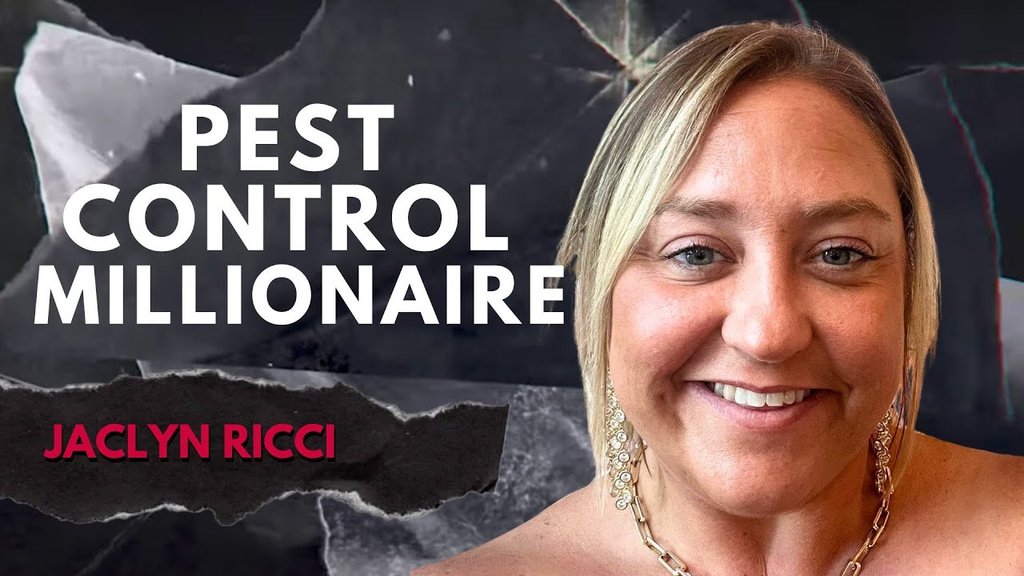
Table of Contents
Jaclyn Ricci owns The Ladybug Pest & Wildlife in Zionsville, Indiana, with her husband, Johnny. When we recorded this in 2025, they had 22 people and expected to be a $3 million business that year. They don’t pay a single recurring marketing bill. “I grew the whole thing on Facebook. I tell everyone that,” she said.
It started with $60 in the bank. To buy groceries, Jaclyn cashed in the change they’d been saving in a Coors Light bottle since they met, at a Kroger Coinstar. “That was like literally the saddest trip, grocery trip ever,” she said. Johnny was working 60 or 70 hours a week in landscaping and barely bringing anything in, and she had always been in sales. Then she saw a bunch of people on Facebook asking about ant control. She looked around and found only the big guys, no local company. Two ant jobs a weekend would cover groceries, she figured. She built a website on Wix as fast as she could, and right before they launched, a raccoon got into their own house. Johnny trapped it in the attic and said he could do that for other people, so wildlife went on the website too.
This episode is part of the PCM Podcast. For another owner who wins on Facebook, read how Jasmine Almeter turns Facebook into local pest leads.
Start on Facebook because it’s free
“I really worked Facebook. I lived on Facebook. I did nothing but Facebook,” Jaclyn said. She joined every mom group and every chatter group and commented on everybody’s posts with a real, genuine response, saying she’d be grateful for any chance to learn and grow this for her community. She even told mom groups she didn’t know what she was doing yet and offered to try fixing their problem for free. She thinks she spent eight hours a day on Facebook finding leads. Nobody in her area had a Facebook page or a Google listing, she said, so she was kind of a shoo-in.
The phone started ringing. They both still had full-time jobs, so about three months in, she told Johnny they should each take a paid week of vacation and see if they could fill it. By Monday the week was full. They took one more week, and by Wednesday the following week was full too. “We’re done,” she told him.
Today someone on her team is on Facebook about four hours a day. That’s not just commenting and tagging the company to get leads. It’s community engagement too, like commenting on a local community page to thank them for everything they do. Besides parades they do for fun, everything goes into Facebook and their own Google listing and SEO. No Google ads and no recurring marketing bills. “That’s the first place I would start. It’s free. Why not go do it?” she said. Our guide to Facebook marketing for pest control lays out the group strategy.
Your Facebook page is not a billboard
“My philosophy is my Facebook page is not a billboard. I’m not selling to you on Facebook,” Jaclyn said. People expect the opposite. You’ll never see her page say “have ants, call us.” She wants her brand to be a feeling and a story, something people feel, and she was getting ready to teach other owners that at AAC Distributing’s event.
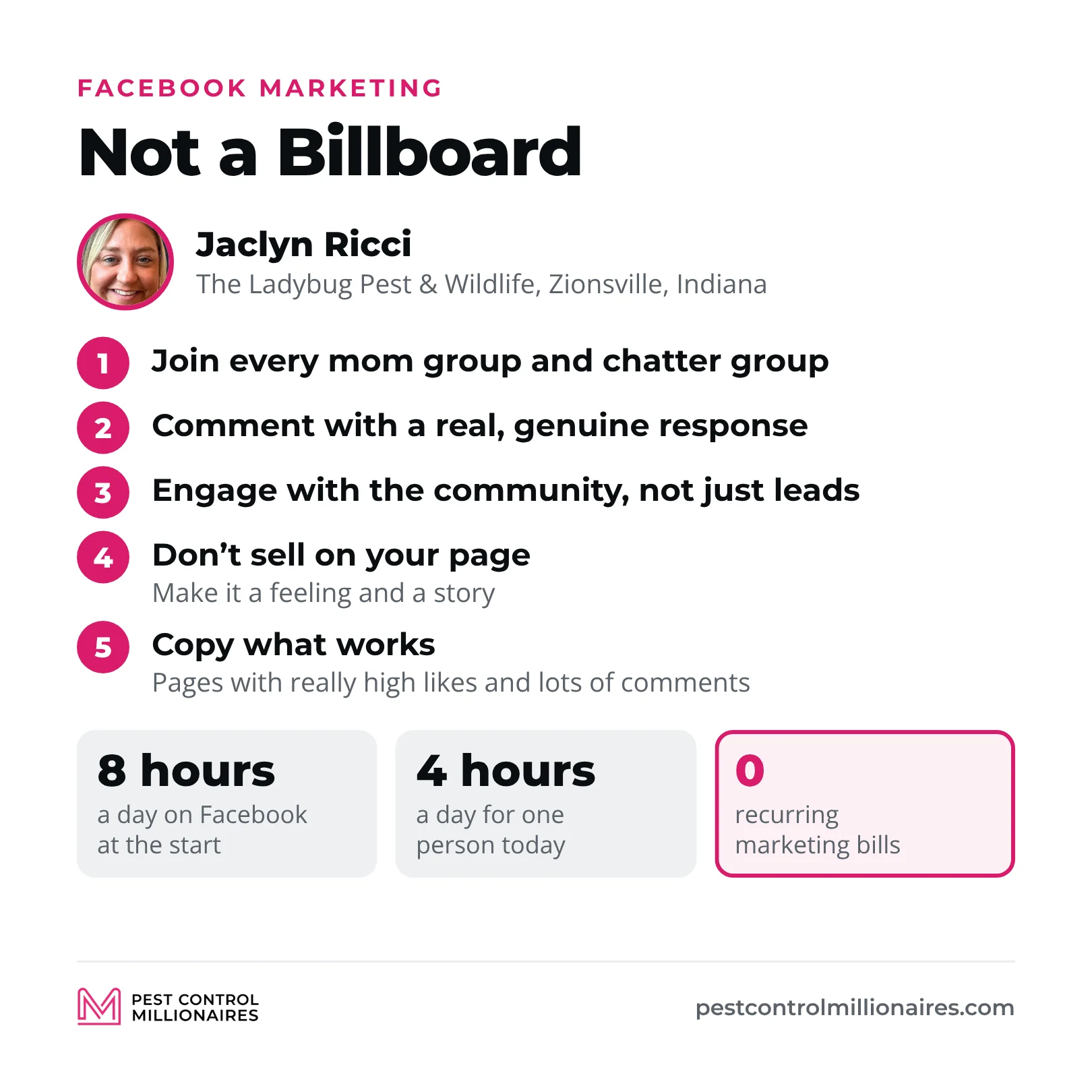
Her last advice in the episode was the same. Look at her page and at other successful pages with really high likes and lots of comments. “Figure out what they’re doing, see what they’re doing that’s working for them, and try to mimic that because there’s a lot of money sitting out on Facebook. That’s free,” she said. If you’d rather buy leads too, our Facebook ads guide covers that side.
Turn your best job into a story
About a year and a half in, a church that was about 200 years old called. They were finding piles of guano outside, and a few other people had told them they didn’t have bats. Johnny got the architectural plans and figured out that about 50 years earlier, the church had built a new roof over the old one. He cut into the old roof and crawled in, and it looked like a cave.
Jaclyn’s first thought was, “Stop what we’re doing. This is a PR moment for us completely.” She called a videographer she’d met at a chamber event, who quoted about $6,000 for a 20- or 30-minute documentary. They brought in the city, the chamber and animal control, held a bat watch and went live on Facebook, and over 5,000 people from the community tuned in. The church had over a thousand bats in the attic. The whole job took about four months, with the siding pulled to clean out wall cavities full of guano and five dumpsters of it hauled away.
The documentary is on YouTube, and it got people talking. From then on, when someone called about bats, they could say, “Oh yeah, we just did a documentary.” “That really got us on the map,” she said.
Sell pest control to every wildlife customer
Pest control and wildlife started together, but wildlife took off first. Now pest control is bigger, because it’s recurring. When someone calls about bats, the team mentions they do pest control too. A lot of people say they have a company but aren’t married to them. “Could we be your people? Like, we’re local,” is how she put the ask. “And they all do. They just all really come over,” she said. All they did was ask for the sale. It’s the simplest cross-sell there is.
Her trucks carry both. Most of her technicians pull trailers set up like little mini shops, and a lot of them are hybrids who do pest and wildlife. A tech on a quarterly service can get a call about a raccoon in a trap two houses down and switch gears without skipping a beat.
They carry a sales tool, too. Jaclyn had an architect draw a house with all the problems they see, and on an animal job the tech circles what this home has. Before that, the wife would hear the inspection, then couldn’t explain it to her husband when the quote came, and the office got a lot of calls. Now the quote matches the drawing, so they can see which areas need fixing and what products will fix them.
On pricing, she tested the market. Whenever Johnny got too busy to take more jobs, she doubled the price. “If it was $225 for a one-time ant treatment, I was like, ‘Dude, it’s 500,’” she said, and people took it. Termites came in the same way. They got termite certified two years before we recorded and never really promoted it, beyond a post or two on Facebook, and they still did about $200,000 in termite work the year before. Their new website was the first time they built it for SEO to pick up termites.
Make realtors your referral partners
Jaclyn joined a women’s networking group expecting sales networking and found a lot of Mary Kay and Pampered Chef. But a Century 21 realtor there started using her, and she saw something in it. So she started stopping by realtors’ offices with donuts or lunch.
She learned early that one or two words can light people up. Here’s her line. “I’m an expert in making sure that the buying and selling process runs smooth and that you don’t lose a sale during a moment where they may have termites, bats, things like that,” she said. She does talks at their offices and has brought bat droppings and rodent droppings in a bag to show the difference, “because that’s the number one thing that the inspectors always get wrong.”
Now hundreds of realtors use them and send leads all day long. Her team tracks how much each realtor brings in per quarter and per year so they can give back and give shoutouts. She approaches it as growing each other’s businesses. “You want to pick an influencer, somebody in a community that really knows a lot of people. Just go talk to some realtors because they know everybody,” she said. More on strategic partnerships in our guide.
Write your processes down early
The one thing she wishes she’d done from the start is document every process. With 22 people, they’re playing catch-up because they grew so fast. “If I had processes this would be the smoothest ride of my life,” she said. Your processes change a lot between $300,000 and $3 million, so I get it. We paid a company to come in and write all of ours about two years before we recorded this, because we didn’t have the time.
So Jaclyn is building them now. In an HR app her office team uses to clock in and build schedules, they block off time with a checklist for every block. One person works on traps from 8 to 8:30, with a checklist for everything he does in that half hour, and they’ve planned what happens to the day when it rains. Rainy days, when the phones die off, are the time to work on processes, she said. She also uses ChatGPT. “It’s like my therapist,” she said. She pays $20 a month and has fed it every detail of her days for a year and a half, and it knows her business and how she thinks.
If you haven’t read The Checklist Manifesto, read it. It’s about how planes and airports run on checklists, and it was SOP 101 for us.
Plan the winter before it hits
Bats make September and October the busiest months. When we recorded, her office was getting 100 to 200 calls a day depending on the weather, and one day the team couldn’t take a single new lead call until 3 in the afternoon because so many jobs were converting and repeat clients were calling.
Winter is the opposite. For a few winters she kept everyone at 40 hours, paying a few extra hours here or there. The year before last, she paid her exclusion guys $10 an hour to sit at home and come in when she needed them. “We lost some money but I was able to keep them so we made a lot of money the next summer,” she said. Then, the winter before we recorded, she let them drop below 40 hours. “That didn’t work out very well. Won’t be doing that again.”
Her real fix is commercial. About 95% of her business is residential, and she needs monthly commercial accounts to keep her guys busy. Until then, she saves like a squirrel in the summer. Here’s how we think about keeping a pest control business busy in the winter.
The weight is yours to carry
Jaclyn’s worst day came at the end of February in 2025. They’d gone two or three weeks without getting on a roof, they had just moved into a 10,000-square-foot facility, and she was thinking about the three more trucks and the technicians she needed for spring. “I’m a failure. This is going to fail,” she told herself. She pushed that pressure onto her people without meaning to, and they called her on it with a little intervention. They told her she needed to come in positive. “I wished I was a better leader,” she said.
You’re the leader of the company, and if your vibe is off, their vibe is going to be off. She came to the same realization that winter. “That’s mine to carry and I can’t push that on to other people,” she said. She’s working on leadership with Seth at Pest Daily, and I told her to read anything by John Maxwell.
She learned the hard way on an acquisition too. She tried to buy a business without an attorney or a mentor and almost lost $50,000. She got it back, and she calls it her master’s degree in business acquisition. “I should have consulted with an attorney,” she said. My CFO was taking a class on acquisitions, and he said you don’t get good at them until your 11th or 12th. Here’s our acquisition process.
Her purpose has changed, too. At first it was survival. Now 14 of her employees are 21 and under, and in five years she wants a clear career path for “a group of individuals that maybe decided a secondary education wasn’t right for them,” where they learn trapping and metal bending and also how to talk to customers, work with their peers and show up on time. “My competition doesn’t matter,” she said.
Frequently Asked Questions
Who is Jaclyn Ricci?
Jaclyn Ricci owns The Ladybug Pest & Wildlife in Zionsville, Indiana, with her husband, Johnny. They started it with an ant job idea, a Wix website and a raccoon in their own attic, and when we recorded in 2025, they had 22 people and expected to be a $3 million business that year with no recurring marketing bills.
How do you get pest control customers from Facebook for free?
Jaclyn joined every mom group and chatter group, commented on everybody’s posts with a genuine response and spent about eight hours a day on Facebook at the start. Today someone on her team spends about four hours a day there, engaging with the community as well as finding leads. Her page isn’t a billboard. She wants it to be a feeling and a story.
How do you get referrals from real estate agents?
Show up with donuts or lunch, speak at their offices and tell them you make sure they don’t lose a sale over termites or bats. Jaclyn even brings bat droppings and rodent droppings to show the difference inspectors get wrong. Her team tracks what each realtor sends per quarter and per year so she can give back.
How do you keep wildlife technicians in the winter?
Jaclyn kept her crew at 40 hours a week for a few winters, once paying her exclusion guys $10 an hour to stay home on call. The winter she didn’t, it didn’t work out, and she won’t do that again. Her fix is to grow commercial work, because about 95% of her business is residential.
Full transcript
Every word of the episode, from the video captions
And we are back. We're really excited for this one. Jaclyn and I were talking a little bit before we chatted last week. We actually don't know each other that well, but we've been getting to know each other over the past week. One of our good mutual friends, Matt Green, introduced to, "Hey, this girl's an absolute rockstar. She He's like got a question about pest control. She will answer. She's super awesome. We jumped on the phone and everything that he said was accurate. So, I'm like, "This is so cool." So, it's also cool that just a girl in pest control. We'll talk about that. Really excited to have you here.
We got Jaclyn Ricci today. She's the owner of Ladybug Pest and Wildlife, right?
That's correct. Yeah. You don't want to butcher it right out of the gate, but yeah, just, you know, Jaclyn, welcome to the show. Excited to have you here. Thank you. I'm so happy to be here. It's super fun to talk about our journeys and everything in this industry. Am excited.
Me, too. Have you done a lot of podcasts in the past? I've done one. Yeah, I've done one. I was on the NWCOA podcast. And we talked about selling to real estate agents and how I work with real estate agents to create leads for our for our business. So, awesome. I'm going to write I take I always take notes so you know. Oh, okay. Okay. As I'm taking notes, I'll just kind of go through those and go through them.
But first, you and I were junior, sophomore, junior in high school. Who is Jaclyn Ricci?
And oh my gosh. Well, I barely graduated high school. My English teacher had to call my mom and she was like, "Dude, if Jaclyn doesn't start doing something, she's not going to make it." I did everything by like the skin of my teeth.
Went to college. I went to the University of Indianapolis, started out in nursing school. I really thought I was going to be a nurse. I about probably my sophomore year, my mom called and she was like, "Girl, you got to get a job. Like, you got to help me pay bills." And I was like, "Okay, cool." So, I didn't have a car.
So, I went to a campus at UND and I applied for a job where I would answer phones or call alumni and ask them to donate to us. And so, I went into the interview and the interviewee called me like a few days later and was like, "Listen, you're just not the right person for this job. You know, you're you're just too quiet and it just wouldn't work." And I was like, "Okay, cool." Well, like a week later, she calls and she's like, "Well, we've had some people quit. Maybe you would be okay." Like, "Well, we'll it'll be a lot of training, but we'll get you there." And I was like, "Okay, fine."
And so, like, I went and she like gave me this script. And long story short, I ended up selling more than anybody I ended up getting more donations than anybody had ever gotten ever in history at UND. And I was like, "Yeah, this shit's easy. Like, this is crazy that you would think I wasn't good for this." And I started like, why am I going to nursing school?
I don't want to do nursing school. So, I switched to business. I was like, yeah, I'm going to be a seller. I can sell things. This is going to be really easy. A guy got in the way and I ended up dropping out. So, I didn't finish it all the way.
Wasn't a wasn't a guy. Yeah. Right. And my own doing, you know. So I ended up dropping out and I always just was in sales. I did fitness industry sales for a good like five years, country club sales, you know, touring people, getting people put on memberships and so that's really who I was in the very beginning of my early days. Just a really like salesdriven person.
That's kind of all my background. Gotcha. And then how did you and I know you told me in the story, but for the listeners, how did you find pest control?
Yeah. So, like I said when we were on the phone, it, you know, one day I was I have two stepids that are now 18 and 21. But at the time they were pretty young and I called Johnny and I my husband and I said, "Hey, like we need grocery money." I couldn't manage the money very well. So, he took care of all of that and he was like, "Well, we have $60 in our bank account." And I was like, "Well, Okay, what are we gonna do?" So, we had a Coors Light beer bottle that we were putting change in from the day we ever met. And I said, "Well, I'm going to take all that change. I'll go to Kroger and I'll cash it all in like at that Coinstar."
Oh my gosh, Jonas, that was like literally the saddest trip, grocery trip ever. And I'm sure a lot of people have the same story in this industry cuz it's such an amazing industry that can change your life. Especially financially. You know, I'm just like going down the grocery store aisle, like tears rolling down my face. Like, I don't understand how I'm smarter than every boss I have. I can see processes and systems so much differently than everybody I've worked with.
I know how to connect with people and get them to buy anything I want than to buy from me. Like, how is this possible?
And then you have my husband who's out working 60, 70 hours a week in landscape like a dog, you know, barely bringing in anything. And I'm like, how is this possible that he's got the muscle to like work, work, work, and I have the brains?
And we're here at Kroger and I just cashed in literally every bit of change we had to buy groceries. And I just remember seeing on Facebook a whole bunch of people asking about ant control. And I started like researching on Google, things like that, like websites, who's around, like who does have who does do pest control in our area.
And it was like there was nobody. I it was like the big guys. And I was like, there's no local company. And this is right at the height of CO is like kind of starting to come out like it's a thought that it might happen.
And small business is just really blowing up in our area. And I was like, I really think we could at least do like two ant jobs a weekend. I was thinking like I could get Johnny just to go and do two treatments a weekend. We could have grocery money.
Dare I say he does a Sunday, maybe we could save up money to go on vacation. So, I built a website on Wix as fast as I could. We both had full-time jobs and right as we were getting ready to launch, a raccoon got in our house and Johnny got up in the attic. He got it kind of old school style. He just put a trap in the attic, but he caught it and he said, you know, I think I could do this for other people.
And I was like, well, let me make a shift in the website really quick and add that. And I really attest a lot of these of how we started getting calls so quickly to my Facebook how how I ran that Facebook page and how I started a Google listing because nobody had those things in my area. So I was kind of a shoe in and the phone just started ringing and now six years later we have 22 of us.
And we're we're kicking it. We're having fun doing it. That's cool. So, talk me through like those first like couple months. Like I see you built a you built a website. What was your first job?
Like how did you find your first job? Was it on Facebook? Was it wildlife or pest control?
It was wildlife. Yeah, it was wildlife. And he had a raccoon in his attic. And Johnny did the same method at our house as he did there. And it was like five days and no raccoon. And this guy's calling every day and he's like, "Get this raccoon out of my house." like getting angry.
Finally, my husband was like, "I'm taking Jaden," who I think was probably 15 at the time, maybe 16. He was like, "I'm taking Jaden. We're going over there, and I'm going to pull that raccoon out by hand if I have to." And I was like, "Okay." It ended up being a disaster.
It charged at Jaden and Johnny. Johnny screamed in the attic. The customer could hear him from You know, we both had full-time jobs for the first three months, so we were kind of just doing it after work. I mean, there was a time the very we had a lady in our neighborhood that had ants, right?
And Johnny went and treated the house and she called maybe like two or three days later. We had no idea what we were doing, Jonas. So, she calls two or three days later and she's like, "I still have ants." And Johnny was at work and I was like, "Johnny, take me through how to fill up the tank. Like, take me through how to treat her house again. Like I'll go do it because she's so angry. She's saying she's going to leave us a bad review.
I went to this lady's house. I did have my license. I'll pre preference that I had my license. I accidentally squirted her in the eye with pesticides. You're lying. No, I'm not. No, I'm not. That was my one and only job, dude. I never did another job. I was like, "No, I'm never ever doing that again." Like, let me just figure out how to make this business work and you'll do that. But yeah, I squirted her in the eye with pesticides in her own house.
Oh my god. Yeah. So, did you get once a review? No, she didn't leave a good one or a bad one. I just say thank God for that. So, are you sick of paying marketing agencies and not getting results?
Well, we are hosting the number one step-by-step class on how to attract and generate sales without paying market agency or having a huge budget. Most lawn care and pest control owners get stuck at a ceiling because they're dealing with outdated systems or relying on guesswork waiting for the phones to ring. Our upcoming class this Thursday provides proven strategies to generate hundreds of leads without a huge budget. We'll show you how to build a predictable system to grow past a million dollars. We show you how to automate your marketing. We'll also teach you how to delegate and build your team so you have more time. So, click the link in the description below. Trust me, you're not going to want to miss this. This is the one thing that I wish I had learned a lot sooner. Now, let's get back to the show. No, the first few years or the first few months were shocking because I didn't realize how much we were needed. There was a huge need for us in wildlife and it was just a lot of trial and error.
I mean I we learned all of our mistakes. We didn't know about NPMA. We didn't know about NWCOA, you know. So here we are. We're kind of running blind.
And it was a lot of trial and error, but it was so much work that within 3 months. We were I said, "Johnny, let's both take a paid week vacation cuz we had vacation time." And I said, "And let's see if we could like fill up the whole week."
And by Monday, we were full for the entire week. And I said, "Okay, we have another week. Let's call our bosses and take one more week." And by Wednesday, we were full for the following week. And I was like, "We're done." How were you getting those jobs then?
They were just calling. I really worked Facebook. I lived on Facebook. I did nothing but Facebook. I joined every mom group, every chatter group. And I mean, I wasn't going to go door-to-door. I'm fat. I'm not going to walk and do all that So, you know, I did the lazy thing. And I'm like on Facebook. I commented on everybody and I had like a gen a real like genuine response. I was like, "Dude, I'd be grateful for any opportunity to like just learn what I'm doing to grow this for my community."
And I even went to mom groups and I was like, I don't know what I'm doing and I need like trial and error stuff. Like, if you have a problem, let us come over and let us try it for free.
And I say I scratched a lottery ticket, but I bet I was on Facebook eight hours a day just finding leads. And I mean even today like one of my part of our business model is I have somebody on Facebook probably four hours a day.
Not just not just commenting and tagging us to get leads but like also community engagement like posting on community things like heart of Lebanon where which is where a city we're from. You know, they have a Facebook page and they'll post and we'll go through and be comment and be like, "Hey, we love you guys. Thanks for everything you do." Like just really trying to pull in that community feel from Facebook. And I grew the whole thing on Facebook. I tell everyone that. Like that's the first place I would start. It's free. Why not go do it?
I literally to this day, swear to God, we'll be a $3 million business this year. I spend zero dollars. I don't buy anything. No, nothing. We'll do parades for fun. But there's no reoccurring marketing bills. There's no Google. There's nothing like that. We're doing on Facebook or Google like our on our own Google like working on our own SEO. Cool. Well, so what came first?
I'm assuming that wildlife came first and then you added pest control and then kind of walk me through that process. Yeah, we kind of started at the same time, but the wildlife really took off. And how were you getting pricing too?
You just making it up at the time? Making it up. Yeah. Testing the market, which I'm really good at. You know, we just I would, I would test the market, right?
And then as soon as Johnny would be too busy where we couldn't take jobs, I would like double the price. So, if it was $225 for a one-time ant treatment, I was like, "Dude, it's 500." And people were just taking it because there was no, it was just a very immature market.
Still is today. I mean, like I said, there's no marketing, which indicates that it's pretty we're not flooded with competition. And so th those kind of things definitely have played in into our luck, but we but we've been really strategic with it.
And now the pest control has overtaken the wildlife just because we have so many reoccurrings. Wildlife can't sell that much as as our reoccurrings u for pest control. And it's been really easy to gain those people because they would call and say, "Hey, I have bats."
And then we're like, "Oh, by the way, we do pest control." And they're like, "Oh, yeah. We have this company, but we're not married to them." You know, it's not like they're doing anything out of the ordinary. And we would just ask them for the sale. Could we be your people?
Like, we're local. Would you mind like switching? Like, we'll we'll do a good job for you. And they all do. They just all really come over. That's like a side question. Are you guys backpack sparers or truck mounted sprayers?
Backpack. Nice. I love it. If there's one thing that you wish you'd have known before you started from now, what would that one thing be?
Or a couple things even? The number one thing is I wish I would have been documenting every process I The bigger that you get, the harder that it is. Oh, yeah. Like I you know now today with 22 people we're playing catchup because we grew so fast which I see a lot of a lot of people struggle with. It's not just me.
Yeah. And I think even if you tried to document your processes early on your processes changed so much from 300,000 to 3 million, you know. Oh my gosh. Right. Right. It's boy I just if I had processes this would be the smoothest ride of my life. Yeah. We actually paid a company to come in and write all of ours like two years ago for that regular. It just too much time to do it. I have been actually considering like I wonder if there's a human being out there I could hire for a year just to come in and watch everything we do and write down everything how it how it all works. Good to know. I need to consider that for sure. Kind of talk about early on because like there's just not a lot of females in the industry.
So I love that you're in it. My director of operations, she's a female, too. And I love having a female in the industry. There should be more of them. Do you think it's been a good thing, bad thing?
Been good for business, bad for business? What do you think there? It's mostly a male dominate industry. That's why I ask. So, I feel like it's an advantage, but yeah, it's a huge advantage. It feels a little unfair to all you great men out there that are out there slaying and working. It does feel really unfair a as an advantage because I'm easily able to know like at least my demographic I don't know about everybody else's but my demographic is between 35 to 55 year old woman and so it's just really easy for me to connect with people and with women because they're the ones that have the purchase power for me and so that's it's been really easy and I a lot of times honestly in the very beginning compared this to almost like a mechanic like a female goes into a mechanic shop and they're at the they're they're they're at they're at their mercy, right?
They have to trust everything that that mechanic says because we don't know anything about cars and how they work. You know, a lot of us don't. And so it's kind of the same thing when you're talking about houses.
You know, I don't know a lot of women that know what a sopet return is, you know, or what a ridge cap is. And, I've been really strategic about mine, though. Like, yes, am I lucky?
Yes. Do I have an advantage? Yes. But I've have the advantage like one of the major sales tools that I actually shared at AAC's convention last year when I spoke there. I have a sales tool where my guys if they have an animal issue, they pull out this brochure and it has a house. I got a an architect that was in Europe and he created this house for me that had all the problems that we see.
And we were able to circle those and highlight those for people because what was happening is we would go to a house and tell the wife what was going on during the inspection and then they would get the quote and be in with their husbands and not be able to explain what issues were actually going on and it was creating a lot of calling the office to understand.
So, I created this sales tool so that they could go back through my quote and it matches up to the sales tool so they can see the areas of the home that need to be fixed and what products we're going to use to fix it. So, I've used a lot of that to my advantage, but I've also created tools that are kind of woman mindset to be able to get me to the finish line. That's cool. Do you have any female technicians?
I don't really I want one so bad. I want one so bad. Like I think we have if I have to guess my head six to eight. They're great, too. I' I've had I've had a few apply but unfortunately they just weren't the right fit over other people that had applied at the time, but boy, I just think it would resonate for especially with Ladybug.
Yeah. You know, and I've dreamed about having a female technicians to run on that side. That's really cool. So, funny story about Ladybug. My daughter's name is Laney and she was wear So, like she we always call her Ladybug. So, her nickname is Bug and then yesterday she was wearing like a Ladybug outfit. I'm like, "Oh, how fitting for this podcast." So that's her nickname is Bug. Some of my swag for sure. That'd be awesome. I'd appreciate it. Any crazy wildlife chops that you guys have ran into that are super memorable?
Yeah. You know, one that kind of put us on the map that like kind of made us, really gain attention, about a year and a half into Ladybug, we got a call from a church that was like 200 years old, and they were finding literal piles of guano outside the church. And they had had a few people come out, and they were like, "No, you don't have And my husband went in and he realized he got architectural plans and realized that about 50 years prior the church had built on to their church and built on a new roof to the existing roof.
So he cut out the old roof and crawled in. And when he crawled in it looked like a cave. There were stelagtites that were like over 10 ft tall from urine and I was like, "Stop what we're doing.
This is a PR moment for us completely. Like, we got to figure out how to make this the best we can." And so I called a videographer that I had met at a chamber event and was like, "Hey, how much would you charge me to create just like a 20 30 minute And he was like, "Yeah, I mean, this is quite a while ago, but he was like, six grand." And I was like, "Okay, cool. Like, we'll make this work. We'll we'll we'll make this job so much that, you know, it'll cover the cost."
Dude, this guy's amazing. Like, he made the most amazing like short documentary. We involved the city. We got the chambers out. We even had animal control out. We did a batwatch, you know, and did like we went live on Facebook. We had like over 5,000 people tuned in the community. Like we re like I had the most beautiful moment for marketing sales that I could ever imagine in my life. I've never had anything else like it happen.
And it's now on YouTube and it really just got people talking. And then as soon as people had bats, we were able to tell them like, "Oh yeah, we just did a documentary." And this church actually had over a thousand bats living in the attic.
So yeah, it was pretty cool. And that really got us on the map. And long How long did it take for all the bats to get out?
Well, their wall cavities were actually filled with guano. Oh, the Oh, the bats. About three to four days. They were and they were actually so many they were trick trickling out during the day. They were coming out during the day. There were so many that was bad.
Yeah. The whole project took took us about 4 months. The all of the wall cavities were full of guano. So we decided to pull all the siding off. The church was going to get new siding. So we pulled all the siding off and were able to vacuum out and sanitize the wall cavities from the outside.
And then we had to completely restore the attic. I mean, that that took quite a long time. I think it ended up being five dumpsters worth of guano. I don't know how somebody didn't die in the church, but you walked in and it was a smell like I'd never smelt in my life.
I know your husband is highly involved. What's his role in the company? And I guess what's your role?
What's that look like? Yeah. We're really going through a shift right now. I've always worked in the business and so is Johnny. And we're trying to start to work on the business a lot lot more like completely step away.
We're running through hiccups. Again, it goes back to those procedures and job roles and you know, time blocking, time management, things like that. We're really working that out. Right now I'm probably 50% working in the business, 50% working out, you know, on the business.
Johnny's a field technician. He loves that. That's what he wants to do. He doesn't want to like manage people, you know, he would rather just do wildlife investigations. That's what he loves. And so that's what we do for him and what he does. And then he also does like fleet management. He fixes all the equipment and does that.
But Johnny's just a really simple guy. He likes to have Coors Lights and ride his side by side and just be outside. He wants a really simple life where I'm like go make this a statewide company.
He's more of a we'll just whatever happens happens. I'm here for the ride. So, and how's the dynamic been working together over the last six years?
We've almost gotten divorced a few times. It's not easy. It's just I mean, you're li you're full of if you say different. You know, it's never a question if the business is going to make it as if you guys were going to make it, right?
Right. Yeah. Oh, god. Yes. That's exactly it. And there's days where we ask oursel that, you know, are we going to be able to be strong enough to get through this?
Because it's stressful when, you know, like Johnny didn't graduate from high school, I dropped out of college. The education's not there to run a $3 million business. And at some point, it collides into conflict. And we've just really had to work work on ourselves and in our marriage to make it work.
I mean, it's just not easy. Yeah. Because like you have problems at work, everyone's pissed off, and you try to go home and you can't just shut it off. You're both there. Right. Right. And then and there's times where we're in different places.
You know, there's sometimes where I'm super motivated and he's not. And there's times where he's super motivated and I'm spent. And so we kind of just like meet each other where we're at, you know, and try to make it work the best we can. He's a great partner, a business partner, and a great husband.
And I think he would say the same about me. We do a pretty good job. At first, it was just so exciting. And then as you gain employees, it just gets really it gets really stressful when you don't have those procedures in place.
But we see the light at the end of the tunnel as we're creating those processes to just make things run way smoother without us having to be in the dayto-day. That's really cool. It's kind of like dating though. Like it's really fun at first and then all like then you get to know each other. It's just like business. Same thing. It's really fun for it's exciting.
Move lots of moving parts and then all a sudden it slows down. You're like, "Oh, this is a real thing. I got to do this the rest of my life. Oh boy." what typically are you guys' busiest months down there?
Typically it's September and October just because we're heavy on the bats. We got a you know, everybody's rushing to get all that bat work done before the end of the year. This year's been way different than any year I've ever had.
We've been busy, really, really busy to the point where like yesterday we didn't even we weren't even able to take any lead calls until like 3:00 in the afternoon because we had so many jobs converting so quickly that we're trying to get those on the schedule and so many like repeat clients calling in for jobs.
So, that's yeah, that's the one thing about pest control, right? It's like it's low ticket items. There's a lot of them. So like you have a couple thousand customers and you deal with a couple hundred phone calls per day.
It's just part of the nature of the business. It's a lot. Yeah. It's a We went through that. We went through that struggle too. It's gets a lot and all a sudden it's like 500 calls, 600 calls, 1,000 calls a day. It's like whoa. Then all a sudden you need a full-blown call center. You know just what happens. Yeah. I mean we're right now we're like in between probably 100 to 200 a day depending on the weather. It's funny how like it rains and it's crappy out, the phones die off. It's crazy. And that's your moment to like breathe and work on processes and stuff like that, you know?
So, as much as you don't want those because they're nonprofitable days, they really are actually extremely profitable when people start putting in the leg work to make things better. Yeah, I agree. What do you do for your technicians to keep them busy in the downtimes like for winter?
Yeah. That's an evolving world for me. We've been really lucky in Indiana the past few winters. I've been able to keep everybody busy. Like everybody's gotten that 40hour mark. If they haven't, I've paid a few hours here or there to get them there.
No big deal. There was the year before last my exclusion guys I paid them $10 an hour to sit at home and then if I needed them they came in. That worked okay for me. I mean we lost some money but I was able to keep them so we made a lot of money the next summer.
And then this winter I kind of just let them not have 40 hours. That didn't work out very well. Won't be doing that again. I really need to grow in the commercial world to be able to get some monthly accounts for my guys.
We're like 95% residential and so that's something that I know I need to work on for winter is that's something that we definitely are struggling to figure out for ourselves. The good news is I save like a squirrel. Spending my spending habits were just actually because I didn't have enough money, not because I had a problem.
We make a plenty of money in the summer to supplement things in the winter. But if it's a this winter was really brutal, especially here in Indiana, I was seeing like I saw a Facebook post where one company was brushing off snow to install ridge cap.
Not not something I'd ever promote for anybody to do with that. But I mean there were days and days where my guys just didn't have work because it was so cold. So we can always just hope for a mild winter that then I don't have any issues. But I need to I need to work on my commercial things. I wish I had a better answer for you on that. I'll have to listen to somebody else podcast to get better ideas for that. That's definitely an area of concern as we continue to grow and how we're going to continue to make that work. And I'd love to be able to have winners where we're where we don't lose money.
Yeah. Where did you where did you go to like start learning about pest control?
I know you mentioned a couple groups, but outside of that, did you find a mentor?
Did you did you get in those groups? How did you find those groups? Yeah, I ended up joining NWCOA. That was the first one. And then I found out about NPMA. A lot of the a lot of the stuff I've learned's been trial and error because I it happened so fast, Jonas. Like it just the phones never stopped. I didn't have time to like think and learn. Like we just kind of learned from our mistakes as we went and learned what worked for us.
And then once we got into those groups, I was able to like get plugged into blogs and podcasts and just listening to other people. We ended up going to conventions. We've, you know, we went to like NWCOA in Vegas four years ago and that's kind of where we started learning about BAT standards and realized, oh my gosh, there's companies out there that specialize in products and they were able to really connect the dots for us to get us in a much better place where we weren't having to do trial and error to figure everything out.
For sure. Yeah, I like that. What type of advice or what would what advice would you give someone starting a wildlife company?
I would tell them to start a Facebook page number one. I love that. That's so smart. Like seriously, I say it all the time. Yeah. And become an expert in wildlife. Start learning about, you know, everything that you can about their behavior, their characteristics.
Home construction. You're going to need to know that big time. Entry points. Figuring out what products you're going to use to seal these entry points. Finding vendors on a national scale that not only provide products but provide support and kind of that camaraderie. Like I'll give a shout out to AAC Distributing. Like they've been like I tell Tony this all the time. And I'm like, "Dude, you do realize I'm a millionaire because of you, right?" Like, I wouldn't say, you know, that he ever ever mentored me. Like, we never like talked oneonone like that, but just him and his team being able to provide me resources and tools and products like I really contribute his you know, his business to why why I'm here today and why I have like a different purpose now.
My purpose at in the beginning, you know, was survival.
You know, I just want to be able to provide grocery money and able maybe be able to get my son a car. And now my passion, I actually have 14 employees 21 and under. And my new passion is creating something for these younger people so that they can have careers.
And I told Tony when I saw him in Orlando for the wildlife convention, I just told him I was like, "Because of you, not only did it change my life, but now I'm going on to try to change other people's lives." So getting vendors that really give back to their people, provide tools, and a good support system is huge when starting your business.
And that's really what started to elevate me and in and getting to where we are as fast as we did. Yeah, that's really cool. I think I'm speaking at AAC this year at their event. So be me, too. So I'll see you there. Look at that. See you there. That's super cool. I'm talking about marketing.
Specifically, I feel like I have one of the strongest Facebook groups in the entire industry. You know, I encourage everyone to go look at mine. My philosophy is my Facebook page is not a billboard. I'm not selling to you on Facebook. And people think that would be the opposite. So, I'm going be talking about that AAC about how to make your branding not billboardish and to make it more of a feeling, a story, something that people feel and I really attest that to our success. So, I'll be talking about that. What are you going to be talking about?
I think on culture, I believe building culture and teams. Yeah, that's been it's been a been fun. I think early on I said this a million times like I heard the culture thing over and over and over again, but like I really missed the boat early on and now like if I go to like one of our locations, I can almost feel when something's off. Hard to explain, but you just have to know what to be talking about.
Yeah, side note, any like what are some what's the worst day in business you've ever had that you can remember?
Like we always have like the 10% of the month that's just shitty days, but it's just been one really hard day that just won't Yeah, there was one day actually happened this year. And it wasn't it wasn't until after work, but I was sitting with my best friend Brandy. She works for me. She's kind of like my right hand and my husband.
And it was I think it was probably the end of February and we were it was I think we were going on like 2 or 3 weeks where we couldn't get on roofs and I just really lost my mind. I did. I like literally was like I'm a failure. This is going to fail. We're running out of money faster. Like we had just moved into a 10,000 foot facility, you know?
I'm thinking, "Oh my gosh, we need three more trucks. I need to hire more technicians for spring. Like, how is this all going to work?
And I just I was really pushing that onto my employees. Like, I was putting that pressure onto my people, which I didn't mean to do. It just happened because I was so worried. And they called me out on it.
They had like a little intervention with me and they're like, "Hey, like you can't do this. Like you need to come in and be positive and put all that aside. And it was just I felt really bad about myself and I wished I was a better leader. And so that was probably my worst day. It was just a few months ago actually. So it was just it's a hard feeling when you're losing a lot of money in the winter and you know that there's something so much bigger h that's about to happen.
And it's it was just a sucky moment in my life. I could have been better for my team. Well, you learned from it, right?
Yeah. Sure did. Sure did. Yeah. You're the leader of the company and if your vibe's off, their vibe is going to be off. Oh my gosh. Yes. Yeah. Yeah. You have to turn that off. It's maybe it was a sad realization, too, that that's what I've taken on for myself, you know, as a business owner. Like it's your burden to carry for sure. This is what we signed up for. No one else made you do it. You know, you carry a lot of weight in our shoulders. I drive a G-Wagon. There's a lot of there's a lot of upsides to it, right?
But it there there is a burden. And I think I had that realization for the first time this winter. Like that's mine to carry and I can't push that on to other people. No matter how bad it is, I got to put on this positive vibe because if not, the whole team's going to start going backwards and it's going to make things even worse.
Yep. Exactly. What keeps you up at night in the winter? Money. Yeah, absolutely. Just because we're losing it. Processes. Those are heavy on your vibing for sure. Thank god for ChatGPT these days. Oh my gosh, it's like my therapist. I swear to God, I owe it money.
I upgraded the $20 a month. I've been feeding my ChatGPT for the last year and a half. Every single detail of my day and you wouldn't believe what it can do for me now. It's unbelievable how much it knows my business. It's crazy. It knows how I think.
It's pretty crazy. But no, like last night I was up till I was pacing my house till 11:30 like typing on my phone ideas that I had on processes and like every situation that could happen. And maybe it's just the season I'm in. I don't know anything different than where I'm at now. I don't like higher up, you know, like to be you, Jonas, I would have no idea what that's like, you know, to have multiple locations.
Well, you're going to find out soon enough. I'm living in this moment where I'm reeling over like SOPs and how much stronger my business would be if I had a lot more of those in place. And so that that's what's keeping me up at night right now.
I can't get these done fast enough. I can't get words down fast enough. In your software that you use, can you create checklists in there for technicians, CSRs, things like that?
Cool. Yep. Yep. Yep. So there's a book that I read a long time ago like I don't think I've ever mentioned on here but it's called The Checklist Manifesto basic it's a great book but it basically just says like everything it's how they created like airports and planes like everything had a checklist. It's like oh how can we add that Checklist Manifesto to our to our business and that's what we did that was like SOP 101. I was like oh this is awesome.
It makes it so simple. We use a newer software platform called connect. Not sure if you've ever heard of it. It's an HR platform. It's so cool. My team can clock in and out. We can create their schedule. So, maybe not for the technician side. Your CRM system is going to probably do that for you, but for your office team, they can create it. And actually, we started blocking off times and being super specific. So, like Cameron, he's my from 8 to 8:30, he is specifically working on traps. And then we have checklists for everything he does during that half hour. And we're blocking out those times.
So for his whole day and then making simulations like, okay, what if it rains this day?
Myuler has weather management he has to pull in. And so we're creating different simulations with time blocks and actual checklists for each thing that you're supposed to do during that time block. And boy, how smooth is it once it runs that way?
Just wait until wait until it's all done by AI. Like ChatGPT goes in there, pulls all your data, and like says here, print me out the next route for the next year, what it's going to look like with rain days here, here, and here, and then like, hey, we don't want to make right-hand turn or lefthand turns, only right-hand turns. Like, it's going to it's going to be crazy just where it's going.
It's going to be bananas. We were my friend Brandy and I were talking about the other day what a different world we live in. We are moving to Google Workspace and we were watching a YouTube video yesterday where you can tell Gemini which is Google's AI.
If this person emails me, flag me immediately and put it as the highest priority. So like I just thought my the you know your brain starts turning. You're like, "Wow, all the things that can help me with, you know, help my CSRs with." Hey, if this realer who produces us a million dollars in sales every year emails us, they get flagged as the highest priority, you know, like how powerful will that be for my team. So, AI is incredible. I mean, we I could talk about it for days for sure.
Because you just said it. I was going to go on to something else, but let's go back to the reloader thing. You know, you talked about that a little bit early on. I had actually had it written down and then I wrote it down for the second time. So apparently we need to talk. Yeah. So I have a really cool program with realtors. It's kind of unique.
It started because I joined this group called ZWIN, Zionsville Women in Network. I'm from a very ritzy ritzy area. So a lot of the women just you know they don't work. And so I went into this group and it was a networking group, right?
So I thought, "Oh, I'm going to be able to network." It was like a lot of Mary Kay, Pampered Chef, and I'm like, "Okay, this is not the sales networking I'm talking about." But I made something out of it. There was a realtor there that worked with Century 21, and she started using me and I was like, "Dude, there's something to this." Like, she's feeding me a lot of things.
And so I would take donuts or lunch or whatever and I would just stop by realtor's offices and start building connections with them telling them like, "Hey, I'm an expert." And I learned early on like the power of words, you know, it could just be one or two words that really lights people up and gets their attention.
I started saying I'm an expert in making sure that the buying and selling process runs smooth and that you don't lose a sale during a moment where they may have termites, bats, things like that. And I can't tell you and we have lists of hundreds of realtors that use us. I really really connect with the realtors. We do pump a lot of money into going and seeing them, giving them like breakfast, lunch. I go and do speaks at their office.
I even like said on my podcast, I'll take bat poop in a bag and show them the difference between bat poop and rodent poop because that's the number one thing that the inspectors always get wrong. And so I've just built a really tight relationship with them and they feed me in leads all day long.
And then my team, we track those and we actually know like how much each realtor is bringing us in per quarter, per year. And so we're able to give back to them or give them shoutouts and just like I approach it as let's grow each other's businesses because a lot of real estate agents, you know, they're that's their business. It's their baby. And so I just tell them, you know, like I'm here for you and to make sure that you don't lose a sale.
I specialize like in insurance claims, things like that, so we can make everything smooth. And I've built a lot of really amazing, strong, strong relationships. And realtors know everyone. I mean, you want to pick an influencer, somebody in a community that really knows a lot of people. Just go talk to some realtors because they know everybody.
I agree. I work out with them every single morning. So, I he knows everyone. When did you do you guys obviously you guys do a lot of termite work?
We don't actually. Up. We got termite certified two years ago and we've never promoted a single time. Maybe once or twice on Facebook like well I don't ever promote myself on Facebook. You'll never like see my Facebook say like oh there's ants have ants call us. Like that would never happen but maybe like we've had one or two things about termite awareness week or something like that but there's currently nothing on our Google SEO. There's nothing on our website anywhere that's mentioned that we do termites, but there are a lot of termites down there.
There are there are I mean we do like I think we did like 200,000 last year in termites. Not even promoting it now. We have a new website launching this week and for the first time ever I know for the first time ever we built everything out to where SEO will pick up termites.
What colors are your trucks? White. White. White. Uhhuh. Yep. They really stand out. I figured they would be like ladybug theme or something. Nope, they're not. They're white. And then we have like animals and bugs on them, like a scene with grass.
They really stand out. And then almost all my technicians have trailers. I have a lot of hybrids that do both. And so we basically have little shop mini shops that roll around with them. So they can take any job at any time. It's super cool to have a technician doing a quarterly in an area and then getting a call that there's a raccoon in a trap two houses down and he can switch gears and cross make me money on both sides without skipping a beat. It's fantastic.
Really cool. What do you do personally to uplevel your leadership and stay sharp? Well, right now I'm working with Pest Daily. Yeah, Seth, my guy. He's Seth's super cool. I have I feel like I have a lot to learn with him from leadership, which is kind of what I feel like I'm what I've I'm lacking. I'm sales marketing driven processes.
I really lack the leadership and that's something that I'm trying to learn how to be better at for my people and for my future people. So I'm tying into that and working with Pest Daily on that. I also read a lot of books about leadership.
Yeah. Anything John Maxwell is really good. Okay. I'll have to check him out. Yeah. It's all about leadership. Like it's like the law of the lid. It's a really good book where basically explains like if you're only a seven or an eight, you can only lead people who are five or six. Nothing over. So it's really it's a really good book. Anything by John Max leadership wise is really really good. I have a lot to learn in leadership. A lot. I think all of us do, you know. Yeah. I have so the industry, there's so much to learn and it's evolving.
I'm watching it in front of my eyes, you know. I'm so young in the industry. I really got friends and only really got in four years ago. The first two years I went blind. I'm already starting to see how much more this industry is providing for small businesses, new people.
It's just really exciting. And then just seeing how people have so many different opinions about how things should be done and watching them do that and watching, you know, some of their successes, some of their failures. It's so interesting to me. And there's so much to learn from people. Even when you think you have it all down, you see somebody that does it different and you're like, "Oh, wow.
That's not a way I would ever consider doing it, but it works for them or maybe it could work for me. For sure. While you're like I do the same thing with you. I used to have long conversations with ChatGPT. I'll put on the voice mode and literally be talking to ChatGPT down driving down the road for like two hours. So, it knows me very well, too.
Yeah. No, I'm so happy I got to share my story on here. And you know, I've, like I told you on the phone the other day, I've really been looking for people that have been here for a long time because I'm meeting a lot of newer people. And so, it's so it's so good for me to meet people that have been in the industry and that are so much more wise and smart than me. It I can learn so much.
So, been through a lot of pains full-time as myself, for sure. Yeah. Yeah. That's why I just try to be super with everyone. Like I don't try to act like everything's okay all the time. No. Yeah. I know. I as I'm sitting here like thinking about how this podcast has gone, I'm like, "Wow." Yeah. I'm pretty vulnerable about stuff and open. That's what makes the podcast good. It's authentic. Yeah. Like it's real. Like I'm I you know want to be like authentic and honest about how how this all works when you decide to get in.
It's changed my life. My life will never be the same. I had no idea I had this in me. You know, to do this and I'm at the end of the day, I'm really proud of where I've come. It's hard.
It's hard to hear people say like, "Wow, do you know how like incredible that is?" And in your brain, you're like, "It's not like it no, like it's not, you know, like it's just normal. I'm just a normal person."
But when you really step back and look at what's been built, it really is incredible to be like, "Holy cow, I did I did put a lot of effort into that." Consistent effort every single day. That's just what it takes. Consistency. That's it. That's it. Yeah. When when people ask me like, "What do you like, why do you think you're here?" Like I also when I tell people I'm going to do something, I do it.
Absolutely. Yeah. Especially customers. And no matter how much money it's going to cost me or what, you know, the heartache, if I say something out loud, if I manifest it and say it into the world that I'm going to do it, I follow through and I do it. No matter what, no matter what it's going to take, I do it. Love that. And then I learn from it. And I'm like, "Okay, don't ever say that again.
Don't ever say you're going to do that again." you know, but I chalk a lot of things up to it's a learning experience. You know, I recently tried to acquire a business and I tried to do it without an attorney or without a mentor and it really backfired on me and I almost lost $50,000.
I was able to get it back, but I really had choked that up to I was getting a $50,000 education. I said, "Well, I just earned my master's degree in business acquisition." it's just really interesting how you learn from your mistakes.
But you were able to get your 50 grand back. I was. Yeah, that's pretty impressive. That's good. It was a really messed up situation where I still had to do my due diligence, but she was like she fired her employees and like gave me her phone. It was I had no idea what I was doing. And all I can say is I should have consulted with an attorney and had somebody there that had been through all of it before I tried to do it myself.
I got a little cocky that I knew what I was doing and that I could handle doing that that I shouldn't have. So yeah, I actually have my CFO currently is going through class online like through college. I can't remember which college you chose, but one of the bigger ones on acquisitions and he said that you don't get good at acquisitions until like your 11th or 12th one, something like that. So the first 10 are going to be learning experiences no matter what. So always consult Yeah. You'll have to tell me your podcast person today didn't even have a bachelor's degree and tried to tried to make an acquisition happen.
That's funny. But hey, 50 grand back, oh, go to I can't believe that she or they go spend it. Well, yeah, I had to get an attorney involved. She got a divorce attorney and then all of a sudden I started thinking, "Oh, I'm an attorney."
Like I did I went from being, you know, a business acquisition specialist to an attorney. And I'm like, "Okay, stop." I had my attorney was like, "You're not an attorney. Stop it. Get your ass back in your seat and sell pest control and stop."
And he's like, "If you ever want more business, you just let me know and I'll get involved." And I was like, "Okay, cool." So, since you're talking about manifesting, since you're talking about manifesting, because I'm sure you do this a lot, what are the next five years look like for Ladybug?
Yeah, I get confused to be honest. I go back and forth. I know for sure I want to be able in 5 years to have a really, really clear career path for younger people. Like for them to be able to come in, have an amazing training program where they can learn skills, not just handyman skills, metal bending, trapping, like I'm talking about like how to talk to customers, how to work with your peers, how to work in a professional setting, you know, how to make sure you're on time. I'm talking about teaching the basics to a group of individuals that maybe decided a secondary education wasn't right for them. I want to be able to provide a really good experience and opportunity to a younger generation. So, I'm hoping in 5 years I have the road map in front of me and that things are running smooth so that I can provide careers to more people.
That's all I know. I don't know where else it's going to go from here, but that's my purpose. That's my story. That's where I'm going. And I just try to focus on that. I drown out everything else. My competition doesn't matter. There's no competition.
It doesn't matter. I just drown out everything else and I focus on my on on where I'm going. And that's all I can tell you is that's where I know I'm headed is just to be able to provide careers for other people.
Love that. What about your personal life? Well, I hope I have a lakehouse in Kentucky. My husband Johnny and I, we ride side by sides. We go to a place called Blue Holler quite a bit. It's in Mammoth Cave, Kentucky, and we drink beers and ride side by sides in the mountains and talk about work and life and watch a sunset. And I'm hoping that 5 years from now, we have a house really close to that park.
And that maybe we're working four days a week and having three-day long weekends a lot. So, that would be that would be ideal for me, but we'll see what happens. A girl can dream. Yeah, for sure. And then last question of the day keeping hour.
Any last piece of advice that you give to anyone Yeah, Facebook. Get on it. Look at mine. Look at other people that are really successful, that have like really high likes, lots of comments. Figure out what they're doing, see what they're doing that's working for them, and try to mimic that because there's a lot of money sitting out on Facebook.
That's free. I love that. Great advice. Cool. Well, Jaclyn, I appreciate your new our new friendship. I appreciate you for being here with us today and chat with you soon. I'm excited about your journey. Thanks. Hey, thanks so much Jonas for having me. I really appreciate it. Yeah, see you later.
Thanks. Hey guys, thanks for listening to another episode of Pest Control Millionaire. We don't charge any money for the show, obviously, but the podcast isn't free. You can pay for the podcast by sharing it with your friends and your family. So, please like and subscribe and give us a five-star review on your favorite podcast app. These things make a huge difference for us. If you have any specific questions you want answered about the business or your life by me or my guest, send an email to info at pestcontrolmillionaire.com.
And if you want to get in touch with me about any personal business coaching, check out our website at ww.pestcontrolmillionary.com. Thanks again for listening and I'll see you guys again on the next one.
Watch the PCM Podcast on YouTube