Jim Steed on California's Fight Over Pest Control Tools

Table of Contents
- California has a plan to phase out priority pesticides
- Every active ingredient is guilty until proven innocent
- There’s no real substitute for fumigation
- Make the case with public health
- Get in the game, and network with the other side
- Be careful stewards of your products
- Your process is your product
- The best-known product wins
- When I becomes we, you can scale
- Frequently Asked Questions
Jim Steed owns Neighborly Pest Management in Sacramento, California. He started there as a sprayer in 1993, bought the last of the company in 2013 and has spent the better part of 25 years as an advocate for our industry with California’s Department of Pesticide Regulation, or DPR, and with lawmakers at the state capitol.
Our first conversation ran so long that we came back the next day to finish it. This is part two, about what California could take from us next, how Jim makes the case for the tools we use and what he’d tell an owner who feels stuck. If you don’t work in California, read it anyway. As Jim put it, “what happens in California will often export.”
This episode is part of the PCM Podcast. For part one, read how Jim Steed went from sprayer to owner of Neighborly.
California has a plan to phase out priority pesticides
DPR is like a second EPA, Jim said, a whole other layer of it. It started what it calls its sustainable pest management program, with a plan to phase out what it calls priority pesticides by 2050. When we recorded this in late 2025, DPR was pulling together a committee to pick the pesticides that could be candidates.
DPR has called it a direction and a goal, “but it’s a very clearly stated one,” Jim said. His worry is that it isn’t based on weighing the risk against the benefit. The people pushing it “don’t care what the benefit is,” whether a product keeps people healthy, keeps crops healthy or keeps people fed.
They also have the numbers. One bill Jim worked on had 48 environmental groups listed in opposition. On our side there were one or two, our state association and our national association. “The greatest ally we have actually is that common sense is on our side,” he said.
Every active ingredient is guilty until proven innocent
What worries Jim most is “an irrational pressure put on every active ingredient in California. They’re all guilty until proven innocent.”
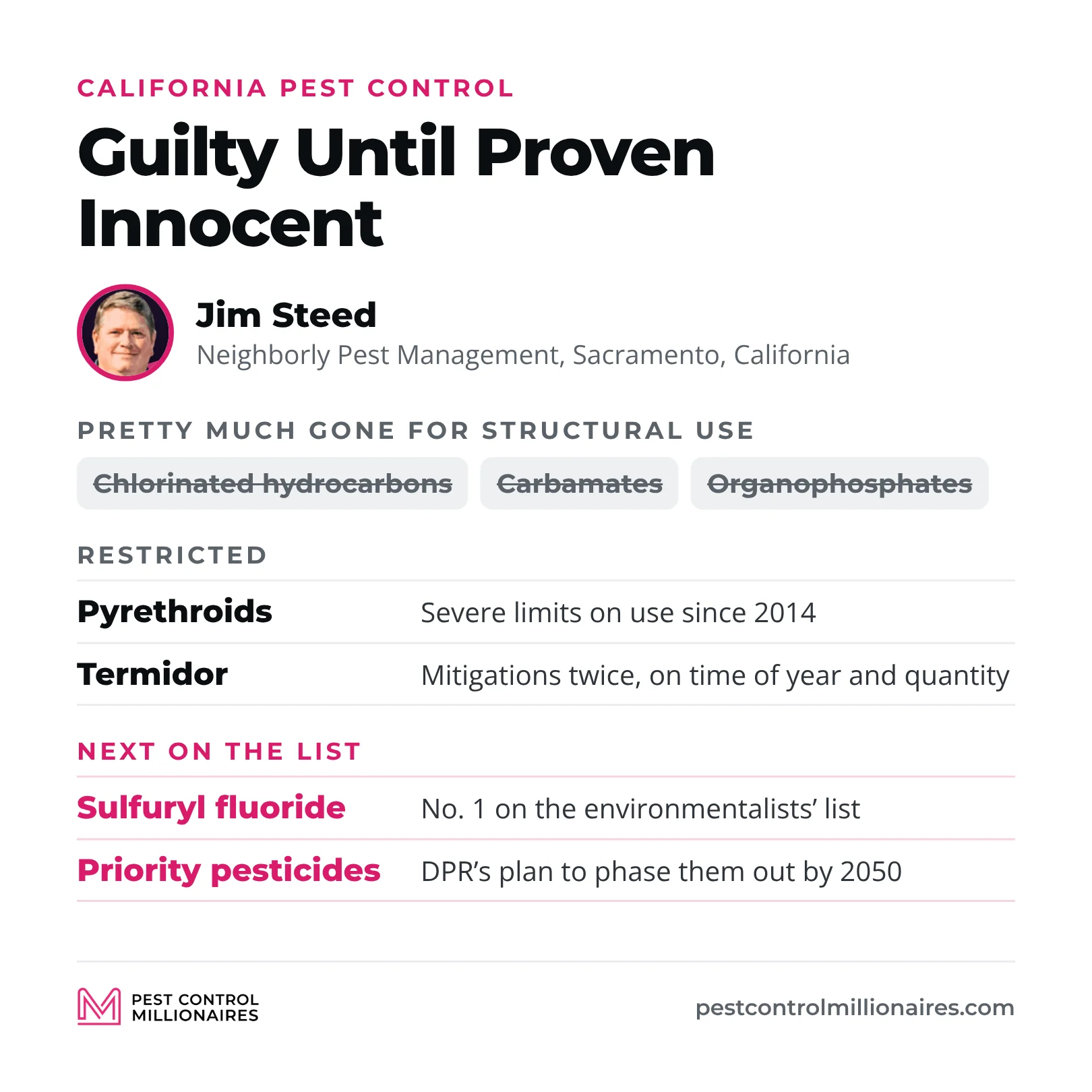
Look at what’s already gone. The chlorinated hydrocarbons, the carbamates and the organophosphates are pretty much gone for structural use in California. Pyrethroids have had severe limits on use since 2014, and Termidor has had mitigations twice, on time of year and quantity. So when regulators look for what to restrict next, “the list is very small,” and Jim worries they’ll end up “doing things that are genuinely counterproductive and will harm California.”
There’s no real substitute for fumigation
The biggest example is sulfuryl fluoride, or SF, the fumigant. It’s No. 1 on the environmentalists’ list, even though losing it would mean billions of dollars in damage, so the pressure is moving to alternatives like heat or microwaves. “There are no alternatives that can give you an equal result. Period. There’s only what I would call almost apologies for not fumigating,” Jim said. A localized treatment, a heat treatment or an orange oil treatment may or may not work against an insect that’s deep in the framework of your home and feeds 24/7.
Neighborly doesn’t live on fumigation. Jim figures not even 10% of California’s fumigations happen in Northern California, and about 80% happen in the greater Los Angeles area. Companies Neighborly’s size down there do two a day. He might do two a month.
The newest attack calls SF a greenhouse gas. By Jim’s rough math, “just me and Google,” all the fumigation in California in a year adds about as much carbon as 11 minutes of LA traffic. Meanwhile, a home is most people’s biggest investment and a big part of their retirement. “Imagine having termites in your 401k,” he said.
Make the case with public health
The chemical manufacturers have a coalition, RISE, but to the other side they’re “the purveyors of poison,” Jim said, so a lot of the time it’s operators making the case. We have an argument they don’t. “Technically speaking, the less of this I use, the more money I make,” he said. His customers don’t know if he used $10 or $20 worth of product. They only know if the insect is gone. His strongest argument is public health, protecting the food supply “from farm to fork” and keeping disease out of homes, offices and schools.
So he shows people the other side of the coin. The federal courthouse in downtown Sacramento had a low-bid pest control vendor who couldn’t solve a rodent problem, and the rodents were running across desks. Jim had been on the 29th floor for about 10 minutes when a federal judge came out and chewed him out. “I’m not the current vendor. I’m the guy they called because the current vendor couldn’t figure it out,” Jim told him. After about two hours of inspection, his team found the conduits the rodents were traveling along the elevator utilities, excluded them and did some trapping over a weekend. By Monday, the judge had a rodent-free floor. “Everybody’s an environmentalist until the rat’s in their house,” Jim said.
At a 2014 meeting with DPR’s leadership about changes to pyrethroids, he pulled a little bag with two or three live bed bugs out of his pocket, opened it and let one crawl on his finger. “Knock it off, Jim,” they told him. His point was simple. “What would you want available if this were in your house?”
Get in the game, and network with the other side
The first time Jim testified in front of a Senate committee at the capitol in Sacramento, the 40-foot walk to the table “felt like it stretched out 150,” he said. He sat down and apologized that he was just a pest control guy who didn’t know how to start. “We’re all citizens here,” the committee told him, and they walked him through it. “If you want a voice in the game, jump in and go start talking and start working and doing it,” he said. Now a lot of lawmakers recognize him, and some members of Congress, state legislators and even DPR employees are Neighborly customers.
Lobbying means being ready to lose and compromise without making enemies, because you’ll be right back in the arena with the same people. What makes it work for Jim is networking, even with the opposition. Once they get to know him and see that he cares about the environment too, his arguments land with more authenticity.
He was building that into a new event for owners. Our industry has big continuing education programs on how to kill an ant or a flea, he said, but what teaches you how to get insurance at a better rate, pick your corporate structure or handle HR? So he and a leadership consultant set up an owner’s academy, with the first one planned for February 23, 2026, in Sacramento. Jeff Davenport, who built and sold Official Pest Prevention, was set to speak, and owners would rotate tables when a buzzer went off, so they’d leave with colleagues they could call.
Be careful stewards of your products
I asked Jim what the rest of us can do. Don’t be the operator who kills a bunch of bees unnecessarily, he said, because that makes headlines. A case in the Northwest “wasn’t necessarily an illegal or inappropriate application but it was definitely unwise,” and it changed pesticide regulation for the entire nation. “If we’re casual with our products, we will be more likely to lose them,” he said.
His greatest hope is technology. We aren’t getting a lot of new chemistries, but we are getting remote monitoring stations and better information about how much to use and when.
Your process is your product
I asked Jim what he’d tell an owner who feels stuck in the truck or under a million dollars. The common story is a really good technician who starts his own company and grows on referrals and friends and family without ever getting good at marketing. “Essentially what they’ll do is they’ll create a job rather than building a business,” Jim said. If that job makes you happy, great. If you want to build something, get clear on what you do and how you stand out. “Your process is your product,” he said. It’s the same trap Benjamin Williams calls the technician box.
His other warning was about cheap help. “Going with low-cost employees is one of the most expensive things you can do,” he said. “If your employee can’t duplicate the quality of what you’ve done, they’re not the right employee for you.” It’s one of the brutal truths I wish someone had told me. If you don’t have profit, you can’t afford good people.
The best-known product wins
Marketing was fairly stable for about 10 years, Jim said, and it kept changing for the five or so before we recorded. So either work with a marketing person who keeps up or become half of that person yourself. Otherwise the companies that do will outgrow you, even if you’re the best.
One of the first things my mentor ever told me was “It’s not the best product that wins, it’s the best known product that wins.” Jim agreed. “If I had understood that better 10 years ago, I’d probably be double the size I am right now,” he said.
He also told younger owners to block out time every week to work on the business, like appointments. “A lot of people will work for your business, but only you are going to work on your business,” he said. I still do it.
When I becomes we, you can scale
At his son’s Marine boot camp graduation, the drill instructor told the crowd, “I love to see a change in behavior in these recruits because it tells me that learning has occurred.” Jim runs his leadership team that way. For a year they worked through Maxwell’s 21 laws of leadership with a consultant, and every time they study a principle at one of their rallies, they ask what they’re going to change.
He used to feel like he had to be the captain of the ship with every answer. Now he coordinates the collaboration, and some great ideas for his pest control have come from the guy who runs his four turf trucks. “We want them to have shared values and different talents,” he said.
In the year before we recorded, they documented every process in professionally formatted binders. Neighborly had been one location the whole time, partly because Jim worried about not being there. Now he thinks he could lay the system over another group of people with similar values and replicate it in about six months. “I has now become we,” he said.
He’s proudest of what he calls the Neighborly way, where everyone wins, the customer and the employee. “We’re not the biggest. We’re not the fastest growing,” he said. But his people are as happy as they can be, and he’s officiated two employees’ weddings, one of them half in Spanish. “There is nothing another company has that they can offer me that’s better than what I have here.”
Frequently Asked Questions
Who is Jim Steed?
Jim Steed owns Neighborly Pest Management in Sacramento, California. He started there as a sprayer in 1993, bought the last of the company in 2013 and has spent the better part of 25 years as an advocate for the pest control industry with California’s Department of Pesticide Regulation and lawmakers.
What has California restricted for structural pest control?
Jim says the chlorinated hydrocarbons, carbamates and organophosphates are pretty much gone for structural use in California, pyrethroids have had severe limits since 2014 and Termidor has had mitigations twice. Sulfuryl fluoride is No. 1 on the environmentalists’ list, and DPR plans to phase out what it calls priority pesticides by 2050.
Is there an alternative to fumigation for termites?
Not one that gives an equal result, Jim says. Localized, heat and orange oil treatments may or may not work against an insect deep in the framework of a home, so he calls them almost apologies for not fumigating.
How can pest control operators help with pesticide regulation?
Be careful stewards of your products, because one unwise application, like killing a bunch of bees, can change regulation for the whole country. Then make the case with public health and get to know lawmakers and even the opposition.
Full transcript
Every word of the episode, from the video captions
Building the business turns you into a different kind of human being.
Realize that failure is a part of the...
I think there's hope out there for all of us. For all of us. They say procrastination be the assassination of destinations. That's why we out here grinded with no association with haters and them other crabs trying to put us down. Pest Badger's in the house. Boy, don't clown. Just keep your eyes on the prize and no giving up. You can do whatever you dream of. Keep your eyes on the prize.
We are back. This part two, which is really cool. We got to chatting yesterday and hour and a half later, we still had a lot to talk about, so we figured we better finish this up tomorrow. We were kind of left off when we were talking about some regulatory stuff and one of the questions that I had written down is, you know, you're highly involved NPMA on the board out in California. Where do you see, you know, some of the regulatory changes that are coming down the future that most operators should, you know, kind of keep an eye on?
Well, let me start with California. So, in California, our DPR, Department of Pesticide Regulation, which is like a second EPA, it's just the same thing, a whole other layer of it, has initiated what they call their sustainable pest management program. And this is a very involved philosophy where they've even laid out a plan where they would like to eliminate 90% of what they call priority pesticides by the year 2050. And to do this, they're pulling together a committee, and there are even positions open for that committee right now where the committee will begin to select pesticides that could be candidates for being phased out in California. And so that's really got the attention of pest control operators here in California. And of course what happens in California will often export. So the DPR has tried to be as sort of calming with us as they can about this saying hey this is a direction and this is a goal but it's a very clearly stated one. I mean when you say we want 90% gone by 2050 those are both you know pretty relevant numbers and The concern I think I have and a lot of other operators is that this is not based on on a balance of you know and you know the benefit the risk and the benefit.
They're just people that don't like pesticides. They don't they don't care what the benefit is, right? Irrespective of whether it keeps people healthy, keeps crops healthy, keeps people fed, they're just purely anti-pesticide. And there's a lot of them here in we have one we had one bill I worked on last year that had 48 environmental groups listed in opposition to...
Yes, there are.
You want to know how many groups there are that are out there defending?
One, two, yeah. Our state association and our national association. And so think about, you know, how do you counter that? How do you how do you work, you know, against that? And the greatest ally we have actually is that common sense is on our side.
One or two,...
And at the end of the day, sulfuryl fluoride or SF is probably the biggest example. It's number one on the environmentalist list. They want it gone and they're trying lots of different ways to make it gone. They could care less about the effect on housing in California, the billions of dollars in damage that it would cause to lose SF. They just don't care. But, you know, with recent studies and discussions in the past, it's become very evident that right now SF is a tool that California really needs. And they can't argue with the science and the common sense of that. So there there'll be more pressure on alternatives. You know, they'll want to figure out some way for heat or microwaves or you know, some other product to take the place of But I would say what worries me most is an irrational pressure put on every active ingredient in California.
They're all guilty until proven innocent. And so, you know, to show that they're doing things, they're they're going to have to make changes and mitigations. We lost the chlorinated hydrocarbons. We lost the carbamates. We lost the organophosphates. All those families of chemistry are gone for structural use pretty much in California. In pyrethroids. We've had severe limitations on use since 2014 and we've had mitigations with Termidor as well twice you know on the time of year that we can use and the quantities that we can use and so when you're looking around and you're saying okay what can you eliminate or restrict next the list is very small and so it worries me that that you know in their efforts to get rid of pest pesticides, we're going to actually get down to doing things that are genuinely counterproductive and will harm...
Yeah. What is the alternative? What is the alternative yeah. Like what like...
To fumigation? Well, there you know there are there are no alternatives that can give you an equal result. Period. There's only what I would call almost apologies for not fumigating. You can do a localized treatment. It may or may not work. You can do a heat treatment. That may or may not work. You could do an orange oil treatment. That may or may not work. And it and it, you know, when it's like your house, you're like, "Wow, why am I why why am I going to spend all this time and money on things that probably won't work with an insect that's deep in the interior of the framework of my home and feeds 24/7, never stops, and is going to keep going until I get it." you know, you just think I'm going to choose fumigation because it gives me the result I want, the result I need, you know, to protect my home.
Does do you guys at Neighborly do a lot of fumigation?
In Northern California here, there are hardly maybe not even 10% of the fumigations in California happen up here. So yeah, I would say 80% happen in the greater Los Angeles area all the way from the grapevine down to San Diego and the rest happen along the coast and Central Valley up in here. So there are, you know, there are are pest companies our size in the LA area that are doing two a day and I might do two per month. That's just where you're located.
Yeah. Yeah, you have 17 individual climate zones in the state, right?
It's crazy.
We have everything from desert, straight...
To almost arctic, you know, ice and snow and high elevation alpine and everything in between, verdant valleys and all of that. So, it's a single state, but it really is very diverse in its environmental conditions. And down south, they pretty much, you know, winter is about 15 degrees cooler than it's it stays pretty warm. And so those those drywoods, they've they've got a pretty happy life year round down there. And another change or difference in the Sacramento area, we have like two and a half million people living in LA in that same area or that same area that I described before. You've got 20 million people. Yeah, I took I've been went over for the first time this spring with my with my daughters. Took them to Disneyland. Can't remember Disneyland. Disney World. I think it's Disneyland.
And it was beautiful. Like they have the mountains on one side and then you have the ocean on the other. It's like beautiful. And then we were at the zoo and I was like, "Oh, the traffic or just say I looked at the map when we got there." I'm like, "Oh, we're only two hours away from from LA." like it'd be cool just to jump in the car and drive to LA. And so we got done like I don't know noon or 1 and then went to get in the truck and we were a six-hour drive because the traffic I've never witnessed like I've heard you know a lot of people talk about the traffic in LA but I've never witnessed it firsthand when you have seven lanes of traffic on each side wall-to-wall like that was new to me.
Hold up quick pause. If you're on a pest control company or fertilization weed control company, you're not in our Facebook group. You're choosing the harder path. Every operator that's there skipping years of mistakes because people are actually sharing what's working right now. So, stop trying to brute force your way through growth alone. Search Pest Control Millionaires on Facebook or click the link below. And now, let's get back to it.
Yeah. One of the ways environmentalists are coming after SF right now is as a greenhouse gas. Because it really traps carbon like 20 times more efficiently than other elements do. It's it just grabs on to a lot of it. And so I did some kind of what I call cran calculations, just me and Google. And based on some of the numbers I found, the total amount of carbon captured or put into the atmosphere by all of the fumigation that happens in California in a year was similar to about 11 minutes of LA traffic. I believe...
And you know just a fraction of any wildfire that's happened in California and yet they want to eliminate this entire you know kind of process as a greenhouse gas and again make California subject to billions of dollars in property damage and uncertainty and you know and you think...
They already can't get insured out there now you have termite issues that Now we're now but you're going to take away SF and now they have so much termite damage now like yeah what is it I don't know what to do from there.
Well and look at how important a home is that you own for Joe Citizen right it's probably your almost your greatest...
Yeah. Especially out there of average home I'm guessing is a million bucks.
Yeah. So or more.
Or more. Yeah. Depending on where you're at. Yeah.
Imagine having termites in your 401k. You know, you wouldn't be really excited about that. And so I think you've got to we have to understand what a home means to the people that live there in terms of it not only as you know their it being their castle, but it's also a big part of their retirement and what is their overall value. And to put that at jeopardy for the average citizen is that's the reckless part for me when there are so many other ways to mitigate greenhouse But that's not how some folks in California think,...
They're very focused. They don't care if it's a contributor. They want to get rid of it. Y, you know,...
Happy to get rid of your car but maybe not theirs.
And I'm not going all electric. We had this talk already. That's not happening. Yeah, it's pretty tough, too. I always thought electric was sort of like a little bit of a scam because it truly isn't you know, free if it's made from electricity that came from natural gas or coal. Your car is a coal car or a natural gas car. It's not an electric car. And so unless your your energy your electricity is clean, then then it doesn't matter what your car is really. It's just a different version of it.
Yeah. How close were you to the fires when when all that fires happened?
Well, interestingly enough, the fires for us in Northern California were probably within oh 50 miles of the Sacramento area. The Paradise Fire was about an hour and a half away. That one was terrible. Then there were some real big fires that burned in the mountain range between Sacramento and Tahoe. And those just devastated big tracks of forest as you drive up the freeway. There are two different freeways that you can take. One is Highway 50, the other is Highway 80. You can just see, you know, miles and miles of forest burned. And then you know the most costly fires were in Southern California because u you know once it got into the neighborhoods the houses were the forest that burned not not the trees and there just wasn't the water infrastructure to fight those and stop those. And so it's like poor Lahaina. It just not to get too political. I hear so many stories like there was water available, didn't you? Whatever the case may be, but you just never know.
Yeah. It just burned.
Yeah. Yeah. So, I guess, you know, when I think about pest control in California and the regulatory world, my biggest concern is regulation that is too narrowly focused. And my greatest hope is actually in technology. I really do feel like well it doesn't seem like we're getting necessarily a lot of new chemistries but we are getting a lot of new technologies you know remote monitoring stations for...
Road I was just going to say wireless bait stations. Yep.
Yeah. You know and all sorts of information that helps us to make better decisions about how much we use and when we deploy that. So I really think that the biggest changes will probably come from technology but you never know you know the big manufacturers chemical manufacturers are not going to walk away from billion-dollar markets you know they know they've got to do the R&D and try to be bringing us new products and different chemistries. So, I'm just crossing my fingers that whether it's you know, innovation from technology or new chemistries, we'll still have some tools to do the job we need to do.
Yeah. And when you're when you're when you're pushing up against the other side of the politicians that want to ban this stuff, are the big companies there with you guys fighting fight with us or with you guys like big chemical companies? Well, there yeah, there's a group called RISE, R I S E, and RISE is sort of a coalition of the manufacturers of pesticides. The problem RISE has is that they're sort of they're persona non grata, right? They are quote unquote the purveyors of poison. They profit off of poison. And so their perspectives are often immediately discounted. And their voices are are often totally muted, you know, and so a lot of times it's us the users, us the operators that are making the cause for the tools we have, you know, saying, "Hey, look, technically speaking, the less of this I use, the more money I make."
You know, I have an interest in using less pesticides because my customer doesn't know if I use $10 or $20 worth. They only know if the insect doesn't show up or if it's gone. And so it helps us a little bit to be able to have some legitimacy when we present our arguments for the tools based on that. But our strongest arguments, I think, come from connecting them to public health in the way that they should. You know, we're protecting from farm to fork the food supply that we have and keeping disease at bay from those insects and pests that would vector disease into your offices, homes, and schools and areas. So, I think we've really had to take up our and own our flag of public health in order to make our case because, you know, they've just become there's nothing good about the word pesticide.
Not at all.
Really almost anyone, right? Yeah.
And so, you have to show what are we getting from this tool, you know, what is the gain? What is the benefit? It's a hard case to make out here sometimes in California because the values aren't the same as everywhere...
Yeah. I think the first place everyone goes to and I could be wrong is Roundup. It's the first place they go to.
Yeah. Well, that's one of the most infamous cases and also...
That really shows you...
Where you know at the end of the day it won't matter. The science won't matter. So, you know, you have a product that is used for decades, breaks down into four derivatives that are some of the most, innocuous substances that can be broken down to. You have more than 50 studies showing that it's not And then you have one that says, well, maybe there's a link to cancer. Maybe. And I you know, I hate the word link because it's like a statistical. Now, let's say every time you have a podcast, there's a coincidentally there's a light lightning strike somewhere. Well, you know, you do enough of that and they can say there's there appears to be a statistical link between these things and all of a sudden something that was not a carcinogen for 50 years is enough for a jury who of course can make that decision only if they're ignorant enough.
If they're educated enough and they understand science and the language used around the cause and effect, they would never find that you know Roundup could have been the primary cause for certain people having cancer. It just it's not justified. But you get the right language, you get people who are uneducated enough and the attorneys will always find the opportunity and they did and they will. And at the end of the day, what happens is there's a bunch of money that goes to potential victims and attorneys and most people are still using Roundup.
Yeah, you're not wrong there. I agree. It's just like I mean even on like I even hear like big big podcasters talk about it. So it's just like so anytime you bring up anytime you talk about any pesticide that's just the first the place people go to is Roundup causes cancer. All pesticides cause cancer or they see the photos of the you know the bobcats with the eyes bulging out.
Exactly. Yeah. And again it's these are are sort of scare tactics. One of the things I've done in the past to sort of counter that is I have a couple videos I like to show of rodents kind of running wild and that get that gets people's attention as well. You know, when you show them how bad a rodent infestation can be. We had a situation here in Sacramento in the federal courthouse and federal accounts are all low bid and they're just that's it. And so they of course had a low dollar company in the federal courthouse in downtown Sacramento and they couldn't solve a rodent problem. We had been used in the building for a special project on bird exclusion. And so the manager of it, the GSA manager called and said, "Hey, I'm in I'm in a bad way here. I have a federal judge that is making some calls and it's a really big deal, you know, can you can you help me out? I said, let me see what I can do.
So, we go down to the courthouse. I get up on the 29th floor and I start to do an inspection and this judge comes out and with his staff member and he starts to chew me out like I don't know what you think you're doing or this or that this and that. And I said, "Hey, your honor, I'm sorry, man. I'm going to interrupt you real quick. I've been here for about 10 minutes. I'm not the current vendor. I'm the guy they called because the current vendor couldn't figure it out. And if you give me a chance here, I think I can figure out what's going on and I can help you out. But I didn't realize the power this federal judge had in this building. But it was he was the Sith Lord. I mean, people were afraid of getting fired.
It was it was pretty massive. And the rodents were running on their desks on their desks. And you know, and so that's the other side of this coin, right? You know, we're not going to live with that. And after about two hours of inspection, we found the conduits where they were traveling along the utilities of the elevator, excluded them all, did some trapping, and over a weekend, and by Monday, he had a rodent-free floor for his courthouse. And they went back to their low dollar and we just ended up giving them a bill for for those services that that you know we had to come in and fix the problem. But you know at the end of the day I have found that you know everybody's an environmentalist until the rats in their house and once the rats in their house in their car chewing their wires putting droppings in their food then they want to talk about how do we handle this problem.
And that's, you know, that's one of that's our job in the advocacy, right? We need to counter these other pictures and say, "Here, be careful what you decide because this is what you could be...
Yeah. I had a lady on the podcast month ago, month and a half ago, probably two months ago at this point, and she travels the country with dogs. Have you had any success? Have you tried anything? Have you seen anything out there with dogs? No, I've just videos. Yeah. And...
Her name was Kim Camera. She's really really cool lady and very very fun to listen to. I'd love to go and check what she does. But they run around with ferrets and dogs and they just chase mice and rats all day long.
Yeah. Some people are pretty disturbed about how the rats are dispatched by the dogs.
I can imagine...
Yeah. But it is pesticide free. It's poison free. But again, what like you're giving us very little options here and then you go back to like you said the other side of the coin of the judge panicking because he has rats run over his desk. Well, they're the ones who have to help support us, you know.
Yeah. I without naming any names, I will tell you I have colleagues in the Bay Area that have contracts that spell out catch and release of commensal rodents. They're trapping. They're trapping cannot harm the rodent.
They've got to trap it and take it somewhere else and release it.
Yeah. So, it's you know, but as you were kind of saying before, California is a beautiful state. I mean, I' I've lived here since 72 and all my family's here and it's a challenging business environment and it's a challenging pesticide environment.
Had a lot of friends that have lived there and moved from there.
Yeah. But it's still there's still a lot of great things about California.
Yeah. The weather. But then they've they've lost Musk. They've lost Rogan. They've lost Patrick Bet-David. They've lost a lot of people who've lived there for a long long time.
Yeah. And you know, I've looked myself, you know, several and may when I'm done with the business side of things for myself, may end up in another part of the country. You know, I've spent time a lot of time traveling and I love the South. I really like Texas. I don't think I could...
A lot of people a lot of people have moved from to there for to Austin, Texas or somewhere in Texas or some in...
Yeah, I would be an exported 49er fan.
Yeah. Well, I'm a Green Bay fan, so...
There you go. Yeah. So, that that's going to go with me if I do. But you said you mentioned earlier in the podcast that at some point, you know, maybe when you're done that you might want to get into politics asisms or have you thought about like staying in pest control industry as a politician and kind of like you are now?
You know, I've always thought it would be interesting to work on a political campaign. Yeah. You know, and try and help someone get elected. I've done a lot of politicking and amateur lobbying and I think it's important. But for me, a lot of that has been more like, you know, you do the laundry because you need clean clothes, I don't really have a passion for that.
Right? For sure. Yeah, I get that.
It's tough business in lobbying. You've got to be ready to lose and compromise and not make enemies or get too upset because you're going to be right back in the arena with people again. And so it's sort of very challenging, not particularly rewarding for me right now.
Yeah, I can see that.
What is it like? What is it like being in there? Well, the first time I ever testified in front of a Senate committee in the Capitol at at the state capital in Sacramento, it's about a 40 foot walk from the chairs all the way up to the tables where you sit and you testify. And I'll tell you, the first time I did it felt like it stretched out 150...
It's so long. And I was actually there with another colleague who had had like 10 years of experience doing it and he bumped me and he said you go handle this and I like I don't know what to do. He said and he bumped me again. He said they're waiting go. So that's how much prep I had. So I walked this long distance up then I sit down and I just I don't even know what to do. And so I apologize. I said I'm sorry. I'm just pest control guy here to try to give a point of view, but I don't even know how to start. And they all said, "Hey, well, don't worry. We're all citizens here. Get tell us your name." And they kind of walked me through it. And so that very first time, I thought, you know, this is really kind of cool because whatever the outcome is here, it's just the citizens doing it, And we all get a little grumpy about politicians and but hey man, if you want to voice in the game, jump in and go start talking and start working and doing it.
And so for me, it felt like, you know, here's this quintessentially American moment where just a guy can go sit down and testify. And now, you know, when I sit down, a lot of the lawmakers actually recognize me from either visits or testimony from before. And I probably sound more like a lobbyist than Joe Citizen. But it's pretty cool, you know, and we do leg days also in Washington DC. So, we've done visits in congressional offices and Senate offices. And it's really neat to think that you're there making those arguments on behalf of your industry, you know, and oftentimes, not always, but often times it makes a difference. So that part of it really is rewarding when you can get something done and make a make a friend to the industry, really open someone's eyes.
Th those are very rewarding. Is there people that are like in the middle on the fence that you can convert to your side? Is it like that?
Yeah. You know, it all depends on people's background. You know, it's kind of think of like everybody at like a high school reunion. Maybe they've all after 20 years, everybody's had this different set of experiences. And I you know, my strong feelings about transcend every part of what I do. And that even it goes into the lobbying. And I love talking with the opposition and getting to know them and getting to have them get to know us better because then I think our arguments resonate with more authenticity when we go in there and we say, "Hey, we care about the environment also." They know we do because they've gotten to know us a little bit...
And they've seen some evidence of that. So, yeah, there, you know, most people think about pest control, you know, in terms of politicians as much as they think about, barbecuing hardly at all. You know, they it's just like, what's bugs and pesticides and is that still sprayed on our food? And are the eagles okay? You know they have very little understanding of our industry and what we do. So and then you know most of them will be exactly like I told you and then anti-pest in their house in their office around them that they both feel pretty strongly about both sides.
Yeah. And you can't have one without the other unfortunately. Well, that's why, you know, they are effective tools. We don't want to live with those. I had a I had a meeting back in 201 14 at with the leadership of DPR about the changes they were proposing for pyrethroids. And I brought with me in my pocket to the meeting like this little dying bag couple two three live bed bugs. So, we go into this meeting and we're we're talking for 20 30 minutes about, hey, you know, we're going to we're thinking about eliminating this use pattern and that and this and that. And I said, hey, I just want to remind everybody here, this is this is what we're after. And I pull this thing out of my pocket and it's, you know, two, three live bed bugs kind of walking around in there and they all kind of back up in their chairs and they're like, are those alive? And I said, yeah.
And I opened the bag and I put my finger in and I let it crawl on my finger. They're like, "Knock it off, Jim. What are you doing?" And I zipped it up and I said, "I'm reminding you that this is what's in someone's home, right? Be careful about the tools we have to get that out of their home. What would you want available if this were in your house?" You know, it's not I just need to remind you of the other side of this because I know you're getting hammered on the pesticide side. A guy who was in that meeting told me years later that they thought maybe on the way out of the meeting I popped the bag open, I dumped them out, but I didn't. It kind of served the purpose, right? And we know that because we go in, we see these couches loaded with bed bugs. We see these beds, we see the people that are bit, you know, we see the rodent damage everywhere. And that's the message, you know, we have to bring home to them to counter the other side.
And it's like you mentioned earlier too, it's like the people who are unfortunate, who can't afford, we've both seen it. They have the worst issues. They can't afford it. Like subsidized housing can't afford it. And now we're only doing exclusion work. And now it's a twice as much or heat only heat. Like there's nothing we that like these guys politicians are they don't really have issues with money. They cannot afford to have a someone spend $30 to $50,000 to close up their home, you know.
Well, I guarantee you almost all of them have their homes on service.
Oh, guaranteed. For sure.
And it's interesting, too, when occasionally after I've gotten to work with some of them, they'll call and sign up with me and it's like, oh boy.
I got to be really careful here because we're taking care of it. So we have we have actually members of Congress that are customers and members of the state assembly and the senate and a lot of other state workers even employees at DPR use Neighborly.
Good time to segue out of out of regulatory and talk about talk about Neighborly a little bit. I know that you mentioned that you guys when you first started there you were on the lawn care side and then you kind of get into pest. Do you guys still do both turf care and pest control? Yeah, I got four trucks that do turf and ornamental and a guy that runs those. And so we do lawn fertilization, injections, deep root feedings, a little bit of fruit inhibition, little bit of growth regulator.
Awesome. Did they I know that you kind of always did lawn and pest, but was the pest control side always bigger or when you first started was the lawn care...
Yeah. Well, it was started in 1978 with pest control and termite. And then in 1988, they bought a couple of trucks and they didn't do a whole lot. And then in ' 91, they finally hired a guy and he started, it was late ' 91. And so when I joined in early 93, he only had about a year of work into building the turf department. And I remember my first month at the end of February, I had completed $2,200 in production. I thought, "Wow, I really made these guys some money. That's $2,200. That's something else."
Yeah. I mean, you worked there for 30 years. Is there anything is there anything that could that you could help, you know, operators with that, you know, maybe they're stuck in a truck or maybe they're sub, you know, a million dollars like you know, like kind of feel stuck and you bet you've been through a lot. So, you've had probably had to learn things, probably had to unlearn some things like we talked about earlier. What advice would you give those operators? You know, this kind of actually draws right back into this academy that I've gotten involved with here because it touches on, you know, how can we learn to develop and grow our businesses so they're more profitable and more successful. And so, maybe I'll talk about your question real quick and then talk about how that led to the academy.
For sure. Then I have some questions around the academy and the people who are in it.
Yeah. So, interestingly enough, I think that your book does a fantastic job of describing all of the different areas that you really need to be tending to in order to have a quality service and a quality marketing program. You know, if you have only one and not the other, you're going to suffer. If you do great at marketing, but your process isn't good, your reviews are going to be poor. Your employers are going to be employees will be unhappy. Customers will be unhappy. And I've kind of seen that before where folks are kind of better at marketing than they are at their process. And it's really costly. And what's more common though is that people who are really good technicians start their own smaller pest business. And usually they can grow without really doing very well at marketing either by referral friends and family and that. And essentially what they'll do is they'll create a job rather than building a business. They've built themselves a job. And if you have built a job where you've got a route and you work for yourself and you're really happy, there's probably not a lot I have to offer that person in terms of advice because they're probably already doing a really good job of keeping as many customers as they want and earning the money they want.
But if you created your business to have more than a job for yourself, but to build something to any degree, then I think the first thing I would do is make sure that I have some kind of plan on both sides of that. What is my process? Because your process is your product. What do you do? Do you do anything that's unique? You know, how do you stand out against the others? And have a lot of clarity on that. When I come to your home, you know, I'm making sure I'm looking at these things, I'm doing this, I'm looking at that, and I'm treating in these areas, and we do it like this because, you know, you with so many choices for consumers, you got to make it so that you can kind of stand out and that your process, bears that out.
You may you may be worried as a new owner about costs and I found that going with low-cost employees is one of the most expensive things you can do. You know, if your employee can't duplicate the quality of what you've done, they're not the right employee for...
Yeah, I actually just dropped a YouTube video like last week or a week before the 12 brutal truths about, you know, business that I wish I'd have known. That was one of them. Like cash is king and if you don't have profit, you can't afford good people. So you just take on whoever you want to. And they're usually people who don't have jobs or are willing to take a low salary. That's the kind of work you get from them.
Yeah, it's really so stay away from that trap would be one of my first pieces of advice. And then second, it would be to search out every kind of resource like your book to learn about marketing and really understand that marketing has been in a dynamic state for probably at least five years. I think it was sort of stable for about 10 years. We had 10 years of kind of SEO and backlinks and people kind of competed with pretty much the same thing for 10 years. But over the last five years, it's...
It is now Yeah. And tomorrow it'll probably be different. And what that means is you've you've got to either engage yourself with a dynamic marketing person or you've got to sort of become half of that yourself. Otherwise, you know, the companies that do that, they're going to outgrow you and you won't be able to keep up. Even if you're the best, they are going to have the best marketing and they'll end up being bigger than you. Yep. My mentor 10 years ago, eight, I don't know, it doesn't matter. First, one of the first things he ever told me, he's a marketing guru. It's not the best product that wins, it's the best known product that wins. You got the best product in the world, but if no one knows who you are, it's not going to help you.
That's absolutely true. And I think I learned that the long and the hard way. I was slow to understand that. And it really cost me. If I had understood that better 10 years ago, I'd probably be double the size I am right now.
Yeah. And like in your you're a thousand times more technical than I'll ever be. And I don't want to be that guy. But I just I had to go hire the technical directors. I had to.
And you can. Yeah. And I can, but only because I was good at this thing. I was good at marketing. That was what I was good at. Marketing and sales was my jam.
But then the technical side, I was good. I was a good like operator. But I just I wasn't very technical, so I just go I had to go buy the technical people, you know.
Yeah. And I think to that to that younger operator, I would say do yourself a favor and carve into your periods. Two hours here, this day, three hours there, whatever it is, like they're an appointment, you know, to work on your business.
I still do that.
Yeah. You So you block it off, right? You actually make the appointment with and for yourself because nobody else is going to work on your business. A lot of people will work for your business, but only you are going to work on your business. And the less you do, the slower you evolve and grow and achieve.
And when you're working in your business, you're a 25 $30 an hour activity. And when you're working on your business, as you know, it's a 5,000, 10,000, hundred,000 million dollars per hour. And that's what you have to be working on as you scale.
Yeah. And I hope folks listening to this have some sense that there that they're a couple just regular guys here talking. No insult to you, but I don't think me or you are going to challenge Elon.
Absolutely. Rocket race. Right.
Not at all. What that means is that a person with decent smarts and drive and ambition can achieve far more than you ever expect. And you know, I'm sure at some point you probably have surprised yourself. I know I have. I sit back and I think, "Wow, I didn't know this could be done." And it's because I came from a very punch the clock work a day background. Everybody I knew worked a job. Nobody I knew worked a business. And now when I'm able to engage with other business owners, I can see there's this common experience where we're able to build and achieve things that are far beyond what we ever thought or expected based on our abilities. And I think the trait that so many of us hold in common is determination and drive.
Yeah. And I think that the people who are listening to the podcast are the ones who want to learn, that have the drive, that again, we're just like we're just two guys who are in pest control talking like you said, we're nothing special. If I can do it, you can do it. You can do it. They can do it. We're nothing special.
Yeah. Yeah. And I hope that sometimes we have a little bit of impostor syndrome, right? Do I really belong, you know, here? Do I? And the truth is, yeah, you do. And not only you do, but America's kind of counting on you. They're counting on these these crazy guys like, you know, in the 1700s, we're the guys that would take a hatchet and walk into the forest and say, "We're going to go build a town over here or something, right?" And we don't know why, but for some reason, we just had to pick up that tool and go and do this thing. And you think, "Oh, I'm going to set out and I'm going to build a log cabin." and you end up building a town. And it's really cool that that you can do that because it's a great benefit to all those families. You're going to employ people, put them in positions, develop them, and grow them.
You know, for for those intrepid owners that are out there, I hope you take a second kind of give yourself a pat on the back because, you know, our system, our capitalist system needs this sort of rare breed of us that are either too dumb to know better or too determined to quit.
I think we're a little bit of both or all of both. Switch gears a little bit again because we're already running out of time. You have an event coming up which is in February, March. Talk to me about the event and then how you got connected with Jeff. Jeff was the one who has the podcast month and a half ago. There's another one of those episodes like this one. Three hours long.
Yeah. Jeff Davenport, great guy. Official. Yep. He was with Official Pest here in California. Just a friend for probably 25 years and with his brother Jamie. And about four years ago, they found an offer so good they had to take it and I was super pleased for him.
And I just met him and I'm so happy for...
Oh yeah. And super impressive. So Jeff is one of the colleagues I have that I've always thought had figured things out much the way you know you kind of have with with all the content that's in your book. And there are a few others. And I've thought for a long long time, you know, why do we have these big continuing education systems for teaching us technically how to kill an ant, how to kill a flea, how to do this and that, but what is there that teaches us how to get insurance at a better rate? Choose the correct corporate structure, whether it's C Corp, S Corp. How do I when do I need an attorney? How do I handle my HR? You know, how can I work on on marketing this? You know, we as the owners, we have to be sort of the arbiter of all these areas and try to be good at them. And it's really tough. And so, I've had for a long time in my head an idea of like an operator's academy, which is basically an owner's academy. And you know had discussions with a lot of folks and last oh few months ago in working with a guy named Brian Alder who has 30 years in the industry and recently went on his own to become a consultant on leadership and he's really helped my company here we've been working on Maxwell's 21 laws with...
For a year.
Yeah. Yeah. And so he that's kind of where he comes in as sort of a leadership consultant and he's done really well specifically focusing on the pest industry. But you know I was just talking with him saying you know golly we somebody needs to create this academy you know where business owners can just go and learn you know like they would from a CE course you know and I know I wish I could have signed up for a couple hundred bucks go out for a day and have four or five topics and you know not every topic is going to resonate with you the same and you might learn two or three things, but the power of the knowledge you can get from those types of things is almost always measured in the thousands or the tens of thousands of dollars.
And so, you know, Brian's a really intrepid guy. He said, "Oh, let's create it." And he did. So, we have our first academy happening on February 23rd next year here in Sacramento. And it's really designed for small and medium business owners. Jeff's going to be one of the speakers and I'll be one of the speakers. There's another one u Lauren Thrasher from Thrasher Termite. And then Brian's also going to be speaking. We're actually going to have a networking activity. So it's not all just sit there and listen. And that's what I was going to say when you said the numbers can be in the,...
You know, hundreds or thousands of dollars and it might not even be...
The speakers talking. It might be just the network that you guys are creating. That will be unvaluable.
Yeah. So that that's actually my topic, but the topic I'm going to be talking about is, you know, you're not alone. How do you create a network and then benefit from that network? And then the last part of it is we network. All the participants are going to be at a table and do some talking together. The buzzer is going to go. They're going to rotate and sit around and they're going to walk away from there with a network of colleagues that they can reach out to for additional help. So I think it's just, you know, I feel like it's something that once we get it going, it'll become, you know, a pretty good institution. And I could easily see it being something that's done nationwide, you know, three, four, five times a year and attract 30, 40, 50 business owners. I know as it's kind of funny. I'm going sort of as a presenter and partly an organizer, but I guarantee you I will be networking and I will be taking notes from every other speaker that isn't me.
I mean, like every podcast. That's exactly right.
Every podcast.
That's exactly right.
There's something that you can learn from everyone. And I have two pages of notes just from our talk already.
That's just the same thing I do and I just I can always look back at this podcast. What did we talk about? Oh yeah, that that looks really cool. I like that. Let's let's do that. So I come up with all these ideas or get up the ideas from you guys and it's like these are really cool. And then I'll think about them for a while and then at the end of the month I'll be like okay this one's really good. I'll give this to my team and they're like, "Is this a this month thing or is this like a next quarter thing or is it next year thing, Jonas?" Because I'm I used to just throw ideas at them all the time. And they're just like, "Whoa, whoa, whoa, whoa." Now I've gotten to the point where like I write it down and then if I don't like it, I'll scratch it off like, "Ah, it's exciting at the moment, but I don't think it'll move the needle." So, I've gotten better. So, when I do present it to my team, they're like, "Okay, this is probably pretty important. We should ask them when when we want to launch this." You know,...
I referenced my son in the Marines, I think, in the in the last episode, and one of my favorite moments with him was at his graduation when his drill instructor was talking to the whole group, and he said, "I love to see a change in behavior in these recruits because it tells me that learning has And I just I just love that.
I like that, too. Because if you think of the axiom, right, learning only occurs if behavior changes.
And it's like you can you can listen to every we're in the information age, right? There's so much information. You can read all the books, you can listen to all the books, you can watch all the podcasts, you can read all the listen to all the documentaries or whatever, but if you don't go implement, it's...
Yeah. And so when we do our rallies here with my senior management group, we every time we study a principle from Maxwell, the question is what are we going to change? And we have to work it until we see something that either we change or we enhance or improve. And we don't walk away from it yet, you know, until we can figure that out. And that's what's really been transformative about our business and working with Brian. Brian works us through these principles that Maxwell teaches and is organized and then we as a group figure out what are we going to change and it's been fantastic. You know, I to me I used to feel like it was up to me to be the captain of the ship and have every answer and do all of this. And now, you know, all I do is kind of coordinate the collaboration that the group I have working with me is so motivated and so smart, you know, that we identify the challenge and then the group really comes up with great solutions and you never know.
I mean, I've had great ideas for my pest control come from my turf department guy.
Yeah. Well, think of like think Yeah. Think of like Henry Ford, which reminds me of the book about Henry Ford. They were they're trying to like do like a gotcha moment and they brought him all into the courthouse and a bunch of lawyers around and they're like, "Oh, where's your degree?" He's like, "Well, I don't have a degree, but I can at any time any day I can call any one of my employees that do have degrees to answer this problem for you." And that's what our job is to do is hire the smarter people that are better at that thing than what we are. And that's our job.
Yeah. Yeah. We want them to have shared values and different talents.
Yeah. What is the next three to five years look like for Neighborly? Well, I think we're having a great time just sort of, you know, kind of implementing all that we've learned about Maxwell leadership and so we've throughout this last year, we've documented all of our processes and those are now being put into actual binders that have been formatted professionally and laid out. And so I feel like what we've done is we've organized ourselves in a way that we've really prepared ourselves for scaling. I could I could take what I've got here now and overlay it on another group of people with similar values and we would replicate in like six months pretty quickly because we've got everything documented well and it's really been vetted well. So, I feel really comfortable now, leaning into scaling and growing.
We've we've got, you know, we've had pretty much one location our whole time. And I've always been a little worried about having more than one location because then I, you know, I wouldn't be there. So, I has now become we. I don't worry about me anymore. It's we, it's the group here, the leadership team. And we are so well documented now that we can take that and overlay that on any group or any opportunity and they'll do it the Neighborly way. So I'm excited to see now now that we've got this together here how how can we scale the Neighborly way in and you know do that in a way that maintains the integrity of who we are but increases the size of what we...
Love it. I'll finish up with the last two questions. One, you kind of already gave me one, maybe two examples, but other than traction and maybe 21 laws of leadership, what are some other good books that you'd recommend?
Here we have Lencioni's...
Patrick Lencioni 17. Good book. Love it.
Yeah, the ideal team player.
Oh, that's a new one.
That's also Lencioni. This one here is another Maxwell.
Yeah, that's a good one, too. Love it.
Yeah, because it really it what it does is it helps you to take the Maxwell that you've kind of now imbued in yourself and start to kind of pour it into others.
Two others that I have that I'm kind of glad I wasn't even sure you were going to ask this, but I just happen to have them all here. Another Maxwell book that's pretty good for individuals, If you've got anybody that's struggling with like perfectionism and taking too long to do a task so they do it perfectly, this is a great book to help them understand and kind of let them loose. And this is the this is the funniest one here because I've heard about this one my whole life.
Feeling For. It's another great book.
And yet the principle in how to win friends and influence people, it seems like it was made, you know, for the friendless guy.
You don't know how to be friendly. You don't know how to do you don't know how to do that.
And it's such an errant approximation of what the book is about. And the and the real question is if you've ever wanted to have a more powerful influence on your family, your friends, your employees, whoever it is, if you've just wanted to be better at that, how can you do that? And that's what this book tells you how to do just it just raises your abilities to have that influence. So those are some of the current ones.
Cool. I love it. All good books. The only one that I hadn't read is The Ideal Team Player. So, I wrote that one down. So, that'll be that'll be on my wish list here soon. And then last question of the day, what are you most proud of at this point in your life?
You know, I referenced a little bit before something I call the Neighborly way and that's it that that we're in this business, but the Neighborly way to do pest control is by having everyone win. The customer, the employee, everyone. And so some people think, you know, maybe we pay our employees too much, maybe we pay too much attention to them, maybe we do this or do that, maybe we don't charge customers enough or some other things along those lines. And I think there's a lot of important questions to ask about your KPIs and your profitability. But I can tell you at the end of the day, we're just people living on Earth. And the people who work here are as happy as they can be. And that makes my life really, really happy. There is nothing another company has that they can offer me that's better than what I have here. And it's just because we're doing it our way. We're we're not the biggest. We're not the fastest growing.
But the way we do it is just so rewarding. You know, I've actually I've officiated two weddings for employees.
That's awesome.
And one of them I had to learn half the ceremony in Spanish, you know, which is kind of cool. Well, you know, when you're you care about your employees and they care enough about you and they say, "Hey, would you would you officiate at my wedding?" You know, it's just such an honor. It's incredible. You know, I wouldn't I was super nervous doing that, but you know, it's a great life. And so I'm proud of the Neighborly way that we do things and that people who come here are are better for it and people who are serviced by us are better for it. And I think there's a market for that, you know, and that's who we want to be in the market.
Love it. I'm going to ask one last question. We talked a lot about regulatory stuff. Is there anything that we can do as operators to help,...
You know, on the on the regulatory issues? I think really what we want to do is make sure that we're not making the big mistakes. We don't want to be the operator that kills a bunch of bees because that makes headlines, right? And then we had a situation like that in the Northwest and you know it wasn't necessarily an illegal or inappropriate application but it was definitely unwise and you know you end up doing some bee control and you change pesticide regulation for the entire nation and you know it so I would say stewardship it comes down to it be be real careful stewards of the products that we use and make sure that you have that stewardship at its highest level. You know, if we're casual with our products, we will be more more likely to lose them.
Yeah, great answer. Well, Jim, it's been an honor to have you on the podcast. Obviously, it was fun. We've been here for three hours total. A wealth of knowledge. You're a great person to have on my side. You're a great person to have in the industry. And I'm honored to call you my friend. So I appreciate you being here. Appreciate the calls outside of this. And I look forward to I know I got some friends in Sacramento. So when I'm out there, I'd love to hit you up, come hang out with you for a day. Talk shop, do whatever, you know.
Well, likewise. And I have to tell you, we are very fortunate as an industry to have you. The kind of person you are, the kind of work you're doing and I really appreciate the invitation and but more so I really appreciate the new relationship and counting you a colleague and a friend and I have a feeling we'll be talking a lot.
I think so too. It's been fun. But all right, man. I appreciate it. I know you're busy. I'm busy so we should run.
Take care.
All right. Peace, man.
Hey guys, thanks for listening to another episode of Pest Control Millionaire. We don't charge any money for this show, but the podcast isn't free. Please like and subscribe and give us a five-star review in your favorite podcast app. This makes a huge difference for us. If you have any specific questions about your business or your personal life that you'd like answered by me or any of my podcast guests, please send an email to And if you want to get in touch with me about our marketing class, we do a live version every Thursday night. Check out our website at Thank you guys for listening. I'll see you guys on the next one.
Watch the PCM Podcast on YouTube