
Most people say that starting a business is exciting. They talk about the freedom, the money, being your own boss. What almost nobody talks about is how much work it actually takes. Most people completely underestimate the grind. The hours. The pressure. The constant problems. The mental load of knowing everything depends on you.
They don’t talk about waking up at 5 a.m. or going to bed at midnight. I’ve slept in my truck before. I’ve gone 3 to 4 days straight with basically no sleep because the jobs just had to get done. Nobody prepares you for that.
So I’m going to share 12 brutal truths that I wish someone had told me before I got started. If you’re building a business right now, especially if you’re still in the truck, this is the stuff I wish I had from the beginning.
Table of Contents
Toggle1. Speed Is Everything
Waiting costs you more money than being wrong. This is one truth I wish someone had drilled into my head a lot sooner from day one. Most owners move too slow because they don’t want to make a mistake. But here’s the reality: a slow decision costs you way more than a wrong decision.
You overthink the ad. You overthink the new hire, or whether you should hire someone at all. You overthink the pricing change. You overthink which CRM or software you should use. You overthink running ads completely. And while you’re thinking, the good competitors are taking action.
Every month that you don’t raise your prices, you lose margin. Every month that you don’t hire, your burnout gets worse. And every month that you don’t send out your marketing, your competitor takes customers that should have been yours.
Waiting is way more expensive than being wrong. A wrong decision gives you data. A slow decision gives you nothing. And a wrong decision can be fixed.
Here’s the part almost no one understands: if it’s good enough, just send it out. Execution and repetition will give you the data you need, and you’ll get better every single time. You don’t learn by thinking. You learn by doing.
We’re in the information age. Everyone wants to listen to another podcast, read another book, get another coach. They learn all this stuff but don’t execute anything. You don’t improve in your head. You improve in the field. Go out there and execute. Knock the door. Send out the postcards. Send out the flyers. Send out the door hangers. Send out the emails. Send out the text messages. Whatever it takes.
Most people don’t fail because they choose wrong. They fail because they choose nothing. Speed is a skill, a mindset, and a competitive advantage. Business rewards the owners who move and execute. Make the decision, move forward, and adjust later.
2. Most Small Operators Do Too Many Things Instead of Doing the Right Things
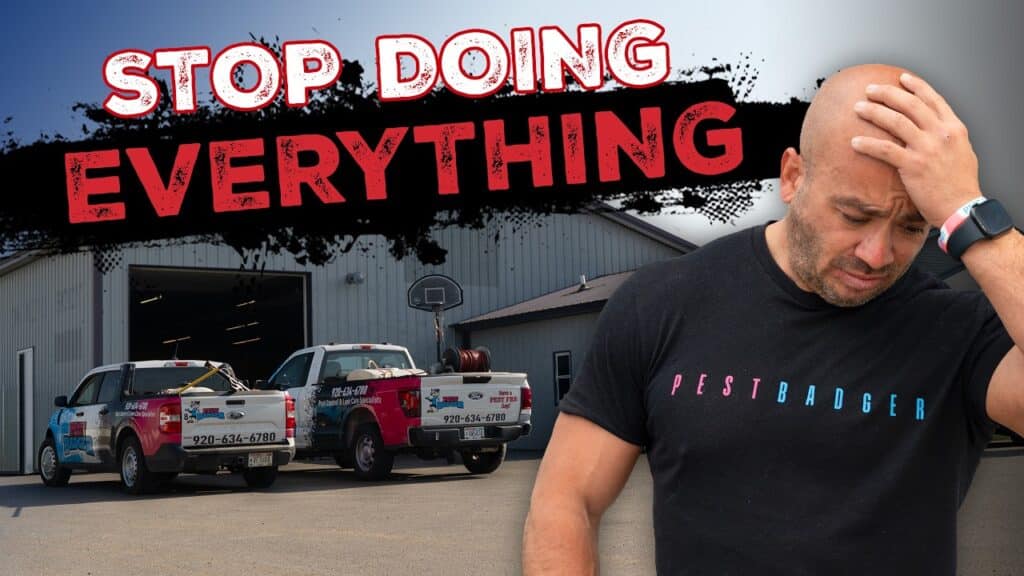
Being busy doesn’t mean you’re being productive. This is a hard lesson I had to learn. You’re literally trying to do everything. You’re doing the routes, the calls, ordering product, doing estimates, handling customer service, posting on social media. But you’re not moving the business forward.
I’m going to keep this very simple. Your business at this size has three things you need to focus on: get customers, serve customers, and keep customers. Everything else is noise. Those three things are signal. The rest is noise. Focus on those three things.
3. If You're the Smartest Person in the Company, Your Growth Is Capped
This is something I had to learn as my leadership developed. John Maxwell has a really good book on this called The Law of the Lid. Basically, your business will never grow beyond your leadership capacity. You’re always the lid. You’re always the ceiling. You’re always the bottleneck.
Every problem needs you. Every decision needs you. Every system relies on you. Your growth is capped by you.
Maxwell says in the book that if you’re a five in leadership, you can never grow someone larger than a three. If you’re a seven, you can never lead someone that’s a five. If you’re a nine, you can never lead someone larger than a seven.
But growth will happen in your company when you hire people who are better than you at specific areas. A salesperson who closes better than you. An ops person who organizes better than you. A manager who leads better than you. A-players raise your lid. You learn from them, and it raises your ceiling.
Growth depends on who you hire. I wish I had known this early on because we all have this ego that we’re better than everyone else. I promise you, find those people who are good at what they do and let them run with it. Your business will explode.
4. What You Tolerate Becomes the Standard
Most problems in small businesses don’t come from bad employees. They come from having no structure at all. If you don’t have clear policies, your team will invent their own. And whatever they invent becomes the new standard.
There’s no handbook, no expectations, and zero accountability. You’re just reacting to problems instead of preventing them from the beginning.
That’s why you always see people in the Facebook groups asking, “What do I do if someone no-calls, no-shows? What do I do if someone breaks equipment? What do I do if techs won’t wear their uniform?” The answer is simple: it’s not written down. It doesn’t exist. You can’t enforce standards you never documented.
A company handbook sounds super boring, especially as entrepreneurs. It is super boring. But it eliminates 90% of the confusion, drama, and gray area in your business. Once it’s written, there’s no arguing, no negotiating, no back and forth. You go back to the handbook, read the policy, point to it. They signed it. They read it. You enforce the policy. Done.
Your handbook should include things like attendance, dress code, vehicle rules, equipment damage, safety, customer service, paid time off, route expectations, and consequences. Reach out to an HR company if you need help getting one set up.
Your handbook is basically your culture in writing. Whatever you tolerate today becomes who you are tomorrow. I promise you, this will fix 90% of your problems when you’re a small business. Even if you’re a million-dollar, two-million-dollar company and you don’t have these in place, you have to get them in place. It’ll save you a lot of headache going forward.
5. You Cannot Outwork a Bad Business Model
This one really hit home this week. I talked to a new business owner who’s been at it for 13 months. Stud of a guy. He’s got about 200 active recurring customers and roughly $450,000 in revenue. I’ll give him some grace since he’s relatively new, but this is a good talking point.
He told me that this year he did 700 one-time jobs. No agreement, no recurring revenue, no route density. He’s just chasing leads.
Let’s do the math. Say he closed 60% of those one-time jobs into an $800 annual recurring contract. That’s 420 new customers and $336,000 in added revenue. Instead of ending the year where he did, he’d probably be sitting around $500,000 to $600,000. And going into 2026, instead of starting back over with 200 customers, he’d have roughly 700 customers that are all recurring. No extra ad spend. No extra marketing. Maybe a little more follow-up. But an additional $300,000-plus in revenue.
The cost of a bad business model could literally be hundreds of thousands, if not millions of dollars. Some owners grind 14 hours a day and still make no money. Not because they’re lazy. I just got done saying this guy is a stud. But because the math just doesn’t work out.
You can’t hustle your way out of a bad business model. The companies that win aren’t necessarily working harder. A lot of them are working hard, but they’re working inside a model that compounds over and over again instead of starting over every single year.
Fix the model, and your hard work will finally pay off. Don’t do one-times. And if you do, make sure they’re less than 30% of your total revenue. Something like 70/30, 80/20, or 90/10. Start this way from day one, and it will save you a lot of time and effort going forward.
6. If You Avoid Hard Conversations, Your Business Will Stay Soft (And So Will You)
Not many people like conflict, but avoiding it is super expensive. This is a skill I had to learn, and a skill I had to teach my partners and the people who work for me.
You have that tech that just needs to go. The customer who needs to go. The prices that need to go up. The expectations that need to be reset. Maybe it’s a vendor you didn’t pay that you need to have a tough conversation with. But I promise you, if you just have the conversation, people will respect you and it will avoid so much chaos on the back end.
The problems won’t disappear. They get bigger. If you talk to anyone in my company, any single person, they’ll tell you I’m the first person to deal with big problems.
And I almost start every conversation the same exact way. It’s very simple. I ask for their permission to have a tough conversation. I’ll just say, “Hey, is it okay if you and I have a tough conversation?” They say yes. One, they gave me permission. Two, they know the tough conversation is coming.
You don’t have to be aggressive. You don’t have to be a jerk. You just have to be super clear. Strong leaders and strong companies face problems early. Most people just starting out in business avoid tough conversations like the plague, but it only gets worse. It only prolongs things. That bad employee you knew was toxic gets worse and worse and things go really bad. Face the conversation today. Ask for permission, then execute.
7. You Don't Need More Leads. You Need Better Follow-Up.
I’m not saying more leads is a bad thing. If you have more leads, you can afford to be worse at sales. I get that. I’m talking about from the very beginning. Most small operators lose 30 to 50% of the leads they’re already paid for, getting in referrals, or people calling in. And it’s not because those leads suck. It’s because their follow-up sucks.
There’s typically no first call. They don’t answer the phone because they’re too busy up in the attic, down in the crawl space, in the basement, doing termite inspections. It goes to voicemail. And in the new day and age, people don’t want to wait. They want their problem solved.
These are usually really good leads. You’re just starting a business or in your first half-million in revenue. A lot of them are referrals. Maybe you started running some Google Ads somewhere along the way. These are really good leads and you’re letting them go to voicemail. You call back and they’re not answering. There’s probably no first call, there’s definitely no second call, there’s definitely no third call. No quote follow-up, no text message, and no automation.
Follow-up is free money. When you learn to automate this, it helps you close deals. The companies that scale aren’t just the ones with the most leads. They also have really good systems in place that make sure phones are getting answered live, automations are running, people are getting followed up with at every single stage of the pipeline to make sure those jobs close.
This will exponentially grow your company. Answer your phone as much as you possibly can. Figure out a VA. Figure out an answering service. Get someone to answer those calls. I promise you, it’s worth it.
8. Cash Is Speed
Most people think cash is about security. It’s really not. Cash is about speed. Cash is about leverage. It gives you options. Cash is the difference between playing offense and playing defense.
Here’s the part nobody talks about: cash helps you hire better people. When you don’t have cash, you hire people you can afford. You hire the cheapest option. You hire people willing to take a low salary. You hire someone who you hope will grow into the job. And seven times out of ten, it just fails.
When you’re desperate and need to hire someone, you’re taking anyone off the street. They don’t do a great job because you’re paying bottom-of-the-barrel people who didn’t have a job to begin with. But when you have cash, you hire based on skill, experience, and your standards.
Cash lets you recruit the people who will move the business forward instead of people who hold it back and take the life out of you. Cash lets you hire that really good manager who fixes all the chaos. That salesperson who closes circles around your other salespeople. That operator who takes all the work off your plate.
When you’re broke, you hire off desperation. When you have money, you hire out of intention. You look for people who have been there and done it, who have a really good background of success, who have actually moved the needle at other companies.
But it goes a layer deeper than that. Cash lets you make decisions from strength instead of fear. When you have no cash, every decision feels risky. You move slow. You say no or “not right now” to almost everything. With cash, you move with confidence. You raise the ad spend. You buy the trucks. You stock inventory. You jump on opportunities before your competitors even know they exist.
And in a black swan event, some companies go out of business. They sell things super cheap. They want to sell because they didn’t save money. It happened with COVID. It happened in ’08 with the market crash. You can get a lot of things at a relatively cheap cost if you just have cash.
A broken truck with no cash is a crisis. A broken truck with cash? You buy a new truck tomorrow and work out the insurance later. If you follow our company closely, you know that happened to us this year. We had enough cash, went and bought a truck the next day, worked out the insurance, got paid a month later. We didn’t have to worry about being down.
Cash is especially important going into the off season. A slow season with lots of cash is a really good strategy because you can hire, train, and prepare. All the bigger companies are doing this. When it’s the “slow season,” they’re getting prepared for a massive spring rush.
Cash shortens the timeline on every goal you have. Cash reduces friction in every part of your company. Less stress, better people, better decisions, faster growth, stronger margins, more control. If you look at most of the larger companies in the industry, they’re charging more than everyone else and paying people better than everyone else. Cash is king. Cash is an accelerator that moves the entire business forward.
9. If You Don't Evolve as a Business Owner, Your Business Won't Either
The person who starts the business cannot be the same person who scales it. The people who get you to a million won’t be the people who get you to ten.
At first, you’re the technician. Then you’re the operator. Then you become the leader. Then you become the builder of leaders. Every new level requires a new skill. If you stay the same, your business stays the same.
If you never want to get better than a technician, you’re never going to be better than a technician. I see this day in and day out. People want to grow. They see that they need growth. But they’re so used to just being the technician that they go out there, do the same thing every single day, and expect new results. That is literally the definition of insanity.
I see it with operators that are 50, 60, 70 years old who say, “I want to grow. I want to push.” But they wake up and do the same thing every single day and expect something different.
You have to start growing. You have to start learning a new skill. That’s all it usually is: a knowledge gap from technician to CEO, just learning new skills as you go. I feel like every 6 months, if you’re not reinventing yourself, the company will stagnate and you will stagnate. If you want your company to grow, you need to grow.
10. Hire People Who Will Push Back on You
As you grow, you need to hire people who are not going to agree with everything you say. You don’t want to hire people you can control. You want to hire people who are willing to push back and set a new standard.
You’re going to find that partner who says, “No, we are not doing that here. We’re going to have a higher standard.” That salesperson who says, “No, you do not handle customers like that. You do not treat them that way.” They demand a new level of integrity. “We’re not doing that here. This is not how we operate at this company.” And they close better. They have high retention.
The ops manager who demands structure, who demands perfection, who insists that every little detail in your business matters.
When you hire people like this and you’re not the smartest person in the room, you grow as a person and as a leader, and ultimately your business grows. Hire people that are better than you in certain specific areas, and who will not agree with everything you say. They’re willing to push back on you. You can push back on them. You can have a disagreement, but at the end of the conversation, you can still remain friends.
That’s what it takes to grow something big, something real, something that goes further than you. Very hard lesson learned for me. Very important for you to learn.
11. Technology Isn't Optional Anymore
I have two stories here. I talked to a company last year, good friend of mine. He had all these issues with routing, billing, you name it. Smaller, newer in business. Told him six months ago, “Dude, stop what you’re doing and just put a CRM in place. It’ll fix all your problems.”
He called me this week. He’s on the phone saying, “Hey man, when do you think is a good time to sell?” I said, “What do you mean? Why would you want to sell? You’ve only been doing this for three years.” He says, “I just can’t handle it anymore. I’ve got this problem and this problem and this problem.” I said, “Cool. We talked six months ago. Did you implement a CRM?” Well, no. I can’t help you.
People say, “Oh, but it costs too much money. It’s $500 a month.” But there’s no routing, no automation, no customer notes, no follow-up. You’re just going out there saying, “I know all my customers. It’s all off memory.” But it’s complete chaos.
I ran my business for three years with no CRM. Back then, there just wasn’t any, or if there were, they were brand new. But I promise you, you’re not saving money. You’re losing money every single day. From the routing alone, you’re losing money having people drive around not clocking into jobs. No automation, no customer notes. You lose one customer because you waited three months to bill them and they got hit with a massive bill? That one customer could have been saved and would have paid for the CRM.
Then I talked to another company doing $5 million in revenue, all on paper. Been doing it the same way for 30 years. I get it, it works. But immediately, if they’re going to sell, that’s the first thing that gets dinged. They’re going to get a smaller valuation on the company just because there’s no CRM in place. Tracking down late payments, getting everyone onto a new system, training all your clients, getting credit cards on file… at $5 million, it’s a lot of work.
Even from the very beginning, pay the $200 or $500 to get started and scale it up. Because at $5 million or even $1 million or $3 million, it’s way harder to transition your customers into a new system.
If you want the majority of your chaos to go away, get a CRM. Chaos doesn’t scale. But if you have good systems in place, they’ll pay for themselves. Better routing, better follow-up, automation, churn tracking, customer history, credit cards, email marketing, text message marketing, clocking in and out, tracking your technicians. I could go on and on. If you’re getting into business, get a CRM from day one.
12. Your Lack of Focus Is Destroying Your Momentum
Trust me, I get this. It’s something I had to learn, something my mentor had to drill into my head over and over again. Entrepreneurs by nature are super ADD. We love the shiny object. We get excited really fast and we get bored even faster. I get it. Showing up to work every single day doing the same boring stuff gets old for us. But extreme focus will change your business forever. And nothing hurts a business more than an owner who can’t focus.
I was one of them. Going back to my first company, winter got slow. We’d be plowing snow, but there would be a week or two where we wouldn’t do anything. So I decided it would be a good idea, because I was bored out of my mind, to start building sprayers. And they were awesome. I could have sold a ton of them. But it was such a huge distraction and a money pit. I probably spent $150,000 that winter and so much time and energy and I never even made my money back. I basically broke even, thankfully, because they were cool and I sold quite a few. But if I had just focused on what I was doing to get ready for spring, I would have been much further ahead and saved 150 grand.
Most businesses don’t fail because of a lack of opportunity. They fail from a lack of focus. Most business owners always want to change everything. They’re constantly adding services, starting new ads, stopping ads, running Google for two weeks and then quitting. They knock doors for 4 days and then stop. They’re adding new services, trying to find the next new thing, constantly changing stuff. And the business never gets to grow organically.
If you just stay ultra-focused for 12 months straight, I promise you it’ll change your business forever. The question is, can you stay locked in while other business owners chase the shiny object?
If you stay locked in for 12 months, your entire life changes forever. If you follow me, you know I stopped drinking. I got ultra-focused on my health and fitness. Got ultra-focused in my business, and the business exploded. Focus is a superpower that most owners don’t use.
These are the 12 brutal truths I wish I had known before I started my business. If you let them sink in, I promise you, you’ll skip years of frustration and save yourself a lot of stress and a lot of money. Let me know which truth hit hardest for you.
Want more tactical moves beyond these 12 truths? Here are 25 pest control business tips and tricks I use across 20 locations.
