How to Get to $10K a Month in Pest Control With Almost No Money

Table of Contents
If you’re trying to get your pest control company to $10,000 a month, I don’t think you should be spending money on marketing yet. I know that sounds backwards. But every week I talk to owners spending money on Facebook ads, Google ads and every other tactic they can find, and most of them skip the things that get you customers for almost nothing.
A few weeks before I made this video in August 2026, a guy who had just started a pest control company reached out to me on social media. He was doing what almost everyone does. His Facebook ads cost way more than he expected, Google wasn’t producing enough calls, and every customer felt super expensive. He was starting to wonder if the business would ever work. So I asked him some questions and told him there are a few things you should do before you spend serious money on marketing. Most of them cost little to nothing, and together they can get you to your first $10,000 a month pretty quickly. Here’s the order I’d do them in.
This video is part of PCO Tips. If you’re starting from zero, read how to start a pest control business first.
Get Found Online for Free
Build a simple website. Build it yourself. With ChatGPT or Claude, you can build almost anything, especially when you’re on a budget. Don’t overcomplicate it. You don’t need a masterpiece. Make sure it loads fast and has a homepage, one page for each service and one page for each city you serve, with a clear phone number and a quote form on every page. Build it for homeowners first and Google second, and make sure AI tools can read it fast. Here’s how to set up a pest control website the right way.
Set up your Google Business Profile before almost everything else. Fill out every field, add every service you offer, your service areas and zip codes, and upload photos. I like to add one or two new photos every week, like every Tuesday, to keep it fresh. Respond to every review. People ask me if AI can write the replies. You can, and at least you’re responding, but I like to make it personal and tell them thank you. Treat your profile like a marketing asset instead of a directory listing, and it will become one of your biggest lead sources.
Claim every free listing you can. Yelp, Nextdoor, the BBB if you want, Apple Maps, Bing Places and Thumbtack, where it makes sense in your market. We have one market that absolutely crushes on Thumbtack. Make a business Facebook page and an Instagram page too. The goal isn’t a hundred leads. When someone finds you or calls your office, they check your social media to make sure you have a pulse. Keep your hours the same on every listing, so when Google and the AI agents look you up, everything matches.
Track Every Lead in a CRM
You need somewhere all of these leads live. Track where every lead comes from, send estimates right away, try to close on the phone, and follow up on every estimate you don’t close. Track the ones you win and lose so you know your close rate. If you aren’t measuring it, you can’t improve it. Tools like GorillaDesk or GoHighLevel can keep your marketing, sales and routing in one place.
A CRM runs a couple hundred dollars a month. I get that it sounds expensive on day one, but it’s really one or two customers a month paying for it. When I started, I ran everything on Google spreadsheets and paper until I couldn’t anymore. Then I found Service Autopilot, and it was the best thing since sliced bread. Since then, I tell everyone you can’t go a single day without a CRM.
Then build automations behind it, because the money is in the follow-up. I still see companies send out a quote that just disappears. Don’t assume someone isn’t interested because they didn’t answer. They’re busy with kids, events and running all over town, and pest control is the last thing on their mind. In a perfect world, you’d have a 21-day follow-up, with a call every day and an email and a text every couple of days. I’ve had people sign up on the 21st day. Follow up until they buy or tell you no. If they say no, fine, check them off and spend your time on the next one.
Answer Every Call
This industry is super slow, so speed wins. The first company to answer the phone usually gets the appointment. Try not to let calls go to voicemail, and when one does, call back within two to three minutes. People are usually calling three to five companies. Wait three minutes, and you’re the second or third one on their list, and if one of the others answered, they probably got the deal.
Answer after hours too. If your listing says you’re open until 5:00 and the phone rings at 7:00, 8:00 or 9:00 at night, answer it. You’re trying to get to your first $10,000 a month, and right now you have more time than money.
Turn Every Service Into Marketing
Once that foundation is in place, every piece of marketing works better. So turn every service into marketing, starting with your truck. Wraps cost thousands of dollars, and you don’t need one yet. A magnetic sign with your company name is still better than a plain white truck, and you can get stickers made for a couple hundred dollars and put them on yourself. Every driveway you pull into and every mile you drive is free advertising. On days you’re not servicing, park it somewhere busy, like a mall parking lot, where people can see it.
Put a yard sign at every service where it makes sense, and leave it for a day or two if the customer is okay with it. Nine times out of 10 they won’t care, and some leave it up for a week or a month. Signs cost almost nothing. A neighbor walks by, sees your sign in five or six or 10 yards on the same street, remembers their own bug problem, takes a picture and calls you after dinner.
Take before and after pictures and videos on every job, from a weedy lawn turning dark green next to the neighbor’s to a wasp nest or a rodent job. Get your techs working and your customers smiling. Use them on your social media and your website now, and in your ads later. You’ll never regret documenting your work.
Ask Every Customer for a Review and a Referral
Reviews build trust before anyone ever talks to you. You’re doing every service yourself right now, so ask every customer. Keep a review link you can text and a QR code on your phone they can scan. Don’t be embarrassed. Everyone asks for reviews now, and you’ll never get what you don’t ask for. Ask five or 10 people a day, and the nerves go away.
Then ask for referrals. They’re probably the best leads you can get, because those people already trust you. Say asking your first customers gets you 25 friends and family to talk to. Close 80% of them, and that’s 20 new customers. Train every tech you hire to ask from day one. We use Clicki to get as many referrals as we can, and here’s how we run our customer referral program.
Knock the Doors Around Every Job
Before you leave the property, leave door hangers on the neighbors’ doors. Keep it simple, like “Hey, we’re just servicing your neighbors.” Give that neighborhood an offer that’s easy to read, like a free inspection because you’re already there, or make a video or a door hanger just for that area. The goal is to build as many customers as you can in one area, so you’re not chasing scattered customers all over town. That route density is the foundation of the company, and if you don’t build it from the start, getting bigger just makes things worse.
Then go talk to people. You have more time than money, and it’s okay if you’re not outgoing. I was nervous too. The hardest door to open is your own. I thought I was going to throw up, but I sold my first door and three or four more that day. Tell people what you’re doing. If they’re not interested, cool, walk away. You don’t have to be great at it right away. You just have to put in the reps. Sales is one of the first things you should learn as the owner, and it will get you your first 25, 50 or 100 customers.
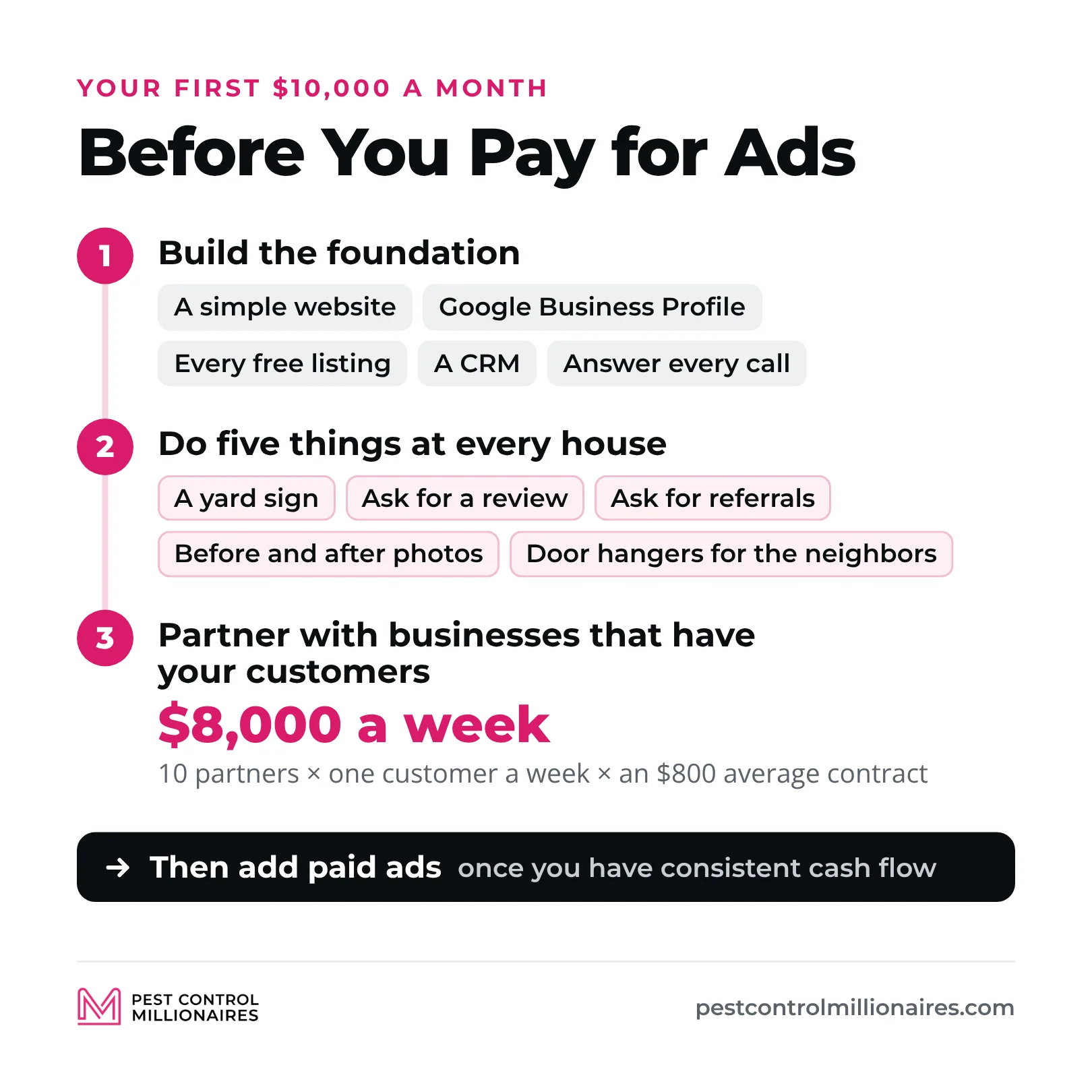
Do these five things at every house, the yard sign, the review, the referral, the photos and the door hangers, and your customers start creating your next customers.
Partner With Businesses That Already Have Your Customers
This one took us years to build, and it’s one of the first things we do in every new market. Ask yourself who already has your ideal customers. Realtors, property managers, lawn care and landscaping companies, house cleaners, pool companies, HVAC companies, roofers, plumbers, wildlife companies, even other pest control companies.
Say 10 good companies each send you one customer a week. That’s 10 customers a week, and at an $800 average contract, that’s $8,000 a week just from referrals.
Don’t walk in asking for referrals, though. Bring them business first, even when you’re just starting out. Ask for their business cards and hand them out with your door hangers. When a customer has an HVAC or pool problem, call the person you met. Then look for pest control companies outside your service area, companies that don’t offer mosquito or wildlife, and owners who are too busy to take more calls, like an older owner getting ready to retire. Offer to pay them for the leads they can’t handle. They still get paid for those calls. Jake walks through how to set these up in strategic partnerships for pest control.
Then Add Paid Ads
Marketing starts with a business that’s easy to find, easy to trust and easy to recommend. What frustrates me is owners who say they’ll do whatever it takes and still lean on Google and Facebook ads instead of doing these things. They’re willing to do whatever it takes, except for whatever it takes. Do the work and you can get to $10,000 a month fast. Like my mentor says, if you go all in for five years, those five years will change the next 50 years of your life. You’re not competing with the other companies. You’re competing with the company you were six months ago.
Once you have consistent cash flow, paid marketing becomes something you plan for and use to speed up growth. Then add it on top of everything else, from every door direct mail and postcards to Google, Local Services Ads, Facebook and TikTok.
Frequently Asked Questions
How do you get pest control customers with no money?
Do the free things first. Build a simple website, set up your Google Business Profile, claim every free listing, track every lead in a CRM and answer every call. Then at every house, leave a yard sign, ask for a review and referrals, take before and after photos and leave door hangers for the neighbors.
Should a new pest control company pay for ads?
Not before you get to about $10,000 a month. Get the free and cheap things working first. Once you have consistent cash flow, paid ads become something you plan for and use to speed up growth.
How long should you follow up on a pest control estimate?
Until they buy or tell you no. In a perfect world, that’s a 21-day follow-up, with a call every day and an email and a text every couple of days. People are busy, and I’ve had people sign up on the 21st day.
What businesses make good referral partners for a pest control company?
Anyone who already serves your ideal customers, like realtors, property managers, lawn care and landscaping companies, house cleaners, pool companies, HVAC companies, roofers, plumbers, wildlife companies and pest control companies that don’t offer what you do. Send them business first.