

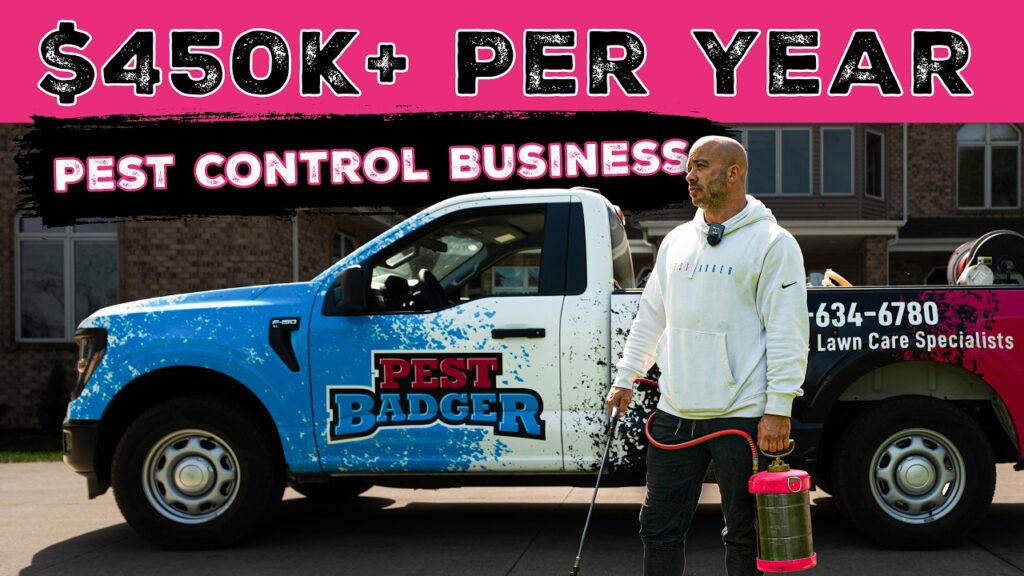
If I lost everything tomorrow and had to start over with $20,000 or less, I would start a pest control business. Some folks call it a pest control business, others Google how to start a exterminator business, but the playbook is identical. Not because it’s super exciting. Not because it looks cool from the outside. But because it works. Starting a pest control business is one of the lowest startup costs of any service business, it runs on a simple model, and it produces recurring revenue from day one. People always need pest control. Through COVID, through market crashes, through every economic cycle you can throw at it, this industry keeps moving, which is why the best time to start a pest control business is right now.
I’m Jonas Olson, founder of Pest Badger. I’ve been in the service industry for 17 years, and over the last five years, I’ve grown a pest control company from one location to 20 locations across six states, going into seven. I use this channel to document how I actually think about building service businesses, and what’s working for us. I wish my mentors had documented their journey, so I’m documenting mine for you.
This is my complete playbook on how to start a pest control business, covering everything from licensing requirements and regulations to equipment, insurance, startup costs, and your first 100 customers. A lot of what I’m covering here comes straight from the framework in my book, Zip Code Kings, where I break down how to dominate local markets one neighborhood at a time. Let’s get into it.
Table of Contents
ToggleWhat It Actually Costs to Start a Pest Control Business
The nice thing about pest control is the entry cost is legitimately low. Pest control business start up costs are some of the lowest in the service industry. If you start lean, you can launch a pest control company for roughly $15,000 to $30,000. And honestly, probably even less. Here’s how much it costs to start a pest control business, broken down piece by piece.
Licensing
To start a pest control business legally, you have to be a licensed operator. Pest control business license requirements and regulations vary by state, so go to your state’s Department of Agriculture website and look up structural pest control licensing exams. This applies whether you want to start a pest control business in Texas, Florida, California, Arizona, Georgia, or anywhere else, since every state writes its own pest control business requirements, license rules, and insurance standards. Registration typically costs anywhere from a hundred to a few hundred dollars for testing and study materials. In some cases, if you have to rent a license, it can run into the thousands. But the licensing piece is straightforward. Just know it’s required before you can start your own pest control business.
Insurance
Insurance is part of the core pest control business requirements, license paperwork, and regulations you have to satisfy before taking on a single customer. You’re going to need general liability insurance and commercial auto insurance. Expect to pay somewhere between $3,000 and $4,000 a year. Not negotiable. Get it done first.
Equipment
Do not go buy the most expensive equipment out of the gate. You can walk into a hardware store and get what you need, and this is where a lot of the pest control business start up costs get blown unnecessarily. A hand-pump backpack sprayer runs about $100. An electric backpack sprayer is around $500 to $600. You do not need a big power sprayer. A lot of people still use them, but I’ve watched that become less common over the last five years, and you definitely don’t need one starting out.
You’ll also want a hand can or one-gallon sprayer ($20 to a few hundred depending on what you buy), a granular spreader ($20 to $30), and a web pole (about $100). For your basic chemical inventory, I’d budget $3,000 to $7,000 combined to get yourself fully operational. Reach out to your local supplier and buy what they have on hand. Start with one gallon at a time to keep it simple.
Vehicles
If you already have a truck or a small van, don’t buy another one. I’ve seen people start their own pest control business and run entire routes on a bike. You don’t even need a truck. But if you do need one, a nice used truck or van will run you $10,000 to $20,000. Get something that looks presentable, not brand new. I had trucks from the 1990s with 250,000 to 300,000 miles on them when I first started. They got the job done.
Software
You need a CRM for scheduling, payments, routing, and customer communication. You need some kind of phone system, which can be as basic as an app on your phone right now. And you need a simple website, not a $10,000 custom build. Something clean that customers can land on and fill out a form. This is one of the first steps to starting a pest control business that pays itself back quickly. You can run ads to it eventually, but just having a presence online for a couple hundred dollars a month is enough to get started.
Office and staff
You do not need an office. I promise you, you do not need an office. That’s the first thing people want to go do when they start a pest control business. I have friends running 70 trucks with no office, no warehouse. This business can be run out of your truck, out of your home garage, just make sure you’re following your state’s regulations around how you store chemicals. And in the beginning, you don’t need any admin staff either. Build it from your truck first.
What 1,000 Customers Is Actually Worth
Let’s talk numbers, because this is what most people miss when they ask how much to start a pest control business and whether it’s worth the effort. The median residential revenue per customer in pest control sits around $418 per year. Personally, I think that number is too low, but it’s what the real data shows. In local markets across the country, most operators are landing between $400 and $500 per customer per year depending on their pricing. For the purposes of this breakdown, I’m going to use $450 per year per customer.
At 200 customers, that’s about $90,000 a year. At 500 customers, that’s $225,000. At 1,000 customers, that’s $450,000. Now double your pricing to $900 per customer, same 1,000 accounts. You just went from $450,000 to $900,000. That’s why pricing matters more than volume.
With 1,000 customers, you’re looking at roughly 250 services per quarter. That’s a heavy load for one truck, but I’ve seen it done with as few as two trucks when the routing is tight. And that’s the key word: tight. You cannot be driving all over town burning windshield time. You need 30, 40, 50 jobs in one neighborhood without moving.
Operating margins in pest control average around 10% at scale, but if you’re a solo operator doing $250,000 to $300,000 with one truck, you can realistically see 25 to 50% margins once things are stabilized. I’ve seen guys doing $300,000 in revenue and taking home $150,000 to $200,000 a year. That’s the kind of outcome that makes this industry worth talking about.
The downside? People get comfortable. You start making $150,000 a year and you stop pushing. You get stuck there for five or ten years living a comfortable life. There’s nothing wrong with that if it’s what you want. But if you want to build something you can eventually sell, you need to keep learning how to grow and get out of the truck as fast as you can.
First Steps to Starting a Pest Control Business: Getting Your First 100 Customers
This is where most people get it wrong when they start a pest control company. They think they need fancy marketing or a big ad budget to get started. You don’t. What you need is effort. If you’ve been wondering how do I start my own pest control business — or how to start your own exterminator business — without a big pest control marketing budget, this section is the answer.
I love the Law of 100 that Alex Hormozi talks about. When you’re starting from zero, you have more time than you have money. Use it. Do 100 conversations a day. Knock 100 doors a day. Put out 100 door hangers a day. Send 100 every-door direct mailers. Send 100 text messages. Send 100 emails. Whatever activity you can do, do 100 of it. Six days a week. Seven if you’re serious.
If you do that for 30 days straight, you’re looking at 2,400 doors knocked, 2,400 mailers, 2,400 door hangers. You will get customers because you’re doing the activity that gets your name in front of people. That’s what wins this business.
When you sell a house, whether it’s a friend, a neighbor, or a stranger who opened the door, go talk to the people around them. Back in the day we called it niner rounds. Two houses to the left, two houses to the right, five across the street. Keep the conversation casual: “Hey, we’re servicing your neighbor Sally today. Since my truck’s already in the area, I can do your first initial service at this price because I’m not driving anywhere new. Saves you money, saves me time.” Simple. No pressure. It works.
Put a yard sign in every single lawn you service. Ask every customer for referrals before you leave, and ask for five, not one. “You were happy with the job, do you have five people I could reach out to?” More often than not, they’ll give you at least one. Sometimes they’ll walk you over to the neighbor’s house themselves.
Track everything in your CRM from day one. I cannot stress this enough. You will thank yourself for it every single day going forward.
When I launched my second location, I went out myself the first day and came home with three accounts. Knocked the doors, sold them, serviced them. Second day, seven accounts. By the second week, I had around 25 active customers and 50 services scheduled. By the end of the month, I had 200 to 300 jobs, all in the same neighborhood. I had built an entire quarterly route in one subdivision without driving all over town, without chasing random leads, without spending a dollar on ads. I just stacked density and kept working the same area over and over.
The Zip Code Kings Approach: Don’t Try to Take the Whole City
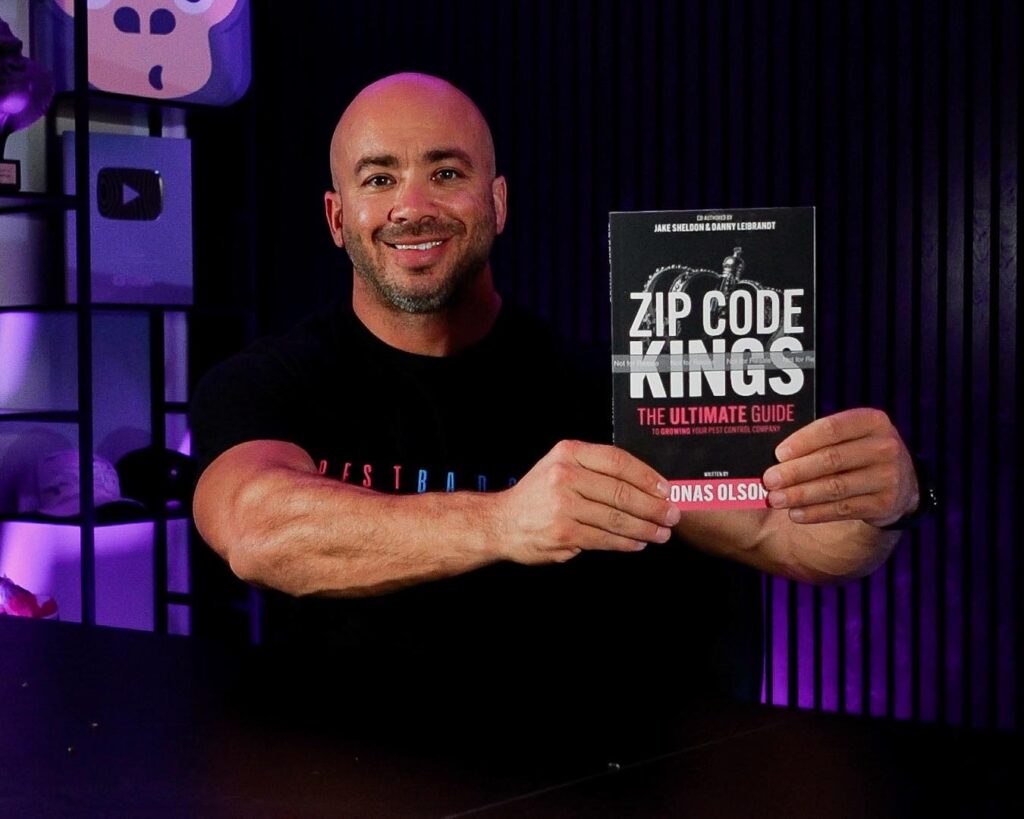
This is the entire premise behind how I teach market domination in Zip Code Kings, and it’s the approach I wish someone had handed me before I started my own pest control business. Pick one neighborhood with a couple hundred houses, not five. Just one, maybe two if they’re close together.
Density reduces drive time. Density increases your visibility because people see your truck everywhere. And when people see you everywhere, they start to trust you before you ever knock on their door. The neighbors talk. The yard signs stack up. You become the company that owns that block, and then that street, and then that subdivision.
We still run this same strategy across 20 locations in seven states, and it’s worked whether we were starting a pest control business in Texas, Florida, Arizona, Georgia, Mississippi, South Carolina, or anywhere in between. It has not changed once. It works, and we’re going to keep doing it until it doesn’t.
What Kills Most New Pest Control Operators
Underpricing
The most common mistake: they Google what competitors charge, find some company that’s been around since 1950 and never raised prices, and decide to come in cheaper. Now you’re the lowest-priced operator in town, driving all over the place, not even making money on the job.
The biggest companies charge the most, have the best equipment, and attract the best employees because they can pay them more. Don’t be the cheapest. Pick your model on day one. If you want to run high volume at lower prices, that works too, but commit to it from the start.
Not collecting payment upfront
I still don’t understand how the service industry ever got comfortable with billing after the fact. You cannot go to a gas station and say “I’ll pay you next month.” Get payment information on file from day one. Card on file before the first service. If they’re not home and they don’t have a card on file, don’t do the job. Call them first. It’s that simple. You cannot grow a business off accounts receivable when you’ve got fuel and product to pay for every week.
Trying to do too many services at once
Pick one or two services and get really good at them. I see new operators doing pest control, rodent exclusion, some light construction, some landscaping, and whatever else someone asks for. You haven’t mastered anything. Stick with one or two, hit a million dollars in revenue, and then you can think about adding on services.
Frequently Asked Questions
How much does it cost to start a pest control business?
Plan on $15K to $40K for a single-truck launch: $5K-$10K for truck, $3K-$8K for equipment, $1K-$3K for licensing, $2K-$5K for initial marketing, and 3 to 6 months of operating cushion. You can start leaner with a rebuilt truck and door-knocking, but underfunded starts kill more pest control companies than bad operations.
What licenses do I need to start a pest control business?
A state pest control operator license (varies by state — Texas SPCS, Florida DACS, California SPCB), business license, EPA/state registrations for chemicals you’ll apply, and general liability insurance ($1M+ minimum). Most states require a certified applicator on staff before you can spray commercially. Check your state’s structural pest control board for specifics.
How long does it take to break even in a pest control business?
12 to 18 months for owner-operators starting from scratch. If you launch with $30K-$50K of recurring revenue from existing relationships or a small route purchase, breakeven hits in 4 to 8 months. The bottleneck isn’t operations — it’s customer acquisition speed and route density.
Should I buy a pest control franchise or start independent?
Independent, in almost every case. Franchise fees (5-8% of revenue) and ongoing royalties dwarf any branding benefit, and you can build stronger local trust as an independent. Franchises make sense only if you want to be told exactly what to do — most operators outgrow that within 18 months. See our acquisition guide for the math on buying versus building.
What is the fastest way to grow a new pest control business?
Door knocking + Google reviews + LSAs. Door knocking gets you cash flow in week one, reviews unlock organic GBP rankings within 90 days, and LSAs deliver inbound leads as soon as you’re Google Guaranteed. Avoid Facebook ads and SEO agencies until you cross $300K — they’re too expensive for the lead quality at startup volume.
Quitting too early
I get messages every day from people saying it’s too hard to get customers when they first start a pest control business, and I hear the same thing from operators starting an exterminator business under that name. And I get it. The first 100 customers are genuinely hard. You’re going to knock a whole street with nobody answering. You’re going to hear no more than you hear yes. You’re going to question yourself for the first 60 days. But the people who win this industry are the ones who are willing to stay in it and endure the pain for 15, 20, 30 years. You can get paid very well the whole time. It just takes longer than most people are willing to wait.
The Simple Summary
Pest control is simple. I never said it was easy. Get licensed. Get insured. Buy only what you need. Don’t overbuild. Don’t spend months on branding before you’ve got a single customer. Don’t try to take an entire city. Pick a neighborhood and execute.
Here’s the recap for how to start a pest control company the right way (the same playbook applies if you’re researching how to start an exterminating business under that name), whether you’re trying to start a pest control business in Texas, California, Florida, or any other state: Get licensed in your state through the Department of Agriculture so you’re operating legally from day one. Get general liability and commercial auto insurance to cover the pest control business requirements, license, and insurance rules in your area. Buy basic equipment and chemical inventory. Get a truck or use what you have. Set up a CRM from day one and get payment info upfront. Pick one or two neighborhoods and run the Law of 100 every single day. Stack density, do niner rounds, put yard signs in every lawn, and ask for referrals from every customer.
Your first 100 accounts should come from pure effort. Call everyone you know. Text everyone. Post on Facebook, LinkedIn, everywhere. Knock doors. Talk to businesses. Make videos on your phone. Layer the awareness until your name is everywhere in that zip code.
Once you hit 100 to 150 customers, then you start adding things like a Google review strategy, local service ads, and targeted Facebook campaigns. Those tools will amplify what you’ve already built. But you have to build the foundation first.
Pest control is not glamorous. It’s not the kind of business that looks impressive at a dinner party. But it’s recurring. It’s stable. It’s recession-proof. And if you’re willing to show up and do the work for long enough, it will pay you very well. If you’ve been on the fence wondering when the best time to start a pest control business is, the honest answer is today.
If I had to start over tomorrow with $20,000, this is exactly how I would start a pest control business.
Once you’re up and running, the next challenge is running the business well. Here are my 25 pest control business tips and tricks that separate the operators who grow from the ones who stay stuck. And while you’re driving between jobs those first few months, fill your windshield time with the best pest control business podcasts. You’ll learn more in a month of listening than most operators learn in a year of trial and error.
