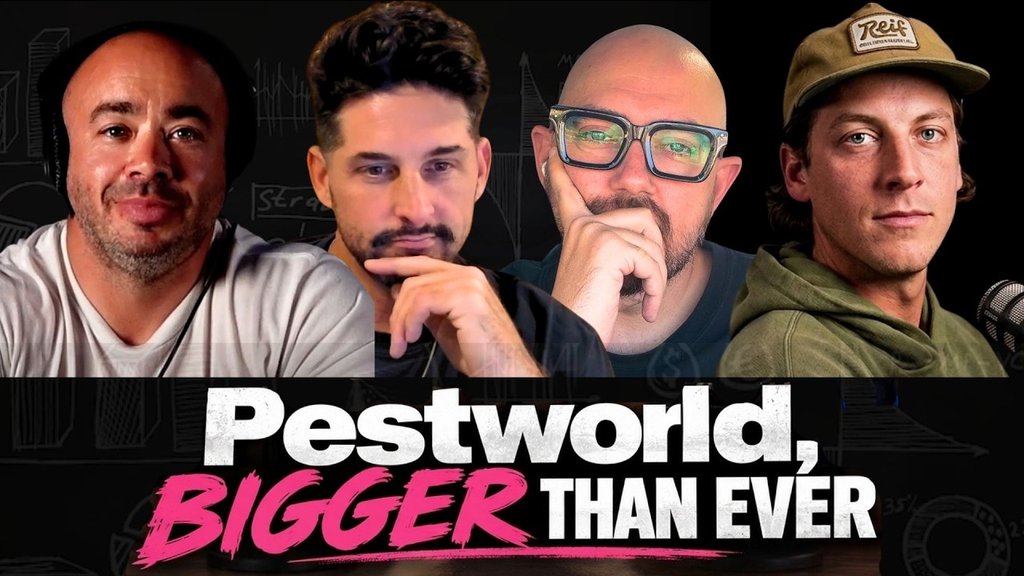
Ben Eastlund and Sullivan Scherber on Running a Pest Control Branch

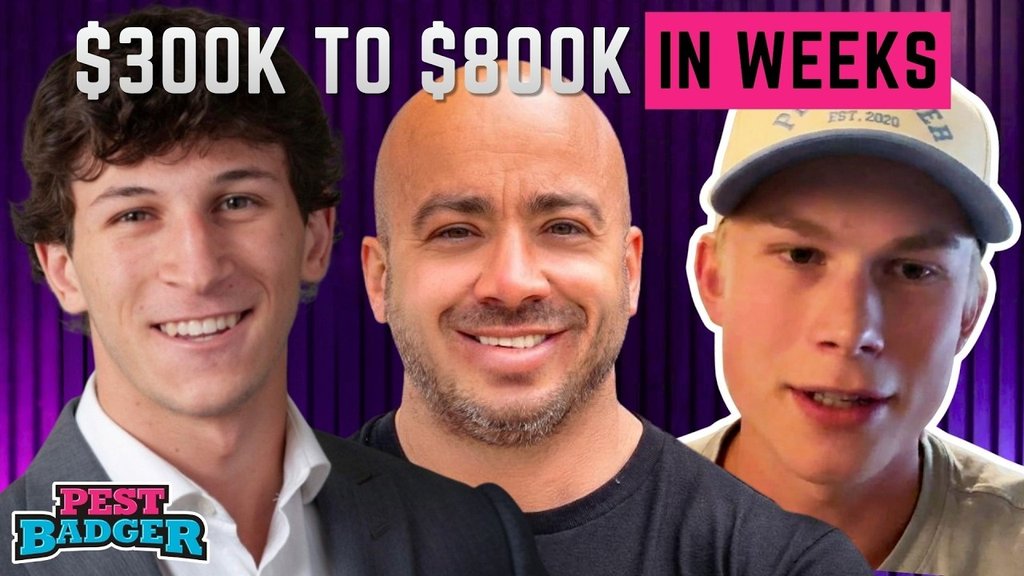
Table of Contents
- Don’t judge a rep by their first summer
- Look at the small deal, and let someone else negotiate
- Learn the operation fast, then make it simpler
- Overhire, and take your time with techs
- Let people go in person
- Trucks will crash, so solve it fast
- Your best reps set the standard
- Give your partners real autonomy
- Frequently Asked Questions
Ben Eastlund and Sullivan “Sully” Scherber own and run Pest Badger’s branch in Minnesota. It’s the branch we built out of Mosquito Crush, a mosquito company doing about $300,000 a year that we bought in April 2025. I walked through that deal on my YouTube channel, and I figured you should hear it from the two guys who lived it every single day.
Both of them came up on our door-to-door sales team, not in operations, and both were 23 when we recorded this in the summer of 2026, in their second summer running the branch. A highlight reel doesn’t teach you much, so we got into the hiccups too. Here’s what stuck with me.
This episode is part of the PCM Podcast. For the numbers behind the deal, read the Mosquito Crush acquisition.
Don’t judge a rep by their first summer
Ben met Pest Badger at a career fair as a college freshman, only because one of his classes made him go. He was the most quiet, reserved kid ever. His first summer, he knocked doors all season and sold about 55 accounts, and I told everyone there was zero chance he was coming back.
He came back a whole different person. In his first week full-time after school let out, he sold about 30 accounts, and he passed his whole first summer in two or three weeks. What kept him around was the team. They had so much fun that he made a lot of friends. The doors built up his social skills, and a semester at a school in Montana, where he didn’t know anyone, pulled him further out of his shell. He did more training, and the learning curve was gone. “I already knew what I had to do at the beginning,” he said.
Every rep has a huge learning curve in year one. If you’d told me Ben would stay past year one, I’d have said no. If you’d told me he’d become one of the best recruiters in the company, I’d have said you were lying. Recruiting is pretty much his full-time job now.
Look at the small deal, and let someone else negotiate
Sully almost never worked here. He heard about Pest Badger from Ben and James on an ice fishing trip, but he was landscaping for his dad and brushed it off. Then he tore his ACL playing flag football, landscaping was out, and he called Ben to ask if the opportunity was still up for grabs. Within a week of being cleared to walk, he was on the team. In his third summer, he and Ben moved to Minnesota.
His dad’s storage units are how we found the deal. At our owners meeting in Arizona in 2025, Sully told me his dad said a pest control company was for sale. It sounded kind of small, and Brian, our CFO, didn’t want to tinker with it either. Then I thought, why not at least look at it, because maybe we can learn something? The cost of goods was around 60%, and they had six vans for what we figured was a couple hundred customers. There were 800-some, and they weren’t charging very much. We were sitting on a gold mine. We had it closed within about three weeks of leaving Arizona, and once we got the data from their software into ours, a company doing about $300,000 a year was about $800,000.
Brian worked the deal and did a great job. I always say don’t negotiate on your own behalf. Have someone negotiate for you, because it’s not their money. If it’s me, I’m like, “Oh, whatever. Sounds good.”
Learn the operation fast, then make it simpler
Ben and Sully came from the door side, and now they had to run an operation. The previous owner spent maybe a few hours with them. Our office helped a ton, but they still had to figure most of it out themselves, fast.
Ben had run a location for about a year and a half, adding a technician here and there as it grew. Here, customers were ready to be serviced the day we closed, and they were building a sales team at the same time. His biggest lesson was how to recruit and train new people at that speed, from zero to someone they felt confident putting in a van on their own. They ran six or seven full-time techs that first summer.
Sully had serviced maybe three days ever, so he took on the equipment, with no walkthrough. There were water tanks, wiring for the water pumps and 18 mosquito foggers. They replaced every pump on the water tanks and switched a lot of them to gravity flow, because there’s less stuff to break. A couple of mechanically handy techs spent rain days in the shop tearing the foggers apart and fixing them.
We ripped off the Band-Aid on the service, too. Customers who were used to getting serviced whenever they wanted now got serviced every 21 to 30 days. Most of them stuck around and got better service. It took a couple of rounds to get dialed in, but now every round looks about the same and nobody is driving back and forth.
Ben and Sully ran a lot of the first services themselves and introduced themselves as the owners, so customers used to orange trucks met the guys in pink face to face. That rapport is another reason the branch worked right off the rip. The old team didn’t last. When you flip a whole business and do everything differently, the odds of them staying are slim to none. I wrote about losing the whole team after the deal.
Overhire, and take your time with techs
I asked them both for their biggest takeaway from year one.
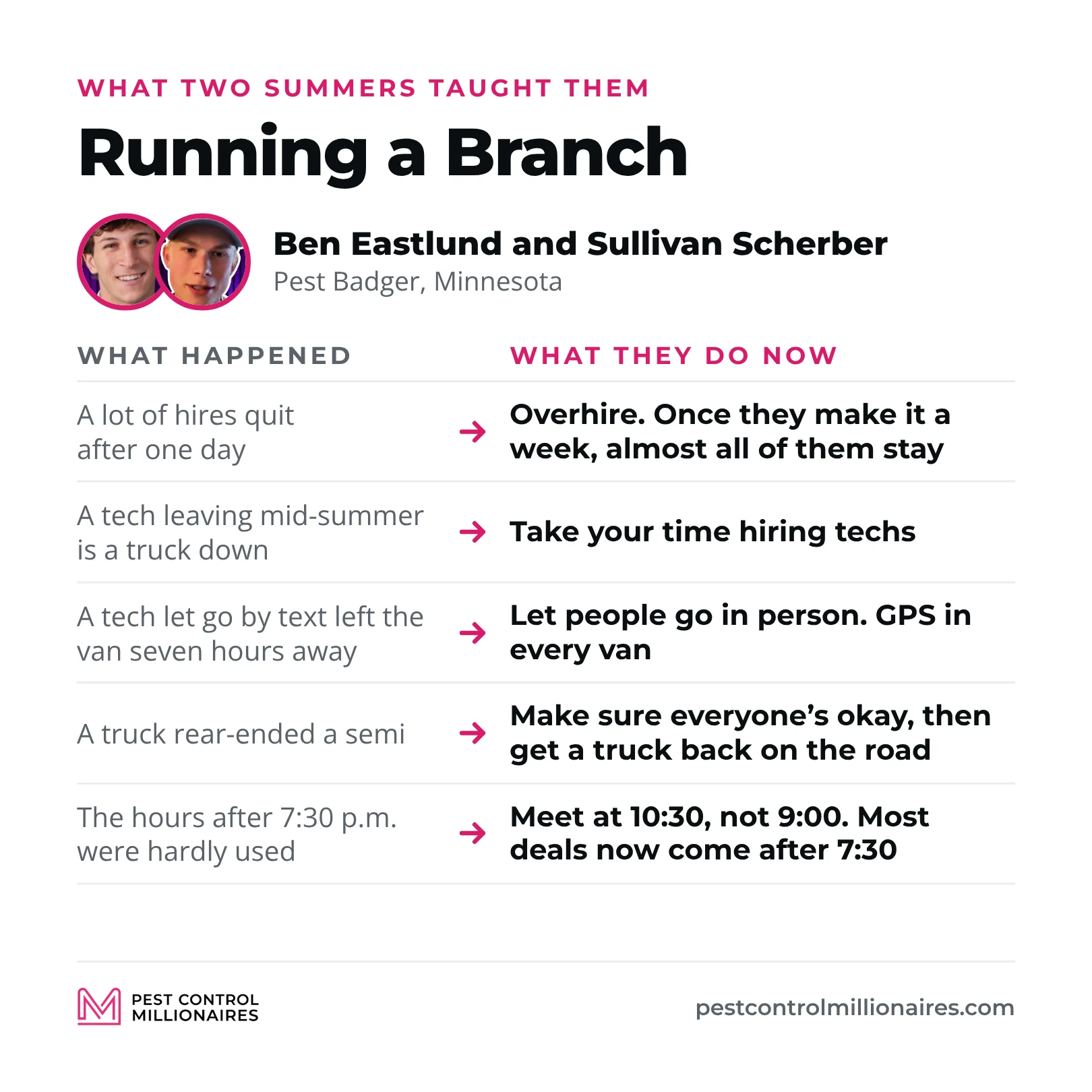
Sully’s was to overhire. A lot of people they hired worked one day and decided it wasn’t for them. Now they staff up on both sales and service and expect people to drop off right away. “Once they make it a week almost all of them stay around,” he said. That’s what got the two of them out of the field, so they could keep the sales team going and the operation running smoothly.
It matches my rule of thumb for a seasonal team. If you hire 50 people, half of them aren’t going to show up, and half are going to quit by the end of summer. That’s just the averages.
Ben’s was to take your time hiring technicians. After the sale, the tech is the only person the customer sees in person, so the tech is your retention. If one falls off or you let one go halfway through the summer, training someone new usually takes one to two weeks, and that’s a truck down.
When good people come back for another summer, it makes a world of difference compared to starting from zero. Take care of them and give them a chance to make good money, and the learning curve is gone.
Let people go in person
Not everything went right. A tech had been a problem for a while. He’d been starting later than expected, and there were customer complaints. After one last straw, Ben decided he couldn’t have him servicing any more jobs. He called him twice, got no answer and sent a text. He didn’t go off on him. It just said this isn’t working, please leave the van at the shop at the end of the night.
The tech called back upset, then agreed. The next day, the van wasn’t at the shop. An hour after Ben found out, the guy texted its location along with a big middle finger. It was just outside Omaha, Nebraska, about a seven-hour drive away. He claimed the mechanic said it was the alternator. As far as Ben could tell, nothing was wrong with it, and everything inside was destroyed. We had it put on a flatbed and sent back. It was our worst van, and it had no GPS. Every van has GPS now.
All the partners jumped on a call afterward and talked it through. Make the decision unemotionally, and do it in person. If you don’t feel comfortable, call the police and have them meet you there, just in case. Have your offboarding paperwork ready, get your shirts and equipment back, and at the very least, you have the van.
The strangest part is that he was the most qualified guy they’d ever hired. They’ve had better luck with people who haven’t worked at other companies yet, because they have no bad habits. You’ve heard me say it a million times. I’d rather hire someone from outside the industry and show them from day one what we expect.
Trucks will crash, so solve it fast
In their first year, one of our trucks rear-ended a semi, and all I got was a picture of the wreck with zero context. With that many trucks on the road, it’s not a matter of if. It’s a matter of when.
Ben was out selling when the tech called. He told him not to worry about it, because they’d deal with everything on the back end. “Let’s just make sure that you’re okay,” he said. The tech came out of it with hardly a scratch. Sully drove to the scene, chased the truck around while it got towed from place to place and climbed a fence to get a picture of it. They’d had that truck less than a month, wrapped and set up. I told him to go buy another vehicle and we’d figure it out with insurance. Within two days, they had a Tacoma out servicing before it was even wrapped.
I’ve been through so many of these that I don’t skip a beat. First, thank God everyone’s okay. Then solve the problem, because we need a truck ASAP. I think they say about 10% of every month is bad days, so two or three in a 30-day month. That’s not terrible. It just happens.
Your best reps set the standard
Year two started with a small sales team that crushed it right off the bat. Two guys they found at the end of the first year set the tone. One placed third or fourth in the state of Minnesota in wrestling, and the other went to sell insurance in Florida, hated it and wanted back in. Both of them work seven days a week, and nobody asks them to. New reps see them and figure that if those two can do it, they can do at least half of what they do.
Everyone wants to hear their pitch, like it’s got to be so good. It’s not about what you say. It’s how you say it. When someone throws up their first objection, you don’t just walk away. Stay in the pocket a little bit longer. That’s what those two are really good at. I broke down the objections reps hear most and how to handle them.
They hired 20 to 25 reps by the end of May and early June and had a crazy June and July. They also moved the morning meeting from 9:00 to 10:30, so everybody stays on the doors until dark. The majority of their deals came in after about 7:30 p.m., an hour of the day they hardly used before. It’s the schedule I walk through in how we run our door-to-door sales team.
With a team that big, Sully took himself off the doors to be the team’s lifeline. He drives reps every day and coaches each one, one-on-one. Then all those accounts have to be serviced, so Ben hired a bunch more techs once June hit, with trucks showing up at 9:30 at night to be ready for a 9 a.m. start. Most people who get into business underestimate how much work it takes. It’s not a nine-to-five.
Give your partners real autonomy
People ask me how much autonomy I give my guys. Full autonomy. It’s their branch. We have guidelines, and I’ll step in to help them solve problems. But they’re entrepreneurs. If I gave them a strict schedule and told them everything to do, they’d tell me where to go, and if I stepped on their toes all the time, they wouldn’t feel like they owned the business at all.
They butt heads here and there, but they agree on pretty much every business decision. Not everyone needs a partner, but a great one makes your life so much easier.
What they’re most excited about is the branch doing a lot more pest control than mosquito control, because pest control is more predictable and you don’t have to hire so many guys for the summer. When I asked how much more they’d learned in two years than in school, the answer was “It’s not even like close.” My mentor says to work your tail off for five years, and it’ll change the next 50 years of your life. Ben and Sully were 23 when we recorded this, way further ahead than I was at that age.
Frequently Asked Questions
Who are Ben Eastlund and Sullivan Scherber?
Ben Eastlund and Sullivan “Sully” Scherber own and run Pest Badger’s branch in Minnesota, which we built out of Mosquito Crush, a mosquito company we bought in April 2025. Both came up on our door-to-door sales team, and both were 23 when we recorded their PCM Podcast episode in the summer of 2026.
How should you let a pest control technician go?
In person, and without emotion. If you don’t feel comfortable, have the police meet you there. Have your offboarding paperwork ready and get your shirts, equipment and van back. Ben and Sully learned that after a tech they let go by text left a van about seven hours away, and now every van has GPS.
How many people should you hire for a seasonal pest control team?
More than you need. My rule of thumb is that if you hire 50 people, half of them aren’t going to show up, and half are going to quit by the end of summer. Sully found that a lot of people drop off right away, but once they make it a week, almost all of them stay.
Why do door-to-door reps start the day at 10:30?
So they can stay on the doors until dark. Ben and Sully moved their morning meeting from 9:00 to 10:30, and the majority of their deals came in after about 7:30 p.m., an hour of the day they hardly used before.
Full transcript
Every word of the episode, from the video captions
Building the business turns you into a different kind of human being.
Realize that failure is a part of the...
I think there's hope out there for all of us. For all of us. They say procrastination [music and singing] be the assassination of destinations. That's why we out here grinded with no association with haters and them other crabs [music] trying to put us down. Pest Badger's in the house. Boy, don't clown. Just keep your eyes on the prize and no giving up. You can do whatever you dream of. Keep your eyes on the prize.
All right, welcome back to another episode of Pest Control Millionaire. Today's going to be a fun one. We've been working on this for a couple weeks. Not all the time do I get to interview and chat with my own guys on the pod, but it's cool. I released two videos on YouTube what, two, three weeks ago, on acquisition that we did. And I figured, well, since we went through those, might as well hear it right from the guys themselves who actually were living every single day with me. So, I get to welcome Sully and Ben to the show. And some of my own guys, which is really cool, you know, like and guys been with me for a couple years now. Ben, it's been three years, dang. So, how long you been here?
Maybe five, four or five, I think, now. A year less than Ben. So, four yeah, thanks for having us on. Appreciate it.
Yeah. Well, welcome to the show, guys. Thanks for being here. Some technical difficulties earlier. So if this podcast doesn't drop on Tuesday to everyone that's listening, I'm sorry that I missed the first week ever. Had a podcast scheduled yesterday, fell through and then today we've been working on this all day trying to get my whatever was going on fixed, but we're fixed. We're back in live. So guys, welcome back to the show. The branch has been wildly successful almost since day one. Had a lot of hiccups in the very beginning like I talked about on the YouTube channel. But real quick, Ben, why don't you just kind of tell every We'll start with Ben. Why don't you just kind of tell everyone how you got here and how Sully got here when he showed up? He was in a Was it I think you were in a cast, weren't you on the first day ever?
Yeah, he's got a funny story, too. Yeah.
You can rip first.
Sounds good. Yeah. So, I met Pest Badger at a career fair as a freshman in college. I had to go to the career fair because my I think one of the classes I was taking forced me to. So walking around with some buddies, met James, and then I think you were there too, Jonas...
Chandler, too. Yeah. So then wrote me down, talked to him for a little bit and then we set up an interview that night I think, right?
Yep. And then had a great conversation for that. James called me a week later. We ended up ended up working out and then I worked for you guys in Appleton. That was like the first year as like a big sales team, right, in Hamilton. Yep. So that was my first summer. It went okay. Wasn't great, honestly.
I gota I gotta tell everyone the story. Okay, so you guys know Ben is like the most quiet, reserved kid ever.
He's I was for sure.
Would never picture him in the door. Super shy kid. Like I even told everyone after the first summer like if I was guessing I'd probably see maybe put on 75 to 100 comments. What was that? Actually, do you remember?
It was I think it was only like 55.
Okay. So, imagine this. You get one knocked doors all year long. You only sold 55 accounts. And I was like I told everyone that summer like there is zero chance Ben comes back. Zero. And then that second year you came back and you came back a whole different person.
Yeah. Yeah. It worked out where so they ended up opening up a location right where I was going to school and then ended up yeah like just worked out because I was going to school. I only had classes like half the half the time and then just wanted to try knocking doors again since like I had extra time and then right off the bat I just started making sales like crazy and then it was like such a new thing to me because I grinded so hard in Appleton to make like the few sales that I did and then it just came like second nature the second year. So that was awesome. So...
What happened on the off season that made you so much more confident come back the second year? Obviously there's a huge learning curve first year, right? Moth you guys know that there's a lot to learn. What happened in that off season? I know you had talked to some guys on the team and came back and I think you started lifting. Talk us through that.
Yep. So I mean the biggest thing that kept me around the first year is just how much fun we had. So like we just had such a like great team and we just were joking around the whole time. So, I just like made a lot of friends. Yep. The following year, like I just like hung out with the house when they were selling, when I was still still going to school. And then, I would say like the big thing that helped me is like knocking doors the first year. Definitely helps with your social skills. Like I was a very Yeah, like you said, like a very conservative guy coming out of high school. That helped the first year. And then I went to school to in Montana for a semester where I didn't know anyone. That helped me get out of my shell a little bit too, just like having to make all new friends and all that good stuff. And then coming back, yeah, the following year, I did some trip more training and then I think it's just like yeah, there's no no more learning curve. I already knew what I had to do at the beginning.
When did you had your your 55 accounts passed in like was like two weeks or week and a half or something. Wasn't it crazy fast?
Yes. Yeah, it was crazy. Yeah, I remember going up. That was like the first two or three weeks you did in the whole whole season of last the first...
Yeah. Yeah. I couldn't believe it either. I was just waiting for I think I had like the first week that I was full-time once school got got over with I think I had like 30 accounts which was crazy for me. Yeah. So, I just kept thinking that like something was going to happen where I was just going to go back to how I was making sales the first year. I thought something was I was I was just on a high for whatever reason. And at some point it was going to stop so I had to keep keep riding it as long as I could.
That's awesome. All right, we'll we'll jump over to Sully. We'll come back to you. Sounds thank you.
Welcome to the show, my friend. Sitting in your Raptor out in Minnesota...
Where? Iowa, Minnesota, somewhere. Somewhere out there on the west side.
Just on the side of 94 here in Minnesota. But yeah, so I got introduced to Pest Badger through Ben and James through like an ice fishing trip that winter. I didn't know Ben and I didn't know James or I mean obviously I knew Ben, but I didn't know James and Chandler at all. And throughout like the ice fishing trip, James kept like telling me about this door too pest control thing that Ben had been doing and how Ben was going to make a ton of money and I was landscaping for my dad at that point. So, I kind of just push brushed it off. I was like, you know, telling him maybe, but most like in my head I was like, "Yeah, I'm not doing that." And then fast forward to the springtime, I tore my ACL playing flag football and obviously landscaping was out of the picture for me because I was in like a full leg brace cast thing for a lot of the summer.
So I called Ben up and I was like, "Hey, is the opportunity still up like for grabs?" And so the like after they cleared me to walk on my knee, within a week I was out there and by the time I got there, there was already a big team of guys going. There's probably like 10 people. You were there. The first day I ever worked was at that team barbecue. And so after that, we moved when Ben opened up his location. I went down to La Crosse and managed that team for my second summer. And then summer number three came and that's when we moved over to...
Yeah. Pretty wild how that all happened. Like again it took craziest things for the stars to line, right? Like you had no intentions of coming to work here. Tore your ACL and then you go work for dad. Your dad runs successful landscape company and you're like, "Oh no, I can't do landscaping." So they're like, "Okay, well I'm just gonna go back to talk about this door to door thing." And then now you are here running successful branch for us. So just crazy how the stars like had to align, right? And then we were all out in we'll get back to Ben in a little bit, but we'll fast forward a little bit to Arizona of last year. So we talked about this on my YouTube channel about how we were all just kind of we had our owners meeting out there. We, you know, rented cars. We went had a good time out there. Got a big Airbnb we all stay at and a lot of things happen. You know, we just get a lot of breakthroughs, a lot worked through a lot of challenges, going through what next year is going to look like, some changes that we're going to make.
And Sully, you your dad has storage units obviously and you brought up to me, you're like, "Hey, my dad said there's this pest control company that's for sale." And so I just started asking you some questions and you're like, "Tell me how big they are." I'm like, "Ah, I just don't know. It's kind of small. Like not super interested." I don't know if you guys I clearly remember like where were we sitting at the table and everything. I was like I just I don't really know and I brought up to Brian and Brian's like ah it's kind of small. I don't really want to tinker with it. Then I sat there and thought about it more and we talked about a little bit more. I'm like well you know what why don't we just at least look at it because maybe we can learn something. So we I think I think like two weeks later two and a half weeks later we end up closing on the thing.
And working through that process with the owner, we noticed a lot of words this carefully, not some great things that were going on, but also there was a pile of customers we weren't expecting either. I know between all of us, we were like, ah, it's probably got a couple hundred customers. They had like seven trucks or six vans. Like, why in the hell do they have so many trucks? And so, broke down the P&L and looked at the cogs and their cogs are like 60%. Like what in the heck is going on here? So I started asking some questions with Tyler and I was asking him the guy that we bought it from and he's telling me how they ran their operation. Couple people were truck how many stops a day they were doing. They had like 8 to 10 stops per day. They weren't charging very much money but there was like 800 some plus customers. I was like dang like I told Brian I told you guys like I actually were sitting a gold mine And so, you know, Brian ended up working the deal.
You know, I always say that don't negotiate on your own behalf. Have some negotiate for you because you'll they'll negotiate better because it's not their money, right? Where I'm just like, "Oh, whatever. Sounds good." Well, they negotiate on negotiate on on your behalf. And Brian did a great job of working out that deal. And fast forward to 2026, you know, that guy was running a construction company, had a lot of things going on. I think that he was just kind of taking money out of a pest control company to feed into this construction company that's doing like a couple like three or$5 million a year. And I was like after talking to him on the phone, I was like, man, that thing sounds pretty messy, too. Like I think I told you guys that like that just doesn't sound good. Like something something there's a lot of things that were off in my brain.
So I just didn't think he had bought the company from someone else. It was like a marketing, right? You guys said he was like a marketing professor. Didn't you guys say that? The guy who started it. Yeah. He had done marketing for a long time for Fortune 500 company. I don't remember which one exactly. But he ended up retiring with his full benefits and he was basically just bored and so this seemed like an easy enough business to get into and...
Yeah and like I said from the very beginning like I think that he had a great brand. I think what they were doing is really cool. The company was Mosquito Crush. They had the orange vans wrapped like the orange crush. Every time they get a new customer, they put like a six-pack of crush like orange crush on the doorstep. I thought the whole concept was really cool. [snorts] Hold up. Quick pause. If you're on a pest control company or fertilization weed control company, you're not in our Facebook group. You're choosing the harder path. Every operator that's in there is skipping years of mistakes because people are actually sharing what's working right now. So stop trying to brute force your way through growth alone. Search Pest Control Millionaires on Facebook or click the link below. And now let's get back to it. So anyway, so Tyler ended up buying from this guy and then Tyler just had never ran a you know service based business before. So I don't I don't think that he knew exactly what he was doing. Nothing against himself.
He was had a couple companies going on. But anyway, fast forward to 2026. That company ended up going bankrupt. So then everything just kind of happened for the right reason. We had we helped him out. Got him him out of some of his own debt. It ended up working out in our favor. Like I went through the whole series on my YouTube channel of just how it went from like overnight like as you guys know like we had to pull all the data by hand and to our system and there was a lot of work that went into the background just to get it from his software into our software because it weren't transferred. And then they had added our, you know, our packages in there. But it went from like zero to I should say zero because it said like 300,000. I think there's like 320,000 they were doing revenue like $800,000. We're all like, "Holy man."
Yeah. This is...
I remember that.
Like over literally, you know, I'd say overnight, but it wasn't actually overnight. It was like a couple weeks before the data put in there. We're like, "Holy man, this is way I shouldn't say way bigger than what we expected because if you guys remember me talking like I think that we're going to fall right in this ballpark." I was like, "I'm thinking between like 750 or 700,000 to 800,000 somewhere right in there." And then got rid, you know, did some churn obviously once we start up in the spring. I don't want to get too far ahead of myself, but it ended up being like $800,000 revenue that we got, you know, for we paid for $300,000 company, which is really cool. So, ended up being a really big win, but you guys were the ones out there having to live it every single day. And it was a heavy lift, right?
You guys were came from the from the door side having to manage the operations, right?
You guys had to learn the operations real fast. I think the owner Tyler came to work with you guys like a day, maybe days. I can't remember. And then he had...
Yeah. Okay. A few hours, right? But we pretty much knew what to do. You guys had seen the service before, been around for a couple years, so you guys knew what to do. We had a big, you know, we had a lot of help from the office side to help you guys out, too. So it's not like you guys were left out there to hang, but you kind of left out there hanging. You still got to figure it out on yourself. You guys have to be quick on your feet, right? You got to learn real fast. But yeah, so then they had like I think they had like three or at one point they had like 12 or 15 guys, six trucks. It was like way over staff like we don't need that obviously. Trim the fat, come back the next year. Then I think they brought like what three or four guys initially. What was do you guys remember?
We had one like one like kind of like a manager that was that came back from the following year but she didn't start until like June. And then we had a guy that was that came from him that worked previously but only worked for like a month. That was it.
Yeah. So they so basically they brought over some people which you know even their manager she didn't stick around very long cuz again we pretty much flipped the whole business. We turned the whole thing around real fast, right? Did everything different. And so to expect them to like come in here and like work the system the way you want to work it. They're so used to doing it all the way and then like the odds of them ever staying are very slim to none in my opinion. I think even if you have a big team, you're probably going to lose half. Again, they're used to working with her, used to working with the owner. We just do things completely The best pest control companies do not leave growth to chance. They build systems. They have a system for generating leads, systems for answering the phone, system for servicing the customer, and systems for collecting payments. But most companies still treat referrals like luck. They do a great job. Hope the customer remembers or tell a friend and maybe send an occasional text asking for a referral.
That is not a system. Clicki Referrals turns your happiest customers into active trackable sales channel for your business. Clicki automatically invites customers into your referral program, gives each person their own referral link, tracks the leads and sales they generate, and makes it easy to reward them when those referrals turn into business. And now Clicki has launched Rewards Pass. Rewards Pass was a brand referral pass for your company directly inside your customer's Apple Wallet or Google Wallet. Think about that. Your brand can live on your customer's phone alongside their cards, tickets, and branded they already use every day. Their personal referral link is always one swipe away. You send push notifications and add special offers, promote events, and stay connected long after the initial service is complete. This is not another app your customers have to download or another login they have to remember. It's your company, your referral program in your rewards living directly inside their wallet. If you want more referrals, stronger customer retention, and a customer experience your competitors probably do not have yet, go to joinclicki.com/pcm.
Book a live demo of Rewards Pass to get $350 in payout credits. Tell them you heard about it on Pest Control Millionaire. That is joinclicki.com/pcm. Stop having your customers send referrals. Build a system that makes it happen. What was it like in the trenches for you guys?
Yeah, good question. I mean, I came in with some operations understanding just with cuz I did or I guess my location for like a year and a half. But obviously this was a big scale up from [clears throat] that. We had like a great team and but it was much more slower. So you kind of learn learn as you go as you grow. You just add a technician here and there. But with this Yeah. So we bought the company and we like closed on it. Was it like mid April or end of April?
Yeah, I think so. It was like after I think after we left Arizona, it was like two and a half, three weeks. We had that thing closed already.
Right. Yeah. So like Yeah. Right when we bought it was like Yeah, we got I remember we were talking to Tyler and he's like, "Yeah, we got customers. You guys can service right now if you guys want. Like they're they're ready to go. So that was it was great. It was definitely great. We had a sales team that we're trying to build up and keep going to at the same time. So want to make sure those jobs are still getting serviced on top of all these new mosquito like contracts that we got to make sure are getting getting serviced. So I would say the biggest thing that I learned is just how to recruit and train. Cuz obviously I did that and but yeah much much bigger scale here and just like how quick we had to do it and run the sales team at the same time.
So that was the biggest I guess tough thing for me for running both sides just getting people going and training people from zero to like good to go and we feel confident them being in a van on their own. So we had we had what do we have full-time? I think we had like six or seven techs that year last year. And yeah, we lucked out with some really good guys that really love to work. So that was super helpful.
Yeah. I wouldn't say you guys got lucky because you guys did a lot of recruiting. You guys went through quite obviously a lot of people. We went through quite a few people that but you went through some people, not say quite a few,...
We did. But you still got to go through the, you know, some of the crap to find the really good ones, too. And those good ones like, oh dang, they're just they're a game changer, you know?
Exactly. Yeah. Yeah. And then especially with mosquito, it's so seasonal where like it's a lot of younger people and then kids got sports and they got family trips and then you just got like all this stuff to like schedule around and make sure that you're still keeping up with mosquitoes too. And then also that year was crazy for rain for some reason. It was just like insane for rain. It was like I swear like rain for an entire week. So that was really tricky to get ahead of too. But customers are understanding on that side of things. But also with switching over to pass battery, it's just a big change.
Yeah, because again they're used to seeing their orange trucks, now they're seeing pink trucks, seeing guys in pink. And I know you guys did like a lot of the fur services. You went there talk with customers yourself. Which which we had talked through a lot like I think this is the best strategy going forward. Go introduce yourself as the owners, get the you know, build a lot of rapport with the customers. You guys did a great job the whole first round handling that. So again, another reason why that branch was so successful right off the rip too, you know. So a lot of things that you guys did that we planned in the background, but you guys you guys had to go pull off, but you guys did a great job.
Yeah, that was cool.
Like what was it like coming from your...
For me, it was very different because I obviously came in with like little to no servicing experience. I maybe serviced like three days ever as a sales guy. I've never even like hardly sprayed a house. So, one of the things that I worked a lot on was like all the equipment and trying to figure out all these trucks cuz there was not really a walk through like on how to use like any of the equipment. To basically just like unlock the truck and then but like the water tanks and the wiring systems for the water pumps and all these mosquito foggers like...
There was not a shortage in supply of mosquito fogger.
No, there was 18 total I think...
There there is a mosquito foggers per day. It's like what the hell do they like they spend a lot of money? They didn't need to.
Yeah. And so trying to like reverse engineer how these water tanks and pumps work. And we had a lot of struggles right away because I don't know if they weren't blown out or what, but basically had to replace all the pumps on the water tanks and switched swapped a lot of them out for gravity flow, which made our lives a lot easier cuz less stuff to break. But then we were able to luck out with a couple of really good technicians who were very mechanically handy. Preston and Andy helped us out a lot with when their mosquito foggers were down, they would just go in the shop on a rain day and just start working on them, tearing them apart, fixing them back up. And so that was like a huge help for us too because I don't have that kind of background...
Right? And so like the listeners have to remember like these guys the customers are used to getting pre like service whenever basically they wanted to and we're like nope we're ripping off the bandit. They're just going to get service every 21 to 30 days like we're roll it out. Whoever cancelled just kind of cancelled that's going to be our customer anyway. And again majority of them stuck around. They got better service you know like there's a lot of things. They never had credit cards and filed. So there's a lot of stuff that we had to do in the background to make this all work. And not not that everything went perfect in that no one canceled that we got everyone's credit card. I'm just saying like we did a very very good job. Yes, it took couple rounds, everything dialed in, but again like now everything everything is just way more simplified, right? Like you're not driving back and forth and every round is not completely different. Everything's just seamless throughout the entire thing for the most part. Again, hookups like I think of one I got some really good idea things to talk about.
Was it last year? I think it was last year. I post on social media too about the picture of when one of our vehicles rear ended a semi.
All a sudden I get a picture I think it was from Ben. The truck's total like wrecked with zero context behind it.
Just a picture of the truck. I'm like oh waiting finally made. But that's just that's just it's not a matter of if, right? It's just a matter of when. When you have that many trucks on the road, people are still going to be people. Yes, there was our fault. Yes, there were watching like I think texting and driving or maybe they're looking at their maps. I'm not sure. Rear ended a semi, you know, and the guy said rear ended the back end of the trailer of the semi. And then the guy claimed that he got hurt. But besides the point, there's just there's things like that that we can't control. People are still be people. But walk us through, walk me through that day.
We were selling. Yeah, we were selling with the sales team that day and then Yeah, I just get a call from the technician and I think it just happened. So, he sounded rough obviously right off the bat and I already knew something was happen right when he like says like, "Hey, Ben." And, like I was just like, "Hey, like don't worry about it." after you like explained everything, I was like, "Hey, just like focus on like getting better. Like we'll we'll deal with everything on the back end. Like don't worry about it. Let's just make sure that you're okay." So, and then he like he handed the phone over to like a police guy and then I just talked to him. But definitely definitely crazy. That was the first experience I've had with like a big crash and I'm sure Sully too. But yeah, it's just like what do you do? Like we had already went through so much that spring just like so much stress with giving making sure everything's just like we're trying to keep on top of like getting this mosquitoes done as quick as possible and just like everything else with people dropping off and adding new people and all that stuff.
It's just like constant stress. It's like okay what else can happen this year? Like it's everything that can happen is going to happen this year. So, it wasn't even a huge a huge surprise. Like, with that many vehicles on the road, something's going to happen at some point. But, we were just happy that yeah, he was he was okay. And no really injuries whatsoever, which was crazy and...
Hard to believe that he never like he came out with like almost nothing wrong, not a scratch.
Super lucky. Yeah, that truck was crazy. But, yeah, so that was a blessing there. But yeah, you just got to move on and go to the next thing. Otherwise, I mean, what else can you do?
Yeah. And it's like it's not like we were down a truck for very long. I think within like a week or a couple days, we already had a new truck bought, rewrapped, and sent back. So, we weren't down for very long. We got extra vehicles. That's just kind of nice when you get to a point where it's like if you know, if you only have one truck and that's all you have and you go to your truck, then it's a problem. You know, like we're past that point. We can get a truck within a couple days, get a wrap, get servicing again. So, it's nice to be on that point. So, what was like coming from your standpoint?
Yeah, I was I had just dropped off our sales guys, like not the people who were riding with me. And so, it was Ben was the one who told me and obviously I had a bunch of questions and neither of us really knew the answers to it right away. We were just like there was we didn't get a picture of the truck. Like the picture of the truck that got sent to you is from like after they towed it off the scene. And so I was like trying to track down I called the sales guys and kind of let them know they were going to be riding with someone else. I tried to go drove to the scene. It was all cleaned up by the time I got there. And so then I was chasing the truck all around because they were towing it to different places. And by the time I got it, that picture I sent you, they wouldn't let me see it. And so I like climbed up on the fence with my phone and took that picture like over the fence because it's all like blocked off. I didn't have the title or whatever on me.
But yeah, that was immediately like a little tough because we had picked out that truck and it was we just got it wrapped all set up. It was perfect. It was...
Yeah. You had the topper put on. You had the You had the tube put on the top. Like everything was set, ready to go. The side like everything was set up ready to go. And then all a sudden you had it not very long. How long you had for?
Less than a month.
Yeah. Less than a month.
Yeah. And so then after that happened, I think I called you and you were just like, I mean, just go buy another vehicle. Like we'll figure it out with the insurance. But it was definitely totaled. So within the next two days, we had a Tacoma again and we were it was out servicing before we even got it wrapped. It was just go.
I've been through so many of these things like it's just again it's it I don't skip a beat like and that's why I you guys like talk to you guys a lot about the things. It's like you know it's like things happen you know every single day like you guys said you guys went through your entire first year. So much stuff happened and it's been that way for 17 years of my life. So is like, okay, it just happened again. And these guys, you guys have already have it. They just learn to solve problem super fast. It's like, okay, well, yes, thank God everyone's okay. It's the first thing we're going to address. Make sure everyone's okay. Then from there, it's like, okay, now we got to solve this problem. We need truck ASAP. What can we do to solve it? But you guys just have to focus on it. You guys did a great job. Guess talked you through a lot of those things, but again, you guys did the majority of this stuff on your own, which is cool.
What was a big takeaway from that first year for both of you guys? Sully, you can go first.
I would say one big change that me and Ben made was overhiring and just expecting that there was there was so many people that we hired, they worked a day and there was just like, yeah, this isn't for me. And so making sure that we had the staff hired both on the sales and the service side and just expected that people are going to drop off right away and once they make it a week almost all of them stay around. And so, that really helped me and Ben out this year because it allowed us to not be in the field servicing as much and we could focus more on the things that were important like keeping the sales team going and making sure everything is like moving smoothly on the operations side. That would have been really hard if me and Ben were still servicing houses to do that at the same time.
For sure. Ben, what's the big takeaway from your one for you? Yeah, I mean I would say a big thing mainly on the recruiting side of things too is just really taking your time, especially on the technician side of things is like making sure that's the right fit because obviously after you make the sale, the technician is really the only point of contact in person with that customer going forward. So, they're so important on that side of things for retention and then also yeah, just keeping the customer happy and then also just like making my life easier. If I get the right technician to start, then it's just like makes that summer so much easier rather than to have to if they fall off or you end up having to let them go halfway through the summer, then you got to train someone up. And usually it takes two to one to two weeks. Maybe more if it if you need more time and then that's a truck down, too. So, just got to really make sure you're making those hires smartly,...
Which we don't have to talk about for too long, but and your role has obviously changed, over the last few years, right?
You basically become a full-time recruiter for a Pest Badger. This is pretty much your life as recruiting.
You guys would have told me that again that one, Ben is going to stay here past year one. I have said no. And then tell me that he's be one of the best recruiters in the company. I'd tell you, yeah, you're lying. Can recruit. I don't know why because you're fantastic at it. You do a great job and I appreciate all that you do for us at Pest Badger. Let's let's so year one is like was chaos, right? A lot of great things that happen, some bad things that happen. That's just business in general. I think they say like 10% of your of each month is you're going to have bad days. So if you know 30 days, you're gonna have two to three bad days. That's not terrible, but it happens, right? But it's a it was a massive upswing. Like you guys knocked out of the park. Which brings us to year two, end almost end of year one. I think you're you guys brought in a couple sales guys the end of last year that really really started to change the business over there as a whole.
And so then they found some young guys that were hungry. They went off in the winter. They did some things. Was one I think placed third or fourth in the state Minnesota in wrestling. Sully was a wrestler and then another guy went and did insurance down in Florida and he's like I hate this really want to get back in the pest control game. Came back and brings us back to year two and you guys started off swinging.
Yeah. Yeah. We had a really small team but they absolutely crushed it right off the bat. We hired I think it was it was a big team that we hired like probably 20 25 guys to start like once it came end of May early June for sales team. But obviously like Sully said just make sure you overhire because you never know what's going to happen.
I always said that like if you if you hire 50 people half of them aren't going to show up and they're half going to quit by the end of summer. That's just the averages. Do we want to be better than averages? Of course, but that's just rule of thumb...
For sure. Like you get your face kicked in and every single day, but then you find those few guys that show what's possible, right? And they can they can turn the whole team around.
Absolutely. Yeah. So, they kind of set the tone like at the beginning of the year and we've just kept kept that they've just kept that going throughout the entire year going forward. So, yeah, we were crushing it with the small team. And then once all the college guys and like high school guys ended up coming in, starting full-time with us. We just really really hit the ground running in June and had a had a crazy June. And we've continued that through the rest of the summer.
Crazy July. I'm sure you have a crazy...
Yeah. Which it's been a great thing all together. What's we talked about this real quick because it seems like everyone just talks about great things that happen in life. So we'll talk about some bad too, right? And so this year we had a guy that I think is a great learning experience for both of you. We had we had a long conversation about this at night after the fact, but you guys had to let someone go and it was not in person. It was I think it was via text message.
Well, I tried to call him, but he didn't oh, yeah.
Yeah, tell us the story.
Yeah, so he had just been a little bit of like an issue with starting a little bit later than expected and had some customer complaints and just like a whole bunch of stuff that just ended up being like, okay, we got to make a decision to let this guy go. And like biggest learning experience for me is just make sure that when you make these decisions as far as letting someone go, it's got to be unemotional and you got to make sure that you do it the right way obviously. So there was just like one last straw. I was like, "Okay, I can't have this guy servicing any more jobs going forward." So tried calling him twice to answer and then I just yeah, I just sent him like a message. It was not like I didn't go off on him or at all. I was just like, "Hey, this isn't working.
Please leave the van at the shop at the end of the night or something like that." And that didn't happen. So, he didn't see my text. I don't know exactly pulled back up, but basically he responded like I think he called me back later. He was like all upset and then he's like and then he agreed with me. He was like, "Yeah, I'll just leave the van at the at the shop." And then I had a bunch going on like the next day. Wasn't really thinking about it whatsoever. I was like, "Okay, just like he's out of my mind. Don't have to think about him anymore." It was just like a huge stressor just off my shoulders. And then...
Is there GPS in that van at that time? In that van or no?
No, that was like our worst van. So like Yeah. But we got to have it in all our vans going forward. That's why we did that after that. But and then we I think I talked to Sully and then the following day like I asked him was like, "Hey, I just was just like thought about I was like, "Hey, is that Van at the shop?" And he's like, "No, I didn't see it." I was like, "Yikes." And then he like a hour after that, he texted me like a location of where it was and basically FU to us and texted us location where the van was. I look at the location. And it was right right outside Omaha, Nebraska, which is like a 7-hour drive from us. So, basically, he just I don't know what happened or where he went after that. I know he was from Texas and I don't know if he was trying to drive all the way down there and realized we were going to I don't know, like send the police after him if he took it any farther, but...
But then what'd he say? Like something was wrong with the van, right? Is what he said. Yeah, he said the alternator like said something about he's going to leave it here. The mechanic says it's the alternator.
Good luck.
And what did it end up being? It wasn't an alternator. Something super easy,...
No, there was nothing. Yeah, there was I don't even think there was anything wrong with it. I think this put on say...
And then he destroyed everything inside the van as one more middle finger to us.
You put it inside, put on a flatbed and got it sent back. You know, this is what we did. And again, I think it was a good learning lesson, right? Like what did you guys learn from that? And I think a lot of the listeners, you know, maybe they're just starting out too in their business or maybe they haven't had to fire anyone and just you have to let go of a technician, but I think it's just a good learning lesson for everyone that's listening and probably a good learning lesson for you guys. But what was the big takeaway here that we talked...
Yeah, obviously doing it the right way, making sure you do it in person. Yeah, exactly. Yeah.
If you think it's gonna be...
One of those things that where you don't feel comfortable, it is okay just to call the cops, have them come wait there, right? Just have them come meet you there. Say explain to the police what's happening that you're going to let someone go. He just wants someone there just in case. That way when they get there, they want to freak out. The cops there to solve things. Like it is so much easier this way. Then you could have if you have any offboarding paperwork, if you want to get your shirts back or whatever equipment you might have, at least you had the van, was a [clears throat] good learning lesson, right? Like one's perfect. You guys are learning as you guys go to and something that we probably just hadn't talked about recently. And I can't be at all locations all the time. But again, good learning lesson. All of us at owners or all partners all jumped on a call. We talked through it. This is what we're going to do going forward. This is what we have to do. Again, it was just it was hindsight 2020. It's just a good learning lesson. Do we ever want to happen? Of course not. But did we learn something from it?
That's what we do. We take these opportunities to learn, you know.
Yeah. Weird thing was he was like the most qualified guy I've ever hired, too. So, honestly, like we've had better experience with just people that haven't had experience with other companies yet and we can just teach them exactly how we do things and they have no bad habits, too. So, that's...
You guys probably heard me say this a million times. I'd rather just hire someone that's not in the industry. They came from a different industry or wants to try something new. We teach them exactly how we do things. They don't have bad habits. You know, maybe like they've been taught a different way that we don't necessarily agree with. And it's like from the rip, they just know day one, this is what we expect. This is how we roll forward. And we've just had really good success with those guys. Everyone that's listening, they've all been through this kind of stuff for the most part. Again, if we talked about highlight re all day long, we could, but that doesn't give the listeners a lot of learning points, right? So, went through a couple couple low spots like that. Again, it wasn't super low. Truck got back like a week later. Didn't miss it that much. It was a piece of crap but it was still a vehicle. Had to get it back with some equipment in it. And so, overall though, this year has been a massive win for you guys. I mean, you guys are ripping. Everything's going for the most part smooth. You guys have a really good team out there from the sales team to operations.
Everything is going good for the most part. So what's been some big takeaways from this year?
I'll just start with the sales team. Like yeah, our two two main guys. They absolutely set the set the standard for what it takes to be successful on the door to door side of things. Like they are absolute grinders. Like both of them will work seven days a week, which is insane. We don't ask that of them, but they do it. And yeah, they love it. They and every single person that started, like obviously they're super young, so everyone that starts, they're like, "Wow, if they can do it, like at least I can do at least half of what they do."
Yeah. And everyone's like, "Let me hear their pitch. Their pitch has got to be so good." It's like,...
It's not about the pitch. It's not about what you say. It's how you say it. Right. And when someone throws up their first objection, you don't just walk away. Stay in the pocket a little bit longer. And that's what they're really good at. And they put in the put in the time they put in the work and or input right you get more output. This [clears throat] is exactly what B all the time like they absolutely work and they set the tone for your branch and they did they did a great...
I think changing our our the times was a big help for me and Ben too. Ben, I don't know if you would say the same thing but...
Working times. Yeah, for sure. Like going from a 9:00 am meeting to a 10:30 meeting if it meant that everybody was going to stay out on the doors until dark and into dark every single day. That way it just gave our guys a little more time in the morning to...
Lift and play the gate, whatever. Yeah.
Whatever they want to do. But there was they knew like in setting that tone early in the year with Bennett Nan and Autumn. So that way when everybody all the new...
Yeah. That that way when all the new people came in,...
It just was we already had the system started that was working really well for us and the majority of our deals were coming in like an hour of the day that we hardly used last year basically like after like 7:30 p.m. And so that was a huge swing for us too. I feel like...
Yeah. How has it been servicing all these accounts?
I mean way different. Another big big tough thing to figure out because I mean we're coming into the year thinking that we're going to do well, but we weren't I don't think we were expecting to crush it like we have as much as I mean to the volume we have. So like we were expecting a lot. So, we did hire a bunch, but I definitely had to hire a bunch more once it hit June.
So, you have trucks getting shipped overnight, showing up at [clears throat] 9:30 at night, get them ready, get them ready for you know, 10 a.m. Start or 9:00 a.m. Start, whatever. The technicians start over there.
Like, so they show up at 9:00. So, he's got to go in there. He's got to put the trucks together, get tanks in, put like there's a lot of work to do at that point. There's a lot of moving parts. And so, like, most people, I think, that get into business underestimate how much effort it actually takes. Like there is so much work work that work that goes into this. It's not a nine-to-five job. It's you're all in for for us it's like nine months out of the year and we still work in the offseason but it's obviously not a massive push like we guys do but I think most people just underestimate how much money it's going to take how much little money you'll make from the first few years. But long term again my mentor says it all the time like if you guys bust your ass for five years which Ben you've been through a branch already. Can we talk about that too?
Bust your ass for 5 years, it'll change the next 50 years of your life. And you guys are living proofs that you guys are doing it.
So, I was like, yeah, you guys are busting ass. You're in the thick of it. It's the grind. It's hard. But you guys are still young. Ben, how old are you? 20...
Me as well. Yep.
You're 23 years old. You guys will be 25 to 27 years old and pretty much be set for life, which is crazy to think, right? You guys are way further ahead than I had ever been at that point. So you guys are way further ahead than I am. You guys I you guys just got to learn from 17 years make dummy decisions that I made. So but again it's like you guys are putting in the work. But there was again a lot a lot to learn and then you scale up the sales side. Now you have to go service all those accounts too, right? So again like you guys had a lot of trucks to begin with. Now you need more because you're just trying to keep up which is a good...
Yeah. I'm most excited about just like having much more pest control than mosquito control in the in the going future years. I mean, we've made a big strides this year, but hopefully in the future just gets gets more and more on the pest control side, I think, just because it's just so much more predictable and like you don't have to have hire so many guys in the summer.
Said we bought 800 or 300,000 turn 800,000 has to be serviced in six months. That's just a lot of like for now we building the pest control around it. Which has been a really great thing. You guys are obviously doing really really well. Oh feel like again Sully and I were just talking about this yesterday, the day before like you guys are in your second and third year and look at where you guys already servicing a month already servicing a year which is to be honest with you which is you guys are already in the top you know 10% of all companies in the industry which is crazy right you guys been doing it for two years and like I told S imagine what five more years can look Just five more years.
You guys will be 20 28 years old. And it's going to be crazy. And I said this five years ago when we first started this company.
Yeah. Six. Look what we pulled off. Now imagine what it's going to look like for you guys in five years, which is crazy to think.
Yeah. It's exciting.
What would be a big takeaway for you for this year? I would say my biggest one of them for me was having a team this large like to take myself off the doors and just build everybody else around build my job around our door to door team and just be like their lifeline. I mean, I drive people every single day and I'm with the door to door guys. Ben is a lot too. Like I'm not taking anything away from Ben, but we're with the door to door team all the time. And so when I took myself off the doors, it allowed me to really help coach and be one-on-one with every single rep and make sure that like everybody is getting the training and the experience and the areas and like the one-on-one contact that they need where they wouldn't have gotten that at a lot of other companies and they wouldn't have got it either even last year.
Me and Ben were one of the main some of the main door knockers at our branch. And so being able to take take a step back and let the new guys take on more of that responsibility, I feel like that really helped me and Ben. And it made their their experience of the new guys a lot better, too. Less driving for them, less dropping people off when me and Ben are doing it, that kind of stuff.
Yeah. And what did you what were you going to school for?
Forestry and minor in business. Yep.
My major was egg and food business management and then I did a minor in entrepreneurial management.
Cool. I love that part. That's entrepreneurial management. Right. How much more have you learned the last two years than you did at school?
I mean, it's not even like close, I would say. I just I just got because I just got a phone call today. Crazy enough, I have four discovery calls this week for franchises alone. And I was just talking to a guy and walking through. I'm like basically you're going to get an MBA in the next five years in business.
To give...
That's just what it is, you know, like you're gonna learn a lot and we talk a lot. We work hard, you know, we have a lot of fun, you know, we travel together, but again, you're gonna learn a lot. And it's something that school can't teach you. And knocking doors, just knocking doors can't teach you. There's so much to other sides of the business that you're going to learn, you yeah. It's fun. It's challenging. It can be hectic. It can be stressful. But again, it's like looking back on it like even if you guys look back on last year like, "Okay, it was hard." But looking back on it like now, was it really that hard?
Yeah. It's so fun.
Yeah. No, it's definitely a different light when you look back on it. For...
It's like, okay, that was some that we went through, but it's like, okay, now we got through it. Got through the rough patches, but it could it could have still been way for sure.
And having some employees come back versus starting from zero, it makes like the world of difference. I felt like...
Find the [snorts] good people, you take care of them, give them a great opportunity, they're making good money, you know, like they come back the second year again. Now you're start just like your second year of sales, right? It's so much easier just like learning curve is gone. They get back to work. Now you guys have pest control obviously to work year round which is great. So a lot of things are definitely changing over there. Cool. Well again we just want to kind of just give you guys an update. Never had you guys on this show but I got one more question. How has your How's your guys' relationship been?
Oo, I would say we're pretty close. I...
I mean, we butt heads here and there, but I would say we agree on pretty much everything as far as like business decisions go. I would say we don't really hang out as much as we used to just because we're always always in contact with like I mean just working together, I guess. We're not like having fun all the time.
Partnerships in general, right? Like grant you're going to agree, you're going to disagree. You got to have hard decisions. You know what I mean? But for the most part, cuz it was like, "Oh, partnerships are so hard." It's like, "Yeah, they can be." And I not saying that everyone needs to have a partner, but you find some great partners. It makes your life so much easier. You know what I mean? And then, yeah,...
Question that I get a lot is like, "How much autonomy do I give my guys?" Like, I give them I try to give them full time. Let them run exactly what they want to do. Like, it's their branch. Of course, I'll step in if they need help. I'll help them solve problems. But again, I want to give them full autonomy because at the end of the day, if I said, "Hey, I'm going to run this branch and I have to do everything for you." Like you guys are entrepreneurs or entrepreneurs, right? Like you just like if I if I said if I gave you guys a strict schedule, you guys had to follow and I told you guys everything to do, you'd just say, "Hey, Jonas, get fucked." Like you guys are entrepreneurs in the day. You guys want to go run your thing. And of course, you know, we have guidelines that we follow and certain things that we follow, but for the most part, you guys run your branch the way you guys run and run it. Like if I if I stepped on your toes all the time, like you guys wouldn't feel like you own the business at all.
No. Yeah, you're right there. For sure. It's And we keep ourselves to a high standard. So, we're like we're both very motivated people. So,...
And if you guys weren't, you guys probably wouldn't be here.
You know, you guys come a long way from where you started. You know, you guys have two totally different roles when you first started, too. You guys were growing a massive branch over there. But it's just cool to see where you guys have come in such a short time and to have you guys on the podcast is super cool because I don't get to interview my guys all the time and you know people like they see it on YouTube or whatever and they know we have a branches. They don't see the partners. They don't talk to them a lot and so like giving them an inside look of what we're working on and like what our relationship's like it's cool for probably everyone to see. Yeah, it's been fun.
Well, again, proud of you guys. You guys are killing it. Everything's I mean obviously I'm super happy with you guys what you guys have done. Pest Badger Hole is just it's been a rocket ship which has been cool but I couldn't do it without you guys. So I appreciate you guys for everything you guys you do over there and just for being on here today.
Yeah, thanks for having us and yeah, excited to see what we do in the next few years.
Yeah, it's going to be fun. All right, buddy. Talk to you soon.
Talk to you later. Thanks so much, Jonas. See you. Hey guys, thanks for listening to another episode of Pest Control Millionaire. We don't charge any money for the show, but the podcast isn't free. Please like and subscribe and give us a five-star review in your favorite podcast app. This makes a huge difference for us. If you have any specific questions about your business or your personal life that you'd like answered by me or any of my podcast guests, please send an email to And if you want to get in touch with me about our marketing class, we do a live version every Thursday night. Check out our website at Thank you guys for listening. I'll see you guys in the next one.
Watch the PCM Podcast on YouTube