Brandon Peterman on Pay, Profit, and Getting Out of the Truck

Table of Contents
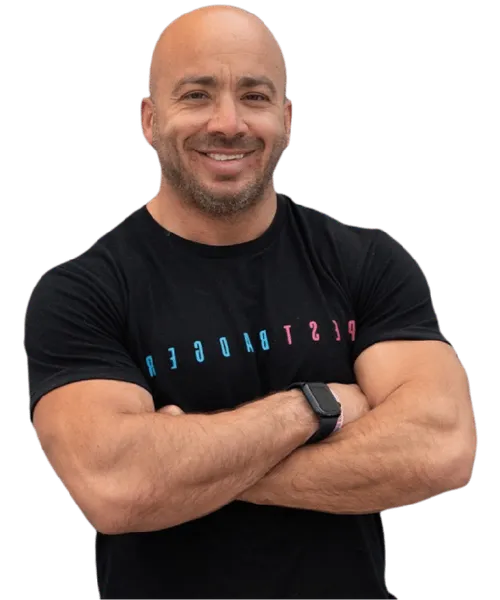
Brandon Peterman was my first guest ever, all the way back on episode one. Now we are more than 130 episodes in, and I had him back on the show. We have known each other close to 10 years, and when we met he was doing about $400,000 a year. Now he runs Elite Lawn Care in Oklahoma City with close to 30 trucks.
We talk almost every day, but this one still gave me a lot to think about. Here are the takeaways I keep coming back to.
Pay for performance beats hourly every time
This was the biggest one. For two years I pushed Brandon to switch his techs from hourly pay to pay for performance, and last year he finally did it. The results were wild.
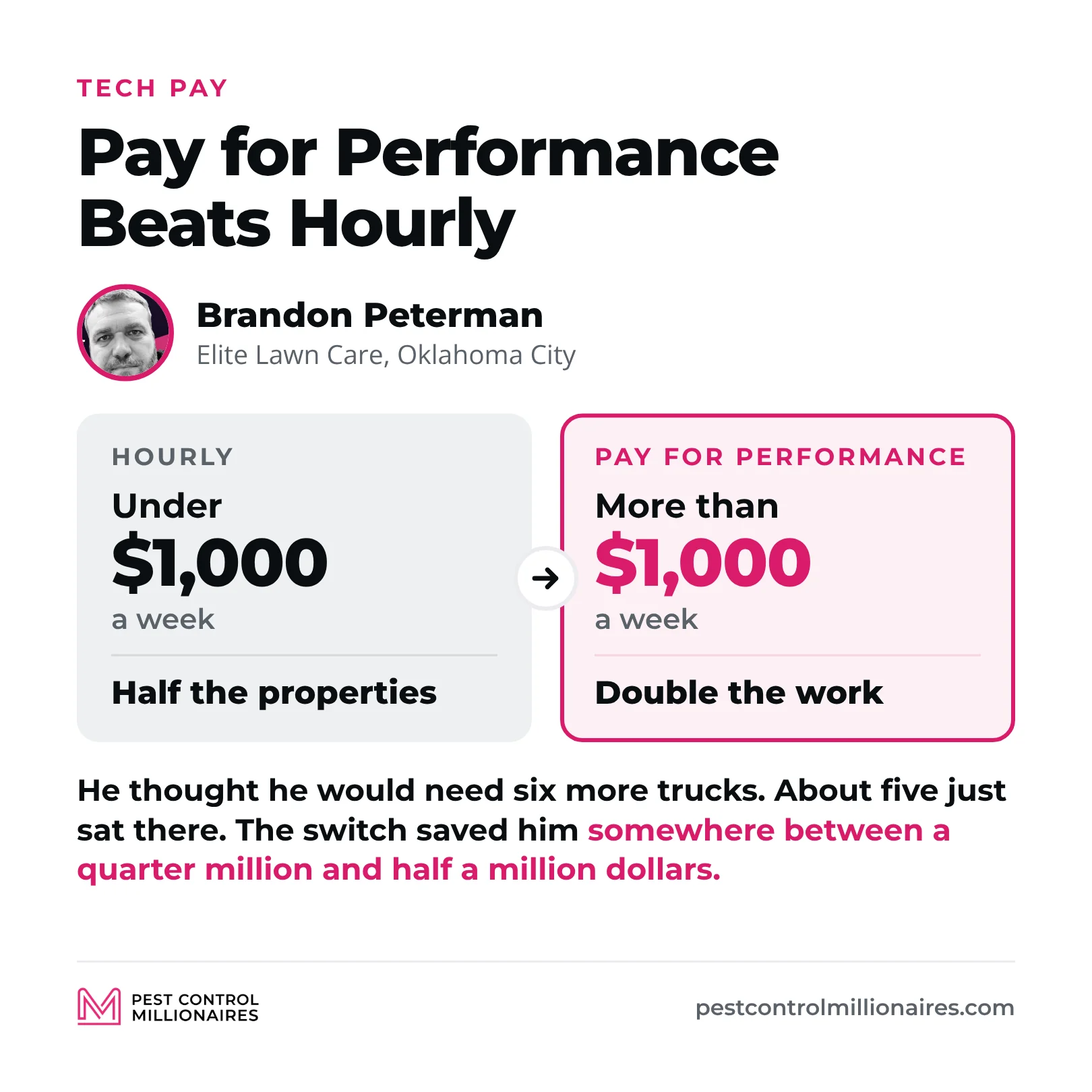
Before the change, his techs made under $1,000 a week and did half the properties they do now. After the change, they made more than $1,000 a week and did double the work.
The top guys do even better. “Our top end employees are making 70 and $80,000 a year just being a spray tech,” Brandon told me, and in his market that is great money.
He thought he would need to buy six more trucks to keep up, but instead about five trucks just sat there because he did not need them. His Ford trucks run around $52,000 to $54,000 before the tanks, and the bigger trucks cost over $100,000. So the switch saved him somewhere between a quarter million and half a million dollars.
The slow guys left on their own, and the ones who used to park at the gas station faded out. Brandon told me he will never go back to hourly, not for a spray tech, and that hit home for me.
Watch the money, not the trucks
I asked Brandon how many trucks he has, and he could not tell me the exact number. At first that sounds bad, but it is not.
“I don’t pay attention to that anymore. I just need to know the financials,” he said. He has people for the trucks, and his job is the money.
He stares at about four spreadsheets every day, tracking his labor, his costs, and his materials, all as percentages. He knows what each number should be. When rent goes over a set percentage, the building is too big, and when it drops under, he knows it is time to buy more space. The numbers tell him what to do next.
That is the shift. When you start, you do the work, and when you grow, you read the numbers.
The best known company wins, not the best one
Here is a stat that stuck with me. Brandon is in a city of about 1.6 million people and has built a real brand, and still, “80% of people don’t even know who we are,” he said.
A mentor used to tell us a line I never forgot. It is not the best product that wins, it is the best known product that wins.
I shared a story with Brandon about a huge operator that runs trucks all over a 20 mile area. A guy lived on one of those streets for 10 to 15 years and saw their trucks all the time. He still had never heard the company name. Wild, right?
So if you are not growing fast enough, look at your marketing first. Most small companies do not have a growth problem, they have a “nobody knows us” problem. Get your name out there.
Stay small or go big, just know your why
People always ask if they should stay small or scale fast, and Brandon and I agree that both are fine. It depends on the person.
You can be a solo tech and make $80,000 to $100,000 a year, and there is nothing wrong with that. Brandon has a friend who does just that. The guy works four weeks, takes two weeks off to go fishing, then comes back and does it all again.
You can also build a lifestyle business with a few trucks, pull $300,000 in profit, and live well. Also fine.
But here is the catch. If money is your only reason, you will stop the second you hit that number, and the gas pedal comes off. I see it all the time. If you want to build something big, you need a bigger why than the money.
Forget work-life balance
This one was honest. I asked Brandon how he balances work, family, and growing the company, and his answer was that he does not.
“I don’t think it’s ever going to be a 50-50 balance,” he said. He makes every morning huddle and tries to be the last one to leave, and some nights that is 6 or 7 p.m. He loves the work, so it never shuts off, and he even dreams about it.
But here is the upside he taught me. All that pressure makes you calm at home. His wife once called to say their daughter fell and needed stitches, and he did not panic. He just asked if she could handle it or if she needed him to meet her at the doctor. After years of problems thrown at you, you learn to stay steady.
Be slow to sell
Brandon’s phone rings every day from private equity, and he finds it annoying. He is also not interested.
“I’ll probably never sell the private equity ever,” he said. When he is done, he wants to be done, with no rolling equity into a new deal.
I get it. He told me about a friend who sold to private equity, and a year later that friend did not work there anymore. He still has equity, but no paycheck, and he had to go find something new to do.
Think about the math. Your business pays you 20% to 30% a year, sometimes more, so where else do you get that? The stock market gives you 6% to 8%. So why sell the thing that pays you so well? Maybe not forever, but there is no rush.
Same goes for buying other companies. Brandon has grown almost all organic, and he worries an acquisition would pull his eyes off his main business. You inherit old customers, a messy system, and a culture that may not fit. I have done two small deals myself, and one was good while one was a struggle. So do your homework before you buy.
Hold your price
Most people do not buy on price, they buy on value. But almost everyone asks for a discount anyway.
Brandon has a smart fix. He raised his prices 10%, then offers a 10% discount if they sign up that day. The customer feels like they won, and he still gets his normal price.
He is also careful about what he discounts. He will not cut the price on his main service, but he will discount a second service while his tech is already at the house. The truck is there, the fuel is paid for, and the extra material is cheap, so there is room to deal. The key is he knows his numbers cold before he ever drops a price.
You are the million-dollar horse
The part of this talk that hit me hardest had nothing to do with business. It was Brandon’s health.
He has had arthritis since he was 21, and it got worse and worse. His feet and legs swelled up and he had trouble walking, and his doctor kept adding more medicine. Then his doctor told him something scary. If he kept going, “we’re going to end up having to amputate your legs.” Another doctor told him he was pre-diabetic.
So he changed everything. He saw a functional doctor and a nutritionist, and he cut out the food that was making him swell. In time the pain went away. He went from 255 pounds down to 197, and he dropped from a size 40 pants to a size 34. He quit drinking, quit dipping, and quit fast food. He started lifting weights and added almost 18 pounds of muscle.
Here is the line that ties it together. A mentor once asked me, if you had a million-dollar horse, what would you feed it? You would feed it the best food and take it to the best vet. Well, you are the million-dollar horse, so why feed yourself poison? When Brandon’s income grew, he could afford the tests and the help to get healthy, and his health and his business grew together.
The thread through all of it
Brandon was my first guest, and almost 10 years later he is still learning, and so am I. He talked about getting the company to $40 million one day, and he knows he has a lot more to learn to get there. That is the whole game. Find the people who have done it, watch your numbers, and take care of your people and yourself. Then keep going.
Watch the PCM Podcast on YouTube