Solomon Airhart on Building Aruza and Starting Over

Table of Contents
- Sell bigger contracts, not more accounts
- Own five neighborhoods
- Give up equity to build something bigger
- Keep summer techs close to the sales team
- Use the cancellation fee to get a second chance
- Growth you have to finance every year
- Money didn’t fix any of it
- Pest control is still where he wants to be
- Frequently Asked Questions
Solomon Airhart co-founded Aruza Pest Control in Charlotte, North Carolina, in 2016 with his best friend, Jordan Agee. As CEO, he helped grow it into a door-to-door company with nine locations in North Carolina, South Carolina and Florida, and it sold to private equity in 2022. Today he runs Growable Ventures, which partners with small pest control companies.
We’d already heard Aruza’s story from his former partner, Christian Ludwig. This was the other half, and Solomon held nothing back, from how they built Aruza to the night he calls his rock bottom. He didn’t even know I was the guy who flew out to Charlotte years ago to learn door-to-door at Aruza until he heard me tell that story on Christian’s episode. Here is what stuck with me.
This episode is part of the PCM Podcast. For Christian’s side of the story, read my conversation with Christian Ludwig.
Sell bigger contracts, not more accounts
Solomon was managing LA Fitness gyms in Arizona when someone at the front desk told him he’d be good at pest control sales. He had never heard of pest control. His first summer knocking doors for EcoShield was in Houston, and he didn’t sell anything for seven days. “I think I’ve made the worst decision of my life,” he remembers thinking. He expected to be bad at first, put in the numbers and tried to make a friend at every door, and he finished the summer with about 250 accounts as a top 10 rookie.
What set him apart came next. Back then door-to-door was all about how many accounts you sold, and most reps sold free initials and $60 bimonthlies. Solomon got paid on revenue. “So why am I so focused on numbers?” he said. His second summer, he sold $120 bimonthlies in one neighborhood of huge houses in Houston, all summer long. With half the accounts, he cleared double the revenue of everyone else. “I don’t need to sell as many accounts if I sell them for way higher,” he said.
If your reps still chase account counts, look at what they bring in. I make the same case in premium pricing for pest control.
Own five neighborhoods
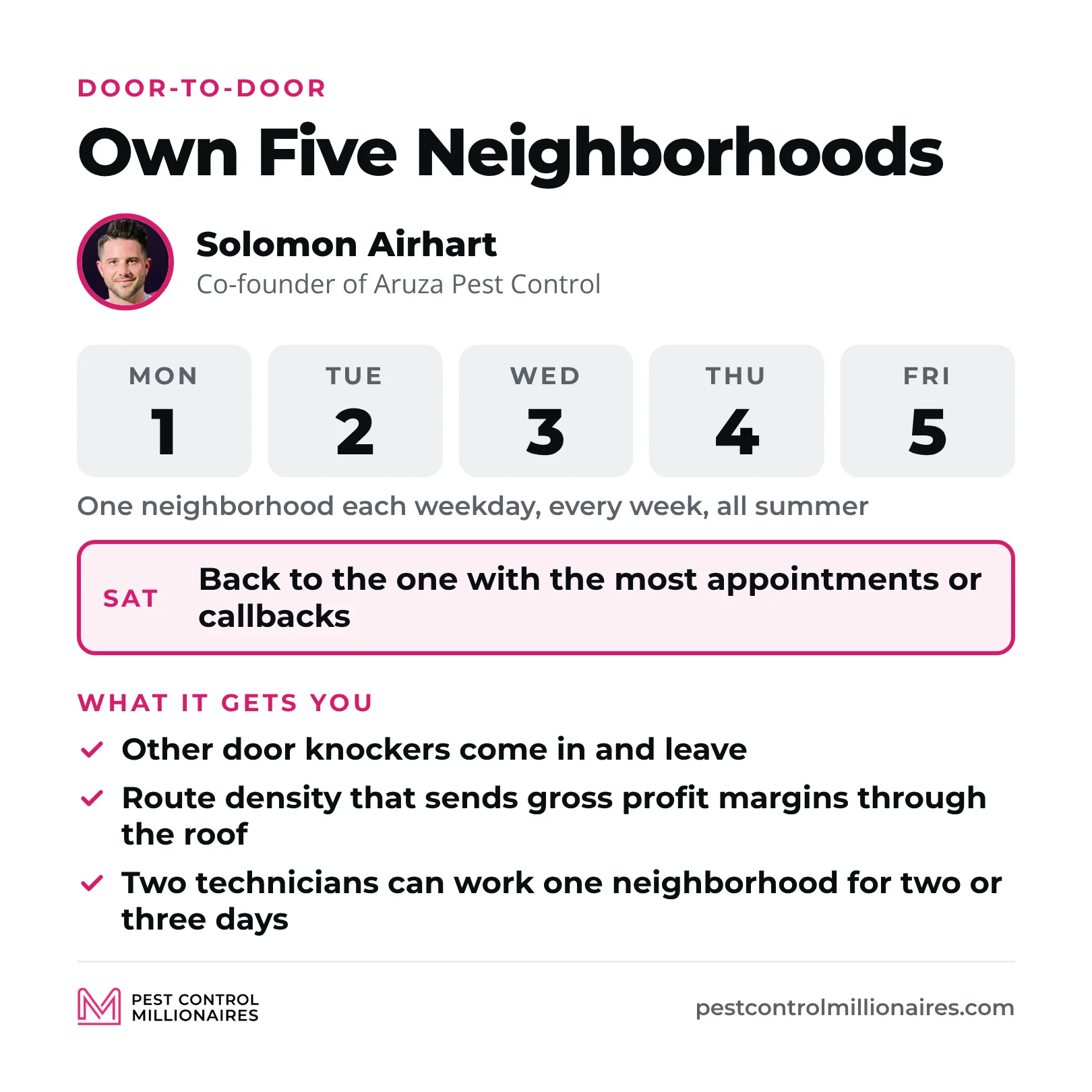
Solomon’s other habit was staying put. He worked five neighborhoods all summer, one each weekday, and on Saturday he went back to whichever one had the most appointments or callbacks. Other door knockers would come in and leave right away, because there was nothing left for them. “Pick five neighborhoods, own those neighborhoods,” he said.
Teams blitz through neighborhoods a lot faster now, and we fight the same thing with our rookies, who decide a neighborhood is bad and move on. For the owner, owning a neighborhood means route density, and Solomon says your gross profit margins would be through the roof. Those are the neighborhoods where you drop two technicians and they stay for two or three days. Here’s how we build tighter routes.
He also wanted reps to look like technicians, in tool pouches, technician shirts and long pants, not cool polos. At EcoShield he usually rode with his own technician and helped service what he sold, and his accounts always had low attrition.
Give up equity to build something bigger
After five and a half years at EcoShield, Solomon was about to turn 30 and tired of moving every summer. His parents were moving to Charlotte, so he called Jordan, whom he’d met selling for EcoShield, and asked him to start a pest control company there. Jordan said yes, no questions asked. They started with two trucks and spent about six months knocking, selling and servicing every account themselves.
Near the end of 2017, Solomon messaged Christian, who had a big team selling for Aptive in North Carolina, about becoming an equity partner. Solomon and Jordan were 50-50 partners, and Christian was bringing a lot and asking for a lot. Plenty of owners walk away right there. “I’d rather have 1% of something huge than 100% of something small,” Solomon said. They structured a partnership agreement that made sure everyone was either putting in the effort or getting paid for the effort they put in.
About 75 reps signed with two and a half months until summer. Charlotte had very little door-to-door then. “This city is going to despise us,” Solomon said, so they opened a second location in Charleston and split the reps about 50 and 25. Vendor partners like Veseris and Enterprise Fleet gave a new company the products and vehicles it needed, and Aruza grew every summer after that.
Keep summer techs close to the sales team
Solomon ran operations at Aruza. His summer technicians, the ones who run the initial services, were paid, structured and trained differently from the regular route techs and were on a different team. He’d keep them in or around the sales meetings.
The reason is what happens at the door. Solomon has heard reps tell people the company would pick their golf balls out of the water. A summer tech who knows the pitch can save that account, with an initial service checklist that goes back through the agreement and what the customer can expect all year. A route tech with no relationship with the reps hears “the guy never told me that,” gets frustrated, and the sale is gone. Solomon would add a shared incentive, so techs get paid when the reps’ sales actually get serviced, on top of their hourly or per-service pay.
He has watched a lot of traditional companies bring in a door-to-door marketing company and fail, because they don’t understand how many more technicians a summer sales program takes. Aruza saw it from the other side, too. When it sent reps to sell for other companies, maybe 20% of the accounts never got serviced and another 20% to 30% canceled before the reps got paid. Aruza guaranteed its reps an 80% retention rate on those deals, to match its own, and lost a lot of money doing it.
Use the cancellation fee to get a second chance
Aruza’s retention started with an attitude. “We’re going to make mistakes,” Solomon said, and when they did, they did whatever it took to make it right. If a one-star review came in, he was on it with the manager right away, and every manager had a monthly budget for flowers or gifts for customers who let them come back after something went badly wrong. Under that was the service. Use good products, spend enough time at every house and don’t overload technicians with 18 to 20 services a day.
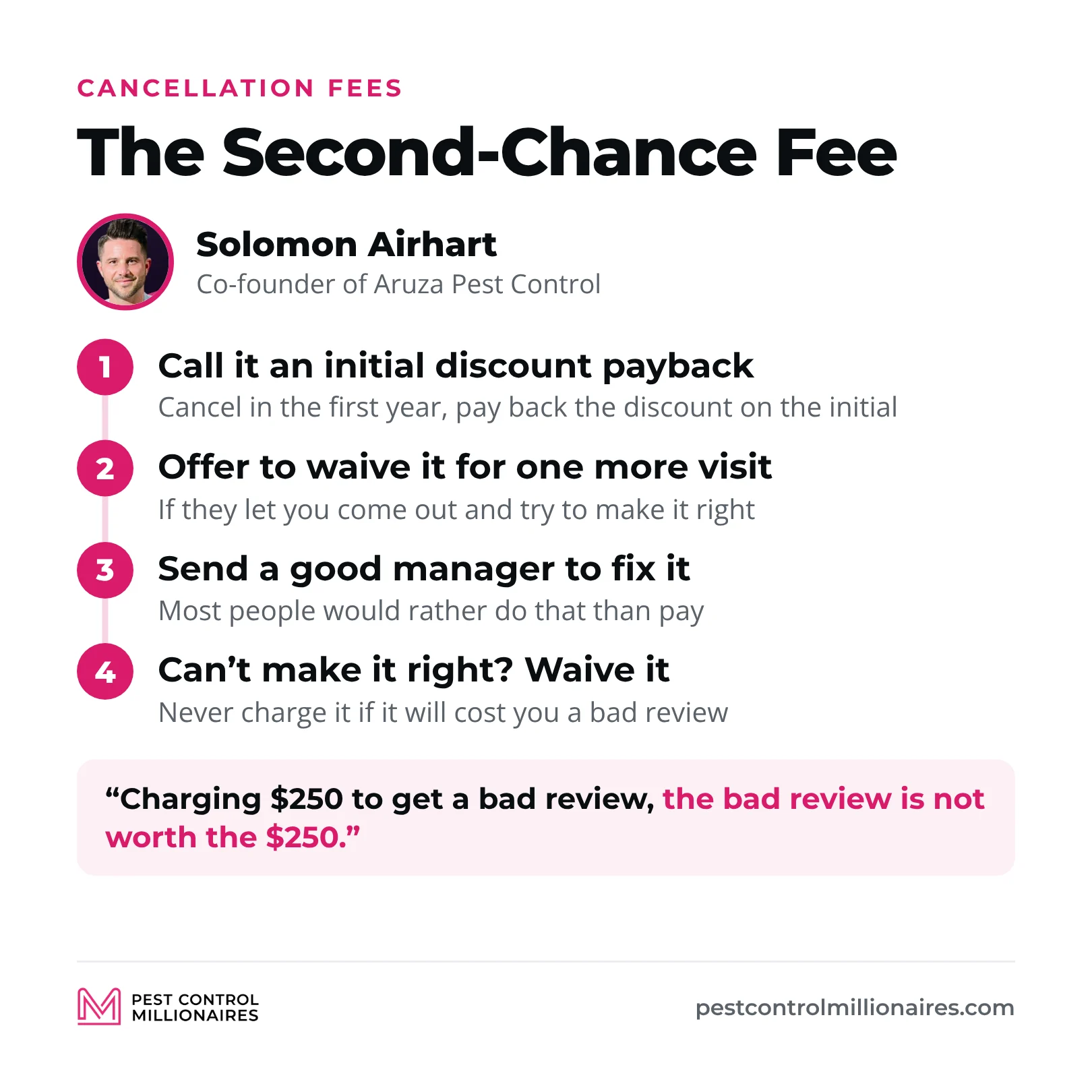
The cancellation fee wasn’t called a cancellation fee. It was an initial discount payback. If a customer canceled in the first year, they paid back the discount they got on the initial. Nothing crazy. “We’re not in the business of making money off cancellation fees,” Solomon said. It was a tool for one more chance to fix the problem. When someone wanted to cancel, his team offered to waive the payback if the customer let them come out and try to make it right. Most people would rather do that than pay, and a good manager who finds the concern and fixes it keeps the customer. If they can’t make it right, they waive it.
How firm was he? Not very. He’d never charge it if he thought it would bring a bad review. “Charging $250 to get a bad review, the bad review is not worth the $250,” he said.
I learned that the hard way. In year one, the people training me came from a company doing over $100 million, and they told me to hold tight. We got bad reviews for it. Five-star reviews mean a lot more to us than they do to them, so the fee is still on our agreement, but now it’s just a tool. Big companies can hold firm because the fees help cover commissions on huge sales programs. Chad Louk once told me about a company where 35% of the revenue came from cancellation fees.
Growth you have to finance every year
Aruza grew so fast that Solomon was learning to run a company while taking on serious debt, keeping the reps happy and dealing with lawsuits, and it was slowly destroying his health. “I didn’t need to grow it that fast,” he said. His ego took hold. He wanted Aruza to be the biggest and wanted to put door-to-door on the map in an industry where it was taboo, so he piled speaking, podcasts and leadership programs on top of everything else. By the end of his time at Aruza he was pre-diabetic.
Growing the door-to-door team every year means financing it every year, and every mistake gets bigger as you grow. By the beginning of 2022 the investors were maxed out and the partners weren’t seeing the same vision anymore. Aruza was on pace for about $12 million in revenue that year. Solomon and Jordan wanted to scale door-to-door back and cash flow, and Christian wanted to keep growing sales.
In hindsight, Solomon would have built a bigger digital presence, until maybe half of new sales came from door-to-door and half from digital and organic, with a company driven by net profit instead of top-line revenue. “If you’re putting up the biggest numbers, but there’s no profits to speak of at the end of the year, what kind of business are you really building?” he said.
Private equity gave everyone what they wanted. Solomon had built a leadership team that could run the company without him, so he could step away while Christian stayed. It still hurt. “This was my baby,” he said. A mindset coach helped him see that Aruza didn’t have to be the vehicle to get him where he wanted to go. He had always said he would only sell as a platform, and he thinks it was one of the best acquisitions of a door-to-door company at the time. Paul Giannamore walked me through what to watch for when you sell on this show.
Money didn’t fix any of it
The sale came at the worst time for Solomon personally. The stress had him on prescriptions, anxiety had locked up his jaw for months and he was on muscle relaxers for it, and he has since realized he had an unhealthy relationship with alcohol. At an NPMA event for its executive leadership program, he went out drinking and blacked out. He still doesn’t know exactly what happened, and the next morning he was asked to leave the program. “That was a very dark time for me,” he said. He went through a divorce in the same stretch.
He carries a lot of shame for that night, and he also calls it one of the best things that ever happened to him, because it stripped away the ego that had been driving him. It took about another year before he quit drinking for good. “I can’t recall anything ever good coming from me drinking. So why am I even doing this anymore?” he said. When we recorded this, he was almost three years without alcohol. He worked with therapists and let himself feel the grief instead of numbing it. “If you quit drinking, it’s like the cheat code,” he said.
I’m not preaching that everyone has to quit. But I couldn’t do what I’m doing today if I still drank, and my kids have never seen me drink. What I didn’t expect was the effect on the people around me. Family, friends, team members and partners quit drinking and got healthy, and I never asked them to.
The other lesson is about money. Solomon sold Aruza for a super high multiple and hit every financial goal he’d ever had while everything else fell apart. “Money is definitely not the most important thing,” he said. His health and the people in his life were. What he missed most about Aruza was the friendships, and he has been working to rebuild them.
Pest control is still where he wants to be
Through Growable Ventures, Solomon partners with small pest control companies. He’s a partner in Peach Pest Co. in Tucson, Arizona, and he and Jordan bought Obex Pest Defense in Colorado. A small company can’t afford a CMO, a marketing team, a CFO or HR, so he’s building an executive team that works fractionally across all of them, with the goal of packaging them up one day and selling for a higher multiple. He has looked at other home services, but recurring revenue keeps him in pest control, which he calls one of the most elite home service businesses there is.
He is proudest of two things. He got himself healthy, and Aruza made five or six people millionaires in six years. His advice to owners coming up is to take care of your people, build a good culture and keep evolving.
We’re all human, and all we can do is learn from our mistakes and get better. Solomon chose to get healthy and start over, and everyone loves a comeback story.
Frequently Asked Questions
Who is Solomon Airhart?
Solomon Airhart co-founded Aruza Pest Control in Charlotte, North Carolina, in 2016 with his best friend, Jordan Agee, after five and a half years selling door-to-door for EcoShield. Aruza grew to nine locations and sold to private equity in 2022. He now runs Growable Ventures, which partners with small pest control companies.
Should a pest control company charge a cancellation fee?
Yes, in a way. Solomon called his an initial discount payback. A customer who cancels in the first year pays back the discount on the initial, and it’s a tool to get one more chance to fix the problem. If you can’t make it right, waive it, and never charge it if it will cost you a bad review.
How do you keep door-to-door customers from canceling?
Do whatever it takes to make problems right, use good products, spend enough time at each house and don’t load technicians with 18 to 20 services a day. Solomon also keeps the summer technicians who run initials close to the sales team, so they know what the reps sold and can save the account.
Why did Aruza sell to private equity?
Growing the door-to-door team every year meant financing it every year. By the beginning of 2022 Aruza’s investors were maxed out and the partners wanted different things, so private equity gave everyone what they wanted. Christian Ludwig stayed to keep growing sales, and Solomon stepped away.
Full transcript
Every word of the episode, from the video captions
Roll here. Another episode of Pest Control Millionaire. I am actually I'm super excited about this one. We've been trying to get this one planned for it's been a minute, dude. Like three months, six months, maybe longer.
Yeah. Yeah. I think you reached out to me a while ago and asked me and I was like, "No, man. I'm I don't know if I'm really doing podcasts right now."
It might have even been a year ago.
Yeah. And you have kind of hit me up a few more times and I was like, "Okay, dude. Let's let's do this."
So, super happy to have you here. We get to hear the other half of the story. We had obviously your former business partner on here. It was a great podcast. We talked for a long time. It was really good. But we could hear the other side. And so you and I chatted before this a lot back and forth and you were kind of says a few things, but whatever. And I'm like, "Fuck it. Who cares what everyone else thinks? Let's just roll. Let's get this done." But we have the founder, former CEO of Aruza Pest Control. Now he's founder of Growable Ventures who invests into other small companies and he's grown his new thing. But Solomon Airhart, dude, good to have you here finally.
Yeah, dude. Thanks for having me. I'm excited to be here. It's awesome. What you've been building. I love it. I feel like I remember you kind of coming up in the with the Turf Badger and Pest Badger and stuff like that. And now the Pest Control Millionaire thing and what you guys are doing with the group, Facebook group. It's awesome, man. I love it.
Yeah, it's been a fun journey for myself. I don't even know if how much you knew the story about me flying out to the Carolinas, coming to visit...
Yeah, I never even knew about that until I until I listened to your podcast and I was like, "Oh my gosh." I remember Christian telling me about somebody coming out and kind of learning the script and learning everything like that and I had no clue who it was. So, it's super funny that it was you.
It's crazy story like I've always been very vulnerable just like, "Hey, I see I see people that are out there doing really big things. You were way further ahead of me and I was like I seen Christian on like door to door wherever like going to Sam's thing like I'm gonna reach out to this guy looks like a stud and like he welcomed me with open arms dude it was super cool thank you for that I know you didn't know but still part of your company took me in like I was family spent a day there down in Charlotte it's really cool and yeah just thank you again and fast forward you know five years later here we are...
Yeah man you've built a you've built a great thing. I It sounds like you're blowing up.
Yeah, it's fun. We just I think we just opened up our 18th location. We're across five states. Yeah, it's been a fun run for sure. And I feel like we literally just started this thing five years ago. Well, 2026, March or April, May, where it'll be. It'll be year six. Full year six.
Yeah. Now, with these locations, you got you have partners within each location. So you're kind of building it up around around these sales partners or equity...
Some Yeah. And some are mine just mine too that we stand up corporately too. So everyone's been a little bit different. I think the traditional model with door to door is kind of like how we started too. And then as you scale you know you can do more with cash and start to grow these things organically too which has been fun. So kind of like more of like Chick-fil-A model too. U so we stand up operations like that and going forward I don't know what it look like. I'm always open to partners like meeting good guys connecting with good people. And whatever happens happens, right? So, I definitely couldn't have done this all alone. Like I've had some I've had some killer guys I got super lucky with that are that are business partners now. They really set the tone. They're the flag carriers to show that other people can do besides me, right? That they can come in, they can prove themselves whether they were doing nothing or doing something big at the time, they came in, they prove themselves, they own multiple offices now. Like, so it's not just me, you know, I have a lot of help from a really awesome team.
Yeah, I think that's part of the most rewarding factor of like building a pest control company the way that you're building it, the way we built it with Aruza, is like creating these people financial future, right? Like that's one of the things I'm most proud about with what we did with Aruza was like creating, you know, multiple millionaires out of the whole sale of that company and I'm still really excited about that.
Yeah. So, we're going to rewind back to high school. Solomon, you and I are juniors in high school. What was the makeup of your personality? Who was Solomon then?
Oh my gosh. And so, in high school, I mean, I was an extreme sports guy, man. I wasn't really a traditional sports guy. Wasn't good in school, nothing like that. I mountain biked. I raced semi-professional mountain biking. Did a lot of cycling, skateboarding, snowboarding. And when I was coming getting, you know, finishing or getting close to finishing high school at the time, I was looking at being a welder.
Dude, I went to college for welding.
Dude, it was it was amazing. And amazing potential you had in welding and I wanted to do the underwater welding, you know, with the highest paid and highest risk. I think I've always a year back in the day.
I think I've always I've always been like a high-risk type of person. And so that really enticed me. However, I ended up, you know, I was living in a small town in Minnesota and I got an opportunity to move to Arizona my senior year and live with family friends of ours. The opportunity allowed me to be able to go there and kind of race more year round, train on my bike more year round. And so, you know, coming from a small town, living with my mom and my sister, I was like, okay, let me let me do this. Let me take this opportunity. So took a huge risk like leaving my small town with the people I grew up when I was since I was a little kid. Like we've been together our whole lives and leaving our senior year and going to Arizona, Mesa, Arizona, and going to high school there and graduating from there and in a school that was almost as big as my whole entire town growing up in Minnesota. And so I took that big risk and that put me in a place where much more opportunities presented themselves.
I kind of shifted my thought process and so welding wasn't really the thing anymore because now I'm not in the Midwest where you know hard labor jobs are kind of the prime and I started looking more into like Yeah. And started looking more into like nutrition and exercise science and kind of started to go to school for that until I you know then fell into this pest control world.
Yeah. Which is I mean I don't know the story but I'm just going to assume the story but walk me through how pest control found you because I know you didn't grow up thinking you're going to own a pest control company someday.
No, I've only I think I've only met a few people in my life that they knew that they were going to be in pest control from the day they were, you know, from their young age. And mostly it's because their parents or family owned a pest control company. Everyone else I've ever met has always had the same story. Is like, "Oh, I never even ever thought I'd ever be in pest control. Didn't even know anything about pest control. And now I'm in pest control and I love it." Right. I feel like that's a very common story. And it was very similar for me. I was in the fitness industry. So I was managing LA Fitnesses out in Arizona running all like personal training sales and personal training development and things like that. And you know, kind of working my way up that corporate type of ladder, but also you know it's a high stress sales job. And so back then like LA Fitness was very very hardcore. Probably the leading fitness gym in the US, maybe still is. I'm not really sure. But, it was very hardcore.
Like the sales goals we had were were very hard. The training was hard. The managers were always breathing down your back all the time, constantly, you know, dangling the carrot in front of you. And I loved it and I and I excelled very well in it. And I learned a lot about leadership, about sales, about management, about personal development. And but I also I needed more time, right? It's like I never got to go visit my family. I never got to take a vacation. I never got to have any personal time. Even if it was my day off, I was still having to check in on my weekend manager. Still having to check on the numbers. Still responsible for whether they were going to hit the goals or not on Saturdays and Sundays, even if I was off. And so an opportunity arose where one of the front desk girls was like, "Hey, you know, you'd be really good at pest control sales." And I was like, "What the hell is pest control sales? I've never heard of pest control. Coming from Minnesota, at least the small town I lived in.
I didn't even know pest control existed. Now going back home, you see some pest control vehicles, especially now that you know, understand the industry, you start seeing a little bit of it. But, you know, growing up, it's like I didn't even know that was a thing. Even once I moved to Arizona, I still didn't even know that it even existed. And so, I was like, okay, well, what is this? And so at the time, you know, her sister, her brother-in-law was one of the partners with EcoShield, which back in the day was called Home Shield Pest Control. And so I got connected with him and he ended up connecting me with Doug and Greg, the owners of EcoShield. And I started chatting with them about it and I was like, "Yeah, it sounds like a great opportunity." But at the time I was like buying a house and because it was the it was 2010 the real estate market had crashed. So houses in Arizona were like selling for like $80,000 $100,000 a pop. So I'm like okay let me get a house real quick and so I was working on all that.
So I couldn't just weave even and change and go to 100% commission job at the time. So I ended up postponing it and then later that year ended up meeting a guy who did door-to-door sales with EcoShield and him and I became pretty good friends and he was like man you need to really look at doing this again. And so I was like, "Okay, let's let's do it." And then that next February or March, I went out to Houston, Texas for my first summer selling pest control door to door. And for the first like seven days, I didn't sell anything. And I was like, I think I've made the worst decision of my life. Like yeah. I mean, it's a very hard learning curve, right? And I mean, I think some people are able to jump out there and just pick it up right away. But also, you know, I was starting preseason, right? So, it's March, so it's pretty early in the season still. So, still colder. The bugs aren't really rampant...
I feel like that's where most reps fall.
Hold up. Quick pause. If you're on a pest control company or fertilization weed control company, you're not in our Facebook group. You're choosing the harder path. Every operator that's in there, skipping years of mistakes because people are actually sharing what's working right now. So, stop trying to brute force your way through growth alone. Search Pest Control Millionaires on Facebook or click the link below. And now, let's get back to...
So, it took me a while. I was I thought I was maybe made the biggest mistake of my life doing this, leaving my job and my comfort, you know, to kind of try this new thing. But then I started picking it up and then I really picked it up and did well. I was no, you know, rock star, you know, compared to the numbers that these guys are throwing down nowadays, but I think I ended up the first summer with like 250 accounts and I was a top 10 rookie. And so I was super stoked and ended up kind of, you know, falling in love with it and sticking to it. And each year obviously I got better and better but you know I was I always focused then on instead of selling big numbers of accounts because back then it wasn't so much revenue based it was really just accountbased right whereas like for me I'm like I don't even get paid on numbers I only get paid on revenue so why am I so focused on numbers and so I think I was one of the earlier adopters I would actually claim that I was probably one of the earlier adopters of higher contract revenue than higher sales numbers right and so my second year, you know, when most people were selling, I think back then it was like free initials and like $60 bimonthlies, right?
I started selling $120 by monthlys and I literally stayed in the same neighborhood all summer. This neighborhood in Houston, Texas called Benders Landing had huge houses and I would just sell $120 by monthlies all day. And so then I, you know, half the accounts I cleared double the revenue of what everyone else was doing. And that's kind of what stuck with me is like, dude, I'm going to I don't need to sell as many accounts if I sell them for way higher.
Yeah. Awesome. I'm going to take you back to first summer, those first seven days. It's like the first what you see with every new rep for the most part. Like said, there's a select few who are just naturally good at it or they just aren't smart enough to pick up on social cues, so they're just really good. There's like two opposite sides of the spectrum. But it's like that it's like that pivotal moment like oh sh did I just you know screw up like am I going to quit or do I have the fortitude to go forward right? What was it in your mind if you can remember like that just said hey I can't quit let's get better because I mean a lot of people maybe not listen to this podcast because a lot of people are just business owners but as a rep because my reps listen to this too. What is that pivotal moment for you like I just need to I just need to push through this to see what's on the other side?
Well, I mean, I think it was one of those things where it's like I've always known that hard things, you know, are are more rewarding, right? And so, if you can push through the initi I mean, and having been in sales, like I knew that the initial part of it was going to be a learning curve. Like, I knew it was going to be hard. And so I set myself up with the proper expectation of like, look, I'm probably not going to be good at this at first. And it's really just about taking the reps, right, of just putting in the numbers. I know if I if I knock enough doors, if I talk to enough people, eventually it's going to click, right? And you know, nowadays what I've noticed in the industry and even having worked with Christian and having seen how he ran the sales program for Aruza is the training leading up to the summers is so much more now and so much better now than what it was when I first started.
There was there was no real training. It was like, hey, here's a little manual and you can start studying it. But there was no like weekly training meetings. There was no, you know, role playing, you know, leading up to the summer. It was like, okay, we all showed up and it's like, now let's figure it out, right? And it's like, and it's going to take time to figure that out, to memorize the scripts, to work through the objections and stuff like that. To where I feel like now the learning curve is it's much faster than maybe what it was back then. At least for my...
Even for me, it was like I didn't have a trainer. I didn't come from door to door. I was like YouTube University trying to figure this thing out. But then once I learned like I remember waking up at 3:00 4:00 a.m. And I go to the bathroom and like I was just memorizing the script in my head at 3:00 a.m. And I'm going to the bathroom like I couldn't shut it off and then I was like overcoming objections. Then I slowly started getting better and better where I went from selling you know first few days I think I got lucky. So the first store I ever knocked sold it got lucky. There was no recurring revenue though like I didn't know any better. I was just trying to sell [ __ ] to make money. I'll be honest. And then like by the end of that summer got some really good training. I think my best day I sold like 15 and I was like, "Oh, okay. I can do this, you know, and so it is a steep learning curve, especially like my back was against the wall." which I'm sure you know what that's like. I didn't have a choice.
Like my I was all in. I was super committed and that's where I was like taking this conversation too. Like that first week or two weeks like the people just aren't sold on the job. They aren't sold in themselves yet. So they're not committed. So it's hard to go sell if you're just not committed yourself. Did you feel like you were there at all or were you already committed? You just want to get better?
Yeah, I mean I was I mean I was committed because I already made the huge jump to get out there, you know? I mean I quit my job, you know, that I had, you know, so I didn't have something to go back to, right? It's like I had a girlfriend at the time and so like she dumped me right before I left. So I kind of had maybe a little like spy and anger inside of me too. Like I can't just like quit now. Like obviously like I've obviously lost everything right now. So like I got to push through. And I mean I had you know people around me that I had seen them be successful. So I'm like I know it's possible. And I think I just Yeah. It just took the time right. Like I was just a slow slow bloomer I guess you would say.
Yeah. And I think just to all the reps that listen to maybe that are newer you just have to have conviction in what you're selling and life gets way easier. Like if you have conviction, you believe in your product, you believe what you do, believe in the company, you can go sell whatever you want. It's all between your ears at that point.
Yeah. I think the big thing for me is I focus on at the very least and in the beginning, right, just like having fun with it, right? So like at the very least like I was going to start a good conversation with somebody. I was going to try to get to know them as best I could. Even if I couldn't get through the pitch or get through the objections very well, like I was going to try to make a friend, right? And I think that made it a little bit easier than trying to go out there and think that I need to sell everybody right away. It's like, hey, look, I don't know how to how to do this perfectly yet. So, if I can just go out there, I can just have fun. I can have good conversations with people, get them to like me, then I'm in a good place from there, right? And I can move off of that.
That's say like listen, believe by, right? And so, and I agree a thousand% with everything that you said, just go have fun. Like anything in life that you do, anything, you're not going to be good at it. So, just like they always say, fail forward, fail fast, get it over with, and you'll slowly get better. Just like any sport, anything that you do, like wrestling, because I'm a wrestler, like if you expect to go on the mat and win your first two matches and you've never wrestled before, it's just unless you're person who's never wrestled before either, like you're never going to win. Like I think my she's obviously extremely good now, but the first two years, I don't know that she won a match. Like two years maybe two years of wrestling which is like six months out of the year maybe maybe she won a match I can't remember but she stuck with it she grinded it out and now she doesn't lose very often you know even de boy she hangs she hangs with best of them but just saying like it just takes time and it's like you said earlier it's like okay now year two year three and now all a sudden you're getting really good you like you brought up trainer for your first summer did you have a good trainer then that you that you were leaning on?
Yeah, I would say I had a good I had a good trainer. There was two brothers, the Worerins and they kind of ran that Houston office and they were really good trainers and so like you know it helped a lot too that I would ride with them and then they would just drop me off, right? So like you really don't have an option like get dropped off in a neighborhood and get picked back up at like 9:30, 10 o'clock at night, you know, you pack a lunch and throw it in the in the bushes. And so like you're just forced to put in the reps, you know, but I would get a shout shadow them and I could see how they would do it and how easy they would make these sales and so it's like from there it's like I knew it was possible.
Like I had the sales training, the foundation of the sales training. I'd been doing that for six years previous, you know, and even before running gyms, I sold cell phones in the mall. So it's like I had a lot of the sales experience. It was just kind of figuring out the pest control part. And so kind of getting to shadow these guys and see how they talked about insects and how they identified the insects and kind of pulled people off the doors and found the issues in the yard. Learning that part of it made me more confident. That's part of what I fell in love with the most of the in pest control was like that whole aspect of like the actual pest control part of it as well too. Made it really fun and then it made me even better at what I was doing once I kind of fell in love with the products and the services.
Yeah, because you can still education. Yeah, that's cool. I love that. And like you said in the title all this together like the training from what you and I had to where these guys are training twice a week via Zoom in person role playing for four months out of the then comes then you come to your first day on the job. You get to go shadow someone like you get to see a service and it's yeah definitely a game changer. Yeah, man. You got the you got the online universities, you got the videos, you got the I mean it's and everyone who's put in the effort to kind of build that part of the industry is, you know, commend them because it's like it's just it's so much better. I mean, you can take these guys who are young and completely inexperienced and within a few months of training leading up to the summer. I mean, these guys can be rock stars, right? And have a super short lead time to getting them to where they're producing and feeling very confident with themselves. And obviously, you know, one of the big things for Aruza is like we wanted to really train our guys because we wanted them to be out there and feel like they were experts, right? Which, you know, is really hard because there's a lot to pest control.
Like I mean, even now it's like I don't feel like an expert in pest control, but like I know my way around a few things, right? But it's like to be able to take these guys from nothing and have them feel like they could be experts in the industry and being out there communicating with potential customers in that way is huge. So the training is light years.
I don't want to get too caught up on this, but what do you see the differences in pest control on the doors compared to 2010 or 11, whatever it was to 2026, 2025? I mean, you know, it's I feel like a lot of companies now it's like much flashier, right? Like, you know, the iPads and the Segways and like we had all that too, but I was never a big fan of like the iPads and the Segways and like looking cool and you know, for me it was like we always wanted to like look like technicians. So, like we were wearing like tool tool bout pouches and like you know, technician shirts and long pants, you know, where it's like not you know, versus the cool polos and things like that. So it's like I think the tech the technology is much more advanced now. Obviously selling on paper contracts versus iPads is a huge difference and obviously you know I think some of those aspects you lo you lose some of that stuff too like I think with paper like it was much easier to keep notes on like houses right so however you obviously couldn't like you know hold on to that for a long period of time like right with an iPad you can have all your neighborhoods kind of mapped out and notes for every house you know and you could keep that with you and return and return and return back to it but like there was something about having paper notes where you could keep notes on a house and it was much easier to kind of go back and forth too as you were walking around the neighborhood.
I feel like some of that was better than the technology now, but I also feel like nowadays it seems to me like guys are are blitzing through neighborhoods a lot faster than maybe working neighborhoods.
We have this talk we have talk company like over and over, especially as rookies. They're like, "Oh, this neighborhood sucks. They're off to the next." I think yeah that's a thing that I think has existed since the beginning of door too but like I just feel like you know these teams work through neighborhood way faster now than they used to. And I think you know it's a precedence to like really work a neighborhood like I for me like when I would sell during a summer I would I would only work five neighborhoods all summer you know and I had a specific routine that I would do it. I would go to one neighborhood on Monday, one on Tuesday, one on Thursday, or Wednesday, one on Thursday, one on Friday. And then I'd go back on Saturday to whatever neighborhood I had the most appointments or like call backs, right? And so, and I would just keep doing that every week. So, every week I was in the same neighborhood, you know, all summer long.
I would have love I'd love to have a map of your your hood. Now, like all the pins that were sold in that area been...
Dude. I mean, I would own those neighborhoods, right? It's like I'd have entire streets, you I'm like, if you're starting a company and you're doing door-to-door, like dude, that's the way to do it. You don't need to spread yourself super thin, right? It's like, you don't need to go to every neighborhood and just cherrypick. Like, pick five neighborhoods, own those neighborhoods, and if any other door knockers come in, like door knockers would come into my neighborhoods back in the day and they would instantly leave because there's just nothing there for them. Like, it would be like finding a needle in the hay stack of an account that I haven't I'm not working with or haven't already sold. And it's like, so you spend the whole day there and find maybe a couple people I haven't sold yet that they're w they're about to sign up with me. And so it's like you would just end up leaving, right? And then obviously, you know, for as a company owner, route density on something like that is it's insane. You know, your gross profit margins would be through the roof.
Absolutely. Those neighborhoods are nice where you go drop two technicians in there and they sit there for two, three days. It's amazing.
Yeah. It's like, dude, pack a lunch because you're not going to leave the neighborhood. So you go worked with EcoShield for two, three years.
So I was there for for five and a half years. So five five or six summers.
They're not a small company.
No, they're huge now. I mean, they're Dude, they're they're crushing it. I mean, you know, the guys that are running most of their door program now are the guys I sold with back in the day and, you know, kind of having since partnered with them. I mean, they've really built a huge huge sales program and they're doing doing really good things. I mean, you know, from there they, you know, like I said, when I was there, we just started kind of pushing bigger contract values and now I know these the EcoShield guys now are, I mean, they're pushing some some really big contract values. And now, I think the lot of the industry has kind of came along with it, right? I think it took a while for some other companies to finally realize like, hey, we can maybe charge a bit more than what we are. And so, I think that's now that's nice now that the whole industry as a whole, I think, is a lot higher contract values than what they used to be. But yeah, I was there for like I said five and a half or six years and then the whole time I was there though.
I always kind of did it differently than most most sales guys, right? So I usually had my own technician. And so I would usually just ride along with my technician. We would go out and I would knock doors and he would service them and I'd help him service a lot of the accounts as well too, just so we could kind of keep moving throughout the day. And that's where I like really got into like the service aspect of the business. Kind of saw how some of that part of the side of the businesses worked. I really got technical with it. Obviously, I didn't wasn't licensed or anything. The technician would have been licensed, but I was just always one of those guys that like I really wanted to know everything about what I was doing. And so, I would learn a lot about pest control, about the products, about how to apply the products, about how to properly take care of different pest issues. And then it kind of got to a point where, you know, obviously with door todoor, you can tend to lose a lot of accounts or the companies maybe aren't supporting the this the customers as well, you know, at the back end. And so, you're kind of losing a lot of accounts.
And I always had really low attrition with my sales, right? But then it seemed like one summer the attrition really jumped up. I was like, "Okay, I'm not a big fan of that." And at the time, my parents were moving to Charlotte, North Carolina, and they were trying to convince me to move out there. And so, it just kind of worked out at the time where I was like, "Hey, if I'm going to move out to Charlotte, like I really don't want to keep bouncing around and moving everywhere, moving different places every single summer as I'm about to be 30. Like, that's kind of hard and I'll probably be single forever if I keep doing that." and so, let me maybe I should just start my own company, right? And so I decided I was going to move out to Charlotte and then that's when I hit up my best friend Jordan who I met actually one summer in Houston selling pest control for EcoShield. And at the time he was doing solar in San Diego and I was like hey man let's go out to Charlotte. Let's start our own pest control company. And he was like yeah dude let's do it.
Like no questions asked. It was just like okay let's go. When do you want to go? And we started putting planning and putting it together and building Aruza from from the beginning there and then moved out to Charlotte and started you know day one out there.
That's awesome. And then yeah keep keep going like don't stop there. Like so year one you got Aruza.
Yeah. So year one so it was just him and I we started with just two trucks you know and we would go and we would just leave in the morning kind of go our separate ways and you know we would go knock the doors. We would sell the accounts. We would service the accounts all oursel kind of for that whole first, you know, probably six to six months. And then we brought a couple technicians on. We actually, these were guys that used to be technicians for EcoShield in Houston for us and they kind of would do the some of the summer stuff. We convinced them to kind of move out to Charlotte. We put them up in a hotel in an apartment and they started teching for us. And so then we would kind of just go sell and sort of tech, but then they would tech as well too. And then we kind of I think we recruited a couple local kids to do some summer sales for us as well. And so and then we hired an office manager. Kind of kept growing slowly from there. I was kind of running the branch as well.
And then like I said from there we kind of were looking for other partners or people to bring on and kind of expand the sales team. And weren't really sure what Aruza was going to look like. We're like, "Okay, look, we can just keep building this slowly ourselves or maybe we go really big and do this kind of like EcoShield." And around then, like end of 2017, kind of going into 2018 is when I think I shot Christian a DM and was like, "Hey man, like if you'd ever be interested you know, in maybe becoming an equity partner of a company and kind of building your own thing, like love to chat with you about it. Reach out, you know, if you if you're interested at all." And I don't think he didn't reach out initially at all. How did you know Christian?
Just found him on Instagram. I think I might I think I might have been just like looking around local stuff like in the in the area. I don't even know how I came across his profile, but and had a team out there in North...
Saw he was with Aptive yeah, he was a regional had a big team, had a partner he was doing stuff with out there and you know, from my understanding, they had built a really good program. And so I think it was like maybe six months later, he just randomly hit me up out of the blue and was like, "Hey man, I'd be interested in chatting with you about it." And so, like he had said, him and I and Jordan, we started meeting up at a subway in between Charlotte and Wilmington and kind of figuring out how we could make it work. And I wasn't sure if we were going to be able to make it work. Obviously, Christian was bringing a lot to the table, but he was also asking for a lot at the same time, too, right? And obviously with me and Jordan being 50-50 partners, it's like, you know, trying to figure out how do we bring this other person in and give him his worth, right, and make it work for everybody. And I think at that point, right, a lot of people would maybe give up and say, "No, we're not going to do it because we don't want to give up the equity, right?" I talked to a lot of guys now, you know, that are like, "I'm thinking about bringing on a sales partner, but like I don't want to give up equity and I, you know, or and it's like they're always battling that, right?
Because they have the 100% equity or they own the whole company now. They don't want to give up a piece of it and maybe it not work out. But like I've always known, you know, this the saying, right? It's like I'd rather have I'd rather have 1% of something huge than 100% of something small, right? And so I'm like, okay, I know we can do this bigger with Christian. So like if we can just figure will if we're willing to just get get less of this and give him more of it, then it'll work out because we'll have way more at the end of it when it's all said and done than what we have right now, right? Or than what we would have by ourselves. And so [snorts] we were able to figure out a deal that that made a lot of sense and kept everyone involved in the business and guaranteed that everyone would be putting in a good amount of effort or an or be compensated for the effort that they were putting into the business. And I think we structured a really unique partnership agreement that that really that I haven't seen any other companies part create a partnership agreement like before.
I think it worked out really really well for us. And then we were able to partner and then from there we brought him on and obviously he had to go he I think he handled everything very very well with leaving Aptive, right? I think the best he could possibly have have done everything, right? He took, you know, he let everyone know he's leaving, said everyone could stay if they wanted to, but if they were interested in coming, they could come with us. And we met with them. And obviously at the time, you know, like I said, I started running the operations and I was always a big proponent on delivering really good service, delivering really good customer experience. We already built a really good brand. We had a lot of reviews online. Our attrition rate was already super super low. So like we had really good numbers to show these guys like, hey, look, if you come sell for us, like it's going to be worth it for you because one, your accounts are going to get serviced faster. Your retention is going to be a lot higher and we're charging way more for these accounts than what you guys are currently charging.
So your contract values are going to be higher and so you're going to just make way more and there's much more opportunity to grow within this company as we continue to scale it with sales partnerships and things like that. And so like I think like 75 guys ended up signing. And you know at the time we just had the one location and we had a couple technicians. So now I'm like okay now I really got to step up and deliver for these guys, right? It's like we got 75 guys signed. We got like two and a half months before the summer kicks off and I need to go hire a bunch of technicians. We need to get a bunch of trucks. And so we ended up deciding to open a second location, too, just because we didn't want to have 75 guys in one city because at the time there really wasn't a lot of door-to-door in Charlotte at the time. There was there was a couple companies that had really small sales teams and then there was like us, you know, me and my partner and a couple guys knocking for for Aruza. And so we figured like, dude, if we bring 75 guys here, like this town, this city is gonna is going to despise us, right?
Like, it just wasn't ready for big teams like that. Now, you could definitely have big teams here. So, we ended up opening a second location in Charleston and putting like 50 guys in Charlotte and like 25 guys in Charleston. And then we had to go get vehicles and we had to like, you know, we got very creative with developing partnerships with companies to get us what we needed to do so we could build these teams and grow, right? Like, you know, I really give Veseris a lot of credit for the partnership that they created with us and the and what they gave us and the terms and you know, that type of stuff to allow us to basically scale the products and services we needed to the way they did. Enterprise fleet, you know, allowing us to get the vehicles and things we needed to with the credit and stuff we had as we were still a really new company. Like, we really had a lot of good partnerships in some of those areas that allowed us to scale and grow that so quickly. And then obviously from there getting out there and grinding to find these technicians and bring on guys to service the accounts and we ended up crushing that first summer, you know, and then every summer from there we just it kept growing and growing and growing you know to where we had like nine locations, you know, throughout North Carolina, South Carolina, Florida.
Yeah. And then for you during this period, how are you doing?
Yeah. So I think that was the challenge. I mean, you know, we were growing so fast and trying to learn how to run this company and keep scaling like that, taking on the type of debt we were taking on, having that type of stress of trying to deliver every summer, retain the accounts all year long, make sure the guys were happy, you know, we constantly had lawsuits and things that we were going on with. So, there was a lot of stress and you know, looking at the time, I feel like I was handling it all very very well. But kind of looking back now is like it was very very hard on me and it was really slowly kind of destroying my mental health and my personal health at the same time which you know now looking back on them I'm still very grateful for the experience but I'm kind of glad that it's over now as well too and I would have definitely probably done things a bit differently if I would if I was to do it over again.
Give me some examples. [clears throat] Yeah, I mean for me I've always had the idea of growing a company, but I didn't need to grow it that fast. And I think, you know, at a certain point when we when we started moving that quickly, then then ego my ego really kind of took hold and it was like we could really be the best and we could be the biggest and I really and I wanted to be a big name in the industry and I wanted to put door-to-door sales on the map within the industry because, you know, within the pest control industry, door-to-door sales was very, you know, taboo and no one would really liked it and no one would talk about it and it was and everyone really disliked it within the pest central industry.
And so I was like, I want to bring this to the industry. And so then I started taking on more responsibilities of like becoming part of like executive leadership programs and NPMA and going to these pest events and putting myself out there and doing speaking events and podcasts and doing, you know, different things. And so I started taking on even more than what I was already taking on because my ego was involved and I was trying to be this big And I probably would have not have done that and I probably would have maybe took more of that time to focus on my personal self as far as like getting my health back under control because at the time I was slowly degressing in my personal health you know getting more out of weight more body fat.
I ended up, you know, becoming pre-diabetic towards the end of Aruza time and stuff like that, which I had always been very very healthy and very very fit kind of before all that leading up to, you know, starting the company and so my health took a big hit in and all of that.
So, you would have slowed things down a bit personally and in the business. Yeah, I mean I think I would have been fine initially scaling the company pretty quickly, but then instead of having to constantly keep growing the sales program, like I would have probably scaled the sales program back if it was just me and focused on growing but then on bu building a bigger digital presence online to where then maybe 50% of my new sales was coming in from door to door and 50% was coming in from digital and organic and then you know continue to run door-to-door but on a strategic strategy of it, you know, versus just saying, "Hey, whatever we can grow this door-to-door team every year, that's what we need to figure out a way to finance it, right?"
So, it's like, you know, every year if you're just trying to grow this sales program, then somehow you need to figure out how to how to fund that. And that can be very stressful.
I was just going to say that's where the stress comes in. Yeah.
Yeah. And when you're then when you have the investors and you have a lot of liability on the line of money you're taking in, it's like you have to deliver. And then any you know, we were still young, right? And we were still just trying to figure this out, right? Like we were failing forward just like anybody. You know, we didn't have the experience going into this. So we were figuring out a lot of stuff as we go as we went, right? How to make payroll, how to pay all the commissions, how to do this, how to figure out this. And you know, we messed we would mess up a lot of times. And as we got bigger, those mess ups could be really huge, right? And then that stress can can weigh on us a lot. And then that can cause investors to get upset and start trying to make maybe make calls on on debt and stuff like that.
And then you're you start getting to a place where then you start maybe blaming each other for certain things and then you start maybe fighting about stuff and you don't start seeing things eye to eye. And so, you know, that's where we got where things is had gotten to a place where they were it was really tough to manage everything. You know, we weren't all seeing the same vision anymore. And, you know, it made it really hard to be on the same page and kind of, you know, march to the same beat at that point. And, you know, then it just kind of all came to a point where it's like, okay, we need to do something different to keep this ship running. And you know, at the same time, is this the same type of ship that each of us all want to be a part of anymore, right?
And that's where we then kind of got to a place where we're like, okay, we need to one, we obviously need to bring on outside investment because we can't keep growing this thing the way that we are. And if that's what we want to do, keep growing this thing the way that we are, then, you know, like I said, we need to change up and get a new investor. And then also, is this what we want to be a part of anymore? You know, for me at that time is like that wasn't what I wanted to be. I wanted to keep doing I didn't want to keep growing this thing that way. I wanted to really scale it back and grow it a bit slower and become and do things more on a digital presence. And also I wanted to, you know, become develop a more net profit, you know, driven company versus a topline revenue driven company...
Because at the end of the day we all know what's most important.
Yeah. Yeah. Exactly. And I think, you know, ego gets involved and that's why you're we where you can be so focused on just topline revenue, right? It's like I just want to put the biggest numbers up every year. But it's like if you're putting up the biggest numbers, but there's no profits to speak of at the end of the year, it's like what like what kind of business are you really building, right? And it's like, you know, if yeah, if you're focused on just building something up to sell it, then that's fine. But like that wasn't really the plan in the beginning, right? To build something to sell it. So, but it ended up getting to a point where it had to it had to do that, right, for us to keep going and keep growing and doing the things we were doing. We had to get it to a place where we had to sell it, you know.
Yeah. What were those convers I know and what were like you don't have to tell us details, but what were those conversations like between the three of you?
I [clears throat] mean, it was really just trying to figure out what we what each of us wanted, right? It's like, you know, from my partner Jordan and I, like we wanted to make money, you know, and so it's like we wanted to do run the business in a way where we could start cash flowing and we can make money and we didn't need the big door to door thing to do that, right? I mean, we were already at a pretty good place. I mean, we were going to do 12 million of revenue that year. And it's like if we started scaling the door to door team back over the next, you know, three to five years, like we could get to a place where we were still growing and we'd be cash flowing a huge amount of money. But the, you know, the other side of that was like, well, we've already built this big sales team. Like, we would be stupid to turn it off or shut it down or scale it back. And it's like, and I can understand that side of things, but it's like I just didn't want to keep having that stress of growing every year and then figuring out a way to finance it every year as well, too.
Did you ever think about taking that like maybe hindsight 2020, but did you ever think about taking that that team, maybe you guys did, I don't know, your team that you guys built and go run a marketing company to help fund Aruza?
Yeah. Yeah. So we did we did some marketing deals some years, you know, to try to strategically, you know, control the growth. But the problem we found was it was really hard because we ran such a good operation that it's like the guys that we send off to other marketing to companies to market for, their service to sales ratio was horrible. Their retention rates were horrible. And so then it came to a point where nobody wanted to do that. And like you can't for I mean yeah you can try to force your guys to go out there but nobody wanted to do it because the numbers that they were getting from those deals versus the numbers the guys were getting from our own branches they were so off you know and so it's just the it was very hard to try to sell a guy on going there if they knew you know 20% of their accounts weren't going to get serviced and then another 20 30% would probably cancel before they got paid on them to where we ended up having to take a huge hit just to keep our guys.
We had to pay we had to cut off the attrition rate for the guys at 80%. To match the Aruza attrition rate, right? I mean retention rate. We had to cap the marketing deals retention rate at 80% just to match our retention rate at Aruza because all the guys were going to leave because the attrition was so high and we ended up losing lots of money just to keep our guys to do that. And so then it was like why why even do this again, you know?
Yeah. So you guys tried it. Again just it's just me asking questions because to learn. Would it do you think if you' just found maybe the right partnership to go sell for would have been better or was it just like hey we got a bunch of guys let's go find someone to go go help these like go make money like let's not do a whole lot of maybe he did. Again I'm just spitballing here. Like they're a big company. They have their stuff together. Or let's just send them over there and then all a sudden like dang they're not that good or like looking back could you be like okay let's go strategically find a really good partner would they do a good job with like I'm just asking...
Yeah I mean I think if you spent if you spend enough time to find the right partner I think it could be it could work right I think at the time though remember still door-to-door was still a very taboo thing you know in traditional pest control companies where obviously I've seen a big shift now and I mean you see it in the you know Facebook groups and stuff too. There's a lot of, you know, guys or gals that are running good companies that are now looking to bring on door-to-door companies to help market for them. And they're probably running very good organizations. But at the time, you know, when we were looking at marketing these teams out, there just wasn't as many companies looking for marketing companies to go sell for them, right? And so we only had so many that we could actually, you know, pick and choose from and that would still fit within the same realm of, you know, right? Because it's like we needed them to be able to run our software and so that way we could have everything kind of work through the same organization so all the guys' numbers could still match and we could run the leaderboards and things like that, right?
So it was very tricky to do it, you know, in that way. And so I think yes, maybe nowadays it may be a lot easier to do something like that than than what it was then.
And I think yeah, there's a lot you said there's a lot of guys and girls that are running really good operations that want to bring in a marketing team to help grow it. And some of them just don't understand what it takes though like they're at like again just fake numbers. They're used to adding 20 30 accounts a week when all need a couple hundred accounts a day. It's a massive shift in...
Yeah. And I've seen a lot of times that just not succeed. Right? Because I mean, you know, it's like when you got door-to-door teams coming out, it's like you need to hire an crazy amount of technicians. Your your service your your service standards are going to have to be increased, but you're also going to have to expect less services from technicians because they're going to be spending more time on these things. So, you're going to need more guys to cover that. You're going to need to expect that, you know, so many of these guys are going to fall off, right? They're going to quit pretty quickly. And you need to structure the pay cycle for them properly so they can be out there. You know, and it's like I think a lot of these, you know, bigger companies that are more, you know, traditional pest control, when they try to bring in a marketing company, they just don't understand how the summer sales program works. And so it's like, you know, even for us at Aruza, we had our regular technicians were paid a one way and they were all handled one way and then the sales summer sales technicians were all completely paid a different way, structured a different way, almost trained in a different way and even like, you know, met and were on a whole different team than the other guys just because it was a whole different type of atmosphere than the traditional guys that were out there just running the routes.
Like you almost like can't mix them together, right? It's almost like an entirely separate thing. And I what I found too is I think it's best to really train and have your summer technicians more like in interrained with the sales team, right? Like they should maybe even be in the sales meetings or be around the sales meetings or they should all, you know, work together at some sort of, you know, huddle within the sales meeting and then they can go out and the sales guys can continue to keep doing their trainings in the morning. But it almost like you need to keep them together and then keep the whole other company almost completely separate.
Yeah, I agree. Let's unpack that a little bit more because all listeners like it be helpful for everyone. Like maybe they're thinking about it. So like I'm assuming the reason they say that is because like when when a start technician goes up to the door, he knows what the sales guys are going to say. So if the customer says something like where like maybe a regular technician wouldn't quite understand like what the whole transaction was like versus a guy who's around the sales guys goes up to the door, he might have to save that initial account like oh they said this. Okay. I know how to frame this. Yeah, I can take it this way. So, I agree with you.
Yeah. Well, yeah. I mean, they understand how the sales guys are selling these deals, right? They understand the pitches. They understand what they're what services the guys are selling because you know sales guys they're going to market these these services so drastically and oh yeah we'll do every I mean you know I' I've heard guys dude I've heard guys tell people that we would pick golf balls up out of the water for them from the guys who would hit their golf balls like you know wash their car like obviously crazy stuff but you know which is funny but you know the technicians would need to know this and obviously they would need to know how to overcome some of those objections to get these people served service, right? One, it's like we want to make sure we're following up, you know, be with these sales with initial service checklist, like reiterating everything, regoing through all the agreements and the contracts and how the service is going to work and what they can expect from everything throughout the year. Technicians need to be good on that. But then also, even just the sales guys and the technicians have to have a good relationship built up because if you just take a regular technician and you say, "Hey, I want you to go start servicing these initials for these sales guys."
And you're and these guys are showing up to the house and they're like, "Oh, well that the guy never told me that or he didn't tell me it worked like this." These guys don't want to the regular texts don't want to deal with that and they get frustrated about that and so they're and they don't have a relationship with these guys. So they're just going to be like, "Oh, well that's how it is. Like we'll see you later and call us if you need us, right? And they're just going to not service that account and we're going to lose that sale, right?" where it's like if the if there's a relationship between the technicians who are doing the initials and the sales guys, these technicians are going to be, you know, much much more excited to fight for these accounts just as much as the sales guys would, right?
And so I think it's it helps to have a have have a relationship between them and then have some sort of shared incentive with the technicians to be compensated for these ser sales getting serviced as well too, right? Not just beyond just their hourly pay or their price per service pay. Yeah, I like that. Let's switch gears a little bit to retention because you brought it up and I wrote it down. What were you guys doing different at Aruza that was like having successful retention in the door to door space?
Yeah. So, I mean, our big thing was like if we ever do like we're going to make mistakes, like we're going to mess up from time to time, like we're not perfect, but if we do, we're going to do whatever we need to do to make it right. And like that was our the way we approached everything, right? And that were, you know, if we ever got a one-star review, it was like we I was on it so fast. I'm on I'm with the manager. Get on the phone with these people. Do whatever you need to do to get this right. Right. And so, it was just one of those things where it's like we I understood and we understood that working with a bunch of sales guys, things are never going to be perfect. The guys are going to say a million different things. We're not always going to be able to deliver on all that because, you know, some things are going to be said that aren't things that we actually do. And it's not like we trained them that way. We just can't control what they say in the door. We would never train them.
Exactly. And it happens. And so I think if you understand the fact that that type of stuff is going to happen, then you can prepare for it. So it's like, you know, like I said, I was all I trained all my managers that it's like we do whatever we need to do to make the stuff right for our customers. And I think having that that mentality like customers see that, right? Like we had tons of customers who would call in, complain, throw a fit, and you know, we would we would make sure like we would reiterate, look, we're going to do whatever we need to do. Yeah. We're going to do whatever we need to do to make this right. And a lot of times sometimes that was crazy stuff, right? Like you know, and we would send flowers and we would send gifts and we would do things to, you know, to show our appreciation for people allowing us to make things right for them as well too. So like go even above and beyond that, you know, like all of our managers had budgets every month that they could use to send gifts or flowers or things that like to for people who would actually let us go out there and make things, right, if something was, you know, catastrophically happened.
And then, you know, so we had we got lots of great reviews for that, right? So I think great reviews helped great retention, but then also is like I was always a proponent of I want to have the best service. Like I want to have great service. I want to use good products. I want to make sure we're doing a lot of it. I want to make sure we're spending enough time at the houses and that our we're delivering for our customers and they're not having issues. And so I think just having a great service and making sure all your guys are delivering a really great service. I mean that you're going to keep customers like right that they're signing up for a reason. They want to see minimal to no pest activity around their home, right? And I think if you do the right service, if you don't cut corners, you're going to see that. And so I think from there then it comes down to compensating your technicians properly. You know, trying not to overload them with 18 to 20 services a day so they have the time allowed that they need to do a proper service, right? So they're not rushing and then the people feel cared for and the technicians feel like they're taken care of and I so we built a really good environment where, you know, our people felt like they were part of something bigger.
They were part of the big vision, right? And they were cared for and they were compensated very well. And so I think with that the customers get a good service, they're going to retain and stay a lot longer. If there's ever an issue, they can see very quickly that it's resolved and taken care of and they're made happy again. And I [snorts] mean, that's a recipe for for high retention.
Yeah. What about cancellation fees? Were you guys running cancellation fees a door to door team?
Yes. So, and I was and I was very adamant about the way we handled that. Right. So, one, we didn't call them cancellation fees. They're initial initial discount paybacks, right? And so, I think that's very common now, right? It's like, hey, we're going to discount your initial. If you cancel within the first year, you just pay back what we discounted you. Nothing crazy like. And so, what I always train my team is this is we're not in the business of making money off cancellation fees. What this is it's a tool, right? An initial discount payback is a tool that gives you an opportunity to identify a m an area of concern that the customer has or a lot or where they've lost value in the service and it gives you an opportunity to try to make it right. So, hey, you know, so we would use that in the aspect of, hey, I know you're wanting to cancel. Obviously, something's going on or you're not seeing the value in the service or whatever the situation is.
We want to obviously keep you as a customer. We're not in the business of making money off charging you fees to cancel. Obviously, if you didn't want to cancel, we do ask that you pay back this initial discount of let's say 200 bucks, but instead of paying that 200 bucks because I don't want to take your money. I don't want to take money from you to cancel. I really want to make it the right stride and I want I'd like to keep you as a customer. If I can come out and meet with you and we can try to see what your concerns are and see how we can fix this for you. If you give me the opportunity to make this right for you and I'm not able to make this right for you and you still want to cancel down the road, then I'll wave the initial discount payback and I'll let you cancel without paying us anything for it. Right? So, you use it as a tool to get you there one more time to try to fix whatever the issue is that this customer is having. And not all the time you're going to fix it. And so, sometimes they'll like, no, you know, it is what it is. Like, I know it's just on me.
I just don't want the service. I'm just going to pay the discount payback. Okay, cool. Fine. And they were like, you know, most people don't want to pay that. So, they will give you the opportunity to go out there. And if you have good managers that can get out there and identify the concern and resolve it and get the customer happy again, then they'll stay.
Two questions. How firm were you guys on your cancellation fee? And two, would if you started back over doing door to door, would you do it the same way as far as cancellation?
Firm, I would say not very firm, right? So, we would hold we would hold, but we would never charge a cancellation fee if we if we thought we would get a bad review from it, right? Because charging $250 to get a bad review, the bad review is not worth the $250. And so, you kind of have to balance that line fairly well because, you know, people can obviously push but and they may not have they may not ever do anything about it, but they'll push and try to act like they're going to do something about it. And so you kind of hold firm, but that's where we then had the kind of the philos the process where it's like, hey, look, we got to come out. We got to meet with you and if we can meet with you and try to figure out what's going on and try to fix this for you and you give us that opportunity, then we can wave this initial discount payback. So you kind of try to hold firm on the payback unless you get out there and meet with them. And then if you meet with them and they're still like, "Look, I just it's not working for me," then we would wave it. So, you kind of get a couple opportunities to fix it before you'd wave the cancellation fee.
And if I was doing to do it again, I would still do it the same way.
Cool. Yeah. I think that's where, you know, me personally, I went the wrong way for year one was like, the people who train me like, "Yeah, you have to hold tight, blah, blah, blah. Don't let them cancel." So, I was doing that and then we get some bad reviews because of it. And I was like, "Okay, I'm getting information from a hundred million dollar plus company. I'm not that like the five star reviews to me mean way more than they mean to them. So that's where we had to like we had to change the model to more like of what you're doing. It's on our agreement that it's there, but it doesn't mean we hold to it. It's just there as a tool like you said. So super smart. And again, if someone want to call and cancel, we just do the same thing.
Yeah. Well, I mean, and you think about these big companies, right, that are charging these cancellation fees like crazy. They don't one, they don't care. It's like if you got enough customers where you can get it and especially nowadays with review generating reputation management software, you can generate lots of reviews to kind of offset a lot of those bad reviews. And then at the same time, it's like, you know, what most people don't realize is like, dude, these at that stage, these companies are making a lot of money off these cancellation fees. And if you're running a sales program and you're paying huge marketing deals and you're paying huge commissions and you're running huge sales programs that cost, you know, if you're a $100 million company, you're running programs that are, you know, getting close to probably hundred million a year to probably run and deal with, right? It's like these guys are charging these cancellation fees to the customer and if the customer pays the cancellation fee, the account's no longer active and the sales guys is now no longer getting paid on it.
So the companies are now recouping a lot of money that is going to help offset the cost of the other sales. And so like they're able to hold firm a lot more to those because and they need to because it's helping them recoup to compensate and pay for a lot of the other commissions that they're paying for so they can actually afford these huge sales programs that they're running...
And they don't necessarily care about their reputation online because they're so massive. We rely on that. You know what I mean?
Yeah. I love it. I'm gonna switch gears a little bit again. I'm go bring us back to Aruza a little bit. Towards the end, conversations started to happen where you guys were kind of arguing. Not not so much arguing. I won't say that bad word. I not seen eye to eye is more what you said. Where was the time where like, okay, Jordan and I, we don't want to do this. Let's have a conversation about...
Yeah. Yeah. So, this was the beginning of 2022. I believe and we already knew that we needed to take on we needed to find a new way to bring in more investment capital. You know we had had some stuff happen and the current investors we had got to a place where they had already gotten to a place where they had maybe pushed like leveraged themselves a little bit more than they would have liked to with us. But they understood the business and they understood our numbers and so they were still willing to give us a little bit more. But it was they definitely gave us the warning like hey look we're about we're maxed out now right and so then that kind of put us in a place where like we need to figure out something else and it's like you know the only real option we have here that's probably a win-win is like finding a private equity partner and bringing them in right and then it was like okay well then if we do that then how does this look and who stays on or how do we you know and it was it was a opportunity where we were like okay well if we bring in a private equity partner The way I've built our executive leadership team and have everything set up is I have it set up to where I could I have somebody who's running the day-to-day and I can put them in charge as CEO and I can step away from the company and I can kind of go now go look at creating a company the way I want to and doing it a little bit slower and focusing more on growing net profit margins and than you know scaling a door-to-door team.
Whereas Christian was obviously really driven to growing the sales program. And so it just kind of worked out where it's like, hey, this is a perfect opportunity for us to all get what we want. And obviously it was really hard too, but it came to a place where I was working with my mindset coach and you know, he kind of got me to a place where he was like, "Hey, look," because I didn't want to I didn't want to sell. I didn't want to do anything, right? Like Aruza, I started this thing from the beginning. Like this was my baby, right? But then after working with him, he helped me realize like, hey, look, man, like this is what you're going to do. Like, you know, it doesn't have to be a cruel like to get to get where you want to go.
Like it doesn't have to be this specific thing. Like there's many other vehicles that can get you where you want. And I was like, okay, yeah, you're right, actually. So that really helped me kind of kind of take the ego out of it and say, look, I don't need it to be Aruza for the vehicle for me to get to where I want to go within this pest control industry. And so then I kind of let my guard down. And I was like, "Okay, look, I'm okay with doing this. I'm okay with stepping away u and kind of starting over." And so then we got to a place where we were all cool with that and that kind of helped you know, everything subside to where everyone knew kind of where we were where they wanted to go and how they wanted this to work out. And so then we started, you know, looking in then we started going to market and meeting with these private equity companies and that was a very interesting experience too like meeting with these guys. One, it was very very exciting to see what we had built and see what these guys and companies these people they were willing to value our company at, right?
And how much they wanted our company. Like that was a very exciting thing because I'd always told myself I would never sell unless we were selling as like a platform. Like I wanted it to be the brand. Like I didn't I never wanted it to be rolled up in anything. Now obviously what I'm building like I don't I wouldn't mind if you know at some point my portfolio gets rolled up into another company. I don't mind that. But at the time with starting Aruza, like I never would have sold it to just be rolled up into something. And so meeting with these private equity companies and seeing how valuable how valuable our company was to them and how much they wanted us to build off of was really really exciting and it was really cool. But obviously the experience of going through all those meetings and the numbers and the contracts and the agreements and everything like that is very stressful at the same time too because you know it seemed like there was a lot of times where things could just blow up and everything would be be done and then it's like then there was always the nervous factor of like okay if this all blows up and none of this happens then what do we do?
Where do we go from from here, right? And it all ended up working out just fine and closing and everything and it was great and I think it was one of the best acquisitions, you know, of a door-to-door company at the time. And so I [clears throat] was super excited about it, but it was very stressful and very scary the entire sales process of meeting with these companies, signing an LOI, going through all the agreements and terms, and finally closing the deal and getting paid out.
Yeah. Christian decided to stay. You said to walk right day one. Was that the best choice for you even looking back?
Yeah, it definitely was. I mean obviously I don't know maybe it wasn't right like I don't know what would have happened if I would have stayed or how that would have looked but at the time when I'm selling my life was in a really crazy place and a lot of those mental health issues like really started taking control over me.
I got my notes we're talking about that.
Yeah. The stress the stress at that point be you know as we were kind of going through everything and then deciding that we needed to sell and then kind of going through that process was very stressful for me and I was having a lot of issues like health issues and I had to start taking a lot of prescriptions and different medicine to sort of help with a lot of that and that was affecting me a lot and then I had real you know looking back now I had realized that I developed over my life right some unhealthy relationships with like alcohol and substances and stuff like that. And kind of all at that time frame, all of that stress of the partnership pressure, the sale, you know, needing to sell the company, me having to step away from the company and my b kind of giving up my baby. I really had like a I guess a rock fall bottom moment, right, where it's like everything just kind of collapsed in on me and I ended up having a real bad moment with the alcohol and the prescription drugs that I was on at the time at a pest control event and yeah. Really drastically ruined my reputation in the pest control industry at that moment and so that was a very dark dark time for me and affected me a lot and ruined some relationships and stuff like that.
Where the cheap part comes in, right?
Are you willing to share a little bit more what happened and then just kind of clear the air and get I mean most of the industry listens to it so share as much as you want as much as you don't. I'm still, you know, obviously to be honest, I'm still not really sure exactly what happened, but I had really bad TMJ and when my anxiety was really bad, my jaw was like locked up for like months. And so I was on muscle relaxers and things like that to try to help with the stress and with the tension in my in my jaw. And I was at an industry event for NPMA as an executive leader in the executive leadership program. And I ended up going out and drinking that night with some people from the event and I ended up blacking out and I'm really not sure what happened.
But from my understanding I was very aggressive or something to a couple of the females that are very very high up and respected in the industry and I respected them a lot as well too. But for whatever whatever happened, I still don't know exactly. But whether I slapped them or grabbed them or pushed them or something like that, but woke up the next morning and got pulled aside and kind of all that fell apart and collapsed and I was, you know, kicked out of the program and [clears throat] obviously then I had to step away from the Bug Bux podcast and then from there it made was a I was already stepping away from Aruza. So I kind of just you know finalized that step back and so really kind of just went from rising high in the industry to complete collapse and it was a very very hard time for me and I had carry a lot of shame for that but I also think it was one of the best things that has happened to me. Through all that, you know, I've been working with therapists and trauma therapists and realized I had a lot of issues and was carrying depression with me for a long time that I didn't even really realize from post-traumatic issues from it being my childhood and stuff like that.
But, I ended up finally quitting alcohol completely. I'm almost three years no alcohol now and substances. And that was the best thing I could have ever done. My life is so much different now. But yeah, having selling the RS and kind of all that period, like I really hit rock bottom for a bit. And you know, it really took a long time to rebuild myself back to where I'm at now. And now I'm in such a better place than I was before. Like mentally, I'm just so clear. Vision so clear, my mission is clear, like my health is so well, like diet and everything like that. And so I'm able to go about business now and a much more relaxed approach, you know, much more focused approach like, you know, I'm not so anxious and stressed all the time. Like, you know, I think I might have been hard to work for back then when I was running Aruza because I was so stressed and I cared so much about how everything was and I was maybe, you know, micromanaging a bit too. But so like just the way I'm approached things now is so much better.
But it really took a lot for me and so I do feel, you know, like I'm kind of the black sheep of the pest control industry.
You said it doesn't [ __ ] matter.
Doesn't Everyone loves a comeback story. It's America...
For sure. You know, it's one of those Yeah, it's one of those things where, you know, like I said, I ruined a lot of relationships, but, you know, there's a lot of people that, you know, they still care about me and they still check in on with me and we still talk a lot and I really appreciate and respect those those relationships. And they're really the ones that I probably care about the most anyways or that I've...
I was gonna say you're really gonna find out who your true friends are was when you hit that rock bottom who's there with you. Sure. You know.
Yeah, for sure. And you know, so like I said, it was it was a very very hard moment, but I'm past it all now, but like you know, and I think like I said, I think a lot of what I was doing within the industry before was very ego- driven. And so I think I would have never stripped those things away from me myself, but I needed to have it them I needed to have them stripped away from me. And so the only way for me to get rid of them would have been to do something so messed up and put myself in such a bad drastic situation where they were stripped away from me. And so even though it was one of the most shameful moments in my life, it was also a big blessing as well too to allow me to get to the place I'm at now.
How much how much longer after that happened did you stop drinking? And was that a decision that you made consciously like, hey, I just want to be done drinking forever or were you kind of forced to stop drinking?
No. So, it took a little while longer. It was probably another year before I like fully fully quit. You know, but that was a huge moment and I was like, "Okay, I need to really focus on things." And then, you know, there was a few maybe a few other there was like another moment that happened where I was fin like, "Okay, this is like this is it." Like, I obviously it's just not healthy for me, right? And you know, I'm at a place now where I'm not willing to do something that puts me in a position to make myself look stupid or do something. And there's and I just realized like I can't recall anything good coming from ever drinking, right? Like it just got to a point where I'm like I can count I can count many times where...
Bad things have happened with me drinking. It's not like I had like an alcoholic issue like where I needed to drink. Is just when I would drink, it didn't take much for me to drink before I would black out and maybe something stupid would happen, right? And so it just got to a point where I'm like I know many times where drinking has led to me doing something stupid that I really regret. And I can't recall anything ever good coming from me drinking. So why am I even doing this anymore? And then finally, it just I quit that one day and I've never gone back since. And my life has just progressively gotten so much better since then.
And I'm not preaching for everyone to quit drinking. Like that's not what I'm saying here. But if they could just see what's on the other side, it is such a game changer. I [clears throat] I think like the three month three to six month window like the clarity that I got and also it was one of those things where it's like by quitting the drinking I was able to like really feel the stuff that I was dealing with at the time too which I think was really really important. It's like actually being able to like sit with my emotions and sit with everything that's happened over the last year or two and realize, you know, and like feel that like feel the grief of everything that has been, you know, that I've lost over the last year.
And that was really important to help me get through the depression and the anxiety and the things like that, you know, and get to where I'm now at a very level place, very clear state. You know, I'm not on any prescriptions anymore. Besides, and I' I eventually came back to some ADD medicine because I just really needed to get through all my work every day. But I even got off all that stuff for a while. But I'm in now in a place where it's like I'm very hyper sensitive to the things I put in my body, right? Like we were talking earlier, like I can barely consume a lot of caffeine nowadays, too, because my body's so hyper sensitive. I think alcohol dulls so many of your senses. I mean, you're poisoning your brain and you're poisoning your body. That's all it is. Poison.
Yeah. Like, so quitting that, it's like I got to a place where it's like the my I feel my food more. I feel all the supplements I take more. I feel the exercise and everything going through my body. Like everything is just impacted so much more in my body now than what it was with all those senses and organs and stuff being dulled or, you know, you know, destroyed by the alcohol.
Yeah. I mean, it's the it's the not the you lose time by drinking. And you lose money by drinking. You do and say [ __ ] that you shouldn't say. You're maybe too open to what you should be. You tell people what you're doing. And then like you go like friends will like or family will go to the bar and say, "Hey, you want to come with and I'll just go like just stand there or whatever." And then the people be like, "Oh, don't you miss us?" I'm like, "Not even a little bit. It just reminds me even more why I don't come here." And so it's always the same people sit in the same bar spot or bar school they spent their whole life. And I'm not there's nothing wrong with that. I'm just saying like it's not for me. And then it's just like, you know, I started this company like the same year I stopped drinking. Like I could not do what I'm doing today if I was drinking. And I can openly say that my kids have never seen me drink. Even my oldest even so I wouldn't drink around her. She'd go back to her mom's house and I wouldn't drink. But my youngest kids have never seen me drink ever.
So that's proud of that. There's so much that could go on about drinking in itself. I'm not here to just talk about that. But it's such a game changer. I'd be lying to you if I didn't say that. Someone reached out to me once a week and asked how I did it. I'm like I just stopped. Like there was no like I didn't get any help. I didn't have a big drinking problem either. I drink like once a month. But when I did drink it was like super dumb decisions. Like let's get behind the wheel and drive home. Like dumb decision.
Let's not...
Yeah. And I'm not this I'm not making excuses for my actions at all. And I'm always open and honest about everything. But I live in the middle of nowhere. We like we literally have a cab one. We don't have Ubers. Like everyone just drinks and drives. I'm being honest with you. And so that's just what the culture was like here. And I don't miss it at all. Zero. And so like now it's to the point, dude, where I'll like I wouldn't say it's a dream or call it a nightmare where like I'm drunk in my dreams and like I wake up and I'm like sweat. I'm like, "Holy crap, thank God I'm not drinking." It's crazy.
It is crazy. And I think, you know, that's one of the biggest things or one of the things I enjoy the most of having kind of been vocal with me not drinking anymore and how it's affected my life is, you know, there's a few people that have reached out to me that have said, "Hey, look, you know, you sharing your story, I've decided to quit drinking as well, too, and how much it's impacted their life." And I mean, I know because it's impacted my life tremendously. And so I just tell people like, "Hey, look." They're like, "Well, you know, do you really notice a difference?" I'm like, "Dude, I'm like, if you quit drinking, it's like the cheat code." Like, your life will drastically change In every way. I guarantee.
For the better. And usually six months later or so, they're like, I can't imagine ever I can't imagine going back to drinking alcohol now.
Yeah, that's what I was going to say, too. The one thing that I didn't realize was going to happen, and looking back, it makes sense because we're the leaders of the ship, right? Is I [snorts] didn't realize the impact it was going to make around all the people around me. My family members, best friends that don't even live by me. Team members, partners that all quit drinking, stopped smoking, got super healthy, and I didn't ask them to. They just saw what I was doing, hear me talk about it, and all of a sudden now some of my best friends, my partners are three, four, two years alcohol-free. It's like the impact that I didn't realize that was going to have has been pretty awesome. And then through the podcast obviously too like I've shared this story lots with through the podcast and it's like every day every week it's like someone's reaching out hey how'd you do it what are you doing like you said is it has it improved your life what are what are some of the benefits that you see like I wouldn't even know where to start like family business like...
Relationships communication style right it's like you know control of emotions...
I mean I love my life so much I wouldn't want to miss like I want to be coherent for every bit of it. And back then, maybe I wasn't. Maybe I was trying to drown some sorrows. Maybe that was just what I was used to doing, going to work all day and then coming home and having a beer or two a night, whatever. Like, I don't want to get caught in that trap.
Yeah. I mean, it's just numbing so many. And you don't realize though, it's like you're also then numbing all the excitement and the good things about your life, too. Right. Everything is just such a level status quo when you're when you're drinking, even if it's for enjoyment or even it's for depression, right? But it's like now it's like I feel everything so much more now than I ever did before. And so it's like I can really enjoy the good stuff, but then also I can sit with and I can feel the bad stuff. I can feel the grief, right? It's like, you know, I never really felt the leeness before, right? Because I was kind of numbing through it those things with you know certain stuff but now it's like I feel it but it's like you can't get through it and you can't learn from it if you don't feel the lows and but yeah I mean game changer that's...
I was just going to say that I don't even know how to like even put it into words. I just don't like at this point like it's just like you said probably the best word for it is the cheat code. I read a book. I read a lot of books, but there's like and I'm going to butcher this, but it's a book called The Wealthy Gardener. Basically, what he says is that there's a there's a king that's over all the workers and the workers work all day long as long as you give them enough wine to not complain and something along that. But like I'll never like I read that portion of my life. I'm like this was shortly after I stopped drinking. I read the book and I was like, "Oh my gosh." Like that's just like it's almost like how we live now like in any country but America or whatever like all the working class not all majority of the working class I don't want to get people pissed at me here but it's like the working class is just like alcohol is out there to consume to just make you keep working your 9 to5 job and then everyone's looking forward to a Friday Saturday Sunday to go waste their time like I don't know like that that verse like a paragraph never lost like it never never could stop thinking about yeah. I mean, there's a reason why the highest level of successful people, majority of them, I think, you know, if you listen to podcasts and follow people on social media, most of them have probably given up alcohol completely.
I mean, it's true.
Yeah. And so, my dad never drank, my grandpa never drank.
Yeah. Never.
Yeah. I mean, it's crazy when I quit it and I was studying a lot of stuff around it and reading a lot of books around the mental health, alcoholism, drinking and listening to podcasts like I think Andrew Huberman's podcast on the alcohol was probably one of the most like turning points for me like listening to that and realizing like how unhealthy alcohol really is. I think it made it a lot easier for me to commit to the no drinking part. But it's like having learned as much as I have about it's like it's so crazy now I can see I can see people's struggle with alcohol in real life now. And so it's like you go out and you and you're hanging with people and you see people drinking like you can see people who have a alcoholism or a drinking problem as they continue to keep drinking the way that they keep interacting. And it's like I never really noticed that type of stuff before, but now I'm like so hyper vigilant to like how people are and their personal relationships with alcohol just by hanging around them while they're drinking or consuming alcohol.
And it's very interesting to see the types of relationships that people have with substances. And so it's like my mission, you know, or part of my mission now is I want to be able to control that stuff within my own life so much better. And then also just be like I said, like if somebody's has questions about like, hey, I'm happy to answer any questions. But the only answer I'm gonna be able to give you is like my life is progressively so much better now than it ever was before.
Yeah. But even if this podcast that you and I are having changes one person's life, was the conversation worth it?
That's why I'm always open about my mistakes. Like always like if I can save one person from the struggles that I went through like I was be willing and open as I possibly can. That's like I have this thing in me that one I never want to tell another lie in my life and two I don't want to ever have something information in my head that I haven't shared with the world to help someone else out. And that's kind of the whole one of the whole purpose of the podcast.
Yeah. Well, that's a great mission.
I don't want to keep you too long. I know we said an hour. It's been an hour and a half. So I'll wrap this thing up. It goes by fast. Sorry. What you're up to now. Let's end on a good note. Not that it's all been bad. Lot lots of great great stuff we've talked about, but what are you up to these days? I know I know what you're doing, but for the public that doesn't know, like it's been a cool story. Welcome back to the industry.
Yeah. So, I'm back in the industry. I've been back in the industry but and it was it I'm kind of like this thought in my head was is kind of hitting me but it's like yeah when all this stuff was happening right it was it was a very low moment for me you know leaving my company selling the company you know having all this stuff happen within the industry and kind of falling out of the limelight and becoming kind of a black sheep and also at the same time I had was married but we went through a divorce and stuff like that. So there was a lot of things that happened and it was a lot of really bad things and my life was pretty low at the time. But then also it's weird because then you sell your company for this super high multiple and you and you become finally hit all your financial goals, right, that you've ever had. And so it was interesting that I did realize at that time that money is definitely not the most important thing, right? I realized that because with all this stuff happening, I got all the money and it didn't matter, right?
And so I realized that my health, my mental health, my physical health, my relationships, the people in my life, those were the most important things. The thing I missed most about the industry and about Aruza was the friendships I had or the good relationships I had with people that maybe had suffered through the actions and stuff that had happened with me. And I'm hoping and I've been working on building those relationships back up because those mattered a lot to me. And now I got to a point where it's like I realized that pest control is still the industry for me and it's still the place I wanted to be in even if I'm if even if I slightly ruined my name in it for a time being, you know, it's like I always knew like I still wanted to be a part of it.
And it my mission was still kind of all the same like I wanted to help people, you know, build a company and become financially free and achieve a achieve all their goals through that home service pest control business. And so that's when I decided I would find and I would try to partner with small startup pest control companies and with the experience and the knowledge I had help them kind of scale and build their companies and grow them, right? And so I partnered with a few companies. I'm partnered with Peach Pest Co. Down in Tucson, Arizona. My partner Kaden down there. And then Jordan, who was my best friend who I started Aruza with. Him and I purchased Obex Pest Defense out in Colorado. And I'm working on potentially a new partnership right now that we will probably close here in 2026 as well. And so slowly just we're going to work on continue to build up a pest control portfolio and provide a lot of executive leadership to them and management to the these companies and build kind of a central hub to that can help manage a lot of the aspects of the company that most small pest control companies aren't going to be able to get advantage to take a be able to take advantage of.
I mean, you know, when you're starting out, I mean, you can't hire a CMO, you can't hire a marketing team, you can't hire a CFO, you can't have HR, you and stuff like that on on payroll, right? Because you just can't afford those type of things. So, you have to kind of handle everything in a very little way. And I think by building the company the way I'm looking at it, I'm going to be trying to build and put together the best executive leadership team I can over the years, that can then fractionally work and help manage all these portfolio companies and give them the support these smaller companies need that they're not able to afford on their own and help scale these companies with the goal of packaging them all up together eventually and helping them sell for a higher multiple and achieving their financial dreams.
And so that's kind of that's kind of where I'm at and that's kind of what I'm working on. I'm still in the game. I love it. I don't think I could ever be fully out of it. I am very interested in some other home service lines though. I haven't pulled the trigger on on making a jump to any different companies. I've looked at acquisitions in some different fields. I've looked at starting up different fields, but haven't pulled the trigger yet because I still think pest control is probably one of the most elite home service businesses that exist right now, especially when you look at the level of reoccurring revenue. Like the reoccurring revenue model versus like one-time revenue in terms of like plumbing or electrical or HVAC and stuff like that. So, I'm still all in on pest control, but there are some other industries that I that I like the idea of that I could be tempted to go towards as well, too.
Love it. Cool. Last few questions. Looking back through everything now, what are you most proud of? I'm most proud of getting myself healthy and I'm also most proud of helping create you know about five I think with Aruza we created maybe like five or six millionaires within six years and so like I'm really really proud of that and I'm seeing you know obviously seeing those guys be able to do what they're doing now whether it's them starting their own companies or starting their own programs and it's exciting to see see that kind of build off of from there. So, I think that would probably be the most most thing I'm proud of is helping, you know, five to six people become millionaires through Aruza.
Any piece of advice you'd give some of the operators out there that are coming...
I think take care of your people, build a good organ, like build a good culture. You know, focus on growth and education and growth in that aspect like constantly trying to evolve and innovate and be better.
Awesome, man. Well, I kept it here. Half hour too long. Hope you don't mind.
It's all good.
I really appreciate you. I appreciate you being open, cander. Like, you're a stud. Like I said before, everyone loves a comeback story. You're starting yours. I know I appreciate you. I appreciate your friendship. Appreciate you for letting me come out there and visit five, six years ago at this point, even though you didn't know I was there. But you're a good dude and like we're human and sometimes we just have to give oursel a little bit of grace. You know, we're just human. We make mistakes and all we can do is learn from them and get better. And that's what you did. You could kept doing what you're doing, but you chose not to. You chose to get yourself better, healthy, and you started a new life for yourself. So, congratulations. I'm proud of you as a friend and I appreciate what you do for the industry.
Thank you, man. I really appreciate that and thank you for having me and...
Even though it took you for the industry. I know I know I'm sorry it took so long but I'm very grateful and thank you for everything you're doing in the industry as well too. I know all these people are going to be very very blessed by what you guys are giving and so that's always been the biggest thing is giving to the other people and helping the helping raise all tides. You know yeah. Cool, man. Again, appreciate your time. Good talking with you and I'll talk to you soon.
It raise rising tide lifts all boats.
Sweet. Thanks.
Hey guys, thanks for listening to another episode of Pest Control Millionaire. We don't charge any money for this show, but the podcast isn't free. Please like and subscribe or give us a five-star review in your favorite podcast app. This makes a huge difference for us. If you have any specific questions about your business or your personal [music] life that you'd like answered by me or any of my podcast guests, please send an email to And if you want to get in touch with me about our marketing class, we do a live version every Thursday night. Check out our website at Thank you guys for listening. I'll see you guys in the next one.
Watch the PCM Podcast on YouTube