Christian Ludwig on Pest Control Brand, Sales, and Burnout


Table of Contents
Christian Ludwig and I go back a long way.
Back in 2019 I didn’t know a thing about door to door. I found Christian because he was making content for Sam Taggart’s stuff. I figured he had to be a stud. So I reached out. He told me to fly out, and a week later I was in the Carolinas walking through his operation. First price sheet I ever saw. First door pitch I ever learned. He was my first stepping stone, and I told him that on the show. Without him I might not be where I’m at.
Christian co-founded Aruza Pest Control, grew it fast, and sold a majority stake to private equity. Today he runs Milecraft.ai, which does route optimization for recurring service companies like pest control. He’s seen the top of the mountain and the rough parts too. Here’s what stood out.
This conversation is part of the PCM Podcast. For more on brand building, see what Cameron Bawden taught me about building a pest control brand people brag about.
Talent isn’t enough. You have to build it into a skill.
Christian’s first summer knocking doors was nuts. He sold two his first night, five the next day, eight the day after. He averaged about 42 sales a week. In 12 weeks he sold over 500 accounts and serviced 396. That was a rookie record at the time.
People kept asking him what his secret was. Was it the iPad? Was it some trick? It wasn’t. As he put it, “just because you have a natural innate ability that you’re born with doesn’t mean you haven’t built that talent into a skill yet.”
That line is the whole thing. He had talent. But he also studied like crazy. Before he ever started, he was on the phone with people who had done it, taking notes, listening to sales audio all the time. He told me it “comes down to wanting it more than anyone else and then being talented and then working harder than anyone else.”
You can’t fake that. You have to want it, and then you have to put in the reps.
Knock in the morning. People are home.
This one made me laugh because we both figured it out the same way. We didn’t know any better.
When I started, I thought door to door meant dark to dark. So I was out by 8 a.m. Turns out everyone’s home in the morning too. I’d have three sales by 11 most days. Christian did the exact same thing. He skipped the team meetings, packed a cooler full of sandwiches, and was in his area by 9 or 9:30. He took a 15 minute lunch and kept going.
Most teams back then took two hour lunches and started late. He just outworked them. Boring lunch, early start, more doors. That’s it.
Brand magic is the real secret sauce
This is my favorite part of the whole talk.
When Alterra sold and became Aptive, one of the top execs pulled Christian aside. He said sales per rep dropped 25% that year and asked why. Christian’s answer was two words. Brand magic.
His point was simple. Alterra built up years of good reviews and loyal customers. When they rebranded and spun up 13 new branches at once, nobody had seen the trucks or heard the name. There were no anchored five star reviews to lean on. The magic was gone.
Christian credits a lot of Aruza’s run to his partner Solomon being ahead of the curve on brand. Wrapped trucks. OCD about five star reviews. He told me, “I don’t think Aruza would have been as successful as it was if I basically started it with a bunch of reps in the beginning.” They spent the first year and a half building the brand before the big sales teams came in.
He also said something I keep repeating. In an old service industry, “the bar is so low that it’s so easy to fall above it in this industry.” Most trucks are plain white. Most websites stink. Show some effort and you stand out fast.
I’ve said it a hundred times on this show. Customers aren’t just paying for the service. They’re paying to be proud of the company that pulls up to their house.
Capital is what forces the sale
Growing fast eats cash. Christian lived that.
His first summer with Aruza they went from 600 customers to over 7,500. He put in $700,000 of his own cash to start. Then he had to sell his home, his boat, his sports car, and his stocks. He took a loan against his life insurance and personally guaranteed loans. If the business failed, he was bankrupt overnight.
Even with hard money loans, it wasn’t enough. By the time they sold, they had over $5 million in those loans out, at about 15% all in. And it still didn’t cover the growth they wanted.
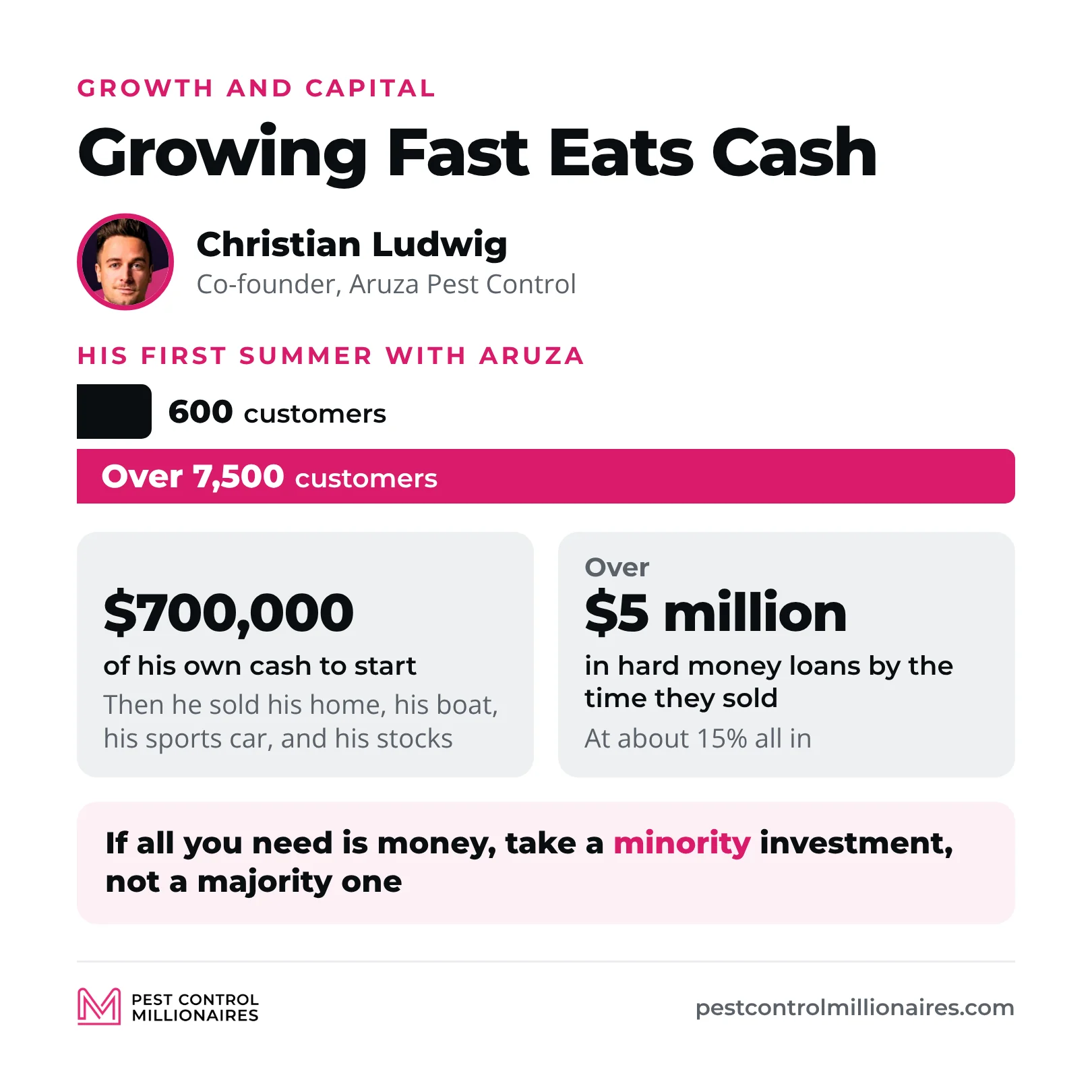
That’s the trap. The customer life cycle is long, so cash trickles in slow. He said it best when he described the early days as building a snowball and trying to get it rolling down a mountain. Hard to start, hard to control once it’s moving.
In the end the sale came down to capital. They needed a big equity injection to keep growing the way they wanted. The company was worth somewhere between $25 and $35 million, and he thinks with enough capital it could have hit $60 million.
His advice if you ever go this route: if all you need is money and you want to keep running your company, take a minority investment, not a majority one. You’ll make less, but you keep control.
Give 90 percent, not 100
This is the part where Christian got quiet, and so did I.
His partners exited fully. He stayed on to work for the new owners. And he pushed himself way too hard trying to please them. He did 300 rookie interviews in one off season just to prove he led from the front.
He told me about advice his uncle gave him years back. “Give 90% effort. Don’t give 100.” Because, as he said, “that last 10% will kill you. It will destroy everything.”
That’s exactly what happened. He sacrificed the gym. He sacrificed his home life without even seeing it happen. A week after he resigned, his wife left him. He didn’t even know it was coming.
When he talks about selling the company, you can hear it. “It’s like losing a baby, man,” he said. He doesn’t blame the PE firm. They were good to him. He put the pressure on himself. That’s the warning for guys like us who go a thousand percent or not at all. The drive that builds the company can wreck everything else if you let it.
Door to door belongs in every company
Even after everything, Christian still believes in the knock. “Door to door is a strategy every company should have and retain,” he told me.
But it only works if your reps are ethical. He trains people to never lie. Good door to door plus a strong brand means low attrition and good reviews. Bad door to door means churn and one star reviews. Same channel, totally different result.
The door is wide open right now
Here’s the hopeful part. All the private equity money flooding in has bought up the good mid-market companies. That sounds bad for the little guy. Christian sees it the other way.
Those big rollups often lose the brand magic. He pointed to Killingsworth in Charlotte. They were everywhere. Billboards, trucks, customers who loved them. After they sold, the billboards came down and the trucks thinned out. It got easier and easier to switch their customers over.
When the giants stop caring about the hometown feel, that’s your opening. A good local operator can knock doors for a bit, build referrals, and spin up a very profitable company. Christian said the consolidation that squeezed the middle has actually lifted the floor for sharp operators.
He also dropped a great market lesson. For years most door to door companies wouldn’t touch North and South Carolina. The reason was the exit. Terminix used to be the buyer when companies sold out their customers, but the Carolinas had a Terminix franchise that didn’t acquire. No buyer, no entry. That left those markets wide open, which is part of why Aruza grew so fast there and sold for such a strong multiple.
What I took away
Christian’s been to the top and back. The stuff that stuck with me wasn’t the eight figure exit. It was simpler than that.
Build your talent into a real skill. Knock early. Obsess over your brand. Watch your cash. And don’t give that last 10% that costs you everything outside of work.
Thanks for coming on, brother. Proud of you.
Watch the PCM Podcast on YouTube