Phil Rinehart’s Legal Playbook for Pest Control Owners

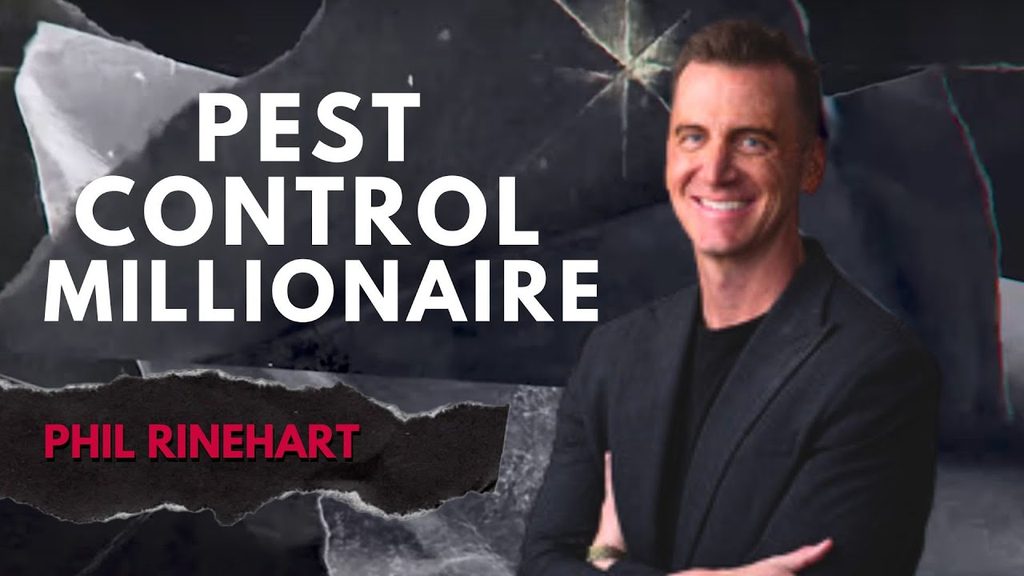
Table of Contents
- The three contracts every company needs
- The fine print that can bite you years later
- Employment contracts beat auto insurance
- The $1,000 a day review story
- Your biggest threat is your own team
- Agree on the buyout math before you need it
- Cover your trucks, then split your risk
- Fire with a reason. Hire with care.
- A few quick ones
- The kind of lawyer worth having
I chased Phil Rinehart for two years to get him on the podcast. Every few months I’d ask again. He finally said yes, and it was worth the wait.
Phil is a rare mix. He started selling pest control at 21, back in April of 2000. That’s 25 years in this industry. He still runs a pest control company today, and he’s also a lawyer for pest control companies all over the country. He’s worked with hundreds of operators, so when he talks about legal risk he’s not guessing. He’s lived it from both sides.
Here’s what stuck with me from our talk.
The three contracts every company needs
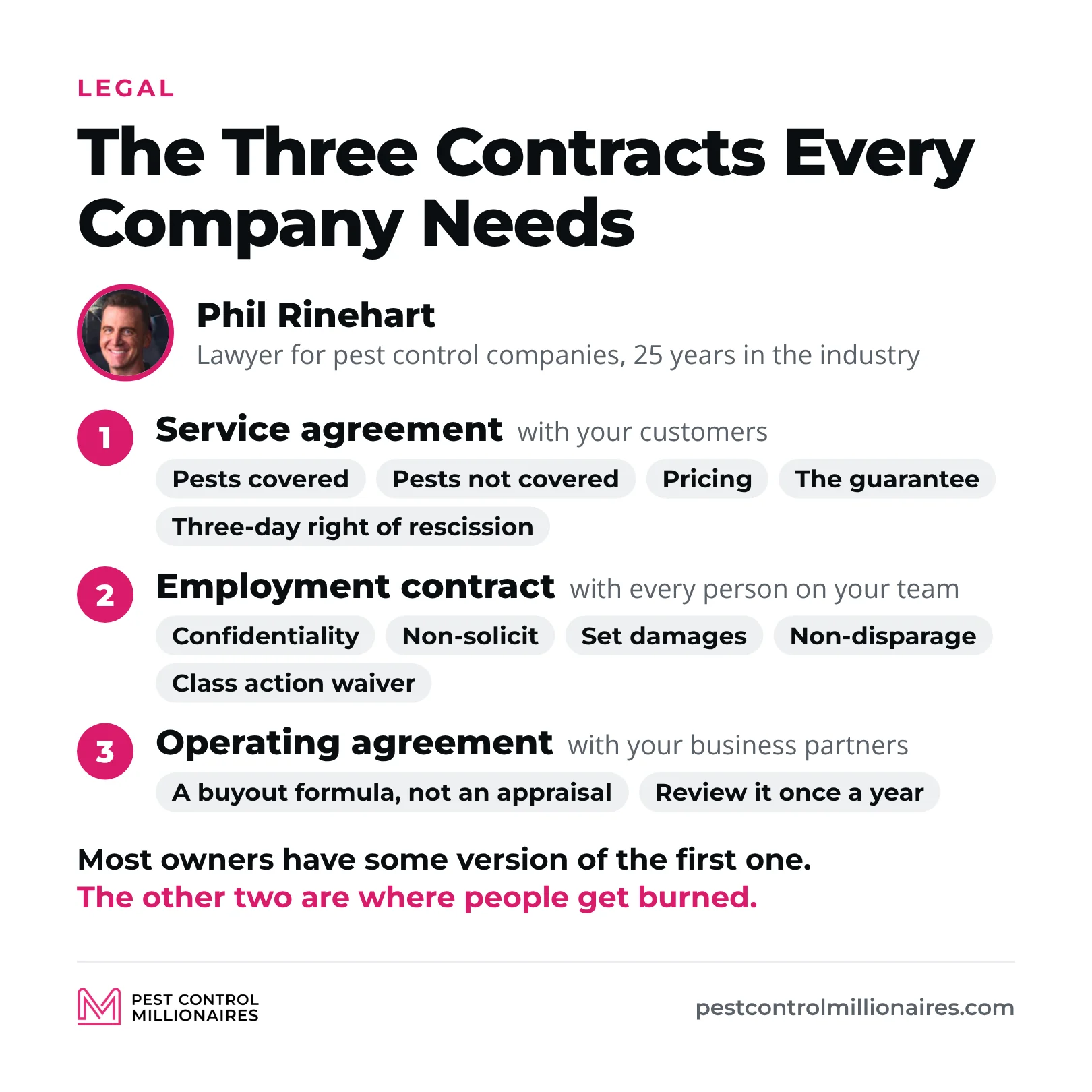
Phil says most legal pain comes from missing paperwork. He breaks it into three contracts.
A service agreement with your customers. An employment contract with every person on your team. An operating agreement with your business partners.
A contract doesn’t have to mean locking customers in for a year. It’s just a written record of what you’ll do and what you won’t. Pests covered, pests not covered, pricing, and the guarantee.
Most owners have some version of the first one. The other two are where people get burned.
The fine print that can bite you years later
Here’s one that scared me. Most states require a three-day right of rescission. That’s a notice telling the customer they can cancel within three days. It’s the law, and you can get fined for leaving it out.
People think it only applies to door-to-door sales. Not true. Say a customer calls your office and you quote them on the phone. Then a tech finalizes the paperwork at the house. Phil said states treat that as a door sale, so the three-day right still applies.
It gets worse. Phil has seen a state regulator force a company to send that notice to every customer who never got it. Any customer who used it could cancel and ask for money back, even customers served for years. Think about that number for a second.
Employment contracts beat auto insurance
Phil didn’t hedge here. “I would probably rather you and your employees drive your vehicles around without insurance than have your employees working without employment contracts,” he told me. “That’s how strongly I feel about employment contracts.”
That’s a wild thing for a lawyer to say. He meant it.
A good employment contract has a few key clauses. Confidentiality keeps your customer list and your systems private, during the job and after. Then comes the non-solicit, which Phil says matters more than a non-compete. A non-compete blocks someone from working in your market for a year or two. Phil isn’t a fan, and the FTC even tried to ban them.
A non-solicit is different. As Phil put it, “You can leave and work and make a living. Just leave our people alone.” Don’t take our customers or our employees, and don’t trash us online.
Then add a set damages clause. You agree up front what a breach costs, maybe $1,000 for every customer taken. Now you never have to prove damages in court. The number is already on paper.
I just heard a story like this from a friend in the cleaning business. A couple of his techs left and took a pile of customers with them. They had the face-to-face relationships. This is exactly what a non-solicit is built for.
The $1,000 a day review story
Phil told a story from his own company. He let a tech go for poor performance, and the guy posted negative reviews on Google. Phil’s contract has a non-disparage clause that pays $1,000 per breach, per day.
So he called the guy. “I’m going to give you the option to remove those reviews and I’ll let it go,” Phil told him. “Or if you choose not to, I’m going to come after you for breach of contract and $1,000 per breach.”
The reviews came down, and he never heard from the guy again. The goal was never the money. The goal was the result.
Your biggest threat is your own team
This one surprised me. Phil says the biggest threat to your company is a class action from your own employees. Usually it’s wage claims, like missed breaks or overtime paid wrong.
One employee might only be owed a few thousand bucks. Not worth a lawsuit on its own. But a lawyer can round up every employee from the past few years, and together that becomes a huge number.
The fix is a class action waiver in every employment contract. Phil pointed to Elon Musk. When Musk took over Twitter, employees tried to file a class action. A judge in San Francisco threw it out because of the waiver in their contracts.
And check your overtime math. Phil said companies get sued for paying overtime the wrong way, not just for skipping it. Some states add fines for every single violation, and he called California horrible on this.
Agree on the buyout math before you need it
Phil compared partnerships to a marriage. Nobody has to be the bad guy. One partner wants to grow while the other wants to pull cash out. A few years in, they want out, and with no operating agreement it gets ugly fast.
Can you fix it once the fight starts? “It’s like getting insurance after the accident,” Phil said.
His buyout advice was the most useful part for me. Skip the appraisal. Appraisals cost a lot, they’re one person’s opinion, and partners argue with the result anyway. Use a formula instead. For example, take trailing 12 months of revenue, times your ownership share, times a discount for the age of the business. The exact formula matters less than having one. Plug in the numbers and you get the price. No fight.
Review it once a year as the business grows. And get one even if you’re solo. A bank asked me for ours once, and I was glad we had it.
Cover your trucks, then split your risk
Phil has seen injury claims hit three to five million dollars. If you carry a one million dollar policy, your company eats the rest. He says to carry several million in auto coverage, or a million plus an umbrella policy.
Then go a step further. If you run door-to-door reps, put them under a separate marketing company. You can even hold your vehicles and employees in one company, and your customers and revenue in another. A simple service agreement connects the two. If a big claim hits, it lands on the company with the trucks, not the one with the value. Customers never notice the difference.
The risk out there is real. Phil told me about a rep who was shot in the stomach while knocking doors a few years back.
Fire with a reason. Hire with care.
When you let someone go, tell them why. Phil was clear on this. If you don’t, they fill in the blank themselves. Often the blank they fill in is discrimination, and then they call a lawyer.
Here’s the part I didn’t expect. “Nine out of 10 wage claims start with a wrongful termination consult,” Phil said. The lawyer looks at the firing and finds nothing. So they ask for the pay stubs, and then they find the overtime mistake. A clear exit talk, signed on paper, can stop that chain before it starts.
On hiring, keep certain topics out of your mouth. Age, race, religion, national origin, marital status, and gender. Not just in the interview, either. Phil warned that small talk counts too. The hallway counts, and so does the parking lot.
A few quick ones
Trademark your company name with the USPTO so you have rights in all 50 states. A guy came at us a few months back over a name close to ours. We had the trademark, and that ended it fast.
If you use subcontractors, check their insurance, including workers comp. If they don’t have it and someone gets hurt, it falls on you. Always use a written sub agreement too.
On 1099 versus W2, Phil said to just follow the rules. Yes, 1099 saves you about 15 percent in taxes. But some states now require W2 for door-to-door reps. And you can manage a W2 team tighter, which often means more production.
The kind of lawyer worth having
My favorite story came from a courtroom. Phil had clients working on their green cards, and the judge grilled them hard for over an hour. His client leaned over and asked if the judge was going to send them back to Mexico. Phil told her it would be fine. Fifteen minutes later the whole case flipped, and they won. His lesson: tough questions don’t mean a bad outcome. Stand in there.
That’s Phil. “I think actually a lot of lawyers maybe cause more problems than they solve,” he told me. He works hard to be the other kind. After five years of monthly calls with him, I can tell you he is.
So if you’re running your company on handshakes right now, don’t wait for the accident. Get the paperwork done this week.
Full transcript
Every word of the episode, from the video captions
Welcome back to episode 123, Pest Control Millionaire. I'm super excited about today. I think Phil and I have been working on this for a couple years at this point. I think I've been I've been asking for two years. Every couple months I' like, "Hey, Phil, you ready for this thing yet?"
He's like, "Dude, I don't even think you need an introduction at this point. I think everyone in the industry doesn't know who you are, especially the pest control space. Maybe not so much lawn care or other services, cleaning or cleaning things like that. But got one of my good friends today, Phil Rinehart.
He is CEO, founder of Ecogen Pest Control, but more known as a lawyer on the side of the world for everyone and pest control. And it's just the law of Phil Rinehart. Phil Rinehart's an absolute stud in the industry. Like I said, everyone pretty much knows who he is. I think all the big conferences you've spoken at. We got to meet each other. God, that was probably like five years ago at this point. And a friend, a friend that you were working with, I was looking for a service agreement or something.
Got us in touch. And he's like, hey, you got to reach out to this guy. And I was literally just starting. I was like, I got to reach out to Phil. And then here we are five years later. Look how much you've grown since then, Jonas. My goodness. Jeez. I'm still 5'7, so I didn't grow too much.
I'm not I'm not 67 like you are. Yeah. But welcome to the show, Phil. Thanks for being here with us today. Hey, thanks for having me. I'm excited to be here. Yeah. Yeah. How you doing?
No, I'm doing great. Yeah. Another busy year rolls on. So, how's the weather out here?
Well, back and forth between Salt Lake and Las Vegas. It's actually been probably one of the cooler springs, I would say, overall. Yeah. Still hasn't warmed up too much yet. But yeah, here either like I think the warmest day we've had here currently is like the other day it was like 65.
Like down in Apple was like 70, but then other than that it's been 40s. Been pretty rough. Lots of rain in April, lots of snow. Not fun. Yeah. Yeah. It seems like it's been a cooler cooler springs for sure. I feel like it's I feel like everyone's been saying that. Just a slow spring.
We're all busy so we're excited about that. But yeah, Phil, like first off, I always ask the same question and I probably know what your answer is, but if you and I were a junior in high school, who's Phil Rinehart in high Oh, well, I played I tried to play a lot of basketball in high school, so that that was mostly my focus was just playing as much ball as I could and trying to keep up with my folks demands on the grades.
So, which which didn't always go very well. So just trying to keep up with the classes and playing ball was mostly what I was doing in high school. So you're super competitive, I'm assuming. Yeah, I really enjoyed playing basketball and I didn't become a real good student until college. I mean, I was average in high school. You're a lawyer. Like I get C get degrees, but Yeah, that's right.
But still, like what made you what made you like after high school like that?
I wasn't really good at that, but I want to go to college and become a lawyer. Yeah, I think I just had much more focus when I got to college about the future and things and in high school, you know, nonacademic things were much more of a focus like well, you know, sports, you know, playing basketball, hanging out with the friends, you know, you know, all that stuff. Yeah.
My stepson just came downstairs. He's playing baseball at Lakeland and he was kind of the same way. Like B's and C's, super smart kid. B's and C's throughout high school, goes into college, always. Good for him. I mean, he'll be successful. The grades I don't know. I think it's an overrated thing. I have a lot of opinions on that. In fact, my folks asked me the other day how my how my son's grades were. He's in seventh grade and I was like, I don't know. I don't really care to be honest with you. It's a total diversion from my upbringing. As long as he passes these classes and graduates, I don't really care how his grades are. I don't think he's going to make a living based off of his grades.
So I don't really care. Well, so I'll ask the same question back to you then. What about college?
How do you feel about college these days? Well, I mean a lot of thoughts there on the college thing too. I think there's certain things you know if you want to do you need to go to college you know being an attorney or a doctor or number of things but I also think college does not take a lot of kids where they think that it will in terms of career and that you know a lot of a lot of people will spend a lot of time and money in college and not really graduate with a lot more opportunities than they had maybe even prior to college and maybe even worse off if they're running up debt and things. So, I don't really subscribe to college being for everyone. I think it's better to develop skills, the trades, trades, skills, be it sales or otherwise or even even whatever it is, laying tile, any skill, I think is going to be more valuable than just a general college Sure. So, what makes you want to be a Well, I grew up with a lawyer and you know, I was around that growing up a lot.
So, I think my mindset w was in that space for for many years growing up. There's a lot of things I like about it. I like problem solving and especially what I do now. I really like working with with companies and I like working with especially small businesses and in particular pest control businesses.
So, it's a good fit for me in that regard. And I think there's a lot of things as an attorney that that I don't particularly enjoy. I think some of it is destructive as far as the litigation goes, but I really like win-win scenarios when when both sides are happy. That's those are the types of situations I like to be in. Yeah, I could imagine that. I know I've talked to you a few times. He's got out of court and pretty fired up. So, it's got to be kind of fun at sometimes, too. I got to say some of the trials can be a little bit competitive and it almost has that, you know, championship game type of feel to it. You know, there's some intensity. You got to think on your feet a little bit. There is some of that that I enjoy, but I think a lot of it leading up to it is expensive and destructive and not overly productive for both sides. I was like a picture. It's like Matthew McConaughey and like what is it like Lincoln Lawyer or something up there just slugging deals. So then how do Okay, so you graduate college and then you go to practice then where does pest control come along?
Well, you know, pest control came into my life well before law school. So yeah, when I was 21 years old I started selling pest control in Sacramento actually even prior to that in kind of in the Bay Area in 2000. Did you get recruited like recruited out of college?
Yeah, I had a brother brother going to sell and so looked like a good good summer job and so that was my entrance into pest control was in April of 2000. I mean 25 years ago and then I just stayed I fell in love with the industry and have stayed in the industry ever since even through my undergrad and through law school in Las Vegas. I was working with a pest control company there.
And then when I graduated from law school, I went straight into pest control full-time and my legal career as well, just kind of juggling both. And some of my law school colleagues thought I was crazy to continue in pest control.
But I've never looked back and love the industry and been in it for a long time. Take us back 25 years ago. What was like knocking doors 25 years ago?
You know, I don't know that it was so different than than it is now. Except we have apps now. That is true. We carried the clipboard and a piece of paper and we had those next phones that that had the little two-way radio on it.
And I remember after three or four years, the text messaging kind of came into play. But yeah, I all all of the technology has certainly advanced a whole lot, but I don't know that the human interaction side has has changed the whole time. Yeah, for sure. What about as far as pressure goes, the door knockers?
It seems like it's increased a lot over the years. Yeah. I remember I remember having some conversations back in those years, you know, like this is a great great thing. Can this continue?
And here we are 20 25 years later and it seems to be going as strong as it ever has. Yeah, I agree. And there's a lot of reps out there. That's for sure. Oh, yeah. Everywhere. Like in every industry, too. I thought at one point it's going to slow down, too. But I don't see it slowing down unless something comes down the pipeline where they say we can't do it anymore. Do you ever see that coming?
There's some of that around. You know, there's some restrictions on that, but it doesn't seem to have slowed anything down. Boy, I mean, and hats off to the companies doing door to door to door sales. I think it's awesome. I mean, I think if they're doing it the right way and talking to people properly and presenting things properly, it's a great way. It's a great thing. Yeah, I agree. It's fast, right?
It's expensive, but it's fast. And but it's hard skill, but it's a great skill to learn. I tell you this, it's got a lot more expensive. You know, that's maybe a big change. You know, the companies are paying these reps are making such a high percentage now. Back in those days, you'd maybe start on a progressive pay scale at 15 or 18%, maybe work your way up into the 20s or 30s, and now it's two or three times that. For sure, I agree with that. I see that all the time.
Are you sick of paying marketing agencies and not getting results? Well, we are hosting the number one step-by-step class on how to attract and generate sales without paying marketing agency or having a huge budget. Most lawn care and pest control owners get stuck at a ceiling because they're dealing with outdated systems or relying on guesswork waiting for the phones to ring. Our upcoming class this Thursday provides proven strategies to generate hundreds of leads without a huge budget. We'll show you how to build a predictable system to grow past a million dollars. We show you how to automate your marketing. We'll also teach you how to delegate and build your team so you have more time. So, click the link in the description below. Trust me, you're not going to want to miss this. This is the one thing that I wish I had learned a lot sooner. Now, let's get back to the show. So, just starting out in pest control though, like where do you see like the most operators fail on the legal side of things?
Is there like right out of the gate? In terms of operators, having worked with a number of operators, maybe hundreds over the years, one big area of weakness, I think this hurts a lot of operators, is maybe on the contract side in terms of maybe not putting proper agreements in place with there's maybe three categories, Jonas, that I view as really important to have contracts with as an operator. One would be with your customers.
You want to have a good service contract with exactly what you do, what you don't do, as well as terms conditions. The second one being with employees. I am surprised still how many companies hire employees and pay employees kind of on a verbal basis as opposed to putting a good employment contract in place.
And then the third one would be with your business partner and that would be typically in the form of an operating agreement. And I'm surprised on this as well, how many how many individuals will get into business together and everything's fine and great and they're excited and all these great plans and you fast forward oftentimes just a couple of years and they don't want to work together anymore and they're trying to get out of business together and that can be challenging if they haven't put an operating agreement in place.
For sure. Let's walk us through each one of those. I personally have worked with you and all three of them, so I know what it's like. And we've actually had to go back on some recently, right?
Especially with employee agreements. Not afraid to say that I'm not going to say names, but it's imperative to have these things for situations like we ran into, you know. Yeah. In terms of customer agreements, and it doesn't necessarily have to be like a hard copy. It could be, you know, on the iPad, but it's important that every company have be pest control landscape.
Yeah. When we say contracts, it doesn't mean like, you know, quote unquote contract, but like an agreement. Yeah. And it's important to clarify as well, you know, a contract or an agreement does not necessarily mean that the company is locking the customer in for a period of time, although that is often the case. It just simply means it's a written representation of what the company is going to do and what they're not going to do. You know, you know, typically have all the terms as far as the customer information, maybe the list of pests that are covered, likely some pests that are not covered, pricing and guarantee and so forth.
Where a lot of companies maybe could do a better job on this would be on typically the second page of the customer agreement where there's the fine print, the terms and conditions, and there's a lot that that needs to be in there. I'll tell you one big one is a lot of states require a three-day right of rescission and usually I get stopped here and told hey you know the three-day right of rescission only applies if you're doing door-to-door sales and it is true it does apply to door to door sales however states have also kind of looked at it where even if a customer is calling into an office for instance and requesting service if the company provides information over the phone and then sends say a technician out to finalize the paperwork and proceed with the service.
That sale is then considered to have occurred at the door and the 3-day right of rescission is still necessary. The 3-day right of decision is a is a disclosure that needs to be provided to the customer which tells them that this agreement can be cancelled within 3 days.
And it's a it's a statutory provision in most states or every state and you can you can get fined for not having that in your terms and conditions for sure. So which basically just in simple terms for us operators just like hey the customer wants to cancel they sign an agreement they're just going to mail in a letter saying that hey they want to get out of this thing. Correct. Email mail whatever. Yeah. And it has there's certain language that each state has. It's slightly different in each state and that needs to be in the terms and I tell you one scary thing here. I mean the I've seen this maybe in Ohio and maybe one other state is it can happen where a state regulator comes in and looks at a company if they provided the proper 3-day right of decision. They can then force the company to provide the 3-day right of rescission to all the customers and any customer then exercising that 3-day right of rescission would technically be able to refund or not be obligated to pay.
So you could have customers that have had services for years that weren't given proper three-year routision.
You're then forced to provide it and you could have a situation where you're on the hook for a lot of money back. That's crazy. Then moving on to like the next the next one. The next next three like you kind of talked about a little bit already too, but with your current employees, this is probably the biggest one. This probably probably the biggest biggest of the yeah, anytime you're doing any business with anybody, be it a customer or employee or a partner, I really, you know, advise I'm not giving legal advice. This is just No, you can't say that. Hey, I'm not a I was never even here today.
But really the company needs to have and it protects both sides but really needs to have a good employment contract in place with every every employee be it the technicians in the field office staff managers need to have a good and there's a number of provisions that need to be in that employment contract that we could talk through. This is this is an area of critical importance. Go for it. I got all night for you Phil. Yeah.
I've been waiting two years for this. Hey, I tell it's not for me. I get excited about this stuff. I really like this stuff because I think it's really really valuable. I mean, it's not always the most exciting stuff to talk about.
Like the con the contract stuff. Yeah, but we could we can literally save someone's business right now on this podcast or many people. Well, we could talk I agree. We could talk through some scenarios. I mean, if you're oper if you're listening to this and you operate a business and you have employees and you don't have you don't have contracts in place with them, I would I'll tell you this.
I was one of them until you came along like, "Dang, Phil, we better fix this." I mean, we could talk through some risks with that. Like for instance, I tell I would probably I would say to that operator, Jonas, that's listening without employment contracts. I would probably rather you and your employees drive your vehicles around without insurance than have your employees working without employment contracts.
That's how strongly I feel about employment contracts. Tell me why. Why? Like deep. Let's dive deep in that. There's obviously you've seen a lot of things happen. Well, anemployment contract is going to protect the company for a variety of provisions. Let's talk through like one one for instance would be a confidentiality provision you need to have in your employment contract whereby the individual your employee has agreed to keep all the information about the company confidential. It's not to be shared. Be that your customer list, maybe your standard operating procedures, how you operate, that information needs to be kept confidential, not only during the employment but afterwards as well.
Another one would be a non-solicit. This might be the biggest one. And the non-solicit is often confused with the non-compete. We can make the distinction here where you'll often see a non-compete for instance would restrict an individual from working within typically a territory for a period of time after employment. Maybe a year or two. It would say, "Hey, you're not able to take a job in this industry in this area for a period of time after employment." I'm actually not a fan of non-competes. The FTC has attempted to put a ban on them, although it's hung up in court. Of more importance in my opinion is the non-solicit which says you can leave and work and make a living.
Just leave our people alone. Meaning don't solicit our customers. Don't solicit our employees. Don't don't solicit any anybody any contractors people we have here. Don't make bad reviews. And a non-disparage is another one. Yeah, you want to have a non-disparage.
We can talk about some some situations there. For instance, a non an unsolicited though quite often you'll see an individual, maybe a technician leave and start his or her own company. Awesome. I think that's fantastic. However, the company needs to protect itself in that there's a non-solicit in place whereby that individual is restricted from soliciting the customers that that individual likely has a better relationship with than maybe the company itself.
I literally just got off a phone call less than 45 minutes ago going over the same exact thing situation that happened to one of my friends in the cleaning industry. Big company technicians, couple of them left, took a bunch of their employ bunch of their customers.
Had this that conversation cuz he was servicing those customers, maybe had a face to face relationship with them. Yeah. Over a couple years time and then they decided to go off on their own. To a bunch of customers. You got to have this stuff in place.
You got to have the non-solicit in place to prevent I mean to prevent that. Well, I mean, you can't necessarily prevent it from happening, but if it does happen, you at least have grounds to protect yourself or maybe shut it down. And along with the a term that kind of attaches to that is a liquidated damages clause.
And a liquidated damages causes this is that if there's a breach, if you just have a non-solicit and there's a breach, you would need to typically determine the amount of damages that the breach cause and that can be challenging, you know, to figure out. So rather than having to determine the damages, you can put a liquidated damages clause in the contract that says, look, if there's a breach, we're not going to figure out what the damages are. We're just going to agree ahead of time what they are. So, as a for instance, a liquidated damages clause might say it's a $1,000 damage per breach. So, maybe every customer that's solicited it's $1,000. You can make whatever number you want, but it's just a predetermined amount of damages and that would be the remedy for the breach.
Gotcha. So, I'm sure you obviously been through these. So, what happens like that that employee takes some customers of yours?
Obviously, you can't get those customers back, but you're going to say, "Hey, you're going to pay me $1,000 for each customer that you took." Yeah. Under that scenario, I mean, the first thing you'd want to do is reach out to that employee and try to shut it down. Be it through a letter, a phone call, just try to work it out to where that employee that I mean, if you can keep the legal system out of it, my opinion is do that. That's a better first step to try to prevent that. Now if you go through that and all its fails, the company would have a breach of contract claim against that individual and they wouldn't have to go through this extensive discovery to determine damages.
They would rely on the liquidated damages caused. They just have to show the breach for sure. But then they're they're a new business of which those people typically probably don't have a lot of money to begin with. So then what happens?
Let's say they can't they don't have the money to pay you the thousand dollars per customer. Then what happens?
They could get a judgment and it was half and nothing. They could execute just keep that judgment alive and just execute on it as as much as you can for as long as you can. Typically though that that would the goal wouldn't necess the goal isn't necessarily to collect $1,000.
The goal is more to prevent the solicitation. Yeah. For them since they more customers. Right. Yeah. Right. Gotcha. And that can attach to that that can attach to a non-disparage clause. Look, I have personal experience with this with my company and with others where hey, you might have an individual leave, be it through termination or resignation, and okay, I'll give you for instance. I had a number of years ago a technician left, poor performance. We let him go and I noticed that he posted some negative reviews on Google.
And I talked to him and I said, "Look, man. I noticed you posted this stuff and I want to remind you about your non-disparage clause in contract and that you're in breach of that clause. And along with that, there is a $1,000 per breach liquidated damages attached.
And so I'm going to give you the option to remove those reviews and I'll let it go. Or if you choose not to, I'm going to come after you for breach of contract and $1,000 per breach. And actually, I think my contract under that scenario reads $1,000 per breach per day.
So, and he removed the reviews and haven't heard from him since. And that has that situation has played out with a number of other companies I've seen around the country as well. Again, the goal not necessarily being to collect on the liquidated damages, but more to get the result that you're after as far as non-disparage or non-solicitation.
Right. I agree. Now, going into the next one with the with the owners. Well, let me touch on one more on the employment contract, which is this. A big problem that companies face days, the biggest threat to your company, if you're listening to this, you're operating a company, the biggest threat is your employees in the in that they could gang up on you via a class action lawsuit.
And it could come for any number of forms. One typically is wage claims where they will claim that you did not pay them properly be that through breaks or overtime. And individually the employees may not have substantial damages. They might only have possibly a few thousand dollar each. Maybe individually it's not even worth them pursuing that. However, collectively it could be substantial.
And so one of the provision you need to have in your employment contracts is a waiver. This would protect you or prevent an attorney from subpoenaing all of your employee names and gathering them all up and suing you collectively for all that. The class action wave would would protect you from in fact when Elon Musk took over Twitter, a bunch of employees tried to file a class action and thankfully a judge in San Francisco disallowed the class action lawsuit based on a class action waiver in the employment contracts. So you have some good lawyers.
Yeah, it works. Got to have it in there. Every company needs all these. Yeah, I mean love your employees of course, but you also have to recognize that that there's some risk there that they can come back and bite you. Sure. And then switch on to operating agreements. I think this another big one. Yeah. The third category is, you know, if you're operating LLC, you'd have typically an operating agreement. If it's a corporation, it' be a shareholder agreement. But the function is the same in that when you're in business together with somebody, an operating agreement governs the entity, the ownership, and there can be some some management provisions in there as well.
I am surprised how many companies or how many how many individuals go into business together and it's kind of a handshake. It's kind of verbal and they don't have an operating agreement in place and it can usually be it's usually fine for a couple of years.
What ends up usually happening though is they want to get out of business together and it gets complicated. Sure. Do you need an operating agreement if you're should you have an operating is a question if even if you're just by yourself. I still recommend you have an operating agreement in place. Although it's my experience extensive is that it's much less important.
Sometime banks or the financial institutions will want to see an operating agreement even for a single member LLC but not as important as I view it absolutely critical if you're in a partnership. Yeah, that's why I asked because they one of the banks asked me for operating agreement even though I was a sole ownership and we obviously had one so we had to share that's why I asked. Yeah. And a big provision in the operating agreement. If you're in a partnership, u it's not that your partner really does things wrong. It's just sometimes they maybe grow apart. It's almost like you're in a marriage and maybe one partner wants to grow and take fewer less distributions. The other partner maybe vice versa. It's not that any partner is really wrong. They maybe just have different views or goals for the company.
The result however is that they want to disassociate and so the disassociation the buyout provisions in an operating agreement are critical and I have you know some some thoughts on how to how to draft those so for instance a lot of them will have the appraisal method I think we've talked about this maybe at the conferences well I'll tell you so a lot of operating agreements will just simply says hey oh you know if we want to disassociate we'll get an appraisal on the business and I'm not a of that approach because oftentimes appraisals are subjective and it doesn't say whether they're appraising the minority or the majority interest or the full company and quite frankly appraisals are expensive and often times the partners disagree with the appraisal anyway. So what does it typically say in there then?
Well typically I what I would recommend for the dissociation would be a formula. So rather than appraisal is they pre-agree on a form. Hey, if we're going to disassociate, we're going to plug some numbers into a formula and it's going to kick out the disassociation number. So as a for instance, it might say we're going to look at the trailing 12 months revenue.
We're going to multiply that by ownership percentage and then maybe possibly a discount multiplier based on how long the business has been in business. The formula itself isn't as important in my opinion as just having a formula that is objective.
And you can plug the numbers in and kick out a buyout number. And then you can also update your operating agreements at any time, maybe annually as as the business grows or as valuations change, just update that. But I'm I very much encourage a formula as opposed to appraisal. How you say you see you recommend up you recommend updating them yearly, signing new ones?
Definitely looking at it yearly and as life and the business matures and seeing if that formula is still in line with the objectives of the partnership and the company. Gotcha. So when partnerships usually end and we've seen a lot of them end, what typically happens there?
Do they what does one person buy out the other or do they typically just sell as a whole?
No, I mean oftentimes partnership disputes are are involve one partner wanting to stay and one wanting to go and the big disagreement being on valuations. But if there agreed terms upon like you said with an operating agreement that there's no it's there. So that's why we have one. That's right. The way it would work is if a partner wants to dissociate, you simply plug the numbers of the business at that time into the formula in the operating agreement and that is the number. It's objective.
And then if a partner doesn't want to comply with that, then there's a breach of contract of the operating agreement. That's how you would resolve that situation. So what happens there?
There's a breach of an operating agreement. Yeah, you could force the you could just force the sale in terms of a breach of contract claim that there's an assassociation event and here's the formula. Here's the numbers we plug in. This is the buyout as opposed to an appraisal where it's subjective. Is it a qualified appraisal?
What are they appraising? And they disagree typically with the appraisal anyway. Or even worse, they don't have anything in place, right?
So, you're going to go off the operating agreement and that person null and voids the contract like you said, you're still going to pay out that like that what it says on the evaluation or he doesn't get how does that work?
Well, if there's a if there's an operating agreement in place and an individual is disassociating that individ if they've agreed to the operating agreement and has a formula, they would be obligated to comply and follow what's in the operating agreement. Otherwise, they're in breach of the contract. Right?
So then they breach on the operating agreement, but then what would happen after that?
They be like, "Okay, they breach operating agreement." Do you still pay the guy out, let him walk away, or does he not get anything at that point?
Well, it the departing partner would would typically need to sign an assignment of the shares over and so if he or she's will, you know, not willing to do that, then you could you could get into court and force force that issue based on breach of the contract. Yeah. Yeah. It doesn't sound very fun. Well, that's not fun. But it's much it's much easier to resolve those situations when you have a written contract in place you can point to as opposed to just nothing in place. They have nothing in place now, go get one. Obviously, get as soon as you hear this. You reach out to Phil, blow up his email.
And but then if they have if they don't have one in place and they're already going through it, what can you do?
It gets tough. I mean, it's like getting insurance after the accident. I mean, it's probably too late to put an operating agreement in place if you're in if you're in a dispute. You probably just have to work it out otherwise.
But yeah, if you're if you even if you've been operating for a while and you don't have an operating agreement in place, you don't necessarily have to put one in place when you start the company. You can put one in place at any time. Very smart to do.
We'll move on from there, but you've seen some crazy things. I asked you before the podcast, what has been some of the craziest things that you've seen when it comes to the legal side of pest control or service industry?
Oh, well, I mean, there's so many stories that that come to mind. Ones that you're allowed to talk about. Well, I think the auto the auto insurance is a really really big area. Well, for instance, you need to have enough insurance on your vehicles where if there's an accident, sometimes the damages can exceed the policy. So, for instance, if you have a, heaven forbid, a death or a really bad accident and there's several million dollars in damages and you have a million- dollar policy, your your carrier might just pay out the policy and the company is still on the hook for the remainder of the damages in excess of the policy. So, you want to make sure your coverages are as high as possible, probably several million dollars in auto coverage or a million with the umbrella policy.
And if you're using door-todoor reps, here's here's another thing I'd recommend is you create a separate company. This is important. Meaning your door to door reps do not work for your pest control company. Yeah. So you might create a marketing company, have your reps work for that company. So if there is an accident then your pest control entity is protected in that regard. Didn't you at one point talk about having your vehicles on a separate insurance policy too?
Is that what you said? A customer list or something like that? Yeah. Again, that's another thing that that we I've set up a number of times is you can if you want to be extra protective of your pest control entity vehicles is a huge risk.
You can't actually have your vehicles and your employees kind of under a separate entity. So all the value of your business is in your revenue and the customers and so you can hold that under one entity. And yeah, if you want to be extra protective, you can create a separate entity that holds your vehicles and your employees and they work for that separate entity, but it's a separate entity than the actual revenue collecting entity. And there's just a simply a service or a management agreement between the two companies.
Customers don't really know the difference. But if you had a situation where you had a significant claim, be it vehicle or employment or otherwise, those claims would have to fall on the entity that the individual works for or that owns the vehicle. And if you separate that from your pest control entity, you can protect the value of that company. That just gives you another layer of protection.
Yeah. So, any any crazy stories that you can tell us when it comes to the auto side?
Well, I mean there's a number of there's a number of high high dollar claims. I mean, not even deaths, but there's a number of claims that are three to five million maybe for significant injuries, be it back injuries or otherwise.
And those are scary, especially if you only have a million dollars in coverage. Door to door reps. I mean there was a door-to-door rep shot in I think Oklahoma a couple of years ago shot in the stomach. There's been a number of deaths and it's not just injuries to the reps. As bad as that is, it's also, you know, door to door reps or even anyone driving a vehicle causing injuries to others.
And when that happens and they're under the scope of employment, that can fall on the company. Craziness. You brought up W or you brought up door to door reps. So, this is a good topic to transition to from like W2 to 1099.
You see a lot of people maybe having 1099 reps but not paying them correctly or vice versa, W2 with overtime, breaks, things like that. Chat about that for a bit. Yeah, that's a big one. I mean, particular on the on the door-to-door side, that's been a topic for a number of years is especially in a few new states, right, with a couple new laws coming out and some states require those door to door reps to be W2. Florida in particular, is there Florida?
Was it Oklahoma? Is it Kansas City and California? I think Georgia might be in that mix or maybe North Carolina in that as well. Okay. Yeah, I think you're right. North Carolina. North Carolina. Yeah. I mean, my advice is always just to follow the rules and, you know, if you're exert and actually here here's the job.
On the W2 1099, I think it's heavily viewed as being more favorable to the company to pay 1099. And I get that because the company is saving 15%. They're not paying the self-employment tax and the Fedicare, the Fed, the FICA and Medicare matching and all that. I did all of that, but at the same time, as a W2 employee, you can, you know, manage those individuals differently than you can manage a 1099. I think there's some advantages to that. Whereas a 1099 is technically supposed to keep their own schedule.
Whereas a W2, you can really kind of manage tighter a W2 individual and arguably get more production. So, I don't think companies should necessarily be be scared or frightened from paying individuals as W2. So, I think there's some advantages to that, but overall, I recommend just following the rules on that and not trying to get around it. Sure. What about like the overtime thing?
Have you seen I'm sure you've seen a lot of situations where people were put on a salary but weren't technically a salaried employee, were working overtime, but they worked 68 hours a week. Have you ran into that ever?
Yeah, overtime is a huge huge problem right and not just companies not paying the overtime, but also paying overtime improperly or calculating the overtime improperly. That that's one. And this ties into what we talked about earlier. If you're going to get a class action lawsuit, it's very likely that overtime is going to be part of that or maybe the reason for that.
And it's not just if you're if you're calculating your overtime wrong, it may not be a significant difference. For instance, you might be slightly underpaying certain employees and that can be costly. However, a lot of states also have statutory penalties, meaning you be penalized.
California, for instance, horrible. You be penalized a certain amount for every violation, and that's where it gets expensive. Gotcha. We talked a little bit about this before. Maybe you talked about it in one of your one of the events too.
Trademarks. Yeah, trademarks is another area where if you want to protect your company name and you want to have rights to use that name throughout the country, I would recommend filing a trademark with the United States Patent and Trademark Office whereby you kind of have the rights to use that name in all 50 states.
Definitely recommend that. We ran into a situation like a couple months ago. Guy reached out to us kind of the same thing but we had the trademark and there wasn't much he could do about it but again small solo operator wasn't quite the same name a little bit different but thank god we had it you know is there any like legal risk that could take a company down like overnight even if it's big or not that there's some major watch outs terms of the legal side I overnight would be tough I think actually a state regular regulator would probably be, you know, maybe more of an overnight risk if you're not in compliance with with certain maybe application.
Those would be maybe I would actually be more scared of an agg or a state regulator coming in than the police if they have power over your licensing. I will say the bigger that you get, the more eyeballs you attract.
That that's one that you absolutely need to be dialed in on in terms of all the all the requirements on your on your equipment paperwork in terms of state license. But in terms of broader civil issues, the items we talked about are are really important. The insurance critical as well as the employment contracts, these class action lawsuits are the real deal and they can be they can be costly, especially if you're at any side, any scale.
You're gonna you're gonna have a number of employees and they go back a number of years on those and those can get very costly. Have you ever seen someone get shut down because from the department of egg?
You do you do see not necessarily the company get shut down but maybe licenses get suspended and then it can be a scramble if they don't have a backup license. Have you ever seen stories like that?
Yeah, that that's scary. It really is. Oh man. Oh jeez. Yeah. They part like you said you attract more eyeballs the bigger you get and they just really watch. Not just one location, all very closely. Is there there's got to be some really good stories that you can tell us that you've ran into.
I just want to hear a courtroom story. That's all I'm trying to get out of you. Like I want to see this like a litigation story that I know you can't really talk about a lot of things, but it just be fun to hear when Well, I tell I mean I was recently in trial. I don't know as pest control. I had some very nice clients and they're they're working on some green cards and the jud trial all afternoon and the and the judge was coming down on us heavily and you know she was really just crushing. It went on for maybe an hour or more.
And I remember my clients leaned over to me at one point and they said, "Uh, it was going so poorly." and she said, "Uh, hey, Phil, do you think the judge is going to deport us back to Mexico?"
And you know, I was shaking there, worried about the situation. And I said, "No, no, I assure her everything would be fine that it was." And then within the next 15 minutes, the entire case shifted and we came out on top. The judge ruled in our favor and it was just the most amazing outcome. It was just the most dramatic turn of events and they were so thrilled and I just kind of thought, you know, I think the judge was really questioning us heavily because she wanted just to just to kind of test us and see how we would respond to all that. And I think we passed all those questions, but really she was maybe leaning our favor, but she wanted to put some pressure on her decision and I think we passed that. So if you have somebody come in and they're questioning you heavily, just go through that process and it doesn't necessarily mean you're going to get a bad outcome, but just withstand it and it could be a really positive outcome. What about subcontractors?
Here's the thing with subcontractors. If you're going to subcontract work, you need to make sure that subcontractor has proper insurance in place because otherwise it will fall on the company. For instance, workers comp is one you need to make sure is in place. So if an individual gets hurt on the job, even if they're a subcontractor, you need to make sure that subcontractor has proper insurance in place. Otherwise, that will fall on you, the company that's subcontracting that work out. Yeah. Smart.
Should you have a subcontractor agreement in place, too? Always have it. Yeah, I always have an agreement in place, what they're doing, what the pay is, scope of work. I feel like I've lost I've asked a lot of questions and I and I don't want to miss anything is what I'm saying. You know, I just really don't. Is there anything that's big ticket item that we should talk about that you have written down or you were thinking about that I just sp my head?
I'll tell you one that that comes up a lot is termination. You know, the hiring, the firing, but more so on the firing. When you go to terminate an individual, you know, the question I get asked a lot is, you know, should you tell that individual why And my advice on that, even though I'm not giving advice, my recommendation is it is a good idea, allegedly, you It is a good idea to inform that individual why you're terminating him or her. And the reason the reason I say that is this is if you don't inform as to why you're terminating, that individual might get the wrong reason in their mind as to why they were terminated. And that can lead to maybe that individual thinking they were terminated for a discriminatory reason.
And if that individual consults with an attorney, that attorney might determine that the individual was not terminated for discrimination. However, nine out of 10 wage claims start with a wrongful termination consult. So that attorney will then say, "Hey, but you know what?
We don't think you were terminated for a discriminatory reason, but why don't you bring all your payubs in and let's have a look at the overtime. Let's have a look at the breaks. Let's have a look at how their employment practices are and let's start rumaging through all that and then they find that there's maybe a miscalculation of overtime or breaks or so on and it leads to a way it doesn't lead to a wrongful termination claim but it leads to a wage claim and that would all be prevented if there was communication at the time of termination. Here's why we're terminating you all the reasons.
And that would typically maybe prevent that individual from consulting an attorney about a wrongful termination claim. Whereas if you do if you don't tell them, they don't know, they can get all sorts of thoughts in their head about that.
Yeah, that's smart. And just do that on your exit interview. Just kind of explain what happened and where you're coming from and get it signed in paper. And that's it. And on the hiring side, you know, there's things you do not want to talk about in the hiring.
You don't want to talk about age or race or religion or national origin or marital status, anything like that. And not gender, gender, big one. Don't want to talk about that. Not that people sit down and ask those questions directly, but where it usually comes up is in the small talk.
You know, before, after where you think it's informal, you think it kind of doesn't count. It's hallway, it's parking lot talk, tell about your family, so on. That still counts. So, you need to be careful in your hiring practices that that you're avoiding those topics as it can be viewed as possibly discriminatory.
Awesome. I have a personal question. Yeah. How was your first few years on the doors?
First year was at first it was a little rough. It took, you know, quite a learning curve. But after that, I knocked it out of the park. Did you?
Yeah. I was literally Yeah. Did you enjoy it? I loved it. Yeah, I did. I worked at Clark. Clark maybe had I don't know, maybe 140 sales reps those units. I finished second. Wow. Oh, just finished like n so long. Hey, you know, just put the time in. Just talk to people. Just talk. For sure. Yeah. When's the last time you've knocked the door?
It's been a little We should go do it together. That's Hey, I would love that. Just for fun. I'll come up to Arizona or you can come to Wisconsin. I think it'll be easier over here. I'll come to Wisconsin. Let me see a cold weather sale there for sure. We've done them before. I think the coldest one's like been negative 13. No way. Yeah, that's a record that we someone holds. I can't remember. I think Christian holds it, but yeah, that's a cold one.
I still remember the house and everything that was it was it was cold for sure, but they still had issues. Yeah, still bugs in that or he was just really good. I'm not not sure, but they bought he's a doctor and they called us. It's pretty cool.
What's the next 3 to 5 years look like for Phil? What's your plans? Retiring soon. No, no, I'm more of the more of the same. You'll continue to grow and you know, I really enjoy working. I mean, really, I think actually a lot of lawyers maybe cause more problems than they solve.
And so I at least I view myself maybe as a little bit differently. I try to be a problem solver. I try to make people's lives easier, better. I'm passionate about helping companies and I really am. Yeah. I know. I mean, I've been working with you for five years. I talk to you at least once, twice a month. Yeah. And I enjoy I love I love those conversations and I take a lot of them. You know, I'm an operator as well. You know, I'm in I'm in those shoes. I think that's a different perspective. I know what it's like and my goal is really to protect companies and help companies be successful.
That's really what I enjoy doing and that's what I'm passionate about. So, I hope just to continue doing that for a long time. Yeah. Are you much of a reader, documentary guy, podcast guy, what are you?
I do like to read. And I like podcasts, too. Yep. Driving. That's What are you What are you listening to over there?
Well, I like books, you know. I like podcasts. All the industry podcasts I listen to. I'm big on those. And then books, you know, any any good books you recommend?
You know, a good one recently that sticks out is who not how, you know, as far as, you know, you presented with a situation, it's how am I going to handle this?
Instead of maybe sh you know maybe shift my mind into and instead of feeling like you're imposing on somebody it can actually create opportunities for other people. So I that one stood stood out to me. Yeah. What about for the for the pest control business?
What's your plan with that? I just keep keep growing and keep you know that that I really enjoy as well and love being in the industry. So you know it's not a conquer the world type of situation but just continue to operate and grow.
Yeah, that's awesome. I love that you do both. It's so cool. Like you said, like you know the industry so well. You've been in it for 25 plus years. You own and operate a company and you're lawyer on the side of for us. So, it's pretty cool. So, we all appreciate you. I appreciate it. No, I appreciate being on. No, and all the content that you share, Jonas, is awesome. Great service to the industry. I appreciate it. Well, Phil, it's an hour. I told you I'd only keep you an hour and we started a little bit late, but again, thanks for your friendship. I appreciate you. All the things that you've done for us as a company, all the things that you've done for the industry as a whole, too. And thanks for hanging out with us today. Awesome, man. It's been my pleasure. Thanks for having me on. Yep. See you later.
Hey guys, thanks for listening to another episode of Pest Control Millionaire. We don't charge any money for the show, obviously, but the podcast isn't free. You can pay for the podcast by sharing it with your friends and your family. So, please like and subscribe and give us a five-star review on your favorite podcast app. These things make a huge difference for us. If you have any specific questions you want answered about the business or your life by me or my guest, send an email to info at pestcontrolmillionaire.com.
And if you want to get in touch with me about any personal business coaching, check out our website at ww.pestcontrolmillionaire.com. Thanks again for listening and I'll see you guys again on the next one.
Watch the PCM Podcast on YouTube