Lenny Gray on Why Door to Door Is Not Dead and How to Do It Right

Table of Contents
- Door to door is not dead, no matter what people say
- Why it has a bad name, and why that is unfair
- The upsides owners overlook
- You cannot switch a customer who feels taken care of
- How to handle a do it yourselfer
- Roots before branches
- What good retention actually looks like
- There is no magic market
- Hire four to keep two
- Beware the recruiter who promises the world
- Sales forces fail at the top
- Fail forward
- What separates the elite reps
- A few things I am taking with me
I have been looking forward to this one for weeks. Lenny Gray was a mentor of mine before he even knew he was a mentor. I followed him closely for three or four years before we ever talked, and now we connect every month or two. He wrote Door-to-Door Millionaire and More Door-to-Door Millionaire, he runs the D2D Millionaire training company, and he owns Rove Pest Control. The guy has been doing this for 25 years. So when he sat down with me, I just tried to soak up as much as I could.
Here’s what stood out. For more on going door to door the right way, see my conversations with Parker Langveld and Chad Louk, or browse every episode on the PCM Podcast.
Door to door is not dead, no matter what people say
I asked Lenny straight up if door to door is dead. “It’s totally dead, I’d never do it,” he joked. Then he made his real point. As he put it, “There’s still a lot of greenfield out there to just go crush it.”
He told a great story to prove it. He had a call set up with a guy who was sure door to door was a dying thing and there were no markets left. The weekend before their call, a door to door solar rep knocked that same guy’s door. The guy lives in Puerto Rico, of all places. And when he mentioned Lenny, the rep said oh yeah, I know Lenny Gray, I have read his books. So even the guy who thought it was dead got a live demo on his own doorstep.
By the way, the company name has a fun story too. Rove Pest Control is named after the Rove Beetle, a bug that hunts and eats other bugs. They had already picked the name. Then on a trip to Kenya, Lenny and his partner were brushing their teeth at an outdoor sink one morning, and a Rove Beetle walked right through the sink between them. They took it as a sign they named it right.
Why it has a bad name, and why that is unfair
Lenny was honest that door to door has earned some of its bad reputation. Any business that can pay people really well attracts some greedy and dishonest folks. He has even had competitors lie about his company. One rep went around telling Lenny’s own customers that Rove had been sold, so they just needed a signature to keep service going. Total fabrication.
But his take is that the bad apples are the loud minority. He used a referee analogy I loved. “You don’t know a referee’s name until the referee really messes up,” he said. The good ones just do their job and nobody thinks twice. Door to door is the same. The honest reps, who are the majority, go unnoticed. The problem now is that we live in a tighter, more connected world. One bad rep gets caught on a doorbell cam and shared to the whole neighborhood group in minutes. The good stuff never gets posted.
The upsides owners overlook
I asked Lenny for the real benefits at the owner level, and two stood out.
First, it opens up an untapped market. Everyone is fighting over the same leads from TV, radio, billboards, and SEO. Door to door reaches people who were never going to call you in the first place. Different customers, less competition for them.
Second, and this is the one I see every day, route density. With online leads you might get five calls in one morning spread across five different cities. With door to door you can work for a few hours and get five sales within a block of each other. We have neighborhoods where we just park the truck all day and never move it. That is huge savings on fuel, wear and tear, and windshield time.
You cannot switch a customer who feels taken care of
This was the heart of the switchover conversation. Lenny said price is not even close to the main reason people switch. As he put it, it’s “top five, it’s not like the top one.” What keeps a customer locked in is the relationship and the service.
He painted it perfectly. If a customer tells him they have been with their company ten years, their tech Joey is the best, and they can call the office and Nancy always picks up, he is not switching that account. He could offer it for free and they would tell him to take a hike. So the way Lenny trains it is not the rookie move of walking up and saying your company stinks, we are cheaper and we do more. That is elementary. Instead his reps ask good questions to find out what kind of experience the customer is actually having. If they love their company, great, leave the door open for later. If they do not, now you have something real to work with.
And it does not matter if the customer is with a big franchise or a small mom and pop. What matters is whether their technician and their customer service are good. A company that nails both is hard to switch, big or small.
How to handle a do it yourselfer
Most reps blow this one. They tell the DIY homeowner that their time is too valuable, so they should hire it out and go spend time with their kids. The problem is that a lot of those people actually enjoy doing their own yard or pest work. It is a hobby. If you try to take away something they like doing, you have already lost.
Lenny’s approach is to supplement, not replace. He tells them to keep doing what they love, and he will just add to it with products or techniques they cannot get on their own. As he put it, “I’m not going to come in saying hey, take off the overalls, I’m your guy now.” He is going to compliment the work they are already doing.
Roots before branches
Lenny had a sharp way of describing the teams that flame out. They go in guns blazing, blast on as many accounts as possible, and their branches end up outweighing their roots. Put on too many accounts too fast and the service quality drops, retention tanks, and now you have to keep selling like crazy just to replace what you lost. He called it a drug, and spinning your wheels in the mud.
His own approach to entering a market is holistic. Not 40 reps and nothing else. A mix of door to door, acquisitions, and traditional marketing all at once. He used the legs on a chair idea. One leg will not balance. Grow several ways and you have stability if one thing gets taken away. He also pointed out that an established company can add door to door years down the road. Just hire two to five reps and aim them at the neighborhoods where your routes have gaps. It cleans up your routing and fills in the holes.
What good retention actually looks like
Lenny broke down the numbers plainly. Attrition is the accounts you lose. Retention is the accounts you keep. Rove keeps well over 80 percent of their door to door accounts after the first year, and some years they have hit the 90s. He has heard horror stories of companies down under 50 percent, even 25 or 30. At those numbers the economics just do not work. You are paying through the nose for accounts you cannot hold.
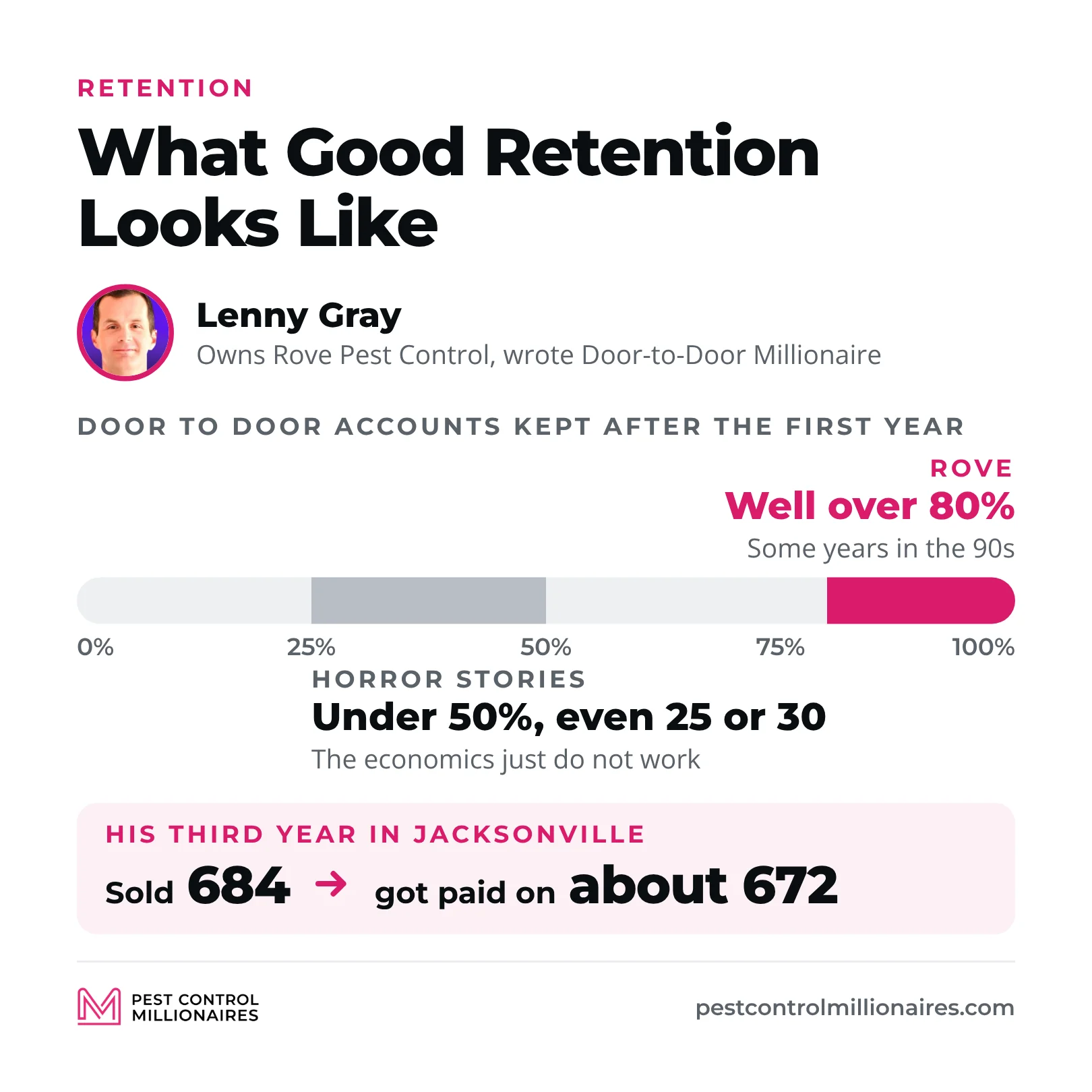
The difference comes down to how the reps were trained. If they sell a one year agreement, you get the customer for a year. If they sell a real relationship, the customer stays. He made a point I had not thought about. In door to door you are often creating a need the person was not even thinking about. That is harder to retain than an inbound lead, where the person called you because they already have a need.
There is no magic market
I asked Lenny about traditional markets like Texas and Florida versus non traditional ones like Wisconsin and Minnesota. He said retention does not have to be any different. It comes down to the same thing every time, relationship and service. He has clients in Canada doing it well.
What changes is the objection. In a traditional market, almost everyone already has a service, so you better be great at switchovers. In a non traditional market, the pushback is we do not need it, we do not have bugs, so you better be great at handling that. He said there is no perfect market out there with a built in need and no competition. That place does not exist. It is always one of the two, and often both. We do not need it, or we already have it.
Hire four to keep two
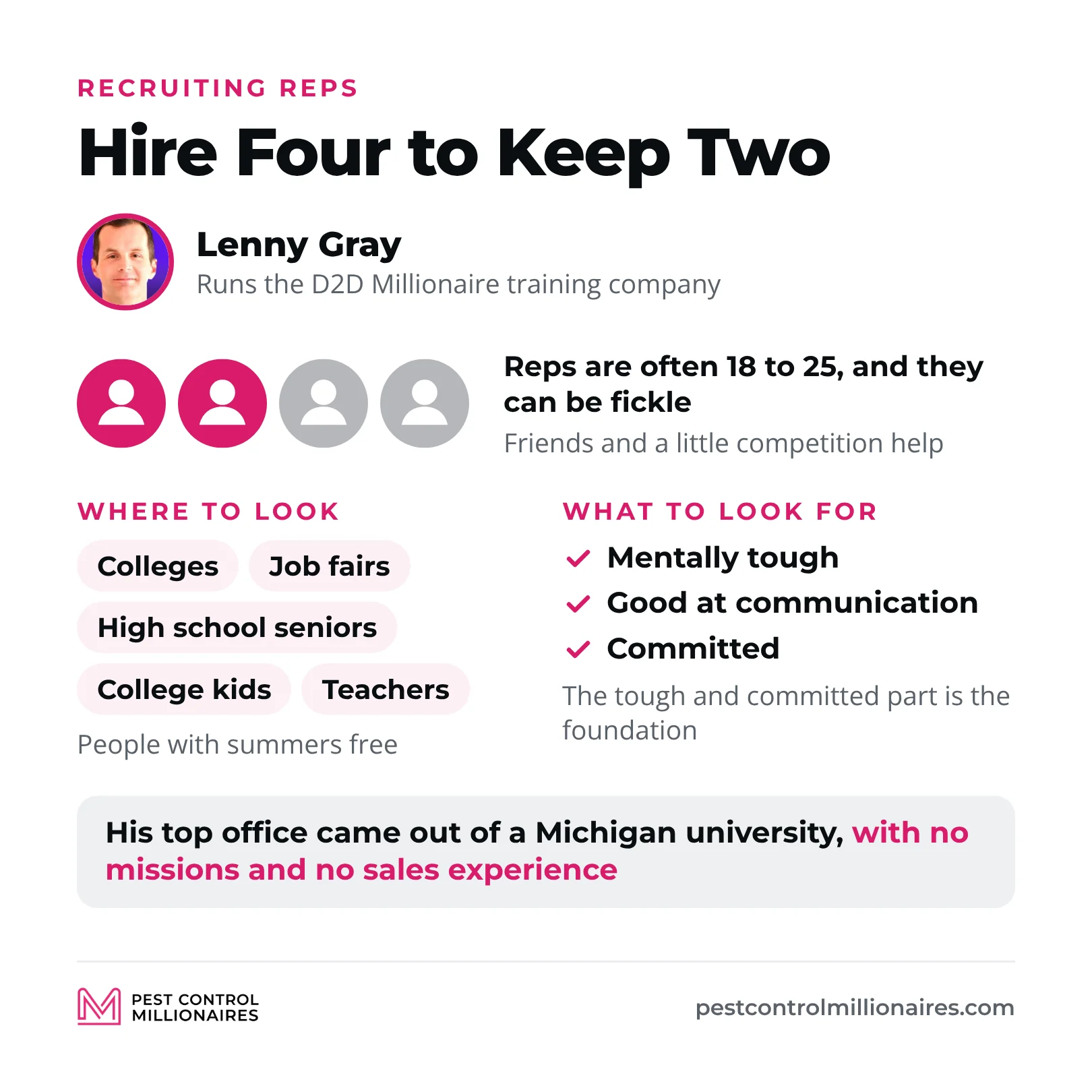
I told Lenny my rule is never hire one rep, always hire two, so they push each other. He raised me. Hire four so you can keep two. These reps are often young, 18 to 25, and they can be fickle. Bringing on friends and a little competition helps, because success breeds success. When one guy sees another sell six in a day, it lights a fire.
On where to find them, he goes where his demographic is. Colleges, job fairs, anywhere he can reach people with summers free. That includes high school seniors, college kids, and even teachers, who have summers off and tend to be good communicators. Then he looks for the right type of person. Mentally tough enough to take rejection without folding, good at communication, and committed. A lot of that can be taught, but the tough and committed part is the foundation.
And here is the myth he killed. You do not need church mission kids or guys with door knocking backgrounds to win at this. He once had a team out of a Michigan university where nobody had done a mission and nobody had sales experience. They were his top office. They just took the training to heart and worked harder than everyone else.
Beware the recruiter who promises the world
Lenny has seen 25 years of this, and he says nothing has really changed. Same complaints every era. I did not get paid my back end. I was over promised and under delivered. His warning is that the best recruiters are dangerously good. They know exactly what a 20 year old wants to hear, and they will promise all of it, because they get paid on overrides whether you ever see your back end or not.
So his rule is simple. If all you are hearing is how glorious and fun and easy it will be, you are being over promised. When Lenny recruits, he paints the realistic picture. This is hard. You might want to quit. If you bail early, you may not get your back end. Most recruiters will never tell you that. He also called out the ugliest mindset in the industry, the companies that treat each year’s new reps as fresh suckers to burn through. That is trash, but it is real.
Sales forces fail at the top
When I asked where most sales teams break down, Lenny did not hesitate. Leadership. They are either led by the wrong person or by nobody at all. Your first few reps need someone in the field guiding them, with daily training meetings six days a week to keep the motivation and the skills up. Without that leader, you fail.
He told a story from his own start that explains why he teaches the way he does. His first training was a 15 to 20 page manual. He memorized it in a couple of weeks and flipped through it between doors. He was promised a VP of sales would come knock with him. He waited through all of May and June, outselling his own managers, with no idea if he could be doing better. The VP finally showed up in July, met him in the parking lot with a video camera, and said he actually did not have time because he had a flight to catch. He just wanted to record Lenny answering a door. Lenny thought, I am supposed to be getting trained here, not the other way around.
His point is that back then there was almost no information. Today there is no excuse. Between his books, a blog he has run for over a decade, his newsletter, and a YouTube channel with hundreds of videos, a company would have to actively fail to leave its reps in the dark.
Fail forward
Lenny is not scared of failing, and he had the stories to back it up. His third year knocking in Jacksonville, he sold around 700 accounts. To show how he sells for the long haul, he sold 684 that summer and got paid on about 672 of them. That is incredible retention. As he put it, “The only way somebody’s going to cancel from an account that I sell is they’re either going to move, lose their job, or die.”
But even in that monster year, he had four days with zero sales, one in each summer month. That is the mental toughness piece. Sales are all over the board. Nobody actually sells five a day every day. Some days you get zero, some days you get 23.
On the business side he has hired the wrong people, entered markets he should not have, and once lost a lot of money in what turned out to be a Ponzi scheme. He does not call any of it failure. He calls it learning, as long as you do not repeat the same mistake. He compared it to cooking. A flopped recipe does not mean you stop cooking. You adjust the ingredients until you find the one that works.
What separates the elite reps
I asked Lenny what makes a 15 to 20 deal a day rep different from a two or three a day rep. His answer surprised me. It is not work ethic. It is reading non verbals and qualifying fast, so you do not waste time on people he calls Mission Impossible.
He gets told no more than anyone, and he does not care. His reps will see him get rejected and act shocked that someone told him no. But that is the point. Once he qualifies a person and gets them on the hook, he closes better than almost anyone, because he knows he is talking to someone who is actually sellable. As he put it, “I don’t sell the unsellable. I’m not Houdini.” He just qualifies quick, closes, and moves to the next door. And he was clear that this is not about cherry picking the easy sales. There are only so many of those in a day anyway.
A few things I am taking with me
Here is what I am walking away with after talking to Lenny:
- Door to door is far from dead. There is still wide open ground for anyone willing to do it right.
- You cannot switch a customer who feels taken care of, so ask about their experience instead of trashing their company.
- Put roots down before you grow branches. Too many accounts too fast kills retention.
- There is no magic market. It is always we do not need it or we already have it.
- Hire four to keep two, and look for tough and committed over experienced.
- If a pitch is all sunshine, you are being over promised.
- Leadership is where teams live or die.
- The elite reps are not working harder. They are qualifying faster.
Thanks to Lenny for the time and for everything he has taught me over the years, most of it before he even knew he was teaching me.
Full transcript
Every word of the episode, from the video captions
Guys, welcome back to the next podcast. I've been excited for this one for a couple weeks. It's one of my personal friends, coaches, mentors. And he was a mentor before he even know he was a mentor. I followed him very closely for, you know, three to four years, and then finally just started. Connect with them. Or last year and a half, two years. Talked to him on a, You know, monthly bi-monthly basis, and he's helped me a lot throughout the years. He's a world-renowned, door-to-door guy. We can talk a lot about that. He's an author of Door-to-Door Millionaire and More Door-to-Door Millionaire. Got two Good books?
So I highly recommend that you guys jump on there and, you know, download those or get the book on Amazon or wherever. Laney wants to get it. And again, thanks for being here, Lenny, I'm super excited to have you and thanks for being here. Appreciate it, Jonas. I love the opportunity to come and chat about my background and hopefully help your listeners to.
To get a better understanding of door-to-door, direct sales or whatever else you want to chat about, pest control, anything for sure. So why don't you just tell us your personal story first?
And then we'll kind of just take it from there, like, How did you get into the industry?
How did you start your company? Start there? Yeah, I appreciate that. So, yeah, I. I started like most guys in Utah. I started with a company that was a marketing company that did door-to-door I had. I was recruited by a buddy of mine, played high school football with him and actually he came. You know, initially to get me to do it. And I didn't believe him. That you could actually make the kind of money that he was telling me could make. You know, you make 30 grand in the summer or something like that, and.
Man, I came from nothing like a lot of us in this world, you know, we. My dad was a police officer. My mom owned a small little house cleaning company, and he was trying to tell me that I could make as much in. You know, in a summer that they, you know, maybe made in a year. And I. I just didn't believe it, so I said, but I trusted this guy. But I said, Hey, why don't you go do it?
And if it's real, then let me know, and I'll come do it with you next year. And sure enough, he let me know. At the end of the summer, he said, Hey, man, I did, I made like, 25 grand. I'm, you know, hiring a team for next year, we're gonna go to Birmingham, Alabama, and I want you to come join us. So that's kind of how my story started. I did that during my undergrad.
Once I finished my undergrad, I got hired by a company that was a marketing company for ORC and Pest control, and worked for them. For a couple years, met a good dude who was who knew pest control. I didn't know anything about pest control, I was just selling it. I hadn't really serviced a home or anything like that. But this guy knew the day-to-day the operational side of it, so tag teamed with him. We started a company in Salt Lake City in about five years we were the biggest residential company in the state.
You know, the first summer it was me selling him spraying and that was kind of how we did it. And in the interim, with, you know, running Utah, we opened up several other offices in different states, and we were acquired in Utah.
Back in, I think, 2007 and we grew a bunch in the Midwest. We had an acquisition in 2014 with six or seven branches, and now we're back up to about five or six branches. And just building again, just growing and building and doing the pest control thing. So that's a little nutshell of my story. And it's Rove Pest Control Rover, right?
Yeah, roof pest control. We named it after there's a scavenger beetle called the Rove Beetle. It's not really prevalent in the in the U.S. But it's a it's a beetle that kills and eats other bugs. So funny enough, my business partner and I we were in, we were doing a humanitarian trip in Kenya and we were literally brushing our teeth one morning kind of in our outdoor.
And we'd already established the company. It was already rogue, but we were brushing our teeth one morning and kind of this outdoor. I guess you could call it like a sink. It was. It was kind of an interesting type of sink. But anyway, this literally this rogue beetle goes trooping through the sink like kind of in between us and kind of cruised out. We were like, Oh my gosh, like, I guess we named our company the right, the right thing. So, yeah, Rove pest control.
That's been our company, that's awesome. First question I'm going to ask you is, I think you get asked us a lot, probably. But is Door-to-door dead?
Oh, it's totally dead. I'd never do it. No, of course not. Oh, you know, the direct selling game. It's funny because a lot of people say, I just got off a call with a guy that y'all can get about. Get into it later, but he's got an idea. I get that across my desk quite a bit, you know, ideas for doing direct sales. And he literally he knew he had this call set up with me last week, and this weekend he had a door-to-door solar guy, hit him up. And this guy lives in Puerto Rico, right?
So he's like out of nowhere, and so he's like, You know, this guy. I've never had my door knocked, I was, you know, I'm gonna meet with Lenny Gray, the door-to-door millionaire. And then this guy comes knocking on my door and he I, you know?
He said. He asked him, he says, Do you know Lenny Gray? Oh yeah, no, Of course I know. Lenny read his books blah, blah, blah, blah. And so I think even somebody like that who thought the same thing like there's no other markets or any other. Way to do Door-to-door anymore?
It's kind of a dying or dead industry. I'm okay if people think that. But at the end of the day, those of us that are involved in direct selling door-to-door, selling there. Man, there's still a lot of greenfield out there to just go, go, crush it, why don't most people do it?
I think there's a lot of uncertainty of how not only to recruit and hire, but actually how to train and manage reps there. Everybody's heard the horror stories. In whatever industry you're in, Door-to-door is no exception. So you heard the horror stories. Well, we hired a team or we subbed a team out. We sub-marketed a team from another company and they came out and they put on trash accounts and the reps weren't trained. Well, they, you know, got a lot of negative reviews for our company. Because they were, they were, you know, unethical, and they weren't saying good things on the doors, to people. And there. There is still that out there. You do have to be careful.
But, you know, for me and my expertise is I teach people how to go recruit like, you know, Jonas, you and I talked right like that was. Our discussion is, here's the formula for recruiting. I would highly recommend getting your own recruits rather than hiring those out. Because the pricing right now for hiring out a marketing team is ABS. Absolutely astronomical and ridiculous. Not only that, but then the quality is going to suffer. You don't know these reps, you don't have a relationship with them and you're paying out the nose for them. And then the retention on the accounts they give you normally sucks to be frank about it. So to me, it's if you can learn how to do it yourself. You manage expectations, you have realistic expectations, and then the most important part is you got to get them trained right. Because nobody wants to do door-to-door unless there's an opportunity to make good money.
You know, while you do it, because it's not just something that's fun, that's, you know, just mindless that you can just go do and you get paid for. And so if you have to have the right training program to breed success. Because if sales reps are knocking doors and having success, they're going to stick around, so it's not dead. But there's a formula with it that a lot of people don't know or are just unfamiliar with. And that's really the goal of me and my company. Door-to-Door Millionaire D2D Millionaire. That's. That's what we do, is we really educate and teach business owners if Door-to-door is an option for them. And if it is how to go out and do it, yeah, I love that and you mentioned a couple things, but why is it getting?
Why does it get such a bad name like you always just hear the horror stories you don't ever hear anything good about it. You just hear all the bad, all the batteries, all the bad raps. Yeah, and it's because there are, and again, that's it's no different than I would think any other industry right?
You have industries that have bad reps that have bad reputations, and I don't think Door-to-door is any exception. I do think there are a lot of. I'd say greedy people in the industry. There's a lot of people that are unethical in the industry. Because anything that can create and generate a lot of revenue and pay somebody really well. There's going to be people that come after that in a way that is just not the right way to go about doing it. That that was really one of the reasons for me. Writing my books is I wanted to write books that showed exactly and told the story of exactly how I approach people. What I say I can sleep well at night knowing I'm doing it, you know, above board. I'm not saying anything to lie, cheat and steal people. But there are still those reps that do it. And I think as a society, we're getting closer together right like we're more. Tight-knit like now we have neighborhood groups that can, in an instant, take a picture of somebody from from a doorbell cam.
And they can take that picture and send it to their whole neighborhood group and say, Hey, this guy's going to come knocking on your door. He lied to me and don't, don't give him the time of day. And so now you've got this closer knit society. Now these negative stories are being shared where I would hope, and I think, and I think this is fair to say the majority of reps going door to door are good, upstanding people. But you don't hear about that, right?
It's like, you know, for those of you that follow sports like you don't know a referee's name until the referee really messes up. And then, you know the rep and you should never know referee's name, right?
If they, if they, if you know their name, they've really messed up a call or, you know, they're gambling on on sports or whatever it is, but. You know, the really good ones just go about their job and nobody really says much or thinks much about them. And that's similar to Door-to-door. In my mind. Yeah, I agree. But then what are some of the upsides?
So door-to-door sales again, it's it really breaks open. A market for business owners that is untapped to a certain degree, right if all of us are are beating the drum of traditional marketing measures. You know, TV, radio, billboard, all of those things, and we're going after SEO, we're online, we're doing all that. Everybody else is doing that as well. So now we're getting customer bases and we're fighting for those customers with everybody else. Whereas direct marketing you're, you're showing up on somebody's doorstep. And, you know, even though it's getting more crowded that space, there's still so many homeowners, there's still so many people to go after.
So that that's a benefit, is it's different. We're not after maybe the same demographic of client. I think the other thing is just, you know, especially in the home service industry, you're talking about route density, that's a huge part of it as well. You're you could get, you know, five different calls one morning for for a, You know, an online campaign. And they're in five different cities all over, you know, spread out throughout the metro wherever you are, whereas door-to-door. You could go out for a few hours. Give get five sales and they're within a block of each other. And so there's some efficiencies there with the door-to-door brings that other other types of marketing just aren't as efficient to save on a lot of expenses and just make the company run. A little bit more smoothly. Yeah, I agree. I mean, I can't count how many neighborhoods we have where we just go. Park the truck all day long and don't wear and tear on the vehicle and fuel expenses. And all those things. Yeah, that's it's night and day difference. Besides a technician, just windshield time and, you know, driving all over the place and burning fuel and time and resources.
And going to do one service, then off to the next one, you know, in an hour or two, I agree with you, so you look, you know, we're we're all on these Facebook pages. Pest Control Company But all the pest control owner operators, technicians.
Why do they hate the door-to-door guys? Well, you know, if they're good at switching over their accounts, that's one reason, right, I. I think what it's done, though, you know, and we're gonna just take the segment of Liars, Cheaters, you know, out of the equation, like those ones are hard. My company gets bombarded by by some of those as well, and so, you know, things are fabricated about my company. I mean, once we had a sales rep from a competing company that was going around to our customers saying, Oh yeah, they sold their company to us. So I just need you to sign here to give us, you know, verification that we can go service your home. Under the new name of the company, we didn't sell our company in that market, you know, so that, you know, again, take take that segment out the liars, the cheaters, the Thiefs of the world. And I think you have a better opportunity with those that are on the up and up that they, if they're doing it the right way, it really increases the.
Standards of a company like a company can't just be okay. Now a service company has to be really good to protect their client base to provide a quality service for for a good price. And if you're doing that again, even if you're you're more expensive, if you're providing a quality service, people won't switch if they're loyal to you, your technician, you. You've done a really good job of building a reputation and value with each and every customer. I do think that the Door-to-door game has helped lift the, you know, the rising tide lifts all ships mentality, right?
It lifts everybody to become a better pest control provider or a lawn care provider. Or you know what, whatever else is being direct, directly marketed. So I think there that that aspect of it, too, is sometimes goes unnoticed.
Yeah, I love that, and I agree with you, 100 and all that. So the people that are in those groups that just frown upon it is because, you know, they get. They're getting their accounts switched over, because maybe they don't do such a great job, or, you know, they might. Their prices just aren't quite right, or their billing wasn't quite, and they'll just switch to your company because of those reasons alone.
Sometimes, yeah, I mean, it depends on on where it's at. You know, I, you know, if I, if I'm going to, if I'm building a relationship with a client or I'm, you know, I meet somebody, and you know, they're like, Hey, I've been with my company for, you know, 10 years, and Joey, our technician, he's the best technician ever, and Nancy. She answers phones and anytime I have a question, I can call Nancy up and she's just incredible. I'm not going to switch that account and I can say it's for free, I can say I'm doing it for free. And they'd say, You know, take a hike because I'm totally happy with who who I have and who I built this relationship with. So I think if you're really good at taking care of your customers, it makes it really difficult for people to want to switch over. I mean, most of the switchovers, at least that that how I train, to do it and my guys and even my experience switching over it wasn't. Because of price.
And pricing is a very, you know, even if you look at why people make certain buying decisions, prices is out there. But it's top five, it's not like the top one. So if they feel like they're getting taken care of their relationship with their, their, the people in the company, it. That just makes the switch over darn near impossible. And when you guys are looking for switchovers, or and you have, you know, local competitors in your market.
Just the smaller mom and pop shops, which are the toughest ones to switch to begin with because they have that smaller company, feel they build rapport. Do you tried to switch those still, or do you guys just move on to the next and go after the bigger companies?
Yeah, the way I train it is obviously we want to find out if people are getting taken care of. So it can be some pretty basic questions, you know, like we're asking a lot of good. Find out questions for people to know, Hey, how long have you been with your company?
What do you think so far? What did you sign up for, What are they taking care of for you?
What is their scope of service include? Like? To me, it's more like, Let. Me, find out about it before I just tell you, Hey, the company uses horrible. We're going to do it for cheaper, and we're gonna do more service like that's a very elementary way to go about it. And that's unfortunate. There's still, you know, reps that go out and try to preach that. Whereas we're just going to beat them on price and tell them we do more service, so we're gonna, we're gonna get them that way. It's not so much about that. Let me find out about the experience, like my reps are trained to find out the experience that they're having and if they love their company. And it's almost like the questions that I ask if somebody really loves their company, it just kind of it. It just solidifies that for people. It's like, Oh yeah, no, my company's great. They let me know before they come out, they come out, they do a good service, they'll come back. If I need them. I can call the office anytime then, although they'll respond onto my emails if they've got that kind of backing. Yeah, it just it kind of to me, it's like, Okay, well, if they're happy with the service, fantastic. If your company isn't going to treat you well in the future or you feel like you're getting less of less of a service.
You know, hit us up, let us know, you know, let us know later. But, yeah, Switchover has become really hard. If a company is being taken care of, whether you know a larger company or they're more of the mom and pop company. Doesn't matter if a company's taking care of their people, they're equally as as difficult to switch. Do you think they're easier to switch from a mom and pop shop to from a door-to-door company or from A?
Like a big franchise, I don't think it matters. I think it depends on their technicians. You know, what kind of service, not just service, are they getting and the effectiveness of the service, what kind of customer service are they getting?
That's what we at my pest control company, that's what we try to do. We try to provide a fantastic service, a wonderful customer service experience, kind of a whole thing. If a company's figure out how to do that, it doesn't matter if they're doing it on a large scale or a small scale. I don't think it matters. They could be as difficult or as easy to switch over based.
Just on on those two things. I agree with you there. I mean, a lot of your markets, you know, let's just say they all have a lot of do-it-yourselfers you run into those guys. Like most people you talk to, just do it themselves and for the for the listeners, what do you, what do you talk, How do you, How do you handle those smoke screens or objections?
Yeah, no, and here, here's here's what most reps do that is. The wrong way to go about switchovers or, excuse me, do it yourself or DIYers. Most reps come in there, you know, and it's, Hey, you know, we take care of that stuff. I do it myself. And how they come back to that is, they're like, Oh, well, your time is two more. There's too much value in your time why you shouldn't be spending time going out and doing pest control or doing your own lawn care. Let's hire a company that now you have time with your kids and you can do well. What they fail to realize is that sometimes people actually enjoy doing it, and it's a hobby for them, right?
Like I enjoy getting out in my ear, I enjoy shoveling snow when it snows, I enjoy mowing my lawn. Those are things, just that I like to get out my yard and do so. If somebody came to me and said they were going to take away something I enjoy doing, that's not setting up a really good. You know, playing field to try to, you know, play ball with somebody. So I try to take that DIY or and say, Let me supplement her. Let me compliment what you're doing by doing X, Y and Z. You keep doing what you're doing, you love to do it, and I'm not taking away your hobby. But I'm going to supplement by maybe doing some different techniques, or using some different products, or some things that maybe I can do that they can't necessarily do that. That's the approach I'm going to use with a DIY. Or I'm not going to come in and saying, Hey, you know, take off the overalls. I'm your, I'm your guy now. You don't have to worry about it anymore, because quite frankly, they might, they might enjoy doing it. Yeah, I. Like that, and that's why we would teach our guys, too.
We must learn something good, I guess.
When you, when you start in a door-to-door team in your certain locations, is there a market penetration that you're going after when you first start up?
They say, Hey, I know I can get to this revenue in this area, and then I'm gonna pull my guys out and just work on retention. Or how do you guys handle that in your company?
So if we're going into a market, I mean, we have a very holistic approach. I, we don't just go in guns blazing with, you know, 20, 30, 40 door-to-door reps, like some companies, do we?
We want it to be a mix. That's the secret formula. And for those that are in the door-to-door?
Game I will speak to them and those that are curious about Door-to-door, I'll speak to them as well. Because I think there there's different ways to look at this, depending on what angle you're coming at it from. But I think the Door-to-door team specifically that go in that just try to blast as many reps get as many door-to-door accounts as possible. Typically what's going to happen is they're they're going to come in and they're gonna, they're gonna dominate the door-to-door space. But maybe their retention numbers aren't great because they're putting on too many accounts. And so it's kind of like the branches are outweighing the roots, so to speak. And so they're just gonna have to repeat that over and over again, to try to replace all those accounts, that they lost. You know, after that, that first year of the service ground, quite frankly, even before the first year's up. If people just feel like they've got a crappy service and it again, if you're putting too many accounts on too fast, I mean, how good can your service be as well?
You know, what's the quality of service, the quality of service is going to suffer. That's not going to help with retention as well, so you're going to see those attrition numbers too high. And then it's just, it's almost like, you know, it's like a drug where they just got to keep doing it, and they think they can get the same thing. But really, they're just spinning their wheels in the mud. You know, a lot of times I will say so, but for, you know, for us, when we go into a market, yes, we will have a certain percentage. When we first go there that we feel like we're going to have our door-to-door teams accomplished. That might be half, that might be 75, might be 25. It just depends. The other things we're going to look at is.
You know, are there companies for sale in that market? We're going to look at again what we talked about before, just the traditional marketing methods we're going to do. TV radio SEO, we're going to kind of blast all those. And we want to again create this holistic approach where we want to grow with a bunch of operator opportunities. Because, you know, it's like the legs on the chair, you know, theory, right?
If you just have one leg on a chair, it's not going to balance very well. But if you are growing in multiple ways, one thing can get taken away and you can still be, you know, you still have some stability now, if I'm a if, I'm a company, that's been in a market and I've been there for 20 years. And everybody's come in and done door to door and I'm getting pissed off and I want to do door-to-door.
I think that's a great opportunity to again start small, hire two to five sales reps, get into your market and go fill up some of those spaces where you've got. You know, route deficiencies. We'll call it right where you need the growth. We'll send your door-to-door teams to those places and try to build up those efficiencies. And you can start even though you know, maybe you didn't start that way with with your growth. But you can get going 5, 10, 15, 20 years, it doesn't matter down the road you can insert door to door, and it can really help clean up some of your routing. And maybe other inefficiencies you have within the organization. Yeah, and you brought a patrician, and a lot of people might not know what that is. Cool, can you kind of touch on that and what a good percentage is for?
Maybe another one like, Maybe go ahead. Oh, I was gonna say, Are you talking specifically for Door-to-door?
Yeah, let's just talk Door-to-door, and if you want to use past, Serve Lawn as the example of this fine. And then, you know, from one market, maybe a traditional versus non-traditional market, and where where you can see the retention difference.
Yeah, and you know, as far as that goes, you know, attrition's basically just what accounts you're, you're losing right, you have attrition on one side and then retention on the other. What accounts are you keeping We obviously want to retain all the accounts. That would be ideal, you know, for me. The way we train our reps and how we kind of hold the customer's hand and try to build that relationship with them. Our retention, even for our door-to-door teams, is well over 80 percent, if not. We've had some years where we've been in the 90 percentile post one year. So after the one year's up, we're going to retain the good majority. Now I've heard horror stories of companies that are under 50, you know, even 25, 30 percent where where they're losing. The good majority of the door-to-door accounts that they sign up. So and again, I think there there's a lot that goes into that. You know, how were the Reps trained?
Number one you know were? They trained in a manner that's going to lead to long-term relationships with people. Or they just selling One-year service agreements, because if they're just selling One-year service agreements, you're proud going to get that customer for a year. Because in direct sales, you're talking somebody into something they may not have thought about before you might be knocking on a door or somebody. The last thing on their mind is a pest control service. Well, you're talking them into the idea of it. And so it sounds good. But if there's if it's just, hey, just try us for a year. And then you don't have to worry about it, or you're not going to see any bugs again. If you get reps talking that way, then, yeah, your attrition is going to be, so the better you can, you can, you know, obviously keep those numbers, the more value there is in a door-to-door team. But if you're retaining 25 of accounts, that's you're paying out, the no's for those, and that's just not worth it. The economics don't make sense in that regard. So for us, yeah, I mean, we want to be in the 80 plus percentile as as far as retention of our new.
Our new accounts from door to door. And, you know, maybe a little bit higher on on, you know, SEO and other marketing, because, quite frankly, those people probably need it. That's why they're, that's why they're calling, that's why they're, you know, emailing, and that's why there's responding to different ads because there's a need there. It's a lot easier to retain somebody that has a need for something than it is where you're creating that need. You know you again, that's when the relationship and building that quality service and quality customer service comes into play. Yeah, and then when you compare like a traditional market like, Let's say of Texas or Florida versus a non-traditional market, let's say Wisconsin, Iowa.
Do you see it difference in retention there? So not really both, right? We've had the traditional markets, we've had companies, you know, we've currently, we have a company in Arizona, but we've been in Arkansas and Tennessee and.
Kind of some of those southern markets, I mean, I sold in Florida and for, you know, Southern Virginia and Alabama. And, you know, we've been in Oklahoma, Tulsa and Oklahoma City, but then we've also had the markets up in Madison. We've had, you know, we're headquartered in the Twin Cities. We were in Boston, we're in Detroit, you know, we're kind of all over some of those non-traditional markets. I don't think the retention numbers need to be any different. I think it boils down to the relationship and the quality of the service and the quality of the customer service that you're providing for your people. I can't, I can't hit on that enough.
If you're if you're doing those things, and I don't even care if you're up in Canada. I have some clients of mine that are up in Canada if they're doing the same things. And it's, you know, brutal winters or, you know, not really year-round need for pest control, so to speak or different pests. You know, different times of the year, whether you're talking rodents and those types of things. I think you can have the same retention expectations in a non-traditional that you can have in a traditional we do. Yeah, that's cool.
And I think to myself, You know, selling down in Florida, every door that you talk to someone has pest control. You get back up in here like you market like Minnesota or Twin Cities like that. Not every single person is going to have pest control. Maybe three out of the ten, compared to nine out of the ten down in.
So you're gonna run into a lot of people who don't have pest control on their mind and never would hear as compared to down there. Yeah, so, and that's the thing. When I coached, you know, my clients and my companies that I that I have relationships with. It's like, Yeah, if you're in a traditional market, the main concern is going to be we already have a service, so you better be good at that.
If you're in a non-traditional. The main concern is we don't need it, we don't have bugs, right?
And so you better be good at handling that objection so that's the secret and where the fine line is. Where's the longitude, the latitude?
Whatever it is, you know, where's that perfect line where there's a need and nobody's there that doesn't exist?
I will just tell you that that's You know, imaginary land, so there's always it's always going to be one of the two, if not both of them. And regardless of what market, we don't need it or we already have it. Yeah, that's awesome, so we're going to switch over to like recruiting, because we're kind of talking about that before. And he said, If you're just getting to door-to-door space, go hire. You know, two to three guys. My philosophy is never higher, one always higher, two. I don't know if you can agree with me or not to push them against each other a little a little bit. You know, create a little bit of a competition.
And if you were to go hire your first sales guy, where would you go first?
And then what would your onboarding process look like? Yeah, and I think it's important even to what you said about. Don't hire one, hire two. I would say, don't hire one or two, but hire four so you can keep two right. Yeah, I mean these, yeah, you know, most. Most of the door-to-door that people willing to do that are probably a little younger. You know, maybe they're 18 19 in their 20s. They could be a little fickle, as far as you know. You know, keeping their commitments to certain things, so it's always better to have friends do it as well because it does give some comp. I think that's what you're alluding to Genesis is. There's a little bit more competition there right like you. You want them to see success and go, Oh man, she went out and sold six today. Why am I only getting one or man?
I've been blank three days in a row and she's out there selling two a day, you know, non-stop, so you always want to want to have people push people and see. Some see some success because success breeds success, as we know, so that that's important. But I do think there's, you know, when we talk about attrition. It's not just in, you know, accounts, it's also in reps.
So you know, if I'm gonna go, I'm gonna go where where? These people are looking for work, you know, because at least in the pest control and lawn care industries, you get a lot of people that you know, those. Those busy seasons are going to be the warmer months. And so now you can coordinate that with, you know, school schedules. And so you think, Okay, well, maybe we could have some really ambitious Go-getter types that are that are, you know, in high school, maybe they're seniors.
You know, are going into their senior year. Maybe they're in college, you know, they're in their college years, or maybe they're teachers for crying out loud. Because guess what?
Teachers have the summers off too, you know, and they should be decent communicators. So you can look at a pool of what you're looking for, and that's really where you set up shop where it's at a local university or it's in a job fair or anything. That again, would lead me to somebody that would fit the demographic and fit the mold of having some extra time in the summer.
But then, of course, then you're looking for the right type of personality you want. Somebody that's not gonna, you know, get told no or maybe get told off by somebody that their their mom's ugly, or I don't know whatever people say that. That's, you know, horrible and horrendous. On the doors, you hear it all.
You don't want somebody to curl up in a in the fetal position and call it good after one rejection. So if you find the type of person who's tough. Mentally, most importantly, is just, you know, the mentally tough type of people. That rejection is not going to bother them, and they're good at communication skills, they have good community communication skills. A lot of that can be taught, but if they're just naturally good at communication skills, they're mentally tough, they're committed. Those type of people are the type of people that generally succeed on the doors. Would you rather have a new rep that's never done anything before, or one that's been trained already that you brought from another company?
Well, it, that just depends. I. I wouldn't have a preference, I'd look at both of them and you know how?
I think what you're getting at is how teachable would somebody coming from another company be because you know, and what was their experience?
Another company? I'd say, Why are they leaving another company, are they leaving, are they choosing to leave, or is the company they work for choosing to let them go, that that would create some red flags for me?
If they were, you know, if the choice was the company, they didn't want it back. I don't know how excited I'd be about that, rep. You know, but I don't know, I want to find out the whole story. I'd probably do a little bit of, you know, research and contact the other company and find out. You know, let's hear the story from them and that rep, because both of them are going to tell two different stories. And the truth's always in the middle. So we'd find out what happened on that one, and then the new one, like I said, Yeah, I mean the new one. You're gonna roll the dice a little bit more. If somebody hasn't knocked doors, there's certainly no guarantees that again, after a couple hours of hearing, No's they don't just pack up and head out. So, you know, I don't know, as with most most quests or answers to questions, right, Jonas. It depends, yeah, I guess would be the best way. And the reason that I ask is, I have a lot of friends that'll just call me like, Hey, I just had this. This sales rep set by, he said he's looking for a job like Red indefinitely.
Red Flag. There's a reason if they're a good sales rep. They're usually not in the market long and not looking for a job because they're getting recruited like crazy by someone.
Yeah, yeah, no, you do have to look into each case. There's a lot of variables that come into play there and I won't. We don't have to mention any names here. But you probably see all the stuff going on online recently.
In the past a few months of backend checks and things like that. So there are some of those reps who are going to be moving. What's your thoughts on of what's going on in the industry?
There's a lot of changes happening there. Even their people are leaving solar, they're getting a bad taste out of pest control, they're moving from industry to industry. Like you said, trying to do, let's talk about that for a minute.
Yeah, you know, I mean, it's, I will say me. Having done this for 25 years, nothing's changed. Maybe the amount of people has changed that are being affected by their back end or changing industries. Maybe that's changed because there's a lot more people that are in door-to-door and direct sales now than there used to be.
The other part of that is again. We're a closer society because everything can be posted on somebody's social media, and so the word gets out a little bit more. Than maybe what it used to, but really, nothing's changed. Jonas. It's the same in the 90s, in the early 2000s and the 20 teens, and now in the 2020 it's always the same stuff. I didn't get paid my back end, I was over, you know, over promised under delivered on this, that and the other. I mean, because most of the time I think what happens is you get these younger crowds that are.
These recruiters are really good. Let me just say that they are so good that they know exactly what a 20 year old wants to hear. A 25 year old wants to hear and they will promise it up and down because they're getting paid off. You know, overrides off. Whatever whoever they recruit, you know that goes in and sales they couldn't. Care less, though, if you get a back end or not, because they've already been paid out more than likely. So I think you have to be really careful with it if it seems too good to be true. If you're just hearing all the great and good stuff about it, you're getting you're getting over promised. I guarantee it because, you know, when we're recruiting our people, we try to paint a very realistic picture. This is very difficult. You may want to quit you may not get paid, you're back in because of this. This and this happens right. You don't fulfill your commitment if you quit early, if you've got to kind of set the table.
Most recruiters aren't going to do that, they're just going to sell the stories of, you know, everything's.
Glorious and great, you're gonna have so much fun, and we're gonna go to the skateboard park every morning and, you know, we're we're this company that, you know, I think at the other day, all this is just rinse and repeat. You know, it's just I once heard, and I won't say the company that I heard it from, but I once heard that, you know, kind of, and we can get into the, you know, this.
Probably a good, good topic to discuss as well is what kind of person are you looking for?
Maybe if you don't have people that have knocked doors for for church missions, or that because some people believe that that's the only way. If you don't have a connection with church missionaries, you can't do door-to-door. And that's completely false. And we can, we can go off on that path. Sure, but I once I once heard a company basically say, Listen, you're going to get new suckers that come in every day from the, you know, every year from the mission that you're going to be able to talk back into. Regardless of what the guys the previous year, you know what their experience was, and that's just trash. But.
I've heard that before, and I know that's the mentality of some of these companies that go out and recruit everybody and just are looking for. Because they just think, Hey, new suckers are rolling in next year, and so we'll just, we'll just do it all over.
Yeah, so let's let's go down that path, like, what are you looking for? Like, again, I'm gonna push back a little bit because we're the same way like we don't have anyone around here that's ever even actors. So you'd say, You guys do what like you guys knock doors like, that's that real thing. That's what we run into around here. You go to Utah. Everyone already knows that they're gonna have to leave for the summer, whether it's in their missionary or they're going to knockdoors afterwards, so they're used to that. Here we're, we don't have that at all. So I agree with you don't have to have those missionary guys to go knockdoors because we've never had one that's ever previous experience.
Yeah, yeah, we had a group once. Out of Michigan, at a university out of Michigan that we recruited in. And you know, we had them, and then we had like three or four other teams that were were kind of more. Your traditional kids from Utah that go out to whatever place well, these guys were all from Michigan. None of them done church missions, none of them really had much sales experience, and they were our top office. And to me, it boils down to the training they got, you know, they did the training.
Just like we talked, you know, we didn't bury our training, but they just took it to heart more, they internalized it. Maybe they worked a little harder, you know, all those things where they were. Our top office, not a single, not a single missionary. So I just look at it and go, If you have somebody like I said before, who's mentally tough, who's committed?
Who's not afraid to work hard? If you, if you have those three elements, then you're gonna find somebody that that can be successful at this. Yeah, so for a lot of people that are listening that don't do residential that do more. B2B Could you build a team and I know you already do, but how do you would you build the team?
If you're going to do B2B or business business sales, you'll see the same profile, the same hours. Or what does that look like?
Not really, because you're now, you're looking for for a group that is, you know, maybe your commercial sales team and we have a full-time, you know, commercial sales team. Your commercial sales team is going to be year round, so now you look at it. More of the marathon versus the Sprint, like the summer sales. The college kids, that's a sprint. We are trying to go, as you know, six days a week, seven hours a day, 50 people a day. Talk to, you know, trying to close out one to two plus sales a day on the doors. That's just it is a full-on sprint. We're going as fast as we can.
Whereas now, when you're talking about a year round a commercial team going business to business, the sales techniques can be very similar. But you're also talking about a group of people that are going to be compensated differently. They're certainly not just paid on commissions, there's some guarantees there, they're looking for more long-term. You know, a business to business sale sometimes doesn't happen in 10 to 15 minutes, like a door-to-door sale, you know might, might happen in. So, you know, getting in front of the decision makers, you know, cutting through the red tape of, you know, gatekeepers and this, that and the other. There's just some, there's a different way and different expectations, different compensation. There's different ways to do it, but certainly building a commercial, a B2B team, that's all, conceptually, the you. Know what you say and how you say it is all very, very similar.
Which one do you like better, or is it a mixture of both? Yeah, I mean, I interact, you know, every week with my commercial team and I love it. And then the Door-to-door team will start and I'll interact with them every week as well. And I enjoy that too. So I don't know, I've been doing this long enough where I don't. I don't have just one like favorite thing that I like to do. I personally, I just like to help people to learn the language of sales and direct sales like that's what I enjoy the most like. I. I love seeing people succeed, and that's why my consulting company, that's why we'll teach exactly what I teach my people. It's like it doesn't matter like I love people to succeed the right way and to do it ethically and to do it honestly. And all those things I, if people can succeed like that, then to me, that's a win for the industry as a whole. And again, I've been doing this long enough to where?
I don't have to sell anymore, I wouldn't have to sell an account the rest of my life, it wouldn't matter. I don't have to teach anybody, but I just I really enjoy that part. That's what that's what my passion is teaching how I do what I do. Because I, you know, I was just some regular regular kid, you know, nothing was given to me. I had to kind of go work for for what I work for. And I just feel like I can teach how I do what I do to darn near anybody who's willing so, and I can attest to that. So thank you for everything that you do for us, too. Where do most sales forces fail?
I think the biggest, the biggest points of failure are leadership. I don't think they're, they're led by the right person. Or by anybody at all. I guess one thing you can't do if you're not willing to step in a leadership role to guide, you know, your three to five sales reps your first year. If you're you're not going to be there to be a leader, you better have a leader there. Because these this direct selling game is tough, and you need that like, you know, like I said, the sprint mentality. I mean, we're having daily training meetings every single day Monday through Saturday. You know, we are training these reps on different things that they're hearing and keeping just the their motivation up and trying to instill. You know, passion about what they're doing, and it's tough to do so. So, yeah, I think that aspect of it you definitely need to continually.
Motivate and bring guys up, and if you don't have the right leader that does that, you're you're gonna fail miserably. The other thing is just I just see. So when I, when I first started, my first experience with training was I was given a training manual. That was maybe 15 to 20 pages long, and it was like, Okay, this is what you need to know, everything you need to know about knocking doors. And I had that thing memorized in a couple of weeks. I've taken on the doors with me. I just flipped through the pages as I'm in between doors knocking and I. I digested that thing and I was like, Wow, and then I was told I was going to have some VP of sales. Come knock doors with me at some point. And I, you know, waited and waited and waited. Now we're into July, I've been knocking all of May, all of June. I haven't seen a single person from corporate even come and try to help me. I'm out selling my managers. I. I was like, I don't even know if I'm doing great if I could do better, and I remember the guy finally came.
The VP of sales finally came out in July.
And we were gonna go knock doors. I was so excited to watch him and we got out to the parking lot. He had his video camera because it was the 90s, you know, his phone. We didn't have those cell phones back then, but he had a video camera and he said, Okay, actually, I don't have time. I gotta go catch a flight, so I just want to record you like, What would you say if someone answered the door?
And I'm like, Man, I thought you were supposed to be training me. Not, not the reverse, and I just felt like there was just so little information out there. Nowadays. That's not an issue at all, like there's so much information, not just my books. I mean, I've got a lot on my website. You know, you go to Lennygray.com, and I got a blog that I've been running for over a decade now of just valuable information. I got a newsletter that I put out regularly to people that subscribe to my newsletter. I've got a YouTube channel with D2D Millionaire YouTube channel with hundreds of videos, so it's like there's so much information. Now. You really have to fail at, not whether you want to educate yourself or have a company train, you, your company train you. They would really have to fail not to give you so much.
Yeah, that's great information, because, I mean, go back to like, day one when we started knocking doors. I didn't have anyone leading me. I just again watched so many videos, read so many books. Everything that I could consume and went out there and started figuring out myself. And then I was like, Okay, well, I'm getting pretty good at this now. I just start training my guys and that's just. But I was with them the first year, all every day, six days a week, all summer long. And now I have those guys to go out there and run teams for me, which is pretty awesome, so I agree with that. It's really cool and obviously your training is really good, so that helped us as well. Along the way, you know you've trained, you've had many trainings with my guys. In the mornings too. From hotel rooms to Airbnbs we've had, we've had many of them.
I have a question for you, that's my personal question. In your experience in business, what were some of your biggest failures like that you've learned?
Quick from? Yeah, you know, and I love it like it's all about failing forward, right?
And if you don't fail, or if you're afraid of failure, failure, you'll never get to the heights that that you should get to. So I don't, I don't fear failing at all, and I've. I've certainly had my share of failing, right?
So I mean, just when I think about my knocking experience and then we'll get into more of my, you know, running a business experiences. But when I think about my knocking experiences like Shoot, I had my third year knocking. I was in Jacksonville, Florida, my third year, so I. I had sold about 500 my first year, about 600 new accounts my second year and my third year I sold about 700.
And just as a side note, I ended up, I ended up the summer like selling. I want to say 684 accounts and I got paid for, like, 672 of them. It's amazing just to give you an idea of my retention like I. I was serious when I say I'm selling for the long term, like I wasn't just selling.
Just to put numbers up like it was, I was selling things. And the only I always say, the only. The only way somebody's going to cancel from an account that I sell is that they're either going to lose their job or die. That's it, like one of those three has to happen. Or they're gonna stick on, you know, you know, with the service. So, but I had, I remember distinctly.
I had four days that summer, one in May, one in June, one July and one August, where I got zero. Sales like Legit sold almost 700 accounts and I had four days of zero. And that to me, was like, You know that that was a gut check. Like, Am I really good at this?
Do I really know what to do? Yeah, I know. I sold 12 the day before, but I got zero today and that's the mental toughness. Part of door-to-door to me is, you know, sales are all over the place you everybody would love to say. I can just sell five a day if I could just sell five a day every day, I'd be happy. Well, that that doesn't exist either. Like in sales, you just never know. Some days you're gonna have zero, some days you'll maybe just have one. Some days you might sell 23. I don't know whatever it is right, so it's all over the board. So I think failure on the doors it can be door to door, it can be day to day, but. But I love the idea of just failing and learning from your failures and then seeing things that you learn. And don't make the that same mistake again and grow from.
From a business standpoint, man, I definitely we. We've hired the wrong people in the wrong positions like everybody else. We've probably gone into markets. We would. If we could do it over again, we wouldn't do it.
You know, there's a lot of business failures that I've had to shoot. I. I invested a lot of money and found out it was in a Ponzi scheme. I lost a lot of money like I've failed there, but anything that I fail from, like I said, I don't look at it as a failure. But I look at it as a learning experience. And I try not to repeat the same mistakes over and over again. That's even as a parent, as a husband, right, like I'm just. I'm trying to be better and improve all aspects of my life. And so failing isn't necessarily a bad thing. If I repeatedly fail at the same thing, then I'd start to question if I'm. I'm really understanding what I'm failing, the reasons I'm failing and what I'm learning or not. Learning from from those failures. Is there anything that in business you failed?
From that we could learn from, and the listeners could learn from. Well, there, yeah, wow, that's a loaded question. We go to down a lot of paths there. Of course, like any failure, I think there's lessons to be learned like anything that you fail at, you know, like, if you realize that, you know the maybe you. You have a new incentive program for your, your inbound team or whatever. And you realize that it's not really motivating, you know, and you could look at it well, that was a failure. It doesn't mean you stop trying to motivate your inbound team, you don't stop incentivizing your inbound team. You just find a different way to go about it, to try it again. It doesn't mean it's not going to work it. Just maybe you just didn't have the right formula, right?
It's like cooking, I don't even cook, but it's like cooking. You know, you got these recipes, and how many times do people try a recipe until they hit that one?
That just it's perfect? This is the formula, this is the recipe that actually works that people love the most. Sometimes it's just a matter of adding some ingredients, taking some away, adding a little more, a little less of something, and just finding that perfect formula, that perfect recipe, I like that.
What is the difference between a five-day rep, two day rep, two to five day rep, and then the 15 to 20 plus a day, right?
What's the difference is it just work ethic. No, no, I think there there's got to be. This is what I think. The Secret to Me is reps that can read non-verbals and reps that know how to qualify.
So they don't talk to people that are what I would call Mission Impossible. Like sometimes reps just go on and on with somebody and they have not earned their time. Like. I teach qualifying principles and I teach Non-verbal and reading those things that that maybe buying signs or not buying signs. And it's like, I just know, like I get on the doors with my reps, and I'm still. Very active on the doors and I can get on the doors with my reps and I get, you know, turned down and whatever. And we're walking. And they kind of get this look like, Oh my gosh, somebody told you, No, can you believe that?
Like you got told no, and I'm like, I've been told no more than anybody. I don't care to be told no. My secret is once I get somebody qualified or on the hook, so to speak. I'm going to close those accounts more than anybody else, because I know once I qualify somebody, I'm talking to the right person that's sellable. Now.
I've got a better chance than most people at selling that person. I don't sell the answers sellable. I'm not, I'm not Houdini, I'm not the magic you. Know the magician here. I. I don't do that, but what I do is I sell people I can. I can get on the hook and qualify. So you think it's just qualifying fast as fast as you possibly can. Closing those accounts and getting onto the next, it just has to be. It should has to be right, right?
You just have to do it the right way. Because again, and that's not just selling laydowns either, that's the other. Part of this is people think, Well, you just, you just sell the lay downs. Well, if you were just selling the easy. There's only so many laydowns like, I'm not gonna lie like, Yeah, I sell laydowns like anybody else would. But I'm not just selling those, because if you were just selling those, you're only going to sell so many a day. I agree with that, I don't run out of time here, I don't know how long you can stay with me, but. It's usually about an hour, but I have a question for you because you have a lot going on. Like from the consulting side and from, you know, your own companies, you've been working on some really cool projects you probably can't talk a whole lot about. But what is Lenny up to these days?
Yeah, no, I'm an open book man, I don't, I don't. I didn't sign any non-competes and says, I can't talk, talk about anything I'm doing. Okay, I'll just tell you so, yeah, so I had my own pest control companies, of course, you know, we've been in business. This is our 20-year anniversary. We took a bunch of our guys off the little island off of Fiji and went and enjoyed.
A week and a half of just sun and sunburns and sharks, and all sorts of hikes and just a good time with our executive team. We kind of celebrated our 20-year anniversary, so definitely still rocking and rolling. Thank you, we, yeah, it's a big deal for us. You know, to be being the pest business for for 20 years. It's quite the accomplishment and we've we appreciate.
Being in this industry, it's taking really good care of. But other than that, yeah, some of my clientele, like I do, you know, two-day training conferences with teams. I've got some set up for a team in Florida, I've got one in North Carolina. I've got one. Back on the West Coast in Northern California that I'm doing, so. I do training conferences for teams all the time.
It's pretty much like I say, it's like everything that I've learned that's taken me 25 years to learn. I basically give them two or three days, you know, to people that that have those willing. I will make them able in two or three days to go out and kill it, so I do a lot of that. Especially this time of years. We're ramping up for, you know, summer sales season. I've got another relationship, you know, in the home service industry, in the garage door industry where we're still hiring. For Jonas, you know about this?
My friend Tommy Mello there at A1 Garage Door. I think they're in 20 states now, they're headquartered in Phoenix, and we've got a sticker program for really, you know, people that that maybe the door-to-door selling thing doesn't resonate, maybe they're not great at it. Well, we've got a kind of a lower tier, you know, you make just great money as well. But a lower tier read maybe aren't necessarily going in closing accounts or setting appointments.
But you're just marketing for this garage door company that's taken off. And we just set a record last month for our best month in company history. I've been doing that for two and a half years. Also working for a company now or consulting for a company now that's doing the ERC, the employer retention credits you. Know those, those things are going away. We were, you know, benefited from that. Our pest control company, I know your pest control company, Jonas, benefited from employee retention credits shoot the most companies, small to medium-sized companies can benefit from employee retention credits. You know, the sacrifices that we had to make during during the coveted years, and you know, the challenges that we faced. I know the Department of Agriculture was shut down, the government shut that down. So you couldn't hire new technicians. So we had one of my, you know, my business partners that moved states. You know, he's from Idaho, he moved to Minnesota and started spraying houses because he was licensed. And you know, all those challenges that the companies faced in COVID, we've kind of got a B2B program that we're, we're helping out. Companies actually get paid.
You know, the employee retention credits, or at least going through the application process. Seeing if they've, they've earned any of those credits so they can get paid for those those difficulties they had. So those are, yeah, I'm not really not that busy, basically, is what I'm saying. Yeah, I think I even made one of your Facebook shorts.
Oh, really, yeah, I remember when you and I were on that same call. Oh, that's right, that's right with Tommy. Yeah, that's right, I. I do remember that now. Yeah, no, and I don't. I'm fortunate enough to have somebody who manages a lot of my social media stuff. So, you know, he puts stuff out and it's fun.
Yeah, it's fun, but anything with D2D Millionaire obviously is my stuff. Whether it's Instagram, you know, he's got some Facebook, some Twitter stuff. Obviously my personal stuff is out there, I'm kind of all over the place. So if people wanted to come, find you to work with you, or even to be a sales rep?
Or maybe the ERC thing, or for the Tommy thing, how would they connect with you?
Probably just best. You know, they my website's just Lenny D2dmillionaire.com. That's an easy way. Like I said, I'm on all the social media pretty easy to find. I got a website. Lennygray.com. You can go to that and hit me up from there as well. So, yeah, there's a lot of ways to reach out. I'm not hiding cool. Well, it says just about an hour, so I'll let you get rolling. I know you're super busy, but I appreciate you being here had a lot of fun. You and I could private tech for hours, but like I said, you're busy too, so I don't want to hold you up. But I appreciate you being here and thanks for your time.
Awesome, no, thanks for having me, Jonas. It's been fun. Thanks for checking out another episode of the. Pest Control Millionaire podcast If this was valuable to you, please leave us a review on iTunes or wherever you get your podcast. It really makes a big difference for our growth. And if you do need any help growing your business, go ahead and check out pestcontrolmillionaire.com We have lots of courses up there from sales to operations. I have some courses there about producing short form content. Plus, we have a mentorship program where you can get one-on-one business coaching from the Pest Control Millionaire himself. Thanks for listening and we'll see you in the next one.
Watch the PCM Podcast on YouTube