John Speed on Growing Kilauea Pest Control in Hawaii

Table of Contents
- He was the tech who wouldn’t lose a customer
- Buy the small ones, and keep the local name
- Optimization isn’t maximization
- Zig when everyone else zags
- Find mentors, even from an island
- Take care of the people who take care of your customers
- Pick your next service carefully
- Build options, not an exit date
- Frequently Asked Questions
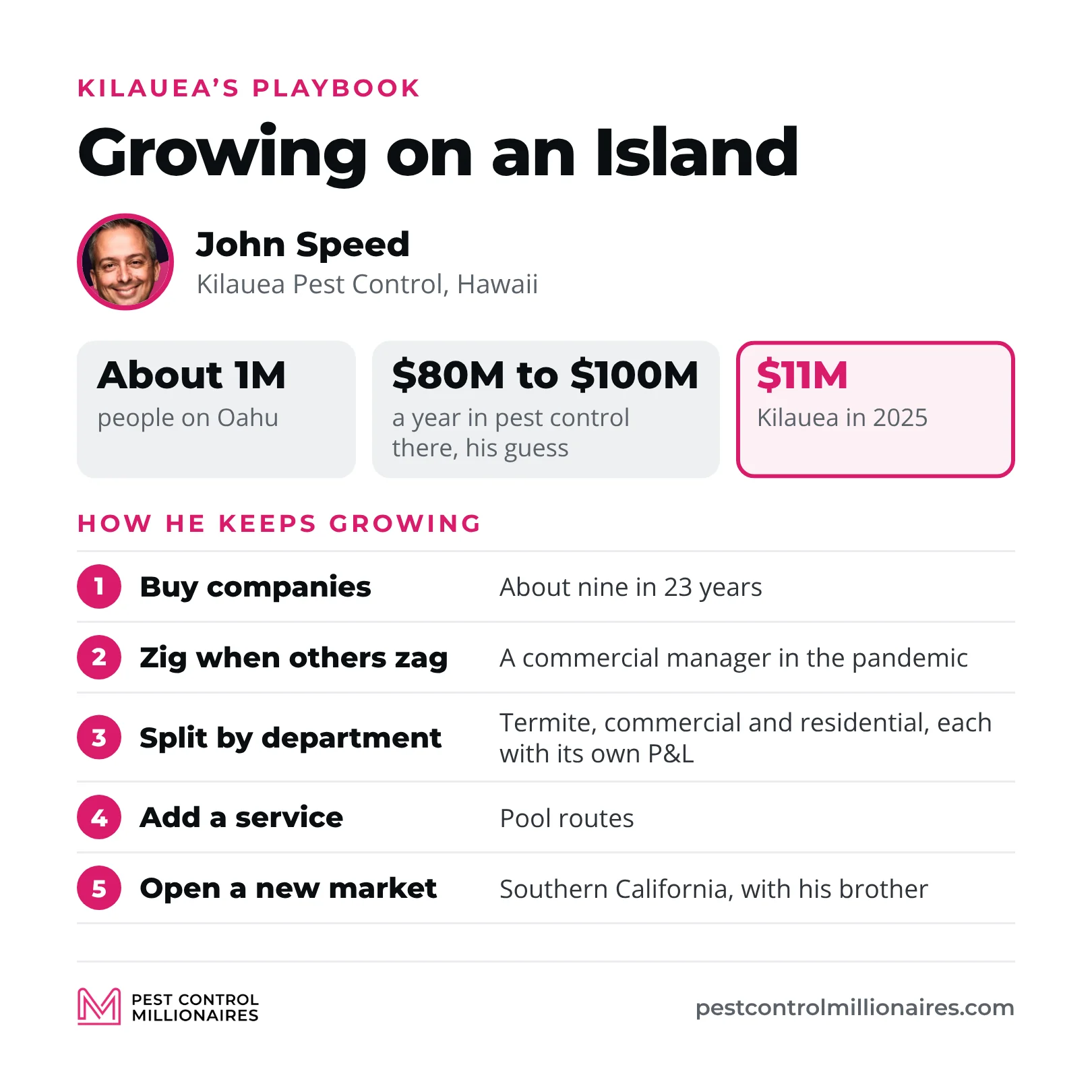
John Speed is the president of Kilauea Pest Control in Hawaii. He started it about 23 years before we recorded this, with about 120 accounts his brother sold for him on the doors. When we recorded in December 2025, John expected Kilauea to do $11 million that year, and it was the only Hawaii company on the PCT Top 100.
A friend in Arizona put us in touch by email, and I’d been looking forward to this one for months. Kilauea sits on an island, which makes John’s problem different from most of ours. There’s only so much market on Oahu, so he’s had to find other ways to keep growing. Here’s what I took from it.
This episode is part of the PCM Podcast. For more on what your market allows, read how big your pest control company can actually get.
He was the tech who wouldn’t lose a customer
John grew up in southeast Texas and went to school in Hawaii, where he met his wife. His brother got him into door-to-door, and he knocked for four years. His brother started a company in Orange County, scaled it to probably seven or eight routes in two years and sold it.
Then his brother came out to Hawaii for a couple of months to help John start his own company, and he sold him about 120 accounts. John knew he couldn’t play the door-to-door game the way his brother did. “I’m going to be the technician and I’m not going to lose a customer,” he decided.
He grew slowly. For years, he said, “if somebody gave me a loan of $50,000, I wouldn’t even know what to do with it.” He skipped the full-page yellow pages ads, but his degree is in information systems, so he had a website from the start, and about 10 years in, he got a ton of Google reviews. When he turned 36 and realized he was “closer to 40 than to 30,” Kilauea was at about $1 million. That was about nine years before we recorded.
Buy the small ones, and keep the local name
Even in that slow first year, John bought a company. The owner had moved to the Big Island, and John offered to buy his customer list. He didn’t hear back. A few months later, when some customers had dropped off and the owner needed the money, they made a deal. John only got about 20 customers out of it, but people in the industry learned he’d buy a business if it looked good, and he’s done about nine acquisitions in 23 years.
He bought a company on Maui about three years before we recorded, and it’s still Bugman by Kilauea. The business had been there for 30 years, “so it has massive brand recognition,” he said. His employees there want to switch to Kilauea, so he probably will. But if he bought a company on Kauai or the Big Island, he’d never change the name. “They are hyper local and they don’t even want an Oahu company coming to their island,” he said.
I usually rip the band-aid off and rebrand on day one, which I explain in how to integrate a pest control acquisition. But a 30-year local brand on an island where people don’t want outsiders is exactly the kind of exception I talk about there.
Optimization isn’t maximization
Kilauea’s marketing budget is super low, and it gets a very high return. That’s where John came from, back when he didn’t have the money. But he’s learned the difference between optimization and maximization. “You can be really good and have that massive ROI, but you can’t get really any bigger,” he said. Maximizing means doing things that won’t return as much and will be harder. “But ultimately, that’s what you have to do to grow.”
Oahu has about a million people. You can’t easily send a technician to another island, and on the neighbor islands, labor is hard to find and expensive, and management is even harder. His guess is that Oahu does $80 million to $100 million a year in pest control, and Terminix has probably a third of it. So how much of the rest can you get?
Not every revenue stream is worth chasing, either. About 35% of Kilauea’s revenue is termite work, but John never got into fumigation. “It’s a liability. It’s a headache. And frankly, the guys in Hawaii are the best at doing it,” he said, and it doesn’t build value in the business. So he subcontracts it to partners, sends them a lot of work and still makes pretty decent money on it.
Competition helps, too. EcoShield came to Hawaii, and it offers Kilauea’s customers a free initial service. John’s answer is quality, from technician training to follow-up. He has three door-to-door reps of his own, maybe 20% of his growth, but he can’t make the math work on what he called “the 80 or 90% contract” with outside door-to-door marketing companies. We run our own door-to-door team at Pest Badger. It’s our most expensive channel, and I explain why I keep it in how much to pay for a new pest control customer.
Zig when everyone else zags
During the pandemic, residential was going crazy and restaurants were going out of business. John likes to zig when others are zagging, so that’s when he hired a manager just for commercial. Commercial has been Kilauea’s fastest-growing segment for the four years since.
The man he hired was one of his first technicians, who had moved away, gotten a couple of master’s degrees, worked for the state and was about to start a handyman business. “For better, for worse, I hire my friends,” John said. There’s no equity, but there’s profit sharing, and another manager on that same structure makes a lot of money because of how it’s set up. “He thinks a lot differently than I do. And I very much value that,” John said. Friends know him well enough to challenge him, and he wants that. “I have so many bad opinions.”
Real estate in Hawaii is expensive, so Kilauea runs one super branch and splits by department instead of by location. Termite, commercial and residential each run their own P&L and have their own call center. “It’s like three different businesses,” he said. The weak spot, he admitted, has been middle management.
Find mentors, even from an island
For years, John had no one to learn from. There was no social media, no groups and no podcasts. “You’re in the desert really,” he said.
About eight years before we recorded, he needed new software. He’d run Kilauea on the same software from a compact disc for so long that he had to buy used computers on eBay to run it. A software company’s website listed some of its customers, so he just called one of them, Arizona Pest Control. They put him through to the owner, Bruce Tennenbaum, who talked to him for at least a couple of hours. Bruce was a founding member of The U Group, a peer group that meets twice a year, and told John he could join once he got to about a million and a half or two million. It took him a year or two. Now he’s in the U Group, EO and a University of Hawaii family business group, and he started an EO accelerator for companies doing $250,000 to $1 million.
He’s honest about what he sees in those rooms. Kilauea is growing a lot compared to some of the group, and he thinks “it’s way less me and more that I’m in Hawaii,” where there aren’t a lot of aggressive pest control companies. New things reach Hawaii years late, so traveling shows him what’s coming early. He even put Kilauea on the PCT Top 100 because it opens doors to the biggest companies in the country.
That’s why I want owners around people a few steps ahead of them. Tateum O’Hanlon told Dan that being able to message operators like John is part of what keeps his ceiling high.
Take care of the people who take care of your customers
About five years before we recorded, in the middle of COVID, John hired another friend to run HR and employee wellness. She’s always looking at things like whether Kilauea can give everyone some form of life insurance. He had a technician die of diabetes a couple of years before, not on the job, and some insurance would have blessed that family so much. Every employee and their family also gets a Dave Ramsey program and someone to help with their taxes.
Some of these things only cost about $4,000 to $6,000 a year, and as word gets out, people stay longer. “If you can have a technician stay on for 20 years, like holy cow, how valuable is that to your customer base?” he said.
It isn’t free. When we recorded, his bottom line was probably the worst it had ever been, percentage-wise, because he was so glad to finally get labor that he kept hiring. But his customer service had never been better.
John asked me how we pay at Pest Badger. Everyone, from techs and CSRs to management, has some performance pay. If you’re switching, test it for a full month with no holiday in it, show each person what they’d make each way and let them pick. “The further that I get away from the hourly pay, the better that I sleep at night.” Brandon Peterman made the switch and won’t go back.
Pick your next service carefully
The obvious second service for a pest control company is lawn. John looked on LinkedIn, found the pool manager at one of the ABC Pest Control companies in Texas, called ABC and asked for him, and they talked for about 20 minutes. “If you guys were just doing pest control and you could either go into lawn or pools, which would you go into?” John asked. “Pools,” the guy said. “So, I’m doing pools,” John told me.
A U Group member whose company did about $40 million, mostly in lawn, told him to stay out of lawn too. “Dude, you do not want to be in lawn. You’re just fixing machines.” And there are always pool routes for sale. When we recorded, Kilauea Pool Service was six months old, and John was making sure the service quality was really good before rolling it out to his customers. If you’re adding services, read my guide to pest control upselling and cross selling.
Build options, not an exit date
Private equity calls John weekly. His plan is to be ready for anything, with no exit sooner than five years, more like five to 15. “I want to be able to exit in two years. I want to be able to have great grandkids working for this business,” he said.
Starting new companies is part of that. When we recorded, he had started about four in the two years before, including the pool company and a new pest control company in Southern California with his brother. Everyone says don’t do business in California, John said, but “that challenge is an opportunity,” and his parents live there. “Are you going to buy Nvidia or Tesla stock or would you rather run something that you know?” he asked. New companies need younger people running them, so he hired a younger manager for the pools.
What he’s really leveraging is his management team, which he calls “the secret sauce of Kilauea.” He flew his California guys out to Hawaii and had each of his managers spend a couple of hours with them on HR, marketing and whatever else they needed.
As for robots and AI, the bigger businesses in his other peer group keep having to pivot hard. “I’m so glad I’m in pest control, man,” he said. It’s going to be a long time before a robot gets under your cabinet to squirt some gel.
Frequently Asked Questions
Who is John Speed?
John Speed is the president of Kilauea Pest Control in Hawaii, which he started about 23 years before his PCM Podcast episode with about 120 accounts his brother sold on the doors. When we recorded in December 2025, he expected Kilauea to do $11 million that year, and it was the only Hawaii company on the PCT Top 100.
How do you grow a pest control company in a small market?
John Speed’s answer is to stop optimizing and start maximizing. On Oahu, he buys companies, hired a commercial manager during the pandemic, runs termite, commercial and residential like three different businesses, added pool routes and started a new company in Southern California with his brother.
Should you rebrand a pest control company you buy?
Usually, yes. I rebrand on day one. John Speed kept the name of the 30-year-old company he bought on Maui, now Bugman by Kilauea, and he says he would never change the name of a company he bought on a hyperlocal island like Kauai or the Big Island.
How do you keep pest control technicians for 20 years?
John Speed invests in his people beyond pay. His HR lead looks at benefits like life insurance, and every employee and their family gets a Dave Ramsey program and help with their taxes. A technician who stays 20 years is worth a lot to your customer base.
Full transcript
Every word of the episode, from the video captions
Building the business turns you into a different kind of human being.
Realize that failure is a part of the...
I think there's hope out there for all of us. For all of us. They say procrastination [music and singing] be the assassination of destinations. That's why we out here grinded with no association with haters and them other crabs [music] trying to put us down. Pest Badger's in the house. Boy, don't clown. Just keep your eyes on the prize and no giving up. You can do whatever you dream of. Keep your eyes on the prize.
All right, welcome back to another episode of Pest Control Millionaire. Actually super excited about this one. Been looking forward to this for a couple months now. John and I met actually through one of my friends out of Arizona. He put me in an email with you and I was like, "How does this I was trying to make the connection so you can tell me that in a little bit." And I was like, "Man, this guy's a stud." And then we talked on the phone for like, I don't know, 40 minutes one day just kind of chatting. And then three months go by, we never really talked and all a sudden someone else brought up your name like hey you really got to meet this guy. I was like actually I've met John before like on the phone like we've had a good conversation. I like I really need to get you on the podcast and like a week ago I finally got this set up but John Speed welcome to the show. He owns I'm going to butcher that...
Kilauea Pest Control is the largest local route-based company pest control company in all of Hawaii. So there's gonna be a lot to talk about, a lot to unpack. John's been in the industry a long time, a lot of value that he can bring to all the listeners and myself. But John Speed, welcome to the show.
Glad to be here. Thanks so much for having me, Jon. It's good to good to be here and chat it up. This will be fun. It...
Is going to be fun. I know we talked about 10 minutes before the show even started. I'm like, we just got to start hitting record. So much good stuff already. But I have a I have a lot of questions to ask myself for myself. And for the listeners too. Good. So I think it' be a lot of really good conversation here. But I want to go way back. I want to take it like I love to understand like what drives people and like when I was young I was I was always super competitive. I was driven at a young age. I started wrestling by the time I was three years old. Just taught me a lot of discipline, commitment. Got the value of winning but also the value of losing and taking some losses you know and learning from them getting better every single day and it was kind of shaping who I was even though I didn't really know it spent a lot of time growing up on a farm so a lot of summers you know I didn't have a job per se when I was young like real young 8 to 12 years old but we were pounding a fence post we were bailing hay and just sweating not getting paid but it just it gave you It showed you a value of a true hard days worth of work where you could look back and you can see the line of fence post that you put in.
So I want to know like what your come up was like when you were young like you're young, you're a hustler, you got your MBA, got your undergrad, you did a little bit of door to door. I'm going to pause at door to door. How did you get into door-to-door?
Okay, so door-to-door my brother again started doing door-to-door. He was up in Provo and that was the beginning of the Eclipse marketing going for Orkin and all that good stuff.
And so he did that for a year. He talked me into doing it and he was really good at it. I was good enough just to kind of be there and make enough money to where it really sucked but it was worth it to come back.
Right. Right. And how many summers did you do that for? I did it for four years and then I started my business and by that time my brother had sold his first business. He had it for two years, sold it, came out to Hawaii for a couple of months and helped me get started up.
Gotcha. So, like if you and I are juniors and seniors in high school,...
Going back to the original question, who were you then? I know you said you weren't you weren't the smartest of your family, but obviously you got your MBA, your undergrad, you're smart guy,...
Super successful now. You took some losses along way like talk me through that.
I just liked an adventure I guess. So I was always like building skateboard ramps or you know halfpipes and things and just trying to get the most out of that side of life and I learned to so in I grew up in southeast Texas, right? Nothing's really going on there. But I had an aunt that lived in Switzerland and she would bring her my cousins every couple of years. They'd come visit. And so it's cool to like see, you know, see what they were up to, see have a vision of the outside world a little bit. And then I went to go visit them as a junior senior in high school. And I think that was pretty pivotal for me because it got it got me out for one and once I got out, I was like I went I served a mission for my church in the US, but then after that I lived in Korea for a year.
I taught English. I went back to school or went to school in Hawaii. I went back and lived for a year in China and did a program out there and learned Chinese a little bit and...
Yeah. What was it? Did you go to China to teach English?
No, it was through a program through BYU Hawaii.
So during my time in Korea, I decided, hey, I want to learn Chinese. So when I went to Hawaii, I took a Chinese class and I learned about a program that was not not many people knew about it, but they would definitely, hey, if you took these classes, you could go to China. And so I did that and the girl I was dating at the time, I had come out and we went to different parts of China, but then we got engaged and after we got married. So I met my wife in Hawaii, but we spent the first few months of our marriage in China.
What was China like? I've never been there. So...
Yeah. So this is 19989 and I lived in Shenzhen which was very modern at the time is it's just across from Hong Kong. So I go down to Hong Kong on the weekends and hang out. But Hong Kong was super super cool. But the energy and the hustle like Shenzhen is a economic zone and so even people in China they couldn't actually go it was kind of like Hong Kong you can't actually go to Shenzhen if you don't have a resident card or whatnot and so yeah and a lot of stuff is made in just that southern China area that then they ship to Shenzhen and ship out or ship to Hong Kong and so that was that was super interesting. So I got to kind of see that side of like distribution and just opportunity there. And then my fiance slash and then wife was going to school in Xi'an and I went there to school for after we were married and that was more that was the ancient capital. That was before Beijing was the capital. And so they have like the terracotta warriors and just a lot of history. And we were able to travel a bit and go out to like the desert like western China a little bit and see some some of the Muslim and the other areas that that usually you wouldn't you wouldn't see.
Can you spill Can you can you still speak Chinese today?
No, I can I can get around in a taxi and Yeah. Get a massage. That's about it. [laughter] Yeah,...
That's funny. Kind of the same thing with me though, honestly. Like, before we talk before the podcast started and coming from a really small town and I just didn't really know any different. And then also my mentor flies me into Dallas. I'm like, holy man, is there this is a big world. And so, you just don't know what you don't know. And then recently went to New York and New Jersey twice in a row. And it's the energy there is I don't know if it's similar to what you were used to in China, but the energy and the buzz in New York is on a just different level. It is so big and there's so much money and so much going on. It's absolutely Hold up. Quick pause. If you're on a pest control company or fertilization weed control company, you're not in our Facebook group, you're choosing the harder path. Every operator that's in there is skipping years of mistakes because people are actually sharing what's working right now. So stop trying to brute force your way through growth alone. Search Pest Control Millionaires on Facebook or click the link below. And now let's get back to it.
So when you talk about door to door, what was door to door like back then? I know you probably don't do any door to door now, but what was like back then? Paper contract was like was it easier? Was it harder? Like...
I would say is probably easier. And it's funny to say there was less competition, but we were in Orange County, so there was still a ton of competition. There's still you're re-encking area. You're having, you know, four or five other companies go in behind you at the time. And so it was it was it was challenging, but and then in Orange County, there was always brand new home areas, so I got kind of used to that. And...
Yeah. Yeah. New homes are always always fun to run into. No, they've never been knocked before. They have new houses. Perfect. So, you went into that for four years. So, I'm assuming you knock pest control, right?
Yeah. And so, that's where you got your your teeth wet in pest control and then you run you do door to door for four years and then you go start your own company. Where did you start your first company? Was it right in Hawaii?
Yeah, it was in Hawaii. So, started the company here and was able to get the license. Super hard to get a license in Hawaii. And so I just got lucky with some stuff. But once once you have the license, you're in and I could see it. And my brother had scaled a business in two years to probably seven, eight routes. And so for that I was like, hey, I won't be able to do that. I won't be able to play that game, but I'm going to be the technician and I'm not going to lose a customer. Right? So, and door, like I said, door tod door was super tough for me. So, I didn't want to do it. I really didn't do it for myself. I would train other people. I always thought, hey, you could hire somebody at BYU Hawaii that's like me, went to school there, but went to the mainland or whatever and sold and then come back to school and you could be able to, you know, do some off-season selling.
So, but that that didn't work out too much either.
Gotcha. Your brother's company, where was that at?
That was in Orange County.
Orange County. So, you were knocking for his company then.
So, I knocked for Orkin for a couple of years with Eclipse and then my brother started this company, worked for him for two years, and then he sold it.
And then you're like, now I'm like you're like, now I got to go find something to do. So, you decided it'd be a good idea to go start a pest control company in Hawaii.
Yeah. I like options, right? So, I that was kind of plan A, but then I was set up to go do an MBA in San Diego, San Diego State. And so, but once I got the license, I was like, okay, I can see not millions of dollars, but hey, I can go live in Hawaii and I can have a decent job. I'm not going to go we're not going to go hungry. We can stay here for as long as we want. And my wife is from Oregon and she's she loves Hawaii and is never going to leave. Our kids have grown up here. But...
Yeah, you were going to go do an MBA doing what? Remember...
Just a general MBA. So just do more education, right? And just expand the opportunities, right? And so what happened with that was I started my business was growing it and kind of growing it slow, but I my MCAT or not my MCAP, my GMAT was coming up. It was like good for five years. And so I was like, well, I'm never going to take that test again, so if I'm going to do something, I'll, you know, do it now. So I got into school at University of Hawaii and finish that up.
And was that are you glad that you did that? Was it helpful? In your entrepreneur career today,...
You got to do something, right? So I think given the same three years, it's good to just keep your head in it and keep learning and give you more experience. So my thing is if I hadn't have done that, I probably would have just watched more movies. Right. So you know, keeping you engaged.
Yeah, for sure. I like that. Just keeping your mind busy and focused on something. For sure. And then from there, like you go start your company in Hawaii. What are the first what is the first year like? How are you getting customers? What were you doing for marketing way back in the day? I know you weren't doing door. You said you're growing slow. Like, walk me through...
I didn't do anything. I My brother My brother got me like 120 accounts.
So, your brother came over and knocked doors for you.
He came over and knocked doors. And so, he was here for like two months. And then he and I and my buddy that came out to also sell we went to Palau, went scuba diving, they went home and I just started teching and I was like, "Hey, we're living. We don't have a whole lot of overhead. We have this business." And I can just remember at the time, not not maybe that first year, but even like several years into it, like, hey, if somebody gave me a loan of $50,000, I wouldn't even know what to do with it. Right. I wouldn't like I put into marketing. What kind of marketing? Wouldn't I was on the come up it was yellow pages,...
Right? Right. And so you open the yellow pages and these guys have these full page ads. I'm just like, hey, I'm just not going to do that. One thing I did do from from the very beginning which wasn't helpful but I had a website because my degree is in information systems. So I was able to you know knock out a website and even at that time I really didn't get online sales right and there really really wasn't online sales too much. So it was just an informational website. But when and this is a no-brainer now, right? But very early on Google reviews, we got we got a ton of reviews and we got it to where we could get different locations and things and set set that up. But this is like 10 years into the business, right? This is, you know,...
What year is this like 10 years in?
10 years in. So that's probably 2013, 2012, 2013.
Yeah. And...
So like 0 was it 08 like I'm trying to think of like it was 08 or 09 or 2010 when like the.com bubble happened where everything just kind of blew up online. Were you there through that? Like I'm assuming yeah got tons of tons like you're probably one of the first ones...
Yeah. So 98.99. Yeah. So when I graduated in 2000 that was the dotcom bubble burst and I was trying to get you know Intel. I was up in Portland and so Intel and some of these other companies and nobody's hiring, right? So I'm like, well, I guess I'll go back to pest control, you know, I can I can do that. So...
So you're getting a ton of reviews online and you're just you're growing slow organically and then what happens? Obviously the mindset shift happens somewhere. Something happens where like, okay, I'm gonna go grow this thing.
Yeah. So, well, and I had seen my brother grow, you know, I'd seen, you know, the door to door thing and but I just didn't know where to find information and I'm out here in the middle of nowhere, right? And you're out in Hawaii, so it's not like you really have we do have a state association, but in Hawaii, your competition isn't very fierce either, right? So, I there was no real mentorship. There was not a whole lot. I mean, there wasn't Facebook or social media or any kind of these groups or podcast or anything like that. So, you're in the desert really. And so, that's one thing just on my own, I guess, is when I remember turning 36 and I was like, man, 36 that is that is closer to 40 than to 30. So I was like, okay, what am I going to do in the next four years?
And let me think how long ago that was. That was nine years ago. So that's about Yeah, that's a Yeah, that that's about that where we just were up to a maybe a million dollars in revenue, which is nice, but it's still very hard at a million, you know, but I had been doing it so long it was pretty, you know, I had I had some good systems, some good people, but it's not really enough to pay management or anything good like that. And so,...
Yeah, it's usually like three techs in...
Yeah. Yeah. But I had seen my brother sell part of his business, like sitting at the table, in San Diego. He sold a couple of routes to Lloyd's. And so I was there and saw, okay, this is a thing. This happens. And so even from the get-go, when I say I didn't do anything my first year, there was one thing that I did, and that's, I did buy a very small company. And the guy had moved to the Big Island and I just reached out and said, "Hey, I'll buy your customer list off you." And he didn't he didn't really get back with me. And then I approached him two or three months later and this is when some customers had come off and he needed the money and so he was like, "Okay, we'll we'll we'll do it. We'll figure it out." And so bought his customer and I only got like 20 customers off of it or something.
But it was something that when they come up I have a decent enough relationship with a lot of people in the in the industry that people know that I will buy a business or two if it's you know if it looks good. So yeah, that was I guess on the come up, we've done like maybe nine acquisitions so far in the 23 years I've been in business, but one of those was about that time about maybe 12 13 years ago. And we got a lot of hotels out of that one. And so it wasn't super profitable work, but it was something new, right? So just putting yourself in a different opportunity to grow, right?
Is good.
Yeah. You almost like you put yourself in a constraint and it makes you grow, so you learn a lot because now you're getting some commercial work. You can raise prices. You can go get more commercial work. I didn't even ask that question. What is your revenue? Not I don't know your revenue number, but your revenue split between commercial and residential.
Well, we're PCT top 100. So I mean you can look it up. For we'll do 11 we'll do 11 million this year. The split is like 40 probably 35% termite work. Most of that is not reoccurring but this is during the during the pandemic I kind of like to you know zig when others are zagging right and so like residential is going crazy. What's not going crazy right now? And that's commercial. There's a lot of, you know, restaurants going out of business. And so I want to go into commercial business. And so I hired and we had always done a little bit of commercial, but I was like, hey, I want to hire a commercial specific manager. And he has that's our fastest growing segment the last four years.
Yeah. And so because when we were doing commercial work before when I was kind of in charge, I mean I haven't been in the field or even really in operations for probably the last 10 years, but really I wasn't going to hire or do night work and have the a situation where somebody was calling me in the middle of the night. Right. I needed to...
If you get If you get a phone call at If you get a phone call now at 8 o'clock on a Saturday, there's a problem. A big one.
Right. Yeah. Which you know you got to answer. Where did you find that commercial manager? That's the call commercial manager. And then then kind of tell me the story about...
Yeah. So that's a good story because it's indicative of a lot of what I've done and that is for for better for worse. I hire my friends. So, this was a guy that was one of my first technicians and worked for me for a couple of years and then moved away, got a couple of master's degrees, moved back, and he had worked for the state and a few other things, but then he was going to start his own business, handyman business. And so, I just presented him this other option. And, although there wasn't equity, there was profit sharing in it. And I had another one of my managers that had had that that comp structure and we're all really good friends and he makes a lot of money because of the way I've set it up and it's like hey this is going to take some time but you can you know participate in this in this real upside on the on the business.
And so thank goodness he's come on and it hasn't been the easiest. It's commercial work commercial works hard, but he thinks a lot differently than I do. And I very much value that. I really enjoy and when you hire your friends, there's so much trust involved. And so I've heard the story of how is it James that I met in Orlando? How you how you met him and is it was like a Facebook like hey do you want do you want mentorship or whatever and it's like to be able to connect on that is amazing that's super cool and now he's so valuable to your business and for us it's different but it's the same thing I already have this good trust and we can kit around with each other and they know enough to challenge and some of my longtime managers that that were not that were they're not coming out and doing like a potluck or something at my house.
But we've been in management a long time and so those guys, they won't push back on me. But...
That's what we want, right? Yeah. And we don't want if everyone agrees the 100% you say, you're not going to get anywhere. You want people to challenge your opinion.
Well, I have so many bad opinions, you...
Exactly. Yeah. We don't know everything, but we want to be pushed against the idea. Ex. Absolutely. I agree with you.
Was he really good like right out of the gate of getting commercial work or did it take some time?
Well, we have a pretty good name here in Hawaii and so we already had that and so, it's interesting. Our marketing budget is super low and we're we get a very high ROI on that but and that's where we've come from where we didn't have the money right but now it's at a point where it's like the difference in optimization and maximization right it's like you can be really good and have that massive ROI but you can't get really any bigger and the additional effort you put in is not as good as the earlier stuff right so...
That's the thing where when you're maximizing, you have to like do some things that aren't going to ROI as good and are going to be harder. But ultimately, that's what you have to do to grow. And especially in this market, that's the challenge with Hawaii is...
That's what I was going to ask you. What is the population of where you're at?
It's a million people on Oahu. And it's not like you can really easily send a technician to another island really easily. Right.
Right. How far is the closest island?
The closest island is probably 15 miles away. But that's but that's 18,000 people on that island. Like it's not worth really going to make money, right? We actually have a technician on that island. We bought a company three years ago that was on Maui. So, we have a we have a presence on Maui and we're growing that. We're excited. But the other neighbor islands, it's very difficult to get labor and it's and it's very expensive and it's even harder to get management. And so, there's so much business on Oahu available that's easier than going to a neighbor island. And so, we probably will not go to other neighbor islands.
Yeah. Yeah, because I mean a million a million people is it's pretty pretty big market. So you got room to move.
Yeah. But that that's it, right? And so...
There my guess is that there's probably between 80 and hundred million dollars in re annual revenue on Oahu in a year. And so how much of that can you get? Can you get 50% of it? Like the Terminix probably has a third of that here. And they're by far the biggest company. And I know you said there's another large competitor that's local, but they do all fumigation, too. You guys never got into...
No, we didn't. And it's and we still look at it even even now. There's other opportunities that come up.
Yeah. That's a that's a liability in...
It's a liability. It's a headache. And frankly, the guys in Hawaii are the best at doing it. And so I'm going to try to compete with them on something that's super difficult and not that it is good money, but it's not it doesn't build value in the business really. It's not really worth anything. And so I'd rather put our efforts towards, you know, the re reoccurring side, of course. But there is a lot of termite work in Hawaii. And so you can't dismiss it. And so we subcontract it and our partners that we work with, they we give them a lot of business, you know, and we make pretty decent money from it. So...
Yeah, that's awesome. So do you service all of Maui then or is like is there a third party you don't service yet?
It's a good question. We service everything because the company we bought I mean they will go out we have some customers in Hana and so the guy will drive out to Hana do the work stay the night and do the next day and then come back and then do that again the next month just one you know just the two days out in Hana so...
Yeah how far is that like hour is it further like I don't know like I've never been to Hawaii so how far is it from one side of the island to the other...
From basically from anywhere to Hana is probably two hours, a couple hours, two and a half hours, but it's very very windy and it's a slow it's a slow track. It's great if you're vacationing.
Yeah, for sure. Yeah. And what are what are like what are the most common insects you guys deal with? I know there's termites, but is there a little bit of everything over there because it's so warm all the time or what do you guys usually deal with?
Yeah, there's a lot. There's a ton of ants, ton of roaches. It's temperate year round, right? So, it's we don't it's not too seasonal. We have more kind of a rainier season and in the winter, right? And then summer...
Which is winter, right? You said like that that brings a lot of challenges in itself, right? How do you guys how are you guys servicing the in a lot of like kind of like Florida like it's raining all the time? Like how do you guys service? If we're servicing and it's just regular rain, you just kind of either work through it or nowadays guys like to take off. They don't they don't want 40 hours. I want them to have 40 hours, but they don't want 40 hours. So, it's, you know, we used to worry about that and try to get rainy day protocols and they can work in the office or something, but most people don't don't really care. But in the in the summers sometimes there's no wind and so it gets super hot. So that's kind of the other side of it. But yeah, rain people and it Well, I'll say this. When there's no wind, it will sit there and dump and which it's been doing the last couple of days. And so when that happens, then you just take the day off.
But otherwise, if it's just sprinkling, it's probably like in Florida, you just kind of power through.
Right. Right. The fires, was it last year, two years ago? How long has been now since all the...
Yeah, it's like it was three years time goes by fast. Were you are you close to Were you close to that?
Three years ago. So, we had bought the Maui company. So, that was Maui, right? And we bought that company maybe three or four months before that. And so we lost I think 10% of our customers from the from the fires and that I mean that island still hasn't recovered. Economically it's still struggling. Big Islands the e economy there is really good. Oahu but Maui's yeah it's still challenging over there. So we're still doing the work and it's fine. And I don't want to sound like it, you know, the loss of revenue is like negligible, but you know, what the people have been through over there is just horrible and we do what we can.
Yeah. What are the biggest challenges that you guys deal with on the islands? Like I know you mentioned labor. Is it really tough there?
Yeah, it has gotten better the last year. I think like with everywhere, but you know, I'll say this and it's a some of the this may resonate with folks out there, but our bottom line this year is probably the worst it's ever been percentage-wise because we still we're so excited that we can get labor that we're just still hiring, right? And so the inside of the business is awesome. Like the customer service has never been better. You know, we're doing some extra things, the sales and the, you know, the outbound stuff and it's and we're still growing, so it's good, but that labor is expensive, right? But after, you know, COVID and everything that's gone on through there and not being able to get labor. Yeah, it is making that change, but it's you know what you haven't had you want, right?
Yeah, I agree. Outside of labor, like what's your biggest challenge right now?
I Well, for Kilauea, that's our our main company.
Did you I don't mean to cut you off. Did you rebrand all the other companies that you bought to Kilauea, too?
Yeah. Yeah. The Maui company is still Bugman, but it's Bugman by Kilauea, so it's a it's a real slow roll out there. And the employees want us to switch it over. We've had it for three years, so I think I think we'll probably do that soon. And it doesn't really matter about that too...
Like, thinking back on that, do you wish you had just ripped the band-aid off right away? No, because we didn't know. And I mean, there's some very unique things out here. Like I didn't know, but I do know that if for some reason if this great opportunity came up on Kauai or the Big Island, I would never change the name. I would not want them to know because people on those neighbor islands, they are hyper local and they don't even want a an Oahu company coming to their island, right? So, it's all super local. And Maui, my guess was that it was more not like that. And I think that's correct after having been there and worked there for three years. But, so, but we didn't know. And so we didn't know if we were gonna flip it or we just wanted to keep our options open.
Yeah, that's smart. And so now that you know that, you're like, "Okay, now we can switch it's not a big deal. But the business was there for 30 years, so it has massive brand recognition,...
And what do you make a difference?"
Right? And that's I was think that's what was going on in the back of my head like you're a bigger company. Your brand probably carried a lot more weight than their brand, but it sounds like it's there for 30 years. It probably didn't. Maybe their brand maybe their brand carried more weight than yours,...
But now you say like they're just not they don't really care as much as you thought they would. Just rebrand it. That's what another another question for you. PCT top 100. Why did you decide to put yourself on there?
It was kind of a goal. You just see I'm just getting into the business again. I didn't grow super fast and I really wasn't concerned about that. But when you find like you can do something well and you're successful at it, then it does open doors, right? So I went to the PCT top 100 event that they had and it was just for those those companies and so I got to really spend some some quality time with those big companies. Now I'm in The U Group and I'm in different you know I generally do PestWorld and I'm out there but that that was that was an opportunity that that most companies don't get to have. So...
I wanted into that. Yeah, I just the only reason I asked because obviously we had we've had an opportunity to be on there and I just kind of shied away from it because I feel like we already have a target on our back. Why do we need a bigger one? So I wanted to hear the other side like and now I'm like okay yeah I like that. It makes sense. Like tight it's a tight community of 100 companies like some of the best obviously the best of the best are there. So yeah networking with those guys is pretty invaluable.
Yeah. Well it and it's one way or another right? I mean, there's there are those billionaire families that no one knows about that they can go out and nobody would recognize them. And then you have the other way where it's all like Mark Cuban is still doing Shark Tank, right? He doesn't need the money, right? But he need he does need that exposure, right? So, if you're going to go one way or another, there are good and bad things to both of those things, right? So,...
Was there anything bad that came from being on the PCT top 100? Well, if I check my email, it would be getting more emails. But [laughter] that's what you have a good assistant...
I know what you mean. I know what you mean.
No, I don't I don't I don't think there's anything bad. And again, being in Hawaii, like there's we get to say that we're the only there might be company bigger than us, but I don't know because they're not on the list, right? So, we can say we're we're on the only Hawaii company on the PCT top 100 or a top 100 pest control company.
I love that actually for you guys. Definitely make me think. Is there any door-to-door companies because I know you talk about door to door, you talk about door to door in Hawaii. I've had some friends say that there is a door to door company out there. Is there still is that a thing out there?
Yeah. So, EcoShield's out here. Terminix has has a lot of years had a door-to-door presence. And then just in the past couple years, there's some local companies that have had marketing companies come out. I can't understand paying the 80 or 90% contract. Like I can't make that math work for me.
The math doesn't math to anyone unless you have super deep pockets.
Yeah. If you're selling your business, it kind of works out. But,...
Yeah, if you're going if you're gonna go PE or you're gonna go stock exchange, whatever. Like, I get it. You're gonna go public. I get it. But, you can. Yeah.
Yeah, you can arbitrage it a little bit, but for me, I know enough to be dangerous, right? I have some door to door guys right now and it's just it's just like three guys and it's maybe you 20% of our growth but you know it's marginal you know it's not it's not going to break us if we don't have it and it's helpful that we do just to give some competition to like the eco shields out there that have a that do a great job and for me that that's actually it's actually really good to have the competition out here. It makes us so much sharper, you know, when you when you have door-to-door and not necessarily putting a target on anybody's back. The I feel like the relationships the definitely the local relationships are pretty good out here between pest control companies.
But yeah, to have to have a big door-to-door company that's making the gains, it does expand the market and it's not necessarily it's good and bad for us and I choose to see the good in it.
Yeah. And I'm sure have you felt that at all per like with your pic have you have you had people switch?
Yeah, for sure. I mean people I mean nobody's perfect, right? We make mistakes and they're very aggressive. They don't switch over. I do know that just for us, EcoShield has a special they will do their initial services for free if they're killa customers. So they so we definitely have a target on us. They definitely want our customers. I don't know that they get a ton.
And how do you how do you combat that? Oh, that I mean it's all the effort into quality, you know, just customer service, the training of the technicians, the following up, the management layer. That's probably the one one of the things that I would say we're the we've done the worst at is middle management, trying to dial that in. One thing that we bought a company like three years ago. We bought the Maui company and then within a month or two we bought another company. The owner of that company came on as as a manager for us and that was super helpful. So he's yeah, some of the middle management and then our termite division. So, it's kind of kind of weird, but you know how you have like a location, like a branch, say, and I've heard, you know, Paul talk about like, oh, about 2 million, 2 million, and you start another branch.
Well, in Hawaii, like the cost of real estate is super expensive. And so, we have one super branch, right? And it takes care of everything. And so how we've split it up is between departments, not necessarily geographic locations. So our termite department, our commercial department, our residential department all run separate P&Ls. They have a different call center for each one. And it's like it's like three different businesses. And then and so now this is probably something I mean since you do pest and lawn we're not into lawn yet but we've started wrapping up rolling up pool routes and so we're dipping our toes into the pools and we're looking at other home services.
Yeah. I actually just I created a YouTube video on that specific this morning. It's like when you get to where you're at, right, and you got to maximize it's like what are the services you can add because you can only like you said, you can only get so big in your market. Then what do you start doing? So I actually made a YouTube video on that this morning. Pretty fun. How often do you get hit up by PE?
I mean I wouldn't say daily, but weekly for for sure.
Yeah. Who is the who is who's coming at you the most? What do you hear from the most? My phone rings probably like yours. It's like once, twice, three times a week. On a good week, it's every day, you know?
Yeah. I honestly don't look at my email, so I don't know.
Smart man.
Yeah. I Well,...
I took myself out of our company email because I was just couldn't do it...
Yeah. Yeah. That's one cool thing in the last I mean I guess I hired them in this summer. But I've had an assistant for about six months now that does my email and starting to run my calendar and do some of the and I'm kind of a control freak. I do a lot of travel and so like I like specific things but kind of giving that up has been pretty freeing and honestly I wasn't that good at email before. So, a net benefit to everybody that somebody else is running that.
Does she like how did how does she do it? She just texts you when there's an important email.
Yeah, I figured.
Where did when when and where did you find The U Group and how impactful has that been for you? I know you and I talked about this offline a little bit,...
Yeah. So I was So when I started my company, my brother was selling his and so I bought a truck and I brought I bought a compact disc of Smart Biz. It's an old software that was from FMC, the FMZ, you know, the chemical.
Yeah. So I had this smart biz and we used it for so many years that they stopped I mean after a couple years they stopped supporting it and then you couldn't even get it and so I had to buy used computers on eBay so that would even run our software right and so at some point you're like okay well we need to be on the smartphones and that sort of thing. This was probably like maybe eight years ago. And so I looked at PestPac. I looked at ServSuite. And on the ServSuite website at the bottom, they say, "Hey, these companies use our product." So I just called up I called up Arizona Pest Control. It was one of the companies and they put me right through to the owner and Bruce Tennenbaum talked to me for like at least a couple of hours about so much stuff.
And this is like we were kind of talking about before that I didn't have like a mentor or anybody but or just anybody to talk a non-competitor about the biz. And so after during the conversation with Bruce, he was telling me about The U Group and he was a founding member and he's like, "Hey, when you get to a million and a half or two million, something like that, you can join The U Group." And so at that point I was like, "Okay, I'm I gotta get to whatever it is, a million and a half to join these guys." And so it took me a year or two and joined the group. And since then it's been super helpful. It's like everybody does things so differently and that's good and bad, right? You can see where I mean we meet twice a year and you can you get to know the guys and they're the different way they run their business, right?
And there's some things that are like, "Hey, that's so cool. I don't think I can do that in my business, but what else can I learn from it?" And then the other side of like, "Oh, that's why the growth isn't there." Or, "Hey, you're doing you're spending all this money on a certain whatever that is function." and is that playing out? And I can see that we're growing a lot and you know compared to maybe some of the other groups, but it's not I think it's way less me and more that I'm in Hawaii and there's not a lot of competition out here. Competition is not the right word. There's a ton of pest control companies, but not a lot of aggressive pest control companies out And so that's been interesting to see from a nationwide these companies all over the US and how their personalities play into their businesses and what that what that looks like. It's super fun...
For sure. And then you just brought up software and I'm not going to give anyone a shout out but just curious what software you end up where are you at now with software?
Yeah, we use FieldRoutes.
Awesome. Yeah, us too. Yeah. So, we did we actually to finish the story, we did go to ServSuite for a couple of years and then I think FieldRoutes did something a little different with their pricing and just the user experience for us was so much better with FieldRoutes and so we went there and then now that they're under the same umbrella and they can't even get those ServSuite people over to the FieldRoutes, it's just man private equity can really wreck...
We go on a rant about this. This is our biggest struggle with M2. It's been tough for sure.
Yeah. Are you on FieldRoutes as well...
And if and it's like we've talked about switching so many times and I'm a firm believer and I know this. I'm wise enough to know that all software has its issues. I understand that. Happy with the software. It's been good. Things are a little slow to move where I'd like to see them and I see other platforms that are doing really good AI stuff and lots of cool things happening there and their support I'm not trying to dog them I get it but man is it rough you know but again I get it I'm not trying to dog them by any means software is great obviously there's things I like to see change but again I understand that nothing's going to be perfect and I'm okay with that we there's a workaround for everything you know but when you're just trying to get a hold of someone and you just need to fix get something fixed and it can't get fixed and that's a struggle...
And you're of a considerable size like hey not to pull that card but help me out here...
And thankfully with that being said and I get got to give credit where credit's due. We have a weekly meeting every single Tuesday with the FieldRoutes representative so we have that access. So that that's been a big win for us. So, I got to give credit where credit's due. I'm not trying to dog them, but it's to the point where like you almost feel like the pain of staying with them sounds is like way worse than the trying to like the pain of switching. So, it feels like we're like almost like in handcuffs like because just the thought of having to switch all of our customers over to new software oh it just it sounds terrifying and I've done it once before and it's not fun.
No, no, it is not. And with the acquisitions, we've tested out their the different softwares out there. We've we've played with everything. But we've switched back to FieldRoutes and got them on our stuff. And it's interesting. It's interesting to learn. And then the way we run things is and I'm sure every pest control company runs things a little bit differently, right? But we have some pretty sharp people in our office that do some some good workarounds. And...
Yeah, us too. And thankfully thankfully we have those on our team, you know, because small operators probably don't.
And so it's funny, they'll call me be like, "Hey, can I borrow that person for a little bit? Have fix this." So I'll just give them a call. It's kind of funny. How much do you think the industry has changed since you started till today?
And then and then after that, I'll ask how do you think the customer has...
Okay. Okay. So, I wouldn't know except that I'm doing a new pest control company in Southern California right...
I have that I have that on my note to talk about, too.
And so I'm looking at, hey, my brother started his company in Orange County 25 years ago. And now he and I are back together in this partnership, starting it up. And it's still very challenging. He's going out on the doors and he hasn't been on the doors for like 10 years at least. And so there's all the Ring cameras, there's the even more competition than there was back then. But I did want to mention though I it was super helpful. So the story of how we got back together, right, is I met some of your guys in Orlando, right? And some of the Pest Badger guys and just to be around them and to see the energy of young people and then jump back into my new business where it's three 50 year olds trying to run this thing with, you know, a young technician maybe, but like the energy that they have was so exciting to me.
And it's like, okay, I can do this with one company, but we're looking at I mean, we have probably four companies that we've started in the last two years and it's like from here on out any new company is probably gonna have to be younger younger folks you know running it and that's so my pool company that's what we did we hired a guy and he came on he's younger energy he's super stoked about being able to work with our management team learn from us and we can level him up and just kind of get that synergy going right but it's different. It's different working with with older folks and more experience, but you know, we you know, we might not be there till 5:00 in the evening. You know, it's a...
Couple a couple really good topics to talk about. First one is what was your decision to start another company in California? I know you and I talked month ago or whatever it was two months ago. You're like, "Yeah, it's been challenging. It's hard." but why did you decide to do that? Was it because the capacity that you were at in Hawaii, like you just don't feel like you could grow, so you decided to start another market? Was it your brother? Was it all of it?
It was all of it. It's really options. I've seen people sell their companies and then it's great for a couple of years and then they want to get back in the game. And so I'm like, well, if I want to start some other businesses now, then I can sell the big one. I can sell off other pieces and have an exit. It kind of depends, excuse me, if my kids want to join the company or what kind of, you know, management, you know, bench that we have, so to speak. But it just gives options and the opportunity to play in that Southern California market, a new market for me and to leverage our team over here was just too good to pass up because it's like what are you going to do? Are you going to buy Nvidia or Tesla stock or would you rather run something that you know that you know you give something you know you've been in it five years and you're murdering it you know if you have you know a good 10-year run like you can you can do a lot of different things and have a lot of different options.
The Cal the other thing is like is like I say everybody says don't do business in California. It's super hard and it is right but that challenge is an opportunity right as where you can go and get leverage on somebody else exiting or not you know I mean we can't all be in Dallas and Raleigh you know it's like and that's a challenge too you know those are great markets but they're super competitive you know so I'd just rather be and frankly my parents are in Southern California. And so if it gives me an opportunity to travel and see them, h it's awesome. You know, we're we're not getting any younger. And it's all about the relationships.
Yeah. How how often do you travel to...
I think December is the only month I'm not traveling this year. So, and that's US, whatever. And so if I'm not going to California, I am going to the mainland at least probably seven or eight times this year. And so not every time, but a lot of times I can just stop in on a layover for a couple of days and check in with the guys or fly them out to Hawaii and then we you know, pow.
That's not a bad deal. It's not a bad deal. Just fly them out to I'm sure they hate that.
Yeah. Yeah. You brought up kids. How many kids you got?
We have three children.
Awesome. Boys, girls?
Yeah. A couple boys and a girl. Have a son that's, my middle child is serving a mission now in Georgia. [snorts] my oldest just got engaged...
Last week. And so, thank you. It's super super weird, but amazing. I'm super happy for him and his fiance. Very nice young lady. And I met her parents. She's from Vegas, but they're coming out for Christmas. So, son gets in tomorrow night and then I have a daughter in high school. So, It's awesome. She's a sophomore. So, we have a couple years until we're empty nesters here.
Awesome. What grade?
Yeah. My oldest is a sophomore in high It's fun age for sure. I love it. In It is. But she's so good. Like I got I can't say enough about the girl. She's...
It's a heartache.
She's just she's great. She's easy to deal with. 4.0 student. She's great athlete. Like I mean she's just an all-around rock star. She's such a great kid. I've gotten super blessed with all of my kids. But you know she's just she's the oldest and she set the example and she's she's awesome. Like she's a wrestler. She's tough.
Yeah. First goes, then everybody can follow. And that's so good, man.
So, she's ranked fifth in the state in female wrestling. She's really tough. She's fun to watch. We travel the country for sure. It's so much fun to watch her. Love it. So, it's been fun. You mentioned exit, too. Maybe you don't have an exit plan, but maybe you do. What are you...
I'm preparing for everything. I'm preparing to exit probably I wouldn't say any sooner than five years, but I say five to 15 years. So like I have no plan to exit, but it's both. Like I want to be able to exit in two years. I want to be able to have great grandkids working for this business, right? So whatever options are out there to make me feel good about you know the possibilities then we can make the decision make the decision later. But I'm planning on both if that makes any sense.
It does. No. Yeah. You always got to be set yourself up for because you never know what's going to happen. That's kind of where I was going to gear this next question to. The future, right? You guys are in The U Group. I'm sure you guys talk about the future a lot. What it's going to look like. All the AI stuff coming, robots, like who knows? Like what are like I'm sure you guys talk about a lot. What is your What is your take on?
My take is I'm so glad I'm in pest control, man. I [laughter]
For real.
For real. I'm in a I'm in another peer group that they're all younger, hotter, much more wealthy, much bigger businesses than I'm in, right? But I meet with them three, four times a year, travel to the mainland, and at this last event, like it seemed like almost all of them were having to pivot so hard. And it's like to move this, you know, $50 million company, like your algorithm has changed or the government has changed the laws and you have to like completely redo your business. It's like I mean those are real businessmen like pest control like another tech, another truck, like let's go. It's so yeah, there's changes. There's the technology. It's more competitive now. I'm GL I'm so thankful that I got in when I did, but there's still opportunity even even for the startup like in pest control. And so that's where in Hawaii Hawaii specifically because of the geographic constraint that I'm in the pest control business, but we a lot of us now think, oh, we're in the home service business, right?
But it's all labor, right? I sure there's going to be a time when there's drones and other things taking but man, it's gonna be a long time before there's a robot getting up underneath your cabinet to squirt some gel, you know? I mean,...
Yeah. And if you listen to like what Elon says and whether you believe him or not, he's usually accurate at some point. He likes I think his timeline is usually a little bit later on than what he predicts, but he says in the next five years is going to be five or I think he says half million or five million. Can't remember the exact number. He said robots on Earth doing all of our work for us. So what is that going to look like for us? Is it like homeowners own this $20,000 robot that does this work for us or is it like hey we're going to own the robots as a company and they're going to go do the work for us self-driving cars like what that's going to I have no idea. So just to bring it up like so to say because I said that I was going to go on a 20-y year run when I started pass. I'm like I'm going on a 20- year run. We're on year five. I got 15 more years of me. But at the same time with you I same thing I kind of agree with you like I want to be set up so no matter what happens I have a plan, right? So if things start to get a little rocky and all this stuff starts coming, I we could sell have a good exit. I just don't want that that to cost us a lot of money.
You know what I mean? So, I got like you said, you have to be you have to play kind of both sides of that fence, you know, but I don't know what the future looks like.
Yeah. Yeah. You gotta go with what's what's worked, you know, keep an eye out for the future, but I mean, there's still brand and there's still your customer base, right? Which is obviously the most valuable thing that that you have, right? It's that customer base. So, what can you leverage with that even with robots? Like I don't know this is what I'm thinking more on the pool side you know pool automation okay that makes a little that that's chemical you still have to have somebody come up but that will get I think a lot more automated right and so from there there's still a labor part there's still a human side but again it's the it's the customer base right what can you do with that customer base And that's the value in that.
And so I think that will I'd like to say it'll it'll always be valuable, you know, as long as you do run a good brand, then you know, and massive companies have shot themselves in the foot not not paying attention to those things. So as long as you're properly paranoid and like thinking, you know, it could happen to me, then I think we're going to be okay.
You have to be paranoid. You have to be. Even even the real wealthy guys, you know, that they're looking they're looking out and they're seeing what you know, doing the SWAT analysis and like figuring out where that competition is going to come from. They're they're they're playing to win and that's it's that's a fun it's a fun place to be.
It is. And it's like capitalism at its finest. May the best man win. It's just like you never know what's going to happen. I said this on the podcast before, but like two years ago I was out in Florida at a Patrick Bet-David conference and I was talking to he was like over the robotics of Ford and he said Jonas there's already robots in our lab right now that can do your job. Your job is to have enough capital so when they do get released that you can be the first one to capitalize on these robots so you own them first. So just having those connections like what people are thinking about like okay good to know you know like it's coming down the pipeline. My mentor has been on the board of robotics lawnmowers for years and they've been trying to figure out this lawn robot for 20 years and they still not quite there yet. And so I think just this year they finally launched the first fully robotic lawnmower that's like a 52 in whatever and you don't have to have someone there watching it all the time.
It's still in beta. It's still new, but they've been working on this for 20 years. Like, it's not out there doing pest control. It's out there cutting grass. And that's the easiest of all services to do in my opinion. And it took 20 years to figure that out. And I know it's with AI and all this new stuff technology that's getting faster and faster and faster. So, how long do we have? I have no idea. I wish I had a crystal ball, but I...
It's not going to be everywhere all at once, right? You'll be able to see some of that. And especially that's that is one benefit about Hawaii that if you know it's not easy to travel that much and to see what's out there, but if you do, you see what's coming earlier. And that that's definitely an advantage that that we've had and we've seen because things are slower to get out here and the competition and customers like don't even know about it, number one. But you know when it does trickle in it's you know a lag of several years.
Yeah. And it's like okay okay so they launch these robots let's say in five years but then the government has to approve that everyone can own robots. So is the government going to say yeah everyone can own a robot like who knows...
But your California business on the other hand like that's where it all starts right? Yeah,...
That's where that's where you know all of especially in the Bay Area like that's where all like the AI guys are coming from, right? So that'll probably impact they're the fastest. It seems like everything starts in California, trickles throughout America, you know.
Yeah. Yeah. California on the other hand, I mean, there's some issues with the pesticide law that is like they're they're clamping down on that so hard you're really going to have to know some...
Agreed. I just got off a two-hour podcast last week with a guy that's on the board in California.
And yeah, it's it sounds like it's going to be tough.
Yeah. Yeah. It's gonna be it's gonna be tough for everybody and that's really I mean you know we all know IPM it's a communication issue and is a robot going to be able to communicate that better than you know a trusted person I don't know maybe but it's not as easy as it looks. No, like we talked about rodenticides for an hour and like you know everyone sees like the cat with a missing eye or like a bobcat with a missing eye or they see an eagle that's you know like blow that's exploded and they see all this stuff but just from secondary poisoning or whatever and no one wants to see that. Like I get it but the flip side of that is no one wants to deal with rats either. Like he was telling me about this it was like at the Capitol building that where the laws come from like their whole office was infested with rats during the day climbing on their desk and the judge was so pissed like at their pest control company like what do you want us to do like we can't use anything.
So now they're seeing the other side of it like they're so infested with rats and mice that they're that they're dealing with it on a daily basis now.
Oh yeah. And plague and the disease and all the crazy stuff that's happening in the homeless communities over there. It's insane.
Yeah. And that's exactly what he said. He said it's not like the middle class or the upper middle class that can't that can that they can afford to go get, you know, someone to come in and do a $30,000 exclusion. It's the people who are homeless or the people who are less fortunate that can't afford this stuff that just going to have to deal with them. Is that that at that point it's going to be a plague. Like that'll be the next co or whatever. It's going to be a plague from all the rats and the mice. They're gonna have to do something. So, yeah, it's going to be interesting to see what happens, you know, and hopefully with the advancements in AI and technology, they'll get some relief, but yeah, it's a struggle for for sure.
And I was just I was just listening to Rogan last Yeah, I was just listening to Rogan last night and they were talking about like just like all the bo like all the mountain lions that are in California and the attacks that people are getting just on the like just jogging at night close to town and I can't remember the guy's name. He's a was a famous hunter's brother was just running. He's getting chased by a mountain lion. And it's because they can't kill cats out there. The cats that they can kill are done by the by the state or whatever the government. They have like a certain amount they kill per year, but there's no one else controlling them. They're not allowed to hunt them. So, they're overtaking the mountains and they're literally...
Yeah. Yeah. And then you can't carry a gun probably.
Can't carry a gun. Yeah. [laughter] So, yeah, it's interesting with California for sure and on a lot of different things for sure. Without getting too political, but yeah, it's but it just seems like whatever they start kind of trickles throughout the whole US. So hopefully they get it figured out soon. How are you guys like I know it's new, but how are you guys handling all that so far? Yeah. So [sighs and gasps] I think it's especially because of my experience in just seeing the value of being in associations and just networking and that sort of thing when we're on the front side of training and all the new laws that are coming down, but also the new pest control changes and opportunities there. It's good. It's been good because there is a lot of rodent work, right? And you know, exclusion work. Well, I'll say this. Anything any pest control any one-time pest control service, you can put a warranty on. You can have some sort of reoccurring aspect to it, right? And so there's the great money. It's always nice to get, you know, a big job, but...
Yeah, because the big job is take you take the money from the big job and you put that into marketing and use that marketing dollars to get more reoccurring work. And I talked about that in the YouTube video this morning, like wildlife business is a great business. Just make sure it's the model set up correctly because every like you just said, every single pest control job out there, whether exclusion or wildlife, can be reoccurring at some It's and it's so profitable, too. I mean, yeah, like you say, that the money that you can put into marketing or whatever or employee wellness, like you got to have cash flow. [laughter] Yeah, you gotta have some good margins.
Yeah, for sure. And pest control is one of those services that has really good margins if done correctly, you know.
Yeah. Yeah. I mean, the reoccurring work has good good margins. The and then the one-time work has even better margins, right? So, yeah. You mentioned employee wellness, which is a cool topic. What do you guys do that is maybe maybe not different, but what do you guys do for your employee wellness?
It's a...
Well, we do we do a few things. We...
The profit share in there, which is...
We have that for for some of the management. So we do we do an annual conference and I do an open mic that you know employees can just ask me a question. They want to know if they can invest in Kilauea. And the answer is no, but bring me a business and we'll partner, right? But you want some upside, do something I can't do. Go find me another business to, you know, to bring on. And, you know, that's most of that's not going to fly with people, but for but for a few of them, they're out there. They're going to see they see real estate opportunities, they see business opportunities, and so if we can leverage some of that, then then that's cool. But we do well and I'll say going out and seeing this isn't rocket science. I mean, most people do this, but for people in Hawaii, to be able to travel and go to some of these conferences, I remember going to some conferences and seeing HR directors at at different companies and be like, that's what I need.
And this is like five years ago. I was like, I need an HR director, you know, somebody just the employee wellness, you know, middle of COVID, like how can we just attract, you know, the biggest and brightest, right? So the same time I hired the commercial guy, we hired another one of our friends that's been amazing at our HR, just employee wellness, right? So, she's always like evaluating opportunities like, hey, how much is it to just give all of our people minimal, not minimal, but like some form of life insurance, right? Because people do die, right? I had a technician die a couple years ago just not on the job but just diabetes and it's horrible you know and it's like if we had had some insurance like that I mean that could have been blessed that family so much so we're looking at things like that and providing the better insurances and you the vision and all all the stuff no so in Hawaii like we've always had Obamacare right we've always had if you're over 20 hours like you have to provide full insurance for your for your employees.
So, stuff like that. The last few years we've been doing a lot of education and just the personal side, you personal finances. We're doing a Dave Ramsey program, right, where they get access to a somebody to help them with their taxes, and that's for all of our employees and their families. And some of these things are are not too expensive. You know, four, five grand, five, six grand. You know, that just every year if you kind of keep chipping at it, the word gets out, people stay longer and you know, you know that that's a driver. You know, if you can have a technician stay on for 20 years, like holy cow, how how valuable is that to your customer base, that's the that's the goal.
Yeah. Do you guys follow any like meeting structure like a weekly cadence, monthly cadence? What do you guys do you guys follow like a scaling up? Do you guys follow anything like that? Yeah. So, we self-implemented EOS about probably six years ago and then this Okay. Oh, we have our annual coming up. Our last quarterly meeting was with is the first time we've had a facilitator and he actually didn't do EOS, he did scaling up. Gotcha.
So, but we're getting at a point where...
We really shouldn't be talking about issues too much. I mean you talk about that some but it's more strategy you know and so there is a point to which EOS like...
So did you like do you do you copy it word for word or do you kind of just create your own version?
We definitely do our own just because of personality but I did tell my people when we started hey we want to try to do this as by the book as possible because I know that I'm not the best at following the rules. Right.
Right. Let's let's lean into this and see if it'll help. Right? So, because on our L10, you know how you're supposed to just like write down all the issues and just from the scorecard, like we're just issue after just we continually go through it as we go through the scorecard. So, we're not super disciplined on that, but we definitely have our quarterly meetings and so I just have everybody everybody takes a turn and somebody's in charge of it and they'll set up the food and whatnot, but then they'll also like divvy out the responsibilities. Okay, you're going over the quarterly rocks, you're going over the health or whatever. And so, yeah, that's how we've done...
We do the same thing. What was it like when you brought in your first, implement? Well, I think they liked it. I think they liked it. It was It was good. However, they didn't they didn't like how much it cost because if you're doing profit sharing, it's coming out of their pocket, right, at some point. So,...
What was the reason? What was your reasoning for bringing in an...
So, kind of a long story, but so I'm an EO. I don't know if you're familiar with entrepreneurs...
Yep. And so I'm an EO and I just started an accelerator program this year. So it's companies 250 to a million to try to get them over a million. And so we've been recruiting for that. So in the accelerator program we have a quarterly learning day and that our quarterly learning day person we fly out from the Bay Area and he is a coach and he does all this training and whatnot. He was going to be out here already and helping facilitate another EO member's quarterly. I was like, "Man, my quarterly is the next day. Just come on in. Let's you're here. Let's let's do it." So, that's what he came from that. But, he works he's been working with Scaling Up for 20...
Yeah. Was it was there a like what like I've read Scaling Up. I've read Traction a bunch of times. Was there a big difference the way they implemented or not really?
Not Not really. I mean, there was more...
No, he was pretty easygoing. I think he can read the read the room and we have some people on our management team that have had bad experiences with gurus and things like that. Personally, I eat it up and I can, you know, separate whatever and appreciate. I can appreciate Rich Dad Poor Dad for the energy that it brings and not for the okay, if you drill down into the numbers, it doesn't it doesn't math out. It's not that easy, but I need I need energy, right? I need to like be stoked about whatever somebody's entrepreneurial journey or, you know, bring this new thing. Let's try this,...
Yeah, that's awesome. Was it helpful to have him there? Did you did you learn anything? Did you take anything away? Yeah, it was he definitely brought some some new ideas and it was more strategic, more vision and so he went through some he went through personally with me before the meeting some meditation and some real stream of conscious you know writings and things about the vision of and prompts to me questions about, you know, how I wanted the business to look and then he kind of had the presentation of that, me doing that presentation to talk to our people about the vision and that that was that was really good. And then some other team health things that I'm highly I think that's sometimes the highest and best use of your time together as a team to get together and to be closer, right?
Because thing crap comes up, you know, you can you can get, you know, people that are pissed off at each other and whatever, but you have to have that baseline team trust, all that good stuff to make a business grow. And if you don't, things can go south really, really quickly. And so, I'm sure like you and other people, we're just trying to keep the bus on the wheel. We can see, hey, we're growing really good. Like we can see that and it's we don't need to take it or we shouldn't take it for granted, right? Things can go south. So, what do I need to do to make this thing healthier? And that's what we do as leaders, right?
Yeah, for sure. When you were you talked about a little bit about meditating, is it hard for you kind of it's hard for me to shut out the noise like and just try to think super...
Oh, yeah. And I don't want to. I want content. I'm listen to podcasts all the time and I'm getting ideas and writing them down. That's what I do, right? But you're you're absolutely right. I mean, the deep work, the thinking through things that is and as leaders, it's real personal. You can do it with a team. You can do the group stuff, but to have that time and to really think through that's one of the big things I've learned from this other peer group that I'm in is just how to how to do that. How to how to think through and how to break down your quarterly rocks into like weekly stuff and just really focus on that. How many peer groups are you in? If you have I mean I know of three kind of sounds like for sure. Obviously you've seen a major impact by joining those groups like I told you before like it was a it was a pivotal time in my career too you know.
Yeah. So yeah group EO I'm in I just joined one that's it's more an association but it's the University of Hawaii family business group. And so that's super interesting to see some of those those generational families this seven generation, you know, company that my family is interacting with to look at how that looks to have a generational company. And hey, you my kids might not want to be in pest control, but there's some assets there to deploy and to manage. And if that's interesting to you guys, then like let's let's build something great because I don't think any of us want to move from Hawaii. So,...
No, I can't imagine.
I want to move there. You were like, I'm gonna go turn on the AC and I'm like, I'm going to turn on the heat.
Yeah. [laughter] yeah. I would I would absolutely love to come visit. I think it'd be so cool.
We're dealing with a foot [snorts] of snow over here, you know? Yeah. You say the word, man. We got you.
Awesome. You mentioned books. Are you I know you mentioned a couple books. Are you avid reader? Do you like to...
Yeah. Yeah, I read quite a bit.
I see some books behind you. Kind of why I asked, but...
Yeah. Yeah. I mean, I'm mo mostly listening to them like everybody else. I'm listening to the Jeremy Renner book right now. Autobiographies. I listened to the Rockefeller one this year. Gosh, there's some other the billionaire ones. I just there's some random books by billionaires that are are so fascinating to me. I read one this year that was Jon Huntsman, the LDS fellow that he actually came up with like the clamshell thing for McDonald's. But it was it was awesome to read just the deals he was involved in and the structure and how he struct structured those things. And then and then it was crazy. He put he exited not exited but he was the chairman of the company. He retired his very very capable son that ran for president a few years ago was or one of his sons was running the company for like a year or two. The market went south and they were gonna go bankrupt and he had to jump back in.
The dad out of retirement and pulled his company back up and you know has made his billions and done amazing things with cancer research and but yeah, stories like that that...
Do you remember what the book was called? The Jon Huntsman book. Yeah, the Jon Huntsman. I don't I don't yeah, I think he has a couple...
Okay, I'll just look it up. That's cool. Yeah, I just read The Ultimate Gift. I don't know if you ever read it. It's pretty cool read. I really liked that. Just it was it was different. That was really cool. And another one that I just got done reading was The Science of Scaling. That was a really good book, too. So, you ever read...
The science of scaling. Yeah. And then the then three previous books he did with...
Homeboy. Yeah. Yeah. The science of scaling is very good. And that right now I'm like in way too many peer groups. So like I have to get out of some to do the coach again. But that his his program is looks pretty interesting.
It does. I agree. I can't remember what his first book was called. Drawing a blank, but it was really good, too. 10x is faster. 10x is better than 2x or 2x. Yeah, 10x is better than 2x. That's what it was. Yeah,...
That one was really good. Who Not, how and the gap in the gain. I think...
Those are all really good. Yeah, the 10x is easier than 2x. I really like that one. Then the newest one was really good, too. I liked those. Any other book recommendations you have for us that I've never read the Jon Huntsman book, so I'm going to read that one, too.
Yeah, let's see. I can put that right here. Let's see. I got my Audible up now. I'm going to tell you the gap in the gain. The art of spending. I just The art of spending money. If you've ever It's kind of It's kind of what do you call it? Cotton candy. It's a It's a fun read though. But talking about have you have you read Die with Zero?
Yeah. I don't agree with the title of the book, but it's very interesting. It's very interesting way to look at you know basically you should die with nothing so that and there's ways to do that you know with annuities and whatnot but the idea is that like any any money you live with or any money you die with you should have not worked that time and done more of what you know and of course as entrepreneurs it's like okay you're trying to get to the next level or whatever but it's the game right I mean that's like yeah we could both retire We could both exit right now and we'd be just fine. Our families would be just fine. But being in the game, having the fun, seeing if you can be the best at that you know how is there's not a lot more fulfillment than that.
I agree. Yeah. I think that like this kind of a goal is like to live out our genetic like history. Like we want to be the best version of ourselves to see how good we can actually be, you know? And I've said it before, like I'm trying to get better every single day and I have a lot of work to do it, but I want to be so effing good that people want to work for me for free. That's just what I want to try to get to. Like I want to be that and I'm trying, you know.
Another business book that ju just in general, one of my favorites is Jim Collins's first book.
Is it good to great? That one beyond...
Yeah. Yeah. So, how the mighty falls, awesome, you know, good to great. Those are those are great books, but his first one for on entrepreneurship is really good. And then kind of a diversion from business. I'm reading a marriage like help book and called Hold Me Tight. And I just went through the program with my wife. This is super good. Really good. It was it was helpful. So just putting that out there. I know probably everybody has great marriages, but no, it's a struggle. It's a struggle...
For sure. What is the I know we talked a little bit about California, talked about Hawaii, what you what your future is there, adding more services. What for my own question why did you pick pool service?
It's a good question. So leveraging the network and the technology. So I know that ABC Pest Control right down in Texas, the three brothers, right? You look at them, they're doing the HVAC, the plumbing, all of it, right?
Yeah. [snorts] And...
Can Boden kind of do the same thing out in Arizona?
Yeah. Yeah. So yeah. Yeah. Yeah, he's a monster. The so the I mean the typical one is lawn, right? It's like Jack and Jill, the pest and lawn. But I called I looked on LinkedIn. I found the pool guy, the pool manager for one of the for one of the ABC pest control companies. Called ABC, asked for the guy. They put me right through to him and I just talked to him for about 20 minutes. And during the conversation about pools, I was saying, "Hey, if you were just doing if you guys were just doing pest control and you could either go into lawn or pools, which would you go into?" And he said, "Pools." So, I'm doing pools.
Yeah. And yeah, I don't know what the lawns are like out there. I have no clue. It was just my background. That's what I knew. That's what actually where I started in business. So adding pest control was different. And then as we were growing like we're like 90 well like 50% pest control then we're like 60% pest control then like 70 like that. That's how the business kept growing. And in the cold season market like this and you can only service lawns seven months out of the year. It only made more sense to go all in pest control. We can service year round.
Yeah. Yeah. That's Yeah. That's a that's a no-brainer. I mean, pest control and I haven't found anything better than pest control. Like, it's that's the best. But again, on the maximization thing, like what else is going to be the easiest thing? And I there's always pest control routes for or not pest control, there's always pool routes for sale. Pest control is harder to come by, but pool routes doing these little...
It's kind of like lawn care, like mowing. Like I feel like that would be the easiest business to roll up ever, but no one wants to do it because it's not a lot of money in it. Lots of overhead, you know, lots of equipment,...
Lots of overhead. And that's another one just there was a guy in The U Group that owned a massive I mean I want to say a $40 million it was mostly lawn, right? And I called him up one day and I was like, "Hey, is it a good idea to buy maybe a four three four million dollar lawn care company that does a lot of commercial and cross-ell that for pest control?" And he was just like, "Dude, you do not want to be in lawn." It's and he's like, you know, this massively successful guy. He's like, "You're just fixing machines. That's all you're doing is fixing machines. So just go pay a4 million dollars to the best sales guy in Hawaii and have them sell all your commercial stuff. I'm like, "Oh, okay. Well, that's [laughter]
Yeah. I agree with him. Lawn lawn and not every market's like that, but you get into like the market I don't know how big the lawns are over there, but like you get into like a let's go in central Dallas, right, where lawns are a,000 to 3,000 square feet where you can use a little push mower and you can knock out 30 jobs a day. I can see that with little robots or whatever. But you get into these other markets where the average square foot is just 20,000 square feet and you got to go spend $20,000 on a mower to go make $1,000 a day or $800 a day. It just doesn't make sense to me anymore. And I've done that before. I've done it. And so I'm not knocking anyone that's doing it. It's just a harder business in my opinion. But then it's like I think pest control is kind of cool because like you start out the podcast was like it was hard to get a license in Hawaii. It's hard to get a license in pest control in general. North Carolina, California, Hawaii, Florida, Texas. It's all hard. But that kind of is a good And so I like those services like HVAC, plumbing, maybe garage door where you have to have like a license to get into it.
Where like a flip side is like lawn care, pool cleaning, easier to start up, a lot more competition, but again probably easier easier sale too, you know. And then you brought up cross-selling like lawn career pest control is no one's really figured it out yet. Not there's no one that's really good. Even True Green bought or yeah, one of the I think True Green bought a pest control company. They were going to cross-sell. I can't remember who it was. They spent like $15 million on this lawn care company to try to cross-sell pest control. They had to shut the business down like two and a half years later. And so it's a it's a tough sale. It's a totally different totally different like sale. Like the c the customer just sees you as a totally different business.
So, it'll be I'm interested to see what like are you going to start us like because I know like over in the other small island you kept that brand with your pool cleaning company. Is it a separate brand as well?
No, it's Kilauea Pools...
Or Kilauea Pool Service. Yeah, actually.
So, do you start out just upselling your current customers like in FieldRoutes? [clears throat] Did you have all your technicians like mark down all the customers that had pools or where did you start? Yeah, we're we're doing that. I mean, we're we're only six months into it, right? So, we're still like making sure that the service quality is really good before we like really roll it out. I like [clears throat] that. So, other than the pools and California, what is the future for John Speed? The future for John Speed is well it's backing out of responsibility [laughter] I to do more fun stuff but...
You've been doing it for 30 years you...
Well yeah I'll be in it I'll be in it for a long time. It's super fun. But I've been able to do both like have a lot of fun travel goof off. But right now the last year, the next year or two is going to be super it's these startups are no joke, right? So I'm I was taking flying lessons all this past year and I've just had to say, hey, you know what? I need to I need to stop for a year and just focus on these businesses and then I can like resume and keep because I want to keep going, you know, I want to, you know, do the instrument and do the commercial and just do all the fun stuff and then do acrobat, you know, or go to a neighbor island or whatever you want to do. [snorts] But you can't do it all, right? And flying is one of those things that like you can crash, you know?
You better know what you're doing. You know, you better be on your game. And so, because I'm traveling so much, I'm getting back and my afternoons are spent flying, but then I'll go away for a week or two weeks or and it's not it's not good for one, and it's not good for my business because it's like I exercise in the morning, work out, and then I have like a couple hours to work, and then I'm flying in the afternoon. That that doesn't it's not...
It's funny that you mentioned this within the last three months I've been really like leaning towards flying lessons. I called the flight instructor flight instructor maybe maybe it's less than that maybe it's two weeks ago three weeks ago left in a voicemail he called me back and I never called him back. I have a couple friends who are three or four friends that are also pilots and they're like yeah it's a great idea because you have all these branches be save you save me so much time so much time but they said it's not something that basically you can like kind of half ass like you got to go all in to make sure you have give enough time like oh I don't know if I can give it that much time so it's like okay now I got to be smart about this like you said like it sounded like a great idea but then it's like oh I could crash this thing like it's real Like, so what are your thoughts?
Like, I know you've probably flown multiple times now, but what do you think? Like, you're...
I have like 100 hours. Like, I have over 100 hours. Like, I'm Yeah. And I'm probably like still 30% away from getting my private. Like, I've done I've done a solo, you know, I've gone inner island, you know, over the water and whatnot, but there's still a lot of there's still a lot of work to do to kind of finalize everything. So I'm going to get a I'm kind I'm kind of into researching Sims now. And so I'm going to try to do that and still kind of keep up with it this next year, but just not have the feeling like, hey, if I'm in town, I got to go fly, you know? So,...
Why did you want to fly? Is it just so you could get to the mainland faster?
Oh, no. No. Mainland, you're talking two two pilots. You're talking crazy money.
Like, that's Yeah. So, you just wanted you want to be able to hop from island to island.
I want to be able to hop from island. That was the I mean, I've always kind of wanted to fly, but really when we bought the Maui company and we have a guy in Molokai, I was like, "Oh, I'd like to spend more time in Molokai." The yeah. Yeah. [laughter]
Right now. Like I'd love to be at my branches more often, but it takes me by the time I drive there, it's six to eight hours, then I'm there for a day and a half, then I drive back six it burn three days, you know?
Yeah. Yeah. It's your Walmart wake, right? That's what he did.
It's exactly what he did.
Yeah. It's so fun. And then and then I have flown with a buddy that did acrobatics and it's like that sounds fun. That would really scratch an itch for me. Because you want to be super safe in the airplanes, right? But acrobatics is designed to have a lot of fun and, you know, goof off in an airplane. That's...
I just want to get from point A to point B. [laughter] I don't want to jump out of a plane. I don't do acrobatics. I just want to save some time...
And all that's fine. And to be able to fly in and I've flown with some friends and it's just so nice to just park, pull out your plane, go whenever you want, you know? I love it. But I love not going through TSA. It's not it's not balling. It's not like a jet or anything, but it's convenient, man. It's very nice.
So, could you can you with your 100 hours now, can you fly on your own?
No. No. I need a private pilot. I need to finish it up.
And how much longer do you how much I don't know how long it usually takes.
I mean, the minimum's 40 hours. And most people are like 80 100 hours before I think they get a private spice. But you just have to go through all the different you know qualifications and know all your maneuvers and the comms are the worst. So like knowing like what they're saying on the radio and how to respond and memorizing. I'm not very good at memorizing and so just that practice and lift listening to like a live ATC and oh okay that's what they're saying. That's what that means. And then having to memorize all that stuff. It's challenging.
Again, I kind of same with you. Like I'll go fly with my friends and they're talking all this gibberish and they're just like cruising along and they're just chatting away and they're pressing all these buttons. I'm like I have no idea what's going on. Like I don't know if I could do that. I'm so add like on my phone. I don't know. And it's very interesting. But that's kind of like the cool part about it. Like testing myself. Could I do it? You know,...
For sure. For sure. That's exactly for me. It's like I'm very scattered. I'm not a details person.
But if my life depended on it.
Yeah. If my life depended on it, can I do I trust myself to fly me and my family in a plane? And I tell you, one of the coolest things, dude, for me, it's horrible because all you're looking at is people's dying. But do you follow like the Facebook like no, I don't see any of it.
No, the crashes. Oh, no. No, no, no. Follow the Facebook crash reports and it will say what they did. You know, hey, this is the mistake that this guy with 10,000 hours, this is how he screwed up on that flight. Go follow those. Very interesting reading. And I don't know if I want to do that. Like that's scary as it is.
No, that's the good stuff right there, man. That's...
I don't want to have nothing to do with crashing. I guess again, I just want to be able to get up and get back down. Like I mean, my furthest drive is like eight hours. I could be there in 45 minutes, you know? Maybe an hour, but it'd be so awesome.
Yeah. But it's learning from others mistakes, right? And that's better than being up there and like and I honestly I've learned so much from reading those reports. And it happen it happens to the best of them. So it's like, well, am I that good? Well, I don't know. But at least I can learn from that.
Yeah. Have you had any close calls at all or anything crazy happen there? Been pretty smooth sailing.
There was one time we took off and we started our turn. We were about 1500 ft and the engine hiccuped for a little bit. The RPMs went down and I was I was and then it came back back up. It was like 2 seconds. But so I was like, should we keep going? Because I was like, "Okay, well, okay. I guess that happens. I don't know."
And the guy was like, "No, we're turning around. We're we're we're landing." Right. And after again going through all those reports of what can happen, it's like that's exactly what you do. But I wouldn't I wouldn't know that unless But there's some very basic things like especially on the takeoff where people try to turn around. They don't have the height and they don't have power and you do a stall and you just fall out of the sky, right? And people that happens to people, but you know, if you're aware of it's pretty easy not to do that, you know, and that's the first thing they teach you is if you lose an engine, how to land. Like, so I'm pretty confident in that.
What kind of what kind of kind of airplane do you practice in, you know? A Cessna 172. I used to do the steam gauges, the just the six-pack and those are older planes. And then after that one experience, I was like I can afford a glass panel. I So I just fly in nice Cessnas now. [laughter] Gotcha.
You know, but with...
The like a dual engine because if one shuts off, you have...
No, not not a dual engine. Gotcha. Not dual prop or whatever they are called.
Yeah. A single a single engine Cessna. But just a newer Cessna with like the good electronics.
That's what's scary though. Like I see these planes that are like 1970s and 80s or something. Like I don't want to drive some 80 fly some 80s. Like I want a brand new plane,...
I don't want to deal with so long.
You know. And then you talk about all the all the mechanical stuff and all the...
The stuff that you have to do for those planes. And every time you go out, you're doing the checklist, right? And you're you're doing a visual inspection. And almost all of those those crashes that that happen are pilot error, you know, and so there is there's that human error of like, hey, you didn't follow the checklist or you didn't do enough training or you're trying to do this all over the place and not like being consistent. So...
Yeah. And when you go up, how often are you usually up? Is it 45 minutes, hour, half hour? Usually a couple of hours. Well, by the time you're up and back down, probably an hour and a half to two and a half hours. Sometimes I'll have like a three.
So, you like say you're taking a hundred trips before you're even ready to go by yourself at all. Right.
But yeah, once you get into it, you'll see that you cannot get a private pilot's license without really really knowing your stuff.
Right. Right. Which I like.
Yeah. If you've talked to your pilot buddies, like the there's so much stuff you can I could have done it way cheaper just learning those coms and all that.
Looking for cheaper. Yeah. [snorts]
Yeah. Well, no, no, no, no, not cheaper, but like I could have done it smarter maybe because I could have learned a lot more before I actually started going up in a plane, but I just wanted to go, right? So, I'm like, "Hey, just put me in for the hours. I'll learn it along the way." and if I was training, if I was, you know, mentoring a young a teenager and, hey, this is how you do it, I would have done it a lot different than I did because I didn't know how to I didn't know what I was doing. I just wanted to fly. So, get me in a plane. Let's go up. And so, it was fun. They'll take your...
Yeah, for sure. Have you have you have you landed yourself? Have you taken off yourself yet?
Yeah. So, yeah. So I've done one solo as where so we fly out of Honolulu, go over to an a airport close by, just a small airport. The instructor jumps out and then you have to talk to the talk to the tower and tell them where you're going, get set up and take off and come around and land again and take off and then land and so it's pretty fun.
That's really cool. So, I kind of deviated from like your future, but and you said you like asked you like what's the future for John Speed? He said you want to do more work, less flying. I kind of went on a tangent about flying. So, sorry about that because I was interested. So you want to do more work, less flying, but and more traveling. So,...
That's the short term the next couple years with these new businesses. But again the to me the secret sauce of Kilauea is our management team. Like we've been together we have a good cadence. We have a good we know we know what the heck we're doing, right? And so if we can like get into other industries and mentor some of these operators, we can do more with what we have. We can we can leverage the best of us. And so and so I went over to acquisition.com a couple of months ago and the Alexi like kind of thing and what he does is he has his management speak, you know, go through and speak to you and then and then to see what level those guys are playing at is pretty cool. And it's like...
It's impressive, isn't it? We're not anywhere near that. But I was I went I flew out my California guys a couple weeks ago and that's what I did. You know, I had that model. Okay, that's how it looks like. Okay, so spend each of my managers spend a couple hours going through what they're doing to kind of level up my California folks and they can ask about HR issues or marketing and whatever. And so it's been fun. It was I enjoyed every second that I was spent there, too. It's been a really good really good time out there. I'm going back two times again this year. Probably keep doing it for a while. You know, it's they're they're awesome out there. That's really...
Yeah. Have you done the VAM thing?
Yep. We did V3. Yeah, we did the V3 V Oh, we did the Yeah, we've done it all. It's been been really really fun.
Cool. Cool. I have to go.
I enjoyed Yeah, I enjoyed it. Got to spend eight hours with Alex. Then I got to spend time with this team. Then we did everything else and then now we're going back out there this year for our second year. So be really excited to see, you know, where that's going to take us. Been really cool. Alex just chill dude. Super cool. Been fun. Yeah, I enjoyed it out there for sure. And he's so smart and just like taking what he thinks that if he owned the company, what he would do with my company and yeah, it's definitely was a game changer for us for sure. You It is. Yeah, it was really cool. And then like to wrap this thing up, talk a little bit about Dallas for next year. I know like got the PestWorld stuff coming on.
It's amazing. That's amazing.
Sounds like maybe maybe not. I wanna...
No, I'm in. I told Matt I texted Matt and I was texting with Allan last week and I was like, "Hey, I told Matt save me a save me a save me a bed that's awesome. It and they're like, "What do you guys think of John?" I'm like, "Dude, everything that I know so far has been awesome." So, everyone's really excited to have you there. Don't want to spoil whether you're gonna be there, whether you're be there or not. See what happens. But, yeah, it's exciting. Now, you met, you said you flew out last year, met with Matt, went to go see Matt's dad's car...
For you guys."
How was that?
Did you take a tour of the facility,...
Yeah. Yeah. So that was cool, man. Bless my wife's heart. Like she so I had a group meeting in North Carolina and so I flew in I hung out with those guys and then I went over to Greenville and hung out with Chase Hazelwood for a couple hours just me and him on a Friday afternoon toured his place and then the next day went over to Raleigh and hung out with I had dinner with u oh my boy from from the other podcast Donnie Shelton. And it was just the whole it was the pest control tour last summer. That was...
Yeah, that was super fun. Hey, do you mind if I ask you a question?
Okay. Performance pay. What's your do you guys are you guys production? What do you what do you guys do over there?
Yeah, we do all performance pay. Everything that we do from every from every aspect of the company from sales CSR to technicians even to my management at least some form of production pay like at 30% of their 30% of their pay they're on a salary too because they're your C-suite executives but 30% of their of their salary is performance-based so I was in the carpenters union a long time ago again as a young kid. Great. It was good to work for them and I was the Greenhorn. I get it. I was a young kid. I was doing all the grunt work. I get it. Like I totally get it. But I will say this. Even though they were very talented because they were they were very good craftsman. Give them God dang were they lazy and it drove me nuts. And I so my philosophy I always said from that day if I ever started a company I don't care if you've been for 30 years or five years may the best man win and that's just what I created. So that's what I did in our company across the board.
All everyone has performance-based pay even myself. If we don't hit our KPIs that's just what it is like let let the best man or female win. So that's what we do. And you know and if you haven't done performance pay you're thinking about doing performance pay. Are you gonna lose some people? Probably. And I would say that make sure that the month that you do test it out or a couple weeks you test it out. Again, lesson learned. Make sure there's not a holiday day in there because even though there's a holiday pay, they're their pay would have been smaller to begin with. When you launch it, just make sure there's not a holiday pay where they're not going to be working because they're like, "Oh, I made less money. I don't want to do So, I just say if you're testing it out, make sure that you pick a full month. Say, "Hey, this is what your pay is now.
This is what your pay would be. Let's test it out for a month, and whichever way you like, we'll pay that way." 9.9% of the time, they're going to be like, "Yeah, let's go that route." Except for the people who are the bottom feeders anyway. And I'm not saying that everyone has to be paid the same way. Maybe you have some older guys that that do a little bit different things. And not everyone's pay comp has to be the exact same structure. And you can have different you have technicians that are paid differently, but we try to push everyone towards the performance pay. And yeah, the level of performance that that it did for us was through the roof. Like night and day difference, not only for the company because we have a baseline of saying, hey, this is what our percentage is going to be every single week, right, for performance base, but also the technicians are making way more money. And then the flip side is like, okay, well then they're just going to do a crappy job.
That's what I hear all the time. And yes, that could be very well be true. They could just rip through jobs, get done super fast, and not care. But we call it yellow slip. So if they get a yellow slip and they have to go back there, that's technically on their own time. Yes, they're getting paid an hourly wage, whatever you set that wage at. So it's not like they're not getting paid, but it comes out of their performance pay. Also, let's just say let's just say their average, let's just say their paycheck for the week was $800. Make this sense, but that they made but they got $1,000 on performance base. So, there's $200 worth of bonuses basically. Right now, let's just let's just say they didn't strap down a web pole or they left their backpack sprayer in the back of the truck and they it was their fault and it rolled out of the back of the truck and busted. Well, cool. Like we're going to take that $200 off of your paycheck. It's not really a paycheck. You're not taking out your paycheck, but you're taking out of your bonus for that week. And there's a lot of things that we talk about through that, but that's just how we do.
So, it makes them more accountable to their things. I would never ever ever, unless I'm forced to go back to anything hourly, ever. Never. The further that I get away from the hourly pay, the better that I sleep at night.
Yeah, that's super cool. Cool. Thanks. Thanks for...
If you ever want to chat offline about it and how we how we structure, we can do that for sure.
Yeah. Yeah. No, I want I'm Yeah, I'll have to definitely get on a call with you and chat some Hormozi stuff and...
Yeah, it was really really good. Did you do the V3 thing? V2 or anything like...
I'm doing the just the basic one, the $34,000 like go out.
Yeah, the V2. Yeah, VAM. I think it's VAM 2. Yeah, we did V3, which comes with V2. We did that. Then we did like their just their their 10 thou well it was $5,000 thing where you go out there and just kind of go through like their workbook. And then I actually brought my CFO with me. He really liked it. So he could see my side of the world where I'm coming from and then Yeah. Now we're doing V we're going to do V2 again this year. Yeah. We'll see. I'm really excited. Yeah.
Okay. So I got to ask you your CFO is that that's an in-house and where did you pick that person up at? How did you qualify person?
Yeah, it was actually really cool. So, my old company that I started doing landscaping, lawn care, all that. We were in a mastermind group that I was telling you about. And Brian, my CFO, was actually doing fractional CFO work with one of my friends, Kyle, and we flew out to Washington to go check out Kyle's operation. And so, I met Brian for the first time, I don't know, six, seven years ago. And so I actually brought him in as my fractional CFO to help us with all of our stuff. And then like through co transitioned into pest control, started Pest Badger. He used to work with us and I said, "Brian, you're going to work for me someday." And he literally laughed in my And he's like, "Yeah, haha. Yeah, right." Cuz he's working at like a 30 or $40 million. He's a controller for a $30 million construction company.
And so he's like, "Yeah, yeah, right." And I was like, "Well, these are my goals. This is what I'm going to go do." And he's like, "Whatever. I hear this all the time." And then we went and did it. And he's like, "Oh crap." And so then I offered him the job. I actually flew him out here and see if he liked it. He came out, saw what we were doing. He's like, didn't say a whole lot. He just kind of watching, seeing how we operate. He's seen obviously he's seen the financial side things like watch us grow. And then he came out here and then he flew back home on his flight back home from Washington. And he said, "Jonas, whatever you're doing, I want to be a part of it." And he said, "I'm all in." And so...
Yeah. So, he had already been working for me for like five years and then came on full-time two years ago. And best decision I ever made. Like that guy is so smart. He knows so much about financials. He'll he's forgotten more about financials than I'll ever know. And he's set us up in a really really good place. And not because of me, because that's not my strong suit. And I openly admit that. But that's what he's good at. And I'm good at the sales and marketing and I'm not good at operations and I know that about myself. I'm good enough to be dangerous. Like I know what's going on. But I hired a director of operations before I could afford her. But again, she moved the needle. Brian moved the needle. Every single time I've spent six figures or more in person, it's moved the needle big time.
So yeah, it's worked out well. And it was a calculated risk. Maybe maybe it wasn't. Maybe it's so calculated, but I knew where we were headed and I knew that we needed those people on the team for sure.
Can you can you do me a favor and just ask your family if they want to go to Hawaii? [laughter]
They already do. They've been asking because I take my girls on a trip every single year and my sister and my youngest is six. Just turned Yeah. Just turned seven. And the goal for this year was to go to Hawaii. And I was like, I don't know if my youngest could make it that far. We went to California last year. We're on a plane. And so we're How far of a flight is it from California to...
It's like five hours that way and then maybe four hours the other way.
Yeah. So it's not terrible. So maybe they would love it though because they're already asking. I was like, I just don't know if my youngest could make it that far. But maybe if we did like a red-eye flight where she could sleep, it'd work out pretty good, you...
Yeah. Yeah. Usually red-eye, you're coming home. Red eye.
Gotcha. But they're already asking, so I'd be down. Like I think it'd be so cool. And every time we go on a trip, like honest, I'll be candid with the whole with the podcast. Like every time we go on a family trip, there's a little bit of business in there too, you know, for a day where I go...
Talk with meet up with the pest control company or lawn care company and we're doing podcasts, we're doing whatever. Like there's always a day of that, but they're used to it and they just kind of do their thing or come with. But yeah, they would love Hawaii. I would love Hawaii. Cool. Cool.
Yeah. Well, we're two and a half hours into this thing, which I knew would probably happen. I told you from day one, like from the from the fir from from the first time, like I don't know. I think usually like 45 minutes to an hour, but knowing you and I it's probably going to be a longer one. You're like, "Okay, well, I'll take the rest of the day and save it for us." So, John Speed, you're a stud. I appreciate everything you've done for the industry. I appreciate what you're still doing. Like it's going to be really really fun to watch what you've do in the next 3 to 5 years with California and new adventures you're going on. Thanks for bringing so much value to the podcast to myself and I just really appreciate your time and the new friendship. It's going to be fun.
Yeah, for sure, man. Thanks so much for having me. It's been awesome. And yeah, we'll we'll talk soon.
Yeah. And hopefully we'll see you.
Yeah, I'm gonna try and definitely see you in Dallas for sure.
Yeah. All right, buddy. Talk to you soon. Cool,...
Man. All right, have a good one. Thank...
Hey guys, thanks for listening to another episode of Pest Control Millionaire. We don't charge any money for the show, but the podcast isn't free. Please like and subscribe and give us a five-star review in your favorite podcast app. This makes a huge difference for us. If you have any specific questions about your business or your personal life that you'd like answered by me or any of my podcast guests, please send an email to And if you want to get in touch with me about our marketing class, we do a live version every Thursday night. Check out our website at Thank you guys for listening. I'll see you guys in the next one.
Watch the PCM Podcast on YouTube