John Carney on Turning a Mosquito Side Hustle Into SafeSpray

Table of Contents
- He found the business by getting bitten
- Seven years on nights and weekends
- Cut the learning curve
- More branches isn’t always better
- Lawn care is 11% of the business and 90% of the problems
- Termite claims leave no room to cut corners
- Grow your leaders from inside
- Build the business around your life
- Frequently Asked Questions
John Carney is the owner and president of SafeSpray Pest Control in Alabama, with offices in the Auburn and Opelika area, Huntsville and Daphne. He came out of corporate America, at Office Depot, Newell Rubbermaid and Clorox, and started SafeSpray in 2011 by spraying yards for mosquitoes on nights and weekends. He didn’t go full time until 2018.
We finally met at PestWorld after a couple of months of talking online, mostly about hunting, and I caught him for this in the fall of 2025, right in the middle of hunting season. This one is about the jump from a corporate job to your own company, and what opening new markets taught him. Here is what stuck with me.
This episode is part of the PCM Podcast. For another owner who left a steady job to build a company, read Benjamin Williams on getting out of the technician box.
He found the business by getting bitten
Two years into college, John had no clue what he wanted to do, so he got a business degree because he’d be safe there. He worked at Office Depot as a transportation analyst, which he describes as playing Tetris with trucks, then at Newell Rubbermaid and at Clorox. The plan was to climb the executive ladder at a Fortune 500 company.
Then his wife got a great job opportunity in Auburn, and John found a job there with a German automotive manufacturer. While they built a house, they stayed with her parents. His phone didn’t work inside, so he took every call outside, and if there’s a biting insect anywhere near him, it bites him. None of the big companies offered mosquito service at the time, so he bought a blower and the chemicals and sprayed the yard himself.
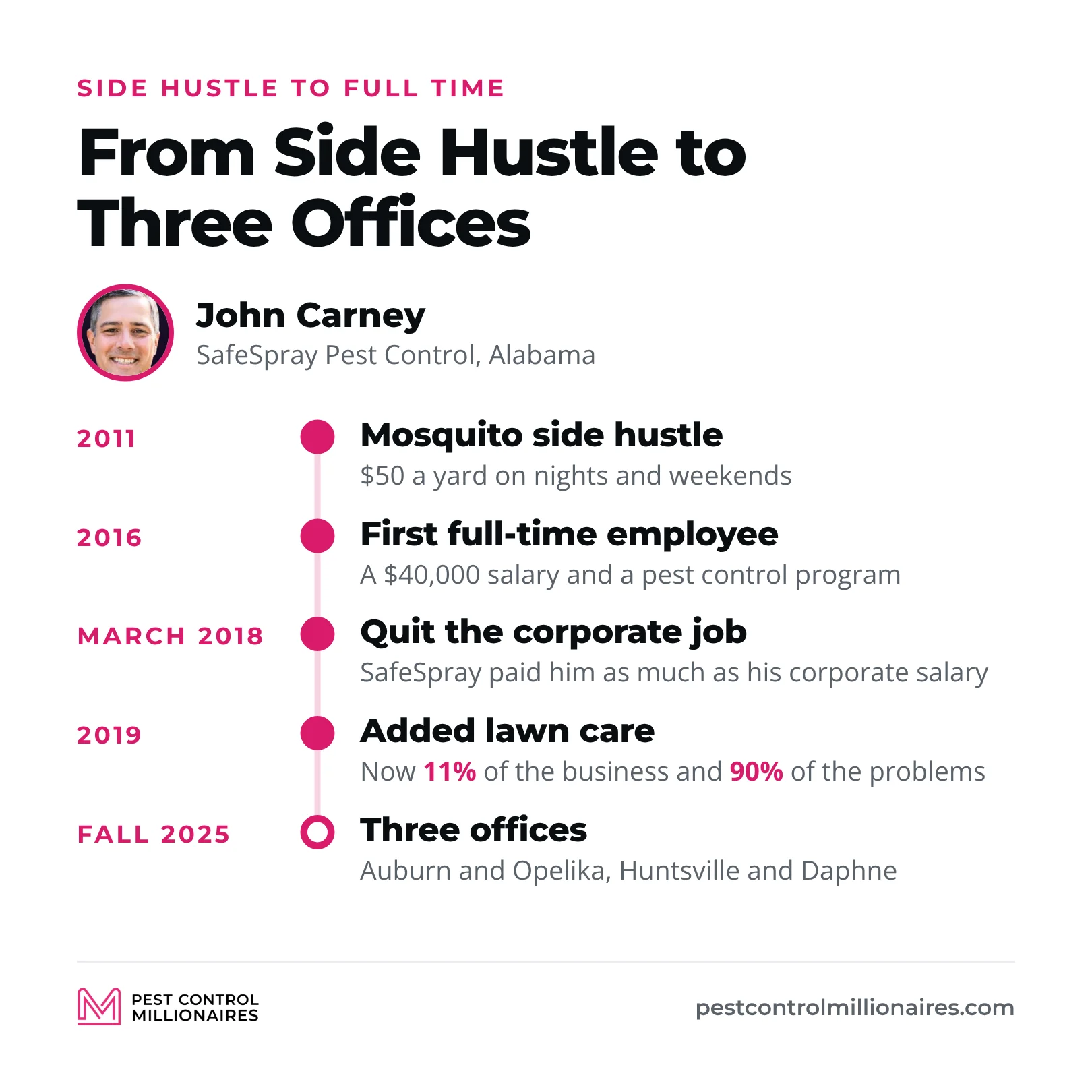
A neighbor came over, asked whether it worked and asked John to spray his yard too. “Well, give me $50. That’s about what it cost me and I’ll spray your yard,” John told him. The neighbor told other neighbors, and John had a side hustle.
Then a man from the Department of Agriculture called. He’d seen John’s signs around town and congratulated him on his nice little business. “The only problem is, you don’t have a license,” he said. “That shows you how little I knew about this industry,” John said. He got about six weeks to take an online IPM course from Purdue University, then passed the exam and kept treating.
Seven years on nights and weekends
Even licensed, SafeSpray stayed a side hustle. John’s day job had him traveling about two weeks a month, to Germany and China, and he had a newborn daughter at home. For four or five years, SafeSpray only did mosquito control. “I’m in corporate America. I’m going to climb this ladder,” he thought.
In 2016 he hired his first full-time employee, someone with pest control experience, and they added pest control and cross-sold it to the mosquito customers, the same play I lay out in pest control upselling and cross selling. John was “scared to death to sign up for a $40,000 salary,” he said, and his wife basically made him do it. I remember that feeling. My first real employee was a spray tech making $40,000 to $50,000, and he wore a tie to his lunch interview.
A year later, a friend who builds custom homes told John he was switching from liquid termite pre-treats to bait stations. “If you’re switching companies, then you need to switch to me,” John told him. SafeSpray didn’t do termite work yet, so John asked for a couple of months, got licensed and started doing termite pre-treats on new construction.
In March 2018 he finally quit the corporate job. By then, SafeSpray was paying him as much as or more than his corporate salary. “We really started in 2011, but really we kind of got focused in 2018 and started growing,” he said.
Cut the learning curve
From 2011 to 2018, John didn’t know anybody in the industry and figured everything out on his own. Then Dan Gordon of PCO Bookkeepers introduced him to Donnie Shelton, who owns Triangle Pest Control in North Carolina and owned a pest control marketing agency at the time. SafeSpray hired the agency and started digital marketing.
Then John went to a conference Donnie used to run, and it was his light bulb moment. He was around people running good companies and hearing best-in-class ideas. “This is actually not just a side hustle. We can really turn this into something big,” he said.
Now he’s the opposite of the guy who didn’t talk to anybody. “My superpower is knowing I don’t know everything,” he said. Pest control isn’t that hard, and there’s no need to recreate the wheel. At PestWorld, he spent two days walking 10 feet, talking to somebody for 30 minutes, then walking another 10 feet. “It’s all about how can you do things quicker and cut the learning curve out,” he said.
I agree. Most people spend six or eight months wondering whether they should go learn something, then never do anything with it. If you don’t have the money, go learn it yourself. Once you have the money, hire the person who already knows it.
More branches isn’t always better
SafeSpray’s main office, in the Auburn and Opelika area, covers all the way to Montgomery. The other two offices are in Huntsville, Alabama’s largest city, and in Daphne, near Gulf Shores and Mobile. Each is about four hours from the main office, one north and one south.
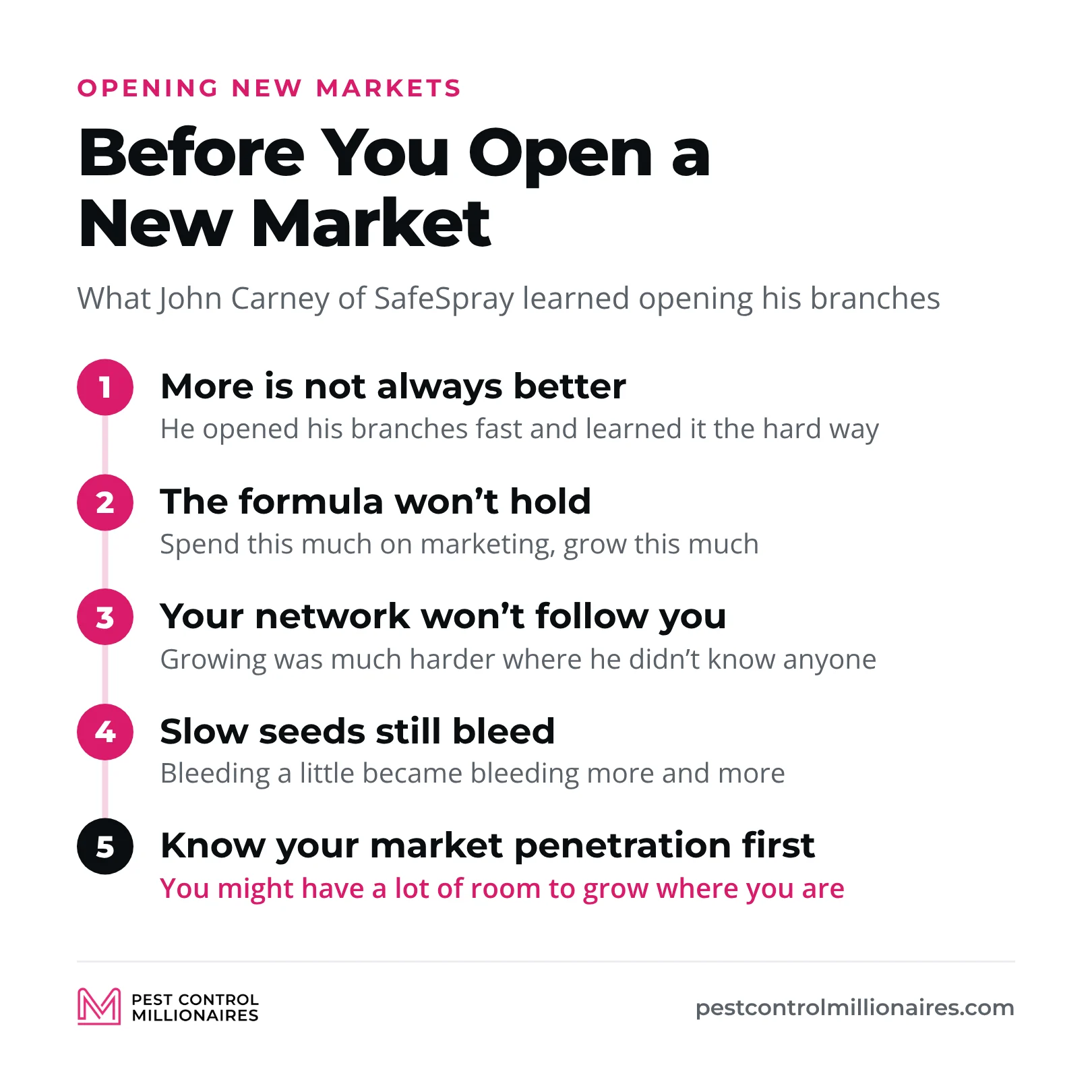
John opened his branches fast. “I learned a lesson the hard way that more is not always better,” he said. He had a formula. He knew what a lead cost, what his team closed and what it cost to get a new customer, so he’d spend this much on marketing and grow this much. “Well, I learned pretty quickly that it didn’t work like that,” he said. He’d underestimated how much his personal network helped SafeSpray get traction around Auburn. In two cities where he didn’t really know anyone, growing was much harder.
His theory was to plant a lot of seeds and let them grow slowly, without putting a ton of money in. That was fine while the branches were tiny. Then they grew, and “now I’m not just bleeding a little bit, now I’m bleeding more and more and more,” he said. He had to get them profitable fast, and for a while he thought about shutting them down. He’s glad he didn’t. They were growing when we recorded this, just more slowly, and the tougher markets had SafeSpray testing everything beyond Google, from streaming TV commercials to direct mail. Four hours each way is a long drive, so John also got his private pilot’s license. Now Huntsville is a 45-minute flight.
Here’s what I tell people who want to open a new market. What’s your market penetration now? Most people don’t know. Figure that out before you go anywhere, because you might have a lot of room to grow. When I bring people to my town, it’s 12,000 people, and they’re shocked by how many trucks we have on the road. John agreed his branches were premature, and all three of SafeSpray’s markets still have so much room to grow. I walk through the math in how big your pest control company can actually get.
Lawn care is 11% of the business and 90% of the problems
SafeSpray sticks to four core recurring services. About half the business is pest control and about a quarter is termite, with mosquito and lawn making up the rest, and it’s about 90% recurring and 90% residential. John stays away from the shiny objects people keep floating his way, like crawl space encapsulations and wildlife, and focuses on what SafeSpray can pump volume through.
Lawn is the one he added because of competitors. Around 2019, other companies came to town bundling lawn, pest and termite, and enough customers said they’d go bundle with them that it got under John’s skin. When SafeSpray rolled lawn out in Huntsville and sold 40 or 50 accounts, it added too much complexity for that team. So they called those customers, apologized, refunded them and told them to go to someone who could do it well. Lawn stayed in the Auburn market, and John has talked about spinning it off into its own business.
“Lawn is 11% of our business, and it’s 90% of our problems,” he said. You can treat the most beautiful yard in the neighborhood, with one weed in the middle, and get a one-star Google review over it. A builder slaps cheap Bermuda on top of red clay that doesn’t drain, and SafeSpray gets yelled at when the grass won’t grow. His team is really good at lawn now, but knowing what he knows now, he’d probably have stayed focused on pest.
I was a lawn care guy first, so lawn was easy for me and pest control was the hard part. But “I think lawn is significantly harder,” John said, and I agree. You’re battling the weather and so many more variables. Read lawn care vs fertilization vs pest control before you add it.
Termite claims leave no room to cut corners
Alabama is in the epicenter for termites, John said, especially down at the coast, where Formosans do a lot of damage very quickly. There’s an attorney in the state who focuses solely on termite claims and has won a lot of them, and only two or three companies will even insure pest and termite companies in Alabama, which makes it really expensive.
So SafeSpray trains its people on what happens when termite work isn’t done right, and uses that as motivation. Every inspection gets “a 100% job,” and you “just can’t cut corners,” he said. New construction gets bait stations only. When a house already has termites, SafeSpray adds bait stations, trenches and treats the exterior of the affected area and inspects inside, sometimes foaming the walls or ripping out sheetrock to spray them where they are.
Grow your leaders from inside
For a couple of years, summer brought turmoil at SafeSpray. Technicians left, there weren’t enough of them and orders didn’t get done. It took about a year and a half to fix most of that. Now the director of operations looks three months ahead every month at what’s on the schedule, how many technicians they have and how much each can do by service type, and plans for it. Finding the techs is a marketing problem of its own, which is how I look at it in how to find pest control technicians.
That director of operations, Sawyer, started as a seasonal mosquito technician with a biology degree and moved up quickly. Charlie, the director of customer experience, started as an office manager. Both had been with John six or seven years when we recorded this. It works because of a core value. “We believe in growth,” John said, and SafeSpray tells everybody up front that their role is going to change as the company grows. He’s had people get mad when that happened. SafeSpray had been growing about 30% a year, closer to 20% in 2025, he believed. One of our core values at Pest Badger is adapt, for the same reason.
The next push was inside sales, studying why SafeSpray wasn’t closing the leads it didn’t close, how it followed up, how it went back to people who didn’t buy and how it attacked cancellations. What John is proudest of is the reputation and the team. When a customer takes the time to write two paragraphs about how much a technician cared, or how they brought the trash can up or helped unload the groceries, “that’s what it’s all about,” he said.
Build the business around your life
John has a 13-year-old daughter and a 10-year-old son, and being at their events is his biggest priority. He used to be at the gym at 5 every morning, until it wore on him and his family, so now he goes after he drops the kids off.
I don’t miss my kids’ events either. Flying home from PestWorld, I missed my connection in Detroit, and the next flight would have made me miss my oldest daughter cheering at her football game. So I rented a car and drove eight and a half hours straight through the night. The smile on her face was worth it.
People complain about how busy their business is. It’s your business. If you don’t like it, change it so it works around you.
Frequently Asked Questions
Who is John Carney of SafeSpray Pest Control?
John Carney is the owner and president of SafeSpray Pest Control in Alabama, with offices in the Auburn and Opelika area, Huntsville and Daphne. He started spraying yards for mosquitoes as a side hustle in 2011 while he worked a corporate job, and he went full time in March 2018.
When should you quit your job to run your pest control company full time?
John ran SafeSpray on nights and weekends for about seven years. He hired his first full-time employee in 2016 and quit his corporate job in March 2018, once SafeSpray was paying him as much as or more than his corporate salary.
Should a pest control company add lawn care?
Probably not, in John’s experience. He added lawn care around 2019 because competitors were bundling it. When we recorded this, it was 11% of SafeSpray’s business and, in his words, 90% of its problems. Knowing what he knows now, he’d probably have stayed focused on pest. We both think lawn is significantly harder.
When should you open a second pest control location?
Not before you know your market penetration where you are, because you might have a lot of room to grow. John opened his branches early, his formula didn’t hold, his personal network didn’t follow him and the new offices bled money until he got them profitable.
Full transcript
Every word of the episode, from the video captions
John Carney, welcome to the show, my man. I'm actually surprised that I caught you on the podcast this time of year. Isn't it hunting season?
Yeah, it is. It is. And I try to sneak out when I can, but usually during the daytime I'm good. So, this is great. Thanks for having me.
Yeah, no problem. You're out of Alabama and you run a SafeSpray Pest Control, right?
That's correct.
And we'll get into talking a little bit more about all this stuff in a little bit, but we've been talking online for a couple months and then we finally got to meet at PestWorld, but we just always kind of talked about hunting and stuff. So, your profile pictures was it I think it's an elk, wasn't it?
Yeah. Yeah. So, that was a year a year ago right now. So, yeah, it was last year this...
When did you shoot that? See, how'd they get you this time of...
Yeah, up in Montana. So, that was definitely a highlight. I was hoping to go back this year and take my son, my 10-year-old. He loves hunting and so, but I didn't draw a tag this year. So, yeah. So, is this a lottery out there? Is that how it works?
We didn't get to make the trip. Yeah, it is. And you get obviously the more preference points you have, the better chances you have to draw and whatnot. So,...
That's cool. Yeah. So, again, welcome to the show. So, we got a lot to lot to learn about you. You got a lot going on in there. Super excited to have you on here. But real quick, if you and I are sophomore and juniors in high school, who is John Carney in high...
Oh, wow. Man, I was really into sports, you know, so that was kind of I'd say my identity. I played football. You know had some aspirations of playing in college and so that was kind of my life during that time and ended up not working out for for a few reasons but mainly just where I was in life at the time and you know what I wanted to do but...
Really just football friends I wasn't I'd say I wasn't the best student you know I was a BC student in high school and just kind of you know got by on you know minimal work and that sort of thing. I was, but I was mainly concerned with having fun and hanging out with friends back in those...
Yeah, I was too. And I always talk about listen the podcast had like a 1.8 GPA, but not because I wasn't smart. I just didn't care. It was sports, girls, and I just wasn't interested in learning about history at the time. I don't know. And u...
And you know the cra that's the crazy thing is I love history now. I absolutely love learning about history. And like back then I could care less. I never did homework. I didn't study for any test. And I was a BC student. And so...
Same like I would literally lift up like not a joke. I'd lift up my desk. I'd bring it over to my best friend Christie and I'd set my desk next to her. We would take the test together. [laughter] I would copy off her test. Like teachers watching the entire time. I put my desk back. She would get an A and I would get a C.
Yeah. They didn't that that didn't fly. I'm from from a small town in Alabama about an hour north called you know really the only thing it's famous for is it has the I think the purest biggest natural marble in the world believe it or not and like the steps of the US capital are made from and I think part of the Washington Monument or Lincoln Memorial or something so there's a lot of this pure white marble used and out of Sylacauga but that's about all we're known for it's a small town I think we were 12 or 14,000 people something like that and so we were...
You know spent a lot of time hunting and riding dirt roads and that was about that was about the entertainment in Sylacauga.
Yeah, we I wish you know looking back obviously I wish I would have tried a little bit harder but like then I found something that I was interested in when I found business and like I just couldn't get enough I couldn't consume enough content whether that be online or books or whatever. Like once I found something that I was that I absolutely loved like I just can't consume enough knowledge. I still continue to read. I actually do like learning about history now that I'm older too. So, it's kind of cool. But I now looking back, I'm like, maybe I should have tried a little harder, but it is what it is.
Yeah. You know, and I didn't I was one of four kids and I'm the middle I'm the next to youngest and you know, growing up and I meet [clears throat] with a lot of like young college kids being in a college town, you know, just kind of mentoring and doing that kind of thing. And it's interesting to me how many of them come in and they're just like, I know I want to do this with my life. This is the job I want. I mean, I was two years into college and didn't have a clue. Same...
Nothing. And you know eventually I ended up...
My older brother one of his good friends I kind of got close with a little bit and I was asking him I was like what should I do? He's like get a business degree you know you'll be safe there. So, I went into business school and got a business degree and ended up kind of getting in a corporate job in over in Atlanta and you know then I kind of started setting my sights on I always thought you know I climbed the executive ladder in one of these Fortune 500 companies and that's kind of where I started out outside of school.
Yeah, that's really cool. I actually had one of my friends over here the other day. He was on the podcast too runs an insurance agency and he did the same thing. Ran that corporate ladder right out of right out of college. Super smart kid. Went to Notre Dame, 4.0 kid, like grew up together our whole life and just watched him like be successful. It's been really fun, a different journey. He did the same thing. He went did the corporate ladder for a while. Then he just kind of like just knew he was stuck. Like he just he's going to be at the same spot for quite a while and watched his managers in front of him that were maybe a little bit older but probably had 10 15 years. He's like, "Yeah, I don't think this is for me anymore." And went went on his own, which is really cool. Did you have that same epiphany or what was that?
Well, no, it was it's a little different. So, I'll give you a quick rundown. So, first job out of out of college was Office Depot in their transportation department. I was like a transportation analyst, they called it. So, I basically played Tetris with trucks. I tried to get maximize the efficiency of the truckloads. So I did that for a little while. Then I took a job over at Newell Rubbermaid, which is the corporation that owns Rubbermaid, Calphalon, and a lot of Graco and lots of different consumer products companies. But I worked for the corporate office and did in indirect sourcing which was basically negotiating trucking contracts and rail contracts for all the different business started doing that for IT equipment for a little while and left there went to the Clorox company and was responsible for all the raw material purchasing for the bleach business and I got accepted into their management development program which is it's a pretty prestigious program that they have and they kind of they kind of put you around at different quickly they'll run you through different departments and try to fasttrack you up into upper management And so I was doing that and I was married at the time.
I got married right out of college and my wife had an opportunity to take a job with Boston Scientific for a medical device rep job and she really wanted to do that and it was in Auburn and we had always talked about retiring back to Auburn one day and...
That's where you went to school, right? Is that where you went to college?
Gotcha. And so we thought you know maybe it'd be when we're old or whatever. But she had this job opportunity. It's really good opportunity. And so she asked me if I would look around for jobs. And you know off the top of my head I'm like there's no big companies here. Like I'm you know I'm kind of squashing my dreams a little bit if I do that. But I found one I found two jobs actually. I applied for both of them. One didn't call me back. The other called and wanted me to interview the next day. So I drove down. It was with a company called Hoerbiger. It was a German automotive manufacturing. We made compact hydraulics for convertible tops and SUV doors. And so I drove down, interviewed on the way home that afternoon, they actually called me and offered me the job. And so we ended up she ended up accepting hers, I accepted mine. We packed up and moved to Auburn. And so I'm doing this job and how I got into pest control real quick.
I am we decided to build a house when we moved here. But in the meantime, we were staying with her parents who live here in town and my phone did not work inside the her house at all. So I had to constantly I'm taking phone calls outside and I just I if there's a biting insect anywhere in this in my proximity, it bites me. And so I'm getting eaten alive talking on the phone and I was like I'm gonna pay for y'all to have mosquito service because this is horrible. And I started looking around and nobody offered it. Like none of the big co even cooks or none of that none of those people offered at the time. So I started doing some research, figured out, hey, I can buy a blower, I could buy these chemicals, add some water and hose down my yard and no mosquitoes. And so I started doing that and a neighbor one day came over and he was like, you know, what are you doing? And I was like, spraying for mosquitoes. And he was, you know, I of course asked if it worked and I told him it did and he asked me if I'd spray his yard and like a light bulb went off and I was like and I just spit out.
I was like, "Well, give me $50. That's about what it cost me and I'll spray your yard." And he did. And he was so th he was so excited about it like you know he asked me to keep doing it and then he started telling some neighbors and so I started spraying some other neighbors and all of a sudden I had this side hustle of spraying for mosquitoes on nights and weekends and you know for I was pretty busy for for that point. Actually in my in my job job I mean I was traveling you know probably two weeks a month you know Germany you know every other month I'd have to go to China and different things like that visiting suppliers to buy these different components that we used in our in our hydraulic system so it was a pretty busy time between you know my work travel and I had we were let's see I think we just had my daughter so I had a newborn baby at home and then I'm kind of doing this side hustle and so it was a fun time but did that for a while.
Ended up hiring a couple college kids. Being in a college town, there was tons of young guys who wanted to earn some money. And really funny story in the beginning, I got a phone call from a gentleman at the Department of Agriculture. And he said, "Hey, you know, this is so and so at Department of Agriculture." He goes, "Hey, I noticed some of your signs around town. Looks like you got a start a nice little business. This is this is good. Like congrats." And I was like, "Yeah." And I'm feeling great. I'm like, "Man, somebody noticed me. This is so cool. And he goes on and he says, "Well, you know, the only problem is," he said, "you don't have a license." [laughter] And that that shows you how little I knew about this industry. I had no idea you had to have a you had to have a pest control license. So, [snorts] are you sick of paying marketing agencies and not getting results? Well, we are hosting the number one step-by-step class on how to attract and generate sales without paying market agency or having a huge budget.
Most lawn care and pest control owners get stuck at a ceiling because they're dealing with outdated systems or relying on guesswork waiting for the phones to ring. Our upcoming class this Thursday provides proven strategies to generate hundreds of leads without a huge budget. We'll show you how to build a predictable system to grow past a million dollars. We show you how to automate your marketing. We'll also teach you how to delegate and build your team so you have more time. So, click the link in the description below. Trust me, you're not going to want to miss this. This is the one thing that I wish I had learned a lot sooner. Now, let's get back to the show. And so, what happened from there? What did he did he help you get licensed? Did he write you a ticket?
Yes. Yes. So he No, he told me he said you can have I think he gave me six weeks to take this IPM course at from Purdue University online and if I did that then I could sit for the exam. So I mean I crushed it, you know, spent a lot of hours doing this online course, knocked it out, went and took my exam and got my license and was able to keep continue treating.
That's really cool. And then so how long do you run both you know the full-time job and the part-time you know business you went on? So for about five four years we were doing just mosquito control and you know we got fully licensed you know became a business and but at this you know honestly it was still a side hustle like I still thought like I'm in corporate America I'm gonna I'm going to climb this ladder and so we did did that I think in 2016 so this was 2011 I started the company so 2016 I hired my first full-time employee and it was somebody with pest control experience. And so we developed a pest control program at that point and started cross-selling to our mosquito customers. And I believe the next year, a good friend of mine who is a custom home builder here in town, we were we were I think we're hunting or something and he mentioned to me that he was going to switch from liquid pre-treats to bait stations. And I said, "Well, hold up. If you're if you're switching companies, then you need to switch to me." And he was like, "Well, you don't you know, you don't do that." that and I was like, well, you know, if you give me a couple months, I'll go get licensed and do it.
So, again, here I am busting my butt studying and getting licensed. And so, I did that. And so, 2016, 2017, we started doing new construction pre-treats for Termite. And then 2018, I believe it was March of 2018, I finally hung up my corporate job and went in full-time. And so I always tell people like, yeah, we really started in 2011, but really really we kind of got focused in 2018 and started growing.
Yeah. What was that conversation like with your wife?
She was she was excited. I think she saw the value and she always believed in me and what we could do here. And honestly, she was a she was a big piece of the puzzle. She never worked in the business, but I remember when I was talking about the first employee I ever hired, like I was scared to death to sign up for a $40,000 salary and you know, for somebody else and she basically made me do it, you know, encouraged me to do it and so she was excited about she saw the potential of what we were doing and I think it by that time I had, you know, I was making as much or more than my corporate salary and so she was she was fine with us jumping in and going going for it.
Yeah. Do you remember how many customers roughly you had at that point?
Oh gosh, no. I'd be I'd be making it up. I feel like now.
Yeah. Yeah, I remember those days too. Like I remember I remember two things specifically. One, I remember buying like my first like real like MacBook that was like a,000 bucks and like I remember having her come with me. My palms were sweating as I'm buying this MacBook. And then the same thing with my first like real employee employee that was actually like you know $40 $50,000. It was spray tech as well. And I remember we took him out for lunch, had an interview like over lunch with his with with her and then his wife and he came wearing a tie. It was super cool. And he worked with me for like six or seven years. Great guy still. But I still like she was like holding my hand through the whole thing too. Like it's a big decision at that time, you know.
Oh yeah. And then you know at that point too I started I don't know how I came across them but I came across Dan Gordon and PCO Bookkeepers at some point. And again, at this point, I had no interaction with the pest control industry whatsoever. I mean, everything we had done to that point, I had kind of figured out on my own. And so I came across Dan and he introduced me to Donnie Shelton who owned who owns Triangle over in North Carolina and he owned Coalmarch at the time. So we started using Coalmarch. You know introduced digital marketing you know got changed over to monthly bill like and I went to he had this CO2 conference that he used to run and I remember that being like game changer for me because I'm around all these people that are running these good companies and all these like best in you know class ideas of how to run the business and my head was like about it was you I see it now at conferences when newer people come in they're hearing these ideas for the first time and it's like the light bulb moment and that was definitely mine and just ri fig figuring out like man this is actually not just a side hustle like we can we can really turn this into something big and so we've just really gotten to work since then and just you know implementing a lot of ideas but 2018 was a kind of a pivotal year for us where we really started transforming.
Yeah that's cool. How was PestWorld for...
It was cool. So, I've been been two or three times now. And for me, it's all about the networking. Like, I love just meeting new people. And like I mentioned earlier, from 2011 to 2018, I didn't know anybody in the industry. I didn't talk to anybody. And so now I'm like the complete opposite. I tell everybody all the time, my superpower is knowing I don't know everything. And I love to go find people, meet people, you know, figure out what they're doing. Cool. Like you know pest control is not that hard you know it's and there's no need to recreate the wheel all the time. It's in our industry. One thing it's just so special about it is people's ability to like share information and network and because again it's not we're not doing anything special or secret and so many people have helped us along the way and I just love that. So I spent I mean basically two days just walking 10 feet talking to somebody for 30 minutes walking another 10 feet talking to somebody for 30 minutes and so it was a good time.
I really enjoyed it.
That's cool. How do you know Nick? Where did you meet Nick at?
So Nick I met how did I meet Nick? Maybe Seth.
Seth Garber. Yeah,...
I think Seth introduced me to Nick and u you know we've worked together on some financial stuff and some planning and he's a great guy. He's he's a he's he's not only super smart in what he does and does a great job, but he's a fine guy to be around.
I agree. Where do you know where do you know Seth from?
So just from the industry and then I started working with Pest Daily. So I work with their you know kind of go through consulting I guess almost business coach in a way.
That's awesome. I work a great job. Yeah. How long you been with them? How long you been with Seth? So I've worked with them about a year and a half now and probably knew him maybe a year and a half before that and we would talk periodically, see each other at events. I go down to their I've been down to their conference a couple times and that sort of thing. But they got a great team and they're seems like they're constantly adding new resources. They've hired, you know, people that specialize in marketing, office operations, and we've actually might might be jumping ahead a little bit, but I have two kind of key leadership people here. One that's kind of a director of operations role and then one that's a director of customer experience. And our director of customer experience runs our customer service team and inside sales. And so we've actually they've hired somebody on their team that's kind of a specialist in office operations. So the sales the inside sales and customer service. So we've actually started a additional program for for her to work directly together with the resource that pest daily has.
And so that's been a huge help. Again, it's for me it's all about how how can you do things quicker and cut the learning curve out.
And so it's all about...
Yeah. It's all about you know, continual development of yourself and you know the people around you.
Yeah. All that all it is a lack of knowledge in one specific area typically, right? We can really move the so either you go learn it yourself which most people spend more time figuring out like should I go learn it rather than just jump in and doing it just go learn the thing. Otherwise you spend six eight months thinking hey should I go learn this then they don't do anything with it. Well if they had just spent that six months they'd already done it by now or you just go buy that when you get big enough you can just go buy that person. Okay, cool. This person's going to cost me x amount of money. We'll do this amount of money in revenue for us or save us this much money or whatever. And that's just that's just the key unlock. It's like, yeah, it takes a while to get to there, but either A, you can go learn it yourself, if you don't have the money, and then B, if you have the money, go hire that talent.
It just mov forward.
Yeah. And you've you've seen it in your business, I'm sure. I mean, you hit I mean, gosh, I remember it took, you know, forever to get to that first plateau of like a million dollars. It seems like it was like never going to happen. And then you make a quick jump to three and then you get to five and then it's like then but you hit these different at each kind of step you hit these plateaus and it's like you know like where one of the ones we're at right now is like we built a great foundation on like inside sales. We have a good team in this, but now it's like, all right, to get to that next milestone, we got to dial in some of these processes. You know, we got to now study why are we not closing the leads we're not closing, you know, how are we following up with them? How are we kind of rehashing people that we didn't sell to? How are we attacking cancels? And so really diving deep into kind of more processes and procedures and that sort of thing. And that's where people I think like a consultant, I mean there's a few of them out there that are really good can help you kind of dive into those and not waste a lot of time trial and error, but hey, this works.
Use this.
Yeah, I love that. Same thing we did too. Like so there's always people out there that have been there and done it. Just reach out to them, figure out what they did and pay them to learn. Like it's not that hard. And most of us like yourself and myself, if someone reach out to me and like the eager people, I love helping them. Like that's the whole podcast is about like it's to give as much value to the industry as possible for free.
Yeah. Yeah. No, it's awesome. I love I love podcast. I am a reader on on some levels. I have to be interested in it. You know, I've three quarter read about a million books.
You know, sometimes I have a hard time finishing. Same.
But I love podcasts because when I'm in the truck or in somewhere, I can listen to them. And you know, it's always interesting because everybody like yourself, I mean, you know, one of the common themes you hear is like, you know, I have this, Tommy Mello says it all the time, too. Like, I have this podcast to learn from. I invite people that I want to know about and see what they're doing differently or what they're doing cool that we could do. So, that's really neat.
It's like It's like you talk to studs like yourself. Yeah. You talk to studs on yourself like this. I get to learn, you get to learn, and then everyone just gets to learn like as they listen. So, it's so cool and I love that about it. And like, so they're just, you know, when I got in the industry and there wasn't a there's a couple podcasts here and there, I'm like, just whatever. We're going to go all in and do it. And I've been doing it for 150 60 episodes and a couple years in and it's been fun. Like I get to learn so much from it.
It's cool, too. Like, you know, you're disciplined to keep doing a lot of people you see pop up and, you know, they'll do five or 10 episodes and then all of a sudden it just disappears, you know. So to do it and I know I mean you know I have a busy schedule like you do I'm sure and you know to make the point to say hey if I'm going to schedule this and we're going to do it we're going to show up and we're going to do it each week.
And that's just how I am with everything though. Like I'm either 110% in or I'm out completely. Like with me there's nothing in between. But that's the way my brain works. I was like you should go like go like golf or find something like a hobby. I'm like I think that would be fun. I love hobbies. I think, you know, I might talk about this about hunting. Like, yeah, I enjoyed it, but like if I'm into something, I got to be in 110%. So, I know what I would do. I go buy the best bow or the best gun. I spend all my time practice, practice, practice, practice because I want to be so dang good at it. So, I was like, I just don't have the time for that stuff right now. Like, I'm all in on this thing. Like, got the podcast, I got the business, and it's like all in on these few things and get really, really good at it.
Yeah. Yeah. And it's tough. I mean, we're in a I'm in a season of life right now. I've got a 13-year-old daughter and a 10-year-old son, and they've got activi they both do multiple activities. And so, it's weird. You know, I go through phases where it's like 100% allin, but then it's just like now I feel, you know, you don't get the time back with your kids, you know, when they're young. And so, you know, for me, that's I'd say my biggest priority is being there and being able to be at their events and all that. At the but I'm I'd say I'm pretty efficient with my time though. You know, when I'm here, I'm working, but as you know, as a business owner, you don't really get the luxury of turning it off either. So, a lot of times it's nights, you know, you're laying in bed with an idea and I'm jotting notes on my phone, you know, kind of thing.
Agreed. Thousand% too. Like it doesn't shut off. Whether it's a gift or a curse, depends if you ask, right? One of my non-negotiables, I'll never miss my kids events. I don't care. Like when I was at PestWorld, here's a good example. Pass world was flying back home. My oldest daughter had a football game that she had to cheer at on Friday. I left Thursday night, landed in Detroit at 10 o'clock at night. So she's got a football game at 6 o'clock probably night. Like cool. I'll be home in, you know, tonight. Go to our game. I get there. We get in late because we left Florida late. Missed my connecting flight. And now the next the only next flight home is like at 10 o'clock the following night. So I had to miss our game. Like I'm not doing that. And so I rented a car and I drove eight and a half hours straight through the night,...
Just to get home. But that's just one of my non-negotiables. Yes, I might travel a lot for work and I got to be gone, but when my kids have something, I'm not going to miss it. I'll do whatever I can to be there.
Whether that's you don't. And so like for me to show up and she knew I was running late like and just a smile on their face was worth the nine hour drive.
Get that time back.
That's just one of my non-negotiables. Like whether it's a Christmas program, whether it's a dance or homecoming, like I'm just not going to miss it. That's just one of my things. But I mean that's why we built the business, right? So that we could works around us.
And I've talked about this in the podcast before too. Like people complain and about their business. It's so busy. Like it's your business. If you don't like it, change it. I told that to one of my partners. He's like he looked at me. He's like a deer in the headlights. He's like I can do that. I'm like, "Dude, it's your business. Change it." He's like, "I've never thought about it that way." So if you don't like the business the way your business is now, change it. It's yeah, it might be hard, but fix it so it works around you. But yeah, I mean I'm thankful thankful that I started this know years ago got to scale it up or I don't have to be there 99.9% of time if I didn't have to be. Obviously I choose to be because I'd love to do it, but if I need to leave to go watch my kids, like I can. Yeah, that's also it's funny you say that because you know I used to be a wake up at 4:30, be at the gym at 5 every day and you know it just got to the point where that was just wearing on me. It was wearing on my family too.
You know my wife waking her up and the puppies barking and just all this and so finally I'm just like you know what I don't have to be at work right at 8. So pushed my schedule back and go at 8 o'clock after I drop the kids off.
Yeah, I'm the same way. Like I'm usually up early like I get up at 5 between 5 and 6:30. I don't set an alarm. I mean, I haven't set an alarm in probably 10 years. Even if I have to wake up at 5:00 and be on the plane the next morning. Like I just my body naturally just wakes up like this internal clock of mine that it's like, "Oh crap, I got to get up early." So I hardly sleep. I usually sleep like crap because I know that I have to wake up, but I just wake up and I'm out out the door. So I'm kind of the same way, but like I get up early, I do my thing, but then I get the kids ready for school. I bring them to school, drop them off, and then I go to the gym from there. Then I go to the gym, get done with gym, then I go into work. Usually I'm working. Yeah. Like, you know, I'm usually working before, then I do my kids, go to the gym, then I'm working till, you know, all after hours, too. So, not like it shuts off, but I just built it around my schedule.
Yeah, that's the way to go. I found it to be much more enjoyable. You know, it makes your day a little better than than go. But I did I did enjoy I had a good group of guys at the gym early because there's not there's not many of us that that would do the early rotation like that. And so we had a had kind of a fun cruise. So I miss miss that but we still have a good...
Yeah, it's cool because like you know I used to go at like 4:15 in the afternoon and that is just hard. Like it's just right in the middle of my day. So that was hard and then I went early and it was fun but then again kind of like you just kind of got in the way and I was like this doesn't work. So I started going now and like we have a good group of guys and that's half the fun. Like, yeah, you're getting a good workout in, take good care of yourself, but then you get to shut that brain off for like that 45 minutes to an hour, just chat about life and with your comrades and you're pushing each other. It's fun. I enjoy it.
Yeah, same.
Yeah. How long have you been going to the gym? Like ever since high school or...
Yeah. I mean, you know, being an athlete growing up, you know, I've gone through periods and seasons of course like where you kind of swing out of it for a few months, but then always like, hey, get get back to it because generally you just me it's, you know, the gym. I mean, there I'm sure there's actually some scientific chemical stuff when you're working your muscles and tearing them down and rebuilding what it does to you. It just seems to get you have a lot more energy throughout the day and just focus and so when I'm in this in a rut of not going I kind of feel it through other aspects of my life as well.
So do I. Like now it's the point where I'm so like I'm such a routine guy. Like I'd be so easy to kill because I like almost walk out of the house the same exact time, go to the gym, like I'm so like stuck on this routine. Not that that's a bad thing. It's just rigid. So I'd be really easy to murder. Like I'm walking out my door at this 30 seconds, you know? At 6:13...
For real. That's just how I am. But it's a very it works. It's a good schedule. And then if I'm out of town working, then of course usually run the same schedule. Sometimes got to get broke whatever to go to the gym. But I'm the same way. If I miss the gym even a day, like I just feel off like my brain like shut doesn't seem like it I don't know. It's just way I built up like it just seems...
Routines are like that though. Like I'm the same way. Like I'm a routine guy with stuff. But if I break a routine for a period, it's hard. You know, it's like any any routine you're in, you know, it's awesome while you're in it. But it but if you break it's you can slip quick.
Yeah. I agree. What is the makeup of your services now? Like from mosquito to pest. And I know you did some lawn care in there before, but we can talk about talk about that.
Yeah. So we're about, 50% pest control, probably 25% termite, and, probably 17 or so mosquito. I'm trying to think, our lawn and mosquito are probably about the same size, actually. But [snorts] but yeah, so we focus on those core those four core recurring revenue services. We try to stay away from all the shiny objects that that float our way. I mean, we hear all the time like crawl space encapsulations or this or wildlife and this. And we've tried to really just stay let's stay focused on what we do good. Let's stay focused on what we can pump volume through and you know, grind those out and do them really well. And so, we really just kind of keep it in those core businesses. Most of our we're probably 90% recurring revenue business.
We're probably 90% residential and so that's what we focus on. You know, we're in not in major metropolitan areas. We have three offices here in the Auburn Opelika area where you mentioned Auburn University is Huntsville which is Alabama's largest city up in the north end of the state and then one at the coast in Daphne which is Baldwin County which is near Gulf Shores or Mobile area you probably know of. But all of those we cover very large service areas and you know we continue to kind of take outliers and kind of get rid of them as we kind of build density. But when you're trying to grow a business in you know smaller areas and with the goals we have obviously you can't you need to take what you can get you know to continue growing. And so we have pretty big service areas like Huntsville. I mean, we cover from southern Tennessee, right across, it's just right, I say it sounds like a long way away, but it's really just right across the border.
I mean, you know, within 45 minutes to an hour of but yeah, so we're we're in three markets. We cover very big areas. Our this office is our biggest office and we cover all the way over to Montgomery, which is probably about 4550 minutes away. We have plans to eventually add a what we call kind of a service center there. It'll just be for service and technicians and materials and stuff, but right now we're traveling, you know, back and forth. We've been wanting to build up enough to kind of cover the cost for that. Probably Birmingham eventually we'll put a branch and then from there, you know, we're probably just going to focus on on growing and building density in our in our markets. I don't see us having, you know, growing a ton outside of the state of Alabama. There's just so much opportunity here to continue growing. You know, I we opened three branches really quick.
Questions actually.
Yeah, I learned a lesson the hard way...
That more is not always better. And so agreed it took a while to really get those profitable and a lot of learning curves out because I thought, you know, going into this, we did a good job with digital marketing and our inside sales team. So I said, "Hey, I know it cost X dollars for a lead. I know we're closing them at X percent and I know it's going to cost X dollars to get a new customer. So we're going to spend this much on marketing and this is how much we're going to grow." Well, I learned pretty quickly that it didn't work like that. It just it's not it's not as simple as a formula for that. I mean you know I you know being from this area like I knew a lot of people and I how much probably my personal network helped us get started in the beginning and get some traction. Because in two cities where I don't know really anyone, it's been much much harder to grow.
And so that's a learning curve that we're still, you know, it's they're growing and it's just slower, but we're now having to, you know, it's pushed us outside of our comfort zone. So where before we were, you know, primarily focused on Google, which we still are. We do a lot of digital marketing, but we're exploring tons of other stuff now. You know, everything from OTT, you know, over the over the top TV commercials on streaming, direct mail, Glass House, Slybroadcast. We're just throwing we're throwing everything at the wall and seeing what works. You know, we've tried things like Yelp, but Yelp doesn't work here. Nobody uses Yelp. Yelp in Alabama for some reason.
It's the same here where I'm at. No one uses Yelp here either.
Yeah. Facebook, Instagram, you know, we've we've tried that. It seems to be maybe some some brand equity you build there, but as far as generating leads for sales, never has really worked very well for us.
So, what was the whole reason of starting office number two?
So, I mean, you know, I knew I wanted to grow this business. You know, I don't really didn't really have a number in mind, but I knew I wanted to be a big business one day, and I knew I couldn't do it in just this market. So, my theory back then was, let's just start planting a lot of seeds and let them grow slowly. Let's don't we're not going to invest a ton of money. We're not going to blow it out of the water, but let's just start letting them grow. Let's just plant it and let it start growing slowly. And so, that was my original theory. And that that was fine when it was really small, but as it started growing a little bit, I realized, well, now I'm not just bleeding a little bit, now I'm bleeding more and more and more. And so then I had to really focus on getting them profitable in a short amount of time. And I had even contemplated for for a period of time whether we just shut them down and focus on this, but I'm glad I didn't and we stuck it out and got them to where they need to be.
And now they're they're growing and we still got a long way to go. But you know it's definitely to where we need to be in the future. We have to have more than just this location just because the size of...
I was the same way. Same town of 12,000 people. You can only do so much, right?
And so that's what happened to me too. Just had to had to go somewhere else. Yeah, it was definitely a learning curve for sure. But then every office that we open since then feels like we get better and better and better every single time, you know.
Yeah, I agree. I think if it when I do the next one and like I said there's only going to be maybe who knows what the future is but I mean I know of probably two locations I want to be in and I think I could definitely do a better job knowing what we know now and you know the other thing that makes that hard too is you'll think this is kind of crazy but both of my offices are about four hours away from our main office in either direction. And so we're in central Alabama. The other one's in the north, the other one's on south. And so,...
Well, the nice thing about that though is that if something does go wrong, you can still jump in a truck and get there within four hours. It's not ideal, but you can still get there. It's not like you have to travel 15, 16 hours or catch a plane. You know what I mean?
Yeah. Good. I don't know if I mentioned this to you, but I'm actually a pilot, too. So,...
Actually, I think you did not tell me this, but I want to said that maybe I seen it on your Facebook or something.
Okay, possibly. Yeah. So I actually I have a couple friends who are pilots and you know I we'd go places and I'd sit up front and I always thought it was so cool but never really, you know, thought I mean how how do you become a pilot? Like right, you know, never was even within my realm. And one of them told me like, "Hey, there's this guy in town who does instructing on the side and he has a plane you can rent." And so anyway, I just started going through the process and when I opened these branches, you know, I was having to drive four hours to get up there and I was like, man, that would be really cool if I could just fly up there. And so, I started working towards it and got my license and now I can, you know, now that I have my license, I can be there in 45 minutes, which is which is really...
My like my two-year plan was to own a...
Yeah. And so with that being said, I have to, you know, the whole pilot and all this stuff. But I have a small airport that's literally right next to my house, like walk up my front door and I can see it. Fly over every single day. It's small, really, really small. There's like one gate and like two hangers, maybe three. But I've talked about it and I kind of looked into it and it was like 8,000 bucks, I think. Don't quote me, but somewhere in there like $8,000 for the class and then it's like a I want to say like a hundred or maybe $200. I can't remember exactly what it was, but what was that like?
Yeah. So, costwise, I don't remember to be honest. It took it took me about a year and a half. I want to say it's probably 10 or 15 grand total to get my private pilots license. But it took me a year and a half. Like I went through a few periods during training where I was like, man, this might not be for me. Because like there's certain aspects of it that you just have to like get a feel for. Like landing an airplane, for example. I mean, it's a it's a you know, when you're holding the yolk and you have to know when to flare and how to, you know, finesse the plane down smoothly. That was something that was really hard for me to grasp at first. And so, I had a lot of like rough, bumpy landings during during my training that, you know, quite frankly, it kind of scared me a little bit. And so, there was a couple times where I'd go home and tell my wife, I was like, I'm not doing this. Like, I'm not doing it. I'm not doing it. I'd take a month or two off and I like, you know what, let's go again.
But then but then it's like one day it clicked like I felt what my instructor was telling me. I was like, "Oh, that's what you've been trying to tell me. Now I get it." And then it's like from there it's just m you know, it's muscle memory.
Yeah, it's just like ride riding or drive anything else. The more you do it, the better you're going to get. But I'm kind of the same way. Like I feel I feel your pain there because I'm so add like I tell myself this. I probably do, but I don't know if I like I watch my friends do it. They're a couple of them are pilots. I've been up in planes with them. There's so much going on at all times. Like I was like I was scared myself. Like maybe it's just something in my head, but like I don't know if I have the focus to go do all that. I don't know.
Yeah. It you know I still I probably my buddies I fly with most often probably would tell you I say it all the time but you know there's so many times I'm in the air and I'm like man this is so cool. I can't believe I can fly a plane. You know, because it's kind of surreal when you're up there and you're flying along and you're just like, man, this is like so cool because it's not something that you that I wasn't around it growing up. It's not like my parents are pilots or friends or I mean, it was completely out of the blue for me. So, it's something that's still really cool.
So, funny enough is that at our camp, we have an airplane hanger and a runway. My grandpa was a pilot and then my dad, he worked for the county and his office was at the airport. He's a maintenance director for Delta County and his office is at the airport. So we were always at the airport, always around planes and his buddies always take us up like it was it was fun. So like I've been in a lot of planes for those reasons alone and my grandpa and so we had planes in our hangers. I think we had like three planes at one time. They sold them off like I want to say like two years ago finally they sold off their planes just small like I don't know what they were held like two or three people.
Pretty small but so it runs it kind of runs in the family which is kind of cool. So, I've always considered it. My CFO said that he wants to go get his pilot's license. I'm like, that sounds way better than me doing to do it. But I don't know. Did you end up buying a plane? Do you rent a plane? How does that work?
Yeah. So, I have one that we bought. So, yeah.
How often do you fly?
I'd say usually once a week, once every other week or so. You know, it's easy. Like a lot of times these conferences like PestWorld, you know, I was able to zip down there in hour and 45 minutes or you I went to Huntsville, our office last week. It was 45 minute flight. And my parents live about two hours away, but have an airport 10 minutes from their house. So there 15...
This like this gets me excited to go do it. Like I'm like I'm one of those people like that sounds really cool. I'm probably going to get off this year and go make a few phone calls and get it lined up. How...
How much work is it? Like actual like te testing is it...
I would say it's a lot. Yeah. And I mean you know it's something in your personality I think you would do great at it because you take things serious and you know you like you said when you're doing something you go all in because you know flying for me is I mean quite frankly it's life or death you know.
Yeah it is.
Yeah. You've got to you know be on your agame like you know you can't be the kind of person that's taking risk and doing you know just flying by the seat of your pants so to speak. I mean, like I'm very cautious with, you know, I've got a lot on my shoulders, my family and, you know, kids and whatnot. And so, like, you know, I don't fly in risky weather. I don't fly in risky conditions. You know, I thoroughly flight plan, fuel checks, weight and balance, like I don't skip anything.
So, all things that I just said about getting super excited just got like all taken away from you. [laughter] I don't want to do that.
No, it's you know, it's weird. It's like you need to have a healthy fear of flying. I call it a healthy fear like and I don't mean fear in the negative sense, but you need to understand what can go wrong. And because when you're up there, things are going to happen. I mean, things have happened with me up there and you've got to stay calm. You know, they say, aviate, navigate, communicate. So, first thing you're you're you've got to fly the airplane. You know, no matter what happens, you've got to fly the airplane first. Then you navigate, you figure out where you need to go and then you can start talking to people and communicating with people around you, ATC or whatever. But the number one thing is you've got to keep flying the airplane because a lot of times people get and you know something's not working and they're they're playing with it or trying to figure it out and they end up getting slow and stall or turn or whatever, you know.
And so you've got to be able to, you know, be cool under pressure and, you know, just focus on what's I'm already nervous. [laughter]
Keeping that plane in the air. But like again, so here's a good example. We were down in Dallas and Steve, if you're listening, shout out to Steve. Great pilot, flies really big planes, jets, whatever. You know, he owns a big landscape company down in Baton Rouge. Super cool dude. Anyway, one of my good friends, we're flying over Dallas, you know, going for lunch, you know, at a conference. Like he's like, "Hey, let's go up for a flight for lunch. We're going to go zip over to this airport, go have lunch there, and come back." Cool. Sounded fun. I'm in. Me and Chase and Steve are all in the plane. All of a sudden, like I'm in the back, they're in the front. And like what I thought happened didn't happen. But like what I like all of a sudden like we're like going straight down and like what I thought I saw was like the glass like caving in cuz it happened so fast. Like I like wear my seat belt. My head hit the top of the roof and like my yeah my phone like goes flying over the floor and like I looked up and they're like adjusting their headsets or whatever and like you okay back there? I'm like yeah but some birds have flown up and like they caught them like last second like and we had to we had to we had to dive down and it was wild.
Like I'm like I'm never flying again. It was fun. Like I enjoyed it but I know what you mean. Anything can happen, you know. And there were big birds too. Yeah, I've never had any super scares. I've had things like you know just like autopilot not working correctly or my radios not working correctly that I've had to troubleshoot, but never anything you know major.
Yeah. How far how far do you usually fly at a time? Like can you what's your range of your plane?
So probably four and a half hours is the range. But, you know, there's it's a smaller plane, so you're not getting up and going to the bathroom and stuff. So, you know, usually you're limited by when you want to stretch or go to the restroom or something. So, I'd say typically that's max of three hours. You know, I'm kind of I'm a big guy. I'm six, you know, 6'2 or something. And so, like, you know, I need to...
I made you look I mean I made you look pretty small standing next to you.
I know that's [laughter] true.
So, that makes getting to the getting to the places a lot easier and quicker.
Yeah, that's really cool. And like I said, I have like settled up, you know, we have all our offices. They're within the same distance, like four to six hours. Like it would be so cool. Make my life so much easier if I could just, you know, jump on a plane, be gone for 45 minutes, an hour, land, and come back home that night. It would be so cool instead of spending eight 10 hours driving in these places, you know. And not only that, because I could get them I could get there and back sooner, but then I'm not wasting an entire day just driving there.
Exactly. I mean, we get up there, we'll meet, and I'll be home by 3:30 or something, you know?
Yeah. I might have to pick your brain off the podcast about this a little bit.
Yeah, I' I'd love to. I can kind of point you in the right direction, tell you some easy ways to kind of at least how to navigate and find what you need to get get going with it.
Cool. That'd be awesome. What the next like three to five years look like for you with the business?
Oh, three to five years. I mean, you know, where we have been is, really trying to dial in processes and smooth things out. I feel like over the last couple years, we've had just a lot of growing pains, turmoil in the busy season, which is, you know, summertime, technicians leaving, not having enough technicians, then be scrambling, not getting your orders done. And we've worked really hard over the last probably year and a half fixing a lot of that. And so we have, you know, for example, labor planning. We have a process now where our director of operations is looking each month three months ahead at what we have planned, looking at how many technicians we have, how much can they do, you know, by service type, and you we're planning out. So like we've eliminated a lot of those. And so now we've kind of built some systems.
We're focused on inside sales right now and customer service on you know, professionalizing that team and they do a great job. I'm not saying we want to get better though. We want to get our close rates up.
Yeah. We want to get our close rates up and that. So, really over the next couple years, man, we're just focused on growth and like I mentioned probably putting a service center in Montgomery and probably something in Birmingham. But other than that, we're just focused on growing our markets and creating...
When you be when you moved to the new market, your first or your second office, was there still room for growth in your first office?
Oh, yeah. Yeah. Like I said, I did it real early.
Yeah. And I mean, you know, it depends how you look at it. You know, you...
The only reason I bring it up is I already knew the answer, but I hear it all the time. Oh, I'm just going to go open up open up a new market. Okay. Well, what's your market penetration now? Well, I don't know. Well, how about you figure that out before you go anywhere? Because you might have a lot of room to grow. Like, I can build a company that big. Like, if you saw the size town that I'm in, when I bring people here, which you know, it's 12,000 people, they're shocked the amount of trucks we have on the road.
Oh, yeah. Yeah. And it's you know, we definitely premature, like I said, you know, my whole plant the seed...
Strategy. [laughter] Yeah.
And but learned a lot from it. So, now we won't do the ne we're not in any hurry to do it. It's when it's the right time, the right place, the right opportunities, but we still got, I mean, in all three of our markets, we've got so much room to grow still. And so, dialing in those lead generation processes and like I mentioned earlier, I mean, we're doing I got on my board over here just like 10 things. Clicki you know, weed world, we've got we've we're signed up. We're rolling, you know, rolling out now. They're working on the integration and so that's a I'm I've got big big plans for we're getting that going and like I mentioned, you know, a lot of those other marketing kind of channels. We're we're just kind of I mean, we're full speed ahead on on lots of different stuff right now.
Guy. Yeah,...
Cool. Love that. When did you add lawn care? I know we talked about this a little bit at Paso, but there's a love-hate relationship there.
Yeah. So lawn care is you know probably I don't even know I may have it over here on a piece of paper. Yeah. So lawn is 11% of our business. And it's 90% of our problems and you know not even always like our problems. You know you know how it is. You can you get a call that your my yard's covered in weeds. It's horrible. Get out here and you'll have one weed in the middle of the yard, the most beautiful yard in the neighborhood with one weed in the middle and you'll get a one-star Google review over it. And so, we do a lot of that. But we got into lawn in the first place. I think in 20 19 I think 2019 we started lawn and the only reason we did it was because we had some other companies that came into town and they were bundling and we kept hearing from our customers well I want my you know this other company's going to do my lawn pest and you know termite so I'm gonna go bundle with them and so you know I heard that enough time it probably wasn't a ton but it was enough to kind of get under my skin and I said you know what we're gonna do lawn And so we started just marketing it to our current customers and you know then we started selling and cross-selling and marketing here.
We rolled it out in Huntsville and probably sold 40 or 50 accounts. Started adding a little bit too much complexity to that team up there. And so we ended up canceling those. We didn't even sell them or anything. We just we just called the customers and said, "Hey, look, we're sorry. We don't really have the infrastructure here to support you well. So, we would rather you give you a refund and you go somewhere else and that that can do it well. And it was fine. Most of the people were fine with that. And so, we're just focused on lawn here in our current market. And we're going to probably keep it that way for now. We may we've talked about maybe spinning it off into a different business eventually. Yeah. And breaking it out from the pest control. Just to have its own team, to have its own, you know, people that are really 100% focused on it because it seems like it does distract us here from what we do really well, which is the pest control and termite mosquito and so we that may be in the future for us in lawn care.
I'm not 100% sure though. We're still navigating that.
Yeah. So, if you could go back, would you wait till you were larger to add it or not add it at all?
I would probably not add I'd probably stay with focus on pest. I probably wouldn't wouldn't knowing what I know now, I probably wouldn't. But we've there's just been and I say that only because there's been a lot of growing pains. We're actually really good at it now. We really know our stuff in lawn care or not so much me but our team really knows their stuff in lawn care and do a great job. It's but there was a lot of headaches and learning learning curve there that we had to overcome. And again, I just I just ask the thoughtprovoking questions because I get the question all the time or I'm gonna go add lawn care. I'm gonna go add lawn care. I'm like, it's not that easy. Like, you're doing pest control pest control. I could told you pest control. I was a lawn care guy at first. It's all I'd ever known and done. So, it was easy for me. Like, pest control was the hard part. And so, once you got pest control, like it just worked for us. Like, hey, we're just doing both now. You know what I mean? But we still have many offices that only do pest control.
Yeah. I think lawn is significantly...
I do too. Just you're battling more weather. Like there's, you know, like again whether it's variables.
There's so many variables like pest control. I mean, you know what I mean?
Yeah. I mean, pest control, you can take care of a lot of the issues regardless of the environment. Lawn care. If you have a builder that's slapping, you know, cheap Bermuda on top of red clay and then they call us wondering why their grass isn't growing because it doesn't drain and their irrigation doesn't work and they don't water it, you know, it's just like then we're getting yelled at. So, there's just a lot of variables there.
Are you guys granular, liquid? Do you guys do a little bit of both?
So most of as far as fertilizer goes, we're granular. We've done liquid fertilizer in the past. Didn't quite work as well. So we've gone back to granular, you know, the as far as weed control, I mean, we're spraying, so it's liquid. I have a background. My dad actually Have you heard of Polyon time release fertilizer?
Yeah, I have. Yeah.
Yeah. It's the green polymer coating. My dad actually...
Yeah, my dad and a couple of guys actually invented that in the 80s. Yeah. And so I've kind of been around fertilizer my whole life. He's a chemical engineer and so that was kind of cool too. I always felt like it was in my blood a little bit so I kind of had a little eagerness when we when we got into pest control we always used Polyon and so it was kind of cool.
Yeah, that is cool. And then as far as like mosquito control, are you are you guys doing like lawn treatment? Are you guys doing bait stations like mosquito bait stations? Are you just spraying? What are you guys doing?
We're blowing. We've tried and I won't, you know, in our markets the traps didn't seem to work quite as well. People are used to kind of immediate results and the fogging seems seems to do a better job at that. And so we treat once a month. We rotate chemicals. We found that mosquitoes are are starting to build resistances to certain things and so we rotate chemicals now and seem to have pretty good luck. You know but still it's you know super sunny breaks down quicker rainy conditions and you have then you're dealing with you know homeowner conditions, gutters, French drains, vegetation and all that kind of stuff that you got to kind of battle as well.
Yeah. One of the questions that I wrote down, what is the weather like in Alabama like throughout the winter too?
So winter I would say it's you know kind of it doesn't get super cold. I mean it does a few times a year get you break freezing but I would say most of the time it's you know 40s 50s in the morning kind of upper 50s 60s in the day kind of through the winter.
So like you guys do like pre-emergence throughout the winter then?
Yeah. So, we do we do a pre-emergent in October kind of right when it starts getting cool. We use Specticle, which is awesome product. It's, you know, for Poa and then we're doing a pre-emergent again in kind of January, February time frame for summer weeds. And I'm not sure exactly. We used to use pro prodine type situation. I'm not sure what we use now, but then we're doing some fast release fertilizers early spring. Then we're using the slow-release Polyon kind of after that. And then some spot treating applications throughout the summertime.
Yeah, that's cool. So you guys are doing f year round.
Yeah. Yeah. Well, the fertilizer the yeah. That's cool.
Program just a program. Yeah. I actually just made a YouTube video just on this. Like I love those markets where you can run year round. It's so...
Yeah. Because y'all are down. How how y'all have snow? Like are y'all snowed in a certain part of the year?
Yeah. So, we'll get we've gotten snow already. We have we have like a hundred apps left, like a 100 customers left to finish up. Supposed to be in the 50s next three days. So, we'll rip through those real quick and then it'll be done for the year. But yeah, from here we're done until late April. Here specifically, late April to May. Obviously, we run pest control year round. Can't do mosquito. Lawn drops off. But then the further south that we go, so like we get into like lower Wisconsin now, we're talking we could be back on lawns by March, you know. So there's only like three months usually that we're totally off the lawns, you know, but it sucks. But then we have, you know, markets like down in Oklahoma that do really well that we go that we're running year round at. So definitely like in the warmer markets for sure.
Yeah. Yeah, the only thing we drop off, we do our mosquito control monthly March through October and so it drops off November through February, but as far as termite pest and lawn, it's year round.
Yeah. And so up this far north, like we don't have termites. Like you get into like lower Michigan, lower Wisconsin, then we run termites down there. But this far north, they're just not here yet. Knock on wood. And I'm not hoping that they'll be here, but I'm kind of hoping that they'd be here eventually. We found we did a job last year this spring in Green Bay, which is pretty far north, but they're brought in on construction lumber. It's not like they're there to stay, but we've been getting more and more jobs a little bit more north. You know, even like into Oshkosh, which is like 45 minutes to an hour and a half below Green Bay. We've done quite a few jobs there now, too. So, they're coming.
Yeah, it's the it's we're kind of in the epicenter of it here, especially down at the coast. I mean it's you know it's I'd say the pressure is really really bad down there and they have formosins really bad and you know they do a lot of damage very quickly. There's and then in Alabama we have something unique. We have a there's an attorney here who focuses solely on termite claims and you know he's done a lot of them and won a lot of them. And so we even from an insurance perspective in Alabama, there's only a few options now. Like you can't just go to anybody. There's only like two or three companies who'll even insure pest termite companies in Alabama. And so that's difficult. It makes it really expensive. It makes you know the jobs. But you know, we just try to do everything. We train the importance of termite and the implications of not doing a good job. And so we just it just we use that as motivation just to you know every time we do a 100% job on all of our inspections and just can't cut...
Yeah. And you mentioned that you're doing like new home construction pre-treats and then you're doing it sound like you're doing a lot more bait stations currently for exterior. Are you running both power sprayer for the termites on or you're only using bait stations? So, we only do bait stations with the caveat that on new on new construction, for sure it's only bait stations, but you know, if you called me and had termites in your house, we're going to put bay stations around it, but we're also going to you know, we're going to trench and treat the exterior of the affected area. We're also probably going to examine the inside to determine treatment methods. Sometimes we'll foam the walls. Sometimes we'll rip out the sheetrock and just, you know, spray them and kill them if we know exactly where they are. So, it kind of we'll use above ground bait stations sometimes and so really depending on what's going on in the...
Cool. That's awesome. Did did you hire someone who had a lot of experience in termite work or did you go learn it yourself? I think you learned some of it yourself to begin with, right?
Yeah, I mean the one guy that I mentioned was my first employee, he came from another company, so he knew he knew some, you know, he knew a little bit. He had had some experience doing it, but a lot of it's, you know, we've just learned over the years and luckily we haven't, knock on wood, we haven't had a had a ton of claims to have to deal with, but we've had a had a couple situations we've had to navigate, which you know, anytime you go through one of those, you learn so much and you know what not to do the next time. So, it's been a little bit of that, a little bit of that as well.
Yeah. I'll couple more questions then I'll wrap it up. I know it's probably going over your time, but when did you start building out your leadership team? How many years ago is...
So, both of my two core people that I would consider our leadership team here have been with me for six and seven years now. So, and then kind of our our even my top three three people have been here six or seven years. And so, I would say and you know, both of them started in roles that are not what they are now obviously. And so like Sawyer who's our director of operations, he started as a mosquito control technician. It was a you know seasonal position and he had a degree in biology. He had come from like a fisheries background and just had that kind of technical expertise and just wield and so he moved up very quickly. And then when I when that guy that I mentioned was my first employee when he left it was kind of like a no-brainer.
It was like you know get in here and he's grown so much. And the same thing with Charlie. She started as an office manager and just kind of jumped in and she has a business degree from Auburn as well and you know just done a fantastic job jumping in doing you know she started more of an admin role and we've just slowly as we've as we've grown and as you know you know in a small business that's growing you've kind of got to wear wear a lot of hats and you know one of our one of our core values is we believe in growth and we tell that to everybody when they come in here. It's like because I've had people in the past, you hire them and as you grow their roles change and they get mad, you know. So, we are very upfront that like we're growing, you know, we've been growing more like 30% a year. This year it's more like 20 I believe, but we're still growing pretty fast and it's like your role is going to change and you have to be on board with that to do what it needs to do what we need to do to grow. And so, everybody's kind of expected to have that mindset that like, hey, man, we're we're we're all on the after the same goal, and it's to grow and take care of our customers and deliver kind of a top-notch customer service experience, and whatever that role takes is what it's got to do.
And both of them have just done such a great job. I mean, they're such they're such valuable team members here.
That's awesome. Yeah. That one of ours is adapt for the same exact reason because we're growing so fast and like all the roles are constantly changing and adapting and like things just happen and you just got to adapt and overcome them, you know? So, we're on the same page there, too. Last question and I'll let you get out of here, but I know you said you're an avid reader. You got a couple books that you would like to throw out there for that are good listens or that you'd like to read?
Yeah, I mean there's the ones I mean some of the most you know the ones that were most inter instrumental to me obviously E-Myth.
Awesome. Y...
How to win how to win friends and influence people. I would say those are probably two of the biggest ones that had the biggest impact.
Traction was a good mindset book. I mean, you know, we ran EOS for a little while. We've kind of tweaked it to our own. I call it EOS light now.
We did, too.
Let me look on my shelf here. See what else is oh seven habits of high effective people is good.
Good one.
Yeah, those are those are most of the ones I think are were kind of monumental. E-Myth probably. I mean that was one that I read probably around 2017 2018. I was like it's another like yeah. Mind it was like mindb blown back then when I read it too.
Game changer. And it's just a mindset shift you know. It's getting it's...
Of working in the business working on it. Yep. Yeah. Yeah. So,...
That's a cool then last question for you before we run is what are you most proud of?
Man, I'm really proud of the reputation our company has here. You know, the team we built. One of the things that kind of and I tell it kind of sounds cliche, but it's the truth is like, you know, the thing that keeps me going is growing this company is the opportunities we're creating. We have a lot of just people here that I've been able to see develop over the years and just you know that are just super on board with our mission and what we're doing and you know delivering customer a great customer experience to our customers and just when you see those Google reviews come in where you know to write a goo Google review you've got to take time to do it right and if you're going to take time and write two paragraphs where you talk about our team members and how good of a job how much they cared and how they brought your trash can up or helped you unload your groceries.
I mean, that that's what it's all about, man. And just and just so that that's what I'm most proud of is our team and the impact we're having on on them and just being, you know, being able to be generational change agents and their family and just kind of being there for them and coaching them up.
Love it. Well, man, again, thanks for taking the last what hour and a half with me today. Appreciate your time. New friendship and looking forward to next few years for you.
Absolutely, man. Thank you for having me and it's great talking with you see you bud.
Yeah, see you. Hey guys, thanks for listening to another episode of Pest Control Millionaire. We don't charge any money for the show, but the podcast isn't free. Please like and subscribe and give us a five-star review in your favorite podcast app. This makes a huge difference for us. If you have any specific questions about your business or your personal life that you'd like answered by me or any of my podcast guests, please send an email to And if you want to get in touch with me about our marketing class, we do a live version every Thursday night. Check out our website at Thank you guys for listening. I'll see you guys in the next one.
Watch the PCM Podcast on YouTube