

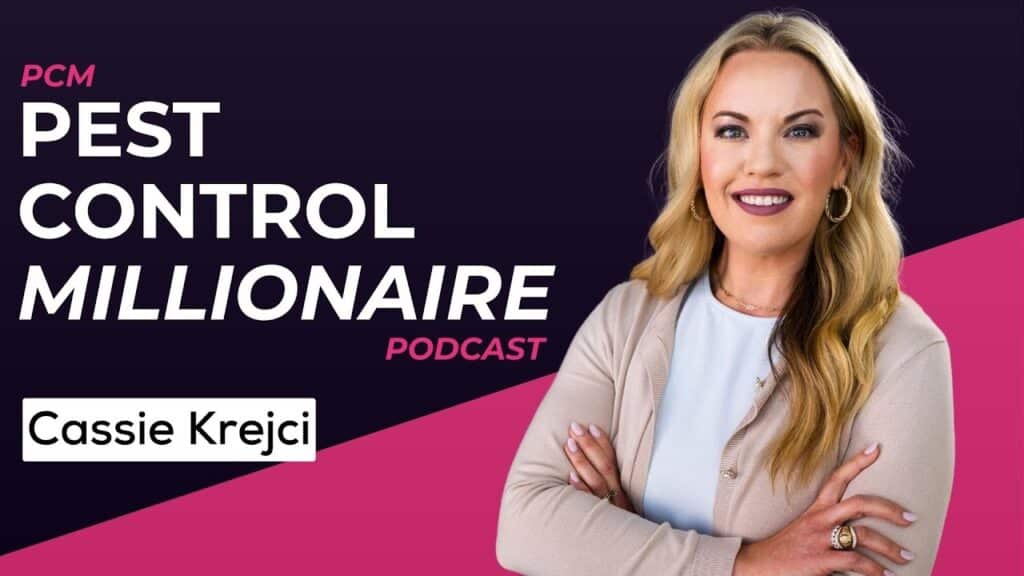
I just got off the mic with Cassie Krejci, who runs science and innovation for Rentokil Terminex in North America. She has a PhD in entomology. She is also one of the most fun people I have had on the show.
I told her up front that I can't nerd out on bugs the way she can. But what she shared wasn't really about bugs. It was about how to run a better pest control business. Here are the lessons that stuck with me.
Table of Contents
ToggleRun every new idea through the "what's in it for me" test
Cassie has a picture in her office that shows four people: a Rentokil tech, a Terminex tech, a homeowner, and a food customer. The caption says "What's in it for me?"
That picture is her filter. A scientist can walk in with the coolest idea in the world, but if it doesn't help one of those four people, she passes. As Cassie put it, "if we can't answer the question about what's in it for those four people, then it's probably good to pass on."
This is a good rule for owners too. New software, a new product, a new service. Ask what's in it for the tech and the customer first. If you can't answer that, save your money.
Pest control is not the same in all 50 states
This came up again and again, because Cassie does not believe one playbook works everywhere. She gave me a line I won't forget. "A bed bug in a brownstone in Brooklyn is not the same issue as roaches in a slab on grade in Dallas."
Different pests, different homes, and different weather all mean the way you treat has to fit your area. She said it flat out: she does not believe pest control should look the same across all 50 states. For us, that means you have to know your local pests and how they live. Don't just copy what works three states away.
The customer changed, so you have to change too
The biggest shift she has seen is the customer. People don't just pay every month and look away anymore. Now they want to understand the value behind the service.
She said one thing I want every owner to hear. "It's not just about acquiring the customer. It's how you acquire the customer that keeps them." Do it with class and empathy, and you keep them longer.
She also made a great point about data. She compared it to her Ring doorbell. She pays about a hundred bucks a year, and for that she sees every package and every knock. Now use that same idea in pest control. Show the customer what is happening in their backyard, and tie it to their comfort. Cassie says they get addicted to that information. The digital tools are coming fast. The owners who share data well are going to be hard to fire.
Own the public health conversation
Cassie is a board-certified medical veterinary entomologist, which is a big title with a simple point behind it. When ticks spread Lyme, most people call their vet to protect the dog, but she wants them to call pest control instead. "I want people to think of pest control, not their veterinarian," she told me.
A barrier treatment and some wildlife control do more for the ticks in a yard than treating one pet ever will. That is a real selling point. You are not just killing bugs, you are protecting people from disease.
A new pest in your area is a gift
We talked about termites showing up in places they never used to live. I am in central Wisconsin, and we barely saw termites for 20 years. Now I am getting calls, and I got one just yesterday about 20 minutes away.
Cassie says this is happening all over. She thinks climate plays a part, along with all the goods we move around the country. She pointed out that is how we got Formosan termites in the first place, since they rode in through a port on a shipment.
Here is the opportunity. When a new pest shows up, the news covers it. People get scared and start searching. If you are the one with the knowledge and the fix, that is your moment to be the local expert. She even offered to help confirm a find, because if you spot something new you can get your name in the trade press for it.
Grow your own expert
Not every company can afford an entomologist on staff. Cassie gets that. Her advice came from how she grew up. She rodeoed as a kid. Fancy horses were not an option for her family. But her mom was a great horse trainer, so they grew their own barrel horse instead of buying one.
She does the same thing in her career now. Find the person on your team who wants to level up. Help them earn a certificate or attend the technical track at your state meeting. Now you have an expert who actually knows your business. For quick questions, she said you can send the bug photo to NPMA or to an entomologist. Most of them love it. She does too.
Hire trainers for empathy, and keep training simple
I asked what she looks for when she hires someone to train branches, and her answer was fast. "Empathy 100% of the time. I can train anyone to the technical side, but if they can't relate to the people that come in to join our business… then they're not going to be successful."
She also said new hires have short attention spans, so training has to be hands-on and broken up into pieces. And it has to be simple. As she put it, this should be pest management 101, not entomology 101, because you don't need to turn every tech into a scientist.
Then there is consistency across branches, and her rule there is plain. Everyone speaks the same language. She says communication is the key to whether you succeed or not.
Watch the rules that could shrink your toolbox
Cassie also handles a lot of the science behind government issues, and one she is worried about is PFAS. These are chemicals that help things last longer, and they show up naturally in some pest control products like termite baits.
A few states want to ban a wide list of PFAS, and if that hits termite baits, we lose a key tool. The cost is bigger than it sounds. Lose the bait, the home gets termites, and then you either fumigate or tear it down and rebuild, and both of those are worse for the environment than the bait ever was.
The point for owners is simple. Keep an ear on the rules, because the tools you count on today are not promised forever.
Just start sharing online
Cassie has built a real following on social media, and it started during COVID. She was stuck at home with knowledge to share, so she shared it. She even taught herself to film and fly a drone.
She likes different platforms for different reasons. TikTok goes everywhere, even to people she will never meet, but LinkedIn is the one she loves. "LinkedIn is my people," she said, because it is where her peers cheer her on.
She thinks a lot of small owners miss LinkedIn, and I agree, since I ignored it for too long myself. There is chamber and policy work there that can drive real business. One last thing she said that I loved is that we are not exterminators anymore. We are professional pest management, and that little shift in how you see the work matters.
Final thought
Cassie left academia thinking she might end up in a quiet lab. Instead she fell for service work, and she told me she will never leave it. After this talk, I get why.
The science is cool, but everything she does comes back to people. The tech, the customer, and the team are all the same game the rest of us are playing too. Thanks for the time, Cassie, and send us your bug pictures any time.
