How We Run Bed Bug Heat Treatments and What It Costs

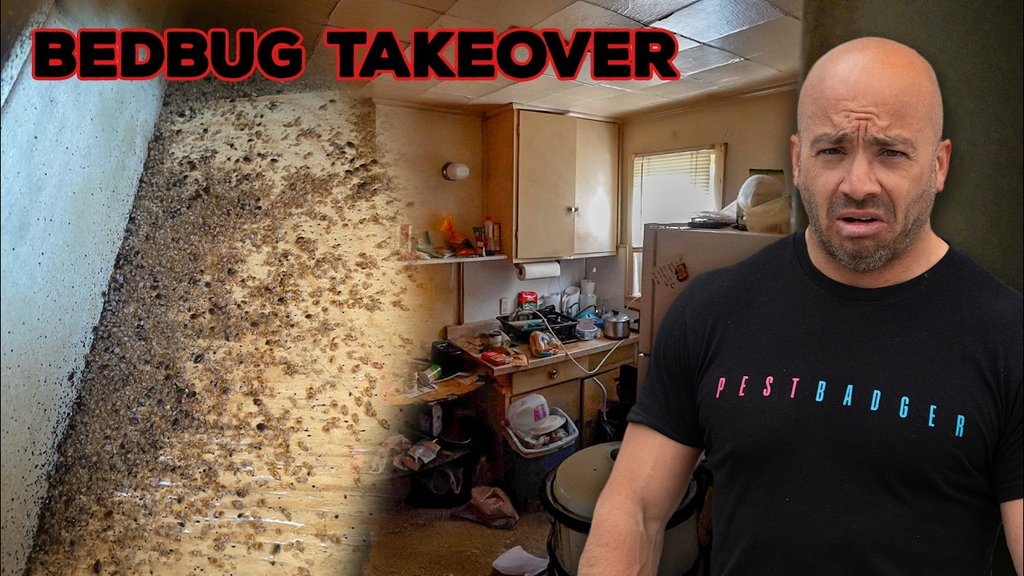
Table of Contents
- Why We Heat Instead of Spray
- How a Heat Job Runs, Start to Finish
- Get the Heat Into the Furniture
- Push the Air Through the House
- Propane Beat Electric for Us
- What It Costs to Get Started
- Price by Square Footage and Be Upfront About Callbacks
- Keep the Crew Safe and the Bugs Off Them
- Frequently Asked Questions
This one was a field job. We heat treated an eight-room boarding house that was so bad the plan was to heat it twice. The first time, with people still living there, we killed about 90% of the bugs. Nobody cared that they had bed bugs, and they kept bringing them back in, so everybody was moved out, and we came back to heat it again while it was empty.
There was fecal staining all over the walls, a layer of shed skins about an inch thick and bugs even in the bathrooms, which is very rare. Like most of our jobs, it’s owned by someone in another state, and this owner had never even seen the property.
Tyler, who has been doing bed bug work for eight years, walked me through the whole thing. When we filmed this in September 2025, we were running heat treatments basically Monday through Friday. If you’re deciding whether to add heat treatments, here’s what goes into them, what the equipment costs and what the jobs pay.
This video is part of PCO Tips. Heat jobs are specialty, one-time work, part of the 10 to 20% of revenue that sits on top of your recurring base in the pest control service stack.
Why We Heat Instead of Spray
Try to come in and spray, and you find out people don’t prep. Heat soaks into everything, the walls and the furniture, and kills everything in there. And when everybody moves out, the bugs lose their hiding spots and go into the walls and floors. Heat is the only way to get to them there, unless you start drilling holes in the walls.
Tyler prefers heat all day long. It doesn’t need all the follow-up visits, and it’s way more effective. If he ever got bed bugs himself, the last thing he’d want to do is launder everything he owns, put it in garbage bags and isolate it, like you’re supposed to with a chemical treatment. Products have come a long way, though, and we still do chemical treatments for hotel rooms, which are never really that bad, small apartments and places that don’t want heat. Once you’ve got bugs in multiple rooms, it’s way better to heat the place.
About 90% of the bed bug calls Tyler gets are from people who tried to handle it themselves and made it worse. Bombing your place just spreads them, pushing them into the walls and harder-to-reach places. And it isn’t a dirty-person problem. Not long before this, we did a $750,000 home with cleaning people. Bed bugs are hitchhikers. For finding them, read how Kim Camera’s dogs sniff out the bed bugs technicians can’t see.
How a Heat Job Runs, Start to Finish
Every job starts with an inspection. We walk through the whole house with the customer and a checklist, showing them what needs to come out and what doesn’t. Batteries, aerosol cans and wax candles come out. TVs and electronics stay, unplugged, because we’ve found bed bugs in TVs. You can go through the whole checklist and show up on treatment day to find they haven’t done a thing. It also helps if the customer cranks their furnace a few hours before you get there. This job started at 87°. Sometimes we start at 65°.
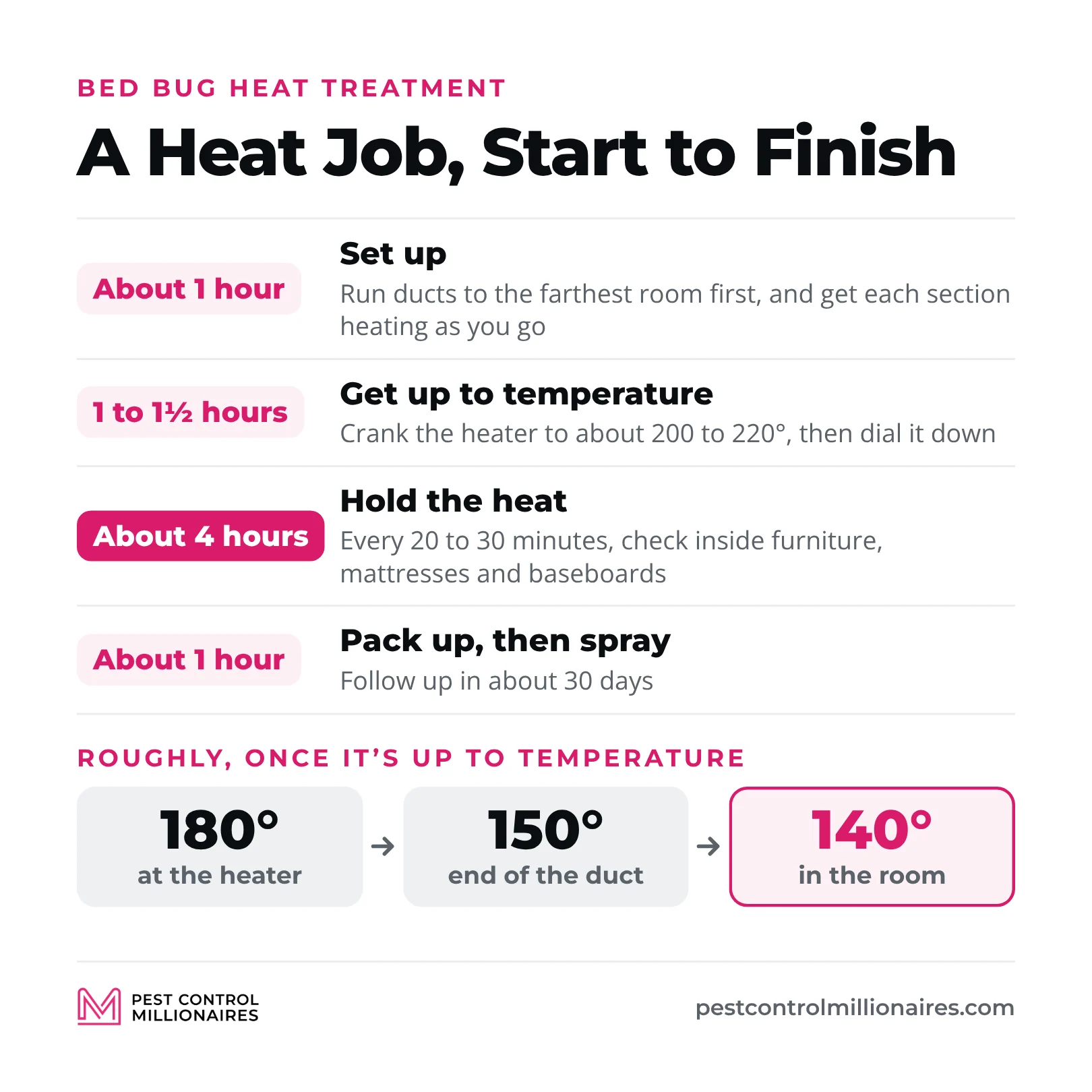
Then it goes like this. About an hour to set up, an hour to an hour and a half to get up to temperature, about four hours holding it, and an hour to pack up. Then we spray. All in, Tyler says a heat job generally takes 8 to 10 hours, depending on where we’re going, so the faster you set up and get things rolling, the better. Run your ducts to the farthest point and work your way back, and get each section heating as soon as it’s set up. On a building this size, the first rooms can be holding while the other side is still heating.
“You never want to kill the heat early,” Tyler said. “No matter how much you want to go home, you’re there to get the bugs. You’re not there to get a paycheck.” On a bad place like this one, you can heat longer to let the heat get in more.
We spray right after every heat job, even though some companies just do heat. When you’re talking about thousands of bugs in a place, you do your customer justice by spraying in case one is left. You’ve already eliminated 90% of the bugs and fried the eggs, and anything left over dies from the product. We like Crossfire for that. Spraying after is what lets us give a 30-day warranty, and Tyler says it “ensures we always get 100% success rate.”
Get the Heat Into the Furniture
We were trying to hit about 140° in the rooms. Anywhere from 140° to 150° is fine, especially in a vacant unit, and TVs and electronics are still fine at 150°. If a room runs hot, open a window or pull the duct out. We do a lot of cockroach heat treatments too, and roaches die at about 150° to 155°.
The air temperature doesn’t matter. What matters is the temperature inside the furniture, inside the mattress, down at the baseboards and underneath objects. After about an hour to get up to temperature, we go in every 20 to 30 minutes to take readings. Prop up mattresses and separate them from box springs to get the air flowing. Tyler drilled holes in a piece of PVC pipe to jam into the cracks of couches and chairs and push the heat in. Once rooms are up to temperature, you can choke off the air to them and force it to the rooms that are still behind.
Watch the details. Poorly installed vinyl floors can bulge in the heat, and they go back to normal if you push them down while they’re hot. On places with fire sprinklers, like hotels, we put covers rated for 155° over the sprinkler heads, and we don’t go that hot in the first place. A lot of people are nervous about those jobs. We do them regularly. You just have to take the proper precautions and pay attention to your heat. Magnetic vent covers and blankets over doorways hold the heat in, and Reflectix under the ducts and around special objects keeps the heat off them.
Push the Air Through the House
Our big propane heater, about a million BTUs, can do 3,000 to 4,000 square feet by itself. It pulls air in from outside, runs it over the burner and pushes it into the house, so you’re constantly pressurizing the place and forcing air out through the cracks around the windows and doors. That helps force the heat. Tyler runs a duct into each bedroom, puts a splitter at each doorway and pushes the air back toward the front door, where the heater sits. It takes a little more equipment and work up front, but in his opinion it pressurizes the house better and heats it faster.
Put the heater right in the doorway instead of way out in the yard with a long duct, where the outside air cools the duct down. Tyler says that cuts propane use by about 60%. To get up to temperature, he cranks the heater to about 200° to 220°, so the end of the duct is about 180°. Once it’s there, he dials it down to about 180° at the heater, 150° out the end of the duct and about 140° in the room.
Fans do the rest. Fans pull more air than they push, so use the strongest ones to pull and the rest to move air around. Don’t point them straight at a wall. Angle them so the air bounces off the walls and swirls through the whole place like a tornado.
Propane Beat Electric for Us
We used to do whole houses with electric heaters, plugged into the dryer and stove outlets. They were very effective, but they don’t pressurize the house, so a treatment ran 24 hours, about 12 to get up to temperature and then overnight. You’re asking people to leave their house for a day, if not a week. With propane, they leave at 8 or 9 in the morning and come back at 7 at night. Electric is also very technical. Tyler was breaking down the house’s whole power system by amps and watts, and he blew fuses more times than he can count.
Electric heaters run about $2,600 to $3,200 each, plus about $600 for each special cord, and Tyler has a graveyard of them at the shop. Knowing what he knows now, he’d still go with propane, and if you don’t have a lot of money and you’re just doing apartments and hotels, he’d buy one small propane heater instead.
What It Costs to Get Started
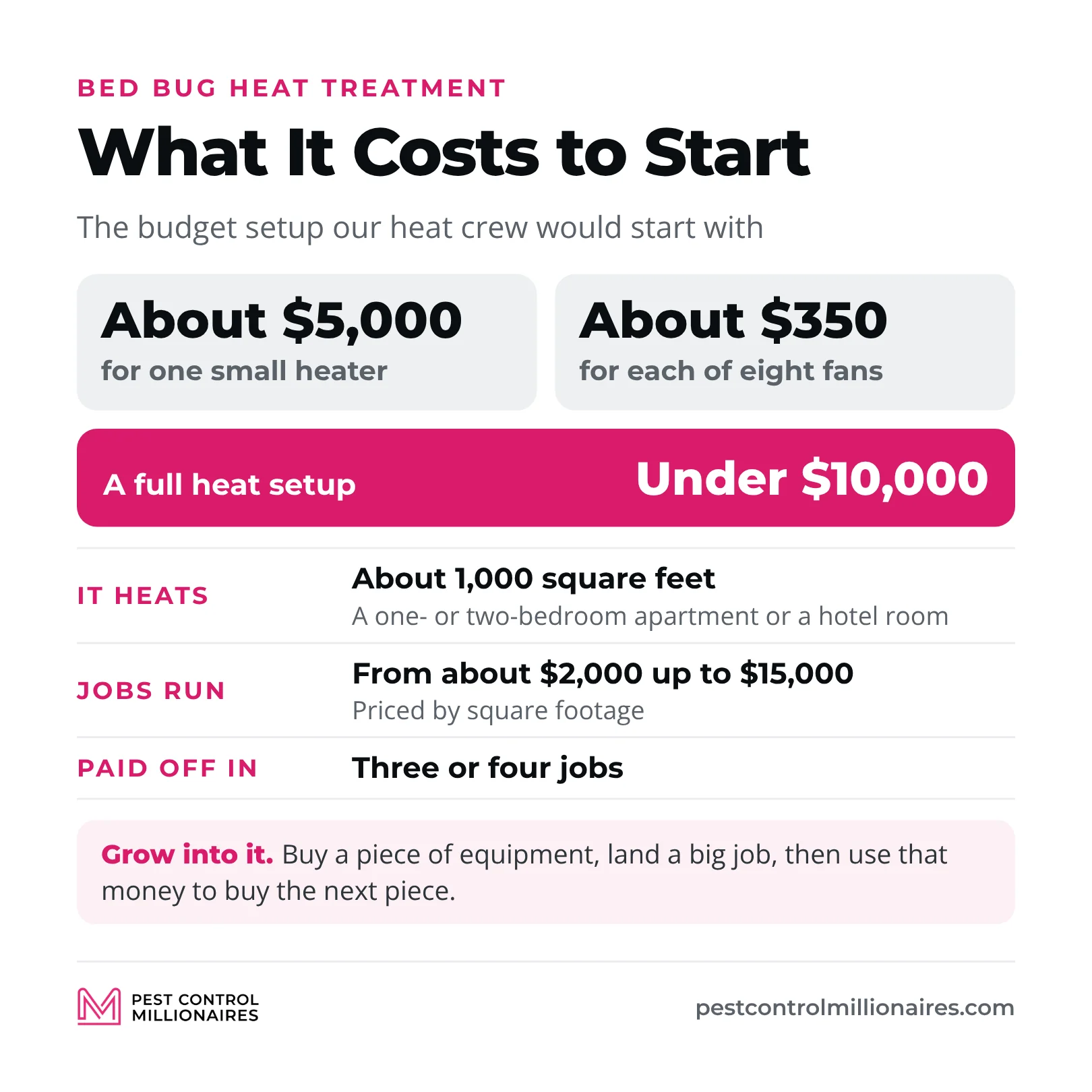
On a budget, Tyler would buy one small propane heater for about $5,000 and eight fans at about $350 each. For a little under $10,000, you have a full heat setup. It does about 1,000 square feet, enough for a one- or two-bedroom apartment or a hotel room, and with three or four jobs, it’s paid for.
Don’t take a job your equipment can’t handle. With one small heater, Tyler would turn down a four-bedroom house. A lot of companies try to heat a house in sections, but you don’t get an even temperature on both sides of a wall, and the bugs can run, so you end up pushing them back and forth. You can do it. It’s just a riskier game.
Grow into it. In the early days, they’d buy a piece of equipment, land a big job they knew would pay, then use that money to buy the next piece. Over eight years, that added up to about $250,000 in bed bug equipment, with about $150,000 in this one trailer. A lot of companies do one or two heat jobs a month, maybe five or six. When you’re running them Monday through Friday, the equipment long pays for itself.
Propane adds up too. Each tank cost about $75 to $100 to fill when we filmed this, so get in good with a local propane supplier. A set of tanks lasts six or seven jobs in the summer and about two in the winter. In Wisconsin, the tanks would freeze up, so Tyler had a custom regulator made to run the big heater off four 100-gallon tanks. Now we can treat in zero-degree weather, so heat jobs can be winter work, too.
Price by Square Footage and Be Upfront About Callbacks
Our average small place starts around $2,000, and we’ve done places for $15,000. It’s basically all square footage. The bigger the place, the more goes into it. Bed bugs aren’t for everybody, either. This place smelled like death.
After the heat, we put everything back in the trailer exactly the way we found it, spray the entire place and follow up in about 30 days. Be upfront with customers that callbacks happen. If any bugs are left over, they usually show up in the first day or two, because we just disturbed them and made them real mad. To come out of hiding, they have to cross the product we just sprayed, and they die, just not instantly, so we ask customers to give it about two weeks. Within two weeks, we don’t have to do anything. If it’s two to four weeks out, we come back with a different type of product, one that doesn’t hold up as well in the heat. It never comes to bringing the whole trailer back.
The 30-day warranty doesn’t cover bugs that get brought back in. It doesn’t happen a lot, but every so often someone can’t figure out how they got them in the first place, or they gave them to a family member or a friend.
Keep the Crew Safe and the Bugs Off Them
At least one person has to be on site the whole time, and Tyler likes to run two. There’s a lot of equipment, and on hot days, going into 140° heat is very hard on a guy. With two, they can take turns going in and out, and if something happens and a guy doesn’t come out, the other one goes in and checks on him.
As for bringing bed bugs home, any that get on you in 140° heat just die instantly, Tyler said. Beyond that, he doesn’t sit on things, touches as little as possible and looks at a spot on the bed before he brushes against it. Best practice is to take your clothes off outside, put them in the dryer and bring a change of clothes and a plastic bag. Tyler admits he doesn’t do any of that, and in eight years he’s never brought them home.
Frequently Asked Questions
How long does a bed bug heat treatment take?
About an hour to set up, an hour to an hour and a half to get up to temperature, about four hours holding the heat and an hour to pack up, then we spray. All in, a heat job generally takes us 8 to 10 hours, depending on where we’re going.
What temperature do you heat a house to for bed bugs?
We aim for about 140° in the rooms, and 140° to 150° is fine. What matters is the temperature inside the furniture, the mattresses and the baseboards, not the air, so we check those every 20 to 30 minutes.
How much does a bed bug heat treatment cost?
Our small places start around $2,000, and we’ve done places for $15,000. It’s basically all square footage, because the bigger the place, the more goes into it.
How much does it cost to start doing bed bug heat treatments?
A little under $10,000 gets you a full setup, with one small propane heater at about $5,000 and eight fans at about $350 each. It does about 1,000 square feet, and with three or four jobs, it’s paid for.
Is heat or chemical treatment better for bed bugs?
Tyler prefers heat. It doesn’t need all the follow-up visits, it’s more effective, and nobody has to launder and bag everything they own the way you’re supposed to with a chemical treatment. We still use chemical treatments for hotel rooms, small apartments and places that don’t want heat.