
Kim Camera on Using Dogs to Find Rats and Bed Bugs

Table of Contents
Kim Camera owns Urban Canine Pest and Wildlife Solutions near Aiken, South Carolina. Her dogs find rats, mice and bed bugs, and pest control companies bring her teams in when their technicians can’t find the problem. Before pest control, she was a K9 handler for FEMA, deploying all over the country with her dogs, and she ran a boarding facility and a dog training company. When we recorded this in the fall of 2025, she had 22 dogs.
I got on the phone with Kim a couple of weeks before we recorded, heard her story and knew it would make a great episode. It’s something totally different for this show. Here is what a pest control owner can use from it.
This episode is part of the PCM Podcast. For another company built around one specialty, read Gustavo Hernandez on carrying his father’s legacy at 1-800-Raccoons.
Her dogs needed a job
Kim grew up a farm kid, where you took care of rats with .22s and dogs, not rodenticide, because of the other animals. She was a falconer for 30 years. At FEMA, her lifeline dogs found people alive under rubble after a disaster, and her cadaver dogs found the victims.
Five years before we recorded this, Kim went through an aggressive breast cancer. She couldn’t fly her birds, so she gave them to a friend and started working with her dogs. “The dogs literally just saved my life,” she said. When COVID hit, she retired, and it lasted six months. Her dogs needed something to do. “So we started killing rats for fun,” she said. People started asking her to catch rats at their houses and farms, and that’s how the company was born. It still does farms and ranches for free.
Her bed bug program started three months before COVID, so she had a year while the world was shut down to learn pest control and how important observation is. She was 63 when we recorded this. “I found pest control four years ago and I wish I would have found it 30 years ago,” she said.
Dogs find what you can’t see
The rodent program started because of a salesperson. Kim told her they’d have one the following year, and she spun around and said, “I need it in three weeks.” Kim had a little dog she’d had for three weeks, so she didn’t charge for the first job, a restaurant that had been struggling with rats. On the perimeter check, the dog disappeared into a burrow under a bush nobody had seen. Inside, he went crazy on a wall where everyone said there were no rats. Kim pulled out a filing cabinet, found a chewed hole by the electrical box, and a rat came flying out. The dog caught it in midair.
Three months later, the restaurant cut into that wall and found an old cast iron pipe nobody knew existed, full of rats and rat fecal. A plumber’s light down the burrow outside showed the runway, right through the French drain and into the pipe. They sealed it up and had no more issues. “What canine does, it allows you to see what you can’t see,” Kim said.
In a warehouse of about 1.2 million square feet with mice, Kim wanted into the maintenance room, about 80,000 square feet, and was told it had been cleared. “It’s quiet. It’s dark. That’s where we need to be,” she said. Bailey, her little Jack Russell, went nuts on an electrical box, where the mice had chewed a tiny hole through the caulking around the conduit. It led up to the roof of the maintenance room and a ledge running to the back of the building, where the dogs kept hitting on a pipe. That was the runway, and once they found it, 28 mice were trapped in just a few days. “No human would have found that,” Kim said.
Observe for a full day before the dogs go in
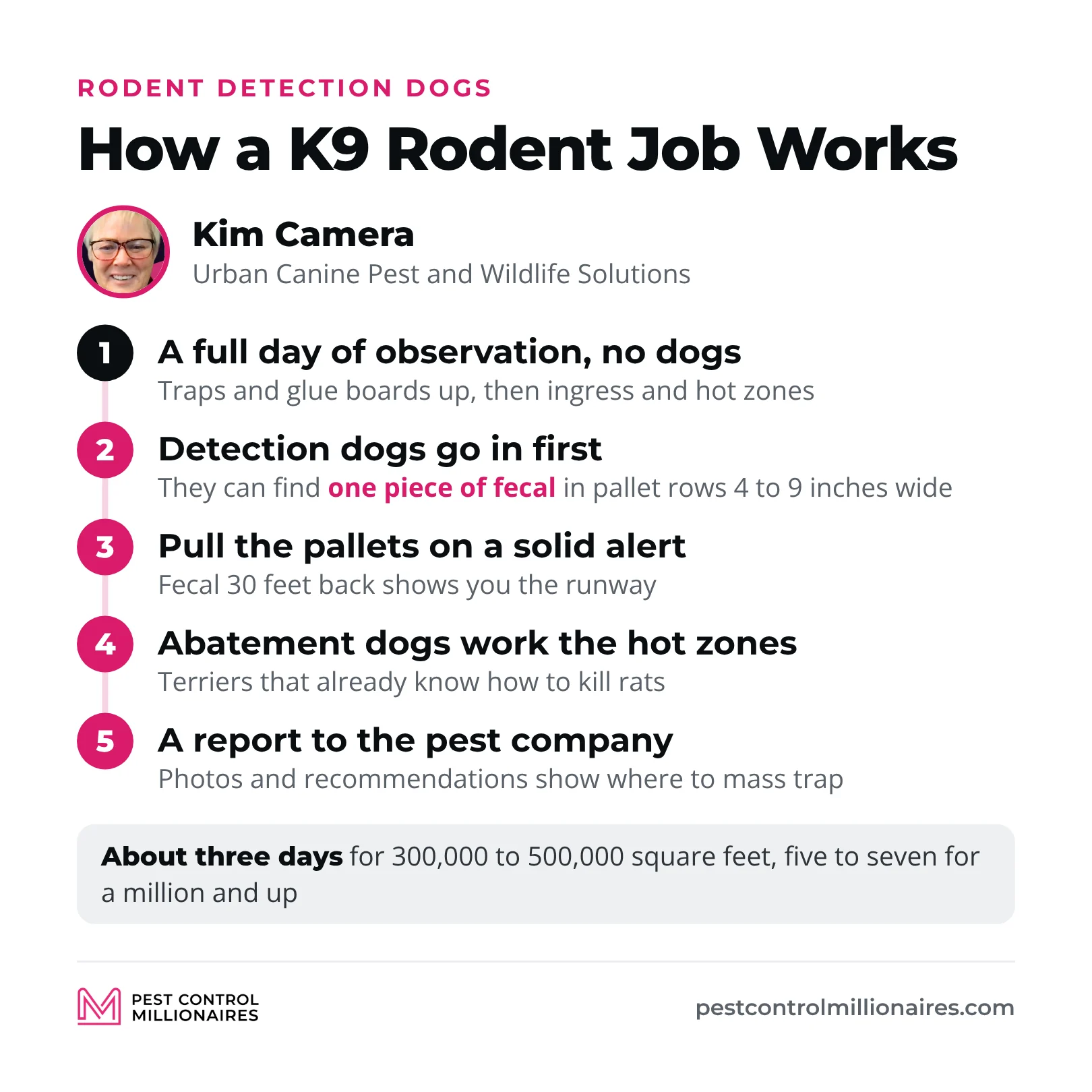
Urban Canine used to walk into a warehouse with the dogs right away. Kim felt that didn’t give the pest company enough information for its mass trapping, so now there’s a whole day of prep and observation first. Her team makes sure the traps and glue boards are picked up (“I’m so tired of picking glue boards off my dog’s faces,” she said), looks for ingress and chewed products and packages, and meets with the warehouse teams to find the hot zones. “It’s not who can find more. It’s a total team effort,” she said.
On day two the dogs go to work. They check the outside perimeter, get up into the ceiling if there is one, then work the pallets, in rows 4 to 9 inches wide that no technician can get down. On a solid alert, they pull the pallets, and they usually find fecal. Fecal 30 feet back means they’ve found a runway, and now the pest company knows where to mass trap. A warehouse of 300,000 to 500,000 square feet takes about three days, and a million square feet and up takes five to seven.
The dogs come in two kinds. Kim’s abatement dogs are terriers that already know how to kill rats, but they’re looking for a live rat, so they weren’t telling her about fecal or runways. So she trained rodent detection dogs to such a low odor threshold that they can find one piece of fecal. The detection dogs go in first, and the abatement dogs work the hot zones. Then the pest company gets a report with photos, observations and recommendations. “We’re just the eyes and the ears of the extension of the pest company,” Kim said.
Read the kill to find the colonies
On a property full of burrows, Urban Canine spends two days observing first. Where are the runways? Where do the rats go under the concrete? What’s their favorite food, and where do they get water? Then comes the mass kill. They gas the burrows underground with a BurrowRx, and each dog takes a section of burrows and waits for the rats that come out. The dogs break the necks very quickly. “It’s very humane,” Kim said. She also flushes burrows with tiny ferrets she imported from the UK.
Then she studies the kill, counting the males, the females, the pregnant and nursing females and the young. On one job, 87% of the kill was male. That told her the colony was at high capacity and had split off. They found two more colonies about 90 feet away and a maternal colony under the dumpster, where the young could climb right up into the dumpster to eat, with water puddles and low predation. “If you’re not doing your observation and you’re not looking at your kill, you don’t find that information,” she said.
The most they’ve caught is 3,000 rats in 10 days, and then they monitor for two months to make sure the burrows stay closed. Kim’s model is the sportsman. “They observe, they track, they find the runways, they plot, they bait, and then they harvest,” she said.
Rodenticide goes last, not away
Rodent populations are skyrocketing, Kim said, and on the East Coast it’s worse than she’s ever seen. Regulations are changing there too, not as drastically as in California, but things that start in California tend to creep across the country. Jim Steed walked me through California’s fight over pest control tools on this show.
Kim is fine with using less rodenticide. At an apartment complex near her, Urban Canine does the rodent work with just canine, and the property has cut back on rodenticide. But when I asked whether banning it across the country is smart, she said no. “I don’t think we can do without it. I think we just need to be smarter with it,” she said. Norway rats in burrows she can get a handle on. Roof rats are the hard part. “You’ve got one chance, two chances and they’re gone,” she said. Her plan is to crash the population first with canine and gassing, removing several hundred to several thousand rats at one time, then let rodenticide keep it down.
Her advice to operators was simple. “Be patient. Observe,” she said. Observation builds a comprehensive inspection, helps you understand more and lets you educate the customer. Her order is education, sanitation, exclusion, canine, trapping, and then rodenticide last.
One bug between the mattress and the box spring
Bed bug dogs are trained just like bomb dogs or drug dogs. You pair the odor with a toy or with food, so the dog thinks it’s going to find its toy. Kim’s team trains every day it isn’t working (they were out at six the morning we recorded), and it keeps bed bugs fed so the dogs have something to train on. That job falls to her husband, Greg, who retired from Georgia Power, while he watches football.
A dog searches about two floors, 20 to 25 rooms, before Kim rotates in a fresh one, because that’s a lot of nose work. Once, she inspected a room herself and told Greg, who was handling, that he didn’t need to bring the dog in. He did anyway. He ran a golden retriever down the edge of the bed, and she sat. Between the mattress and the box spring was one bug, with no castings and no fecal. The resident had come home from the hospital the night before. “I ate crow for a week on that,” Kim said.
To get certified, the dogs pass odor recognition tests, and Kim’s team spent three days in Cleveland certifying nine dogs. All nine passed. When we recorded this, bed bugs were about 70% of Urban Canine’s income and rodents about 30%, but rodents were growing, and a rodent job brings in a larger infusion of income at one time.
Add K9 to keep the account
Most of Urban Canine’s work comes through pest control companies. The day before we recorded, Kim took on two new partners, one for bed bugs and one for rodents, and she had just landed her first national contract, rodents for a multibillion-dollar company. Businesses call her directly too, and when they do, she asks who their pest company is and calls them. “We’re a tool and we’re an excellent tool, but I really want to partner with them,” she said. She wants the pest company to know she’s coming, and she doesn’t want the client giving it the runaround.
The pitch is time. Your technician isn’t doing a bad job. He’s doing his inspections, but he can’t find a small hole in the wall of an 80,000 square foot room, and he has to get to the next stop. “We have the time that they don’t have,” Kim said.
It costs the pest company nothing. Kim usually doesn’t need to go on site to quote. She talks to the technician, who knows the building inside and out, and builds a price that the pest company forwards to its client with a markup. “When we create our budget, we create our budget so they can mark it up,” she said. The first priority is customer service, because that’s what stops the client bounce, and then everybody gets to look at their bottom line. Every account you keep is one you don’t have to pay to replace, and I broke down what we pay for a new one in how much to pay for a new pest control customer.
Kim told me about a pest company that had just taken over a big warehouse contract from another company. As they picked up the old company’s traps, the manager asked what they were going to do differently. They were doing the exact same thing, so they brought in K9. The client had given them the job hoping for something different. “Don’t stop what you’re doing. Add to what you’re doing,” Kim said.
Frequently Asked Questions
Who is Kim Camera?
Kim Camera owns Urban Canine Pest and Wildlife Solutions near Aiken, South Carolina, which uses trained dogs to find rats, mice and bed bugs for pest control companies and businesses. She was a K9 handler for FEMA, deploying across the country with live-find and cadaver dogs, and she had 22 dogs when we recorded this.
Can dogs find rats and mice?
Yes. Kim runs two kinds of dogs. Detection dogs are trained to such a low odor threshold that they can find one piece of fecal, so they go in first and show you the runways. Abatement dogs, terriers that already know how to kill rats, catch them and work the hot zones.
How do bed bug dogs work?
They’re trained like bomb dogs or drug dogs, with the odor paired with a toy or food. Kim’s dogs search about two floors, 20 to 25 rooms, before she rotates in a fresh dog, and they pass odor recognition tests to get certified.
How can a pest control company use a K9 company?
Bring one in on the accounts where you can’t find the problem. Kim builds her price by talking to your technician, so it costs the pest company nothing, and you pass it on to your client with a markup. The dogs’ report shows you where to trap, and the goal is to keep the client from bouncing to another company.
Should pest control companies stop using rodenticide?
No, Kim doesn’t think so. She’s fine with using less, but she says we can’t do without it and need to be smarter with it. Her order is education, sanitation, exclusion, canine, trapping and then rodenticide last.
Full transcript
Every word of the episode, from the video captions
Well, let's get rolling. So, today we have [music] Kim Camera, which is really cool. I thought I was like, am I reading this thing wrong? But [laughter] because I had had you in my phone as Kim Camera, but she's with Urban Canine and we met through Joshu a couple weeks ago and I was like God jumped on the phone and like started hearing your story. I'm like this is really cool. I think it'd be an awesome episode for the podcast. Something totally different like off-the-wall like different. So I thought it'd be really cool. So Kim, welcome to the show. I appreciate being here with us today.
Oh, thank you so much for having me.
Of course. So first off, let's just I always ask this question. If you and I are junior, senior in high school, who is Kim in high school?
Who is Kim in high school? I was the class clown in high school. I was the one in all the plays, marching band that would always march the opposite direction. I never knew my left or my rights. And that's still good for today. Directionally challenged, class president. I just I grew up in a farm community, so it was a really small high school. I grew up out of, you know, 300 people in a town which now has 3,000 people in the town and yeah. It was just a small community. It was a great time to grow up.
It's 10xed. Cool. And then you didn't find pest control for a really long time. Like...
I Oh, I found pest control four years ago and I wish I would have found it 30 years ago.
Right. But what did you do in your first...
So I worked for FEMA. I was a K9 handler for FEMA. I've deployed all over the country with my dogs doing cadaavver recovery work and live fine. And I ran a boarding facility and a dog training company. And when COVID hit, the world went crashing. I was like, I'm retiring. I retired and that lasted six months. And then I my dogs needed something to do. So we started killing rats for fun. And that has just led into pest control. How do you find like you say it so fast but how do you like it just doesn't happen where you just find rats for fun like walk me through like FEMA like what did you do with your dogs then what was what did you do...
So we FEMA is a really intense training so we trained every week I would drive to Tennessee once once a week to train and we bounce all over the country training our dogs so FEMA is the organization that gets called in for large disasters And the misconception is that they just run and FEMA can't. FEMA has to be invited by the state to come in for big disasters. K9 teams, there's 26 K9 teams in the country. I was on one of those K9 teams. So, it was a real honor to serve beside those people.
And what were your dogs doing for female? Like what did you what were they looking for?
I had I put four dogs through the system and one of my I had lifeline dogs. So they're looking for people trapped under rubble, looking for people stuck in trees, you know, a typical terrible disaster. They're looking for people who are alive and are struggling and are a part of that disaster. And then I had cadaavver dogs or they now call them human remain detection dogs and they're finding the victims of those disasters. And they could be anywhere from in a sunken car to, you know, typical earthquakes, hurricanes. It's absolutely horrific what these people go through. So the dogs are so important. They are also used as emotional support dogs to the firemen and to the teams that are there. So it was an incredible experience.
So you've seen a lot of stuff.
Yes, I have. [laughter]
And I kind of told you my background. I don't like I come from like a dog family, but my all my brother's dad they all train German wirehaired pointers draws. And they track like they would they would go to Germany, they train in Germany, they did a lot of blood tracking. So when like hunting's like a big thing around here. So when people would lose an animal like if they shot a deer and went running and could find it, they would call my brothers come out and they would blood use them as blood trackers and go find their deer for. So my brothers did a lot of training, seen a lot of training firsthand. It's really cool growing up with it, but I just never got into it. So it's super awesome. So I'm familiar with what you guys are doing, but just a whole different level.
And so how do you find pest control? Like you said, for fun, you started fighting rats. Like that just doesn't happen on...
Well, that and that's what I wanted to get into. So being a farm kid, you always grew up with rats and, you know, they were so destructive on the farm and between 22s and dogs, that's how we took care of them. We didn't use pesticide, you know, chemicals or rodenticide on a farm because of the other animals. So we were really green with it. So I'm a falconer and I hunt. I was an avid falconer. I hunted for 30 years constantly and I went through what a lot of women face. I went through breast cancer five years ago and it was very aggressive. And so I had to give my birds up because I couldn't fly them. So I gave them to a friend. And during that time I just started working with my dogs. And that's how our company was born.
And I needed something to take my mind off of what I was going through. And the dogs literally just saved my life. I'm convinced of it. They kept me going. And that's how this company was born. It was born out of a out of a life event, I guess you could say. And people having me come over and catch rats at their houses or in their farms. We do a lot of farms today and we do them for free. We don't charge for ranches or farms. Most of those people are going through enough on their own, you know, with the way today's environment is for farmers. So, we like to help them out.
Funny enough that you said that. I said this twice in the past week, which is weird. We're talking about farms. I said, you just don't ever see a new farm going up anymore.
No, you don't.
You don't. And it's sad because that's we're importing so much produce and the farmers are the backbone of our country. And because of I don't know, I really don't understand why we keep bringing in produce instead of just supporting our local farmers, but now you don't see people growing up. When you were a kid, did you have a lot of farm kids in your...
We did. So, I'm from a small town, too. Not 3,000 small, but 13,000 small. So, not a big So, we had a lot of farms as well. So, a lot of dairy farms growing up. Yeah, I would say the majority of like the kids were that especially like on the wrestling team, they are really strong. They're farm hands like in the middle of summer they're bailing hay like Yeah. There's a lot of farms around here. A lot of dairy farms, a lot of beef cattle. Yeah. Lots of farms here.
Yeah. And it's you know back in my day and in your day it was everybody stayed and worked on the farm. The kids stayed and worked on the farm and then they're still doing that. You don't see that today that farmers can barely make it. So...
Yeah, we I think we raised like one maybe two cows. Had like a pig here and there. We named them and we ate them. It's kind of funny.
Yeah, I want a mini cow, but my husband says unless we eat it, we can't have one and I won't eat it.
But I grew up on like a I grew up on a horse farm. It's a little bit different, but we were still bailing hay every summer. Like this is what we did, you know? We get up in the morning, go bail hay all day, and then we would just we lived on the farm. But so before school, we'd have to get up. We'd have to clean horse dolls. I was young, but so my brothers did and I had to just throw poop at them. But...
I had to go to a friend's house. I didn't personally grow up on an active farm, but I had to go to a farm kids a farm and milk cows every morning before school. So I still had to work. So yeah.
Yeah. I actually had friends that lived two miles away that they had to do the same thing every single morning before they went to school. Go milk cows. Yeah. What? So you again you someone just called you one day and said hey like we have some rats like how do you find a rat?
I wanted to start Yeah. I mean I basically wanted to get into the pest control world and I didn't know how because I wanted to get into it with the dogs. So we started with bed bugs...
And sense...
And we started our bed bug program three months before COVID hit. So, I had a year once the world shut down, which was fabulous because I had a year to understand pest control, understand what they went through, how they searched for bed bugs. I got to learn bed bugs. I got to learn natural history, how to find them, where they hide. I got to learn my job and learn how important that observation part of pest control actually is. And so, when the world opened back up, we had strong dogs, we had strong handlers, and we just kicked it. And we're very busy with our bed bug program. And then I was with one of my salesmen at a huge job and I said, "Hey Karen, next year we're going to have a rodent program and she spun around to me and said, I need it in three weeks." I went, "Okay, three weeks."
I had the this most incredible little dog and I said, "I'm not charging you for this. I don't know if this is going to work because we've had him for three weeks." Not only did it work, we solved the problem to the restaurant that they've been struggling with. So, we did a perimeter check with this little little powder and he disappeared into a burrow. I mean, literally just bloop gone and I could just barely see his tail and it was in a bush and nobody saw this burrow. Once we got him out of the burrow, we got into the restaurant, did a perimeter in the restaurant and he hit on a wall and just went crazy. And they're like, "Well, there's no rats there. We've already confirmed that. And so I pulled a filing cabinet out and right there at the electrical box there was a chewed hole and a rat came flying out and he caught it right in midair. He caught it. I screamed like a girl. [laughter] It's like it shocked me.
And three months later they called me and said they cut into that wall and there was an old pipe they didn't know existed and it was full of rats and rat fecal. It was an old cast iron pipe that wasn't used anymore. So, I suggested they get a plumber and run, you know, run a light down in that a plumber's light down in that burrow we found. Well, that went right through the French drain right into that cast iron pipe. They chewed into it. That's what they were using for the runway.
So, what canine does, it allows you to see what you can't see. So, the dogs can find what you can't see. That's why it's so important. And from that point on, they I think they ended up fumigating the restaurant and that was it. They've sealed that up and they haven't had any more issues.
I have lots of questions already.
Are you sick of paying marketing agencies and not getting results? Well, we are hosting the number one step-by-step class on how to attract and generate sales without paying market agency or having a huge budget. Most lawn care and pest control owners get stuck at a ceiling because they're dealing with outdated systems or relying on guesswork waiting for the phones to ring. Our upcoming class this Thursday provides proven strategies to generate hundreds of leads without a huge budget. We'll show you how to build a predictable system to grow past a million dollars. We show you how to automate your marketing. We'll also teach you how to delegate and build your team so you have more time. So, click the link in the description below. Trust me, you're not going to want to miss this. This is the one thing that I wish I had learned a lot sooner. Now, let's get back to the show. Go back to the bed bug thing. How do you train a dog for bed bugs? What's that process like? I'm sure it's a lot of work, but how do...
Oh, it's a lot of fun. So, it's trained just like a bomb dog. It's trained just like a drug dog, a cadaavver dog. So, the dog is actually you pair the odor with a toy or you pair the odor with food. And so that's how you know, so the dog's just thinking he's going to go find his toy or when he finds the odor, he gets the toy or he gets his treat or he gets his food. So that's it's a it's a it's a it's a long process. It's a fun process. It's a motivating process. And but they're trained just like drug dogs, bomb dogs, you know.
Yeah. And how often are you training? Like especially in the very beginning, how how often are you training?
We train every day.
We train every day now. Every day that we're not working, we're out training. We were out this morning at six o'clock training. You know, we have a really nice kennel here. So we get the kennel routine done in the morning and then we get up and we start training.
Awesome. And then how many dogs? And he told me this on the phone, but how many dogs do you currently have?
22. Somebody asked.
Yeah. Yeah. Someone asked me not long ago, what gets Kim Camera up in the morning? I think they were expecting a philosophical answer. I'm like, dogs got to pee. So, and they're all outdoor dogs or do you have one that's retired that's inside?
Yeah. [laughter] yeah. So, we I still have one of my cadaavver dogs from FEMA left. I just lost Gunnar. He was a 17-year-old lifeline FEMA dog for kid for Malinois. He died at 17. He lived long time.
A long Yeah. A long time. And then Spanky, he's down there. Spanky is a unique dog because he was found on the streets of Chicago and it took three weeks to catch him. He went through a police department. He went through so many handlers because he just It took me a year to teach that dog to sit. He turned out to be one of the best FEMA dogs. He, you know, he didn't need anybody. He just needed you to take him to the site and off he would go and do his job. It's just he was very independent, you know, he was a street dog, but he was phenomenal. So, he's about 16 years old now. And so, I still have him. The rest are young. I have all young dogs. So,...
What So, I'm going to go way back now because I'm just curious like what made you get into dogs for female in the first place? Where did you find dog handling? You mean just getting into the getting training dogs?
Oh, I was that kid growing up that drug everything home, you know? It followed me, you know, the it followed me home story. I had everything from raccoons to possums to snakes to everything. And I've I don't know. I've just always trained. I come from the zoo world and I've trained everything from birds of prey and freeflighted shows and I'm a falconer. My family is a heavy sports sportsman family, you know, hunting, fishing, and I got into it by falconry. I killed my first sparrow when I was like nine and I cried for two days after I killed it with a BB gun. It was awful. But I had no problem, you know, hunting with a bird. So, that was my part of being in a sportsman family.
That's really cool. I know I had a falcon around probably like six oh maybe it's been a year now but it's super fascinating there too. So you got 22 dogs. What kind of dogs are they?
So we've got everything from golden retrievers, Patterdales, English springers, field cockers, a lurcher, couple mutts, anything with really high prey drive. If you call me and say I've got a dog that wants to kill my cat, I want that dog. It's got high prey drive and I can train it to do pretty much...
Yeah. We can't have the way not we but my brothers can't have the way her pointers around any cat.
End of the world. It's just over.
Oh yeah. It's done. And any of these hunting dogs and hunting breeds are just like that because that's why they're good at what they do. They've got You've taken that high prey drive and you've turned it more into detection, flushing, pointing. So you've you've curved it. You But you didn't take away that drive.
Yeah. I have a cat that is constantly in fear of its life here, but it is a house...
Yeah. So, walk me through first walk me through like a typical day and then I then after that I'll have you walk us through like what a job looks like. I'm super fascinated.
Well, a typical day for us is we get up. We just head right down to the kennel and check on all the dogs and everybody starts going out. We've got 14 acres here. And so everybody goes into their groups and into their paddics and they get to run for two to three hours while we're cleaning and preparing their meals. And we feed raw and we feed kibble. So everybody's on a little special diet and they come back in, they eat, they sit for an hour. If we're here, then we start training. You know, everybody sits for about an hour, lets their food digest, and then we just start getting our groups out and taking off. I've got handlers out today training. I've got a handler in Georgia working today on a bed bug job and I'm in the office this afternoon and I've got trainers coming over this evening to train. So, it's kind of a typical day. Yeah. The dogs come first. The dogs are our family, you know. These are just like your brothers.
I mean, they're our working dogs and but they're family and they're they're gold to us. So, we take really good care of them.
Yeah. What like when they're training, what are you guys working on?
What do we work on? Yeah. We work when when you're working a dog and you're actually in the field, your brothers would probably tell you the same. That's where you create bad behaviors and that's where you find where you've got to fix when you train. So, anything that we see like if our dogs start false alerting or if they get distracted or they're fearful of something, then we start fixing that in training. There's no time to fix that at a job site, you know. You just you just work, you figure out what it is, come back and we take pretty good notes with our with our jobs and with our training and then you're you're rehabbing what problem you caused in the field basically,...
Right? So, like, do you have live rats? Do you have dead rats? Do you have bed bugs laying around? This is like we always had ducks and rabbits...
We do. [laughter] yeah. We Yeah. We had the cages of duck that we just use for training...
And that's what we do. So we've got bed bugs and if Greg wants to watch my husband, he's in the company, too. And if he's retired from Georgia Power, he keeps reminding me he's retired.
He's retired. Yeah.
And I keep reminding him he said he wanted to travel. And then he's like, I didn't mean Mississippi and a trash dump chasing rats. And I'm like, well, you should have been more specific with that. So,...
So, if he's laying on the couch watching football, he's feeding the bed bugs. So, he doesn't he doesn't blow up from him. Boy, if I get bit by a bed bug, I blow up. So, he's he doesn't even have a red mark. So, we try to keep our bed bugs fed, you know. So the dogs have something to train on. And then, we have rats and we use the rats to train the dogs on. Detection. We always start with detection. We don't teach the dogs to kill rats. They know how to do that. We teach them to find the rats. So, we want them to go into a warehouse and tell me where's the runway, where's the fecal, where's the harbage areas, and, you know, let me know what's going on. They already know how to kill them. They're they're they're terriers. They're they're awful little dogs, so they know how to kill about everything.
And we have ferrets, so we run a ferret program, and the ferrets will flush the rats out of the out of the burrows to the dogs.
Really? She's let you let put a pharaoh in a burrow. Mhm. The I'm learning this from the UK boys. They're pros at this and this is what they do over there and feriting is an old sport. I've had old, you know, oldtimers come up and go, I did that when we were when I was a kid. We had ferrets. So I imported ferrets from the UK.
Are they aggress? Are they aggressive?
Yeah, the ones I have now are I' I've pretty big size. So, it's funny because so the ferrets here are really docsil. They're the hunts been bred out of them. They're all from one bloodline basically. So, I had to import ferrets into the country that would hunt. And these guys are small so they can get down into the burrows. Typical ferrets two maybe two and a half, three pounds. These are about 200 to 300 grams. They're not even a pound. They're tiny. And they can get down. And all I want them to do is to flush those rats. I don't I don't want them to kill them. I just want them to flush the rats and then the they'll flush the rats up dogs. We use smoke. So, we use a lot of stuff to flush from the burrows. We'll use smoke. We'll use a BurrowRx. It really depends on the environment that we're in and what we're allowed to do.
It's just so easy to dump a ferret right down through there.
That's wild because I mean, you go into like a big farm job like you were talking about, you have burrows all over the place.
Yeah. And b and farms are wonderful because they don't put out a lot of rodenticide or pesticide for the ferrets. So I don't have to worry about the ferrets, you know, getting down into a tube and someone's put tracking powder in there. So I have to be careful with that, you know, in other environments. But yeah, it's nice. I've never lost a ferret.
That was my next question. Like dogs, cats haven't been bit once. Dogs.
Me or the fer?
No, not you or the dog. The fret or the...
Ferrets have never been bit by a rat. A rat could kill a ferret. So, they're just they'll they can crush a ferret's head very easily. Those big Norway rats, the dogs get bit all the time.
I was thinking too,...
Oh, really?
Yeah. And especially a young dog because they want to grab them from the butt and they have to learn to grab them from the middle or the head and then shake them and then they don't get bit.
Is that just a training thing there,...
It is. I actually train that. So, we'll take young rats that we raise here and we'll teach the dogs how to get them safely and it pays in the field because it's it does it pays for the dog safety in the field.
Gotcha. So, now we're going to go circling back to your first job like went to this job for free. They said, "Let's see if we can go find it." Found the big rat, no rat come out of that behind the bridge or whatever. And that's where it's like, "Okay, we can do this. I'm going to turn this into a business." And then walk us through like a typical job like in a warehouse. A typical warehouse job, the first thing we do is we'll go we will go in ourselves and we're going to go do an inspection. So, we're going to make sure all the traps have been picked up or at least we know where the traps are. The glue boards are I'm so tired of picking glue boards off my dog's faces so I make sure the glue boards are all picked up. And then we'll start looking for ingress. We'll start looking for chews on products and packages. We meet with the teams. We find out where their hot zones are. There's a whole day of prep and observation before we even bring the dogs in.
We used to just go right in with the dogs. And we were giving information, but I just felt we weren't giving the pest control enough that you know to help them with their mass trapping. So, we're finding that a full day of observation, us inspecting, we're finding things that maybe the pest control missed, we're finding the same things. You know, we're a team. It's not who can find more. It's a total team effort. Then, when we bring the dogs in that second day, we can go right to work. You know, we can do our outside perimeter check and we're always finding things. The dogs are always finding things that no human found. So we're doing our our perimeter check. We're we're getting up into the ceiling if at all possible and if there is a ceiling and then we start our pallet work and it's just long rows. You know, the rows are four to nine inches wide and the no pest company or human can get down there to see what the activity is.
By putting the dogs in those areas, we're looking for tiny things like change of behavior. We're looking for alerts and then we're marking those down and then we're flagging the area. If we feel it's necessary, we'll have them pull those pallets out. If I get a solid alert, we're going to pull those pallets out and we usually find fecal, which is amazing information. You know, fecal 30t back, we've now fronted a runway. And now the pest company knows I need to mass trap back there. So, we're just the eyes and the ears of the extension of the pest company. Our goal was to stop that client bounce, you know, help, you know, help them, you know, keep maintain their client, maintain their reputation, and give them better information.
Cool. So, then you set the dogs out, then what happens from there?
So, when the dogs come in or...
Yeah. Like, cuz now you like you just finished basically finish your inspection for full day and then how do then Yeah. Talk us through like how the dogs come in? Like does does everyone have to leave the warehouse or do they keep working?
Yeah, we'll keep working. So, we usually start we like to work two shifts and I like to work the second and third...
To give the dogs a break or just to swap dogs or...
We swap dogs. So, we'll go in with four to five dogs and we take breaks, you know, we want breaks, too. We'll take lunch and we'll take breaks. We'll go outside and sit with the dogs for a little bit. Usually takes three, you know, a three to 500,000 square foot warehouse will take about three days and, you know, a million and up take anywhere from 5 to seven days. So yeah, we're we these dogs will they won't tell you when they want to quit. You've got to make them quit because you know they want to find that mouse. And something we started that is really helped, we used to do everything with our abatement dogs, you know, our killers, our serial killing rat dogs. They're just looking for that live rat. And it dawned on me, they're not giving me information on fecal. They're not giving me information on runways. You'd see that little head check, you know, like maybe [snorts] nose go up and a head check, but if you missed it, you missed a runway.
So, we started training rodent detection dogs. And so, we have detection dogs and we have abatement dogs. And the detection dogs, they can find one piece of fecal. And that's what they're trained on. They're trained on that low of threshold, odor threshold,...
And they're going in first.
They go in first. And then if we find something now, we can bring our abatement dogs in. Or if we know we have a hot zone, if they have they know like, well, we've had nest here and we see a lot of activity here. I'll throw my abatement dogs in that area and let two handlers work them while we're over here working the detection dogs and then we just swap places. So, and I'm finding we're giving a lot more information back and then we'll do our report with our our photos and our report and our observations and recommendations and we just turn that over to the pest company.
That's awesome. So, then you bring your dogs in and it takes like three to five days depending on how big it is, right? How many rats are you usually finding?
So, it really depends and sometimes we don't know honestly. Sometimes we just don't know. The last job we just did was with for a oh my gosh a very very large company. It was a million and two square feet and we weren't finding much and it was mice and I wanted to get into the maintenance room which was huge. It was about 80,000 square feet. It was huge and it had a rooftop to it and they said no it was just cleared and I said well it's quiet. It's dark. That's where we need to be. And I finally found the right person to let me in the maintenance room. And I took Bailey, a little Jack Russell. She went in and she started and just went nuts on this electrical box. And of course, I'm like, "Greg, get down there. Get on your knees." And so my husband's getting down there. He was 70 years old and he's getting down. We found it. Bailey found it. It was a tiny hole.
They had chewed through the caulking of the joint in the wall where the conduit and everything electrical went up through. They had chewed through that. There was so much mouse grease. There was so much fecal. And I realized, well, that's going to the roof. So, we got on to the ceiling, the rooftop of that maintenance inside this warehouse, and there was so much fecal up there. There was tracks up there. There was chews up there. And then there's a ledge that goes all the way to the back of the building. And our dogs were hitting on this pipe in the back of the building non-stop. And it was like, there you go. There's your runway. So they were they were going through that wall to the top of that rooftop, hitting that ledge, going traveling that ledge all the way to the back to the product.
And they trapped and I think it was I forget the days now, but they got 28 mice in just a few days once they got once we found that runway. But they had everybody said no. The you know the auditors basically said the maintenance room was fine. It was cleared. No human would have found that it was tucked up so far underneath all these wires and underneath that box. So again that's what K9 is good for is to finding things that we can't see. That's they're brilliant at that.
I agree. Find it super fascinating too. So like where do most of your jobs come from? Are they coming from pest control operators that are calling you in? Do they come from the actual companies themselves?
They come from both. So, we're getting a lot of pest control. We just took on two new pest control partners yesterday.
Yeah. One for bed bugs and one for rodents. And then private industry will call us.
If I get a phone call from the private sector, I always ask who their pest company is and I call them. I really want to partner with the pest company. We're a tool and we're an excellent tool, but I really want to partner with them. I want to know, do you know we're coming? I also want to make sure the client doesn't do a runaround, you know, with with them. I pest companies really need to be involved with this. And so, yeah, we make sure we reach out to them.
That's awesome. And I know you said like what state are you in where do you live?
We're in Aiken, South Carolina. And we travel nationally with bed bugs. We've got five states that we cover. We're bed bugs with rodents. We can pretty much travel wherever. Wherever. We've done We've done airplanes. That's interesting. Doing an airplane makes me not want to fly anymore. But [laughter] just like, oh my god, there's rats on planes. So, we've done airplanes. 2 million square foot warehouses, restaurants, homes. We're not a lot in the in the residential. So I think what we're we're really I think it helps pest companies to bring us in because we help with time. We have the time that they don't have. You know, we have the time to get in there and to observe. You know, their technicians are on such constraints sometimes with getting from one location to the next location and servicing people. So, by bringing in companies like ours, we have the time to do the observation.
We have the time to do the monitoring. We give the feedback, the reports, and it's just allowing them to do a little bit more.
Yeah. And like you said, like the technician not necessarily doing a bad job. He's doing this job that he's supposed to be doing, doing inspections, doesn't see anything or he can't find a small hole in the wall in the 80,000 foot warehouse. You know,...
That's right. They're going in and they're doing an excellent job, but they have other responsibilities. And subcontracting a company like us, that's our sole responsibility and it's to give them the tools to do their job better.
Yeah. And you'll like So, how do you get like I know you said you travel across the country to go to other companies, help them.
You like taking your dogs, put them in a trailer and heading out.
We have a van. We got a 350 Ford Transit that's all situated for the dogs. It's got solar and yes, we ride in that or we put them on a plane and I'm always nervous the whole time on a plane now. Or we'll or we'll fly. I can take two bags. We're going to Mexico the end of November to do a rodent seminar, which I'm really looking forward to. And we're just going to put two dogs on the plane and fly down...
Yeah. It's funny enough because like my brothers will ship horses across the world. It's like how in the heck do you get a horse on a plane? But it's crazy.
Yeah, they do. So, like let's just talk about like California. Have you been there yet?
Was in California one time and I've got friends that work out there that have a really strong K9 program and we're partnering on some things. I went out there one time, Los Angeles, and took Leroy on the plane. He was phenomenal. Found a lot of the issues with that restaurant that the pest company couldn't see, which was really nice. Yeah. So, that was nice. California is I was just talking to a good friend from there. I said, "Well, you know, you can kill cockro cockroaches with soap and water." And he's like, "Yeah, we can't do that here. It's just their hands are tied in with so many regulations now." So, and I think we all need to be a little more sensitive what everyone's going through with all these changings and regulations.
Kind of why I brought it up because like that's kind of why I went this direction because thereides out there, right? They banned a lot of the first generation and so it's making their job a little bit harder. I know we've talked about this before. You're not a huge fan because you've had a dog pass away I think from rodenticide. So let's talk about that. Like they have a really bad problem California with rodents in general. Now they got rid of firstgen if I believe I'm maybe I'm wrong. So tell me if I'm wrong. Rodendicides they've seen a from what I've heard I've talked to people in the industry like they've seen a massive spike and increase what's your thoughts around all that...
They are they're having a massive spike and a massive increase in rodents and Jeff and I talk about it quite a bit no it's getting it's getting worse across the country here in the east coast it's worse than we've ever seen and you know regulations are changing here too not as drastic as they that they have in California but usually when things start in California, they creep across the country. You know, I'm fine with this reduced in rodenticides. I think I think we can do better.
I'm not wrong here right...
We've got an apartment complex here that we're doing just canine with. They are they've reduced the amount of rodenticides they're using there. I think we can reduce it. Jeff's seeing a reduction in the clients that he's using canine for. The issue is roof rats. Norway rats are, you know, a little easier to get into the burrow situation. The issue is what are we going to do with these roof rats and the spike in roof rat populations? They're so hard to manipulate. You've got one chance, two chances and they're gone. You know, they'll move. But no, the rodent population is skyrocketing right now and we just need to be more proactive. Observation and Jeff's seeing a big difference in doing observation as well. Well, look at the sportsmen. They observe, they track, they find the runways, they plot, they bait, and then they harvest.
And it's a it's a process.
Yeah, I agree. And just like banning it completely. Again, it's just me talking out loud. What do I know? Like I agree we can do a better job as an industry as a whole of reducing it, but do you think banning across the country is the smartest thing?
No, I don't think we can do without it. I think we just need to be smarter with it. And I think we have we have other tools that we can use too. We can gas underground. We can we can we use the BurrowRx a lot and so we're gassing underground. It's not a residual effect. It doesn't hurt plants. It doesn't hurt anything and we're killing hundreds of rodents underground. So Norway's we're really getting a good handle on. But we can't reduce pest control. We can reduce it, but we can't we can't do without it,...
Right? Where do you see the future? Where do what do you think is going to happen in the future? You had a crystal...
I think we're g I think we need to see more canines working. I think we need I think it's an excellent green quick. If I can go in, I'm 63 years old. I am new to the pest control world.
53 years young.
Thank you. [laughter] I can go in to a burrow infested facility. I can kill 3,000 rats. That's what I've gotten my buckets in 10 in 10 days. 3,000 rats in 10 days is the most we have caught in buckets. I don't know what I'm killing on.
It's insane. And then we go back and we monitor that for two months. Burrows aren't opening up. We're making sure we find any of the fisions of the colonies separating the maternal colonies. If we can do that, this is a valuable tool for pest companies to bring in. And you're you're going in, you're quickly reducing the colony. Your pest control now is working more effectively. It's catching up with the rodent population. It'll keep it redosed. Now they're looking at this birth control called Evolve that's now in out into the world. I know India's starting to use it. France is starting to use it. I'm not for sure if we're using it here yet or not, but I can see we're adding rodenticide crash the population. Take the rodents down to a non-detectable level with canine and BurrowRx gassing underground. Now add your rodenticide and your birth...
So birth I mean birth control is pretty simple to figure out, but yeah, I've never even heard of that before. They have that for rodents now.
Yeah, they're doing it for rodents. And this has been tried in the past and before and it didn't work as well. And it's been tried with a lot of different animals. Coyotes.
I wonder why. I wonder why it doesn't...
I don't think it would c I think it works, but it takes like two to three years, you know? I mean, think about it. You're just slowly not every female is getting into it. And now they're these females are still having young. So those females aren't eating it. So you still have this massive population. But if you can crash that population, if you can take that capacity, that high level capacity, crash it with K9, remove several hundred to several thousand rats at one time. Now you got your rodenticide, you've got your birth control. I think it's manageable. I think it's very manageable.
How many K9 companies are across the country? Do you have any idea?
I don't. I know of three. There's two here.
Yeah, I know there's two here in South Carolina. Me and another company. Jeff's out in California.
And No, four. And then in Virginia, there's four.
I mean, I've heard of a lot of dogs doing bed bugs. Lots inspections, but I've never heard of them like actually going in doing rats and mice. This is pretty cool. I got to check this out.
Yeah. Yeah. And I think most people now are getting into the detection, and I think that's great. I mean, we're providing a valuable service, but I find it I find it actually more fun and I find it more helpful going out and reducing the population. It's insane. I showed you the pictures, you know,...
But my goal is seriously to come out there when you find a job and just like come out there, bring the video team, just go spend a couple days with that and just record everything. Be so...
Oh, I want you to because you know after we go in and we all we're doing for two days is observing. I'm finding runways. Where are they going under the concrete? How are they getting into out of the area? What's their favorite food source? Where are they getting their water? Have they ingressed into any of the buildings in the area? So, we'll go and we'll inspect all the buildings for any rodent, you know, ingress. Then we put the dogs out. The dogs will spend that whole day. We'll do a mass kill that first day. And then we look at the demographics of that kill. How many male, how many females, pregnant females, nursing females, and young. The last job we had, 87% of that kill was male. And that's when it hit me. Oh my god. The colony was at high capacity. Now we've got to go find the other split off colonies. So those were all adult males.
We found two colonies about 90 ft away. And then we found a really nice maternal colony underneath the dumpster, which was perfect because the young can just go right up into the dumpster. They're not seen, you know, they can eat, feed, there's water puddles down in there, low everything to protect them to grow. So, it's perfect. But if you're not doing your observation and you're not looking at your kill, you don't find that information. That was my aha moment that we need to really start paying attention to what we're killing the demographics of that kill so we can go look for those colonies. So we killed both of those colonies. We gassed them underground. The dogs get what comes up above ground. Of course we're killing underground...
And they're just sitting there waiting at the...
Oh yeah. They start seeing smoke coming out of the holes. They hear the BurrowRx. Boom. They hear it and they start looking and then wherever there's smoke they go to those burrows because they know rats are coming to fly out. So all the dogs will grab a section and they just wait and they just start catching and killing and it's, you know, I people visualize a mass, you know, mauling and it's not rats.
Yeah. The rats come up, they're grabbed, they're shook, off they go. The dogs go off to another yeah. Just to the next one. They break their necks very quickly. So it's very humane. It's very green as quickly. It's done quickly.
And then the dogs just go to the next...
What is what's easier for the dogs? Is it I feel like mice would almost be harder because they're smaller.
Mice are harder and I don't want my I really don't want my dogs catching mice because they're so small. They just want to eat them honestly. They just, you know, it's you know, you're screaming most of the time, drop it, drop it, drop it. She's like,...
So and mice are a lot harder to catch. So mice is where we just say, here's your mice colony. And a lot of times we're just going in there and grabbing them. We hand catch rats. We hand catch rats. We handcatch mice. So, it's fun. We always have a we always have a competition who catches the biggest rat and catches.
Do you do you have like a do you have one dog that's just like outshines the...
Bailey. Bailey is seven years old and she will just sit at a burrow and wait. She'll hear it and she'll just wait and then she just springs backwards and once that rack comes out about a full body length, she grabs it. She has hit her head on so much concrete, so many burrow holes. She's done with it. She just...
She's smart. Yeah. Is that is that like a prime age for for dogs?
No. About she's not ready to retire, but probably another two years she will.
Yeah. So, about three, you know, most my dogs are three and they're all really good, but she's she's really good.
What's going to happen when they retire?
All the dogs are moving the house.
Yeah. They stay right here. They rotate between the house and the kennel a lot anyways, but you know, they just Yeah, they move into the couch once they retire. They got a couch job.
I'm assuming that bed bug detection is way easier on them than than finding rodents. Or is it...
It is, but you know, the rodents, it's not stressful on their joints, you know, and these high prey drives. Bailey was a bed bug dog. She was a certified bed bug dog and she was a food dog. We had to reward her with food. She had no prey drive. She had no toy drive. So, she had food drive.
At two years old, she me, too. [laughter] At two years old, she killed a squirrel in the backyard and that was it. You can't get her to do bed bugs. We'd take her to a job and she'd do 10 rooms and she was done. So, she just now does rodents. That's all she does.
That's really cool. What is the process of getting a dog certified for by bugs?
The process, so there's four organizations now. There's NASDAQ, WDDDO, CPDA, and International Resort Working Dog Association out there.
That was good. Good job. [laughter]
And we certify on all of them. I Oh, yeah. I'm Switzerland. We're going to certify on all of them. I'm neutral. So and it's just an odor detection test, you know. It's just simply an odor recognition test.
Do they come to you or do you have to bring the dog to them?
You have to go to them.
We just went to Ohio to Cleveland and spent three days certifying nine dogs with CPDA, K9 Professional Detection...
And I'm assuming you had a 100% pass...
They did. They actually all passed. And it was interesting because I wanted to put a hide up high and we you don't test with stuff like that. You just want to know that the dog is can find odor. We had a rat that was 15 feet off the ground in a box. All my rodent dogs found it and we forgot it was up there and he's like, "Oh my god, I didn't take that out." So they found something that wasn't even on the test. So that that was nice that they all found that hide hide like that.
Yeah. When you're going into like a big apartment complexes or something of that nature, how many rooms can a dog do...
For bed bugs? We let them do about two floors. That's 20 to 25 rooms and we rotate out and I like to keep my dogs fresh. You know, that's a lot of nose work and a lot of sucking in air. So, 25 rooms and we do a lot of low So, a lot of clutter, lots of stuff for the dogs to go through.
It's amazing that I can find that one thing with all that.
It is amazing. I went and did an inspection in a room and told the handler, "You don't need to go in. I inspected it. There's nothing in." He's like, "I'm going to go search with the dog." "No, no, no. You don't need to go search with the dog." It was my husband. So, we had a wife husband moment. No. No. Oh, yes. Yes. He went in. He ran that golden retriever down the edge of the bed and she sat. And I'm like, "There's no bugs there." He goes, "There's a bug." He picked up that mattress. There was one bug about 9 in between the box springs and the mattress in one bug. The resident just got home from the hospital the night before, so she had to bring them from the hospital. There was no bed bug. There was no signs, no castings, no bed bug, fecal, nothing. Just one bug and that dog found it. I ate crow for a week on that.
I bet [laughter] I bet. What's the like as far as like a like a revenue split? I don't need the number like between bed bugs and rodents, which do you do more of? So we have two divisions and I would say my bed bugs are 70% of the income 30% rodents but the rodents are growing and the rodent income's like a large it's a larger infusion of income at one time.
Right. Right. For sure.
Bugs are more the residual type of infusion cash infusion. Yeah.
And I remember you said on the call, correct me if I'm wrong, that you wanted to do this for five years, right?
Yeah. We started right before COVID. So, we were down for two years. This makes September 1st made our fourth year. This is our second year doing rodents. So, it's growing quickly. We're very busy and we're starting to add dogs and people. So, I'm very happy. Yeah.
Awesome. What's the future look like for you guys?
Future look very good. It looks very good. We got our first national contract with a very very large multibillion dollar company. So, only a few of those. Yeah. So that was exciting. That was for rodents. And we also do bed bugs for that company. And we do geese patrol for that company here locally. We chase...
There's only a few of them. So,...
Geese off.
Interesting. What does that look like?
That what does that look like?
Yeah. You take your dog out to the field and it's a border collie. And if there's geese, they just chase them off the facility. But with with him, I can I can ask him to go away to the right or come by to the left. He'll work one side of the pond. I'll work the other side of the pond. And the idea is just to let those geese know that there's a predator here. You can't come back. They get used to everything else. They get used to the stuffed owls and the dogs, you know, the stuffed cardboard dogs in the field and they recognize the dogs, the real dogs as a predator. So, they don't come back. They had about five 500 resident geese. That's what we deal with here residents. And yeah, we haven't seen a geese for a couple weeks now. A goose for they're just used to go lay in that same spot hanging out in the pond or whatever, but they have the dog coming around. That's cool.
That's really cool.
Well, and the issue is they want to go up by the building and it's a food production company and the fecal's in the parking lot. So now the staff is tracking that fecal into and they failed an audit. So that's why we're there.
Makes sense to me. What's been your most memorable moment?
The most memorable moment. So, oh my gosh, a month ago, we took a dumpster out and there was so much water and slosh. The rats carry in a lot of garbage and dirt because they're building a warm area to raise their young under these dumpsters. And so, I'm there and I'm in just all this junk and I use the BurrowRx and I'm thinking there's nothing there. And I shove it into the dirt and rats just started bubbling up. Babies everywhere. I'm hand grabbing all these babies and all of a sudden here comes an adult and I just literally just and all this gunk just need on it and I can't get up and all of a sudden I hear can I help you and I'm like God [laughter] it was the big wig district manager of all these complexes and I was like I need you to come get this rat. And of course he's like no.
And I was like, I'm gonna let go of this rat and he's gonna run to that box and I need you to block him in. So he said he would. So when I let go of the rat, I fell over sideways and all the slop. I've got about nine rats in my hands here. I got gunk all over me and he's back there screaming. He stepped on it and he's got it under his foot and he just thought that was the best thing in the world. That was probably the most exciting thing of just falling in rap rat and having all these handcaught rats and having a big I mean he was right up there by the president. I he was thrilled with it. So we got all their properties because of that. So [laughter] I was real tickled that but he was standing on that rat and he was so proud of himself that he caught that rat. So yeah, that was probably that was the latest fun moment.
That's pretty cool. With the live rats that you're catching by hand, are you saving those for training or are you...
I have I have brought babies home and I've taken the babies and I put them into into my domestic colony to kind of get a more hyper rat. But we did go to a beautiful facility and it was the old Indian culture and you know they have a belief about rats you know that their family and reincarnation. I had people praying over the rats and so now I can't I can't dispatch this rat these rats anymore. So we're catching them in boxes and we're taking them out to an old farm and there's an old house out there and we release some of the rats out there so the dogs have places to train. It's on a thousand acres and we go out there and train quite a bit. So that was I called my pest control person and she's like, "Are you telling people you release these dogs? Like you release these rats on a farm?" I was like, "Yeah, do you want me to tell them I'm killing their relative?"
I said, "I can't do that." So that and that, you know, that taught me we do need to be culturally sensitive when we're we're doing some of these things. We really need to have a sensitivity towards that.
Yeah, I agree. To all the pest control operators that are listening, what advice would you give for them?
Be patient. Observe. Observation will will allow you to build your comprehensive inspection. It's going to help you understand more. It's going to allow you to educate. So we do education, sanitation, exclusion, canine, trapping, and then rodenticide last. Just be patient and try to get your observation in and hire companies like us that can come in and we can take that time and do that work for you. The job, our job is to keep your client with you to stop that client bounce. That's our job.
That's really awesome. And then I know we're going over an hour here already, so I told you I keep you an hour. What's the best way, and we'll put all this in the description, too. What's the best way that these operators can get a hold of you? They can call [phone number removed]. That's myself day or night. I don't care how late. Or just go to our website at They can reach us through there or my email at [email address removed]. We can be on a plane in the matter of hours. Don't lose a client. Let's make a positive change and keep clients from jumping because I was with a pest company not long ago and I went I said I wanted to see the inside the warehouse so they took me with them and they just took over the contract from another big box company. This is another big box company and as we're picking up their traps the manager says so what are you going to do different?
Were they were literally doing the same thing that the last company was doing and that was their aha moment and they turned around and said we're bringing K9 in. They got the job because they said that they were hoping there would be something different. So don't stop what you're doing. Add to what you're doing.
That's awesome. And then how does that work from there? Do you come up there, do an inspection, give them the price, do a quote? Like how does it work?
I usually don't have to go on site. If I can just talk to the technician, they know those buildings inside and out and we can build a price. So, we're a free service to these pest companies. It costs them nothing to have us come in. They're forwarding the price onto their client and they're marking up. So, they're making money off of our work and we want them to. So, when we create our budget, we create our budget so they can mark it up. You know, first priority is customer service. That's going to stop the client bounce. And then everybody needs to look at their bottom line.
Super awesome. Well, again, Kim, thanks for taking the time with me today. I'm super excited about this. I know we're going to line something up this winter. Like I said, come out there, hang out, check things out, and just really get to get get this thing figured out. I want to check it out in person.
And if you get a burrow a burrow issue up there, we'll come up there and we can get it. You can film it. We will have so much fun, Jonas. It's a good time.
Cool. Well, I appreciate being here with us today. It was nice meeting you. I'm sure I'll meet you in person soon. Hopefully at PestWorld if you go.
I hope to see you at PestWorld, too. Thank you.
All right. Sounds good. See you.
Thank you. Bye. Bye. Bye.
Hey guys, thanks for listening to another episode of Pest Control Millionaire. We don't charge any money for this show, but the podcast isn't free. Please like and subscribe to give us a five-star review in your favorite podcast app. This makes a huge difference for us. If you have any specific questions about your business or your personal life that you'd like answered by me or any of my podcast guests, please send an email to And if you want to get in touch with me about our marketing class, we do a live version every Thursday night. Check out our website at Thank you guys for listening. I'll see you guys in the next one.
Watch the PCM Podcast on YouTube