
How to Win the Pest Control Offseason

Table of Contents
- Winter Comes Every Year
- Know Your Winter Cash Number
- Keep Your Best Technicians and Train Them
- Sell Rodent Control to the Customers You Already Have
- Talk Customers Out of Pausing
- Pre-Sell Spring in January and February
- Don’t Shut Off Marketing Just Because It’s December
- Change the Ads, Not Just the Budget
- Don’t Add a Second Business to Stay Busy
- Review Your Prices in January
- Hire and Buy for Spring Now
- Fix Last Season’s Three Biggest Problems
- Frequently Asked Questions
Every winter I watch pest control companies make the same mistake. Demand slows down, they turn off their marketing, start laying people off and wait for spring. Then April comes and they’re scrambling to hire technicians and recruit salespeople while the phones start ringing again.
We built Pest Badger from one location to 20 locations in nine states over about six years, and some of our northern markets have brutal winters. So we’ve had to figure out how to get through the offseason without putting ourselves in a bad spot for spring. Here’s how I think about running a pest control company from November through March.
This video is part of PCO Tips. For the services that keep trucks busy in the cold, read how to keep your pest control business busy in the winter.
Winter Comes Every Year
One of the reasons I love pest control is the recurring revenue. You sell a customer once and hopefully they stay for years. Lawn care is different. Once the grass stops growing, the revenue pretty much stops.
Pest control still has seasonality, especially up north. Mosquito revenue disappears when it gets cold, and some customers want to pause their service because they don’t think they need it in winter. The biggest change is demand. In June and July people are outside seeing ants, mosquitoes and wasps, and the phones ring off the hook. In November the temperature drops and people just aren’t dealing with those problems. Fewer searches mean fewer leads and fewer new customers.
Even Rollins, the company that owns Orkin, does roughly 20% less revenue in its first quarter than in its third, and it has commercial accounts and southern markets to offset the slowdown. A residential company in the Midwest feels it even more. But your expenses don’t slow down. You still have truck payments, insurance, rent, software and office employees. If you build your expenses around June and July, January gets uncomfortable. Winter happens every year, so there’s no excuse for being surprised by it.
Know Your Winter Cash Number
One of the biggest mistakes I see is spending money in the summer like it’s going to keep coming in at the same rate all year. So start by figuring out what it costs to keep the business running in the offseason.
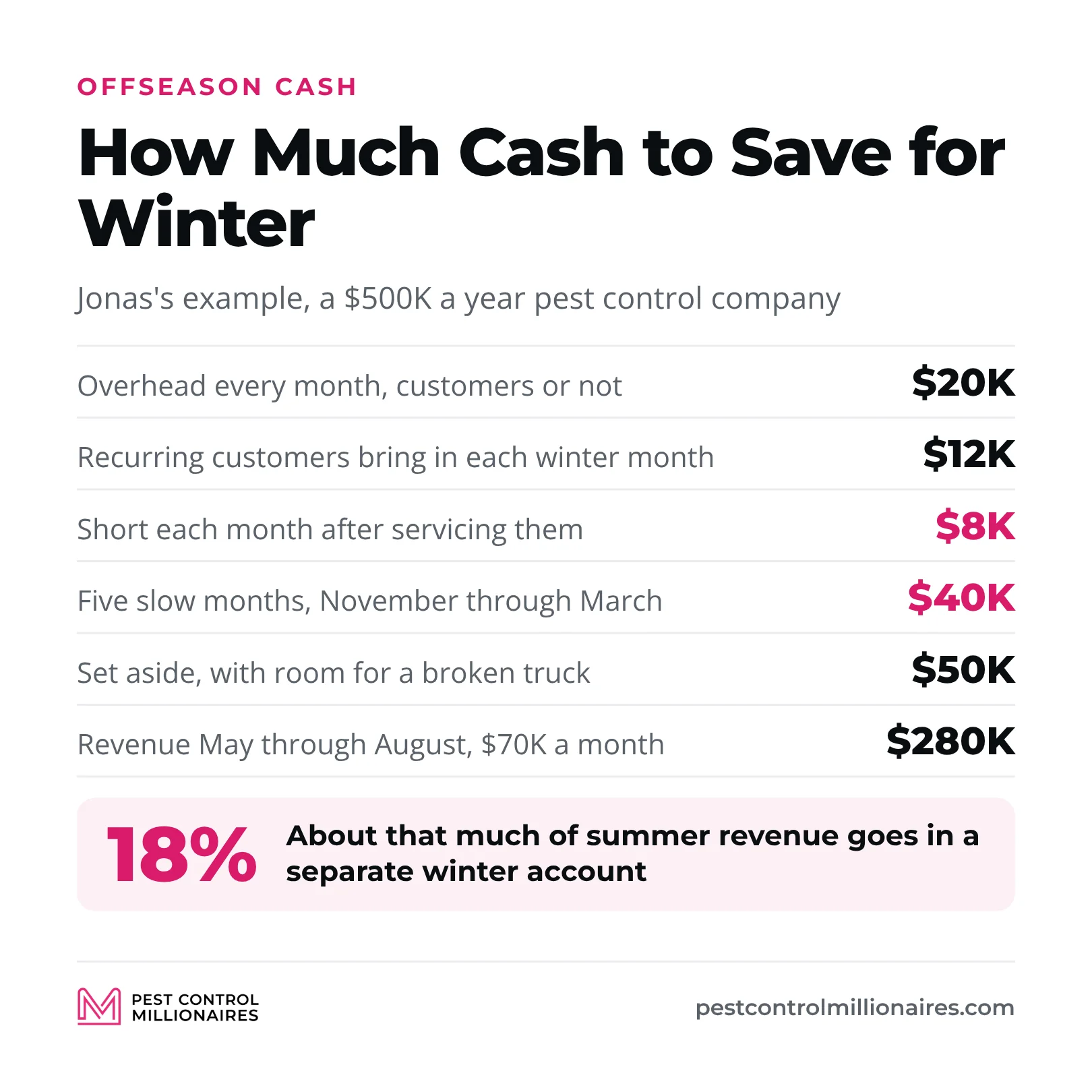
Say you’re a $500,000 a year pest control company with about $20,000 a month in overhead, the truck payments, insurance, software and everything else you pay no matter how many customers you’re servicing. In winter your recurring customers bring in about $12,000 a month, and after the cost of servicing them you’re about $8,000 short every month. With five slow months, November through March, that’s about $40,000 you need just to cover the gap.
I wouldn’t go into winter with exactly $40,000. A truck breaks down, somebody quits, something unexpected happens every year. So maybe you set aside $50,000. If you do about $70,000 a month from May through August, that’s $280,000 over four months, and saving $50,000 means setting aside about 18% of that revenue.
That doesn’t mean you can automatically afford to save 18%. You have operating expenses and taxes. But now you have a number to build your budget around. When I started out, I’d put that money in a separate bank account. Call it the winter fund, whatever you want, just keep it apart.
There’s a second number I want too, what it’ll cost to grow in the spring. Maybe you need another truck, two more technicians, or $5,000 a month in marketing once demand picks up. You pay for all of that before those new customers start paying you. So I look at two separate things, what I need to get through winter and what I need ready to launch in spring. Start budgeting for the coming year in October and November.
Keep Your Best Technicians and Train Them
Once you know your cash, you can make better decisions about payroll, which is always going to be your biggest expense. Look at how many services you have scheduled, how many hours of work that is and how many technicians you need to get it done. Most companies wait until spring hits to figure this out.
If I can keep great technicians through the winter, even if things are a little tight, I’d much rather do that than start over in April. If they have extra time, train them on the services you can sell in winter. Bring in outside trainers part time. The offseason is when you make the team better and more efficient, so when spring comes they’re knowledgeable and ready to go. Some guys can keep knocking doors in markets where it makes sense, some can recruit for the summer and some can do inside sales.
Sell Rodent Control to the Customers You Already Have
If you have a decent customer base, there’s probably more opportunity in that list than you realize. The biggest one in winter is rodents. When it gets cold, mice look for a way into garages, basements, attics and crawl spaces. The National Pest Management Association estimates rodents invade about 21 million homes in the United States in the colder months. If you have a few hundred or a few thousand recurring customers, you have a list of people who might need help and might not know you offer it.
Start with your technicians on the fall services. Have them look for droppings, entry points, gaps around utility lines and damaged insulation. When they find something, they show the homeowner, take pictures and video, and explain what they see and what they recommend.
There are two opportunities here. One is adding rodent protection to their pest control program, which is more recurring revenue. The other is exclusion, finding and sealing the places rodents get in, around the foundation, doors and windows, and up on the roof at the soffit and fascia. Depending on the property, that can be a big job.
Say you have 500 recurring customers. Look at who already has rodent service and who doesn’t. Have your techs document what they find, and have your office or inside sales team start calling as the weather changes. When people start calling you about rodents, demand is picking up, and that’s when you turn the campaign on. You still have the cost of doing the work, but you’re selling to people who already know you instead of paying $200, $300, $500 to acquire a new customer in the offseason.
Talk Customers Out of Pausing
Pay attention to the customers who want to pause in winter. A lot of homeowners think pest control isn’t needed once it’s cold. When you call about rodent control, not everyone says yes, and some will say they were about to call you to pause. Your office, your salespeople and your techs should all be able to explain what the winter service covers and why it’s valuable.
You won’t convince everyone. But every pause or cancellation you prevent protects revenue you already have. I wouldn’t lose a customer over pausing one service and starting back in spring, though. And billing plays into it. A customer on monthly billing sees your charge every month all winter while you show up once and they don’t see any bugs. They start asking why they’re paying.
Pre-Sell Spring in January and February
You can start selling spring services before spring gets here. We do this every year. The first time we rolled it out, we sold over $100,000 in mosquito control in the first week or week and a half.
You know homeowners will start calling about mosquitoes, so why wait? Contact your existing customers in January and February and give them a reason to sign up early, like a better price for prepaying the season or for committing before March. We’ve seen roughly 20% of our customers take a prepay offer when we run one at Pest Badger. That depends on the offer and the customer base, but it’s worth testing.
You bring cash in during the slow months, and those customers are signed up before your competitors start knocking doors or marketing in the spring. Just be careful with the cash. If someone prepays $600 for a program you’ll perform all summer, you still have to pay to service it. Don’t spend it all in January and have nothing left for your technicians in May. If you’re a sole operator, you can do this yourself. You have the customers and their contact information, and they know you personally.
Don’t Shut Off Marketing Just Because It’s December
This is where a lot of companies pull back on everything, and I understand why. Demand drops, leads get more expensive and owners don’t want to waste money. But I look at what it costs me to acquire a customer and whether that still makes sense.
A marketing benchmark report released in 2026, using pest control companies’ data from 2025, put the average Google Ads cost per lead at about $126 in August and about $157 in January. December was the most expensive month, at about $241. Your market could be completely different, but it shows how much lead costs move through the year.
Now say you’re paying $157 a lead and closing half. That’s about $314 to acquire a customer. Is that too expensive? It depends on what the customer is worth. If your average customer pays $800 a year and your direct cost to service them is 30%, you have $560 before overhead and marketing. Take out the $314 and you have $246 left in the first year, and if they stay three, four, five, six years, the numbers work. If your average customer pays $400 a year and cancels after the first year, that $314 probably doesn’t work.
So I don’t look at marketing as a fixed percentage of revenue. I want to know what a customer costs, what they’re worth and how long they stay. If those numbers make sense, I’ll keep spending even when winter demand drops. Our article on how much to pay for a new pest control customer goes deeper on that math.
Change the Ads, Not Just the Budget
I’m not running July’s Facebook ads in January. In summer people deal with ants, mosquitoes and wasps. In winter somebody finds mouse droppings in the basement or hears scratching in the attic. Use real pictures and video from those jobs. Show where mice get into houses and what the signs look like, and have your technicians explain what they find on real jobs. That’s the content I’d run on Facebook in winter.
On Google, I’d focus on searches from people who already have a problem, like mouse control, rodent control and rodent exclusion. Someone searching for mouse control near them has a far more immediate problem than someone scrolling Facebook.
If you’re a smaller operator who can spend about $1,500 a month, roughly $50 a day, I might start with $1,000 on Google and $500 on Facebook. That’s not a perfect split, just a starting point if you don’t have history to work from. Whichever one produces customers at a better cost gets the budget. If neither works, figure out whether the problem is the ad, the offer or the sales process before you spend more. Say that $1,500 brings in 15 leads and you close six. That’s $250 a customer, and you compare it to what your customers are worth.
Go back through your old leads too. Think about how many people called in the summer and never signed up. Maybe they weren’t ready, maybe your salespeople didn’t close them, but you already paid to generate those leads. Same with canceled customers. Find out why they canceled and whether you can bring them back. They know you and trust you. Our reactivation strategy for old clients shows how we work those lists.
Let’s be honest, most companies shut their ads off in winter, which leaves more opportunity for the ones still spending. In February I start getting spring campaigns ready, the ads, landing pages and offers, before demand picks up. Then around March, depending on the market, I increase spending as the weather changes and the numbers justify it. I don’t want April to show up and realize we haven’t generated a lead in three months.
Don’t Add a Second Business to Stay Busy
A lot of service owners add completely different services in the offseason just to stay busy. I speak from experience. When I owned my lawn care company, we did Christmas lights and snow removal. At one point I had about $2 million worth of snow removal equipment, and most years we basically broke even.
Pest control is different. You already have recurring customers paying you all year, rodent service, exclusion, spring services to pre-sell and new customers you can still acquire. Before you buy snow plows, ask whether you’re really using the opportunities inside the pest control company you already have. Every new service brings more equipment, training, employees, insurance and a whole new set of problems. Do more of what’s already working.
Review Your Prices in January
While things are slower, look at what you charge and how much your expenses went up over the past year, labor, insurance and materials. Go through your existing customers and check whether they’re paying the right rates. If your costs went up and you haven’t raised prices in three years, you’re probably leaving a lot of money on the table.
I’m not saying raise prices in January. It’s probably not the best time. But I want them reviewed before the busy season starts. Here’s how we raised customers from $50 to $129.
Hire and Buy for Spring Now
Every spring demand picks up, salespeople start signing customers, and suddenly you need more technicians. Most companies post a job, interview, hire and then work through licensing and training. Depending on your state, that can take weeks or months, so the technician you needed in May might not be ready on his own until June. Meanwhile your existing techs are working overtime. I’d rather have them hired and trained before I need them and build a bench.
To do that, you need to know how many customers you expect to add and how much work that creates. Say your techs can comfortably do 15 stops a day. You know how many working days are in a month, minus some rain days. Check how many services are already scheduled in your software and how many new customers you planned for back in October. Work backward from there. If you need another technician running in May, start hiring in February or March. For a first hire, read how to hire your first pest control technician.
There’s another opportunity in winter. Other pest control companies are laying people off, and some of them are good technicians who’d rather be working. If you have the workload and the cash, I’d be looking for them. Someone already experienced makes getting ready for spring a lot easier. Recruit salespeople all winter too, door-to-door or inside sales. Good reps aren’t waiting until April to decide where they’ll work. Know how many reps are coming back, how many new ones you need and what training will look like.
Same with trucks and equipment. If you need another truck in May, line up the financing, find the truck, get it wrapped and install the equipment now. Go through your old equipment, mosquito foggers and backpack sprayers, and get it fixed. I’m not saying buy trucks you can’t afford, but know when you’ll need them and what they’ll cost.
Fix Last Season’s Three Biggest Problems
Every company has problems that get pushed aside in the busy months. Maybe your office wasn’t answering calls fast enough, your routes were a mess or you had too many cancellations because nobody was following up. Write them down, pick the three biggest and fix them before March, one at a time. When spring comes you’ll be busy again, and everything you said you’d fix gets pushed off another year.
For a smaller company this doesn’t need to be a complicated business plan. Put it in a spreadsheet and work through it in an afternoon or a day. But have the numbers figured out before the season starts. Go into November knowing how much cash you need, how many employees you can afford to keep and what you’ll focus on selling. Keep marketing as long as your acquisition cost makes sense, and use the slow months to get ready for spring. The last thing I want to spend April and May on is recovering from winter when I should be growing.
Frequently Asked Questions
How much cash should a pest control company save for winter?
Work out what you’re short each month from November through March, then add a cushion. In my example, a $500,000 company with $20,000 a month in overhead and $12,000 a month coming in from recurring customers is about $8,000 short each month after servicing them. Over five slow months that’s $40,000, so I’d set aside about $50,000, about 18% of the $280,000 it does from May through August, in a separate account.
Should pest control companies turn off their ads in winter?
Not automatically. Leads usually cost more in winter, so look at what a customer costs you against what they’re worth and how long they stay. If those numbers still work, keep spending, and change the ads to winter problems like mice in the basement instead of running July’s ads in January.
What can a pest control company sell in the winter?
Rodent control and exclusion to the customers you already have, since mice move inside when it gets cold. You can also pre-sell spring services like a mosquito program in January and February, follow up with old leads and canceled customers, and keep acquiring new customers if the numbers work.
When should a pest control company hire technicians for spring?
Before you need them. Licensing and training can take weeks or months depending on your state, so if you need another technician running in May, start hiring in February or March. Work it out from how many stops a tech can do in a day, the services already scheduled and the customers you expect to add.