From Construction to $400K: How Jesse Beltran Built Drop Dead Pest Solutions on Word of Mouth and Real Relationships


Table of Contents
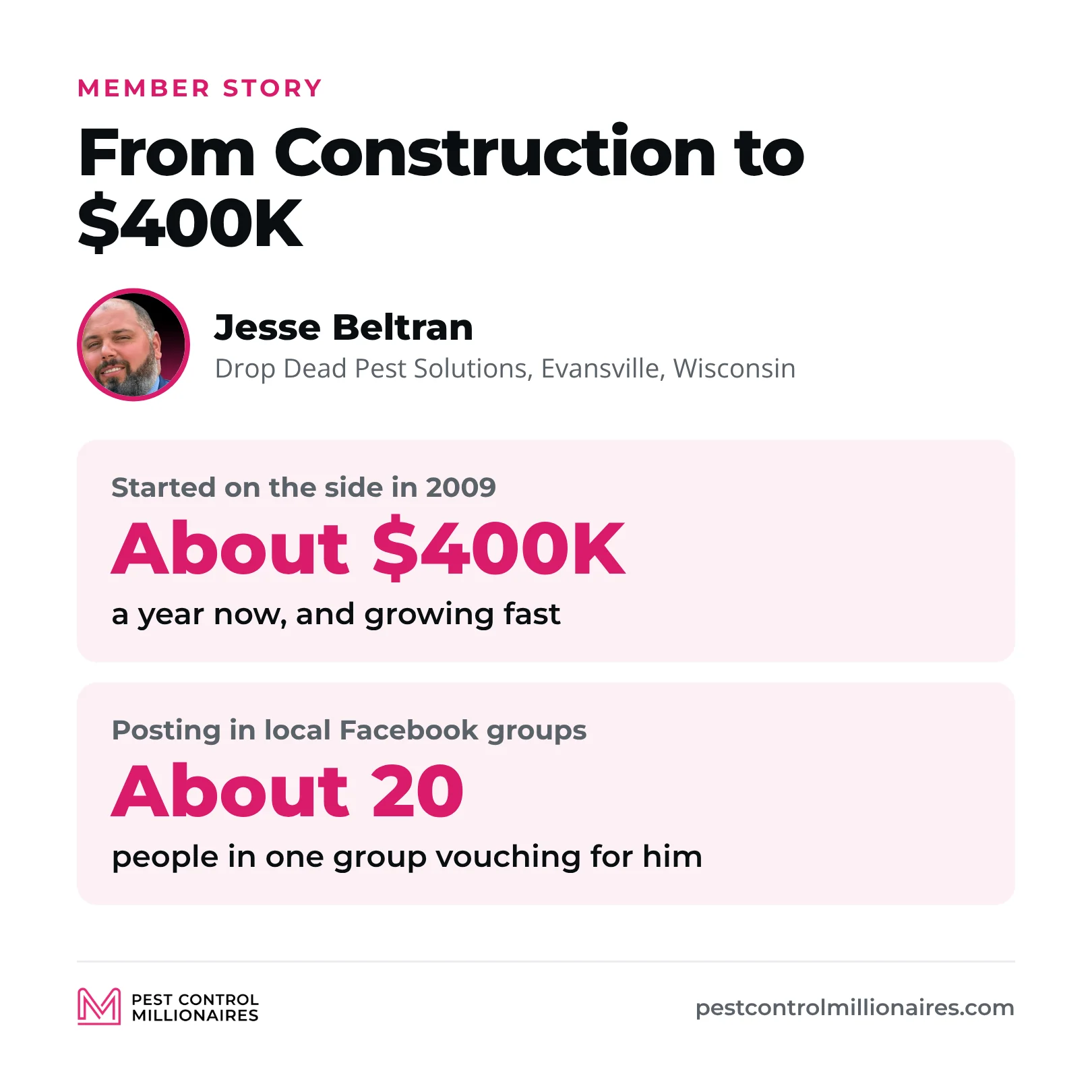
I recently sat down with Jesse Beltran, the founder of Drop Dead Pest Solutions out of Evansville, Wisconsin, and his story is a great example of what steady, patient growth looks like when you finally stop holding yourself back. Jesse’s been in pest control his whole life, literally, growing up riding along with his dad on service routes as a kid. He started his own company back in 2009 on the side while still doing construction, went full time in 2013, and has built Drop Dead into one of the most trusted names in his area. They’re doing about $400K a year now and growing fast. His story is less about overnight success and more about what happens when you stop being the bottleneck in your own business.
A Family Legacy
Pest control isn’t something Jesse stumbled into. It’s in his blood. His grandpa worked for a pest control company called Wil-Kil for years before retiring and starting his own small operation on the side. His dad was in the industry too. Jesse grew up riding along on service routes as a kid, even back in kindergarten during the summers. One of his dad’s biggest accounts was House on the Rock, one of the biggest attractions in Wisconsin. Jesse loved it.
When his grandpa eventually needed help with his little company, he came to Jesse. At the time Jesse was doing construction, roofing and siding, and his grandpa wanted to help him get off the roof. So Jesse started helping out here and there, a day at a time, learning the basics. After a few years, Jesse approached his grandpa about growing the business together. His grandpa wasn’t interested in that. He liked doing the easy stuff, working three months a year, keeping it simple.
So Jesse started his own company. Drop Dead Pest Solutions opened its doors in 2009, but it was a side hustle at first. Jesse was still doing construction during the day and running pest control jobs until dark.
The Grind of Doing Both
Those early years were brutal. Jesse would put in 10 hours on a construction site and then work until dark doing pest control. His wife was a huge part of making it work. She had a good job and carried a lot of the financial weight so Jesse could chase the business without the pressure of needing it to pay all the bills right away.
Eventually his wife was the one who pushed him to go full time. They had two kids by then, and she told him straight up. “You need to go full time. You need to be home.” Jesse admits he’s not a risk taker by nature. He likes the safe bet. But his wife saw where things were heading before he did, and she gave him the push he needed.
“I would be years ahead if I would have listened to her a little more and took a little bigger risk,” Jesse told me. Going full time changed everything. The business grew fast, mostly through word of mouth in his small town. Within a few years he was back to working dark to dark, just doing it all himself.
Word of Mouth Built the Foundation
Jesse’s growth in the early years was almost entirely organic. He lives in a smaller town, and when you do good work in a place like that, people talk. Neighbors tell neighbors. Someone at the hardware store mentions your name. It snowballs.
“People come up to me and I don’t even know who they are because we do so much work,” Jesse told me. That’s the kind of reputation you can’t buy. It takes years to build, but once it’s there, it does the heavy lifting for you.
The problem was Jesse couldn’t figure out how to translate that local trust into online marketing. He tried throwing money at Google and Facebook without really knowing what he was doing. He tried newspapers, a billboard, even local paper ads. The billboard didn’t bring in a single customer. The newspaper stuff brought in older clients, which was fine, but the return wasn’t there. He was swinging in the dark and he knew it.
How the Program Changed His Marketing
Jesse joined Pest Control Millionaires about a year ago, and the Facebook groups strategy hit him like a truck. He’d never thought about posting in local community groups on Facebook as a marketing tool. He was part of his town’s information group, sure, but he never connected the dots that it could actually drive business.
The first week he implemented what Jake taught him, he doubled his money back and then some. His phone was blowing up with messages from people in those groups wanting pest control. But what really made it explode was the social proof from other people in those groups.
“I had probably 20 people say, yeah, we love Jesse. We do this, hire Drop Dead,” he told me. Twenty people in one group all vouching for him at the same time. That’s not advertising. That’s the digital version of word of mouth, and it’s way more powerful than any ad you can run.
Jake also gave him a step by step template for the posts. Jesse used it as a starting point and made it his own. He posted a family photo at a local restaurant, everyone wearing their Drop Dead shirts. It blew up. “I didn’t think it was gonna do that,” Jesse said. Now whenever business slows down, he hits up some Facebook groups and the phone starts ringing again.
The Facebook ads side was another big turning point. Before the program, Jesse was just guessing. Now he actually knows what he’s doing with his ad spend, and his money is going somewhere that gets results instead of disappearing into the void.
The Dog Treats That Built Loyalty
One of the coolest things about Jesse’s story is how seriously he takes customer service. After Jonas talked about the idea of being a customer service company that happens to kill stuff, Jesse took it to heart. He started asking himself, what can we do to make this experience better than just showing up and spraying?
The answer came from his 12 year old daughter. She came up with the idea of giving dog treats to customers who have pets. She even designed little cards that say “Thank you from Drop Dead” with the company dog on them. Jesse and his daughter spent three or four hours tying ribbons on all of them together.
It sounds small, but it works for a couple of reasons. First, it’s unexpected. Nobody does that. Second, it actually addresses a real concern. When customers call about pest control, the number one question is almost always about their dog. Is it safe for my pets? By showing up with a treat for their dog, Drop Dead is saying, we already thought about that. We already care.
Jesse’s team also tracks details in their software. If a customer has a dog, they put the dog’s name in the notes. If someone went on vacation, they note it so next time they can ask how it was. It takes seconds, but it turns a one-time transaction into a relationship. “When you can create that relationship, you’re gonna have a customer for life,” Jesse told me.
They’re working on something similar for kids too. Stickers, small toys with the Drop Dead name on them. The idea is the same. Make people feel like more than just an account number.
Finally Hiring and Letting Go
Hiring was the hardest thing Jesse had to do, and he put it off for way too long. His first hire was actually pretty easy. A buddy he’d worked with in construction years ago had told him, “If you ever need someone, let me know.” When Jesse finally texted him, the guy was in immediately. No interview needed. Jesse already knew him, already trusted him, and the guy loved doing both pest control and animal control. It was a perfect fit and he’s still there today.
But the bigger hire, the one that changed everything, was his office manager. And that turned out to be his wife.
Jesse was handling everything himself. Phone calls, emails, scheduling, billing, on top of being in the field. Jonas laid it out for him in the program. Once you hit three techs, hire an office manager. Jesse’s wife had been wanting a career change anyway, and the timing was perfect. She took over the office side and within the first week she was shocked.
“I didn’t realize everything you did for phone calls and emails,” she told Jesse after her first week. “Your phone doesn’t stop ringing. It doesn’t stop going from texts, emails. It just goes on.” Jesse had been carrying all of that weight by himself for years. Once it was off his plate, the business started moving faster than it ever had.
Jonas also gave Jesse a roadmap for scaling. Three techs, then an office manager. Five to seven techs, then a service manager. Nine or ten techs, then you can start thinking about branching out. Having that structure laid out in front of him made the whole thing feel less scary.
Wildlife on the Side
Drop Dead does about 75% pest control and 25% wildlife removal. Raccoons, bats, the usual suspects. Jesse loves the wildlife side because it scratches that outdoorsy itch. Outsmarting raccoons, trapping them, removing babies from attics in the spring. It’s fun work and it pays well, especially bat exclusions, which not a lot of companies in his area even offer.
But Jesse is starting to pull back on wildlife a little. The problem is it’s mostly one-time work. Someone calls about a raccoon, you get them out, you do the exclusion, and that’s it. They’re not going to call you again for pest control just because you removed a raccoon. Pest control, on the other hand, is recurring. Mice in the winter, bugs in the summer, wasps in between. That’s the bread and butter of a sustainable business.
Jesse still wants to keep wildlife in the mix to fill gaps in the schedule, but he’s going to be more selective about it going forward. No more driving out to outlying areas for one-off jobs. Focus on what builds the business long term.
What’s Next for Drop Dead
Jesse and his wife sat down recently and mapped out a real growth plan. The old approach was slow and steady. Pay off a truck, wait two years, get another truck. Low overhead, low risk. But as Jonas pointed out, low risk is low reward.
The new plan is to hire two guys next March. One tech will handle the normal growth coming in from Facebook, Google, and word of mouth. The other tech will cover a door to door sales team that Jesse is putting together. The year after that, two more guys. Once he gets to the point where the trucks need upgrading, he’ll do that too.
The long-term goal is nine or ten technicians. After that, Jesse isn’t sure if he wants to branch out into other states or keep it local. He’s thought about passing the business to his kids someday if they want it, but he’s not pushing them either way. “If they want to take it over, great. If you don’t, that’s great too,” he told me.
The point is, Jesse finally has a roadmap. He’s not swinging in the dark anymore, and he’s not letting his own fear of risk hold the business back.
Key Takeaways
Jesse’s story is a masterclass in what happens when you finally get out of your own way. First, delegate early, even when it scares you. Jesse was the bottleneck in his own business for years because he refused to hire. Once he let go, everything accelerated. The office manager hire alone was worth more than years of him trying to do it all himself.
Second, word of mouth is powerful, but you have to amplify it. Jesse built his reputation the old fashioned way, by doing great work in a small town. The program just showed him how to take that existing trust and turn it into leads through Facebook groups. The social proof from real customers in those groups did more than any ad ever could.
Third, customer service is your real product. Jesse learned from Jonas that killing bugs is table stakes. Every pest control company does that. What sets you apart is how you make people feel. The dog treats, remembering the dog’s name, asking about vacations. None of it costs much. All of it builds loyalty that lasts a lifetime.
Fourth, figure out where you want to be and work backwards. Jesse spent years not knowing where he was going. Once he set a clear goal and mapped out the steps to get there, everything got simpler. Short-term goals, long-term vision, and a plan in between.
And finally, take bigger risks than feel comfortable. Jesse is the first to admit he’s not a risk taker. His wife had to push him to go full time. Jonas had to convince him to hire. Every big move he made felt scary, and every single one of them paid off. The safe bet might feel good in the moment, but it’s what was holding him back for years.
From riding along with his dad as a kid to building a $400K pest control company with a clear path to scaling even bigger, Jesse’s story is proof that you don’t have to be a natural risk taker to build something great. Sometimes you just have to stop letting fear make your decisions for you.
Want to connect with Jesse? You can find Drop Dead Pest Solutions on Facebook, Instagram, and Twitter. Everything is under Drop Dead Pest. He loves talking business and connecting with other owners in the industry. And if you’re looking for the kind of clear roadmap that helped Jesse finally stop being the bottleneck and start growing, that’s exactly what we’ve built with Pest Control Millionaires.
Frequently Asked Questions
What made Drop Dead Pest Solutions successful?
Word of mouth and real relationships. Jesse built his reputation by doing great work in a small town, then the program showed him how to turn that trust into leads by posting in local Facebook groups, where about 20 people in one group vouched for him. Hiring help, especially his wife as office manager, took the weight off him so the business could move faster than it ever had.
How did Drop Dead Pest Solutions leverage branding for growth?
By making the brand personal. Jesse’s 12-year-old daughter came up with dog treats tied to a “Thank you from Drop Dead” card, the team notes each dog’s name in their software, and the post that blew up in local Facebook groups was a family photo with everyone wearing Drop Dead shirts.
What marketing lessons come from Drop Dead Pest Solutions?
Amplify the word of mouth you already have. Before the program, Jesse threw money at Google and Facebook without really knowing what he was doing, and newspaper ads and a billboard didn’t pay off either (the billboard didn’t bring in a single customer). Posting in local Facebook groups did, and now whenever business slows down, he posts in a few groups and the phone starts ringing again.
Full transcript
Read every word of the interview
00:00Dan Leibrandt
Hey there, my name is Dan Leibrandt and welcome back to Pest Control Success Stories, where we sit down with members from our Pest Control Millionaires program who are doing incredible stuff. Today I am joined by Jesse Beltran, the founder of Drop Dead Pest Solutions out of Evansville, Wisconsin, which is actually just like 30 minutes or 60 minutes away from me, which is pretty crazy. Jesse has been in the pest control industry for over a decade carrying on a family legacy that spans multiple generations. Since starting Drop Dead Pest Solutions back in 2009, part-time and then 2013 full-time, he's built a trusted brand known for quality service, integrity, and environmentally conscious pest management. In this episode, we'll talk about how Jesse got started, the lessons he's learned growing his company, and what it takes to run a successful pest and wildlife business in today's competitive market. Now without further ado, Jesse, welcome to the show.
00:51Jesse Beltran
Thanks for having me Dan. How's it going?
00:53Dan Leibrandt
Of course, yeah, yeah, no, it's going well. So I want to jump into your background, Jesse. I find this interesting. So you are kind of a generational or multi-generational pest control guy. Your grandpa was in pest control, your dad was in pest control. It just seemed kind of the next route, the next logical route for you. First off, I just wanted to ask like, what was that like of, you know, a lot of your family being in pest control?
01:18Jesse Beltran
Growing up it was just kind of normal. Even I remember being in kindergarten in summer, I'd go with my dad. I got to ride along with him. I don't know how the corporate let him do that, I got to ride along with him. I don't know if you're familiar with House on the Rock up here. It's one of the biggest things. That was one of his biggest accounts. It was fun to go along and learn and do what he did and got to see a lot of cool stuff.
01:46Dan Leibrandt
Yeah, yeah, interesting. Okay, you've kind of always been around it and then I think, did you start a company with your grandpa, you said?
01:57Jesse Beltran
Yeah, so what happened is my grandpa worked for Wil-Kil and he ended up retiring. But he was one of those guys that was go, go, go. And he enjoyed talking to people, enjoyed doing pest control. So what he ended up doing is he wanted to do the easy stuff. So he started his own company, just doing a lot of the easy stuff, general bug control. He basically worked three months out of the year in the spring and in the fall. And that's what he did. And he grew enough that over I he did it for like five to 10 years. He grew enough that he had enough customers and wanted help. So I was doing construction at the time, doing roofing and siding. So he approached me about working for him, because I'm a big guy and construction's hard on your body as it is. So he kinda wanted to help me get off the roof and stuff like that. So I started helping him just on the side here and there, a day here, a day there type of deal. So I got to learn a little bit. About doing easy stuff, the pest control. And then after a few years, he approached me about just working for him. And I wanted to do, I approached him about doing more business partner and like, let's grow this business and let's get big. He didn't really want to do that. So I started my own company. I said, I have...
03:22Jesse Beltran
Your knowledge because I had some knowledge I knew I grew up around it but I didn't have it all. So he helped for the first year he helped me where he could and I figured it out on my own as I went. So that's kind how I got into it. I started off on the side so I still did until I could build up enough clientele I still did construction until about 2013.
03:48Dan Leibrandt
Okay, cool. And did you, just because I feel like different people have different perspectives on this, did you always plan to be a business owner? Did you always know you were gonna start a company?
04:00Jesse Beltran
Yes and no. When I was 18 I actually I started my own roofing company. This was back before the bubble popped like the economy and everything. And being that young it's hard to you know you're 18 it's hard to make sales when it's a $15,000 roof. So I and then the bubble popped and I went worked for a guy that was very well established. But he also he kind of let us do, he was a great boss. He let us do what we wanted as long as we got work done. So was kind of working for yourself, but you got a paycheck every week.
04:36Dan Leibrandt
Mmm.
04:37Jesse Beltran
So I always loved that and I couldn't wait to really go back. As far as being a business owner, I never saw myself like that. I just saw working for myself, being self-employed and doing what I needed to do.
04:47Dan Leibrandt
Mmm. Yeah, okay, interesting. So you've always kind of been an entrepreneur, but you just more so wanna do your own thing. Okay. Okay, so then tell me about the first few years of Drop Dead Pest Solutions. What did that look like? Was it tough or was it easier than you thought?
05:08Jesse Beltran
It was I guess it was tough. It was definitely tough. I have my wife She's very smart. She was always you know, not the Corporate side of things so she always made a good amount of money So it kind of relieved some of that stress of money wise so I could pursue that she let me pursue what I wanted to do then she could see She could see where I was heading towards. Anyway, so she let me pursue that so that helped immensely take a lot of weight off my shoulders. But yeah, I turned into a lot of hours just going, especially when it was a part-time thing. I would work 10 hours construction and then I'd work till dark doing pest control. So it was just go, go, go. And she actually pushed me then to go towards full-time. She's like, you need to go full-time because at that point we had two kids. And she's like, you need to have time to be home type of deal with and be with them. So, she was a, she was the push behind going into full time. It still was tough because we have two kids, which was nice. Cause they could come to work with me. They throw around the truck, you know, depending on what I was doing, they could sit in the back of the truck and call her and have fun. So, which I loved. That was great. That was part of the thing.
06:30Jesse Beltran
Being my own boss that I can take the kids with me. The dog can come with me. Like. It's flexible that wise.
06:39Dan Leibrandt
Yeah, yeah, definitely. Yeah, so you were maybe three to four years you were part-time, then what made you make the switch to full-time?
06:47Jesse Beltran
It was my wife. Was like, it's too much. You need to go full time. She goes, I'll help with the bills. We'll get that going. She's been the biggest push behind me. I don't take risks. I like the safe bet. And with business, that's equal slow growth. And that's not always good. I would be years ahead if I would have listened to her a little more and took a little bigger risk. But that was that was the biggest thing. It's like she need you need to be home more because all I was doing was working Yeah...
07:20Dan Leibrandt
Hmm. Okay. So you were doing pest control and construction, then you went full time. Did you start growing faster when you went full time?
07:30Jesse Beltran
Yes, I grew really fast. Was kind of crazy because then within a few years, it was back to me just working. Was just dark to dark. Anytime, just going. And that went a few years again. And my wife again was like, you need to hire. And that scared me. I mean, it's a lot of pressure because not only am I helping support my family, but now it's somebody else's family. So that was the biggest thing. And I pushed it off for a while, about a year or two, I pushed it off. And because I would just work all summer and then winter, I just chill, you know, so. Then that's she was the biggest push behind it. It like, need to hire. So that's the I grew very fast. All of or mainly a lot were word of mouth. I live in a smaller town. So it's just a lot of word of mouth. And, you know, people come up to me and I. I don't know who they are because we do so much work and they were, you know, we chat for a while. So it just kind of, grew very fast, which is awesome.
08:37Dan Leibrandt
Okay. Okay, so a lot of word of mouth. That's how you were growing earlier. Your wife pushed you to get started. What was that first hire and how difficult was that?
08:48Jesse Beltran
The first hire, it actually kinda, it wasn't very difficult to find. I had a buddy that actually, when I was 20, he worked on the same crew as me and doing construction. And we had a chat and he's like, if you ever hire, let me know. Like I wanna work for you. And I was like, all right. So that was about a year before I actually hired him. And so one night, me and my wife were talking, so I sent him a text and he's like, yep, I'm in. Like it was, it was, and I worked with them already. So I already knew we didn't really have to do the interview. I already knew. So we worked on how much you want to get paid. And that was, that was kind of it. And it was, it was a pretty easy first hire. He's made it. He loves doing pest control. He loves doing animal control. So it made it very easy and it was a really good fit.
09:18Dan Leibrandt
Dang.
09:39Dan Leibrandt
Huh, it seems like that kind of just fell into your lap. You just got pretty lucky.
09:41Jesse Beltran
It really just like landed right there. Yeah, it was very nice.
09:46Dan Leibrandt
That's awesome. Okay, yeah, and you mentioned wildlife. What is your split there? Are you mostly pests and a little bit wildlife or how does it go?
09:53Jesse Beltran
Yeah, we're mostly pest, mice, stuff like that. And then we do, so I would say probably 75 % is pest control, like just pests and mice. And then the other is animal control. So bats, raccoons, all that fun stuff. It really depends on the time of year. Even that right now, I'm starting to like limit it down a little bit because I'd rather focus little more on pests because that's a little more ongoing versus a raccoon gets in your attic once. You your one-time customer. So yeah, it's about a 75-25, but I like to keep it around just to help with the flow of work.
10:33Dan Leibrandt
Yeah, yeah, talk to me more about the difference between the two and would you recommend people getting into wildlife if they're just in pest or you were mentioning that you kind of just want to get more pest people because it's more recurring.
10:44Jesse Beltran
Yeah, and starting out, like, I love doing animal control. It's fun. I love, I love hunting. I love fishing. Like I love being outdoors. So that was kind of a more natural like, Hey, this is kind of fun. We get to outsmart raccoons and outsmart stuff. And you know, you're interact with them and you let them go. And especially in the spring, you get babies in the attics, you trap the mom, you get to go in and you get to remove the babies. And you know, that's fun. And it is, it did help fill that gap. Because just pest control, there's a rolling, you know, this time here it's mice, this time here it's bugs, wasps, stuff like that. And it just helps fill the gap a little bit. So animal control, can be done the right way. It can be very profitable, especially when it comes to getting them out and then do an exclusion. It can be very profitable. Just as I grow, like I said, we're gonna keep it. It's just, I'm not gonna do it as much. We'll probably say no to outlying areas type of deal. Before I just did it all.
11:45Dan Leibrandt
Yeah. What is your favorite slash most profitable animal control service? Is there like, is bats the best or?
11:52Jesse Beltran
Yeah, bats is a very, there's not a lot of people that do it, especially around here. So it is a very, it's a weird, it's, the job is very profitable, but then it's not, we don't do it all the time. Like it's such small windows. We have that small window in the spring. We have a small window in the fall. So it's just, it's still, it's one of those things, a re, a rolling thing that we've used it to fill the gaps, but it is very profitable. Yeah.
12:21Dan Leibrandt
Okay. Have you tried upselling those people to pest control?
12:25Jesse Beltran
We do, yeah, we do a lot. People call us about bats. Even like general pest control, if we're there looking around, do, you know, we're walking around and we'll point out like, you have bats, like this is going on, like people don't know it. You know, stuff like that. Or we're talking, we see spiders, we're doing a bad job. So I've upsold those and I'm working with the guys, training them just to kind of be observant and see what we can upsell people on just to become a reoccurring then.
12:53Dan Leibrandt
Yeah, definitely. Yeah, talk to me more about your, I guess, like initial service process. Like, are you doing a full inspection of the home or what is like the typical funnel, I guess, of people, maybe they contact you or they're kind of unsure. What is the usual customer journey?
13:16Jesse Beltran
The usual, yeah, so if somebody, if they call and they don't know exactly what's going on, they have any issue, whatever, we will set up an inspection. And it's just to get eyes on the place, see what's really bothering them, what's their pinch point on what's bugging them. And then once we're there, like I said, we can take a look at what's going on. If spiders is their biggest thing, then we can sell them on the quarterly. If we're there and we see you know bad droppings stuff like that or mice we can start working with that and kind of up some but I do like to get my eyes there and see what's going on There are the hand for like I got spiders and we can Google Earth their home It's like what's gonna be about this much and it's done like I All communication is done real quick then like I've I'll never see him. Never talk to him in person type of deal Which is fine but I do like that, I love talking to people. And you create, when you do that inspection, you create that relationship, which I love. And then now you have a customer for life. So, if at all possible, I like to be there. I like to do the inspection. Me or one of the guys. Just so then there's that face there, there's that handshake, and go from there. But we always, I always like the inspections. That's kind of the biggest,...
14:39Dan Leibrandt
Okay. Yeah, no, I know there's more and more software companies coming out. I don't know if you've seen like DeepLawn where they'll do almost like you said, not Google Earth, but they will take a satellite view of all the homes, let's say just in the US or in your area, whatever. And they can measure the area, essentially the lawn around your house. And then they can give you a quote that which I think it's more for lawn care companies, but you can use it for pest control too. So yeah, there's those quote tools, but like you said, I mean, when you establish that relationship in person, and I mean, I feel like it's impossible to give them a perfect quote online. I mean, you have to see what it's actually like.
15:24Jesse Beltran
Yeah, you can. Yeah. Like, especially like we do ticks in the summer. Like I can look Google Earth. You can map it out and it's done. Like, hey, this is your quote. Like, but most things, like I said, I do like to be just there's that relationship aspect of it. And then you got a customer for life. So that's kind of that kind of the biggest thing. And the text, we try to stay the same. So he's Jake, for instance, is always doing that job or Riley's doing this job. Or I'm right now I'm in the field because I can't find somebody else to hire so then I'm always doing that job but it just creates that relationship I was there to inspection now I'm there doing the job...
16:03Dan Leibrandt
Yeah, yeah, 100%. I'd like to switch gears a little bit here. You guys are doing about 400K a year. You're set to do 400K this year. You mentioned that word of mouth was really helpful in the beginning, but how have you been acquiring customers? Has it still been mainly word of mouth?
16:22Jesse Beltran
A bunch is word of mouth still. We have that reputation. We don't have gobs of money to just drop it on Google ads and Facebook ads. So a big chunk is that, but we started utilizing our Facebook ads. And at first I was swinging in the dark, just like, let's try this, see if it works. I didn't really know if it was working or not. We were advertising, that's great. All my friends are like, see you all the time on Facebook. And I was like, well, that's great, but you're not my target. You already know me. So that was my biggest struggle. I was just chucking money at Google and chucking money at Facebook and hoping something stuck with it. Those are, I tried paper, newspaper, stuff like that. It's just, that's kind of old school. We were getting a lot of older customers, which is fine, but it's just the return wasn't there. I wasn't seeing a return. Billboard I tried a billboard once I don't think I got one. Not saying that doesn't work for somebody else but I personally didn't so that's where I started switching gears to Facebook and Google.
17:28Dan Leibrandt
Yeah, yeah. Yeah, and you mentioned to me, you joined the Pest Control Millionaires Program about a year ago. Tell me, because I think you learned some Facebook ads and Facebook group stuff from there and some other things. Talk to me about what the pivot was there and what you're doing with marketing moving forward.
17:48Jesse Beltran
Yeah, that was a huge turning point for me for Facebook, for the ads and groups, because I never utilized groups. Like, in my local town, I'm obviously part of the information group, but I never thought outside that box. So that was actually a huge turning point for Facebook. I actually, the one week, I don't know if it week one or two, whatever it was, I implemented that week. And I actually doubled. So whatever the cost for the group was, I actually doubled and I made my money back and then some that week. It was insane. Like my phone was blowing up just constantly. And I think that with that a lot was the Facebook groups. Started joining groups, other information groups. Jake had a template and I basically, I use that and then just changed to here and there. I put a family picture, we were sitting at a local restaurant. With me and my family with the selfie and we all had our shirts on and it just blew up. I didn't think it was gonna do that. Was like, let's give it a shot. Seems, you know, I don't know, but it works. It's still, I don't do it all the time, but if we go through that slow season, I'll hit up some Facebook groups and it just blows up and there's not a slow season anymore, you know? So that was huge. That the groups was completely massive in that group a few were like, don't know, it hasn't worked for me, blah, blah. I don't know if they weren't doing it right, but it blew up for me and a few of my buddies that were in that same class. It's worked for them too. So...
19:10Dan Leibrandt
Haha...
19:27Jesse Beltran
And then the Facebook ads too was a huge turning point because now it's like Jay gave us a step by step of do this and this. And that was massive because it's like now I'm not swinging in the dark. My money is actually going towards something that's going to get to somebody. And be very useful. So that was that Pest Control group just that week alone. Think Facebook ads, I think was two weeks, but that was just a huge turning point for me for Facebook ads.
19:54Dan Leibrandt
No dude, that's insane. Mean, that's like exactly what we wanna hear. You made your money back in like a week or two. I mean, that is so awesome.
19:59Jesse Beltran
Yeah, it was, it was still, it was unbelievable. Like it just still blows my mind.
20:06Dan Leibrandt
Yeah, and just be clear on that too. You're saying the like, so when you're doing posts and Facebook groups, they're blowing up. What does that mean? Like it's getting a lot of likes and people are messaging you or how does that turn into customers?
20:18Jesse Beltran
It's not so much likes but messaging. People message me. Like it's an instant. Then I'm just sitting on my phone just trying to message her back and getting phone numbers. Now I get phone numbers so then I my office manager reach out to them as fast as we can. But yeah, was just they don't like, they'll comment a lot of those groups because we do a lot of people in those groups and they actually would get under there and be like, yes, we know Jesse. He does a great job. Like, and that's... You know, still word of mouth, but it's in that group. And once you get three, I think I did one was a local town. I had probably 20 people say, yeah, we love Jesse. Like we do this hire Drop Dead. And like that completely blew up in that city. Cause I had so many people saying, yes, yeah, go with them. And my phone, that group alone, I think it was like 20 people messaged me that night to come out there. And it was just, that was unbelievable. So that does help when you already know people in those groups. Customers and that really did help them.
21:20Dan Leibrandt
Wow, yeah, no, that's awesome. Mean, like 20 people all in the group also supporting you, because then everyone else sees that. And it's not so much you being like salesy, but now it's like, I mean, this is like a business the whole community vouches for. How could you not choose that?
21:36Jesse Beltran
Yeah, it is. It's absolutely nuts. My own community is when people and anybody asks for pest control, it's always like just a whole list of me and then like one one other guy that's and it's usually like an H-word company. But and I talk to people like we only see your name on those Facebook groups, which is which is unbelievable. You know, that's awesome.
21:55Dan Leibrandt
Dang. That's just so powerful. I mean, I feel like part of that, because I wouldn't think of that solely as marketing, but I feel like you guys also have to be doing a great service too, right? Like you're treating the customer well, you're actually getting rid of their problem. So talk to me about that of like your customer service. How do you treat the customers? What do you make sure to do?
22:17Jesse Beltran
Well, that was part of the group that Pest Control Millionaire Jonas brought that out of like, we are customer service that happens to kill stuff. And that's that, that ruminating with me where I just thought about that all the time. I was like, well, what can we make our experience better? Like, yeah, we kill stuff. That's great. But so does every other guy that, you know, does pest control. So as I are, what can we help? A lot of it was creating that relationship. Like I said, doing inspections, being face to face. We do a lot of them, but face to face is huge. We just implemented, actually my daughter came up with it. We got dog treats and then she created a little business, like thank you from Drop Dead. And then she put our dog on there and all our social media. And me and her sat down for like three, four hours and just tied all of them on there. And so gave them to the guys and so with their, they know they have a dog or the person's home, we hand it to them. And it's just like that just adds that extra bit of customer service. So we try to be, we try to do stuff like that. Even with notes, like we have GorillaDesk so we can leave a lot of notes so everybody can see them. I've been working with the guys of like, Hey, if they have a dog, put the dog's name. So then if I show up, I know the dog's name.
23:37Jesse Beltran
Stuff like that. Like, Hey, I was talking to them, they went on vacation. Next time I'm there, now it reminds me of like, how was your vacation? It just creates that extra little bit of relationship with them, which is absolutely huge. When you can create that relationship, you're gonna have a customer for life. So right now, obviously we work on killing stuff, but that is our biggest thing is how can we make this experience more and more just better for life.
24:03Dan Leibrandt
Definitely. No, I love the dog treats angle. Do you know Tommy Mello? So I'm pretty sure, I don't know if he came up with that. I mean, it seems like you guys came up with it on your own, but I'm pretty sure he talks about that all the time. He's saying, yeah, give the dog a treat, pet the dog, ask for the dog's name. For whatever reason, I mean, I'm sure there's some psychological component behind it of like, if you're really connecting with the dog and the owners are really connected with the dog, it's almost like you have that mutual association or that mutual bond. No, that's, mean, the dog treats and the...
24:17Jesse Beltran
Who does it?
24:39Dan Leibrandt
The focus on the dog, not even the kids, but the dog is kind of funny, but it works.
24:41Jesse Beltran
Yeah. Well, that was kind of the thing. Like my daughter, she brought that up. I don't know, because she's on YouTube and stuff like that. So she might have said, I didn't ask her. But then she created that. She's only 12 and she created that all. I'm like, let's run with it. Let's go. Because part of my brain was like, well, a lot of times when people were talking to people and they're like, well, is it safe for my dog? Like, is it safe for my pets? And it's like, yeah, absolutely. And then we show up and they have kids, but they didn't say, is it safe for my kids? So was like, let's work on this aspect of it. Let's really get that dog the pets, you whatever they are. So that was kind of a big thing that I kind of put two and two together.
25:04Dan Leibrandt
Mmm.
25:21Dan Leibrandt
I actually didn't think about that angle, but yeah, that is a big part. They're worried about their dog slash dogs and their kids. So if you show like a proactive care in their dogs, they kind of make the connection that, well, if you're kind enough to bring my dog treats and remember his name, well, these treatments have to be safe for him too. That's actually, I didn't think of that angle.
25:47Jesse Beltran
I was trying to work all those together. Kids wise we are working on like getting stickers. There was a, it's Mike, Mike Ness, I don't know if you ever, he's in Northern Wisconsin. He was talking about like putting a sticker of like future pest control technician. Or like the footballs, would have your name on it, stuff like that. So we're working on trying to narrow down like what would be best so then the guys have that. So if they have kids we can give them a toy and stuff like that that has our name on which is still huge. Kids all love that stuff.
26:19Dan Leibrandt
Yeah, definitely. I mean, it's all branding, right? Like something I've learned just from talking to so many pest control owners, especially the ones that are like doing super well is literally just get your brand out there as much as possible. If you can give out pens with your brand on it, if you can give out backpacks, if you can get people to wear shirts and hats, literally anything, especially the trucks. I mean, like any kind of way of being more visible to people, right?
26:43Jesse Beltran
Yeah, that's huge. Being invisible and just having that relationship of being, you come off as a good guy, which you're good guy, that's all you gotta show.
26:51Dan Leibrandt
Yeah, awesome. I also wanted to touch on a little bit before this call, you said that hiring an office manager and just overall learning and starting to delegate was big for you. Talk to me about hiring that office manager and what that did for you.
27:07Jesse Beltran
Yeah, so that was a part of the group too. Jonas brought it up about delegating. A lot of owners and entrepreneurs, get into that I've done it all, I can still do it all, and that's fine. And that was my mode. Like I can do this all, I can still run around, I still make phone calls, I can still get emails, I can get it all done. And then it just, I was a bottleneck. Like I was a problem in growing the business when I'm trying to grow the business. Um, so actually like after that group, I was talking to Jonas and he, I had like 10 questions for him. And before I even could, I think I got one out, like he just, boom, boom, boom. And he was like, well, you're answering all my questions. Like, so he laid it all out with the delegating, but laid it all out for me for to grow. I mean, he pretty much laid it all out to grow to 10 technicians. Um, but that was, that was a big one. So, um, actually my wife is the one, she's my office manager now. She just wanted a change in career and she's like I want to quit my job and I was finally because of Jonas I was like hey, I need to hire an office manager and I was in the actively looking for one and She's like what if I worked, you know, we work together. I was like, yeah, like she's smart She's great with people like that that works. Perfect. Like there's they can't fail Which was funny because the first week because I ended up getting my own personal number because my personal number was my work number, which I should have separated that years ago and I never did. So now we switched over so she has a work phone and then I have a personal number now. But that first week I came home and she was sitting on her patio and she's got her head back and her eyes closed. I'm like, you're okay? And she goes, I didn't realize everything you did for phone calls and emails. And she goes, your phone doesn't stop ringing. It doesn't stop deeming from texts, emails. She goes, it just goes on.
29:05Jesse Beltran
And I said, yeah, I know. She goes, I didn't...
28:59Dan Leibrandt
Mmm.
29:07Dan Leibrandt
Haha...
29:07Jesse Beltran
Realize what happened. But since she took over, and there's been a learning curve because we do a lot of stuff. It's not just we do only spiders and moss. Like we cover pretty much every bug except for termites around here. We don't really have termites, so that's the way we don't do them. But we kind of cover up. So there's a learning curve there. But she, like I said, she's so smart. Like she picked it up very fast. And so she, even since she took over, like we've blown up and it's stuff that I don't have to worry about now. Phone calls and all that, like it's great. Like I can focus on growth and I can focus on, I'm still in the field a lot. So I can focus on that a lot. So that's been just immense. Like I should have done that years and years ago, type of deal. But it's just, it's a learning curve. I, like I said, I'm not a risk taker. So that was a big risk because now I'm not only have to support my family. But I got to support two other guys and now an office man, you know, so it's a lot, but that's just not the way to look at it. You got to see that can help you grow. You take that, you delegate it, and then they're worth their weight in gold. So that was, her years ago.
30:21Dan Leibrandt
Yeah, okay. And no, I'm glad to hear that, that even though you're not a big risk taker, you still ended up doing it and it worked out really great, it sounds like. You said you should have done it years ago. Maybe some advice for other people. What do you think is the level, like annual revenue where you should hire an office manager? When does it make sense?
30:42Jesse Beltran
So, you gotta figure out, so what I did is I figured out, and this is advice from Max Jonas, is each tech makes so much. And it's gonna vary where you're at and stuff like that. But once they're maxed out, then you do another one. And then his advice was once you get three techs, then an office manager. And then, I think it was like five, I've been written down. But once you get so many, then you get a service manager. And then you kind of go from there. So that was part of him just laying it out for me. I was like, yeah, that makes sense. Like I didn't know really, I didn't know at one point to get an office manager. Cause I've seen some people, they hire one right away and then they're in the field, you know, and I can see the benefit to that, but like having a few techs that that was huge. So really only have two, I kind of skipped a little bit, but I went back in the field more. So technically it's me and two other techs. Have three techs and an office manager. But I can't find anybody higher, so we're working on that. But that was kind of the big, he was just laid it all out. Like, once you have three, just hire an office manager. Once you have, I think it was five to seven, I gotta look. Then it's the service manager. And then once you have nine to 10, you might wanna branch out farther. Like he just laid it all out for me. So like I said, It was doing the pest control thing, the millionaire. That course was just a huge eye opener. Like it just went from I'm swinging in the dark. I don't know what I'm doing. If I if you guys would have had that around five, six years ago, I would be five, six years, you know, way ahead of things right now. It's just I was I'm the one that was bottlenecking my company, even though I was pushing to go bigger and, you know, faster. So.
32:31Dan Leibrandt
Yeah, no, I love to hear that man. That's, I mean, that's the goal, right? Like I said, we want to, I don't know you can think about it as like eliminating pain. I don't want people to go through the growth pain when they don't have to, you know, there's a clear roadmap and you don't have to. You don't have to grind it out. I don't know, I guess you have to grind it out. But I think almost maybe the tougher part about business, I've faced this myself too, is just the unknown, right? Of the things you don't know what to do, you don't know the next step. And to have that of what we're trying to do with this program, I think it's super impactful. So I appreciate those kind words and... As we start to wrap up here, I wanna ask you, what is the future for your company? What would you guys plan to do in the next few years?
33:24Jesse Beltran
So actually I was just talking with my wife about this the other night and so like my initial plan was to grow like and hire every every other year basically keep my low overhead down I could pay off a truck two years have another truck pay off the truck and then basically not have any loans that creates low risk and low risk is low reward so what we decided to do next year is next March is hire two guys and then so we got two trucks, two more trucks on the road and then hire a sales team for door to door. So the one tech can take over all your just normal growth from Facebook and Google and all that are just our normal what we grow. And then the other tech can just cover the door to door guys. So that's our next year. And then the following year still keep hiring two more guys. And then once we get that, then we can start working on. We have older trucks like well they're not older. I think it's 2018-18 trucks, but they have a lot of miles. So then once we get that then we start upgrading trucks so that the guys are a little more comfortable. I don't have to worry about fixing them as much. This afternoon I got to fix one of the guys trucks. That's part of business owner too. I'm mechanic, sales, I do everything. So I get to the point where I can just hire that all out, which is part of delegating. But yeah, that's the goal. Is to have like nine ten employees technicians out there After that, I don't know if I want to branch out into other states A lot of guys I know Jonas is I don't know how many he's got so many Yeah, he's out there which is awesome that's great for him I don't know if I want to do that, but that's also my short term. I just kind of want to figure that out And kind of get to that long term and then figure out what I want to do there at that point the kiddos...
35:06Dan Leibrandt
15 locations now.
35:22Jesse Beltran
I told them like if they want to take it over great, if you don't that's great too. Like whatever they want to do, I'm here to support them. Yeah, so that's kind of our long-term goal. We pretty much have it all laid out and we're just gonna keep adjusting it and figure it out as we go. But we have that roadmap at least right now.
35:41Dan Leibrandt
Awesome, yeah, okay, so hiring two people every year or so, kind of hitting that steady growth, it's still manageable, nothing too crazy, but yeah, no, that's awesome, dude, it's really good here. Sweet, so we'll start to wrap up the show here. Have one more question for you, Jesse. And that is, and I like to ask this to all my guests and you can take this wherever you want, is what is your message to other pest control owners out there? What do you wanna tell them? What do you think they need to know?
36:11Jesse Beltran
I try to think like, you know, my first second year. Know, I must say I didn't really know where I wanted to go. I never saw myself as a boss. You know, I just, I knew I needed to get out of construction. It was hard on my body. And that was my goal. Like, I can do myself. I can get it done. Once I hit that, it was like, all right, I either need to do this until I die or I need to figure something else out. And that was part of growing. And I knew I couldn't do this when I'm 80. I don't want to do this when I'm 80. I love doing what I do, but I want time off. So I'd say figure out what you want to do. Get those short-term goals. Well, get the long-term goals. And then work your way backwards. So in 10 years, if you want to have five technicians, just work your way backwards. So then you get your short-term goals. Take bigger risks. Some people aren't like me and they take huge risks, which is great. But, and then delegate. That was my biggest thing is just delegate that out. Whatever you're not good at or you don't enjoy doing, get somebody else to do it. Somebody that enjoys it. And then that'll help grow things a lot quicker too. There are certain things that I just didn't like doing. I just wasn't good at and that was a bottleneck. So that would be the biggest thing is just. Delegate things out. It's scary but it helps in the long run.
37:43Dan Leibrandt
Awesome, no, those are three really good points. Figure out where you wanna be and then work your way back, take bigger risks and delegate as much as possible. So yeah, those are awesome. Those are all timeless principles. And thank you so much for coming on the show, Jesse. This has been great and I appreciate your time.
38:00Jesse Beltran
Yeah, thank you so much. It was a good time.
38:03Dan Leibrandt
Of course, and for people that wanna find you and connect with you, where can they find you?
38:08Jesse Beltran
So my email is dropped, excuse me, my office is dropped in. My email is [email address removed] and my personal cell phone is [phone number removed]. That's the best way. Text is great. Phone calls are great. I love connecting with other people. I know during that group... Some of the guys other guys in the group would call me and we would talk on the phone for like two hours Just bouncing ideas off each other, which is great. It's that huge business and networking So I absolutely love talking business. I love talking pest control. So it's great...
38:44Dan Leibrandt
That's awesome. Yeah, okay, so feel free to call Jesse and are you on social media at all?
38:48Jesse Beltran
I'm on social media, I'm on Facebook, Instagram, Twitter, all of it. On everything, everything is all Drop Dead. Drop Dead Pest is everything, yeah.
39:01Dan Leibrandt
Okay, perfect. So all those links will be in the description and anything else you'd like to plug or promote.
39:07Jesse Beltran
I don't think so. Mean, like I said, the Pest Control Millionaire, it was a huge turning point. So if anyone's on the cusp of, don't know, it definitely helped me. It was huge in my business.
39:24Dan Leibrandt
No, we appreciate that man. And by the way, I didn't like force you to say that or anything. I always ask at the end of every show and most people will say nothing or maybe, I don't know, they have a side business or if you're in Evansville, Wisconsin. So if anyone is in Evansville, Wisconsin, maybe you're a lawn care owner and you wanna partner, definitely partner with Jesse. Yeah, yeah, definitely.
39:27Jesse Beltran
No. You didn't add it up.
39:43Jesse Beltran
Yeah, yeah, come come visit me. Yeah, so...
39:48Dan Leibrandt
Well, like I said, I think it's been a great show and thanks so much for coming on, man. This has been fun.
39:52Jesse Beltran
Yeah, thank you so much.
39:54Dan Leibrandt
Course.