From Wendy’s to a Million Dollars: How 27-Year-Old John Stopka Built Liberty Pest Control in Just 18 Months


Table of Contents
The Liberty Pest Control success story is one of the most impressive turnarounds in the industry.
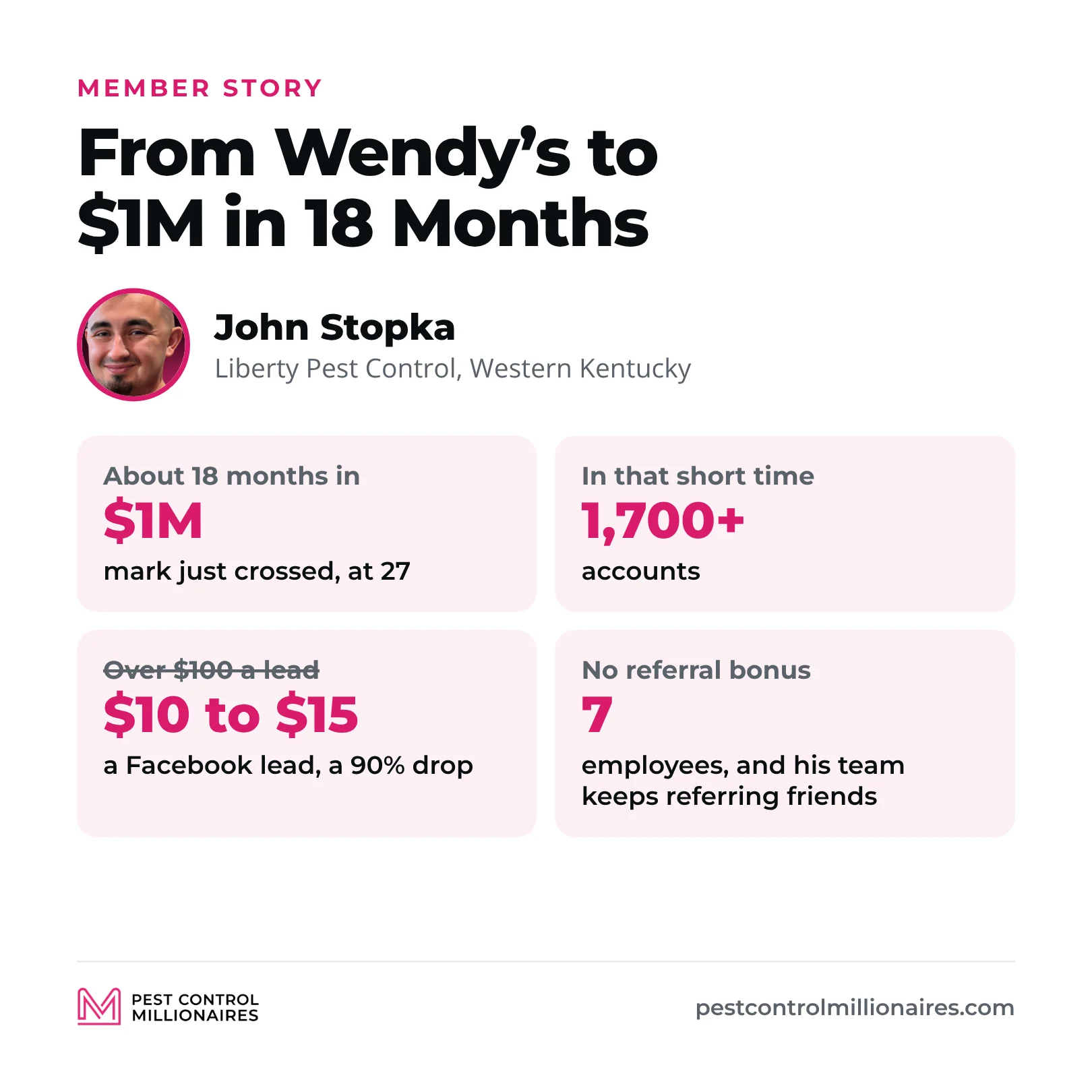
I recently sat down with John Stopka, the founder of Liberty Pest Control out of Western Kentucky, and honestly his story might be one of the most impressive we’ve had on the show. John started his pest control career at 19 years old, and just a year and a half ago he launched Liberty Pest Control. In that short time, he’s grown the company to over 1,700 accounts and just crossed the million dollar mark. And he’s only 27. The guy moves fast, delegates early, and has built a brand that people in his area can’t stop talking about. We sat down and talked about how he did it, what he’s learned, and where he’s headed next.
Getting Started at 19
John got into pest control the same way a lot of people do. By accident. He was 19, working management at Wendy’s, and had his second kid on the way. He knew he needed to make more money, so he walked into the local Orkin office looking for a job. They had a sales position open, commission only. He went home and told his wife, and she thought he was crazy. But they went for it anyway.
“I just always had a be obsessed or be average mentality. That’s just kind of the way I live my life,” John told me. He spent about six and a half years at Orkin as a residential sales rep, selling pest control services, termite treatments, bed bug accounts, and crawl space work. And he learned how to sell.
When I asked him what the biggest lesson from that time was, he didn’t hesitate. It wasn’t some fancy sales technique or script. “Just talk to a customer like they’re a real person and you’re just there to help them. You’ll sell a lot doing that,” he said. A lot of people overcomplicate sales by trying to implement all these tricks and tactics they find online. John kept it simple. People have a problem, you have a solution, and you provide real value. That’s it.
Starting Liberty Pest Control
John always knew he wanted to own a business. He spent years consuming content, reading books, and listening to podcasts to prepare himself. When the time was right, he partnered up with someone he’d met through a local BNI networking chapter and they launched Liberty Pest Control together.
The timing was intentional. John started the company in the middle of winter on purpose. He wanted to spend those cold months building a name and creating an image before spring rolled around and the phones started ringing. So he hit the pavement door knocking, and he kept it genuine. “Hey, my name is John with Liberty Pest Control. I just started. Is there anything I can do for you guys this spring?” No scripts, no tricks. Just a real person having a real conversation.
The Power of BNI and Networking
John credits a lot of Liberty’s early growth to networking, specifically through his local BNI chapter. If you’re not familiar, BNI is a networking group where about 20 to 30 business owners and professionals meet weekly to refer each other business.
John’s advice on networking is pretty straightforward. You get what you put in. He’s seen people complain that nobody at BNI wants to refer them or talk to them. And his response? “Did you talk to anybody when you were there? Did you come to them and say, hey, I’ve got a referral for you? Did you refer this one person? Did you send them five or 10 customers? If the answer is no, then why would they do business with you?”
That’s how John met his business partner in the first place. He saw him at a meeting, approached him, and said, “Hey, let’s get lunch. Let’s see how we can help each other.” He took the initiative, built the relationship, and it turned into a partnership that launched a million dollar company.
Getting Known
One of the biggest lessons John learned, partly from Grant Cardone, is that you have to get known. “If people don’t know your name, they don’t know your company, they don’t know who you are, how can they buy from you?” So John set out to make Liberty impossible to miss in Western Kentucky.
First, the trucks. All of Liberty’s vehicles are wrapped, and they get a ton of attention. John’s take on what should be on a wrap is refreshingly simple. “Your logo, your name of your company. It should be the biggest thing on that wrap. That’s what people are going to remember.” He’s got a giant eagle as a mascot on the side of the truck with Liberty Pest Control in big letters. No need for a QR code or a website URL that nobody’s going to remember. People see the name, they remember the name, and when they need pest control, they search it up.
“You can’t do a pest control service in a neighborhood and not see Liberty in that customer’s driveway,” John told me. It’s a moving billboard, and it works.
Then there’s the social media strategy that really stood out to me. When Liberty signs up a new commercial account like a restaurant, John asks permission to take a picture of his truck in front of the place. He posts it with something like, “Thank you for choosing Liberty Pest Control to keep your restaurant pest free.” Then he gives away a $25 gift card to the new customer, and people share it because they want to win. Every time someone shares it, they see the Liberty truck and the branding. It builds the social media following and creates loyalty with customers at the same time.
Joining Pest Control Millionaires
John joined the program back in March after reaching out to Jake Sheldon for help with marketing. He’d been doing his own marketing for a while, but he wanted to get better at it. Jake told him about what he and Jonas were teaching, and the value was obvious. John signed up right away.
The biggest win from the program has been Facebook ads. Before joining, John was running ads on his own and paying over a hundred dollars per lead. Some leads were costing him $150. He was ready to give up on Facebook entirely.
Then he learned how the algorithm actually works. How to make an ad that stops people from scrolling instead of blending in with every other corporate ad. How to set up a lead form the right way so people actually know they’re signing up for something. And the results were insane. “We were averaging somewhere between $10 to $15 per lead,” John said. That’s a 90% drop in cost per lead just from learning how to do it right.
He’s also learned how to spot ad fatigue. In smaller markets like his, around 25 to 30 thousand people, the same ad can get stale fast. When he noticed leads slowing down and cost creeping back up to $25 or $30, he knew it was time to swap out the creative. Still incredibly cheap leads, but he stays on top of it.
Creating an Offer People Can’t Say No To
John’s a big fan of Alex Hormozi, and one of the lessons that stuck with him is the idea of creating an offer so good that people feel stupid saying no. But he’s quick to clarify what that actually means. “It’s not saying create an offer so cheap that people are like, oh yeah, I have to have it. It’s saying pack so much value into your offer that people feel stupid saying no.”
Liberty does this through the details. While competitors come out and do a quick spray and leave, Liberty does de-webbing, brings a trash can to the garage door, picks up newspapers. The technicians are friendly, they love their jobs, and customers notice. They also offer bundled services and monthly billing, which a lot of older companies in the area still haven’t figured out. “When they call in and you tell them it’s 45 bucks a month, we’ll come out every three months. Yeah, that sounds great,” John said. Monthly billing makes the value obvious and removes any hesitation.
Building a Team People Actually Want to Work For
In just a year and a half, John has grown to seven employees. And here’s the cool part. He hasn’t had to do a ton of recruiting because his employees keep referring their friends and former coworkers. Nobody’s getting a referral bonus or anything. They’re just referring people because they genuinely love working there.
John’s philosophy on employee culture is simple. It’s not always about money. “They want to feel appreciated. They want someone that’s going to say, hey, you did a good job today.” He holds a weekly breakfast meeting every Monday where the team eats together and goes over topics for the week. On birthdays, he surprises people with a $25 gift card to their favorite restaurant. He makes sure they have good equipment, good sprayers, good poles.
“If you take care of your employees, they’re going to take care of the company. They’re going to take care of the customers. They’re going to want other people they know to come work here because they love working here,” John told me. And that’s exactly what’s happening at Liberty.
Where He’s Headed
John’s not slowing down. His star technician is moving into a full-time service manager role so John can focus on growing the business instead of getting pulled into day-to-day operations. They’re planning to open another service location next year, and another one the year after that.
The end goal? $25 million in revenue and an exit. John’s been pretty open about that. “If I shoot for 10 million, that’s the max of what I’m going to hit. If I shoot for 25, I’m either going to hit 25 or I’m going to get pretty dang close to it,” he explained. And at that level of recurring revenue, the exit multiple becomes life-changing money.
There’s also a more personal reason behind the drive to build something big. John thinks about what would happen if something happened to him. A knee injury, something worse. If he’s a sole operator and the sole income for his family, everything falls apart. “That fear drives me that I have to create a company so large that I can make sure my family is taken care of no matter what happens to me,” he said. That’s not just ambition. That’s real purpose behind the work.
Key Takeaways
John’s story packs a lot of lessons into a very short time in business. First, delegate early and often. John has delegated from almost day one, sometimes even before it felt necessary. That’s how he’s grown so fast. He’s not stuck in the truck doing services. He’s working on the business.
Second, get known before you need to be known. The wrapped trucks, the social media posts, the networking. None of it pays off immediately. But when you stack it up over months, you become the name people think of first when they need pest control.
Third, keep sales simple. Don’t overthink it. People have a problem, you have a solution, you provide value. Talk to them like a real person and you’ll close deals.
Fourth, take care of your people. Both your employees and your customers. The little things add up. A birthday gift card, a weekly breakfast, good equipment. When your team feels valued, they show up, they do great work, and they bring in more great people.
And finally, set your goals high. John is 27 years old, just crossed a million dollars, and is targeting $25 million. Whether he hits that exact number or not, the mindset behind it is what’s driving everything. If you shoot low, you land low. If you shoot high, you might just surprise yourself.
From Wendy’s management to a million dollar pest control company in under two years, John’s story is proof that the right mindset, the right systems, and the willingness to move fast can build something incredible. And he’s just getting started.
Want to connect with John? You can find him on Facebook. Just search John Stopka and send him a friend request. And if you’re looking for the same kind of program and community that helped John cut his cost per lead by 90% and scale to a million dollars, that’s exactly what we’ve built with Pest Control Millionaires.
Frequently Asked Questions
What drove Liberty Pest Control to success?
Speed and visibility. John delegated from almost day one, made Liberty impossible to miss with wrapped trucks, social media posts and BNI networking, learned Facebook ads in the program (his cost per lead fell from over $100 to $10 to $15), and built a team that keeps referring their friends.
How did Liberty Pest Control differentiate from competitors?
Through the details. While competitors do a quick spray and leave, Liberty’s techs de-web, bring a trash can to the garage door and pick up newspapers. Liberty also offers bundled services and monthly billing, which a lot of older companies in the area still haven’t figured out.
What marketing approach did Liberty Pest Control use?
Getting known. John door knocked through his first winter, networked through his local BNI chapter, wrapped every truck with the company name as the biggest thing on it, and posts photos of his truck at new commercial accounts on social media. Since joining the program, Facebook ads have been his biggest win, at $10 to $15 a lead.
Full transcript
Read every word of the interview
00:00Dan Leibrandt
Hey there, my name is Dan Leibrandt and welcome back to Pest Control Success Stories, where we interview the top people in our program, Pest Control Millionaires. Today I'm joined by John Stopka, the founder and owner of Liberty Pest Control. John started his journey in pest control at just 19 years old and ended up starting his company, Liberty Pest Control, about a year and a half ago. And in just that time, I thought he started his company at 19. He started his company just a year and a half ago and has now grown it to over 1,700 accounts. And just over a million dollars a year. Just give or take, just about to cross that threshold, which is really exciting. Through hard work, strong values, and a deep commitment to customer service, John has built Liberty into a business that stands for reliability, innovation, and local pride. His story is a great example of how far dedication and a clear mission can take you in this industry. So without further ado, John, welcome to the show.
00:52John Stopka
Yeah, thanks so much for having me, man. That was an awesome bio, by the way. I appreciate that.
00:57Dan Leibrandt
Of course, man. Yeah, so I wanna dive into your journey more. And first off, let's start with you got into pest control when you were 19. How did you get into the industry?
01:07John Stopka
I mean by accident, which I don't think a lot of people get out of high school just wanting to be a bug man, but that's just the way worked out for me. Had my second kid on the way when I was 19 and I was working at Wendy's in management, so I knew I had to do something differently. I had to more money, basically is what it came down to. And I walked into the local Orkin office and went in there looking for job. They had a sales position open, so I came back to my wife and said, hey. How does commission only sells sound? And she thought I was crazy, but said, for it. So took that and ran with it. And that's pretty much where I spent my pest control career at.
01:48Dan Leibrandt
And what kind of sales are you doing door to door?
01:50John Stopka
No, was just residential sales. So I was selling pest control services for Orkin termite services, bed bug accounts, crawl space related work. So I was just a residential sales person for them.
02:03Dan Leibrandt
Okay, cool. So you're at Orkin. How long were you at Orkin?
02:07John Stopka
Until you're in a half go.
02:09Dan Leibrandt
Okay, okay, cool. So you're at Orkin for about six years or so. What did you learn at your time at Orkin?
02:18John Stopka
I learned how to sell. Ultimately, that's what it came down to. I learned a lot in the home service industry. Just talking to people was the biggest thing. That would be probably what led to my career, just them teaching me how to sell. I just wanted to take it a step further.
02:39Dan Leibrandt
Interesting. Yeah. Go deeper on that. Like what did you learn about sales? Maybe like when you were just starting out, what were you like kind of what changed over the course of learning sales? Now you're kind of becoming a pro.
02:53John Stopka
I mean, ultimately I just always had a be obsessed or be average mentality. And that's just kind of the way I live my life. When I say that, if you want to be a top performer, whether it's as a sales rep or just in business in general, you've got to dedicate everything to it. You've got to be obsessed with it. In general, the person that works the hardest and the smartest is going to be the one that ends up on top. So that was just kind of the mindset I had whenever I was there.
03:21Dan Leibrandt
Okay, so you're obsessed and specifically with sales. Do you have any advice for people that are getting into pest control sales or doing sales for their own company?
03:31John Stopka
Yeah, I mean ultimately you're just talking to people you know I mean they have a problem and you have a solution and it's really that simple You know people buy based on value So you know it's generally not based on price so they have a problem. You're offering a solution that has real value to the customer That's really sales is that simple and I think a lot of people over complicated by trying to you know do all these sales gurus online and implement these sales tricks and verbiage and it just talk to a customer like they're a real person and you're just there to help them and you'll sell a lot of money doing that.
04:10Dan Leibrandt
Yeah, no, I think that's lacking today. And also, especially with everyone trying to use AI, maybe they're texting using AI or calling using AI. I think the thing that can actually set people apart now is like you said, just being a person, just being a human, just genuinely caring about people. Like you said, I'm not big on the whole like sales, sales bro culture.
04:35John Stopka
Yeah, yeah, I mean, even when I started the Liberty, I started going door to door. I mean, I was in the middle of winter when I started, but I wanted to start in the middle of winter so we would have time to start building up a name and some type of image before spring got here. But I started going door to door and I was just knocking on doors and just being genuine saying, hey, my name is John. With Liberty Pest Control. I just started. You know, is there anything I can do for you guys this spring? And I was just being very genuine. Random sales tricks or scripts or anything like that.
05:05Dan Leibrandt
Yeah, yeah, 100%. And tell me, how did your company come about? Have you always been an entrepreneur and you knew you were gonna start a company or did it just kinda happen?
05:16John Stopka
I mean both. Been, I want to be a business owner for several years and I ultimately knew that was the plan. So I spent probably countless hours on YouTube listening to subjects about business and reading books. And as far as time goes, it just came down to me and my business partner decided to do it together at the time that we did. It just kind of worked out and we started the company and just took it from there.
05:43Dan Leibrandt
How did you meet your partner and would if you were to redo it because I know some partnerships fall through there there might be something like that goes bad. How did you meet him and how is it going like is it.
05:55John Stopka
Yeah, yeah, that's a great question. So we actually met through BNI chapter. And if you're not familiar with BNI, it is a, yeah, it's a local networking chapter for anyone listening that may not be familiar with it. But essentially, you got a room of 20, 30 business owners, sales reps, just people that work for other companies, and you're meeting weekly to grow each other's businesses and refer each other. So we kind of formed a relationship through BNI. He owned a company. And then I was in there as a sales rep. So we...
06:01Dan Leibrandt
Mmm, yeah.
06:24John Stopka
Built a relationship through that and then whenever he learned that I wanted to my own company, I was just talking to him about it he said, well, we should just do it together. So that's just kind of how it went.
06:37Dan Leibrandt
Awesome. Okay. So you met him at a BNI meeting or slash meetings. Would you recommend other people do that then start going to those?
06:47John Stopka
Me personally, I mean that's part of how Liberty has grown the way we are. You know, is through networking such as the local BNI chapter and stuff like that you get what you put into it. You'll hear about people that go to BNI or a Chamber of Commerce meeting and they say, nobody wants to refer me, nobody wants to talk to me. Well, did you talk to anybody when you were there? Did you come to them and say, hey, I've got a referral for you? Did you refer this one person? Did you send them five or 10 customers? If the answer is no, then... Why would they do business with you? Why would they try to help you if you haven't tried to reach out to them? And that's the way just about any type of networking works.
07:26Dan Leibrandt
So how did you connect with your partner? What was like, did you approach him at the meeting or how did that go down?
07:31John Stopka
Yeah, absolutely. So he actually owns a crawl space company. So they do moisture control, vapor barriers, stuff like that. Nothing pest control related. And he was, in a sense, my competitor because I was also selling the same services. But I had seen him in the meeting and I approached him and said, hey, let's get lunch. Let's see how we can help each other. Obviously I was also selling termite services and we built a good relationship going back and forth. And then I just kind of saw the mountain. Wanted to see how we could build that relationship.
08:02Dan Leibrandt
Awesome. And then you also said, I don't you spent like a few years or so consuming a lot of content, know, books around business and podcasts and such. What were some of the most influential things for you? What would help the most in terms of learning?
08:17John Stopka
Yeah, there's a lot of content out there and there's a lot that is very valuable and there's also a lot that is not so valuable. So you have to be careful what you absorb. But as far as books go, one of my favorite all-time books is Buy Back Your Time by Dan Martell. If you haven't read that one, it's really good. And that really taught me the value of what it means to buy back your time. And that's again, just another way we've grown is I've just delegated everything on a very early stage, sometimes too early. But just delegating tasks and get myself out of the service truck very early on so I can continue growing the business. And that is important what Buy Back Your Time teaches you. Atomic Habits was another really good book I read.
09:07John Stopka
Can't miss that one. Be Obsessed or Be Average by Grant Cardone. I'm a huge Grant Cardone fan. I watched his content for years, but it's just having that same mentality of being obsessed with the average. If you're obsessed with what you do, you love what you do, you're going to be successful.
09:25Dan Leibrandt
Yeah, yeah. No, I really like Grant Cardone too. What would you say are some of the biggest lessons you've learned from him, besides the be obsessed or be average?
09:35John Stopka
You got to get known. Mean, if anyone else had a good intention, it's Grant Cardone, right? And that was probably one of the biggest lessons he taught me was you have to get known. I mean, if people don't know your name, they don't know your company, they don't know who you are, how can they buy from you? So that's what I sought out to do was I've tried to get my name out there any way possible. And it goes back to joining those networking groups and, you know, going door to door and just doing whatever I have to do on digital media, just getting Liberty's name out there to where everybody in Western Kentucky knows who we are.
10:10Dan Leibrandt
Yeah, definitely. Like I mentioned in the introduction, I mean, you guys have grown to a million dollars a year in just the past year and a half. And obviously you have to be known, people have to know about you before they can buy. So talk to me more about how so many people have come to know you in order to buy.
10:28John Stopka
Well, you know, that goes into just getting attention. You know, our wraps, if you've seen our vehicles online, they get attention. I know a lot of people kind of go back and forth. Should I wrap my truck? I not wrap my truck? We wrapped ours. All of ours are wrapped and they get a lot of attention. I mean, you can't do a pest control service in a neighborhood and not see Liberty in that customer's driveway and then we'll get calls. I mean, it's a moving billboard. So we'll get calls from people who said, Hey, I just see your band driving down the road. Call and get a quote. And then local word of mouth. I mean, I've lived here my entire life for the most part. So, you know, that's helped a lot. And again, when you're getting attention, you go into those chamber meetings and seeking people out, running ads on Facebook and posting consistently on social media is probably where I've gotten the biggest attention from. And one of the tricks I used to grow my business is when we signed up a new restaurant, for example. I'd get permission from the restaurant owner and I say, Hey, can I take a picture of my truck in front of your restaurant and say, thank you for choosing Liberty Pest Control. And I would do that. And I would give away a $25 gift card to my new customer and people would share it because they wanted to win the gift card. And every time they're sharing it, yeah, they would see Liberty's truck in front of the restaurant. I would always say like, thank you for choosing Liberty Pest Control to keep your restaurant pest free. So it's implying that the restaurant's pest free. So that really has helped grow our social media following.
11:37Dan Leibrandt
Dang, yeah.
11:53John Stopka
And kind of help build a little bit of loyalty with our customers.
11:56Dan Leibrandt
Yeah, yeah, definitely. I'm curious, because there's a lot of different ways to wrap your truck. You said that it's definitely important to wrap it. People should wrap it. What should be on the wrap? What are like some must do items?
12:11John Stopka
Yeah, so I, in my opinion, you should, if you want to get attention, which was kind of my goal, you should wrap it. Others may have a different opinion and you could obviously grow a company without wrapping a truck, right? But we wrap ours and the biggest thing is your logo is your name of your company. It should be the biggest thing on that wrap. Cause that's what people are going to remember. They're probably not going to scan a little QR code in the corner. They're probably not going to click on a website that's, you know, on the back of your truck. A phone number is helpful, yeah, but ultimately they need to remember who Liberty Pest Control is, right? So we've got a giant eagle as a mascot that's on the side of our truck and in big letters it says Liberty Pest Control and it works the same way with a billboard, right? You see phone numbers on billboards all the time. Well, who's remembering that phone number? Probably nobody. But what they are remembering is the name of whatever company is on that billboard.
13:06Dan Leibrandt
Hmm, okay, so the name is super important. And I've heard Jonas talk about this too, where, I mean, basically, like you said, people will put a QR code or they'll try listing all of your services, but it seems like you agree there. You kind of just have to keep it simple and people are just gonna search your company name.
13:22John Stopka
They do, yeah, and that's whole point of those different forms of marketing that's more about branding. Know, billboards and yard signs and wraps, that's a branding thing. That way when they're ready for pest control, they're gonna remember who you are, they're gonna go on Google, they're gonna go on Facebook, ask their friends, and when they see the name Liberty, gonna say, I've seen that truck all over town, or I've seen that billboard all over town, I've seen the yard signs. They're gonna remember your name, they're not gonna remember your phone number or your website.
13:51Dan Leibrandt
Yeah, yeah, definitely. Something else I wanted to mention, you told me, I believe you've been in touch with Jake Sheldon for a little bit and you ended up joining the Pest Control Millionaires program you said back in March. Can you talk about, I mean, first like how you found out about it and what you've learned from it and just kind of everything you've gotten from the program?
14:13John Stopka
Yeah, absolutely. I had known Jake just from being in the industry and being a part of some online Facebook groups for the pest control industry. And I had actually reached out to Jake wanting help with marketing. I've always done my own marketing. I still do my own marketing now. And I sent him a message saying, hey man, I just wonder if I could get help with marketing. I thought he had owned a marketing company and he ended up selling his marketing company, I guess. And he said, well, I sold my marketing company, but here's what I do now. I teach a class with Jonas Olson of Turf Badger and I teach a class on how to do marketing yourself so you don't have to pay all these marketing agencies all this money. He showed me what he teaches and I'm like, that's awesome, let's sign up. The value was definitely there. So that's how I ended up being part of the program.
15:04Dan Leibrandt
Okay, cool. And you mentioned to me before the call, one of the most impactful things has been Facebook ads. And I know you just mentioned Facebook ads a few minutes ago in terms of like getting known, but talk to me about what you've been doing with Facebook ads and how those have been going.
15:20John Stopka
Yeah, so we've grown our following on Facebook two different ways. One is just through organic posting, organic sharing and cross posting to other Facebook groups. The other part of that is paid Facebook ads. And that's creating an ad, putting on Facebook and using a lead form to get leads from it. We then reach out to those people and call and sell our services. And that was one of things that the Pest Control Millionaires program taught me was how to create your own ad. Taught me a little bit about what buyers are really, what stops that train of thought. Because you've got to stop that scrolling on Facebook, right? And if you're ironic things, if your ad looks too good, it looks like every other corporate ad out there and they scroll right past it. I was like, oh, that's mind blowing. That makes sense. So he taught me how to make an ad that actually stops that cycle of scrolling and generates leads. People click on the lead form, they're filling it out and there's a right way and a wrong way to build a lead form as well. So you'll have people like, oh, everybody I get is they have no clue they filled out the lead form, right? That's probably the wrong way. You've got to set up for you get your lead form set up the right way, you attract hundreds of potential buyers. There's a lot of volume of leads. You're probably going to close 20, 30 % of that. Facebook is generally, the closer rating is going to be lower compared to Google and other forms of marketing. But that's how it went for us anyway.
16:41Dan Leibrandt
Awesome. And you mentioned you were getting like 10 to $15 a lead. How is that possible?
16:46John Stopka
Yeah, that was the crazy part. So before I joined the program, I was running Facebook ads myself and paying over a hundred dollars a lead. And I was like, yeah, this don't work. Right. I think the highest was like $150. I was like, okay, I'm done with Facebook. This just doesn't work. And once you learn the algorithm and what the Facebook algorithm wants, you get a lead on there an ad on there. That generates leads properly, that's what drives that cost of leads down. And so much to the point, we were averaging somewhere between $10 to $15 per lead. And it was just absolutely insane.
17:21Dan Leibrandt
And you mentioned to me, exactly was it that's maybe the ads are reaching fatigue or you're kind of going into the off season. So how are you changing up your Facebook ad strategy as time continues?
17:33John Stopka
Yeah, so sometimes you do reach ad fatigue, especially in smaller markets, you can reach ad fatigue. And I'm not a Facebook expert by any means. I just know what Jake and Jonas and other people have taught me. But in smaller markets, at some point your ad just gets so repetitive and so the leads start to slow down. Sometimes you need to change up the image, which is what we're in the process of doing right now going into fall. So I did end up changing that image and the way I knew it was kind of getting ad fatigue is the leads were slowing down, the cost of leads were going up. And we were up to like $25, $30 a lead, which is still insanely good, you know. But that's when I decided it was time to change up that ad a little bit. And to give you perspective on like smaller markets, where we're based out of is a town or a city of about 25, 30,000 people. So it's not a small town, but it's not a major city either. So that ad can fatigue a little bit faster in smaller markets.
18:24Dan Leibrandt
Okay, got it. Yeah, that's good to know. Also, I wanted to touch on your offer. Have you like, because I saw you had Alex Hormozi's book in the back. I don't know if people can see it or maybe they're listening to this, but have you done anything with like creating a crazy good offer or anything?
18:42John Stopka
Yeah, and so that was a big thing I learned from Alex Hormozi was just create an offer so good people feel stupid saying no to it, right? And that's it. And it's not saying create an offer so cheap that people are like, oh yeah, I to have it. No, it's saying pack so much value into your offer that people feel stupid saying no. Because again, I'm a firm believer people buy based off value. You don't need to be the cheapest company. You just got to provide the best value and people are going to pay more for your services. And some of that goes into, when our competitors are just kind of coming out and doing a quick spray and leaving where we stay, we do a de-webbing service, you know, we just kind of go above and beyond. We'll bring a trash can to the garage door, pick up your newspaper. You know, our technicians are very friendly. They love their job. So that's part of packing that value in. Maybe bundling, screening service bundle, right? Offering monthly billing. You know, that's something a lot of older companies still haven't gotten on par with. And there's value in that monthly billing. People, I mean, when they call in and you tell them it's 37 bucks a month or 45 bucks a month, I like to use the term bucks because it just sounds, you know, it doesn't sound like a dollar. So I'll say 45 bucks a month, we'll come out every three months. Well, yeah, that sounds great, right? Monthly billing is awesome.
19:56Dan Leibrandt
Yeah, so do you have like a core offer that's working best for you?
20:02John Stopka
My. Yes and no. Mean it's a lot of it's just creating a good pest control service. I mean that's really where the offers at is whenever you tell them we're going to do X, Y and Z. You know, and especially like with our bundled service, people love our bundle plan where we do a mosquito treatment and we do a general pest treatment year round. That's one of our best offers, but we don't have like a first service free offer or anything like that.
20:30Dan Leibrandt
Okay, okay, got it. I wanted to touch on hiring and employees. So right now you've got seven employees and I mean, that's just from starting a year and a half ago. What has hiring been like and what have you learned regarding hiring?
20:46John Stopka
Yeah, so I mean, I've had a couple of bad hires that just didn't work out and you know, that ultimately falls on me as the interviewer, you know, and I learned, you know, just because they have experience in pest control, does not make them a good technician, right? So I did, did learn that lesson. But we've grown to seven employees and, a large part of that is they have referred each other, right? So that was part of my reason behind creating a company is creating a company that employees love working for. And in turn, they'll love to take care of your customers because they have that sense of pride. Well, another aspect of that was they started referring people they've worked with in the past. That I haven't really had to do a lot of interviews because we just keep getting employee referrals and it's working out great.
21:08Dan Leibrandt
Mmm.
21:31Dan Leibrandt
Hmm, interesting, okay. And you said essentially like creating a culture that people love working for, how do you do that?
21:42John Stopka
Yeah, there's a lot of different ways you can do that and it's not always about money for employees. Money is oftentimes not the biggest driver. Mean, obviously they want to get paid, they want to make a good income, but they want to feel appreciated. They want someone that's going to say, hey, you did a good job today. You ran 15 out of 15 stops. We have a weekly service meeting and I buy them breakfast and we just meet every single week. It's every Monday. We just eat breakfast real quick and go over some quick lessons for the week or some topics for the week that need to be discussed. But it's just all the little things like that getting them good equipment, you know, they've got expensive I shouldn't say expensive, but they've got very good quality Webster poles Well, that means a lot whenever you know, you get them good equipment or good backpack sprayers All the little stuff of just making sure they understand that I'm here to serve them It's kind of the mentality I have so that but employee appreciation goes a long way on their birthday. I get him a you know, I surprise them with a $25 gift card to their favorite restaurant or just little stuff like that.
22:45Dan Leibrandt
Yeah, that's what I was gonna say. It seems like such small things. And I feel like what I'm getting from you is that it's almost intuitive for you, but I feel like a good amount of owners out there, it's just for whatever reason, you don't think of doing that. Maybe it's a birthday card or maybe just buying them lunch, the things you were mentioning. So I guess the whole point there and it's... Treating your customers and your employees, right? Both of them of like, just those little touches.
23:17John Stopka
Absolutely. Yeah. All those little things add up. And again, I'm a firm believer if you take care of your employees, they're going to take care of the company. They're going to take care of the customers. They're going to want other people they know to come work here because they love working here. You know, we don't offer any referral bonus or anything. They've just referred their former coworkers or friends just because they wanted to come work here.
23:39Dan Leibrandt
Awesome. And I also want to ask you, so you are just now crossing the million dollar a year threshold, which congratulations, that's so awesome. This is like a milestone most people are pursuing for a while. So it seems like you're just knocking it out of the park, that right away? What are the next steps for you and your company? Where are you guys headed?
23:48John Stopka
Thank you.
24:00John Stopka
Yeah, so the next steps right now is, you know, once you get to a certain threshold, your systems and processes have to adjust with it. So this next three, four months, that's part of what I'm working on. My start technician who does all of our starts, he is moving into a full-time service manager role, which seems a little early, but again, I've always delegated early and that's how we've grown is by me delegating early. So he's moving to a full-time service manager role. So we can make sure we're focusing on quality of services, but make sure employees are getting everything they need, because I'm distracted by a lot going on in the business as it is. But we're planning to open up another service location next year. So we're expanding our service area a little bit. And then the year after, plan on adding another location.
24:50Dan Leibrandt
Okay, cool. And what is like the end goal for you? Is there, do you want to pass it out in the family or, you know, sell for 10 million or 100 million?
24:59John Stopka
Yeah, mean, truthfully, the end goal is to have an exit. That's what I foresee in my future. So I've been rather open when people ask me, how big of a company do you want? Well, 25 million in revenue is the goal for me. But ultimately, it's about having an exit.
25:14Dan Leibrandt
Y25.
25:16John Stopka
Um, it's a, it's a very large goal, um, in the time period that I want. Um, but if you, if you put your goals higher, um, you're always going to achieve more. So that's a large part of why it's at 25, right? If I shoot for, if I shoot for 10 million, well, that's the max of what I'm going to hit, right? Cause that's my goal and that's the max. If I shoot for 25, I'm either going to hit 25 or I'm going to get pretty dang close to it. And once you have that kind of recurring revenue, the exit multiple you sell for becomes just insanely high. And to me, at that multiple around that revenue is what I would determine is real money to have an exit at. When you're my age, selling for $5 million does not get you very far in life or get me to where I want to be at. So I'm shooting for a much higher exit.
26:09Dan Leibrandt
Yeah, which by the way, for people that don't know you look, I'd say pretty old, maybe like mid thirties or so. Dude, you're only 27. Yeah. No, I don't know. I think it's a good thing to kind of look older as a guy.
26:14John Stopka
Thanks. Yeah, yes, yes, I actually do get that a lot and a lot of it is my maturity too. I've always been a little bit more mature for my age so people just naturally assume I'm older but yeah, I'm 27 so.
26:34Dan Leibrandt
Yeah, no, crushing it, dude. I've got two more questions for you. One is, and this is general, you can take this wherever you want, is what is one of the biggest lessons you've learned recently in or outside of the business?
26:47John Stopka
That's a good question. Maybe think for a minute. There's the hard part is there's been so many lessons I've learned and it's because I'm always trying to absorb information from other people and I've sought out people that are doing more than me and know more than me so I can just absorb from them. I mean I would say the biggest one of the bigger lessons I've learned is just simply to have a servant's heart and serve other people and everything else. We'll be taking care of at some point. And that goes from serving employees, serving customers, but also serving other PCOs. I mean, I have people reach out to me constantly asking for advice on how to grow their company. And I'm still very early into it, but I have people reach out a lot and I just try to be a servant to them and give any information I have away that's going to help them in their market.
27:52Dan Leibrandt
I love that man. That's what we're doing with this podcast here too. Like some of the people that I've had on already were like, well, dude, I'm not doing that much. You I'm only doing 300K a year. I'm only doing a million dollars a year. It's like, there are many people, like you have so many lessons that you can share and you have such an interesting story. It's definitely worth hearing. And you know, I'm the same way. It's not like, well, how much money can I make? And how can I, you know, get one on everyone else? It's like, no, I just want to help a lot of people and. Make money in the process, right? It seems like you're the same way. Yeah, awesome. And the final question I have for you, again, this is also a general one. Usually I like to ask people that I interview is, what is your message for the pest control owners out there? What do you want to tell them? What do you think they need to know?
28:41John Stopka
Another deep question. Okay, you're making me think man. I think if there was any message I was going to give to other pest control owners. It would be, don't be afraid to delegate and grow your company. I've talked to so many people who are afraid to take that next step to hire somebody. They're afraid that they're not gonna take care of your customers and there will always be bad hires. But ultimately you can't be afraid to hire people because that's how you're gonna grow. And for me, it's almost a sense of fear. And this is part of why delegate and part of why I want to grow such a large company is I have this fear that if something happens to me, how is my wife and kids going to be taken care of? You know, if I go down with a knee injury and I'm a sole operator and I can't walk, well, I'm the sole income in my family, right?
29:36Dan Leibrandt
Mmm.
29:37John Stopka
Or if something much worse happens. Want to, that fear drives me that I have to create a company so large that... I can make sure my family is taken care of no matter what happens to me.
29:49Dan Leibrandt
Definitely, I love that. Yeah, people would call that like key man risk. Don't, if the business is solely relying on you, there's kind of a problem. I love that and the message, delegate as much and as fast as possible, Whatever the role is, get yourself out of the business, whatever people say, you know, work on the business, not in the business, all the cliches, but they're true.
30:10John Stopka
Absolutely. That's where true freedom, yeah, that's where true freedom comes from is by getting out of the service truck and working on the business, not in it. And it does sound cliche, you hear it all the time, but you hear it all the time because it's true. And that's where these people that are building real wealth and real freedom, that's how they're doing it.
30:31Dan Leibrandt
Definitely, I agree. Well, cool, man, this has been a great show. We'll wrap it up here. Where can people find you on social media and connect with you?
30:39John Stopka
Yeah, you can just search me on Facebook, John Stopka. Just search me on Facebook. That's largely where I'm active at. I've got a LinkedIn profile, but I'm convinced it's just there so random people can email me and solicit me for, you know, to purchase stuff. So I'm mainly active on Facebook.
30:56Dan Leibrandt
Okay, cool. Mainly Facebook and anything else you'd like to plug or promote?
31:04John Stopka
No, no, I don't, I don't guess so, man. I'm just, I'm thankful for you having me on here and the Pest Control Millionaires program for, you know, connecting with Jake and Jonas and you and learning what I've learned from all the other owners out there that I've learned from.
31:19Dan Leibrandt
Absolutely, man. Yeah, no, it's been a pleasure having you here. It's been great talking with you and chatting and cool. So make sure to go follow John on Facebook. That link will be in the description or you can just search up John Stopka on Facebook. And yeah, thanks so much for coming on, John. This has been fun.
31:34John Stopka
Absolutely. Thanks, man. It's been an honor.
31:36Dan Leibrandt
Course.