How One Pest Control Referral Campaign Got 255 Referrals in 14 Days

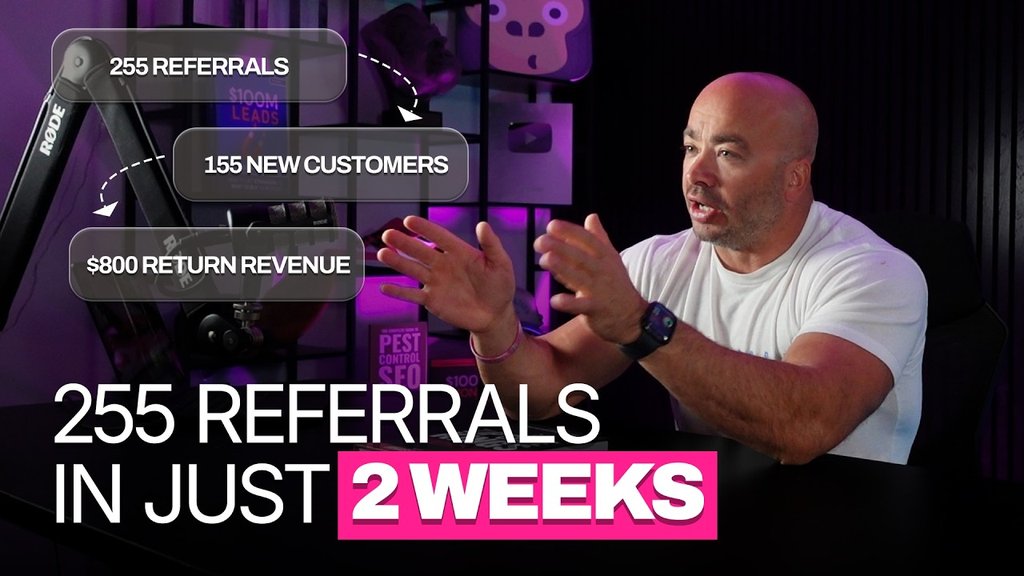
Table of Contents
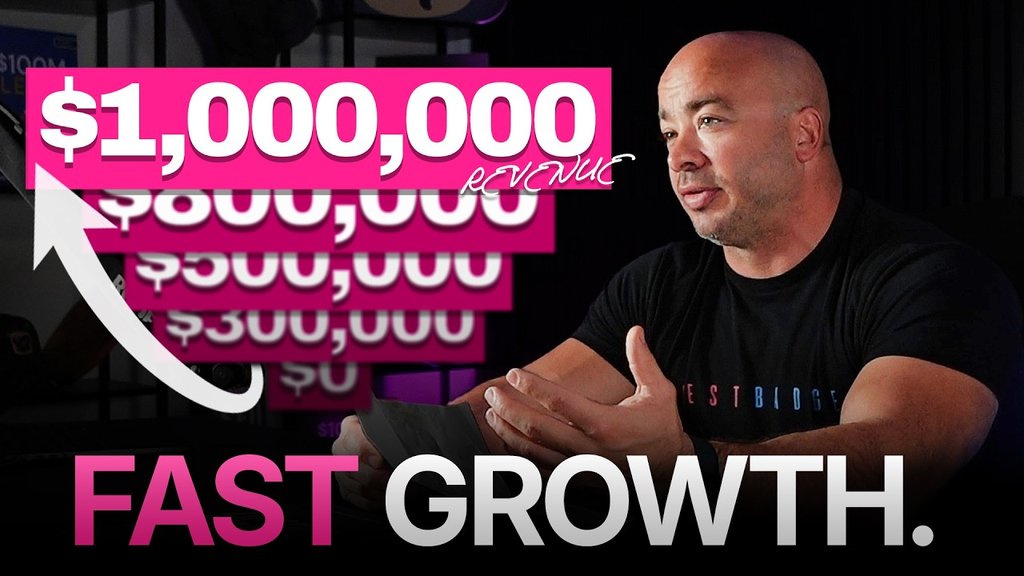
In two weeks, 255 referrals came in to Pest Badger, and 155 of those people became paying customers. Over their lifetime, those customers could bring in about $800,000. The campaign cost about $11,000. Here’s exactly what we did and why I think it worked.
I’ve been in the service industry for 17 years, and when this video came out in September 2026 we were in our sixth year of building Pest Badger, with 20 locations in nine states.
This video is part of PCO Tips. Our standing referral program and an earlier trip giveaway are in how to get more pest control customer referrals.
Start With a Program That Runs All Year
This wasn’t a brand new referral program we came up with for a two-week campaign. Ours had been running the whole time. Our referral software gives every customer their own link. They can text it to their brother, send it to a neighbor or a coworker, or post it on Facebook or their Instagram stories. The link tracks every referral back to the customer who sent it, and a dashboard shows us live who referred them, whether they signed up and who gets paid.
It pays real money. Not a credit on their Pest Badger account, and not $50 off their next service. Both of those drive me crazy. The software is connected to the customer’s Venmo or PayPal. They get paid when someone clicks their link, and they get paid more when that person signs up. Nobody in the office has to remember to send it or apply a credit. It happens automatically, with the whole team hands off.
The problem was that we weren’t pushing it. It was just sitting in the background. So the next step was simple. Give people a reason to use it.
Turn the Volume Up for Two Weeks
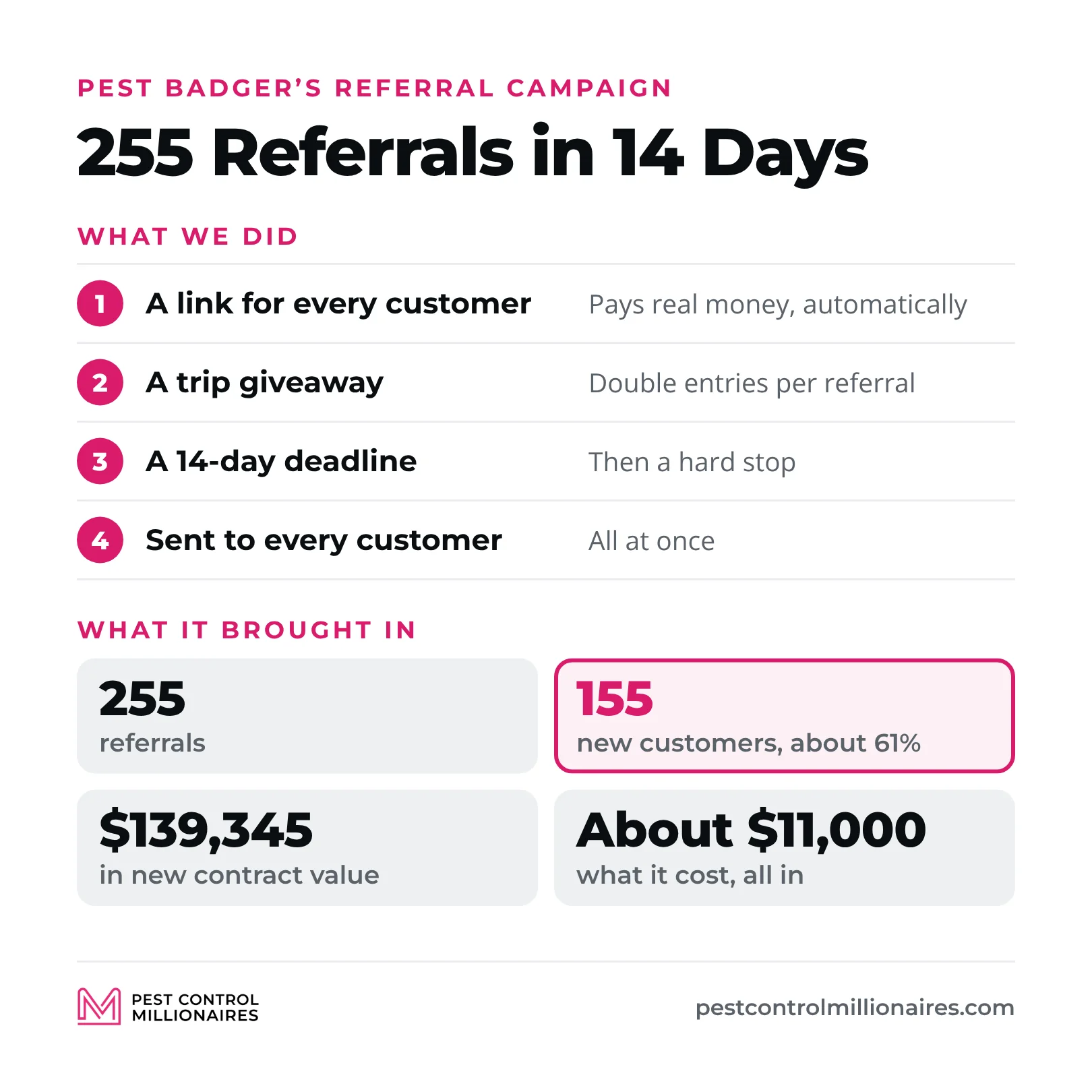
For two weeks, we turned the volume way up and added a trip giveaway. One trip, one winner, and every referral during those two weeks earned double entries in the drawing. If you were already thinking about referring your neighbor, now you had a reason to do it right now.
Then we put a deadline on it. 14 days, and not a day longer. No “Hey, this worked so good. We’re going to extend it for another week.” We stopped it dead, a hard stop. The normal program didn’t go anywhere. You can still send your link today, a month from now or six months from now.
And that’s exactly the problem. People forget they even have it. They push it off, or they never knew it was there even though we told them 10 times. With a running clock, it’s now or you miss out. I think that’s where most referral programs go wrong.
Why Most Referral Programs Don’t Work
Besides the missing deadline, I see two big reasons. The first is that the offer sucks. I’ve seen so many companies offer $10 off the next service for referring a new customer. Nobody cares about $10. Think about what you’re asking. Your customer takes time out of a busy day, thinks of somebody, pulls out their phone, finds the link you sent them, or the piece of paper you gave them, sends it over and puts their own reputation on the line recommending you. I wouldn’t do that for $10.
The second, and probably the biggest one in service businesses, is that everything is manual. The tech finishes the job and is supposed to remember to ask for a referral. Maybe he does, maybe he doesn’t. Then somebody has to put it in the CRM, figure out who referred whom and remember to pay them, if the CSR even put it in the notes. To me, that’s not a referral program. That’s hoping every person in the company remembers to do their part. I want a system that does all the work, hands off.
Send It to Every Customer at Once
There’s a common piece of referral advice I ignored for this whole campaign. You’re usually told to ask at the perfect time, right after the service, right after a five-star review or right after the customer tells you how great your technician was, because that’s when they’re happiest. That makes sense. It’s just not what I did.
We sent this campaign to our entire active customer list at once. Some customers had been serviced the day before. Others hadn’t seen us in two months. It didn’t matter. Every customer got it.
The Real Numbers
Over those two weeks, 255 referrals came in, and 155 became paying customers. That’s about a 61% close rate. We couldn’t get hold of everyone, but more than six out of every 10 referrals bought. These aren’t cold Facebook leads or people calling around on Google for the cheapest company. Their neighbor, their brother or their friend uses us, so some of the trust is there before our salesperson ever picks up the phone.
The average contract value on those 155 customers was $899. 155 times $899 is $139,345 in new contract value in two weeks.
That isn’t where the $800,000 comes from. Pest control is recurring. We want customers for years, as long as they own the home and hopefully after that. If those 155 customers stay at least five years, they’re worth roughly $697,000 in lifetime value. At six years, it’s roughly $836,000. That’s the $800,000. It didn’t hit our bank account in 14 days. It’s what that group could be worth over their lifetime with us.
What did it cost? Between the referral payouts we can track and the trip, about $10,750. I couldn’t pull the click payouts for that exact two-week window, so call it about $11,000. $139,345 in initial contract value, and potentially $700,000 to $800,000 or more in lifetime value, for about $11,000. That’s a trade I’ll make all day long.
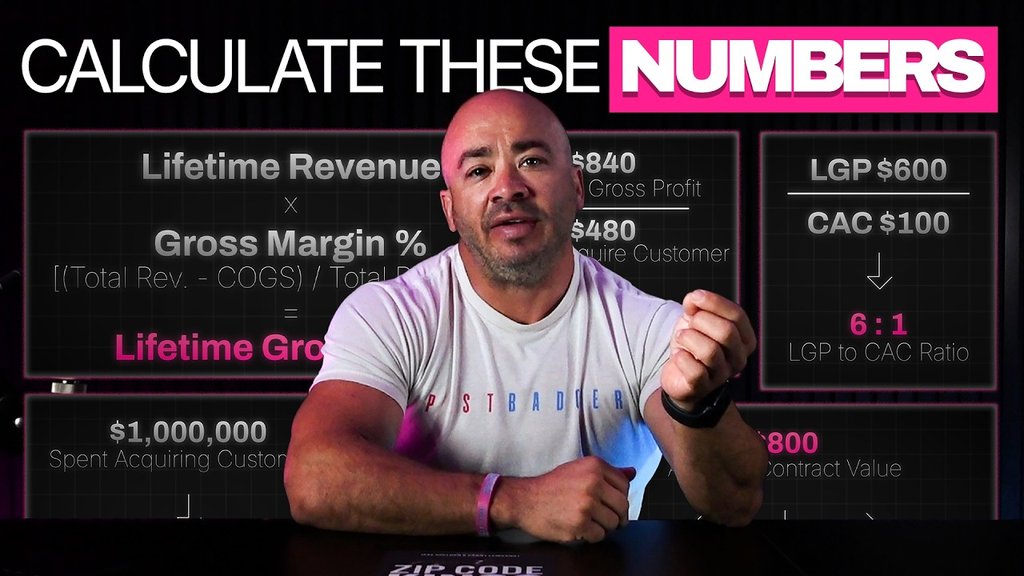
One note on that lifetime value. It’s revenue. A week after this video, I put out how much to pay for a new pest control customer, where I explain why I measure what a customer is worth in lifetime gross profit instead, because you still have to go service them. Use gross profit when you decide what you can afford to pay for a customer.
You Don’t Need 20 Locations
Friends have pushed back on me. “Hey, Jonas, you guys got 20 locations. Of course, you guys can give away a trip.” You don’t have to give away a trip, and I didn’t either for a long time. We didn’t give one away in year one, two or three, when we were smaller. We started with a $500 Visa gift card right before Christmas. A year later we gave away an iPhone. Now we’re big enough to give away a trip.
The prize changes as the company grows. The concept doesn’t. If you’re doing $250,000 or $300,000 a year, don’t copy the prize. Copy the structure. Give away something your customers actually want, something worth talking about. Make referring stupid simple, track it, put a deadline on it and tell your entire customer base. You don’t need 20 locations to do any of that.
Activate the Trust You Already Earned
The trip probably isn’t even the biggest reason this worked. Our customers already trusted us, and that’s the part you can’t fake. The normal program was already working. The trip, the double entries and the deadline didn’t make anyone trust us more. Together, they gave people a reason to act on that trust right now. We didn’t have to manufacture any trust. We had to activate the trust we’d already earned.
So stop treating referrals like a little bonus sitting on the side of the business. It’s a real customer acquisition channel. Look at what you spent on Google, LSA and Meta, and divide it by the customers you got. Was your customer acquisition cost $150? $200? $300 or more? Now look at your customer list. You already paid to get those people, you’ve been to their homes, and you’ve earned their trust. A lot of service companies spend $20,000 to $50,000 trying to get strangers on Google and Facebook to trust them while hundreds or thousands of happy customers sit in their CRM.
I’m still going to spend money on Google, Facebook and LSA. But 255 referrals and 155 new customers in 14 days at a 61% close rate gets my attention, so I’m going to work the customer list we already paid to build.
Frequently Asked Questions
How do you run a referral campaign for a pest control company?
Start with a referral program that runs all year, with a link for every customer that pays real money automatically. Then give people a reason to use it now, like a giveaway with double entries for every referral and a hard 14-day deadline, and send it to your entire active customer list at once.
What should you pay customers for referrals?
Real money, enough to be worth their time. I don’t like credits or $50 off the next service, and nobody cares about $10. Our software pays customers through Venmo or PayPal when someone clicks their link and pays them more when that person signs up.
What close rate should you expect on referral leads?
In our two-week campaign, 155 of 255 referrals became paying customers, about 61%, and we couldn’t get hold of everyone. Referred people already trust you before your salesperson calls, because their neighbor, brother or friend uses you.
Do you need a big prize for a referral giveaway?
No. We didn’t give away a trip until we were bigger. We started with a $500 Visa gift card right before Christmas, then an iPhone a year after that. Copy the structure, not the prize, and give away something your customers actually want.