Shawn Riley on Pest Control Customer Retention

Table of Contents
- Relationships keep customers as long as they can afford you
- Text before every stop
- Show them what you found
- Buy companies whose customers already call them
- Explain every change to the customers you buy
- Lean on your distributor
- Two owners, one answer
- Referrals start in the community
- Frequently Asked Questions
Shawn Riley co-owns Tactical Pest Solutions in Oklahoma City with his business partner, Jacob. Before pest control, Shawn owned a furniture delivery truck, and one of his helpers was Brandon Peterman, who went on to build Elite Lawn Care. Shawn spent about five years at Terminix and did it backwards, going from service manager to salesman to technician so he could learn every seat. In 2013, he and Jacob left to start their own company with zero customers.
They’ve grown on referrals and two acquisitions, and their customers stay. Tons of people move in and out of OKC, so I asked if that hurt his retention. Moving is a non-issue, Shawn said. When customers do leave, it’s usually money or a death. Here’s how he keeps them.
This episode is part of the PCM Podcast. For the rest of Shawn’s story, read how he built Tactical Pest Solutions and my day at his shop in OKC.
Relationships keep customers as long as they can afford you
Shawn says he’s been lucky with his technicians, and that the reason customers stay is relatability. “When you form a relationship with your customer from the very beginning, that locks you in for however long they can afford to keep you,” he said.
So his techs stay in the same areas, and customers see the same face. One tech started part-time, went full-time, got married and had two kids, and his customers gave him car seats and diapers and came to his showers. “It’s more than I expected that we would get,” Shawn said.
That’s what he’s building the company around. When we recorded this, 14 people worked at Tactical, and providing a living for them is what keeps him going. Money is cool, he said, but he’s not money driven.
Text before every stop
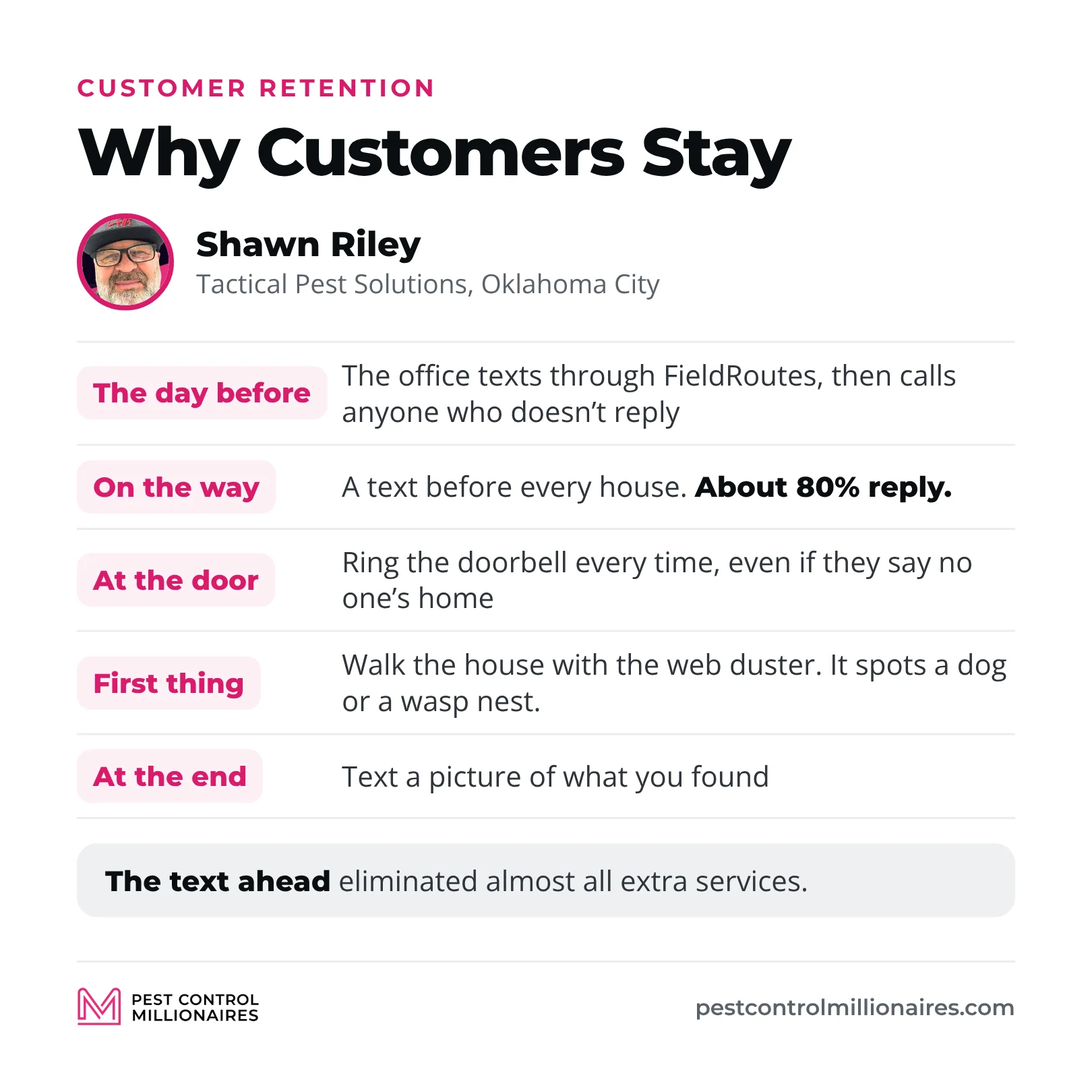
The day before a service, the office sends every customer a text through FieldRoutes, and someone calls whoever doesn’t reply. Then techs text again before every house. “On my way to your house, be there within 15 minutes.”
They used to call ahead and hardly anybody answered. The texts get about an 80% response. Customers write back that they had ants by the window, or here’s the garage code, go replace the sticky traps. People are at work and busy, and they forget to tell you until you remind them. About 99% of Tactical’s customers are exterior only, and Shawn says the text ahead “eliminated almost all extra services.” We automate our own service texts the same way.
Then they ring the doorbell at every house, even when the customer says nobody will be home. Every time they skipped it, somebody turned out to be in the backyard and got scared.
Show them what you found
Every service starts with a walk around the house with the web duster, which doubles as a security check for a dog or a wasp nest the tech wasn’t expecting. Then the foundation, doors and windows, and Niban in the flower beds. I walked through a full service with one of Shawn’s techs in the shop tour.
When a tech finds something, he takes a picture and texts it. Shawn wants a picture sent from every house at the end of the service. “Hey, look what I found. Here’s what I knocked down.”
His reason is simple. “Sometimes this is a business where you do so good you can work yourself out of a job,” he said. A customer who hasn’t seen a bug in two months starts to think they don’t need you. They drop you for a month or two, then they call you back. A picture keeps the need in front of them. “It’s not being deceptive, it’s just being real,” Shawn said.
Buy companies whose customers already call them
Tactical has bought two companies, and both came through its distributor. They’ve used one distributor the whole time and let them know they were interested if anybody wanted to sell. The first, in 2015, had been around since 1968. The owner’s husband had passed away, and she came to work for Tactical until she retired. The second dated back to the 1960s. Its owner passed away, and his daughter sold it. Both deals were self-financed, and an attorney drew up the paperwork.
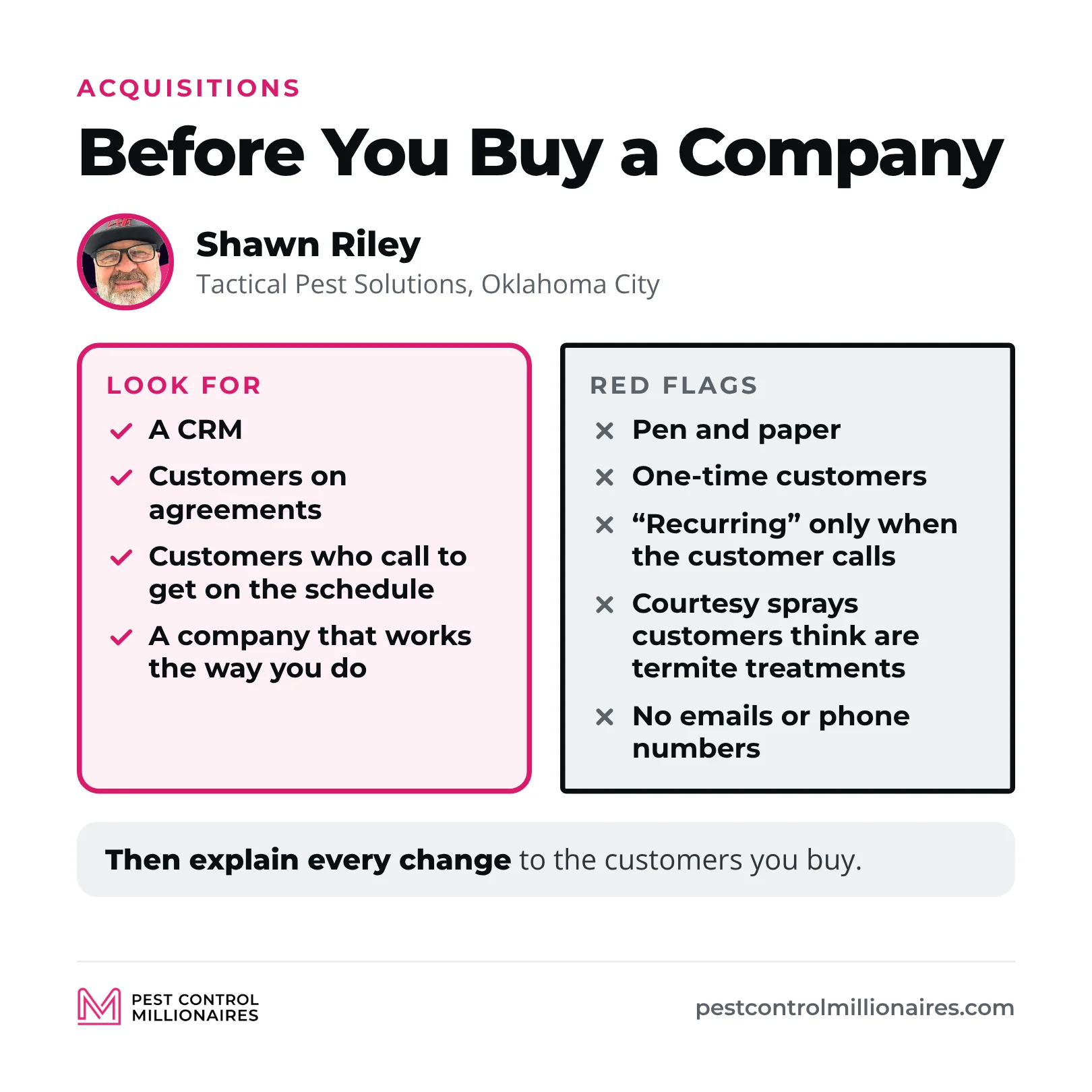
Both were on pen and paper. One office ran its schedule on a yellow legal pad with white tape over the lines. We bought a company with about 5,000 customers whose office called every single customer every spring off a yellow notepad.
Here’s what Shawn looks for now. A CRM comes first. Paper isn’t an automatic no, but it’s a red flag. Customers should be on agreements, and he isn’t interested in paying much for one-time customers. And he wants customers who call you to get on the schedule, because they expect the service. If you have to call them, you’re asking for a yes or no. “I don’t want to search for the no,” he said.
He also wants companies that work the way Tactical does, and he has walked away from a couple. I’ve bought deals I should have walked away from too. Owners get emotionally invested and buy anyway. Get a business attorney who handles transactions and someone smarter than you to look at the financials. More in how to buy a pest control company.
Explain every change to the customers you buy
The second company’s customers were on “recurring” service, but it recurred when the customer called. When Tactical called to schedule, people said they didn’t need anybody coming out that often. Some had an annual termite courtesy spray and thought they were getting a termite treatment every year. One customer was mad because the old owner showed up right at 8 and sprayed 20 gallons around his house, and Tactical’s tech used two and a half.
A company we bought was spraying whole houses top to bottom with power sprayers. But the label is the law. Shawn stuck to his guns, three feet up and eight to 10 feet out, doors and windows. He lost a few customers, not enough to matter.
What kept the rest was explaining. Tactical converted old termite customers, some treated with Dursban back around 1990, to updated Termidor treatments, and customers said this is how it’s supposed to be done. “If you put it where it makes sense to them, they’re like, ‘Well, that makes total sense,’” Shawn said.
On everything else, Shawn eased them in. They took checks at first, then pushed a card on file, and almost all of them have converted. “Keeping them was more valuable than losing them over a payment option,” he said. Just reaching people was hard, because the old company had no emails and usually one phone number per customer. They left prices alone for two years, and it took about a year to get the company running the way they wanted.
I’d move faster on price than Shawn did. On my first acquisition I raised prices slowly, and that was a mistake, so now I get pricing close to our standard right away. My acquisition integration checklist covers the rest.
Lean on your distributor
Shawn’s distributor brought him both of his acquisitions, and there’s more there than deals. Suppliers will come train your techs for free, because you’re buying product from them. It’s a cheat code.
Shawn wants to add exclusion work for his existing customers, but he doesn’t know it well enough to train someone and trust it gets done right without getting on the roof himself. That’s exactly the kind of training a supplier can bring.
Two owners, one answer
Jacob was Shawn’s helper on the furniture trucks too, and he followed Shawn to Terminix, where he became a branch manager. They’re polar opposites, but they have the same vision. “We can talk to a customer separate, not tell each other, and we’ll tell the same thing,” Shawn said.
They still disagree. “I have to swallow my pride a little bit and he’s had to swallow his a little bit to make the best decisions for our company,” Shawn said. “I love him like a brother.”
The problem they had was two bosses. “Everybody has two bosses and that doesn’t always work out because they don’t know who to ask what,” he said. Jacob runs operations, pays the bills and manages the numbers. Shawn runs all the sales and is the service guy for the techs. When we talked, they were both reading Traction to put EOS in place, because they had just promoted their first service manager from within. “I don’t want to be digging into that with key leadership in place and not having a clue,” Shawn said. Once the roles are clear, everyone knows who to go to, and you can run the company off weekly numbers instead of a whim.
Referrals start in the community
Shawn grew up in the small towns of Tuttle, Newcastle and Blanchard, where Tactical does a lot of its work. He joined the community Facebook pages, and every time somebody asked for a pest control company, he put his name out, and his customers piled on with it. Tactical grew 30% a year for the three years before we recorded this. Shawn called it doing nothing. You don’t grow 30% every year by doing nothing.
He backs it with community support. When we talked, they were setting up a Tactical Tuesday at a shake shop on his daily route, giving away $500 worth of shakes in cups printed with their logo. They support youth sports and churches. “If they’re going to pay us money to do their service, I want them to see that we’re supporting their community,” he said. He was nervous about the sticker price on his TRX, but people tell him they chose Tactical because of the truck.
Two years before we recorded this, Tactical had its first $100,000 month, and Shawn was aiming for $1.5 million to $1.7 million that year, on the way to $2 million. His advice for owners under $500,000 was to get on social media as fast as you can, get a CRM that does a lot of the work for you and don’t quit. Tactical ran on Excel for about three years after leaving Terminix, and technology is what he wishes he’d dug into sooner.
Frequently Asked Questions
Who is Shawn Riley?
Shawn Riley co-owns Tactical Pest Solutions in Oklahoma City with his business partner, Jacob. He spent about five years at Terminix, working his way from service manager to salesman to technician, and he and Jacob started Tactical in 2013 with zero customers. When we recorded his PCM Podcast episode in 2025, the company had 14 people.
How do you keep pest control customers from canceling?
Build a relationship from the first visit and keep the same techs in the same areas. Shawn’s techs text before every stop, which gets about an 80% response and eliminated almost all extra service calls, and they send pictures of what they found so customers keep seeing the value.
What should you look for when buying a pest control company?
Shawn looks for a CRM first, then customers on agreements who call to get on the schedule. Pen and paper is a red flag for him, and so are one-time customers and a company that works very differently from yours, because changing everything disrupts the people paying your bills.
How do you keep customers after buying a pest control company?
Explain every change. Shawn eased the customers he bought into his way of doing things, took their checks before moving them to a card on file and explained why old termite courtesy sprays were becoming real termite treatments. I move faster on pricing than he did, but the explaining is the same.
Full transcript
Every word of the episode, from the video captions
Welcome back to next episode, Pest Control Millionaire. Got the one and only Shawn Riley on today. Super fun. Shawn's a super dope dude. This will be a fun one. I'm excited. He I don't have to I don't even need notes for this one. Tactical Pest Solutions out of OKC.
Man, we go way back, actually. It's kind of funny. But, yeah, welcome back. Welcome to the show. So, yeah, you reached out to me last week. He's like, "Man, I can't wait to be on your podcast one day." I'm like, "What are you waiting for?
Let's just do this." And now he's all nervous to do it. So, but again, yeah, super excited to have you here, man. I appreciate it, man. It's an honor. Yeah. How you doing?
How are things? It's crazy. It's busy. Termites are crazy. It's springtime heyday and Oklahoma's nuts. You know it when the termites hit, they usually hit for sure. So, let's go way back. We're taking way back. Shawn, you know the routine. What I do?
If you and I go back to juniors and sophomores in high school, who's Shawn Riley in high school?
Man, just the guy trying to find himself. But I got I got immersed in sports and so football, baseball, just kind of all the way. Captain of the football team, dated to high school, cheerleader, you know. Oh, one of those guys. Yeah, for sure.
Jock all the way. Were you always super competitive growing up, too? Always a little deep, but like I grew up, my dad was an alcoholic and so it was a way for me to kind of hide all that stuff, get dug into sports and weightlifting and just all those things where I was able to hide a lot of that stuff.
Yeah. And you know, you and I have talked about this in the past is about being real and authentic and that's what people resonate to cuz a lot of people grew up that way. So I actually had a couple friends.
Same scenario. One of them both parents are alcoholics. He decided not to drink. His other siblings drink. And I think at his senior all night graduation, whatever it was, he had a stand ovation cuz he never missed a day of school ever in his life.
And if you ask him why, he's like, "Oh, because my parents are alcoholics. I didn't want to be there." You've heard this story analogy before, but this is a real life story of myself. Then you go ask his brothers, you know, why they didn't go to school or why they drank so much. Cuz my parents are alcoholics. I was too. It's like it's so crazy which path you take with the same parents. Crazy. But it's a real life story that happened to me. One of my best friends. So, well, I've never drank alcohol ever. Really?
Never. Never. No. Just I just stay away from it. Yeah. Super. I mean, that's impressive on its own. Like, I commend you for that. You know, I went down my path in high school and not high school, but college. Actually, I didn't even drink till I was 21, funny enough.
Didn't drink till I was 21 and then, you know, kind of the wheels fell off for a little bit and then you know, took me to get a DUI to get my together, but here we are today. But it's just really cool that you know, like it's not cool that your parents were alcoholics or your dad was, but it's just cool that you chose not to. I actually went to school with another kid, kind of the same situation. Never drank a drop. Couldn't get him to drink. It's super cool to have that guy around, too, you know. Yeah. I mean, it just it wasn't never a matter of like I wanted to, but I chose not to. It's just I never wanted to. I didn't go I didn't want to go down that path. I wanted nothing to do with it.
I had so much respect for my dad, but he was a jerk. You know, he's a mean guy. Liked to fight. Watched it all the time. And I wanted no part of any of that. I the fear of being just like him drove me to just it was just not an option for me. So, I just it wasn't like a choice I had to make like my friends are partying and I'm not or something like that. It was just it was never a choice. I hear you for sure.
Is your dad still alive now relationship now? No, he passed away when I in like 94. So Oh, really?
Yeah. And you know, I miss him every day, but I hated every hated every part of what he did to our family. So, Absolutely. So, then what happens after high school?
Like, do you go off college? What's your what's your plan? What changed like walk us through that. So I got a scholarship to play junior college baseball. Did that for a year. Didn't really work out where so after that I was pretty lost cuz when you immerse yourself in sports it becomes who you are not what you do and it's supposed to be the opposite. It's kind of what you do not who you are. And I became that. And so when I got lost without sports and didn't know what to do, so I went to work at UPS, pretty good gig for about five years and didn't really work out.
I end up quitting that job to, you know, several other jobs that I went into. Started a little mowing crew with a buddy of mine. So I felt that entrepreneurial spirit for a while. Just didn't know how to engage in it. You know, and nobody I never even heard the word. Even when I was mowing, I didn't even know what that meant. So, you just get so conditioned to go work a career job and go do the things that, you know, you're supposed to do. Work 25, 30 years at one job. And especially back when I was, you know, in high school, you don't you don't take risk. You just go work and get paid. And retire with a little bit of retirement. But from that I just several other jobs and then my first real gig was I worked for well I worked for a guy delivering furniture and then a few months after that I bought my own delivery truck and contract delivery driver for furniture.
So that was my first real gig into real life entrepreneurial business owner. Yeah. Yeah. And then how do you how does pest control find you?
Listen, this is crazy. So just a little backstory of that. Brandon was one of my helpers. Brandon Peterman. Brandon Peterman. I So I remember that. Okay, this is all coming together. I remember him telling me that's how he knew you because he used to work at a furniture hauling place, right?
Mathis Brothers. And so I own the truck and Brandon coming for me. He was my helper. Dang. Yeah, that's awesome. Before he even started mowing, before anything, he hadn't even started mowing yards. And then shortly after he started mowing yards and then still worked with me and then he actually I bought a second truck and he was running my second truck. So he was in charge of another helper and working a truck and still trying to mow yards and then he got tired of that and then you know there's Elite Lawn Care.
Yeah, for sure. Which we know all the love Elite Lawn Care, especially on this podcast. As you guys know, Brandon is obviously one of my best friends. But so I have to ask just because it's Brandon. How is Brandon as an employee?
I don't think you want to discuss this here. I love him to death. That's why I asked. Holy smokes. Brandon was a handful, but he still is. Oh my gosh. I love Brandon, but we had our issues this time. And you know, he's hard-headed and he's good. Oh, yeah. It's what makes him what he is. So, I have a ton of I have a ton of respect for him. Me, too. He's an absolute gangster in the industry. Again, loved him to death, too. But I still I got to give him Got to poke a little bit because I already knew the answer. I could not imagine working with him. Ask him. Ask him about the time he ran his brand new truck into a pond.
He I don't know if he told you that story, but just ask. Is it?
Oh, you know, I always carry my trusty notebook, so I'm writing down dad's brand pond. So yeah. So you guys, you had a second truck. Brandon's running a truck. Yeah. Yeah. So that Well, married with a young kid.
Unfortunately, my marriage didn't work out. Got a divorce. Doing furniture full-time, being a single dad, was rough. So I have a friend that worked at Terminix, pretty high level. He called me and said, "Hey, come work for me and I'll, you know, put you in a spot." So that's I went to work at Terminix in 2007 and that's where I look back.
Never looking back. How how so how long have you stayed at Terminix for? I'm sure that was a I so I'm sure you learned a ton, but listen, Terminix has its issues and stuff, but like Oh, for sure. We all do. For for me, I've learned everything from that. I think they in the Oklahoma City branch at least really good company.
The guy I work for, he ended up being this VP of in Memphis, you know, under just another guy. So that's I had good direction, good mentorship from him. But yeah, he hired me as a service manager with no experience over about 40 people. That was that was intense.
See, that's pretty crazy because I'm sure you just knew that your hustle, you're already you're already leading pretty good. I mean, decent sized team running our own business. So, just take the same management style, bring it into the company. I get it. So how is that?
How long did you stay there and how was it for while you're there? I worked there right at five years. Good stuff. I mean, and here's what I did. I went as a service manager, got into it, realized how I'm not going to say easy, but how duplicatable this was.
And kind of having the I don't know the beginning stages of like wanting to own my own business. A few short months into it, short months into it, I realized this is I could do this and this was the gig.
So I did it backwards. I went from being a service manager to being a salesman to being a tech. I kind of put myself in those positions say I don't want to do this manager anymore. I want to be a salesman. Then I went from salesman to being a tech and kind of learned all of it. And then right after that I we quit and started our own in 2013. And you said we is there more than you?
Yeah, Jacob, my business partner. Funny. He was my helper at Mathis Brothers, too. Him and Brandon were friends. They kind of just, you know, it kind of worked out. But he's been with me since 2019. He bought his own delivery truck.
And then from there, as soon as I got at Terminix, told him to come over, he came on board at Terminix a year later. And then, in 2013, we exited Terminix and started our own. Gotcha. So, now not just one of you leaves, you both leave. You started a brand new company, zero customers. Walk us walk me through that like the first year both you guys OKC's market as it is, which we all know it's tough market. Oklahoma City's tough. It's a tough market. There's a lot of a lot of good companies here. There's a lot of good opportunity, too. You know, it's an all-season pest control region, so it's really really competitive. But anyway, we Yeah, we started with zero customers. I honored my no compete with Terminix cuz my friend worked there. You know, I wasn't going to and I had no certainty that this was going to work out.
I was I was hopeful and confident, but I wasn't certain, you know. So, I if I had to go back, I could. And we left on good terms. And man, we start I went and got another job at Tinker Air Force Base to work for a year while I was doing pest control. And then Jacob, he got a branch manager bonus and that's what we operated on, like $25,000 for the first year. That's all with two of us.
We started mowing yards and doing pest control and then we just we just dude burned the candle at both ends. For sure. So you're you're doing you're you're doing mowing just to just to stay busy I'm assuming right and then do pest control. Yeah. Yeah. And you know built-in pest control customers right away and they liked us so they just chose us and we knew what we were doing. It's not like entry level pest control. We knew what we were doing. Jacob was the branch manager and he killed it. He was a great great business guy and a lot of cool vision and we just mowed yards and did pest control and then a year later we get into weed control.
We got a couple good deals on some 300-gallon tanks, put them in the back of the truck, started doing weed control, mowing yards and pest control. We did that till we realized none of this was okay except for pest control for us. You know, it was like this is we got to choose something and pest control was the easiest for us, you know. So, we gave 80 100 weed control customers. We just handed them over to Brandon. It's what he does. We just said, you know, it ain't it's not could we have sold it?
Maybe, but Brandon's our friend and it didn't matter. We just gave them to him and just never looked back with pest Are you sick of paying marketing agencies and not getting results?
Well, we are hosting the number one step-by-step class on how to attract and generate sales without paying market agency or having a huge budget. Most lawn care and pest control owners get stuck at a ceiling because they're dealing with outdated systems or relying on guesswork waiting for the phones to ring. Our upcoming class this Thursday provides proven strategies to generate hundreds of leads without a huge budget. We'll show you how to build a predictable system to grow past a million dollars. We show you how to automate your marketing. We'll also teach you how to delegate and build your team so you have more time. So, click the link in the description below. Trust me, you're not going to want to miss this. This is the one thing that I wish I had learned a lot sooner. Now, let's get back to the show. And in the same time, you give away the yards that you're mowing to, I'm assuming, Or we just shut them down. I think we just shut the mowing down. We didn't do much with it, you know. And so, how many years did you do that for the second year?
Probably two two years probably solid of pest control and weed control of it and then and pest till we built up enough business to where we thought we would be busy. So all right tell me that like emphasis on thought what happened there. So you thought you sold this that'd be busy. What year?
So this is 17, right? 18. This would be 13 probably 2015. 2015. Okay, cool. Yeah. So we bought a business. We bought a small business that had been around since like 1968. We that. Unfortunately her husband had passed away and it was kind of dwindling down and she wanted to kind of keep it going. So we bought it for her from her and a few months later she come to work for us. Until she retired last year. So, she's been with us whole time.
All right. That Yeah, that enabled us to kind of get a built-in business to help supplement losing the weed control and the mowing. So, from there, we just man, we just hit the pavement. We you know, we don't door knock or anything. So, don't even know anything about that. The most I know is from what learning in your class and stuff like that, but we working at Mathis Brothers, we have a built-in contact there. We won that contract over pretty quickly.
And it's a big one. It's one of our biggest accounts and you still have it today. Yeah. Yep. Yep. It's big with 28 locations and you know their houses and stuff like that. So, we've been real fortunate to keep and maintain that. So that's how we that's how we overcame losing that and buying that business. And when you when you left, did you start with Tactical Pest Control Solutions or did you change the name or was that the one you bought?
How did that work? The name. So we started Tactical Pest. Yep. Yep. We started that. We went through a bunch of name, I don't know, ideas that didn't really flow and we settled on this just because it's kind of we both respect the police and the military and it just kind of went with what we both liked. So, Right. I got you. That's cool.
And then like those first three years, can you think of like couple days that were just like unforgettable?
Like just bad days in general? Man, I would be lying to you if I told you that all those days weren't scary and some of them are bad, but I to be honest, I don't remember having a bad Not really. I mean, we just Jacob and I have the same exact vision.
We're different people. He approaches things different than I do, but it's the same vision. We can talk to customer separate, not tell each other, and we'll tell the same thing. So, we didn't have a lot of conflicting information going out or It's important. Yeah.
Super important. And I don't want to sound arrogant by any means, but like I just don't remember having really any bad days that stick out. I just I mean, not anything that comes to mind. That's awesome. Well, I mean, people sure have had bad days in the past.
Especially old job when you go get to work for yourself like every day is a new day. You're going to have 10% of your bad days of four days a month like you're going to be worse than others but overall we live a pretty good life you know just in the last podcast too like overall like we're very very fortunate and like in every every business that starts hard in general but how did you guys grow the company?
I know you said you don't do door knockocking but how how were you guys growing because I mean you guys are growing pretty fast. We do we did grow fast. It was crazy. And all referrals to just I grew up so we service this little area called the tri city area Tuttle, Newcastle, Blanchard and I grew up here and I went to two of the three of the two of the three Tri City schools and so I knew a lot of people built it that way able to get Mathis Brothers early and it was just referrals and we didn't know any different man we just joined community pages Facebook groups, all that. And just every time somebody had asked for pest control, boom, you know, we would I would put my name out there and our local customers would just hammer that with our name. So 10 to one, 10 to two referrals and we and to be honest, up until your class, that's all we've done. We've we dabbled in a little bit of marketing, but it just didn't seem to pan out. You know, you got to spend a lot of money paying those people to get anything going.
And it just we weren't spending enough money and we weren't willing to just because it just wasn't working. You know, I wasn't getting a return on investment on that. So, did you guys buy at another company, too, or is that was it the only one you bought?
No, we bought another one that come with a building or the building separate? We bought we bought the second company and it we just leased the building that they were already in. So we kind of just we kind of just took over their lease and their building and that was a really good move for us moving from Tuttle to Newcastle. A lot more traffic and then I don't know a ye two years later or something like that we were fortunate enough to find this building that we're in now and we purchased that. How did you find that company that was for sale a second time?
Both times have been from our distributor. I hear that all the time. That's so awesome. Did you ask him or did he go and tell you?
Yeah, they told us like we asked, you know, hey, if you have anybody, but we have such a good relationship with them and good people that work there and they referred and they may have referred other companies too. They just, you know, they referred us and we've spent our whole time at one distributor. So, there's a little bit of loyalty factor there, I think. And that's cool.
So, that's how we purchased that one, too. Kind of same scenario. Been around since the 1960s. Single owner kind of dwindled down as they got older. He passed away and daughter sold it to us. Really cool. With buying companies like that, a lot older.
They might have been doing a lot of one times, buying those things like I'm not sure what it's like in your area. It seems like common in ours to do a lot of one times or buy by yearlies, you know, because that's just the old-timers did. Did you run into that with with any of the purchases?
So, not very much. We were fortunate that they had regular reoccurring services. The first one was done surprisingly well for being older and had agreements and had termite annual value and stuff like that. The second one was a little more like what you're talking about.
They called them reoccurring services, but they were reoccurring when the customer called, not when we were supposed to go out there, right?
So, when we called people, people were like, "Hey, I don't need you coming out here that often." They used to do this or that. And we didn't match that. So, and then one of my pet peeves is doing termite courtesy sprays, you know, annual courtesy spray that turns into an annual termite treatment to the customer. They think they're getting a termite treatment every year.
We don't do those. We just do inspections and so we were the bad guy. Yeah. How did you over how did you overcome that then what those customers are doing to you obviously in some Yeah we I mean we did a we converted them so we converted them from old treatments to updated Termidor treatments and then they understood so a lot of those we converted a lot of them we just kind of continued to honor the courtesy peskay and we made sure that they knew that was the language not a termite treatment every year so made made a few people mad. Yeah. But were they were they were both companies pen and paper or there some sort of CRM in place at the time?
No, both pen and paper. Fun. That was hard. But you know, yeah, that was that was that was fun. Matter of fact, the lady that ran the office had a the yellow legal pad and she would take white double-sided tape or white tape and stick it on the lines that are already there. And then she would write the schedule and then on the yellow yellow notebook. It was insane.
I only I always started laughing because we went through this two years ago with another company had like 5,000 customers. And the way they had it set up like I get it. It worked. It was pretty neat. A bunch of shelves that are all bug order their routes. Like it was pretty well thought out for like back in the 80s. Pretty cool. I'm not going to lie. Obviously not nothing I want to do today, but same thing like every spring she would call every single customer and every spring she had a yellow notepad that she write down the names and like put a yes or no or what like every single spring 5,000 people. I'm like oh my gosh. So there's a lot of leg work all that just entered in the system in itself you know. Well and just for that the customers are used to what they've done and then you put it in an automated CRM and then they lose their mind a little bit like hey I'm not used to all these calls. I'm not used to all this. Like what are y'all doing?
For sure. They're like they call us like in the spring one time and they all they're going to be out there in the next couple months. Like not the day of nothing. Like you're giving them more information, more data and they don't like it.
Well, just an example, we show up to an 8 to 10. We give two-hour time frames and we gave an 8 to 10 and the guy's mad. He, you know, the previous owner shows it right at the very first 8:00.
Da. He sprays 20 gallons of chemical around my house. You know what?
You guys are spraying two and a half gallons. What are you doing? You know, like that. That was a hard thing to overcome, too. Super. I love that you brought that up because same thing. They use power sprayers.
The company that we bought and they're literally spraying the entire house top to bottom, the entire thing. So, imagine if you're trying to go there even with the power sprayer doing just the base or your backpack sprayer just the base. Like, wait, what?
Like, what do you do? Like, well, I mean, this is the law. You the label is the law. You can't go higher than 3B. What they're doing is illegal, you know?
How did you overcome that with those customers? We just stuck to our guns, you know, like, hey, listen, I mean, I don't know what they did in the past, but we can't do that, you know, and I would show them.
I didn't get too much in, you know, too much information. It's just this is what we do. We're 3T up, you know, 8 to 10 foot out, doors and windows. Well, they used to treat in my garage. I mean, I can pinstream in your garage. I can't treat your No, they used to treat my whole thing as wet. It stay wet for two days in here. And you This is I can't do that. So, we lost a few, but not even a significant amount to even matter.
Yeah. How did you handle like payment? Because there obviously pay cash or check, not cards on file. What did you guys do there?
I just I like the reason I'm asking these questions, I know the answers. I know what we did, but I want all the listeners to go through like just to just to learn from what we had to go through. So if they do go buy a company like older, nothing wrong with it, but like these are the things you're going to have to do to make sure it's put in place going forward, you know. So in the beginning, like we tried to honor everything that they did within the law, you know, over that we couldn't, but if they paid by check, we tried to honor that to make it an easy transition. And then we would try to push, you know, credit card on file and we've converted almost all of those, but we just didn't do that in the beginning.
We tried to we tried to ease into that a little bit and give them a little bit of a break understanding that you know it's a new change and keeping them was more valuable than losing them over a payment option. You know I agree. And then I have two questions to back that up. One did you raise prices year one year two or did you leave them be?
And two was the old company good at gathering information say phone numbers, emails, things like that or is something you guys had to get to?
We kept the prices year one and year two. That's something that we you and I have talked about this that we haven't really done on a regular basis. We kind of we've raised our new customer prices on a regular basis, just not our current ones. So, we left those be anytime we could. If they wanted to do an add-on, we put it to the current pricing or stuff like that. But we didn't we didn't go in and raise pricing. And what was the second question?
I already bought Oh, you're good. Was the current company company that you bought it from?
Were they good at about getting information? No. Yeah. So get no emails, no phone numbers, you know, one phone number. Did you know it was it was really difficult trying to get a hold of people most of the time and I don't I don't know. But one this is how important it is to me to train your customers correctly.
It's a learning experience. I would probably do a little more due diligence on that type of we've had a couple of opportunities again and we've walked away from because just it wasn't worth just the dirty work to get that all done. You know, I we're going to be a little more picky and stuff on who we pick next time. I love that. I think as owners we get too emotionally invested in these deals and we even know we even know we should away but at the same time it's like and I had to do I had so a skill I had to learn too.
We get so emotionally invested in these deals we don't want to just walk away when we know we should and then we buy something that's like that's a lot of work eventually pay off in the long run but timing is probably not right but I love that they brought that up. So you said I'd do more due diligence, which just means you looked more or data, which they didn't have a lot of.
What would you have done different that we can learn from? I would look for companies that match your skill set, you know, because there's a lot of pest control companies that do different than you and your customers are used to that. And then you come in and you really try to change up the whole setting. It's really disruptive for the people that are paying your bills. You know, they pay and if you disrupt that, it's really hard to keep people and convincing them that that you're right and they're and the previous company that they paid years and years to were wrong. That that's a man, that's a hard pill to swallow for a lot of people. Yeah, I definitely agree with that. Just because like they probably have again, they probably have an emotional attachment to that company because they've been with them for 25 years like you said, you know, and then to come in and tell them that they what they did was wrong, which wasn't wrong. You're just improving it.
But it's a hard adjustment. So, you're going to have some churn in there no matter what. But you said to do a pretty good job at keeping most of those customers and you're five years into that deal.
But if you're looking to buy another one, what would you look for? Would they would they would they have a CRM already?
Would they would it be okay if they had paper? Like, what are you looking for now?
Well, I wouldn't eliminate everybody on paper, but I it would be a it would be u that would be a red flag for me. I mean CRM would be the probably the first thing and then agreements. So they would all need to be on agreements and not interested in buying or buying at a high level one-time customers, you know, just not Did you have a lawyer involved who who made the deal happen?
Who made it work? You guys did it all yourself? All ourselves. We didn't. We drew up We had an attorney drop some paperwork, but they weren't involved in it. And I don't know how we do this, but both were self financed. We didn't have to get a loan. We didn't have to do anything. We just paid the own. Yeah, that's really good. And you see that a lot a lot, especially the smaller deals with that, too. Even if they're not small, when I say small, like 1 million below.
Again, it's the owner, two or three guys out there running a business and they've done a really good job. They just can take it to the next level. They didn't either either they didn't want to or didn't know how to, you know what I mean?
So, for us to come in there and take a little Yeah. And so like the guys that I purchased from great dudes too. It's all they've all been pretty good. But there's some that I wish I'd have walked away from too, you know. So I'm right there with you. So again, this is a learning experience. But that's just why I want the listeners to learn like go out and find yourself a really good business attorney that deals with transactions. They're going to save you a lot of money and hassle.
Have someone go in there, look at the financials, make sure you're getting a good deal, you know, send it off to someone much smarter than you or us, you know, to tell if finance the deal. I would say that I would I would be I would look for one that the customers calling your phone number. You're not having to call them to get schedules or calling you. They want your service. They're expecting the service, not ones that you're having to call and ask for the service. And then, you know, then when you're asking, then you're asking for an answer, right?
Yes or no. And I don't want to search for the no. I just we're coming to your house. Yep. I agree. Just look for a reoccurring job instead of like a one time. Just show up whenever you want to. Yes or no. You're random that too.
But yeah, I 100% agree with you there. If you could talk a little bit more about like on the deal specifically, not not so much how you finance it, but like you on board the customers after some time.
How long do you think that process took? I know you have a couple that have been five years, but how long do you think the process took to have it in a good running spot?
Probably a year. Yeah, it probably took, you know, we do most of our stuff is bimonthly services and then we bought that company and they were quarterly some semiannuals and stuff. So getting them trying to get them converted over to bimonthly, you know, we didn't push that too hard, but you know, it's hard to train a customer that's been with somebody else. It's hard to train them four times, you know, to be on your on your on the same page that you are. Yeah. And I and I like biannuals, too, because I feel like there's a lot more touch points than quarterlys, you know, with the customer. Yeah. It took about a year and then some others just took longer. But man, it didn't take very long to go out to a termite annual and they were treated with Dursban and you 19 90 or something like that and convert them over to a updated Termidor and then they were like this is how it's supposed to be done.
Okay, we like this way better. You know a lot of it's just common sense. They just it was never just brought to the customer's attention to where if you put it where it makes sense to them, they're like, "Well, that makes total sense versus what we have been getting." No.
And then I heard you say Termidor. Are you doing all liquid treatments exclusively? Are you using any bait stations or anything like that?
No. Nothing yet. No. Cool. Are you Are you I'm assuming that you guys are using power sprayers still. Are you Are you doing some backpack?
We do We do mostly backpack. The guys you know the backpacks are so good now they put out such good volume that it substitutes I like having the option for the power sprayer just because not every customer can go out and buy a power sprayer so I think it's visually it looks good that's going to be my next question so I just did a video I think it'll be it be put out in next week or something like that for YouTube is a power sprayers versus backpack sprayers the pros and cons of both that I went into detail like how much volume per job per house but then I talk about visual visually what looks better and more professional with no doubt it's a power spray.
So you know you know how TikTok is they sell those backpacks for 80 bucks and they're power sprayers on you know with the backpack and then you so any customer can go do it do it themselves. We know they're not going to do it right. We know they're not going to do it every time, but it's not the point. Like, so I encourage my texts to do both. Like do the front yard with the power sprayer and then put the backpack on and go do the back. You know, that's hard with all the landscape, all those stuff. It's just so kind of a combo of both. Interesting. So there the power spray are still in your truck just for looks basically.
Yep. Interesting. What about when you're doing like trenching or you're doing your termite jobs?
Are you using power sprayers for that? Yeah, we have a dedicated termite trucks. So, they don't they don't we have one termite guy and he has a helper and we have a spare that will get in a truck and go do termite work if we need to. But yeah, that's all separate. Yeah. Cool. What does your truck setup look like?
We don't ever talk about this side of the world ever on the podcast. I'm just curious. Ever. We have toolboxes on one side and you know all of our stuff goes in its we let them organize it however they want and then we have a sprayer in the back and with the tank usually a couple of them have 50 gallon tanks and most of them have 35gallon tanks. How and how many jobs are they typically running a day?
Well they work four days a week so they work four 10our days so they're pretty hammered. Anywhere between 16 and 20 generally. Love it. And you give them a three-day weekend. That's cool. Yeah. Well, they get to, you know, some of them get midweek off, but they get to choose. As long as there's not more than two days, two people off at the same time, then they get to choose. That's cool. Gives them a little bit more freedom to do enjoy life, too. I think it's process for them. They we get the same amount of work or even more out of them. Especially being so hot down there, you know. Yeah. Yeah. And they love getting to spend their time with their family. Yeah. That's cool.
What's your favorite tool in the truck? That's awesome. That's not what I was expecting either, but pretty smart. Yeah. I don't think I even said that. I'd have been like power sprayer for sure. Yeah, flashlight. Because you don't even get the power spray unless you have an issue that you find with the flashlight in my, you know, how we look. So, and we're a termite company, so we're looking for termites all the time, too. What's the What's the revenue split from commercial to residential and termite work?
Not any numbers, just percentages. Just curious. Oh, man. I would say it's probably 70 30 65 35 residential to commercial. We really want to grow we really want to grow the commercial side even more. So but that 35% drives most of our revenue you know it's crazy. So termite work I don't I mean it might be 30% of our revenue total. Gotcha. Are you doing are you doing a lot of wildlife stuff too or do you No wild zero nothing no exclusion work something like that?
No. Is it on the radar to do in the future or something that you just don't want to do?
Sub it out to someone else, make someone else as good at it? No, I think that exclusion work is something I'd really want to get into because I think there's some value there to our already existing client base and pretty pretty good revenue stream.
But having somebody that knowledgeable to do it that I could trust without me having to get on a roof and do all that, I don't mind doing that. I just I don't have the knowledge myself. So, how do I trust that it's going to get done right without without training them and I don't know what I'm doing on that part?
I mean, I know what I want. I just I could figure it out. Shout out to AAC. They're great. They have a lot of training. AAC. Yeah, they're actually right out of in here in Indiana. Don't quote me, but might even be in Michigan. I don't know. Don't matter. Somewhere down there.
But they have they have I think it's Indiana, but yeah, they have awesome training. Jack Sals, great great dude. Taught us bunch of stuff. He's come and visit us a bunch of times. He's done online trainings with us. He's come to our shop and done trainings with us. So a lot of great information.
That's what I tell a lot of people like, "How do you train your guys?" I'm like, "Well, obviously train them, but if you just reach out to your suppliers, they have so much training for you guys already. It's a cheat code.
They'll come in for free because you're buying your product from them. They come for free and give you anything you need to know about your product and how to do it or how to apply everything, you know?
Yeah. I mean, I'm learning these cheat codes just by your class, man. Like, it's like you've always been somebody that I've you know, looked up to and stuff, but your class is really killer. And I like the word cheat code because it's that all your guests, all your people, all your expertise that you bring to your show and it's kind of priceless. And just the networking portion of what you're doing is incredible. So I appreciate all that for me anyway cuz we're I don't like to say we're old school, but like compared to what you're doing, we're old school and realizing that we have I think what we've done the way we've done it is kind of crazy without doing any of the things that you've done. Right. So, I'm super excited about our future implementing all the things and really taking advantage of these cheat codes, you know.
Yeah. Well, I appreciate that. So, I don't ever pitch the class on podcast ever. I'm not other to do that. Just helping people as we go. But I'll take it. So, thank you.
What is one thing that you wish you would have known when you started that you know now?
Maybe more the technology side of it. You know, when we started, we started with Excel. We kept it. We kept everything for about three years on Excel. Even though we came from Terminix with a CRM, we just we got so busy so fast, we just couldn't decide which one. There were so many out there.
And we in the end we chose PestPac and while I like pest it was expensive and then we went to FieldRoutes and it's less expensive but it has more problems you know so it's like and then changing from CRM to CRM is like oh it's a nightmare. I'd love to do it, but the thought of having to go through that with this many customers, like I'd rather just deal with the pain that I'm already dealing with. Like the pain to go to that sounds like more pain than I'm dealing with now. And I feel like that's how they got you locked in anyway, you know?
Well, and everything converted over wrong. We had to go manually do it all anyway. They wanted like four grand to transfer the credit cards on file. So, we did that manually. I wasn't giving them that money just to push a button.
We've done that in the past with with smaller acquisitions, too. And we actually just hired a VA for like a couple hundred dollars, had them do it all for us. Not the credit cards, but everything else, you know. Yeah.
Yeah. So, technology was probably what I wish I would have dug in a little bit more. I think it would have made all of this easier, faster. So, and then listening to you guys and Jake and stuff, it's like realizing that we're really missing our opportunity by which is funny because actually for the listeners that don't know which they wouldn't know this when I started when I got into pest control, Brandon connected me with you. That's how we first got that's how we first got connected.
It feels kind of silly to say that you reached out to me and we talked about stuff, you know, winter services and stuff like that and then here you are killing it. Yeah. But I again like I was already in business. I already built a pretty good size business and then I was just starting into a new new endeavor which is in pest control. I didn't have clue. I there's like Shawn, I told you this before, you probably forgot more about pest control than I'll ever know and I don't really care to know. Like I of course I know enough but I don't know in detail like you guys do.
But I hired those people that are really good at the job and I had a little bit a little bit of money because I sold a company to put into this one. So definitely helps you know make things faster.
But it's funny like going back to like I reached out to you originally like that's how we got connected and now here we are. You're saying you're learning from me. So it's just kind of funny. Yeah it's really cool.
Talk a little bit about your business partner. Like I know like I have business partners, you have business partners. Not every day is a great day. But I knock on wood. I mean it's been pretty good so far with all my partners and but it's not always easy. You have to have some tough conversations for sure.
No. And it's not. But like I wouldn't I we wouldn't be here without him, you know, and we've had just I'm going to say rough days just like you said, not every day is nice. We've had disagreements and all that, but we always come down to making the right decision regardless. I have to swallow my pride a little bit and he's had to swallow his a little bit to make the best decisions for our company. And you know, we both are high we're both high spenders. So, you know, our profit probably a little bit lower than it should.
I bought a TRX for a, you know, for a work truck with Tactical on the side and he's got a big lifted mega cab. But like, you know, other than that, like we get along. I love him like a brother. I wouldn't I wouldn't do this with anybody else. And I mean, yeah, we do weld and he's been with me since day one. Really 2001.
Yeah. Before Yeah. Before when he was my helper. Yeah. Yeah. And so we've been together a long time and it's just I don't know we do a good job together. We work together. He's he's polar opposite on my personality. Yeah, that those could be my future questions like what are the roles inside the company and then what where do you excel where he maybe isn't so great and then vice versa?
How do you guys make that work? We kind of get into a situation where we both run the business and so everybody has two bosses and that doesn't always work out because they don't know who to ask what. We've kind of we've kind of muddied the waters on that a little bit. I'll decide at one time and then he'll decide at the next time. So it creates a little confusion with the employees, but we generally both have the same answers. So that's good.
He's real organized. He's he runs kind of our operations the daily stuff. He pays the bills and kind of manages the numbers part of it and I'm more in the field. I run all sales. I'm the only one that sell.
I say only Jacob will go out and sell too when he needs to. But for the most part I do all the sales and I'm generally the service guy for my techs. And as I say that I'm in here in the AC doing a podcast and he's out doing a termite job by himself. Like we just allegedly you're here.
Yeah. Yeah. No, that's cool. Yeah, and like I said, you know, early on I thought that having a partner again early early on in my career, I was like ah it'd be a bad thing. And then like you just said, like without the partners that I have now, I couldn't do anything what we're doing today. And they've all been great. Of course, like you said, we're going to have bad days. We're going to have some disagreements, have to have some tough conversations, but that's just part of life in general. Like, I'm not and I'm not one to like avoid a hard conversation. Like, I'd rather just go directly to the source, get it out of the way, and then just move forward the best way we both can. You know, it seems like that's what we do. And I think if it wasn't him, my partnership wouldn't have lasted with anybody else, right?
I have so much respect for him that even though if I disagree, I still like we'll get to the hard stuff and then we'll deal with it and then we move on and then we're good, you know. Yeah. So, when you were over at Terminix, you were doing sales there. Is that why you took the sales role here or is that just something that you kind of groomed got groomed into?
I think we just grew into We both did sales, you know, we'd go do it together when it was just us and then like in the same truck we'd go do what we go to the same customer, right?
Pull up, two of us get out and then it just kind of transitioned into he was a branch manager so he kind of knew how to the operating part of it to where reports and budgets and all that stuff where I was always just a service guy so it kind of naturally just manifested that and one of the books that you recommended traction we're both reading that right now getting into that so we're going to we're going to implement the EOS system and have a little bit better vision for everybody, you know, us too. I think also I think like once you guys decide who's what role, right, it'll help you, it'll help him, it'll help your entire company know who to go to and then the seats that you're covering. So if they have a operations question or they have a HR question, like they'll just know who to go to. Make things a lot easier for everyone involved. And so that's what I was going to say earlier, but you brought it up, so worked out pretty good. But Traction is a great book. In fact, I think I've talked about in the last three podcasts and I talked about over and over and over again and some people it might be too big for, right?
But you're at a great size now where you guys start thinking about things like this and it'll change your business forever. Just look at your KPIs like on a weekly basis like and watch all the data like now you can make decisions just off not just off a whim but actually look at the data, watch what's happening on a weekly basis and it's just something you guys need to do, you know?
Well, here's the thing. We're just I'm just a technician, man. I'm just out here doing the best I can, trying to run a business and that's it. So, I've reached my capacity. Yeah, I wouldn't say you've reached it yet, but now you just got to grow, you know, like again, like we always have to evolve, right, as people and as leaders. And so, like now you just have to recreate yourself. And I always say that you should be recreating yourself every six months. You can't be the old version. That's what I was going to say of like I've reached my capacity of my knowledge base on how to how to run my business the way I know how. So now I got to train myself to be better. So that EOS was perfect for us to start to implement that things. And that way I don't even have to run it. It just flows, right?
So how did you approach Jacob with the book idea? Was he open to it right away?
Yeah, very much so. Yeah, great idea. We need to do it. He's listening to it on the podcast on the audible and so that that was an like I said, we're always on the same page. We don't ever conflict with a bunch of stuff. So you're like, "Hey, there's this book that you got recommended. I think we should read it." Is how you pitched it?
Yeah. Yeah. I said, "Hey, dude, like Jonas recommended traction. I've got halfway through it. You need to do it." I sent him the link. And what have you thought so far?
It's a little overwhelming because there's a lot of information that I don't know much about. I understand flowcharts and I understand, you know, KPI stuff, but getting it all implemented and having these meetings and h like just all this stairstep stuff you do seems pretty intimidating in the beginning, but I can see the value of once it's implemented, it just kind of takes care of itself. And it's just like anything else that you do. Like the first couple times it's going to be a little rough. It's going to take a little bit longer with anything, right?
So, but the more you do that, like every week in like your two or three years in, it's going to be like couple clicks of a button, got the report, couple clicks of a button, got the report. Now, you have this dashboard built out. You pull up every single week. It's like, oh, here it is built out. It's awesome. Let's check all of our data. Roll forward. Well, one thing I want to we want to implement this because I say early, 13 years isn't really early, but like we hired our first service manager. We promoted him within. And so implementing this EOS system right now and then as we grow, I anticipate us kind of growing faster than we've ever grown.
I don't want to be digging into that with key leadership in place and not having a clue, you know. So, I think it's critical that we get this in place so we don't fail the people that we hire. Yeah, that's super awesome.
I know you said a lot of it's been off referrals, but what else has been really really working for you guys for to help scale your company?
Jonas, to be honest, we've failed in a bunch of those things to scale. It's just it's incredible. We've grown 30% the last three years doing nothing. It's amazing. I mean, just going out and servicing. But you didn't do nothing because you did a great job.
You have I mean, you're a great leader. You have great technicians. You're branded about like you didn't just do nothing. You don't get you don't grow 30% every year by doing nothing. So I guess branding would be the biggest thing that we've done. We just brand. We just we do a lot of community support. I mean I'm doing a ah see now the real stuff's coming out. Yeah. So Herbalife Shake Shop right up here in Newcastle. One of my stops that I make every day. Have a shake. We're doing Tactical Tuesday there and we're going to give away $500 worth of shakes to the first people that come in. You know, with our I had some cups printed with our logo and they're going to put it in that for me. And so just branding really kind of community support. If they see if they're going to pay us money to do their service, I want them to see that we're supporting their community, the youth, the sports, the churches, whatever we do. We try to be involved in all that. Yeah, that I love it. Like I said, you're you're putting yourself out there for sure. Is your new shop is it on the highway or something like that?
Remember you saying right on Yes, right on the highway. How much do you think that helps or doesn't help?
Do you I know. Please tell me. Kind of crazy. The place that we first were at was in kind of this little dumpy building, but prime location. We moved a little south and it's down a hill, but our sign is giant and people drive by it and they've never even seen it.
So, I think our location has kind of hindered us a little bit compared to the and we're less than a mile away. So, just because it's down a hill 20 feet and that's it. Like it sets down and you drive by and don't even know.
But compared to where we were in the beginning, it's just a tremendous location. We're getting a the biggest Indian hospital in the country is getting built a mile away. A new fire department got built across the street.
Like, 1500 houses are going in as we like literally a quarter mile away. So, I think the vision is going to get there more. We're just a little bit outside of a stoplight south that nobody sees, you know. So, but we'll get the traffic pretty soon. So, I think we got a great location. And there are a lot of tons of people move in and out of OKC.
Does that affect your churn at all? Do you guys hold your customers pretty well?
What does that look like? No, we don't have our retention is awesome and I don't I don't we don't have any issues with keeping customers. You know, maybe income base, maybe you know, financial reasons, death, moving stuff, but no, moving is like a non-issue.
So which is great. So I'm going to talk a little bit more about that. Why do you think that is?
You and I have talked about this outside the podcast, but why do you tell the listeners why you think your attention so well?
Man, I've been real lucky. I say lucky on my technicians. They're just incredible. There I think it's relatability. I think when you form a relationship with your customer from the very beginning, it's just that's that locks you in for however long they can afford to keep you. So, do you have your technicians work the same route all the time?
Yeah. Yeah, they're in their same area. Yeah. I have a guy we hired part-time and then he turned into full-time and now he's single guy and then he married got married had two kids and people give him car seats and they give him diapers and they invite him to they come to his showers and stuff. So, it's like that kind of relationship with your customer is I it's more than I expected that we would get, but I think it's just having some kind of relatability to every customer keeps keeps us Yeah. Walk us through walk me through walk me through a service from a technician from start to finish. Well, first of all, so we call the day before. Our office calls the day before and lets them know we're coming. You know, we don't give time frames to them, but we have twohour time frames, right?
If they ask, we'll give them. But this is all done manually, too. Not leaving a voicemail bomb. Yeah. That we send out. We send out a with our FieldRoutes, we send out a text. Boom. Gone. You're right. And those that don't reply, we call. I have a girl call.
And then so our texts when they start their day before every customer before they arrive at every customer's house they we call them we send a text ahead. So you know hey this is Dawn Ram on my way to your house be there within 15 minutes boom out tons of response for that. We used to call them every time with no response and texting is about a 80% response rate and then it's like thanks Dandre.
Hey, I had ants by my window. Cool. We've found out that eliminated almost all extra services just by a text ahead because they responded. You know, they're work, they're busy, they forgot. Oh, he's coming. Tell them about the spiders or the ants or whatever.
Hey, here's my garage code. Go in my house and replace the sticky traps or whatever, you know. 99% of our customers are exterior only. We don't we very rarely go inside, you know, on request or but we don't I don't even know if we have 10 that are regular services.
Besides commercial residential anyway. So then they get to the house regardless if they're home or not. Even if the customers tell us they're home or not, we ring the doorbell without fail. Cuz every time it's happened where we don't then somebody's in the backyard and it scares them, freaked them out, you know, whatever.
Knock on the door, we start by web dusting. We walk around the house, web dust. I tell them to use that as a security, you know, like a dog or anything that they might see, was nest that they're not looking for.
Then they do a regular pest control service, foundation, doors, windows. Yeah. Doors, windows, and then we come back with a we don't use granules, but we use Niban. So, we put Niban in the flower beds. And so, and then then we try to take any pictures of any issues that we have and we text them again, you know, if we find something that they didn't see. And I don't know that they do it like they need to, but I encourage them to take a picture at every house and send it at the end of the service. You know, hey, look what I found. Here's what I knocked down. Here's ants that I found or whatever. Just creating a ongoing need for pest control. You know, if sometimes this is a business where you do so good you can work yourself out of job.
So you always have to create a need or and it's not being deceptive, it's just being real, you know. Yeah, it is because people don't see bugs for two months and all a sudden they don't need your service because you did such a good job.
Well then if they drop you for an extra month or two then they're calling you back because they need service again. Just more play that's preventative, you know. Love it. It's crazy because I already been on this an hour and I don't want to think about all all day. So, I'll try to hurry up with this.
What's your business goals or personal goals over the next, you know, 3 to five years for Tactical?
Man, Jonas, we're, you know, it was such a milestone for us in the our vision to hit a million dollars, So, two years ago, we had our first $100,000 month. And I thought, what the heck?
You know, our first year, we did $100,000, you know, and then here we are hitting $100,000 month, and now we're not not hitting $100,000 month, you So, we're just we had a we had a vision of trying to have a 50% growth this year versus 30% the last two years.
So 1.5 1.6 this year we're trying to shoot for 1.7 whatever trying to get to that 2 million but in the next three to five man I want to be super aggressive and in five years I want to be close to $10 million and I know that might be hard but that's I want to push. Yeah, you guys will pull it off for sure.
Then I know like you're like you got some crazy engagement on some Facebook posts like recently. It hasn't all turned into leads, but when we put I don't I don't know what's considered good and stuff. Jake said it's like really strong and just we've never done it, you know, and now we here we are just hammering post once a day, twice a day and then putting ads out and we're getting some engagement there and it's it I think that's the future of our growth. We have to.
So, you know, o on top of our I don't think our referrals are going to slow down. I mean, I think that that we just our community referrals are so solid and we just get we have to get into other communities and do the same and replicate that in communities that I'm not a part of, you know, outside of my hometown, you know. Love it. And then personal goals.
You've inspired me to be part of this 75. I haven't done that yet, but I really want to dive into that. So, my mindset is I'm all or nothing. If I if I waver, I won't do it, right?
Or I'll cave and I'll cheat. I've been doing fasting for some. I did a 110 hour fast. I usually do a 75 hour or 70 hour 72-hour fast once a month. So mentally I just got to get to that 75 hard. But that's what I want to When's the start date?
This is the reason I told you because I need some accountability. So, and plus every guest that you have on either boxes or jiu-jitsu or, you know, they're all whatever. So, I'm a little envious. It's not funny. It just I see it happen over it's like over and over and over again. You see it so many times like you can't unsee it. It's like the evolution of an entrepreneur like they like they're they put so much time and effort into their business and they which is great but then they forget about themselves that I'm one I'm one of those people that you like lose yourself or you lose a lot like you stop taking care of yourself putting all the business you're working like he said burning the candles that each end of the stick you're working night and day trying to build this thing because you don't have any you don't you have to you don't have another option then you forget about taking care of stuff and all a sudden they're like they changed from working on the business 100% of the time like now it's like working on the business 75% of the time working on themselves 25 25% of the time.
We started this business to have some freedom and I've taken advantage of that freedom quite a bit and I don't want people to mistake freedom for lazy, right?
So, I've had man I've been so thankful that I got to I got to coach my daughter in softball. We traveled all over the country playing travel softball. She was fortunate enough to get a scholarship to play. I wouldn't have been able to go to any I would have missed all of that if I would have been working at Terminix still or just working for a job. So the freedom to make those choices are worth every sec. I would do it all over again.
But I don't want again I don't want people to think that that's time off, right?
Still working, still like calling the guys, still talking when I'm out of state doing the thing, still have to deal with a wrecked truck or whatever. One of the cool things about having a partner is you can kind of do that and somewhat check out while the business is still being handled. So that's the cool part of having a partner. But I wouldn't My Jacob's daughter's getting to the age where she's in travel ball and going to be traveling all over the country. So we roles have kind of flip-flopped. Yeah. Yeah.
But man, personal goal is just to take care of myself a little better. But I don't money it's cool. It get it makes some choices a little bit easier, but I'm not money driven. My whole thing when we first started this is just to provide a living for people, man. And be be able to provide and we have 14 people work for us and knowing that they count on us to make a living is I process to me. It's a lot of pressure, but it's so cool to see. Like I said, my one of my guys has been with us since before he was married and now he has two kids and been with us and you know, we provide for him and it's super cool to be able to see him flourish as a as a dad and as a husband to provide for his family and that's what motivates me and that's what wants me to keep going and keep growing this business to give that opportunity to everyone.
It's awesome. And the last question to wrap this thing up, what's one piece of advice I'd give, you know, someone doing less than 500K in revenue, just getting the hustle going. Man, I would jump on the I would just jump on social media as fast as you can. I would I would engage in all of that that you can learn that. Get a CRM that does a lot of the work for you.
And I would just say just dig in and just don't stop. Don't quit because sometimes it seems like it's easy to had unmotivating days to not want to do anything, but you just got to pile through them and work on them. And then after that 500k, man, it just seems to kind of just come on its own. Like I've always said it too, like 800,000 is the sweet spot. You got to get there as fast as possible. Yeah.
Because it's like I don't know, naturally it just comes on its own. It's like your name is out there. People start calling you. They want you. They're like, "Hey, I like the way you're you know, I told you earlier I bought a TRX and I was so afraid of that because of, you know, the sticker value and stuff." And I'm telling you, I got so many businesses or so many business opportunities off of my truck. Hey, we chose you cuz you're truck. We like it. We like if you do if you can do that, then you do good work. So, it was the opposite of what I thought.
It was crazy. So, anyway, don't sh don't shy away. Don't quit, man. You if you've got the 500,000, then you just got to keep going. Yeah. It's just consistency, right?
Showing up every single day. Just has to be has to be no matter what. Plus, it's an example for your people, you know. Absolutely. Couldn't agree more. Leadership starts at the top. You got to lead from the front, right?
Awesome. Well, we'll end it at that. And as as always, you know, thanks for your time, Shawn. I'm sure I'll talk to you soon, but thanks for taking time. Thanks for dropping some knowledge bombs on us. We appreciate, man. Yeah, Jonas. Appreciate you a lot, man. Keep doing what you're doing and you're an inspiration to a lot of people. Appreciate it. See you, man. Yep. See you. Hey guys, thanks for listening to another episode of Pest Control Millionaire. We don't charge any money for this show, but the podcast isn't free. Please like and subscribe or give us a five-star review in your favorite podcast app. This makes a huge difference for us. If you have any specific questions about your business or your personal life that you'd like answered by me or any of my podcast guests, please send an email to info at pestcontrolmillionaire.com.
And if you want to get in touch with me about our marketing class, we do a live version every Thursday night. Check out our website at pestcontrolmillionaires.com. Thank you guys for listening. I'll see you guys in the next one.
Watch the PCM Podcast on YouTube