

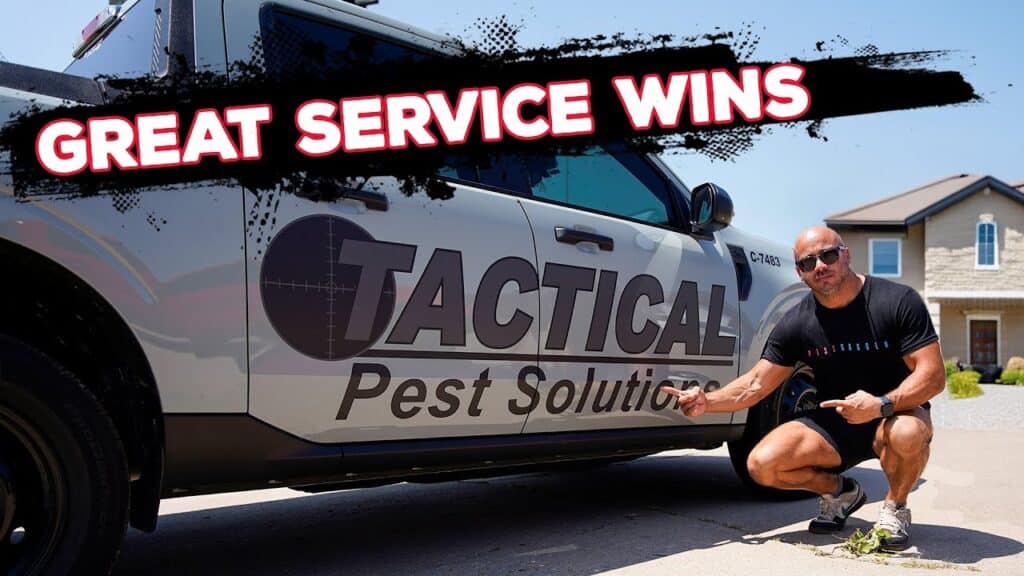
We just wrapped up an awesome trip out to Oklahoma City to visit Sean and Jacob at Tactical Pest Solutions. Got the full tour of their shop, rode along on a couple of jobs, and picked up some really solid takeaways that I think any pest control owner can benefit from. Let me walk you through the whole day.
Table of Contents
ToggleThe Shop Tour
First thing we did was tour their headquarters. Now, these guys have a story. Their building flooded back in February of last year when an ice maker line froze in December and burst. The remediation company didn’t even show up for over two weeks, and by that point, they had to gut almost the entire building from about halfway down. It took nearly a year to get the remodel done.
But honestly, the place looks great now. Everything is new. Jacob’s office is in what used to be the bedroom when he was literally living in the building while they were getting the business off the ground. That kind of scrappiness tells you a lot about who these guys are.
They’ve got a break room with a basketball hoop and snacks. If you see a basketball hoop in a pest control office, you already know it’s a winning company.
Out back, they’ve got a huge lot with room for future growth. They’re planning to build a shop back there eventually. Might be overkill for a pest office, but I love that they’re thinking ahead. And they bought the property at a pre-COVID price because they were locked into a three-year lease-to-own and closed right before prices blew up. So they got in with a ton of equity from day one. Smart move.
Their Scoreboard and Culture
One thing that stood out immediately was this big printed scoreboard they have on the wall. Before the flood, they had it drawn out on a whiteboard. This time around, they got nicer boards and had everything printed. It tracks their main KPIs each month. Simple and visual.
They don’t have dedicated sales reps. Their technicians are the sales force. Sean and Jacob have always been the main salespeople, and they recognize their techs for the effort they put in on that front. There’s a leaderboard for tech sales, which I thought was a nice touch.
They also started a “Rockstar Service Award” this year. It’s not a participation trophy. Multiple people can earn it in the same month, but you actually have to earn it. They give out things like $200 gift cards, which might sound small, but think about it. That buys groceries. That buys school supplies. When you’ve worked for somebody and they recognize you for something, even something that small, it goes a long way.
Truck Setup and Equipment
We got to check out their truck setup on one of the newer Ford Mavericks. Clean build. Camper shell on the back. Here’s how their technician Will had it organized:
Inside the cab, he keeps his crawl suit, hard hat, shoe covers, extra glue boards, tools, and paperwork. Contracts ready to go for new customers. Everything he doesn’t need moment to moment stays tucked away in there.
First cabinet in the back is the chemical cabinet. Locked. Everything from ant bait to roach bait, flea treatment, Delta Dust. All of it on the truck and ready to go.
Behind that, the rest of the setup: Niban granular bait for ants, two B&Gs (one for interiors, one specifically for fleas), Final rodent bait, gopher bait, a backpack sprayer for houses where it’s hard to drag hose around, and a couple extra rodent stations for customers dealing with rodent issues outside.
On the other side, the power rig. Electric pump, super quiet, good pressure. 25-gallon tank on this one, though they have trucks running up to 50 gallons. JD9 gun, reel, and a backflow system that mixes the chemical automatically when they need a quick mix.
I asked Will what he prefers, the power sprayer or the backpack, and his answer was honest. It depends. The power sprayer is more convenient when the route is easy and there aren’t a lot of fences or obstacles. But when you’re dealing with bigger properties, pools, heavy landscaping, all that stuff tangles up the hose. In those cases, you fill up the backpack and you can usually empty the whole thing around a single house.
On average, they’re using 3 to 4 gallons of Talar around a normal-sized house with the power rig.
The Service Walkthrough
Will walked us through a full bimonthly pest control service from start to finish, and I really liked their process.
Step one: web dusting. He grabs the web pole and does a full pass around the house, knocking down every web. This does two things. First, it gives the customer something visible. They can actually see that work was done, because once spray dries, you can’t see it. Second, it doubles as a visual inspection. While he’s walking the perimeter with the web pole, he’s spotting wasp nests, mud dauber nests, anything that needs attention. So by the time he comes back around with the sprayer, he already knows what he’s dealing with. No surprises.
Step two: foundation spray. They start at the furthest point from the truck and work their way back. Three feet up the foundation, 7 to 10 feet out. Will also likes to hit the sides of windows and the seams up in the eaves. It’s a little extra, but it makes for a better treatment.
One thing I appreciated: when there’s a lot of stuff on a customer’s patio, like grills and furniture and things people sit on, Will doesn’t spray all over it. He makes a wider band out in the grass instead. We’ve all gotten those calls from customers saying the technician sprayed their furniture. Avoid that.
Same thing with dog bowls. If they’re out, flip them over, and then tell the customer at the end so they can refill it. Little things like that go a long way. The customer feels listened to and taken care of. And treat every house like someone’s watching, because nowadays, everyone has cameras.
Step three: bulb dusting. This is where they hit the weeping holes in the brick and any little voids in the walls. Quick explanation on why that matters: brick homes have a veneer layer on the outside with studs behind it. The weeping holes let moisture escape and air circulate. But spiders love those spots. It’s moist, it’s dark, and they go in and out of those holes all day. Dusting them keeps the spiders from coming back.
The timing on this changes with the season. Right now, spiders are the big issue in Oklahoma, so they’ve switched over to dusting a little earlier than they normally would. In the winter, they’ll use granular bait in the landscape beds because it can penetrate down to the soil where the bugs are. It’s not a cookie-cutter service. They adjust based on what’s happening.
The whole service took about 30 minutes. That’s thorough.
The Commercial Account
After the residential work, we had a really cool opportunity to go see one of their commercial accounts: Two Fellas Moving Company, the official moving company for the Oklahoma City Thunder. Pretty cool client.
This one was interesting because the building is a shared warehouse space. Multiple businesses operate out of it, and Tactical only handles their section. Two Fellas doesn’t just move stuff. They also store household items for customers who aren’t ready to move into their new place yet or who are relocating to another state. So you’ve got all these crates of someone’s personal belongings sitting in a warehouse. That makes pest and rodent control critical. You absolutely do not want rodents getting into stored items that are going to be shipped to someone’s new home. That’s a nightmare scenario.
Inside, the technician Caleb was hitting corners and thresholds for general pest, plus they’ve got insect glue traps placed behind doors and in hidden spots. In a commercial office, that’s almost a must. You’ve got people working in there who don’t want to see anything crawling around. The traps help keep it to a minimum.
Most of what they’re dealing with in there is crickets, earwigs, brown recluse spiders, and the occasional oriental roach. The brown recluse loves a glue trap. And that’s really the main target because those are the ones that can actually hurt somebody and will absolutely freak out a customer.
They also service interior and exterior rodent stations at this account. The interior stations are tamper-resistant, locked with a key. One detail that’s easy to overlook: when you’re cleaning out and replacing bait in those stations, you have to get rid of the loose filler material that falls out of the bait blocks. If that stuff drops on the floor and someone brings their kid or their dog to the office, you’ve got a real problem. Clean it out every time. Fresh bait in, old debris gone.
One more thing I noticed during the commercial job. There were some old bait stations from the previous pest control company that were still sitting around. The old company never picked them up. My advice? Pile those things up, put them by the front door, and let the business owner know. Have the old company come get their stuff. Our name is on the bait stations out there now. Our name is on the agreement. I don’t want my technicians accidentally servicing another company’s equipment, and the old boxes weren’t as clean as ours.
Residential vs. Commercial: My Take
We get asked this all the time. Should you do more residential or commercial? I still lean residential personally. That’s been my background for a long time. I like the model: get in, get out, card on file, not a lot of accounts receivable headaches.
But the other side of the coin is real. When winter comes, commercial work is steady, consistent income. Accounts like Two Fellas are ideal. Not a ton going on pest-wise, easy to service, doesn’t take long, and they’ve been a client for 10-plus years. That kind of relationship is valuable.
I’m not looking for commercial accounts that are actually infested. I’m looking for clean, low-maintenance accounts like that one. I’d take more of those all day.
The Big Takeaways
Working with Tactical Pest Solutions was awesome. They’ve been in business for 13 years. Early on, like most of us, they were taking every single job under the sun. Some accounts an hour and a half, two hours away because they just didn’t want to turn anything down. Sound familiar?
But as they’ve grown, especially over the last three years, they’ve gotten serious about route density and building up their team. And they’ve done a great job. Their technicians are skilled and well-trained, and you can tell that comes from the top.
We met their CSRs too. Great people. Great culture. You can tell everyone is genuinely happy to work there. Their attrition rate is under 1.5%, which is phenomenal. That tells you a lot about service quality and internal communication.
The next phase for them is putting fuel behind the fire they already have. Getting their marketing spend dialed in, figuring out their CAC and LTV, and really pushing to scale. That 1 to 3 million range is a tough spot to be in, and the goal is to get them through it as fast as possible.
One more thing. Will, the technician who walked us through the residential service, is a college student working part-time over the summer. He’s studying business management. As a business owner, I wish I could hire a hundred of him. The kid clearly loves the job.
And if I owned this company, I’d already be thinking about how to tie his goals to the business long-term. He wants to finish his degree in business management. Where does that fit within the company’s future? That conversation might not happen today or next month, but the long-term play is to match his passion for the industry with his education and find a spot where both sides win.
That’s the kind of thinking that separates good companies from great ones.
If you’re a pest control owner and you’d like to have us come out and take a look at your operation, hit us up. I love doing these visits. I learn just as much from you as you do from me. See you in the next one.
