
Pest Control Business Plan Template Built on Real Numbers

Table of Contents
- What Goes in a Pest Control Business Plan
- Service Area and Route Density
- Services, Your Recurring Plan and Price
- What a Customer Is Worth and What You Can Pay to Get One
- Marketing Channels by Stage
- Hiring Triggers
- Budget and Cash Flow
- Licensing and Insurance Basics
- Milestones From $10K a Month to $1 Million
- Run the Plan Off a Weekly Scorecard
- Frequently Asked Questions
A pest control business plan should fit on one page and answer eight questions with numbers. Where you’ll work, what you’ll sell and for how much, what a customer is worth and what you can pay to get one, which marketing fits your stage, when you’ll hire, how much cash you need, how you’ll get licensed and insured, and what your next milestone is. If those numbers work, the company works, and no amount of writing fixes numbers that don’t.
Banks are different. The SBA says lenders and investors commonly request a traditional plan, which can run dozens of pages, while a lean plan is typically one page. If you’re borrowing, write the long one too. This is the short one, the business plan for a pest control company that you actually use. It’s built from the numbers we run at Pest Badger, which I built to over $20 million a year in about six years, and from the members Dan Leibrandt interviews on Pest Control Success Stories.
For licensing steps, equipment and your first 100 customers, start with how to start a pest control business.
What Goes in a Pest Control Business Plan
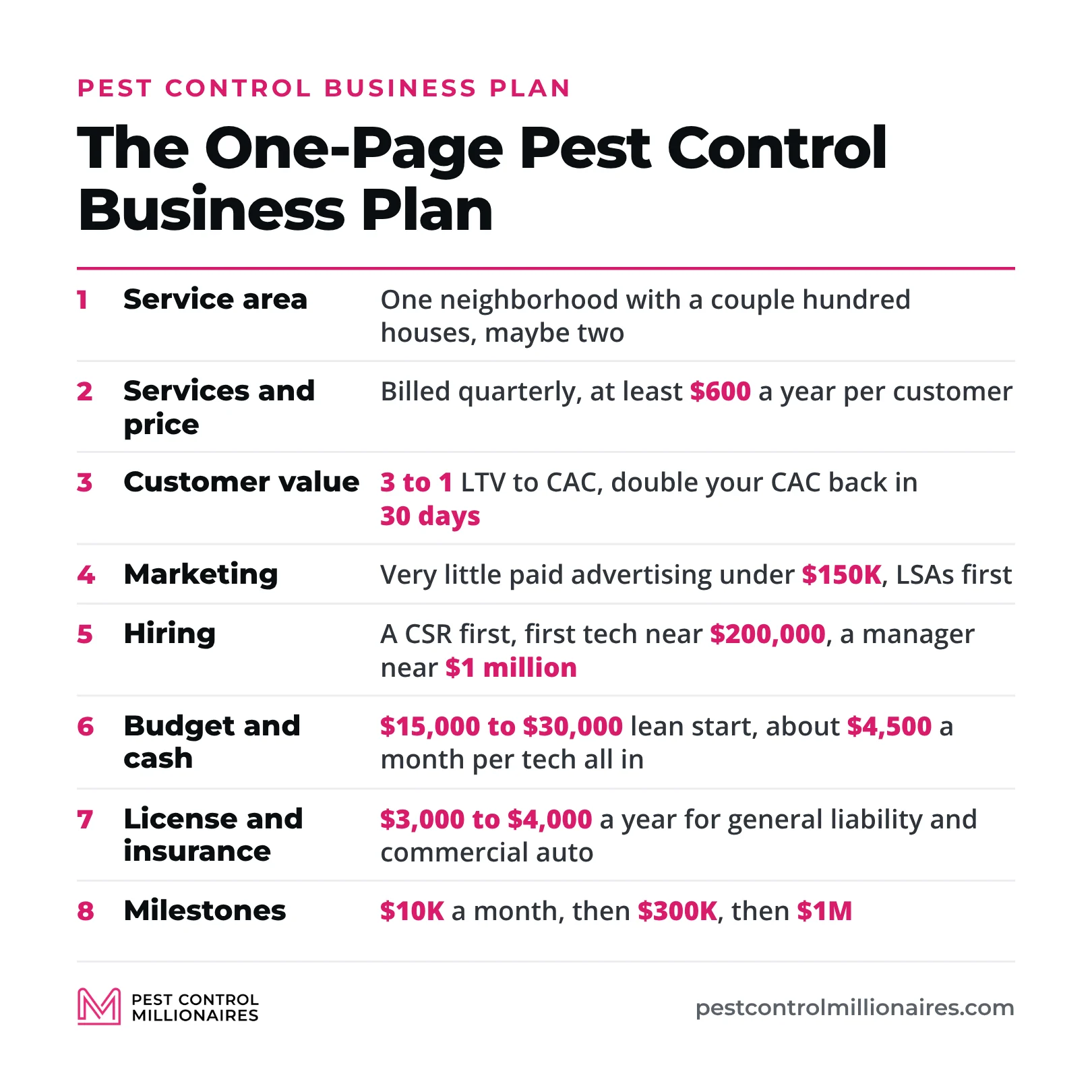
These are the key components of a business plan for pest control services. Copy the middle column onto paper, fill it in with your own numbers and use the right column as your starting point.
| Section | What to write down | Numbers to start from |
|---|---|---|
| Service area | Your starting neighborhood and who lives there | One neighborhood with a couple hundred houses, maybe two |
| Services and price | One or two services, your packages and how you bill | Billed quarterly, at least $600 a year per customer |
| Customer value | Lifetime gross profit per customer and what you can pay to get one | 3 to 1 LTV to CAC, double your CAC back in 30 days |
| Marketing | The channels for your revenue stage | Very little paid advertising under $150K, LSAs first |
| Hiring | Who you hire next and the number that tells you | A CSR first, first tech near $200,000, a manager near $1 million |
| Budget and cash | What it costs to open, what it costs each month, when cash comes in | $15,000 to $30,000 lean start, about $4,500 a month per tech all in |
| License and insurance | Your state license, insurance and payroll setup | $3,000 to $4,000 a year for general liability and commercial auto |
| Milestones | Your next revenue number and the customers it takes | $10K a month, then $300K, then $1M |
Service Area and Route Density
Start the plan with a map, not a mission statement. My advice in Zip Code Kings is to pick one neighborhood with a couple hundred houses, maybe two if they’re close together, and work it until you own it. We still run that playbook in all 20 Pest Badger locations, aimed at $300,000 to $3,000,000 homes and young families.
Density decides your revenue per day. Spread out across town, you work eight hours, get four jobs in and bring in $450 or $500. I’ve been there. On a dense route a tech can drive less than two miles and knock out 25 jobs. One of our trucks at Pest Badger did over $330,000 in technician revenue in a year at about 12 stops a day.
Services, Your Recurring Plan and Price
Pick one or two services. My rule is to stay focused on them until you’re at a million dollars or more.
Sell them as a recurring plan. I like three packages. A is basic pest control, B adds one service like mosquito or flea and tick, and C bundles everything. Most customers pick B. A one-time job should cost at least double a quarterly visit.
How you bill drives cancellations. Data from Alex Hormozi’s team covering over $1 billion of revenue had monthly subscriptions canceling at about 12.5%, quarterly billing about 6% and prepaid 2%. When I checked that against our own customers, we moved every new Pest Badger customer to quarterly billing the same day. Get a card on file before the first service.
Then price from your own costs. My formula is Price = COGS + operating expenses + profit. At the industry averages of about 42% COGS and 42% operating expenses, the average $418-a-year customer leaves about $66 a year in profit, and a couple of reservices wipe most of it out. I want every customer worth at least $600 a year, and to me even that’s low. The method is in our pest control pricing guide.
What a Customer Is Worth and What You Can Pay to Get One
Lifetime value is gross profit, not revenue. Multiply what a customer pays a year by how many years customers stay, then by the gross margin from your P&L. At Pest Badger, a customer is worth about $840. Customer acquisition cost is everything you spent to win customers, sales commissions included, divided by the new customers it brought in. Our blended CAC is $95.86, a ratio of 8.8 to 1. The usual benchmark is 3 to 1, and under it you look hard before spending more.
The second test is speed. I want double the CAC back within 30 days. With a $100 CAC and a $300 initial, you’re $200 ahead, and after about $100 for the tech, fuel and product, the $100 left pays for the next customer. The model is in our guide to customer acquisition cost for pest control.
When Dan interviewed Nick Russler of Honorable Pest Control on Pest Control Success Stories, Nick’s story started with a plan. He and the customer who funded his start spent a couple of months planning. Then he paid a marketing agency $9,000 a month, $50,000 in all, for a $300 cost per conversion on one-time jobs that paid about $290. He was losing money on every lead. After he joined Pest Control Millionaires, his main subscription went from $600 to $1,100 a year and his Local Services Ads ran about $55 a lead. Those are the two numbers this section is for.
Marketing Channels by Stage
Name the channels for the stage you’re in, not the ones a $5 million company runs. This is the order from our pest control marketing guide.
| Revenue | Where the marketing goes |
|---|---|
| Under $150K | Very little paid advertising. Door knocking, referrals, reviews, your Google Business Profile, Facebook groups and Local Services Ads |
| $150K to $500K | Local Services Ads are your paid core. Facebook ads come next, once you can commit $600 a month for 90 days |
| $500K to $2M | Add Google Search ads and real investment in SEO and your website |
| Over $2M | Acquisitions and new markets |
Before your first $10,000 a month, I’d hold off on serious ad spend and do the free things first. Run the Law of 100 (100 doors, door hangers, mailers or conversations a day), put a yard sign in every lawn and ask every customer for a review and for referrals.
Don’t set the budget as a percentage of revenue. I spend as fast as the economics allow, watching cash, payback, capacity and a cost per customer that climbs as you spend more.
Hiring Triggers
Write down who you’ll hire next and the number that tells you it’s time.
Your first hire is a CSR. In the field you earn $100 to $200 an hour, and on the phone scheduling you earn zero. A full-time CSR runs $15 to $17 an hour, and a VA or call center can cover the phones for about $250 to $350 a week until you need one. The full case is in why your first hire shouldn’t be a tech.
The first technician comes when you’re maxed out. You’re booked out two weeks, turning down work and doing admin at night, and your routes, treatment plans and CRM are in place. I’d want closer to $200,000 in revenue first. Budget about $4,500 a month for a technician all in, plus fuel and product, and a trained tech should generate $10,000 to $13,000 a month. The checklist is in how to hire your first pest control technician.
A manager comes around a million. At $1 million and 15% profit, you have about $150,000, and a good operations or office manager costs $60,000 to $90,000 a year. That’s half your profit, if not all of it, so plan for it early.
Budget and Cash Flow
Budgeting for a pest control business comes down to three lists. What it costs to open, what it costs each month and when the money comes in.
I put a lean start at roughly $15,000 to $30,000, with $3,000 to $7,000 of chemical inventory and $10,000 to $20,000 for a used truck if you don’t have one. Monthly costs are labor, product, fuel, insurance, software and marketing, and most grow with every truck.
Cash coming in is where plans fall apart. Take payment info before the first service, bill quarterly and send prepay offers at the last service of the year, while customers are happy. Review the P&L every month, not once a year.
I call a 10 to 15% profit margin healthy and 25% or more crushing it, and a one-person operation can run around 80% until it adds people. Margins by size are in our pest control profit margin guide, and what they leave you to pay yourself is in our guide to pest control business owner salary.
Licensing and Insurance Basics
Licensing rules vary by state. Look up the structural pest control licensing exam on your state’s Department of Agriculture website. Testing and study materials usually run a hundred to a few hundred dollars, or into the thousands if you have to rent a license. The EPA sets national certification standards for pesticide applicators, and the states run the certification.
Budget $3,000 to $4,000 a year for general liability and commercial auto insurance. When you hire, add workers’ comp, follow your state’s labor laws and set up payroll taxes from the first paycheck. Early on, I think for the first year, I didn’t pay any payroll taxes, and at the end of that year I took a massive hit I wasn’t prepared for. The IRS lists what employers have to withhold and pay, and a local CPA or payroll platform can set it up.
Milestones From $10K a Month to $1 Million
Write down your next milestone and the customers it takes.
| Milestone | What it takes | What gets in the way |
|---|---|---|
| $10K a month | 150 to 200 customers at $600 to $800 a year | Paying for ads before the free things are working |
| $300K a year | 400 to 500 customers at $600 to $800 a year | Your schedule, at around 500 to 600 stops every three months |
| $1M a year | Usually three to five techs and one CSR | Profit, about $150,000 at 15% before a $60,000 to $90,000 manager |
Around $300,000, the problem is capacity, not demand. That’s about eight or nine stops a day, and owners tell me all the time they miss four or five sales calls a day because they’re in a crawl space. Around a million, I usually see three to five technicians, one CSR and an owner still handling sales calls, scheduling and hiring. Rewrite the plan each time you pass a milestone.
Run the Plan Off a Weekly Scorecard
A plan you file away is a bank document. Every row in yours has a number to track, and close rate, CAC, production per day, cancellations and profit margin are the five starter numbers in our guide to pest control KPIs. Check the scorecard weekly, the P&L monthly, and update the plan every quarter when you set your next 90 days.
Frequently Asked Questions
What should a pest control business plan include?
Eight sections, each with a number. Your service area, your services, plan and price, what a customer is worth and what you can pay to get one, your marketing for your stage, your hiring triggers, your budget and cash flow, your license and insurance, and your next revenue milestone.
Is there a pest control business plan template I can use?
Use the one-page outline in this guide and fill in each row with your own numbers, from your starting neighborhood to your next milestone. If a bank or investor wants a full plan, the SBA explains the longer traditional format lenders ask for.
How do I budget for a pest control business?
Split it into what it costs to open, what it costs each month and when the cash comes in. A lean start runs roughly $15,000 to $30,000, insurance about $3,000 to $4,000 a year and a technician about $4,500 a month all in. Spend on marketing as fast as new customers pay back double what they cost within 30 days.
How many customers do I need to make $10,000 a month in pest control?
About 150 to 200. $10,000 a month is $120,000 a year, which is 200 customers at $600 a year or 150 at $800. The next milestone, $300,000 a year, takes 400 to 500 customers paying $600 to $800 a year.
Do I need a business plan to start a pest control company?
You need the numbers in one, even if nobody else reads it, and one page is enough to run the company. If you’re asking a bank or investor for money, the SBA says lenders and investors commonly request a traditional plan, which can run dozens of pages.