Pest Control Business Owner Salary and How Much Owners Make

Table of Contents
- How Much Do Pest Control Business Owners Make at Each Stage
- What a One Truck Owner Really Earns
- Salary, Distributions and Profit Are Not the Same Money
- How Margins Turn Into Owner Pay at $1 Million
- Why So Many Pest Control Owners Underpay Themselves
- When to Put Yourself on Payroll
- How Owner Income Grows When Techs and Managers Do the Work
- Frequently Asked Questions
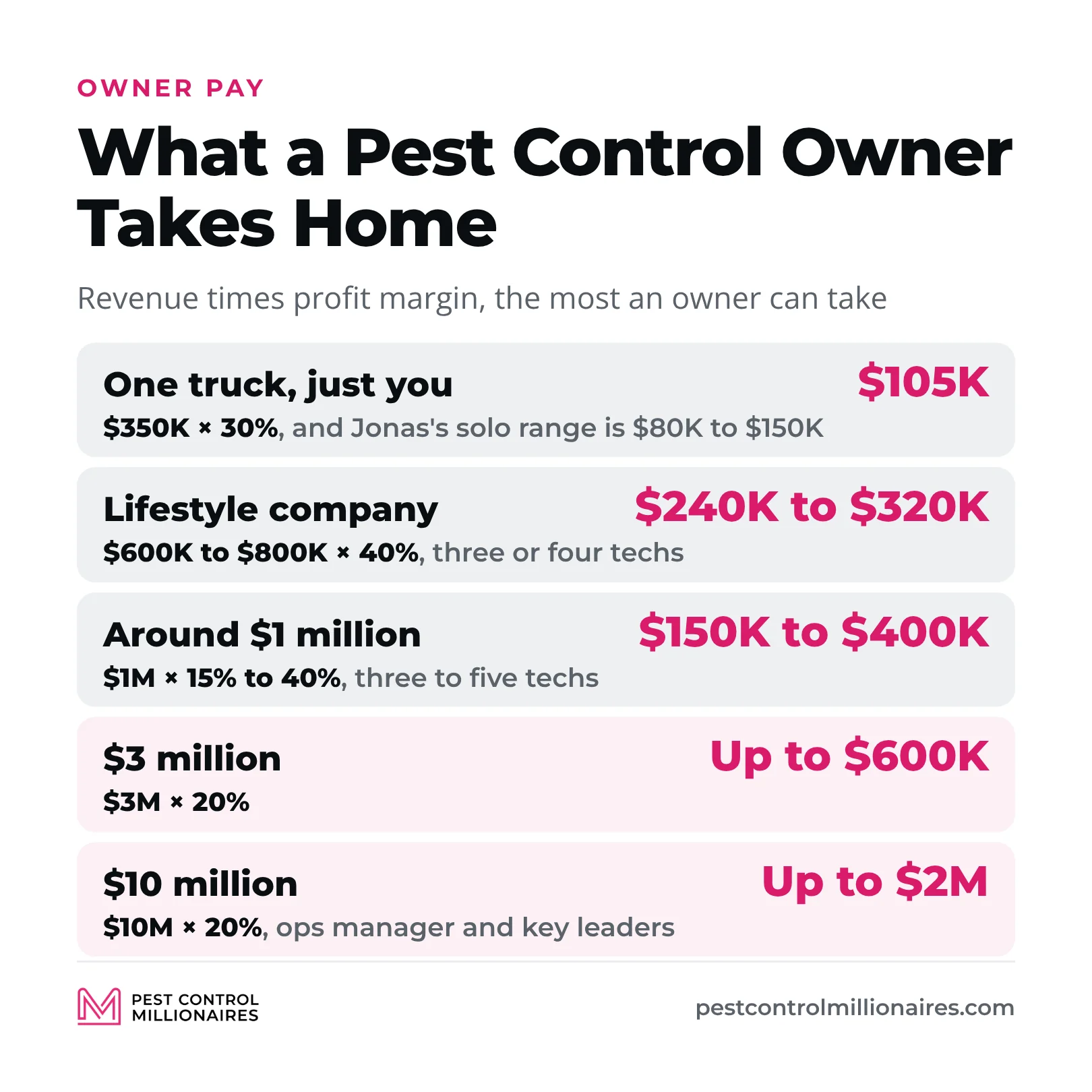
A pest control business owner’s salary comes down to two numbers, revenue and profit margin, because what you take home is the wage you pay yourself plus whatever profit is left. Using my numbers, a solo owner with one truck takes home somewhere around $80,000 to $150,000 a year. At $1 million in revenue it’s about $150,000 to $400,000 depending on margin, and at $3 million to $10 million the profit runs $600,000 to $2 million a year.
I’m Jonas Olson, and I built Pest Badger to over $20 million a year in about six years. There’s no salary survey behind those numbers, just my margins multiplied out, so you can run the same math on your own company.
If your question is how profitable pest control is in general, that’s covered in our guide to pest control business profit margins. This one is about the owner’s paycheck.
How Much Do Pest Control Business Owners Make at Each Stage
| Stage | What it looks like | The math | Owner takes home |
|---|---|---|---|
| One truck | You run the route, answer the phone and do the billing | $350K × 30% margin | About $80K to $150K ($105K at $350K) |
| Lifestyle company | $600K to $800K, three or four techs and a great service manager | 40% margin | $240K to $320K |
| Around $1 million | Three to five techs and one CSR, with you still in the middle | $1M × 15% to 40% | $150K to $400K |
| $3 million | More trucks and more techs | $3M × 20% | Up to $600K |
| $10 million | An operations manager, key leaders, someone running the office and a sales team | $10M × 20% | Up to $2M |
The one-truck range puts two of my numbers together. A one technician operation makes $80,000 to $100,000 a year, and owners who plateau around $300,000 often pay themselves $90,000 to $150,000. Most other rows come from my breakdown of the cost of staying small. The bigger rows say “up to” because profit is the most you can take, and a growing company keeps part of it to grow.
What a One Truck Owner Really Earns
If you’re a one person operation, you’re probably doing around 80% profit margins, because there’s almost no overhead.
Just know that most of that “profit” is your wage. You’re the tech, the CSR and the salesperson, and none of those jobs show up on the P&L.
The US Bureau of Labor Statistics puts the median wage for pest control workers at $45,250 a year in May 2025, or $21.75 an hour. So if your $350,000 route pays you $105,000, about $45,250 of it is what the market pays for the technician job you’re doing. The other $59,750 is what the business earns as a business.
The ceiling is the truck. A solo route usually fills up around 500 to 600 stops every three months, roughly eight or nine a day, which is why so many companies get stuck at $300K. One of our trucks at Pest Badger did $330,000 of technician revenue in a year at about 12 stops a day, five days a week. Your pay can’t outgrow your own route, and if you get hurt, it goes to zero.
Salary, Distributions and Profit Are Not the Same Money
Mixing up these three is how owners fool themselves.
- Salary is what you pay yourself for the job you do, through payroll. It’s an expense, like a tech’s wage, and it comes out before profit.
- Profit is revenue minus all your expenses. It’s that simple. EBITDA is just a fancy word for it, and it’s the number a buyer pays you a multiple on.
- Distributions are money you take out of the profit as the owner.
If you never pay yourself a salary, your P&L counts your wage as profit. The margin looks great, your price looks fine, and you can’t see that the business couldn’t pay someone else to do your job.
Steven Bousquet of American Landscape and Lawn Science in Connecticut put the next step well when he was on the podcast with me in 2023. Net income still has to cover owner’s distributions, taxes, equipment payments and the cash you keep in the business, and “what’s left over after that is really your profit,” he told me.
How you pay yourself also depends on how your company is set up, as the IRS explains in Paying yourself. Let your CPA, or a bookkeeper who works with pest control companies like PCO Bookkeepers, set the split.
I learned the payroll side the hard way. For the first year after I hired my first tech, I didn’t pay any payroll taxes. At the end of that year I had a massive payroll tax bill to pay back, and I wasn’t prepared for it.
Net profit margin is one of the first five numbers on our KPI scorecard.
How Margins Turn Into Owner Pay at $1 Million
Two owners with $1 million companies can take home very different money.
- At 15%, you have about $150,000. That’s the company I describe in why pest control companies get stuck at a million dollars.
- At 20%, with three technicians and you still in the field with them, it’s $200,000.
- At 40%, it’s $400,000.
The 15% company is where the squeeze shows up. A good operations or office manager costs $60,000 to $90,000 a year, which is half your profit, if not all of it. Hire one and you’re left with $60,000 to $90,000. So most owners keep the manager’s job themselves and get paid for two jobs out of one profit.
The 40% company is what I call a lifestyle business. It does $600,000 to $800,000 in revenue at 40% margins and pays the owner $240,000 to $320,000 a year, with a great service manager or lead technician running things.
Getting from 15% toward 40% is mostly pricing and route density. My order is raise prices, tighten routes, then cut overhead.
Why So Many Pest Control Owners Underpay Themselves
Some owners pay themselves too little on purpose. Most do it by accident.
- The price only works if you work for free. When it’s just you, you’re not really paying yourself a real salary, so a low price feels fine. Then you need a second truck and a tech, and there isn’t enough margin left to pay for them.
- You’re doing a manager’s job for nothing. That’s the $1 million squeeze above. The salary you’d pay a manager is the salary you’re not paying yourself.
- Your P&L is behind. Most owners near $1 million don’t have an up-to-date P&L. Let’s be honest, most of the time it’s months behind. You can’t pay yourself from a number you don’t have.
- Someone else is covering the house. Taylor Hansen of Green Grounds Lawn & Pest in Utah County told me on the podcast in 2023 that his wife carried everything for about two years, a crutch that kept him from knowing his numbers. “As soon as I really started paying myself a decent wage, it’s like I really had to tighten up my numbers,” he said.
- You’re reinvesting on purpose. When my partner Dan Leibrandt interviewed Nick Russler of Honorable Pest Control on Pest Control Success Stories, Nick had made $70,000 in a single month and paid himself about 2% of it, around $1,400. “Don’t take your money out before you can really see the light at the end of the tunnel. You need to grow this,” he told Dan. Alex Deageuro and Justin Lidick of Southwest Weed & Pest Solutions kept their day jobs and told Dan, “We’ve been working for free for three years.” That’s how they fund 200 new accounts a month.
The last one is a choice with a plan behind it. The first four aren’t choices at all.
From the PCM Facebook group
How much do you pay yourself?
4 of 13 owners pay themselves nothing and reinvest; 3 take a salary plus distributions.
The opposite mistake is real too. Jason Brassfield of Brassfield Landscaping in Oklahoma City told me on the podcast in 2023 about the owners he keeps meeting at $300,000 who run two trucks, sit in the office, pay themselves $100,000 a year and carry $50,000 in credit card debt.
When to Put Yourself on Payroll
Start with your household. John Pajak, a financial coach for green industry owners who also runs Turf Tamer Lawn Care, told me on the podcast in 2023, “If you know what it takes to operate your household and your lifestyle, then you could know what you should be getting as a salary from your business.”
Then pay yourself a set wage for the job you actually do, put it on the P&L like any other wage, and take distributions from what’s left. Put that wage in your pest control business plan from the start, so your prices are set to cover it.
A good check is the technician’s wage. If your prices couldn’t cover a tech at around the BLS median of $45,250 to run your route, the problem isn’t your salary. It’s your price.
How Owner Income Grows When Techs and Managers Do the Work
Your pay stops being capped by your own route the day someone else runs it.
My numbers for a first technician show why. A trained technician generates about $10,000 to $13,000 a month and costs about $4,500 a month all in. That leaves $5,500 to $8,500 a month, or $66,000 to $102,000 a year, before fuel, product and overhead. I’d want to be doing closer to $200,000 in revenue before that first tech.
At Pest Badger, we pay our techs for performance. Mike Andes, who runs Augusta Lawn Care with more than 150 locations, told me that pay for performance was the switch for him. “We literally went from not making any money the first four years to then 280,000 in distributions to myself, and I was working there like 3% of the time.”
The ladder goes from sole operator to an owner with one technician, then two, then three, then an ops manager, CEO and investor. Each step moves more of your income from your own hands to your team’s work.
At multiple locations, profit and take-home split further apart. For a second location, budget double. Plan on $70,000 and expect $100,000 to $140,000, and that comes out of profit before it reaches you. I’m always shooting for 15% to 20% margins in a growing company, and we don’t work less the bigger we get. We deal with bigger problems.
The biggest check comes at the end. A one-truck business sells for about 1x revenue. Bigger companies sell on a multiple of EBITDA that climbs with size, and key man risk, meaning the company still depends on you, can take about a point off it. Over 20 years, my math has the solo owner walking away with about $2.4 million, sale included, and a $10 million company’s owner with about $52 million. The multiples are in our guide to selling a pest control company.
Frequently Asked Questions
How much do pest control business owners make?
It depends on revenue and profit margin. Using my numbers, a solo owner with one truck takes home about $80,000 to $150,000 a year, and a $1 million company pays its owner about $150,000 to $400,000 depending on margin. At $3 million to $10 million and 20% margins, profit runs $600,000 to $2 million a year, though a growing company reinvests part of it.
What is the average pest control business owner salary?
There isn’t a reliable average, so be careful with anyone who quotes one. What an owner takes home is a wage for the job they do plus whatever profit is left, so it moves with revenue and margin. A $1 million company pays its owner about $150,000 at a 15% margin and $400,000 at 40%.
How much can a pest control business make?
As much as its market and its team allow. One of our trucks at Pest Badger did $330,000 of technician revenue in a year, solo routes tend to stall around $300,000, and Pest Badger does over $20 million a year across 20 locations. A 10% to 15% profit margin is healthy, and 25% or more is crushing it.
Should a pest control owner take a salary or distributions?
Usually both. Pay yourself a set wage for the job you do, put it on the P&L like any other wage, then take distributions from the profit that’s left. The right split depends on how your company is set up, so have your CPA set it.
How much do pest control technicians make?
The US Bureau of Labor Statistics puts the median wage for pest control workers at $45,250 a year in May 2025, or $21.75 an hour. I budget about $4,500 a month all in for a technician, which is $3,500 to $4,000 a month in gross pay plus taxes and insurance.
Read the Ultimate Guide to pest control KPIs