How Casey Ashby Sold $1.3 Million of Pest Control and Crawl Space in a Year

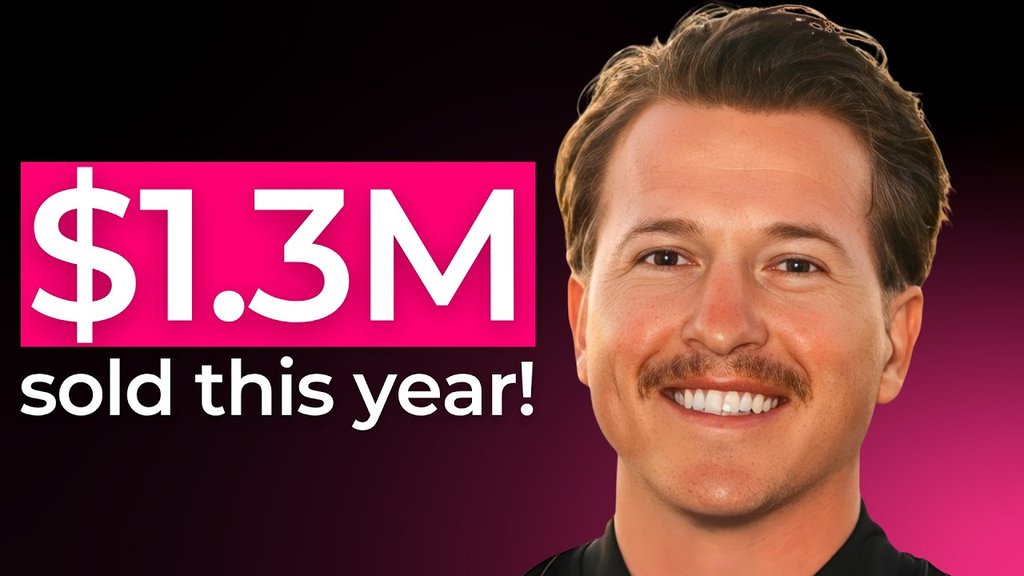
Table of Contents
- The Recruiter Who Hooked Him With Downtones
- $50,000 His First Summer
- Starting Spire With One Technician Following Him
- Should a Door to Door Rep Start His Own Company?
- Should an Owner Start Knocking Doors?
- Casey’s Intro, Word for Word
- Why He Memorizes a Roadmap
- Smoke Screens Are Not Objections
- The Sale Starts at the First No
- Yes Trains and Asking the Right Question
- “Cheap” Is About the Deal
- His Playbook for an Owner Is New Move-Ins
- Texting Customers Before Selling Anything New
- Why He Got Into Crawl Space
- Floating the Customer’s Cash
- What Spire Charges for Crawl Space
- Door Hangers, Yard Signs and Flyerfly
- What He Tells People Who Hate Door Knocking
- What Casey Says About Pest Control Millionaires
- Casey’s Message for Pest Control Owners
- Want to Grow Your Pest Control Company?
- Frequently Asked Questions
I sat down with Casey Ashby, co-founder of Spire Pest Control in Richmond, Virginia. Casey started selling pest control door to door about 12 years ago, and he started Spire with his co-founder, Matt, almost eight years ago. Today it’s a million dollar business.
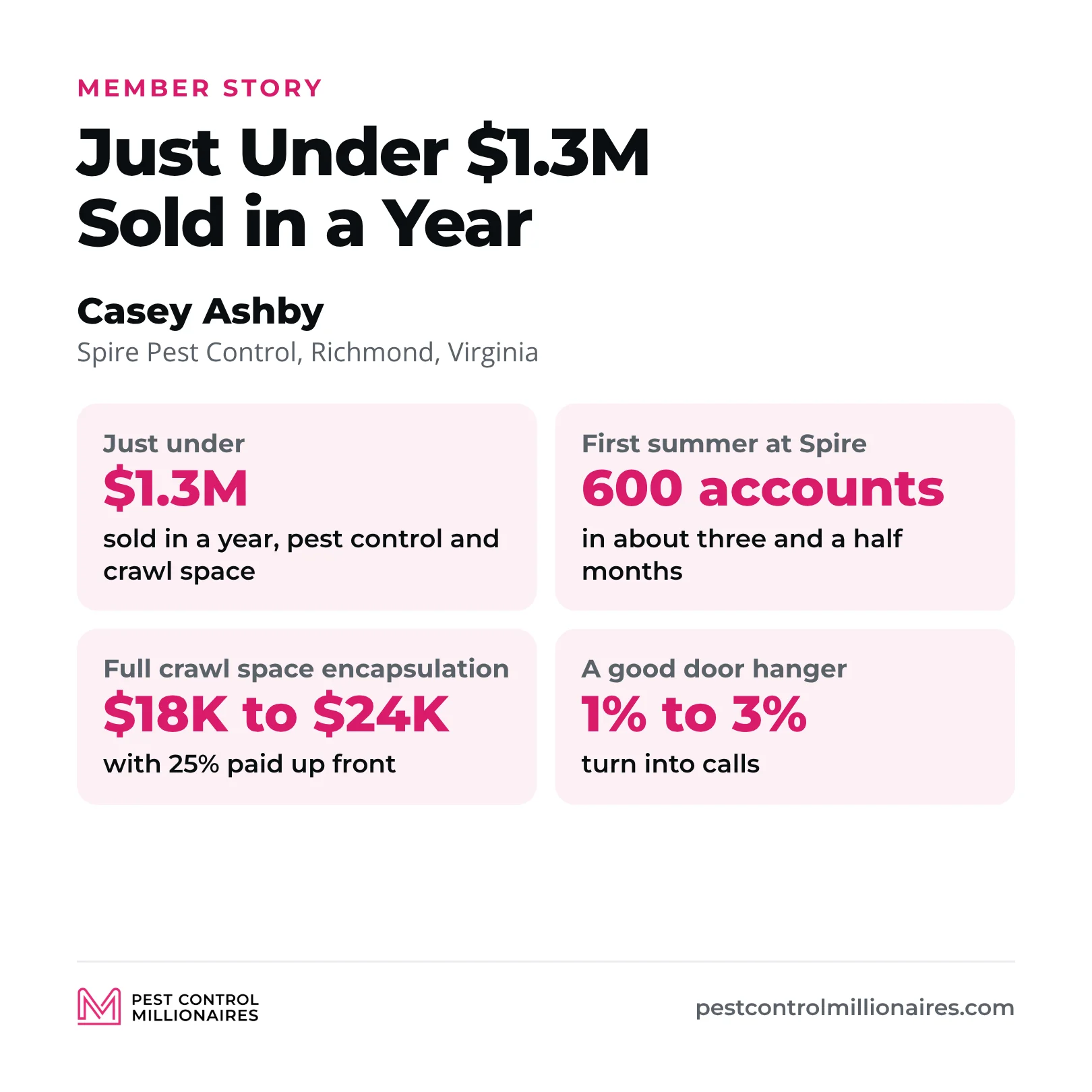
In the year before we recorded in November 2026, Casey personally sold just under $1.3 million in revenue between pest control and crawl space.
We had Casey at PCM House during PestWorld, and hearing him talk about door to door there is the reason I wanted him on the show. He gave me his pitch word for word, how he handles “I’m not interested,” why he sells crawl space jobs two to three months out, and what he’d tell an owner who has never knocked a door. Here’s his story.
The Recruiter Who Hooked Him With Downtones
Casey is from Utah. After serving a mission in Chile for the LDS Church, he was a student at Utah Valley University, working at a call center selling credit repair. By his own account he was an awful employee there.
One day a recruiter stopped him in the hall and told him he could make $30,000 selling pest control for a summer. Casey didn’t believe it. He didn’t feel like a salesperson, so he said no.
The recruiter kept going. He started talking about paraverbal skills and body language, and how the way we communicate impacts everything, from relationships to friends. Then he gave Casey an example that stuck. Say “I love you” going up at the end, then say it going down. Which one sounds more powerful? The second one. It’s a downtone.
Same thing with the kid who stands up in class and says his name going up at the end of the sentence, compared with the kid who says it with downtones. One sounds unsure. The other sounds confident.
“That thing blew my mind,” Casey said. By the end of that conversation, he was hooked.
I’ll be honest, I had never heard that explained before either.
He didn’t go with that recruiter’s company. He found people he trusted and decided that if he could at least match what the call center paid, he’d give it a shot.
$50,000 His First Summer
Instead of $30,000, Casey made $50,000 his first summer, about 12 years ago. He came back, paid for all of his schooling, and was the top salesperson in his office. He sold in Utah for two years for a company called Moxie.
His second summer he made $71,000 and recruited eight or nine of his buddies. Then he did a third summer and a fourth.
It changed everything for him. He could take 21 credits and go snowboarding, and he didn’t have to work a job during school. The sacrifice was his summers.
Starting Spire With One Technician Following Him
The companies Casey sold for offered him a path. Work your way up, work hard, and we’ll partner with you. His thought was different. If they’re paying me this much, how much are they making?
So he reached out to Matt, who had tried to recruit him years earlier, and said let’s go into business together. That’s how Spire began. They came out to Richmond, Virginia, and Casey spent the first summer knocking for himself.
He put on 600 accounts in about three and a half months.
He had never sprayed a home in his life. So he hired one technician and told him, “Your one job is just to follow me.” Casey sold the accounts, the technician treated them, and when summer ended Casey went back to Utah. That one technician ran the Richmond office by himself in the off season until the following summer.
Should a Door to Door Rep Start His Own Company?
I asked Casey what he’d tell the door to door guys who are thinking about starting their own company. His answer was more honest than I expected.
The journey of an entrepreneur is harder than I expected it to be. It’s difficult. It is lonely at times.
When he started Spire, he had the opportunity to partner with Fox instead. Fox later sold to Rollins, in his words, “for a stupid amount of money.” So he does wonder. If he had partnered with a company that already had everything in place, he could have focused on the only levers he’s great at, sales and recruiting.
From a financial perspective, he thinks he’d probably be in a better position today. From a creativity and fulfillment perspective, no. He can move fast, he can turn the ship as quickly as he wants, and he has learned a ton.
For reps weighing it, he explained how those partnerships work. It depends on how much value you bring. If you can show up with a team and add a million in revenue in a summer, he says you can start to negotiate higher than ten, fifteen, twenty, even thirty percent, depending on how many partners there are and how the business is set up. He’s also seeing a lot of strong door to door guys start marketing companies that sell for several pest control companies at once.
Should an Owner Start Knocking Doors?
At PCM House, a lot of owners heard how many accounts Casey adds and asked the same question. Should I get into door to door? So I asked it for the owner doing somewhere between $300K and a million a year.
Casey’s answer was to look honestly at your skill set and your goals first.
If you have some time and some energy, go knock some doors yourself. The accounts are free. It only costs your time, and you’ll realize really quickly whether it’s a place you want to go. There’s plenty of training material out there, and he pointed out the program already has a ton of it. Our guide on how to knock doors as a pest control owner is a good place to start too.
If you’re thinking about a full team, the very first thing he’d look for is someone who can manage it.
The fastest way that you replace yourself is can I get a manager that can take care of the team? Because door-to-door teams require a lot of attention and time.
There’s the culture the guys care about. There are all the meetings. They want to have fun every weekend and they expect you to provide it. Some days it’s raining and they’re tired and they don’t want to work. As Casey put it, you’re constantly trying to create calluses for young men who are figuring out who they are.
He was open about this being his own struggle. He can sell and he can knock, but managing big teams and recruiting has been hard for him, to the point that he has cried over it. What helped was hearing Alex Hormozi say your top sales guys are not going to be your managers. Some people are players and some people are coaches.
If you do want to build one, here’s how we run a pest control door to door sales team.
There’s a middle road too. You can teach your technicians a few questions and the right phrases to say, have them knock a few doors here and there, and you’d be surprised how many sales come that way.
Casey’s Intro, Word for Word
I asked Casey to start with the owner who has two hours a day and wants to dip a toe in. He started with the intro he uses on most doors.
I’m Casey. I work for a ton of the homes out here. A lot of them hired me because I’m cheap. Who do you guys use for the bugs?
A few things are going on in those four sentences.
The first is bandwagoning. “I work for a ton of the homes out here.” Casey made a point of saying that ethics is an important thing in door to door sales. “Out here” is vague on purpose. He isn’t claiming to service everyone on your street.
The second is the downtones from the recruiter’s lesson. Every sentence lands going down.
The third is that it ends on a question the homeowner can answer.
Why He Memorizes a Roadmap
Casey says he isn’t very good off the cuff. Before he ever sold, the thing he feared was the objections. What am I going to say? So he’s scripted, and he thinks that’s the best thing a new knocker can do for their confidence.
If you can get some type of roadmap, it can give you the confidence to go out and sell.
Here’s how it works at the door. The homeowner says, “Thanks for stopping by, we’re not interested.” Casey says, “Sure.” He calls that a transitional phrase. It acknowledges that you said something, and then he moves on. “Sure. Do you have a company or do you do it yourself?”
If they say they do it themselves, he goes down path B, the whole do-it-yourself conversation he already has memorized. If they say they have a company, he goes down the other one.
His roadmap is the same every time.
- Intro. Then he closes the gap with “Let me show you pricing really quick.” That’s the hook. He doesn’t actually show pricing yet.
- Bug chart. He hands them a chart with the main bugs on it and asks what they’ve seen.
- Price. A discounted price, anchored against the normal one.
- Service. “Let me show you what we’re gonna be doing for you.”
- Price again. He goes back over the pricing and that it’s 12 months.
- Close. Then he resolves and closes, resolves and closes, until the end.
If you want a full script to memorize, we have a pest control door to door sales pitch you can start from.
Smoke Screens Are Not Objections
Casey draws a line between a smoke screen and an objection.
When you first knock and someone says, “I’m not interested,” that’s a smoke screen. They don’t even know what they’re not interested in. Some of them don’t know you do pest control yet. “I gotta talk to my wife,” said once, early in the pitch, is still a smoke screen.
The common ones he hears are not interested, I have to talk to my spouse, money’s tight and I already have a company.
We role played it. I told him I wasn’t interested, that plenty of pest control companies had already knocked on my door, and that they were really annoying.
I know man, there’s so many. It’s like you need bug spray for the bug guys, huh?
Then he said he’d keep it short and asked what I was currently doing. I said we’d used Orkin, their technician messed up, and now we don’t use anyone. He didn’t pounce on that. He said it’s frustrating when you pay a lot of money and a company doesn’t do what it said it would. Then he went right back to the roadmap. “Let me just show you pricing here really quick.”
That’s a much easier yes than “are you ready to buy?”
We go deeper on these in door to door pest control objections.
The Sale Starts at the First No
Casey thinks a lot of people who start knocking are afraid to close. They’re afraid to ask for the business. He passed along something door to door people say, that you aren’t a salesperson until your first close gets a no, and that’s when the sale finally begins.
His first close is an option close.
Hey, would you want the back deck done as well? If you did, I would include it for you for free.
When I told him I still wasn’t sold, he didn’t drop the price. He explained what was going on in his head.
The reason you’re not buying is because the value doesn’t outweigh the price. And so I either need to increase the value or I need to lower my price.
You don’t want to go straight to a lower price. You want to add value. So he asked when we last had a termite inspection. I said I didn’t know if we ever had. He explained that moisture is conducive to termites, that a termite inspection can cost about $150 a year, and that if he could get me on the route, he’d include it for free. “Would that help?”
It did.
Yes Trains and Asking the Right Question
I had never heard the term yes train, so I asked.
The idea is that when people keep saying yes, they’re more likely to say yes at the end. So he asks small questions with obvious answers. “You know how we get the rain out here, right?” It means nothing, but it keeps the homeowner in the conversation and it starts the momentum. He nods while he asks. Monkey see, monkey do.
The other thing he fixes with new reps is the question itself. A newer rep asks, “What problems are you guys having?” Homeowners say they don’t have any problems, thank you. Right idea, poor question.
Casey hands over the bug chart and says this instead.
You’ve lived in this house longer than I have. You tell me, Jack, you’re the expert. What have you seen, had, or noticed in the past?
Now they aren’t thinking about a problem today. They’re remembering the spiders or the wasps from last year, and the conversation keeps going.
That’s why he says word tracks make a difference. An experienced rep doesn’t get as many no’s as a new one, and it usually comes down to small things like that.
“Cheap” Is About the Deal
I pushed back here. In the program we teach premium pricing, and many of the top owners I talk to say the same. So why is he telling people he’s cheap?
Casey’s answer was that people want a deal. Some door to door reps say never say cheap. For him it has always worked, and if you’d rather say “I can get you a really good deal,” that’s fine too.
Do I charge less? Do I have low contract values? No. But the perception of somebody feeling as though they’re getting a really good deal is there. And that’s why people buy.
He builds that feeling with price anchoring. Most people don’t know what pest control costs. So the pitch gives the normal price first, then what he’ll do it for while the truck is in the neighborhood. He also tells people he has two spots to fill. When those two fill, he says, he just gets two more. That’s his urgency.
That made sense to me. His contract values aren’t low. The feeling of getting a deal is what people respond to.
His Playbook for an Owner Is New Move-Ins
I asked how many sales to expect from a hundred doors. Casey answered a better question, which is what he’d do if he were an owner in the program thinking about knocking.
Don’t go door to door to door. Go on Zillow and find everyone who moved in recently, and only knock those.
How far back he looks depends on the time of year. Up until about April or May he might go back six months. After the door to door teams have been through, he might tighten it to the last 30 days.
Then the intro changes a little.
Hey, my name’s Casey. I’m the bug guy. I take care of a ton of the homes out here. Welcome to the neighborhood. How’s it been?
His mindset tip here is one I loved. Remember that it’s your neighborhood, not theirs. You’re the expert on the bugs in that neighborhood, especially with people who just moved in. He thinks the people who are really good at sales are the ones who believe they have the best product and the best service.
Texting Customers Before Selling Anything New
On one of our group calls, Casey shared his screen during wins and it was new lead, new lead, new lead, all crawl space. I asked where they were coming from.
For years, Spire was only door to door. They had FieldRoutes for the technicians, and that was it. Nothing on Google, no Facebook ads. And they had never tried to sell their customers anything else. They didn’t even run a mosquito campaign for four years.
After he joined the program and got GoHighLevel set up, they texted all of their current customers and made it really easy to text back. Then they added Facebook ads. Those two things are where the crawl space inspections and the mosquito sign-ups came from.
In his words, “We ramped up really quick with adding on additional services.”
If you have a few hundred customers and you’ve never offered them a second service, read our guide to upselling and cross-selling.
Why He Got Into Crawl Space
Most owners I talk to don’t do crawl space. So I asked if they should consider it. Casey got very real.
I felt like being a pest control owner was always poor.
You never pay yourself much. You put every dollar back into the business and tell yourself next year you’ll grow more. He felt like there was never enough money to grow, or even to live and have a family and kids.
Then he went to a group, saw what some other companies were doing with crawl space, and thought, we have to do this. Richmond has crawl spaces, so he took on figuring it out.
Floating the Customer’s Cash
Here’s the part that changed his cash flow.
Casey knew how to sell, but Spire had no crawl space crew yet. So he sold the jobs first. These were $15,000 and $20,000 jobs. He scheduled them two to three months out, and customers paid 25 percent up front.
So now I’m holding on to this cash that’s free. It costs me nothing.
He put that money into ads to get more jobs. Before Spire had done a single crawl space job or had a crew, he had four, five, six jobs booked. That gave him time to go get the people to do the work.
He was upfront that you can over-leverage yourself doing this. But holding that cash helped them a lot, and once the jobs started, the profit was there too.
This is the pairing I love for pest control. The recurring subscription is incredible, and a big ticket service gives you cash up front to fund your marketing.
What Spire Charges for Crawl Space
Casey shared his real pricing.
- Full encapsulation: about $18,000 to $24,000. That’s 16 to 20 mil poly with a dehumidifier, mold and insulation. They won’t do a full one for less than $15,000.
- Partial encapsulation: $11,000 to $18,000. It goes halfway up the wall and leaves the insulation in, with a dehumidifier and mold. The minimum is $10,000.
- The realtor special: his name for the light option, maybe just a dehumidifier, for someone about to sell the house. A lot of the time it doesn’t actually solve the moisture problem, so people usually don’t choose it.
His rule is that you always need three options when you sell. You want one that feels expensive, because some people will buy it, and most of the rest land in the middle.
He also had a warning for pest control owners getting into crawl space. Don’t get used to selling a cheap 8 mil vapor barrier and celebrating a $2,000 job. People can afford to pay for a lot more than that, and Spire competes with the most expensive encapsulation companies in its market.
Financing is a big part of it. Spire uses Wisetack, so he isn’t selling a total job price. He’s selling a monthly payment. His closing question every time is, “Do you wanna see exactly what your payment might look like?”
Door Hangers, Yard Signs and Flyerfly
Casey has a side project that came straight out of a problem at Spire.
Door hangers work for them. So do yard signs, at least for crawl space and rodents. But one day Rick, his partner and service manager, was drawing streets on a piece of paper to show a technician where to put signs and door hangers. Casey watched and thought, this is not efficient. How do I know they’re done? And how do I track revenue back to a neighborhood?
So he built Flyerfly. It works kind of like Strava, where you can see the path someone walked. The person has to actually walk up to the door or it doesn’t count, and it tracks their pay. When we recorded, he said it was free at flyerfly.io and in beta, waiting on the App Store. He doesn’t plan to charge a subscription. The plan is for it to become a gig app, where you hire someone in your market to put your door hangers out and Flyerfly keeps a small margin.
A few numbers and tips he gave on the physical side.
- Door hangers: with a good one, about 1 to 3 percent turn into calls. Put out 100 and expect one to three.
- Yard signs: someone driving by has to be able to read the whole thing in three seconds. “Got rodents?” and a phone number. Or free crawl space inspection, mold, moisture issues and a phone number.
- Who they reach: a huge population still doesn’t trust online stuff, and something physical builds trust in older neighborhoods.
He knows some people are against bandit signs, and that cities fine for them. His reasoning is that the mosquito companies in his area put them out every single year, so they’ve got to be working. Check your own city’s rules first. Our guides on door hangers and yard signs cover how to do both well.
One more tactic. His reps are trained not to leave door hangers or carry cards while they knock, because “do you have a card?” is a smoke screen. Sell them right there or move on. What does work is hanging the whole neighborhood a week before, with a coupon on it. Then the knocker has a reason to be there. “Did you get the coupon on your door we left last week?”
That’s the point I’d underline. Door to door is a lot easier when it isn’t cold. If people have seen your trucks, your Facebook ads and your door hanger, they’re already warm when you knock.
What He Tells People Who Hate Door Knocking
I see it in our Facebook group all the time. I’m never doing door to door. It’s unethical. I hate getting my door knocked.
Casey gets it. He said he doesn’t even really like it when people knock on his own door.
But if you’re a nice human being, you read the room. The baby was sleeping, so you say you’re so sorry and you mean it. There’s a no soliciting sign, so you get out of there. Do that and you really aren’t going to make people mad.
And he thinks the “everyone hates this” view is a pessimistic one.
There are a lot of people that are thankful and glad that you show up in person as a real person.
Especially when it’s the owner at the door. In his mind, that’s why companies grow so fast with door to door. People appreciate humans.
What Casey Says About Pest Control Millionaires
I asked Casey about his experience in the program and at PCM House.
You guys have done so much to bless my life, so much to help. I know there’s a little bit of a cost, a little bit of a money thing, but that’s not it. You really realize if I look back and out of all the money and revenue and things that you guys have done to help my business grow, I’m like, take my money. It’s been worth it. As long as you’re implementing and doing the things that you guys suggest, it works.
On PCM House, he said he wouldn’t have gone to PestWorld otherwise. He doesn’t care enough about new exclusion products. He went to meet the people.
He also admitted he overthinks things, and that he went in asking himself what was in it for us. What he found was that he didn’t feel like he was being sold anything, and there was no pressure. He got a lot of value, had a lot of fun, and met people who weren’t even in the group.
In his words, “You realize in this life it’s just a lot about relationships and people you know.”
Casey’s Message for Pest Control Owners
I ask every guest what they want to tell the owners out there. Here’s Casey’s.
I love all of you guys. I know that there’s so much crap that you have going on in your life as entrepreneurs. Keep up all the good work. I know it’s hard when you have families and you have your entrepreneur itch that you’re constantly working on and growing. Don’t forget to go run. Do a little bit of exercise.
He also made an open offer. If you need help with door to door, he’s happy to help. You can find him on LinkedIn, in the PCM group, or through flyerfly.io.
Want to Grow Your Pest Control Company?
If Casey’s story hit home, here are two free ways to start.
First, join our free Facebook group. Search Pest Control Millionaires on Facebook and request to join. There are over 5,000 owners in there sharing what’s working right now.
Second, grab our book Zip Code Kings on Amazon. Jonas, Jake, and I wrote it to be the ultimate guide to pest control marketing, from branding and traditional marketing to local SEO and Facebook ads.
If you want to see how other members got their results, read Mike and Elizabeth Gilbert’s story, Kirk Slack’s story or the rest of our success stories.
Casey put on 600 accounts his first summer with a memorized roadmap and one technician following him around. The first step is the same for you. Pick a neighborhood, learn the intro, and go knock.
Frequently Asked Questions
What does Casey Ashby say when he knocks on a door?
His intro on most doors is “I’m Casey. I work for a ton of the homes out here. A lot of them hired me because I’m cheap. Who do you guys use for the bugs?” If the homeowner says they’re not interested, he says “Sure” and asks, “Do you have a company or do you do it yourself?” Then he follows the same roadmap every time, which is intro, bug chart, price, service, price again, then the close.
Does Casey Ashby think pest control owners should knock doors?
It depends on your skills and your goals, Casey says. If you have some time and energy, he’d go knock some doors yourself, because the accounts only cost you your time and you’ll find out fast whether it’s for you. Before building a full door to door team, he’d look for someone who can manage it, because a team takes a lot of time and attention.
How much does Spire Pest Control charge for a crawl space encapsulation?
Casey says a full encapsulation runs from about $18,000 to $24,000, and they won’t do one for less than $15,000. A partial encapsulation runs $11,000 to $18,000, with a $10,000 minimum. There’s a smaller third option he calls the realtor special. Customers put 25 percent down, and Spire offers financing through Wisetack.
What is Flyerfly?
Flyerfly is the software Casey Ashby built to get door hangers and yard signs out and track them. It shows the path each person walked, a door only counts when they walk up to it, and it tracks their pay. When we recorded, Casey said it was free at flyerfly.io and in beta.
Full transcript
Read every word of the interview
00:00Dan Leibrandt
Hey everyone and welcome back to Pest Control Success Stories. I'm your host, Dan Leibrandt, and today I'm with Casey Ashby, who's the co-founder of Spire Pest Control. Casey started Spire Pest Control with his co-founder about seven, almost eight years ago, and has now grown it into a million-dollar business. They have mainly grown through door-to-door and have also recently made a ton of money doing things like crawl space. Maybe diving into Facebook. And also, Casey has even launched his own software platform, Flyerfly. So we're gonna talk about all of these things. Casey's a super cool guy. We had him at the PCM House and was super cool to hear him talk about door to door. So that's probably what we're gonna talk about mostly on this show. Casey, so excited to have you on the show. Welcome on.
00:47Casey Ashby
Thanks for having me. Yeah, I feel like there's a lot of things in this brain that I'm excited to share with everybody that's listening. I have a huge background in sales and door to door and I feel like I'm thirty six, but I feel like I'm young and have a lot of energy and feel excited and so I'm happy to be here.
01:03Dan Leibrandt
Yeah, awesome. So, Casey, walk me back. How did you initially get into pest control and sales?
01:11Casey Ashby
So I'm originally from Utah. I did serve a mission out in Chile for the LDS Church. And then when I got back, I was in at school at Utah Valley University. I had worked a job that my mom had got me at a call center where I would sell credit repair. Basically, people would call in or I'd make outbound calls. And I remember just being an awful employee there. I'd like to go in early, had a blanket over my head, and had to make all these calls in the morning. And anyway, so I did that. And I remember walking through the halls and those in business marketing and just getting my associates, I'm like, man, I and I see this recruiter up ahead of me. And I'm like, this guy's gonna talk to me about something. I didn't know what, right? I walk up with my backpack on, and he's like, Hey, you should come out and sell pest control for a summer. You can make thirty thousand dollars. And I'm like, Yeah, right. Okay, okay. Maybe somebody made thirty thousand dollars, but not me. You know, I didn't think I could I d didn't feel like a salesperson. So I told the guy no, and he's like, No, hold on, hold on, wait. And then I was like, okay. And he started talking to me about paraverbal skills and body language and verbal and about how the way that we communicate impacts everything that we do in this life, from relationships to friends to all of it. And so he gave me a quick example that stuck with me. And he's like, if you know, because you usually at that time, you know, you're dating, you're getting girls and trying to, you know, and he's like, one day when you get married and you just go up to like your wife and you say, hey, I love you. I love you.
02:37Casey Ashby
Which one sounds more powerful, right? And it's like, of course, the second one. It's a downtone. And I was like, that is interesting. That thing blew my mind. He also explained, he's like, you watch all these movies and there's all these geeks and these nerds that get bullied. And he's like, why? They're sitting there in this class. They'll stand up and they're like, my name's Casey. I like to play soccer. I'm going up at the end of my sentence. I'm not very confident.
02:58Dan Leibrandt
Ha ha.
03:01Casey Ashby
And he's like, and then you have these jocks that are like, My name's Casey. I play soccer. And all these downtones, and I'm like, man. And so that that for me was like, okay, I'm hooked. I did not end up going out with that guy and selling with that with that company. I reached out through my the grapevine and found some people that I trusted. And I thought, you know what, if I could go out and at least make the same amount of money, at least the same amount as I'm working at this call center, I'll give this a shot. And I did. To my surprise, Dan, like my and this isn't to impress anybody at all, but my very first summer, instead of making 30, I made 50,000 my very first summer. And then I made and this was 12 years ago. So I was like, it's like twenty twenty-one-ish or so, right around there. And so I made fifty thousand my first summer, and I was like, wow, that was amazing. And that's just me going out and knocking on doors for the summer. So I came back, paid for all of my schooling. I was the top salesperson in the office that I was at, and that was in Utah. I was there in Utah for two years selling for a company called Moxie. And then my second summer, I was like, Yeah, I'm gonna do this again. And I made 71,000 my second summer. And I'm like, holy cow, I recruited eight or nine of my buddies. And then, I did a third summer and a fourth summer. And for me, that was just, it changed everything, right? It was like I was able to go take 21 credits and go snowboarding and I didn't have to work a job. Now there was a sacrifice of my summers that I missed a lot. But that's how I originally got into, you know, door-to-door sales. And then I slowly started to transition into pest control and ownership.
04:32Dan Leibrandt
Wow, man, even just what you said there with downtones, I mean, I guess I like intuitively understand that and maybe do it myself, but I've never actually even heard that explained. The uptones versus the downtones, that was so good. And I've I don't actually think I've heard of that initial part of your story. So that's awesome. So that that was kind of your early twenties. Then what transpired after that and what when did you start Spire?
04:59Casey Ashby
Being the entrepreneur that I am, which is to my demise to most of us entrepreneurs, right? We listen to Alex Hormozi every day and they're like, just focus on one thing. But I was like, you know what, I know I'm creative. I want to use this talents and these abilities for something. And being the stubborn do-it-yourselfer that I am, I had the opportunity to partner with some of the companies that I was working with. You know, it was like, hey, you know, work your way up, work hard, we'll partner with you. Which we can talk about whether that was a good thing or a bad thing. But in the end, decided to, you know what, if I'm getting paid this much money, my thought process was how much are they making? And so I'm like, you what, I'm gonna go start my own. And that's when I'm Matt had tried recruiting me years prior. So I reached out to Matt and I was like, hey man, let's let's go into business together. Let's let's start a business. And so that's kind of how Spire began. And then we came out to Richmond, Virginia. And I spent my very first summer knocking for myself out here, put on 600 accounts in like three and a half months. Just hired a technician. It's like, hey man, your one job is just to follow me. I don't know how to spray. I've never sprayed. I've never been a technician. I've never treated homes. And then his job was just to follow me all day. And so I added all the accounts. And then I went back to Utah. And so we just had one technician that was just out there in Richmond, Virginia by himself in the off season until the following summer. That's kind how it all began.
06:21Dan Leibrandt
And we talked about this before the show. I think this would be a good question to ask. Maybe for the door to door guys out there listening to the show that are thinking about starting their own company, do you think they should?
06:35Casey Ashby
If I heard that question, I would pay a lot of attention right now. I think that, if you're thinking that question, you're probably probably a very creative person like I am. And in door to door you gain a confidence if you are good of I can do anything. 'Cause you are and you can, and I believe that. In hindsight, so I'll share a quick story where I love where I'm at, right? Like I d I don't wanna go back and say, Hey, I wish I would have 'cause I don't think that that serves anybody really well. But I the journey of an entrepreneur is harder than I expected it to be. It's difficult. There are it is lonely at times. And there are skills that I didn't think that I had to develop that maybe I thought I could. I was like, yeah, I'll develop any skill that it takes. But there's just inherently some skills that you are better at and good at that I didn't expect. And so that's been a struggle and a problem. A quick example for you was started Spire, I had the opportunity to partner with Fox. For those in the industry knows that Fox just sold to Rollins and for a stupid amount of money, right? Like they did really well. And you always wonder, man, if I just would have partnered with a company that already had everything put in place, would my life have been easier when I could just focus on sales and recruiting? That's the only lever that I have to pull. That's it. Would I be a better position where I'm at today? And from a financial perspective, I might say yes. I think I would think so. But from a created creativity and fulfillment perspective, no. I don't think that I would have been as happy as and been able to, you know, move fast. I can turn the ship as quickly as I want. I've learned so much. And so from the sake of learning, I'm glad I did it this way, but from the sake of just financial reasons, probably not the best probably not the best decision.
08:26Dan Leibrandt
Yeah, makes sense. When you say partner, do you mean like ideally you get like five to ten percent equity in a company or maybe some rev share?
08:37Casey Ashby
Yeah, depending on how much value you add to a company, right? If you have a team and you can go on and door to door is we all know how many accounts you can add on through door to door gets wild. But if you're like, hey, I can go on and we can add a million in revenue on in a summer for you, like these are these are my recruits or these this is my team, and yes, I mean you can start to negotiate higher than ten, fifteen, twenty, thirty, thirty ish pr depending on how many partners and depending on how the business model is set up. But yes, there is that opportunity, which again for all the door to door guys out there you go, you build your network and you have that option. What is also interesting though, to not go off on a tangent, is nowadays you have a lot of these guys that are really good at door to door sales, they'll start marketing companies. And they just go out and do marketing and they focus on on that as opposed to working just for one single company.
09:24Dan Leibrandt
True. Yeah, I've seen that as well. And then kind of on the flip side of that equation, so that's whether door-to-door people should start a pest control business. Since you were at the PCM House, you're talking a lot about door-to-door since that's your expertise. A lot of people were like, well, dang, should I get into door-to-door? I'd like, you know, I see you adding so many accounts, these other people adding so many accounts. So for kind of the average pest control owner out there, maybe between 300k a year to a million. Do you think they should start door to door?
10:26Casey Ashby
I would if from an honest perspective, I would look at my skill set and see what my goals are and where I want to grow. Now from you know, we listen to these people have these twenty four million dollar companies and that are skill. I doubt they went and learned how to knock doors on their s on their own. Or maybe they did for a very brief, brief moment so that they could gain the skill to then teach somebody. I do think that's probably one of the fastest ways, if you have that ability, is to not go knock doors personally. However, depending on the place that you're at, if you say, Hey, I want to cheaply, I have some time and some energy. I do think that you can go out and knock some doors on your own, figure it out. There are plenty of training materials. And for all of you that are watching, I'm more than happy to help. But the PCM group has a ton of materials already in the program that you can learn from, which has been super helpful. So yes, to answer your question, Dan, it would be if I had some time and some energy I want to go try it out, you can go out accounts for free. It's just your time and go knock on some doors. And you'll realize really quickly, is this a place I want to go or not? And the second thing I'd be is I'd try and find is do you know anyone that can manage a team? That would be the very first thing that I'd be looking for if I was like, okay, do I do door-to-door? Do I grow this and do I scale this into my business? The fastest way that you replace yourself is can I get a manager that can take care of the team? Because door-to-door teams require a lot of attention and time. Unless you hire a marketing company.
11:52Casey Ashby
There's so much time and energy because there's culture that guys care about. There's all the meetings. There's they want to have fun every weekend and they expect you to provide that for them when they come out for summer. And they're needy and they don't want to work sometimes. They're like tired. It's a rainy day and they're like I remember sitting at one of my correlations and one of my owners that I was working for, he played guitar and he was really good. His name was Nate Burnham. He's good guy. Love him. And he was it was dumping rain. This was out in Virginia. And he was just started playing his guitar and we were all getting jacked and excited, pumped. And he's like, getting ready and getting excited, go sit in the apartment today. And just made it made me laugh so hard because you're you're pushing these guys, like, don't go sit in your apartment, go knock in the rain, like go get your umbrella, go get your jack, right? Like you're constantly trying to create calluses for these young men that are figuring out who they are. And so it really does require a lot. But if you have a good manager and if you can help push that, I do think door to door is...
12:30Dan Leibrandt
Ha.
12:51Casey Ashby
Incredible way to grow your business fast.
12:53Dan Leibrandt
Mm. Yeah. I'd say the very least, clover leafing, you the people that you service. Just knock at the houses nearby and say you're you're servicing the their neighbor Stacy. But as you mentioned, that's that vision that you put together right there, where maybe you have a huge team of guys, you're managing them, sounds like a lot. And I don't know if like what you're saying, you probably need to find a dedicated manager. And you were mentioning before the call too. Hopefully it's okay to bring up that to like you struggled doing that of building a team. It's gotta be tough, right?
13:27Casey Ashby
It's hard. Yeah. I'm really good at sales. I can I can sell, I can knock doors, but a struggle that I personally have had have had is just managing big teams and recruiting. I don't know what it is. I have struggled. Dan, I have cried. I've been like, what is it? Why? Why? And I don't understand even till today I don't quite understand. And maybe there's just something unique. I was listening to Alex Hormozi and he's like, you what, your best top sales guys are not gonna be your managers. He talked about, you know, Michael Jordan. And he's like, there's just some guys that are players and some guys that are just coaches. They're just really good at that. And for me, it helped me feel good that I realized that like there's just a skill that I don't know why it's such a struggle. That's hard for me as I but I could just be a top dog and go out there. But coaching and managing others is difficult. And so, yeah, it's a lot to take on. But you can teach your technicians, you can teach a few guys some some skills that if we wanted to go that route of simple things that they could do and questions, as long as they're equipped with the right like words and c phrases to say, then they can go knock a few doors here and there and you'd be surprised at how many sales can just come that way.
14:34Dan Leibrandt
Yeah, yeah. Makes sense. Yeah, let's let's dive into that. Like for the people because I'm guessing a good amount of people here listening have never done door to door. What are the first and most fundamental things they need to understand?
14:49Casey Ashby
Are we talking a full-fledged door-to-door sales team? Are we talking about how we would train a technician or an individual to go knock on a door? Do we want to do a quick door-to-door training on the skills required to sell an account? Where do we wanna approach it?
14:59Dan Leibrandt
I would say at least to start, maybe an owner that's just looking to knock in their free time. It maybe they get like two hours a day to just they just want to like start to dip their toes in the water, see if it works.
15:13Casey Ashby
Awesome. There's really cool principles like bandwagoning. Like we talked about the uptones and the downtones, right? Knock, knock, knock. Hey, I'm Casey. I work for a ton of the homes out here, right? You can be, I think ethics is an important thing when doing door-to-door sales. And so there's something where you can just say, out here, out here is a vague, right? Very vague. You're not saying, hey, I'm taking care of all these people on your street. And so my name's Casey. I work for a ton of the homes out here. A lot of them hired me because I'm cheap. Who do you guys use for the bugs? That's my intro on on most doors. Right? You bandwagon, take care of a lot of the homes out here. A lot of them hired me because I'm cheap. Who do guys use? And then for me, I'm not very good off cuff. I'm not very good at just realizing, coming up with things to say. I anyone that's watching this, maybe you're the same way. The fear for me that I had when thinking about sales was the objections. Or what am I gonna say? Like I'm just one that I don't like to know. What I'm I don't like to go and have that all those question marks. So for me, I'm scripted. And so what's really helpful is having like a roadmap. And that's one of the best things. If you can get some type of roadmap, it can give you the confidence to go out and sell. Where I know that every single time after I do my intro, I'm gonna close the gap. Or right if they say, Hey, I'm not interested, I'm gonna say, sure. Do you have a company or do you do it yourself? Casey, you what? Thanks for stopping by, we're not interested. Sure. Transitional phrase, which means I hear you, but I don't really care. Sure. Or, that makes sense. Yeah, yeah, no worries. Right. I'm gonna s make something that acknowledges that you said something, but I don't care. Sure. Do you have a company or do you do it yourself? Casey, you know, we do it ourselves. Well, guess what? Now you're gonna go down in my mind of my of my path B. I'm gonna explain I already have the whole conversation memorized in my mind for do-it-yourself first. Or if you say, Hey, I have a company, I'm like, cool. Well now I just take the and so if I was a an owner considering knocking on doors.
17:12Casey Ashby
I would have word tracks that I would memorize. I would have a rough roadmap of where I want to take the conversation. And then I would be closing often. I think a lot of people that start off knocking doors, they're afraid to close, they're afraid to ask for the business. And a lot of in all the years of experience, some people say that the sale doesn't actually start happy. You are not a salesperson until your first close and they say no. And that's when the sale finally begins, which is usually after you've explained a few services, after you've explained a few issues, and then you're like, Hey, do you want the back do you guys want the back deck done as well? I'd include it for free. And like, gotta talk with my wife. Now the sale starts.
17:56Dan Leibrandt
I love it. So to be clear on that, like one one thing to understand is you were talking about objections. What is the most common objection? Are there a few?
18:06Casey Ashby
Yeah, one off I there's a difference between smoke screens and objections. Right? A smoke screen when you first knock on a door is hey, I'm not interested. Simple smoke screen. They don't even know what they're not interested to. They don't like some people don't even know you're doing pest control. Like they just no man, not interested. That's a smoke screen. Or early on in the sale or early on in the your pitch and you're like, Hey, yeah, I just kinda talked to my wife. Well, if they say that once, still a smoke screen. It's not an objection. So a few ways that you can overcome a smoke screen would be like, for instance, let's so gotta talk to my spouse, right? Not interested. Money's tight, or I can't afford this. I have a company. Or yeah, those are some of the more common ones, and then just like a simple not interested. So, do you wanna should we cover one of those, like a spouse objection? Okay.
18:56Dan Leibrandt
Yeah. Yeah, yeah. Let's do it.
18:59Casey Ashby
Let's do this. So we talked about the service. I'm gonna do a quick pitch for you. Should we do one? Okay, knock.
19:12Dan Leibrandt
Hello?
19:13Casey Ashby
Hey, I'm Casey. I take care of a ton of the homes out here for Spire Pest. I'm the bug guy. A lot of the neighbors hired me because I'm cheap. Who do you guys use for the bugs?
19:22Dan Leibrandt
No, I'm not interested.
19:24Casey Ashby
Totally. Yeah. A lot of the neighbors said the same thing. Do you guys have a service or do you do it yourself?
19:31Dan Leibrandt
Yeah, I we've talked to many pest control companies that are already trying to knock on my door. You guys are really annoying.
19:37Casey Ashby
I know man, there's so many. It's like you need you need bug spray for the bug guys, huh? I get it.
19:42Dan Leibrandt
Ha ha.
19:42Casey Ashby
Well, I'll keep it really short. I actually don't have a lot of time, so this will be super fast. I know in the neighborhood we do get a couple of the ants and spiders. Have you had pest control before? Do you do things on your own? Like w what are you currently doing?
19:54Dan Leibrandt
Yeah, we were working we were working with Orkin, but they did a really bad job. Their technician messed up, so now we just don't work with anyone.
20:02Casey Ashby
That's so frustrating. I'm sorry. I know you pay a lot of money and you expect companies to come out and do what they say they're gonna do. And then when somebody makes a mistake, it's just it's frustrating. So I get it. I don't have a ton of time, but while my trucks are here in the neighborhood, I'm doing it for like well over half price. I've got two spots that I'm trying to fill. Let me just show you pricing here really quick. And then I c close the gap, we go over some pricing, then I would explain a little bit about the service, and then my one of my first closes that I always would do. Would be and we can talk about yes trains and there's so many th intricate things. But let's say we get to that first close and it's like, Hey, would you want the back deck done as well? If you did, I would include it for you for free.
20:42Dan Leibrandt
Mm. Yeah, that's great. So let's say with with the pricing there, good and by the way, that was really good. Cause it's easy to say yes to okay, let's let's just take a look at pricing together rather than okay, are you ready to buy? But let's say I was like, no, I'm still I don't know if I wanna work with you guys.
20:44Casey Ashby
Okay. And then a few words.
21:02Casey Ashby
Depends on what point of the sale, right? But let's say I close. Let's say at the very end I gone through pricing and I've gotten you on a yes train and we're going through and I'm reading up some of the buying signs. And then my first official close is like, hey, would you want the back deck and back sh it's an option close? Would you want that done as well? If you did, I would include it for you for free. Or which one you want done? And let's say you come up with that objection. I'm not really sold on it, right? Is that where we're at?
21:26Dan Leibrandt
Yeah. Uhhuh. Yeah.
21:28Casey Ashby
Perfect. That that makes a lot of sense. And then I'd go back into building value. The reason you're not buying is because the value doesn't outweigh the price. And so I either need to increase the value or I need to lower my price, which you don't want to immediately go to lower price, you want to add value. So at this point, I would probably go into building value in my mind. That's my roadmap. Dan makes a lot of sense. Yeah. When was the last time you guys had a termite inspection done on the place?
21:54Dan Leibrandt
I don't know if we ever have.
21:56Casey Ashby
Yeah, that's okay. It's there's so many things when it comes to home ownership that people just forget. Let me show you over here. Now, moisture, moisture is conducive for termites. And so what a lot of the neighbors want to done is they people will pay for termite inspections. Termite inspections inspections can cost about $150 a year. Here's what termites are, here's how it works. I'll tell you what, if I can get you on the route, I've only got these two spots, I will include the hundred and fifty dollar termite inspection for you for free. Would that help? Awesome. And then you know, and then you keep going. No, yeah. So you see how y...
22:33Dan Leibrandt
So to be clear on on because I'm sure just myself included, I've never heard of the term yes train. So that's just getting them to continually like is that more services or just getting them to be more convinced to buy?
22:48Casey Ashby
How much time do we have here? There's so many cool things. Yeah, so yes train is the idea that when people keep saying yes to something, they're more likely to say yes at the end. So small things you can do, right? Like if you get somebody to say yes multiple times, they're much more likely to say yes when you actually close. And it can be about dumb things. As an example, you know how we get the rain out here, right? Yes.
22:49Dan Leibrandt
Yeah, as much time as you need.
23:11Casey Ashby
Right? Dumb question, it means nothing. It's an obvious question that they can answer yes to, but now you're putting them on a yes train. It keeps them engaged in the conversation so they feel like they're participating, but it also you get a yes out of them, which continues and starts the momentum of the train. Cool. You know you know how you get the grubs out in the yard, right? And so there's questions you can ask as right? And then you can even get your body language, which nodding your head yes, monkey see, monkey do. And so you're doing all of these things. Communicating as powerfully as you possibly can to help encourage them to say yes and get on these yes trains. So that when it is time to close, they're more likely to say yes.
23:55Dan Leibrandt
Wow, that's great. And yeah, now they've they're they've been trained to say yes at the sale. So let's say we do get to the sale. How do you actually then collect the money and close them?
24:09Casey Ashby
So we've gone through intro. For me, I like to here's my roadmap. I do intro, and then I usually close the gap. And I say, Let me show you pricing really quick. Now for me, I don't show pricing immediately. That's my hook. Let me show you pricing. And then I walk up, I close the gap, and then I give them a bug chart that has all the bugs on there. Not it, not every bug, but you know the main ones. And I say, You've lived in this house longer than I have. You tell me, Jack, you're the expert. What have you seen, had, or noticed in? The past. Now a problem that I see a lot of people that start knocking doors do is they'll ask the wrong questions that don't get them to lead to the right places. Like as an example, newer reps might say, what problems are you guys having? Not going to work. Homeowners are going to be like, thank you. We don't have any problems. We're good. Poor question. Right idea, but not an effective question. But if you say, what have you seen or had or what have you noticed in the past? Now their brain isn't thinking the problem now. It's saying, we've had spiders in the past or we've had wasps in the past. And you're like, right. So that dumb little thing gets you further along in the sales process. Process just by fixing and asking the question a little bit differently. And so this is how this is why it's so important that you can memorize a script and memorize word tracks because they make a difference. And you go out with an experienced rep and they don't get as many no's. They don't get as many objections. And it's like frustrating for newer reps because they're getting no, no, no, no, no. And they're like, man, this sucks. And it's probably because they're just doing things a little bit wrong. So to that question, you know what if you so intro, I say let me show you pricing. And I don't, I go right to my bug chart. And then right after my bug chart, I just say let me show you pricing really quick. And there's something called maximize, minimize, or price anchoring, which has ch made such a big difference in the crawl space sales. If we wanted to get in that at some point. But people usually don't know what something costs, or pricing is what you decide for your business. And so usually it's like, hey, if you were to call, normally it's four hundred dollars.
26:20Casey Ashby
But since the truck's out here, right, price anchor 400, I'll take $300 off and we'll do it for $99 for everything. That creates value. Or right? And so they feel like there's all this value of holy cow, this is a really good deal. And so you can use that same method through a lot of different things, but I go in and I show them a discounted price. And then after I show them price, I don't even I don't even try and close right there. I say, let me show you what we're gonna be doing for you. So price. So intro, bug chart, price, service. I mention price one more time. I go back and I say, again, here's the pricing. I go over that it's 12 months, and then I close. And then I there's something called racking where you just resolve ace close, resolve ace close, and you just keep doing that until the end. Yeah.
27:12Dan Leibrandt
Hmm. Wow. So good. I can obviously tell you're a pro. One thing I guess wanted to push back on was you usually we promote in the program and I don't know, just like all the many of the top owners that I talk to say that we should be we should have premium pricing. But you mentioned, I think, in the pitch that we are like the cheap company in the area and we'll do it for half off, I think. So is it actually cheap or how do you go about that?
27:41Casey Ashby
A deal. So cheap, I think peop you could use cheap. There's different ways for door to door reps. Some people say, never say cheap, never, never. For me, it's always worked. I've this last year, I sold like one point three million in revenue between crawl space and pest. It's like it's like so close to the one point three, it's just a hair below.
28:02Dan Leibrandt
Ha.
28:02Casey Ashby
And so cheap cheap in my mind can work. It's not people want a deal is what they want. And so if you want to say, Hey, I can get you a really good deal, that's fine as well. And you'll find something that works for you. Do I charge less? Do I have low contract values? No. But the perception, but the perception of somebody feeling as though they're getting a really good deal is there. And that's why people buy.
28:27Dan Leibrandt
Okay, good. That makes sense. And also to I guess make this make more sense for people. So let's say you knock a hundred doors. How many sales can you expect to get from that?
28:44Casey Ashby
From are we talking and not not from a boastful way. Are we talking me? Are we talking like a normal person?
28:51Dan Leibrandt
Mm. On on average, I guess you could say, maybe across the industry maybe you can start with what you do.
28:56Casey Ashby
Okay, I think let's if I were let's let's start from the perspective of where I think you're getting at. Let's say you're in a p in the PCM group or you're somebody that's considering knocking doors. Here's my playbook. First thing I would do is don't go door to door to door to door. Don't do that. Go on Zillow and find all the n recent new move ins. Go find all the people that have just moved in within the last six months, depending on the time of year that you're in. If it's during summer, it's if it's at the beginning of summer, let's say up until April to May, I might have it six months back. April, May. After all the door-to-door guys have already gone through and cleaned house, I might change it to be 30 days after the right because they might go do the same thing. But I would go find all the Zillow new move-ins and I would just poach those. I would just drive to new move-in, new move-in, new move-in, knock, knock, knock. Hey, my name's Casey. I'm the bug guy. I take care of a ton of the homes out here. Welcome to the neighborhood. How's it been? It's been good. Awesome. I usually don't just stop by like this, but the reason I'm here is I've got two spots. I can get you a really good deal. It's cheap, it's half half the price. I could put you on the neighborhood group rate. Have you guys had pest control before or do you do it yourself?
30:06Dan Leibrandt
That's I love the two spots as well.
30:10Casey Ashby
Yep. And then guess what? When those two spots fill, I just get get two more spots. Urgency. Urgency.
30:15Dan Leibrandt
Yeah, that's great. Yeah, and I'm sure that would be a much higher close rate. These people might have not gotten their door knocked at all. And also I like that it's like, hey, we're welcoming welcoming you to the neighborhood. I want to make sure that you feel welcomed. You know, you're you're maybe new here, you've never been in the area, and like, hey, I just want to introduce yours myself and let you know, you know, I can I can take care of you. Yeah. Yeah.
30:42Casey Ashby
It's really good. It works. Yeah. And if one important thing that when you're doing that is remember that that is your neighborhood. It is not theirs. That is your neighborhood. You are the expert. The bugs in that neighborhood. They're not going to tell you tell them. Especially for people that have just moved in. Approach it as hey, welcome to the neighborhood. I'm Casey. I'm the bug guy. Much different approach. And it's just a mindset that you have to believe. I think people that are really, really good at sales are the people who believe that they have the best product. They have got the best service that they are. They're the one and they're and I think that really helps a lot too.
31:16Dan Leibrandt
Mm. Yeah. And then something you hinted at, which I definitely wanted to cover was and it's funny, I remember on one of our Pest Control Millionaires weekly calls [the group coaching calls are every other Thursday], you like showed on your screen, because usually we'll we'll share wins every week or two, and you shared on your screen and you were like, you know, new lead, new lead, new lead, new lead of all these all these crawl space leads that you're getting, you're getting a ton. So how were you getting so many crawlspace leads?
31:44Casey Ashby
Yeah. Back tr I think backtracking super fast would be we g going to door to door, right? We'll circle back. We start the company door to door. I didn't know anything about a CRM. We got FieldRoutes. We're like, great, this takes care of all my technicians. But one of the most beneficial things that's really helped like the PCM group and what this is I didn't have I wasn't doing anything on Google. We weren't doing anything on Facebook ads. We weren't doing nothing. It was just door to door to door. That was it. And so when we started approaching that, you guys had talked about, the NextGen and GoHighLevel and all and so you helped a ton with that. And after getting all of that set up, we went in and we texted all of our customers and made it like super easy to text them. And we so we got a ton of leads going that way. And then it would also with ads on Facebook, we just had created a lot. And so those with all those with all of our current customers, now keep in mind we hadn't tried to sell these people anything. Anything, not even mosquito. We didn't even do a mosquito campaign for four years. And I'm like, man. And so once the once GoHighLevel and all that came out, it just we ramped up fast. We ramped up really quick with adding on additional services. And crawl space was one of those things. And so that's where all those text messages came from was text to current customers, setting up crawlspace inspections or for mosquito, and then running ads on Facebook.
33:09Dan Leibrandt
Wow. And most owners that I talk to don't do crawl space. It might do termite or mosquito or wildlife. So should people who don't do it that are out there listening consider it?
33:23Casey Ashby
I'm gonna be very honest and real, I think, with some of the pest control world, at least from my experience. So hopefully that's okay. I felt like being a pest control owner was always poor. It was like I felt like, you know, you don't ever give yourself a lot of money and you try and take every money and you put it back into the business, and it's like, you know what? Next year we'll grow more, next year, next year, and it's like, man, it just feels so like do you go get money? How do you grow? How do you scale? And so I felt so frustrated, feeling like there just was never enough money to grow and or to even live and have a family and kids. And so I went out to a group where I learned about some some what some other companies were doing and that did include some crawl space stuff. And I thought, man, we have to do this. We have to. And so fortunately we're in a market where there's crawl spaces. And so I took the task on to figure it out. And that just there's a whole system to that, which is pretty awesome. Where you can learn about floating cash. Like l let's say let's say you're in an let's say you're in an area where you can do crawl spaces or you can do really high ticket things, right? As a business owner, what we can do is I can go, let's say I don't have any crawl space stuff at all, but I know how to sell. The what we started doing, Dan, was I would go out and I would sell these things. And we wouldn't do them that week. I would push these out two to three months. So I'd talk to customers and we'd sell these $15,000, $20,000 jobs, and I'd push it out two to three months and they would do 25% up front. Right? So now I'm holding on to this cash that's free. It costs me nothing. Now, yes, you can over-leverage yourself. Yes, but we'd take that money and I'd go spend it on ads. And I'd go spend it to grow and get more jobs and more cut. And so now, before even doing any crawl space jobs or having crews, I had four or five, six jobs lined up and booked out.
35:20Casey Ashby
And then that just gave me time to then go get the people and do the job. And so it I held on to a lot of free cash, which was which was really helpful. And then once we started doing those jobs, obviously there was a lot of profit, but floating floating your customers' cash and floating their money helped us out a lot.
35:38Dan Leibrandt
Yeah, that's incredible. Yeah, that's a big lesson I've learned from Alex Hormozi is ideally you're getting a lot of cash up front. So then you can fund your marketing. You're you're making that money back right away. Cause even though pest control is incredible for getting the subscription, like ideally we have both. We have the subscription that basically never ends and the big up front. So I think the pairing is super smart. And those tickets are insane. What is the average ticket for those?
36:05Casey Ashby
We so we sell pricing range. I'll just tell you our pricing that we do. There's a full encapsulation, a partial encapsulation, and then what I would call as a realtor special. So our full encapsulations are anywhere from like eighteen to twenty four thousand for full encap. And this is like sixteen to twenty mil poly with a dehumidifier, mold, insulation, all it's a partial encapsulation, which is where you go halfway up a wall and you leave the insulation in and do a dehumidifier mold. Eleven to 18,000. And then we have the realtor special is what I call it with everybody. By the way, you always need to have three when you're selling stuff, guys. The realtor specials if like they just wanted something to make it look nice or just do a little bit of lipstick if they were going to sell the house. Like maybe you just put in like a dehumidifier, but a lot of times it doesn't actually solve the moisture issue, moisture problem. And so people usually don't choose that option and then they go with like a middle one. Yeah. But our...
37:01Dan Leibrandt
Mm, so good. Why do you need three options when selling?
37:05Casey Ashby
It's just people you walk you gotta always have something that's really expensive that people feel like it's just it's meant to be expensive. It's mostly out of out of the world or a lot. And they're like, Wow. Because you're gonna have people that will buy on that. And then so our minimum pricing for us would be on a full encapsulation is fifteen K. Like we're not gonna do a full encap with everything for less than fifteen. And then for a partial encapsulation, our minimum is ten thousand that we will do that for. And so I know pest control owners a It's funny because when you get into crawl space encapsulations, we have a company out here, it's one of our encapsulation company competitors, I would say, and they just charge r really good prices. Really and so we go and we compete with the most expensive guys out there for that but I feel like in pest control, some companies or people that are getting into it get used to selling these cheap little vapor barriers that are eight mil and they go and they're like, Yay, two thousand dollar job. Yes. Don't do that, guys. You can people can afford to pay to do way a lot more. And so we use Wisetack for financing, and that's helped us a ton. Where customers, you're no longer selling them a total job price, you're just saying, Hey, it's like two hundred bucks a month, it's not too bad. Did you wanna see if you could qualify for something like this?
38:20Casey Ashby
You know, and if you did, do you wanna see exactly what your payment might look like? That's my closing question for it each time. Yeah.
38:24Dan Leibrandt
That's so good. And yeah, you also mentioned the Pest Control Millionaires program. I'd l I'd love to kind of hear your experience with it. And also the PCM House that we were at about a yeah, about a month ago.
38:38Casey Ashby
A lot of fun. That was so much fun. We obviously I get to see you guys here on the podcast. I get to see you guys in the meetings. And I was like, you know what? I did not expect you to be as tall as you are. Guys, if you've never seen Dan in person, you'll be shocked. Like I don't want to spoil the surprise for it. How tall are you?
38:51Dan Leibrandt
Ha ha. Six five.
38:59Casey Ashby
Guys, it is it caught me off guard. It was it was really cool. And so, for me, like I wouldn't have gone to PestWorld. I d I don't care enough about new exclusion work products. I don't care enough about some of, you know, maybe the brand new latest AI tech. And so I for but it was like, you know what, I wanna go out and I wanna see my guys, I wanna see and meet all you. And so that for me was really fun. Because it's just, you know, you realize in this life it's just a lot about relationships and people you know. And so that that was that was awesome. I really enjoyed it for that sense. But as far as learning, you guys have done so much to bless my life, so much to help. I know there's a little bit of a cost, a little bit of a money thing, but that's not the that's not it. You really realize if I look back and out of all the money and revenue and things that you guys have done to help my business grow, I'm like, take my money. This is it's been worth it. As long as you're implementing and doing the things that you guys suggest, it works.
39:51Dan Leibrandt
Yeah. Thank you for saying that. I appreciate that. And yeah, no, it was a ton of fun at the house. Like we want to do a lot more in person stuff because you know, it's cool like getting on the Zoom calls and all that. But when it's actually in person and you see people that are doing the same stuff, people that are I love the PCM mug. I've got mine here too. Let's go.
40:15Casey Ashby
Got that one right there. Got my hot chocolate in there.
40:18Dan Leibrandt
Yeah, no, a ton of merch coming as well. So yeah, no, that was that was super fun. So we'll definitely we're either gonna do a house next year or even maybe a resort if we have a lot of people, get forty people there or something. So that would be fun and maybe some some workshops and that kind of thing. So cool. And then...
40:35Casey Ashby
Are you referring to Vegas or are you just talking about PCM or the PestWorld?
40:40Dan Leibrandt
What was that?
40:41Casey Ashby
Is it is this con the consideration for Vegas or is this for next next year for the...
40:44Dan Leibrandt
Yeah. Yeah. So we're planning maybe like four events next year. I think we want to do a workshop in January. We want to do kind of more of a fun thing in Vegas where we're all hanging out, but like also kind of some business dinners, that kind of thing. Workshop esque. Maybe a conference where we get some guest speakers and that kind of thing. And then potentially the fourth one would be PestWorld where we host a house or a resort and we're doing a lot of stuff there. Yeah.
41:11Casey Ashby
Felt it's interesting because I thought I'm so I think so much. Maybe I think way too much to my demise on some some of the stuff, but I'm like, yeah, and I'm like, man, okay, I'm gonna go to this and what am I w what's in it for them? What are we getting out of this? What am I and I'm like, you know what? Like you go to these and guys, it's just you'll the value you just get so much value and you learn so much about everything. And it was just a fun experience. I didn't feel like I was being sold anything. I didn't feel like I was there's no pressure to do this or to it. It was just like you get a...
41:17Dan Leibrandt
You do. You're you're smart, that's why.
41:41Casey Ashby
Be there with a blot of guys and have a lot. At least that was my experience. And it's already helped so much even getting back. I'm like, cool. Like met people that weren't even in the group. Yeah, it's fun.
41:50Dan Leibrandt
Yeah. And something else I wanted to mention too, something exciting that you've been working on is this project, Flyerfly. And this kind of ties into the door-to-door stuff, but I'm curious, like, what is Flyerfly and like why are you so passionate about?
42:07Casey Ashby
Thanks for bringing it up. Yeah, Flyerfly is as a side project, the entrepreneur inside myself, but we know that door hangers, at least for us, th they have worked. If you can go out and you can put door hangers in neighborhoods over and over, and even for us, for all the crawl space, right? For exclusion work, where you can get these higher ticket jobs, we've noticed that even the signs that you put out, like yard signs I know some people are against bandit signs. I get it. Some people don't want in their city, I get it. They work. They've worked for us. So we had we had a struggle where I had one of my technicians that was in here and Rick, a guy that I work with, partner slash service manager, he was in here trying to tell a technician of where to go put the signs out and where to have somebody go put door hangers out. And he draws on this piece of paper, he's like, I want you to put them on this street. And I'm like, this is not efficient. How on earth are you gonna tell these people where to go, what to do? And if I do have somebody go put out door hangers, how do they know how do I know that they're done? And then how do I track revenue back to this? If I send somebody here's a stack of 500 door hangers, go put these out. How do I track that? And which thanks to GoHighLevel, you can with a tracking number, right? But I still can't track that back to neighborhoods. And so Flyerfly basically solves that. Flyerfly is the easiest way for any business to go get your door hangers and your signs out in your market and then track your drivers and it tracks their pay and it just makes it really easy, kind of like Strava.
43:34Casey Ashby
How you can see someone's path. It just they literally have to walk up to the door or it doesn't even count it as as marked. And so it's a pretty cool software. It's free for anyone watching this. Guys, flyerfly.io, it's free. It costs you nothing. What it will be shortly is a gig app where you could just hire anybody in your market and they'll go put all your door hangers and flyers out for you.
43:35Dan Leibrandt
Hm. Yeah.
43:56Dan Leibrandt
Yeah, so awesome. It's definitely a necessary tool for people that are putting out door hangers and yard signs and flyers and all of that. When is like in your experience for door hangers, is that maybe tied with or paired with door to door? Like any door that they don't answer, you hang a door hanger and w when do you put yard signs out? Because I know a good amount of people just don't do anything with any kinds of like traditional marketing materials. I don't know how you qu qualify those.
44:29Casey Ashby
Yeah, you'll have your there's the big AI push and digital and all that stuff. And then there's the organic guerrilla marketing where it's like, physical and you have some people that are never gonna trust online stuff. You like kind of you're older. You still have a huge population of people that are just fearful of AI and internet and door hangers work really well for them. Like these older neighborhoods and having something physical, it's we've seen that it that it works. Quick stats for you, I would say usually for door hangers you're about that one to three percent like call rates on your door hanger, so you go put out 100. If you have a good door hanger, you're one to three percent on that. Not too bad. And then signs, it just depends on what you offer and how plain your sign is. Your sign, sign tips for all you sign people out there. Somebody driving by needs to be able to read the whole thing in three seconds. So if you have too much stuff on your sign, it's don't, don't, don't, don't do it. Just have something that says got rodents, question mark, phone number. Or like, you know, crawl space and...
45:04Dan Leibrandt
That's bad. Yeah.
45:26Casey Ashby
Crawl space inspection's free, molds, moisture issues, phone number, like just something simple. But to back to back to your question, it would be yes, I do think that there is gonna be an emphasis on digital, but I also think there's a big emphasis that's gonna go towards some more of your guerrilla and people are gonna want something physical and that's where the door hangers can st still help with trust.
45:45Dan Leibrandt
Hm. I see some people I don't know, l maybe get skeptical of yard signs. Like are you doing yard signs only for clients or just everywhere for everyone?
45:55Casey Ashby
We have there's a mosquito company. There's four mosquito companies in our area, and they put those signs everywhere over the whole city. And I get it. There's people are gonna say, Yes, those are trash, keep them out of the city, city fines and all that stuff, but they still do them over and over and over and over every year. They always have, and I'm like, man, they've got to be working. So we started doing some of those, and we have found that they worked for crawl space stuff. That's what we did them for, that and rodents. But more targeted, I would say more people are more likely to do. Door hangers than they are just to do signs. And so huge emphasis on Flyerfly is just door hangers, door hangers, door hangers. You had asked the question about for door to door sales and how people are implementing that. You have we would go out and we'd knock on doors, but you don't want to our guys were usually trained to be good enough to not leave door hangers. Don't leave them because you want to go back and you want to sell people. People are going to ask you for a card. Don't carry a card. That's just a smokescreen. Like don't do that.
46:53Casey Ashby
Sell them right there. And if you're not gonna sell them, just move on. It's the idea. And so, but what I one method that works really, really well would be if you have a door knocking team, you can go put door hangers out a week before. Go do door hangers in the whole neighborhood a week before. And you could even have a coupon on there. And then have you then send your door to door team after and say, Hey, you know, did you see did you get the coupon on your door we left last week? Well yeah, I'm here. Right, and then now I'm here. It's a re it's a justification that yeah, we've seen you guys everywhere. Between digital, between and you guys talk about this in PCM, right? It's like your door hangers, your signs, your digital, and it's like, man, I'm being seen you guys everywhere. And so it's just another tool that helps you be seen.
47:34Dan Leibrandt
Mm. Yeah, I think that's a really key point on door to door as well. Cause ideally you don't go door to door into door-to-door cold where no one's ever heard of you before. But of course, if you like compare the two scenarios where someone never heard of your you and your company before versus this other person has seen your trucks everywhere, they see your Facebook ads, they've gotten a door hanger from you, they've seen you in the area for you know five plus years. Well, they're already pretty warm actually. So it's not, it's not like a crazy idea to close those people. Especially, you know, like I said, if your trucks have been in the area and all that. So I think that's a really good point too, is that door doors should ideally be paired with like some external warming up.
48:21Casey Ashby
You're spot on. That helps. That way when your door to doors go out go out there it just makes it a little bit easier for too. Since that door to door sale is already such a such a problem. It can be so difficult sometimes. But that just helps warm up a bit.
48:35Dan Leibrandt
Totally. One of the last questions I've got for you is some people say, I see this in the Facebook group, I'm never doing door to door. It's unethical. Screw you guys. I hate getting my door knocked. And what do you tell those people?
48:50Casey Ashby
You are always gonna have those people, always. We call just call them the Karens. And I get that some people are like, no, I hate when people knock on my door. Guys, I don't even really like when I when people knock on my door, if I'm being honest. I get it. I do. I totally get it. But if you are a nice human being and you knock on the door and you're like, hey, the baby was sleeping, you're like, I am so sorry. I apologize. Or you're like, hey, I'll be super fa I am so sorry, I'll be super quick, or hey no solicit, get out of here. You if you read the room really fast, you're really not gonna piss people off too much, but you'd be surprised on the flip side. I think that's a pessimistic view. If you are hearing this and you're listening to this right now and you're like, hey, people hate this, I'm gonna tell you right now you probably have a little bit of a pessimistic view. There are a lot of people that are thankful and glad that you show up in person as a real person that gets to t especially if you're an owner or you're somebody that's worked for the company and they're like, thank you. Like that's why so many people that's why why companies are growing so fast with door to door is because people appreciate humans. And they appreciate that realness that you can get. And especially if somebody's really good at their communication skills and can help somebody feel appreciated and valued and wow, I b I trust this person, that is much better than something that's digital in my mind.
50:05Dan Leibrandt
Hm, totally. Awesome, Casey. This has been a great show. I really appreciate you coming on. One last question for you that I like to ask all my guests is what is your message for the pest control owners out there? What do you want to tell them? What do you think they need to know?
50:20Casey Ashby
I love all of you guys. I know that there's so much crap that you have going on in your life as entrepreneurs. Keep up all the good work. I know it's hard when you have families and you have your entrepreneur itch that you're constantly working on and growing. Don't forget to go run. Do a little bit of exercise. It helps get those endorphins going. It helps. And then just keep up the good work. And if you guys need any help, I'm here to help how I can. Dan, you're here and the whole PCM group is here to support you guys, so keep it up.
50:48Dan Leibrandt
Amen. Appreciate that. And Casey, where can people find you in Flyerfly on on the web?
50:53Casey Ashby
Just f flyerfly.io. Go sort again it's free guys. We're actually pending App Store right now. And so it should it's in beta. It'll be free for a long time. Go check it out.
51:04Dan Leibrandt
Awesome. And why is it free?
51:06Casey Ashby
I don't plan on doing some type of subscription. Eventually in the future, we'll you'll have guys that will just come put your door hangers out for you and then Flyerfly can make make a small margin on that. Let's say you pay thirty cents to go put a door hanger out. Flyerfly takes thirty five cents and Flyerfly makes a make maybe a five cent margin. Or there's a few partnerships and deals to work out. But yes, for for all all the customers, anybody using Flyerfly, go get your door hangers out. Go use it. It doesn't cost you anything. It's go send your guys out and track...
51:37Dan Leibrandt
Awesome. I love that. So yeah, everyone go make sure to get Flyerfly. The link to that will be in the in the comments. And where can people find you on social media?
51:46Casey Ashby
LinkedIn, you can go there. My phone number's on Flyerfly for now. You can do that. I'm pretty open, guys. Just in the PCM group, same thing. [email address removed], however you want to reach me.
52:01Dan Leibrandt
Awesome. Well, thank you again for coming on, Casey. This has been great. I really appreciate you and this project that you're working on Flyerfly. I'm really excited to see where it goes.
52:10Casey Ashby
Thanks, Dan. Appreciate it.