How Mike and Elizabeth Gilbert Built Invicta Pest Control From $0 to $800K in Five Years

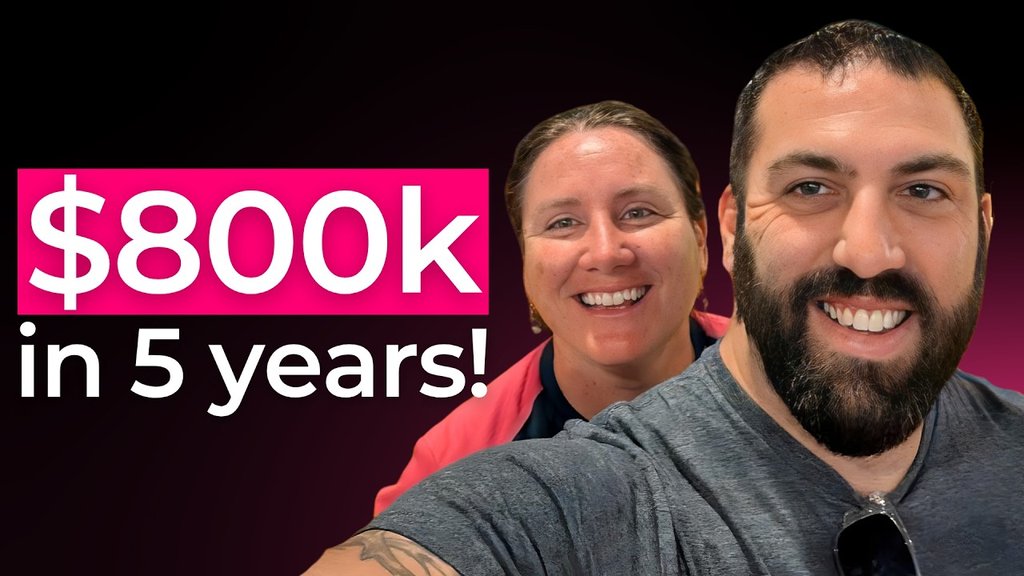
Table of Contents
- From Orkin at 19 to Board Certified Entomologist
- “Why Don’t You Work for Me?”
- The First Leads Came at All Hours
- How GoHighLevel Catches the Calls Their CSR Can’t
- Why Yelp Works for Them When Most Owners Hate It
- The Habit Behind Everything: Asking for Help
- How They Won Their First Government Contract
- Why They Think of the Company as a Table
- The Rebrand They Started Within a Week
- Mom Owned, and Customers Notice
- What Pest Control Millionaires Changed
- What They Took Home From PCM House
- Eight Locations and a Nonprofit for Orphans
- Their Advice for Pest Control Owners
- Want to Grow Your Pest Control Company?
- Frequently Asked Questions
I sat down with Mike and Elizabeth Gilbert of Invicta Pest Control out of Raleigh, North Carolina. Elizabeth owns the company, and she is the one who actually started it. Mike got into pest control at 19 and is a board certified entomologist. Five years ago, after adopting two of their five kids and seeing the pest conditions those kids had been living in, they decided to build their own.
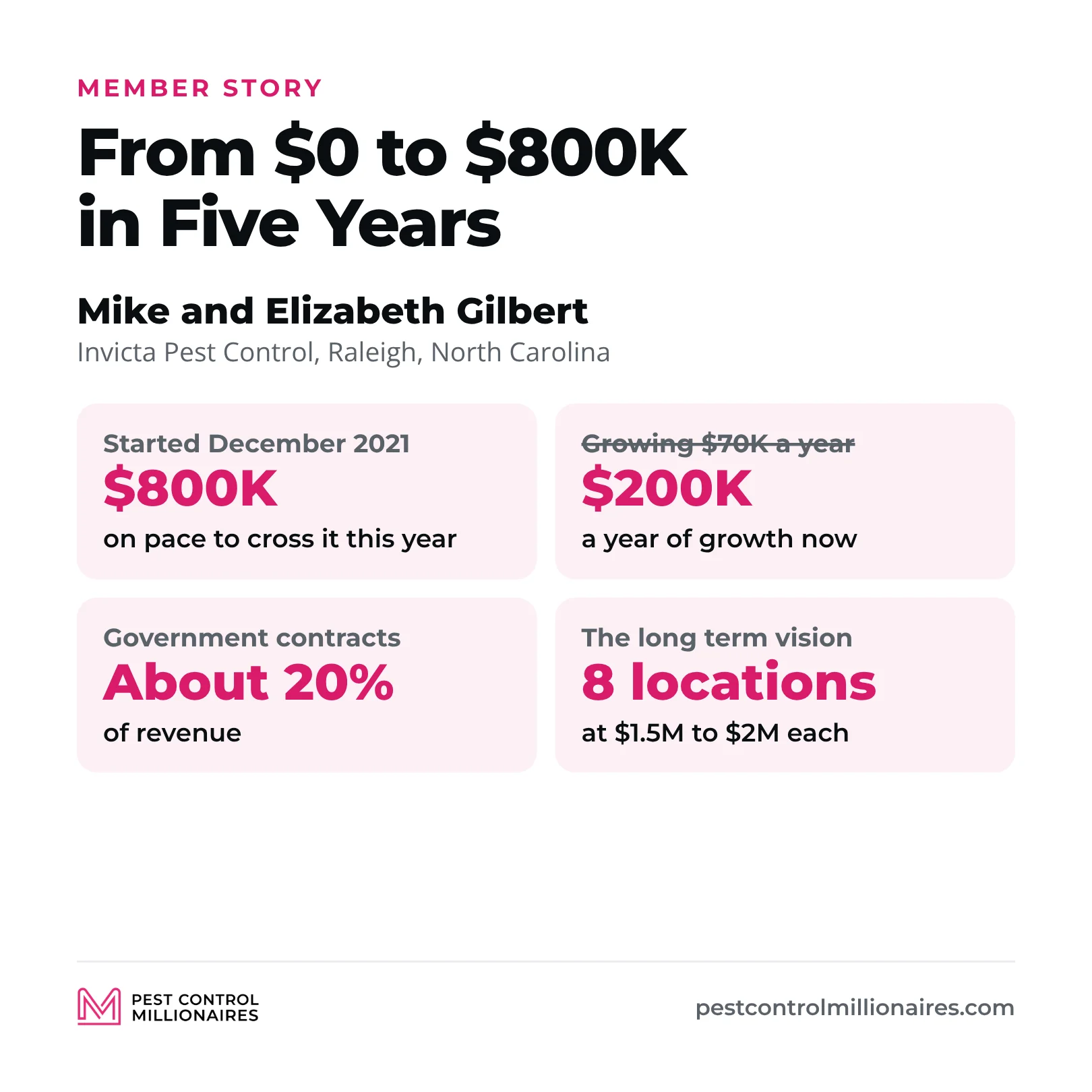
In 2026, Invicta is going to cross $800,000 in revenue.
They got there with a mix most owners never try. Yelp, government contracts, wildlife work and a rebrand they started within a week of deciding on it. And there is one habit underneath all of it that I think matters more than any single channel. Here’s their story.
From Orkin at 19 to Board Certified Entomologist
Mike was 19 when his dream of being a dentist stopped being something he wanted. He was running routes for a uniform delivery company, and a buddy in sales at Orkin told him he was already doing routes, so why not try pest control. Less manual labor, more pay. Mike started with Orkin at 19.
Later he worked for a local company in Raleigh that had a college reimbursement plan. He used it to start on a science degree and become an environmental scientist, which is one of the requirements for the board certified entomologist certification. He was still in school full time when he and Elizabeth started the company, while raising a family too.
“Why Don’t You Work for Me?”
Here’s the part I love. Mike has the pest control background, but Elizabeth started the company.
She was a stay at home mom with five kids, and Mike was working in pest control for someone else. In her words, she told him, “I’m gonna start a company. Why don’t you work for me?”
Mike thought it was a great idea. He had seen what works, what doesn’t, and what technicians really want out of a company.
They formed the LLC in December 2021 and spent months just preparing. Their first customer didn’t come until about February. Elizabeth had her friends call the phones to make sure they would ring, and she practiced answering.
If you’re starting a pest control business right now, that’s what the beginning looks like. A lot of preparation before the first dollar.
The First Leads Came at All Hours
They worked two fronts from the start. Elizabeth got the company ready for government contracts. Mike worked Angie’s List, Thumbtack, and anything else he could think of to get leads. They were paying for those leads and, as Mike says, just trying to muscle their way through the grind.
Elizabeth remembers him answering texts in the middle of the night and setting jobs up for the very next morning. They felt they had to respond at all hours of the day.
They don’t do it by hand anymore.
How GoHighLevel Catches the Calls Their CSR Can’t
Invicta has a CSR who answers the phones. But sometimes three or four calls come in at the same time, and one person can’t answer all of them. So an AI assistant in GoHighLevel answers the overflow calls, and the team calls those people back.
It also replies to messages on Google, Yelp and most other platforms with a pre-made message and collects the customer’s phone number. Mike’s point here is a good one. Once someone gives you their phone number, you know they’re more serious about getting service.
I asked Mike what he’d say to owners who don’t have something like this in place.
Your competition’s gonna have it. And so who’s gonna be the faster person to help that customer?
You did all that work to get the lead. Don’t give them a reason not to go with you. Speed to lead is one of the cheapest wins in this industry.
Why Yelp Works for Them When Most Owners Hate It
Most owners I talk to despise Yelp. Bad leads, too competitive, too much money. Maybe 10 to 20 percent of the people I hear from like it. Mike and Elizabeth are in that group, and Yelp is their number one lead source.
Mike’s read on why it works for them is simple. They already had a five star rating, they service customers on time, customers aren’t complaining, and they respond to questions fast, which goes back to GoHighLevel.
Elizabeth added what Yelp customers are actually searching for. They look for eco-friendly, local and pet friendly, and they look for five star reviews. Invicta matches all of those, so people start with them.
It wasn’t always smooth. At one point the leads were bad. So they called Yelp and asked if there was any way to get better ones. Yelp worked with them, and all of a sudden the leads got really good. There was also a time Yelp charged them too much, and they worked through that too. One of the Yelp reps got to where she called Elizabeth on the last Friday of every month just to see how everything was going.
Here’s the takeaway. On any advertising platform you spend real money on, get a rep you talk to regularly. Helping you succeed is their whole job.
The Habit Behind Everything: Asking for Help
Mike said something right after that I want every owner to hear.
I think that’s been one of Elizabeth and I’s strengths is we just will ask for help from everybody.
That’s how they found Pest Control Millionaires. That’s how they ended up talking to Paul Alley. As Mike put it, “We just ask for help all the time because we need it.”
I see this trait in pretty much every top entrepreneur I talk to. Whatever your goal is, find someone who has done it and ask them how they did it.
How They Won Their First Government Contract
About 20 percent of Invicta’s revenue comes from government contracts. It started with a conversation.
While Mike and Elizabeth were getting ready to start the company, they weren’t sure whether to go with a franchise or build their own brand from scratch. So they asked other entrepreneurs and franchise owners. Paul Alley gave them a lot of great advice, and since he has a lot of government contracts, they asked him about that too.
His answer was to find your PTAC officer.
They had no idea what that was. I didn’t either. It turns out there are PTAC officers in every state, and they give you free advice on how to get government contracts. Elizabeth’s works at NC State. He walked her through everything, from her profiles and her capability statements to which websites to be on, like sam.gov and the local ones, and how to look for RFPs.
It took multiple appointments. She would do the work, he would check it and give her feedback. As Mike said, it was a lot of work.
Now when an opportunity comes up, they get pinged. They usually have three weeks to submit an RFP and make sure the price is competitive. That process got them their first government contract, and those contracts helped them put more trucks on the road and open up more routes.
Mike’s case for trying it, especially if you’re between $200K and $500K and all residential:
You have a free PTAC officer paid for by federal taxes and their job is literally to help you get government contracts. That’s their job. So why not get a free resource?
Elizabeth added one caution. At that size, figure it out yourself. If you pay someone else to chase contracts, they could put in three weeks of work on a bid and you get nothing out of it.
Why They Think of the Company as a Table
Invicta is about 80 percent residential. I asked how commercial and government work compares.
Mike gave the honest version. On a rainy day you can go inside and do a commercial job, where a residential day might be lost. But residential customers pay on the first, and government contracts are mostly net 30. And if there’s a government shutdown, you wait until the government opens back up.
The picture they use came from Paul Alley when they were starting out.
Think of your company as a table and you’ve got different legs on it.
Wildlife, government, commercial, residential. The more legs, the more stable the table. Residential stays a strong leg.
Elizabeth explained why that matters with contracts. Say you win a three year contract, hire a technician and build a route around it. Three years later it goes back on the market, and you have the same fair shot as everyone else. If you lose it, that technician is out of a route. So wherever they have a commercial stop, they build up residential in that same area.
Wildlife is its own leg. It’s around 15 to 20 percent of what they do. Pest control for them is about recurring revenue, and wildlife is more of a one time, big ticket job. It lets their technicians sell more and earn more, and it gives the company cash to buy more leads and work on marketing.
The Rebrand They Started Within a Week
The company started as Invicta Environmental Pest Defense. When Mike and Elizabeth joined Pest Control Millionaires, they decided to go all in. They had me redo their website, and I asked what they thought about a rebrand.
Mike’s reaction was, “Ouch. No. But it was the right decision.”
My thinking was simple. There’s a scene in The Social Network where an investor tells them to drop the “the” from The Facebook. Just Facebook. It’s cleaner. Invicta Pest Control is cleaner, and fewer words are easier to remember.
They knew it would take a lot of money and a lot of mental energy. They had it in the back of their heads already, and Mike says they’ve learned to listen to the little voice that says you need to fix this instead of ignoring it.
What helped was that Mike had read Zip Code Kings before he ever joined. He believes it’s Jonas who says in it, don’t wait to rebrand, because the longer you wait, the more it costs and the more it hurts. So he and Elizabeth had already had that conversation before I brought it up.
They started the process within about a week. Most people wait five to ten years, and it never happens. I have a ton of respect for that.
They also changed the mascot. They already had an ant, and Elizabeth describes the old one as more of a mom figure, kind of sassy, leaning up against the sign. The new one is a little boy named Anthony All-Star. It’s friendlier for kids, which fits a mom-owned, family focused company. The idea is kids outside in their yard playing sports, not afraid of pests.
And it’s working the way a good pest control brand should. Kids look for the trucks and come up to Elizabeth to say they saw one. The technicians got better wraps and new shirts. Mike says the technicians loved it, the customers loved it, and they love their brand way more than they did before.
Elizabeth said the biggest effect was on the customers they already had. They see the truck and think, that’s my company right there. Then the neighbors ask who those guys are, and that’s where the extra leads came from, referrals from neighbors.
Mom Owned, and Customers Notice
Elizabeth technically started the company, and Invicta says so on its website and in its marketing. Mom owned.
I asked if it actually resonates. Absolutely, she said. Customers tell her they looked for it. They get excited for her. And when they call, they talk to her like someone who gets it. A dad tells her his daughter found a roach in her room and will never sleep in that room again, and “you know what I’m talking about.”
What I’ve noticed across most companies is that it’s usually mom calling. So if it’s true for your company, it’s worth saying.
What Pest Control Millionaires Changed
Mike and Elizabeth joined the program around January 2026. I asked what the impact has been.
“Life changing is the quick way of saying it,” Mike said. “The program is helping change our family’s future, our kids’ future, generationally. So for us this is gonna be a legacy business.”
He figures they were doing somewhere around 50 to 70 percent of things correctly before. They just weren’t doing everything well. The program taught them to fine-tune each area, branding, the website, lead generation, marketing, and to leverage everything they can.
Elizabeth’s answer was about systems. Getting everything on paper instead of in their heads, and being more methodical than emotional. When something comes up that they haven’t seen before, she says, “I guess we haven’t thought of that yet, so let’s make a system.”
Then Mike said this.
We would have easily paid ten times that to get to this group because it’s been so valuable. We’ve gone from scaling at $70,000 a year to $200,000 a year. And now I want to scale so much more than that.
What They Took Home From PCM House
A little over a week before we recorded, Mike and Elizabeth were at PCM House, the house Jake and I hosted during PestWorld with ten people from the program.
For Elizabeth it was the camaraderie. Their neighbors aren’t entrepreneurs. Most people they run into aren’t. She says you can feel like an island. At the house, everyone had made the same sacrifices, paying their employees first and themselves later, to build something.
Mike took the same thing from a different angle. He hadn’t realized that owners in their shoes, from about $500,000 up to $1.5 million, are sometimes financially running on fumes, because they put everything they can into growing. “We’re not alone growing our company in this way,” he said.
It also gave him a goal, to get to $1.5 to $2 million as quickly as possible and get past that pain point.
Eight Locations and a Nonprofit for Orphans
The long term vision is eight locations in eight cities, each one at $1.5 to $2 million.
There’s a reason behind the number. Mike and Elizabeth started a nonprofit to help orphans. It isn’t as far along as they want yet, but the idea is to get brand new clothes to orphans in each county. For now they’re sticking to Raleigh.
I don’t see any reason they won’t do it.
Their Advice for Pest Control Owners
I asked both of them what they’d tell the owners listening.
Elizabeth said, “Don’t give up. Push through, make your short-term goals and your long-term goals, and ask for help when you get stuck.”
Mike agreed. Whether it’s pride or low self esteem holding you back, there are plenty of pest control owners outside your competitive area. Ask them. His advice is to get a mentor, or several, who really want you to succeed, ask for their help, and do whatever you can to encourage that relationship.
Mike also made an open offer on the show. He’s willing to help anybody. You can find him and Elizabeth through invictapest.com, and Mike on Facebook or LinkedIn.
Want to Grow Your Pest Control Company?
If Mike and Elizabeth’s story hit home, here are two free ways to start.
First, join our free Facebook group. Search Pest Control Millionaires on Facebook and request to join. There are over 5,000 owners in there sharing what’s working right now.
Second, grab our book Zip Code Kings on Amazon. It’s the book Mike read before he ever joined, and it had him thinking about a rebrand before I brought it up.
If you want to see how other members got their results, read Couri Leuschner’s story or the rest of our success stories.
Mike and Elizabeth built an $800,000 company in five years while raising five kids, and they did it by asking for help every step of the way. That part costs nothing.
Frequently Asked Questions
How did Invicta Pest Control get its first government contract?
Elizabeth Gilbert found her PTAC officer, a free adviser whose job is to help small businesses win government contracts. Hers works at NC State. He walked her through her profiles, her capability statements, the websites to be on, like sam.gov, and how to look for RFPs. Mike and Elizabeth learned about PTAC officers from Paul Alley while they were getting ready to start the company.
Why does Yelp work for Invicta Pest Control?
Mike points to a five star rating, servicing customers on time and answering questions fast, which GoHighLevel helps with. Elizabeth adds that people on Yelp look for eco-friendly, local and pet friendly companies with five star reviews, and Invicta matches all of it. When their leads got worse, they called Yelp and asked for help, and the leads got better.
Why did Mike and Elizabeth Gilbert rebrand Invicta?
They started as Invicta Environmental Pest Defense. After they joined Pest Control Millionaires, Dan Leibrandt suggested the shorter Invicta Pest Control, and they started the rebrand within about a week. Mike had already read in Zip Code Kings that waiting only makes a rebrand cost more. Their technicians and their customers loved it.
What did Pest Control Millionaires change for Invicta Pest Control?
Mike says they were doing a lot of things correctly but not everything well, and the program taught them to fine-tune branding, the website, lead generation and marketing. Elizabeth says it got everything on paper and into systems. In Mike’s words, they went from scaling at $70,000 a year to $200,000 a year.
Full transcript
Read every word of the interview
00:00Dan Leibrandt
Hey everyone and welcome back to Pest Control Success Stories. I'm your host, Dan Leibrandt, and today I'm with Mike and Elizabeth Gilbert, co-founders of Invicta Pest Control out of Raleigh, North Carolina. Mike has been in pest control for over two decades and is a board-certified entomologist. And five years ago, Mike and Elizabeth decided to start the company after adopting two of their five kids and seeing the pest conditions they were living in. Now, this year, Invicta is going to cross $800,000 in revenue. And that is from a variety of lead generation sources, which we're going to talk about in this episode, which is Yelp and their rebrand and their website and getting government contracts and all of these awesome things that they're doing and growing super fast. So I'm super excited for this episode. I know Mike, you joined or you guys both joined the program about at the beginning of this year. So it's been so cool to watch your growth and really excited to have you guys both on the show.
01:04Elizabeth Gilbert
Thanks for having us.
01:05Dan Leibrandt
Of course.
01:06Mike Gilbert
Absolutely, thank you.
01:07Dan Leibrandt
Of course. So I first wanna dive into your background, Mike. How did you get into pest control like over twenty years ago?
01:16Mike Gilbert
Yeah, so I was 19 and my dreams of being a dentist were were not gonna be a reality, not something I wanted to do anymore. So I started in a uniform delivery company and a buddy of mine was in sales for Orkin and said, You're already doing routes, why don't you try pest control's a lot less manual labor, you get paid more. And I was like, Yeah, let's try it out. So that's I started with with Orkin. When I was nineteen.
01:47Dan Leibrandt
Wow. And then you became a board certified entomologist. When did that happen?
01:54Mike Gilbert
Yep, so before we started the company I worked for somebody else locally here and they actually had a college reimbursement plan and so I started with them I started taking my courses then to get become an environmental scientist, which is one of the having a science degree is one of the requirements for getting your board certified entomology certification. So I had to start there and so that was a that was a journey when we started the company was going to school full time as well as raising a family and our company as well. So...
02:33Dan Leibrandt
Hmm, for sure. So Elizabeth, to my understanding, you actually started the company, even though Mike has the pest control background. So how did that come about?
02:44Elizabeth Gilbert
That's correct. I was a stay at home mom with the five kiddos and he was working in pest control and we just made a decision and I said, You know what? I'm gonna start a company. Why don't you work for me? And he said, That's a great idea. I know I've done this before. I have seen it work, I seen what doesn't work, I know what technicians really want out of a company and I wanna make sure, you know, we can provide that for them. And so we just started brainstorming the best way we can come up with to come up with the best brand and the best market here in Raleigh. So that's where it all started. December two thousand twenty one is when we g we started our LLC. Yep.
03:28Dan Leibrandt
So awesome. Just a little less than five years. So you guys are five years in now. I wanted to ask, what did that first year look like?
03:37Elizabeth Gilbert
Yeah, so the at the beginning we started in December and we did a lot of just preparation work. We just spent months just preparing everything and we didn't get our first customer until about February. So we were making we were testing the phones just to make sure that they would ring. And it's like if somebody does happen to call, is it gonna work? And all sorts of things like that. So I would have my friends test call and I would practice answering and it was a lot of preparation work.
04:04Dan Leibrandt
Hm. Okay. So a lot of preparing and then how did you start to generate leads?
04:11Mike Gilbert
Yeah, so we worked on we worked on two different fronts. So we actually had Liza s Elizabeth starting out with government contracts getting us prepared on that front while I was working through Angie's List, Thumbtack, anything I could think through to get us leads. We were obviously paying for them in the beginning, and just trying to muscle our way through the grind.
04:42Elizabeth Gilbert
Yep, I remember him answering texts in the middle of the night, with Angie leads and Thumbtack. Everything is super responsive. So he would just set it up for the very next morning and he was like, We just can't sleep. We just have to respond at all hours of the day.
04:58Dan Leibrandt
Yeah. Well, as you guys know, speed to lead is so important. And w one thing I wanted to bring up, which Mike, you mentioned it's really pivotal or really helpful in your business, is using something like GoHighLevel. So I'm guessing I mean that's probably been implemented this year. What w what is the effect of using something like that?
05:20Mike Gilbert
Absolutely. So on our overflow calls, so we have a CSR that answers phone calls, but sometimes you get three or four phone calls at the same time. And so the one CSR can't answer everything at one time. So the overflow virtual assistant, the AI will answer that a little bit responsive, and then we can call them back after that. So that's one thing that helps out. Also, it'll message whether it's Google, Yelp. Any other platform that you have, for the most part, it'll respond back with a you know, pre made message and collect the phone number for the customer so we can give them a call. So once they give their their phone number, we know they're more serious about the questions that they have for for getting service.
06:09Dan Leibrandt
Hmm. What would you say to people who don't have something like GoHighLevel in place?
06:16Mike Gilbert
Well y your competition's gonna have it and so who's gonna be the faster person to help that customer? You know, you don't wanna give them a reason not once you've worked done all that work to get the customer, you don't want to give them a reason not to go through a service for you. And so if you're slow to respond, you're you're giving them a reason not to continue reaching out to you for service.
06:39Dan Leibrandt
Yeah. And I've especially noticed this with paid directories like Yelp and Home Advisor and Angie, that, you know, it's competitive. And usually like these these people are looking through different companies and kind of shopping around. So I know Yelp is a big source for you guys. How are you I think actually Yelp is the number one lead source for you guys. How are you doing well on Yelp and beating competition there?
07:10Mike Gilbert
Well, I think and Elizabeth, you can correct me if I'm wrong, but I think you know, we had already started with Yelp and having a five star rating was I think a big one for Yelp, being able to service customers on a timely manner, not having them complain about things and then obviously just the go go going back to GoHighLevel, ha having just a speed to respond to their questions. On Yelp and so Yelp I think puts that into their algorithm, but it's just those are the factors that I see.
07:48Elizabeth Gilbert
Yep, there's some other things that Yelp really likes. It looks like customers on Yelp really like eco-friendly and they really like local. So they're they're looking up eco-friendly, local, pet friendly, and they're also looking up if they have five star reviews. So we match all those requirements, so people use us or start with us.
08:07Dan Leibrandt
Huh. Yeah, most owners that I talk to despise Yelp. They've, it's bad leads, it's too competitive, spending too much money. Yeah. No, the...
08:12Elizabeth Gilbert
Ha.
08:16Mike Gilbert
Thank you, thank you.
08:20Dan Leibrandt
That that's what I hear. It's the people, maybe the 10 to 20% of people I hear that do like Yelp, it's like, okay, more for us. So did you guys ever have a bad experience with it? Or is it why do people say that?
08:35Elizabeth Gilbert
I think that at one point we had a bad experience and we called them and we said, Hey, is there any way you can boost our ability to get better leads? And they worked with us and then all of a sudden we got really good leads. It was like they kinda maybe had personnel changes or forgot about us and you know, they just it once they boosted whatever they do, it worked.
08:58Dan Leibrandt
What?
08:59Mike Gilbert
I think yeah, I think it's a lot like any other platform, right? If you want to learn how to use Facebook, you probably need some help with somebody who works in the platform, right? Same thing with Google. Just we asked for help with Yelp and you know, we had we had a time where they charged us too much and we worked through that. But for the most part, honestly Yelp's been pretty seamless for us.
09:22Dan Leibrandt
Wow. That's actually a really good point, Mike. That on these different advertising platforms that you use, you should probably have a dedicated rep that you're talk to talking to some somewhat regularly. And, now they're they're responsible for your success. And you can be like, hey, look, if you don't help us out with this thing, we can't keep putting money here. And that's their whole job.
09:45Elizabeth Gilbert
Yep, one of the representatives would call me the last Friday of every month just to see how everything was going. So she would call me. I wouldn't have to call her.
09:55Mike Gilbert
And I really think to piggyback off of that for just a moment, I think that's been one of Elizabeth and I's strengths is we just will ask for help from everybody. And that's how we absolutely. So we just ask for help for everybody. And that's how we found Pest Control Millionaires, that's how we found talking to Paul Alley. We just ask for help all the time because we need it.
10:06Elizabeth Gilbert
Yeah, we do that.
10:24Dan Leibrandt
Yeah. Yeah. No, that's a trait that I see in pretty much all the top entrepreneurs that I talk to is you have to be willing to change, you have to be willing to learn, you have to seek out mentors. Like whatever your just what I found is whatever your goal is, just find someone who's done that and ask them how they did it. Really it's simple. Versus may maybe it's a huge goal like how do I how do I get to Mars or something? Okay, well, maybe you can't get a mentor for that because it's d no one has done it, but when it's something, you know, like the Paul Alley thing, I actually want you to expand more on that. You've mentioned that I think around twenty percent of your revenue is from government contracts and that Paul Alley played a huge role in that. So what did you learn from Paul Alley?
11:15Mike Gilbert
So Elizabeth, you can start this conversation 'cause I think we had talked to Paul and Amy several times as we were getting ready to start a company.
11:24Elizabeth Gilbert
Yeah, absolutely. We were we were trying to figure out the best type of company to get started. We weren't sure if we were gonna do like a franchise model or you know, start it from scratch with our own branding. We just we were asking other entrepreneurs and franchise owners what the best way to go is. And Paul Alley definitely gave us a lot of great advice and so we were like, this is so cool that he's helping us and he has a lot of government contracts, so maybe we could ask him more about that and he started to give us some information. Information that was really valuable because there's PTAC officers here in our in every state, and they give you free advice about how to get government contracts. So he just said, Find your PTAC officer, and we're like, What's that? And so then we had to do some research. He didn't give us all the steps, but he gave us a good starting point. And he was like, Yeah, just get a PTAC officer. And we're like, sure. So then we had to figure out what that is. And my PTAC officer works at NC State, and he walked me through every that needed to get all my profiles ready and my capability statements and how to look for RFPs, how to just be on the grid, and then once opportunities come up, then we get pinged and we start working towards it. Usually we have three weeks to get an RFP submitted and make sure we have a competitive price. And so all that just helped us get our first government contract. Contracts which really helped us get more trucks on the road, and helped us get opportunities for more routes.
13:01Dan Leibrandt
I've never even heard of a PTAC officer. So he's he's saying that's a non-negotiable, you have to contact that person?
13:08Elizabeth Gilbert
But they're free. I mean, there's just free resources that they know exactly what we need to do. And so what websites do you need to get on, like sam.gov? What websites locally do you need to be on in order for them to find you or you to be able to find what they've posted publicly. And so he just laid it all out for me. It was so mis so much information I had to make multiple appointments with him just to get everything squared away and then I would have him look at it and check it and make sure it looked good. And then he would just give me the feedback.
13:40Mike Gilbert
It was a lot of work.
13:44Dan Leibrandt
So in your guys' eyes, which you're about eighty percent residential, how does residential compare to commercial? What are the pros and cons between the two?
13:58Mike Gilbert
So yeah, we were trying to figure out who's gonna answer that one. So you know, some of the benefits on the commercial side, depending on how your contract is set up. If you have a rainy day, you can go inside and do a commercial job. Whereas residential, you know, you might be out out of luck that day if it's if it's raining outside. So that's one of the benefits there. You know, on the residential side, you know, you're getting depending on how you're company set up for us, you get paid on the first. But on the government side, they have it like most of the time net thirties. So there's a delay in the pay. And if there's a government shutdown, you're gonna wait until the government opens back up. So I think for us, one of the things that Paul Alley told us when we're starting off is make sure there's you know think of your company as a table and you've got different legs on it. And so we want to have, you know, wildlife government and commercial, want to have residential and so the more legs we have, the more stable that t table is. And so we try to try to balance that out as much as we can. But we definitely want to continue the residential side as a as a strong strong leg in that scenario.
15:18Elizabeth Gilbert
Correct. Because if you if you get a contract for three years, you hire a new technician, you got them on the route, and then it goes back on the market three years later and you have, you know, however many people compete for it, you have the same f fair opportunity to get it as everyone else. So you may, you know, be out of luck with your technician now they are kind of out of a job. And so you just want to make sure that if you do have a commercial stop that you get your residential. Potential up in that area so that way they still have a route even if we do lose that contract.
15:54Dan Leibrandt
Yeah. Okay. That makes sense. So for the audience, let's say someone's listening to this, maybe they're at, two hundred to five hundred K in revenue and they're solely residential. Would you recommend that they get into commercial slash government?
16:12Elizabeth Gilbert
'Cause there's local there's a local government, you have the city and then you have the state and then you have like nationwide things that you can work with other companies with. So there's a lot of opportunities people just aren't aware of.
16:27Dan Leibrandt
Mm. But I guess to your point, Mike, it's about diversifying and not having all your b eggs in one basket. Yeah.
16:34Mike Gilbert
Absolutely. And it just as an entrepreneur, it gets you thinking differently and helps you to understand more what you can offer and where you want to specialize in. So if somebody doesn't want to do residential at all, you know, I'm not gonna twist their leg and say, Hey, need to get into residential. And vice versa, if somebody just wants to do government contracts, you know, I think David Poplin is huge in just that. And so it's working great for him. But with your scenario with somebody who's in the two to five hundred mark, the leaves don't cost anything. You have a free PTAC officer paid for by federal taxes and their job is literally to help you get government contracts. That's their job. So why not get a free resource? You're already trying to grind through, you know, I think I can, I think I can, I think I can. And you know, again for us that's a huge part of our company. It helped out tremendously.
17:35Elizabeth Gilbert
Yes, definitely because what's hard is that you don't wanna hire somebody to do the contracts because you they could be working a lot and not get any contracts. So it's probably best if somebody has that small of a company that they figured out themselves. That way they're not you know, spending money to do three weeks worth of work and then they don't get anything out of it. It's a big risk to pay somebody else to do that.
18:01Dan Leibrandt
Got it. It's funny because I've interviewed David Poplin and who's the other one? Paul Alley and some some of these other guys like Jeff Stafford. None of them told me about the PTAC officer. So I feel like that maybe that's a secret that they try to keep on the on the down low.
18:17Mike Gilbert
You know what? They're they're great people. They have been very open one on one. I am yeah, I don't know their their systems for for mentorship, but we learned that from Paul Alley and it's been a huge thing for us. And so they're they're they're great people all the way around.
18:39Dan Leibrandt
Yeah, for sure. Cool. And then I also wanted to ask you guys about the rebrand. So earlier this year, I don't know exactly when, maybe March or April around that time, you guys rebranded. Not a not a full rebrand, you're still Invicta, but what made you rebrand and what has the effect of that been?
19:01Mike Gilbert
I'll probably answer this one, Elizabeth. So we had started out with Invicta Environmental Pest Defense and we got into Pest Control Millionaires and we just talked about it and said, Let's go all in. And so we got you to redo our website and that was fantastic. We just listened to you. You said, Hey, what do you think about a rebrand? And I was like, Ouch. No. But it was the right it was the right decision. We knew it. We kinda had that in the back of our head too. And we've learned to listen to that that little part that says, hey, you need to fix this, instead of ignoring it. So we said, All right. So we knew that would be a lot of money, a lot of mental energy, and but it was the one hundred percent the right decision. Our our technicians loved it, our customers loved it. We actually love our brand now way more than we did before. Is there anything else you wanted to add to that, Elizabeth?
19:54Elizabeth Gilbert
Yeah, it's just the cartoon character. We already had an ant and she was more of a mom figure. She was more like kind of sassy leaning up against the sign. And now we have more of a child. So the ant is a little boy and his name's Anthony All-Star. So it's just I think more friendly for children and that was really what we were going for because you know, the mom the mom-owned family focused idea is kids just really love the cartoon. And it really draws them. So they're always looking for our vehicles and then kids will come up to me and say, Hey, I saw your vehicle and it's just it's something that people are paying attention to. And the p you know the point is to get kids outside in their yard that they're not afraid of the pests but they're enjoying playing sports. And that's where the whole like playful sports attitude comes from.
20:47Dan Leibrandt
Yeah, definitely. Yeah, no, I think because I even though I planted the seed a little bit, you guys you guys handled the whole thing. I think you did a tremendous job on on the rebrand. For people that don't have the context, the thing that I just mentioned was that they were Invicta Environmental Pest Defense. And I was like, just like actually there's if you guys have seen the movie, The Social Network of it's about the whole Facebook story and...
20:56Elizabeth Gilbert
Ha.
21:16Dan Leibrandt
Facebook, the company, and the scene in the movie is that Facebook used to be called The Facebook. So and one of their investors, I forget who it is, but it in that movie says, just make it Facebook. It's cleaner. So it's I feel like I was doing that way, just make it Invicta Pest Control. It was cleaner. So just a slight shift in the name there that I think makes it a little more memorable. When you have too many words there, it's hard to remember. So I think that was definitely the right decision. And I have a ton of respect for you guys for making it right away. I it was like within a week you started the rebrand process. Whereas most people wait five to ten years and it never ends up happening.
22:01Mike Gilbert
So one of the one of the helpful things that we had was I read Zip Code Kings before I got into Pest Control Millionaires. And one of the things that I believe it's Jonas that says that don't wait to rebrand, do it now. It's gonna always cost more, it's gonna you know the longer you wait, it's gonna hurt it's gonna hurt more the longer you wait. And so he kind of primed that conversation before even talking to you. And so that's one of the conversations Elizabeth and I had was if we don't do it now, it's gonna cost us more later on. And so again, we just trusted you guys and went went full on, let's go. We wanna wanna build an amazing company and the book built trust for us to be to be mentored and allow you guys to listen allowed us to listen to you.
22:24Elizabeth Gilbert
Ha...
22:54Dan Leibrandt
Yeah. I'd love to hear that. And I think it'll only continue to pay dividends. I'm a I'm a huge believer in brand. And I so I'm curious, like Elizabeth, you mentioned, which I think is so cool. I didn't even hear this before that like kids will be running up to the trucks and like I see you guys everywhere kind of thing. Have you noticed like a an increase in leads from that or that people are mentioning the trucks more and that kind of thing?
23:24Elizabeth Gilbert
I think it just for our current customers it really was a strengthening for them. They were like, Yeah, that's my pest control company. Just coming in with a better wrap, quality wrap of their trucks, it just looks so good. And then the technicians, we changed their shirts, it looked even better. And so just coming in, just bringing up the quality and that sense of customers are like, Yeah, that's my company right there. I think that that was the biggest impression that we got. And so then other neighbors are like, Well who's those guys? You know, it just paid they paid more attention to it. I think that's where we got more leads automat automatically just from referrals from neighbors.
24:05Dan Leibrandt
Totally. Yeah, it's a brand is a thing that's really hard to measure, but it's something that you kind of just know is working. It's funny because maybe some people think of it as lead generation, but like what you guys were talking about, it's kind of all areas of the business. Like now that actually reduces your churn and that actually might make your company more attractive for future employees and that kind of thing. So no, I think it was it was a great decision by you guys. And also mike, you mentioned the Pest Control Millionaires program. I did want to talk about that a little bit. So I know you joined you guys joined the program around January this year. So can you talk a little bit about that of like maybe some things that you've learned, taken away what has the impact been?
24:51Mike Gilbert
Absolutely. Life changing is the quick way of saying it. So yeah, the program is helping change our family's future, our kids future, generationally. So for us this is gonna be a legacy business and man we've we've learned I think we were doing somewhere around fifty to seventy percent correct. I don't have a good empirical number on that, but just we were doing a lot of things correct. We just weren't doing everything well. And so the Pest Control Millionaires has taught us to fine-tune all those areas to the best degree possible to just leverage everything we can possibly leverage in every way of our business. So again, whether it's branding, our website, lead generation, marketing, you name it, you guys have helped us just leverage over and over again. So our our mindset's different. Our even our our group of other entrepreneurs that we know is different because of you guys. So it really has changed us in so many ways. Do you have anything else with that, Elizabeth?
26:08Elizabeth Gilbert
Yeah, I just think getting everything more on paper rather than in our heads. This is how it's done. Just making sure that everything is organized and categorized and that we're we're more methodical with how we do things rather than emotional. And so it's just like this is the way that we do things and this is how it's gonna be. And it makes it so much easier when things that are if something comes up that's you know, an unknown it's like, well, I guess we haven't thought of that yet, so let's make a system.
26:42Dan Leibrandt
Yeah, definitely. I appreciate you guys saying that. And I also I wanted to mention the PCM House, which we were just at a little over a week ago. Such a fun time. We were at PestWorld for people that don't know. We hosted a house with ten people in the Pest Control Millionaires program. J Jake and I were hosting the house and we were there the whole week of PestWorld and there were different parties and going to the event and all of that. What was the impact for you guys there. What did you learn and key takeaways and all that?
27:15Elizabeth Gilbert
I think for me it was more of a camaraderie thing. It's like sometimes you feel like an island when you're doing things that most people around you aren't doing. You know, we don't have our neighbors aren't entrepreneurs, you know, when you look around. You know, and people that you encounter aren't normally an entrepreneurs. So just a con a camaraderie there that, you know, they have done the same things we have, you know, making a lot of sacrifices just to build the business, making sure that you're not you're not not you know paying y for yourself first you're always paying your employees first and just that camaraderie that other people are doing the same thing which is not always comfortable and it's not always logical in the sense of like man you guys should be earning more keep in that sense but it's like we're driving to build the business so that we can later on. And so it's like other people already think that way. So it's nice to talk to people and hear their experiences just like that.
28:13Dan Leibrandt
Sure. Mike, what about you?
28:16Mike Gilbert
Yeah, so piggybacking off the same idea with camaraderie where on we didn't realize that people that were in our same shoes from you know roughly the five hundred thousand mark to even the one point five million are just kind of f sometimes financially kind of running on fumes as they're building their business because they're just putting everything they can into growing that sucker. And that camaraderie was good. Just, we're not alone growing our company in this way, right? We're learning, we're all learning. And it gave us a goal, right? To get to the one point five to two million dollars as quickly as possible, to get past that pain point. So that was good for me. I want I need a goal to move towards and just meeting you guys in person, learning your heart, where you guys are going. That was a huge catalyst for me to move forward w to that one point five and two million dollar mark as quickly as possible. And also, you know, I've just been I know we've both been just so thankful for the PCM group, and so it's a way for us to give back to grow as quickly as we possibly can. But also help the guys that are there to grow as quickly as they can because we want to get back to you guys. I know that some people go, man, that's an entrance fee into the group. But we would have easily paid ten times that to get to this group because it's been so valuable. We've we've gone from scaling at $70,000 a year to two hundred thousand dollars a year. And now I want to scale so much more than that, because I'm so thankful for everything you guys are done. Have done for us.
30:02Dan Leibrandt
Hmm. Thank thanks again for saying that. It really means a lot. Yeah, no, I totally agree with like the camaraderie camaraderie aspect. It was it was so cool to hang out with everyone in person. Of course, like we can do like the weekly group coaching calls [the group coaching calls are every other Thursday] and all of that, but it's totally different actually getting together in person. And for me personally, that's getting together with people in person that have like I mentioned, done the thing you want to do. It has been the biggest unlock for me or just people also at the same level of huh I'm not in this alone and there are other people that can do this and it's not unrealistic. It's not incredibly difficult. Like there is a path to success here. So yeah it's I think we'll plan on doing that every year moving forward and we want to do a lot more in-person stuff which which should be really fun. And then Another point I want to bring up with you guys too, which is unique to your business, is that of course, Elizabeth, you technically started the company and you guys market across your website and other things that you are mom owned. Would you say, like have you seen a benefit of being mom owned to does that resonate with people?
31:07Elizabeth Gilbert
That's right.
31:21Elizabeth Gilbert
Absolutely. When I talk to customers, they looked for that. They like, Wow, I found that and I didn't even know that was around and they're like, You go girl and they get all excited for me and they were like they definitely have given me really great feedback and you know they it's been it's been fun to hear a lot of the stories of people and they're like, You know what I'm talking about and they'll just the relatabilities there, they're like, you know, when your kids do this and then you're like, I just don't know what to do. You know what I'm talking about. And they just tell me about it. And or s you know, their daughter found a roach. One a dad'll be like, my daughter found a roach in her room and she just does n she'll never sleep in that room again. And you know what I'm talking about. And so just that camaraderie or talking to them is just it's really fun and they understand that I can relate to them what they're dealing with.
32:16Dan Leibrandt
For sure. Yeah. What I've noticed across most companies is that it's usually moms calling because, you know, maybe that they're at home more often. I don't know, that there's some kind of issue. So I think that's a huge impact for your your marketing and something maybe others can consider if they're if it's possible. Because it seems to have worked really well. And I also wanted to ask about wildlife. I know you guys maybe you're at fifteen to twenty percent wildlife. What are the pros and cons there and wh why do you offer wildlife?
32:57Mike Gilbert
Yeah, so in some ways, it allows our technicians to sell more and have more income, right? On the other side, the wildlife allows us to you know, buy more leads or work on our marketing or grow the business in a different way. The pest control side for us has just really been focused on the reoccurring and whereas the wildlife's more of a one time big, big hit, right? A big big ticket item. And so giving a mix of that really has been a beneficial thing for us to add into the recurring revenue.
33:37Dan Leibrandt
Yeah. Yeah, I've heard the same with other high ticket services. Maybe it's termite or something else. That like it's really nice to get that initial cash flow. So then you can you can pump more towards marketing and kind of just stay afloat. Yeah. Sweet. Let's see. Okay. So we talked about the rebrand, we talked about Yelp and GoHighLevel. Maybe one of the last things I wanted to mention was actually d I'll we can close with this is what is the future for your guys' company? But where do you guys want to take this and what is the vision?
34:16Mike Gilbert
You want me to answer this, Elizabeth, or do you want...
34:17Elizabeth Gilbert
Sure, go ahead.
34:18Mike Gilbert
Okay. So we'd really like to be in eight different locations. And part of our part of our vision is to be in the cities. We have a nonprofit that we started to help out orphans. We haven't gotten as far as we want to with that, but the idea is to get brand new clothes to orphans in each county. And so part of that vision is to get in eight different locations to get in eight different cities, right? So that's kind of more the long term vision. You know, currently we're in Raleigh, so we're gonna stick to that city, but eventually we'd like to get each each location to you know one and a half to two million dollars each location to kind of give you an idea of where we're trying to go.
35:12Dan Leibrandt
Awesome. I think you guys are totally gonna do it. I don't I don't see any reason why you won't. And the last question I have for you guys, which I'd like both of you to answer, is what is your message to the audience? The pest control owners out there listening? What do you want to tell them? What do you think they need to know?
35:17Elizabeth Gilbert
Thank you.
35:30Elizabeth Gilbert
Don't give up. Push through, make your s short-term goals and your long-term goals, and ask for help when you get stuck.
35:45Mike Gilbert
Yeah, yeah, I would agree. Just ask for help. You know, whether it's a pride thing or low self esteem or how whatever you're struggling with there, there are plenty of pest control owners that may not be in your competitive area. Ask them for help. Obviously if you ask the people in your competitive area, you may not get the best answers. So ask yep, yep. For us, the catalyst really was...
36:08Elizabeth Gilbert
Yeah, probably not.
36:14Mike Gilbert
Again talking to Paul Alley early on, but also the PCM group here with Jonas and Jonas Olson, Jake Sheldon, and you, Dan Leibrandt. So that's been a huge catalyst for us and I know their their heart is to help you guys. So my goal or my advice is to get a mentor, several mentors that really want you to succeed and get their help, ask for their help, do whatever you can to encourage that relationship.
36:45Dan Leibrandt
Hmm, totally agree. Yeah, I would say the same. Mentors have been super impactful in my life. You just you have to find those people that are willing to lead you and teach you and coach you. So awesome. Well, it's been a great podcast. Thank you guys so much for coming on the show. Where can people find you online and connect with you?
37:09Mike Gilbert
Invictapest.com is our website. If you want to email me, my number my email is [email address removed]. I'm willing to help anybody. And I can give you my phone number if you email me. I don't want that going over the internet, but you can also find me on Facebook pretty easily as well. So or LinkedIn, just reach out.
37:36Dan Leibrandt
Awesome. Cool. What about you, Elizabeth?
37:39Elizabeth Gilbert
Yes, yeah, Invictapest.com. You can even do a web form and just type in everything you want to ask and we'll we'll get to it. And my email is [email address removed]
37:52Dan Leibrandt
Awesome. Sweet. So thank you guys again so much for coming on the show. I am such big fans of you guys and I can't wait to see where you take this company. Yeah, of course.
38:04Mike Gilbert
Thank you.