

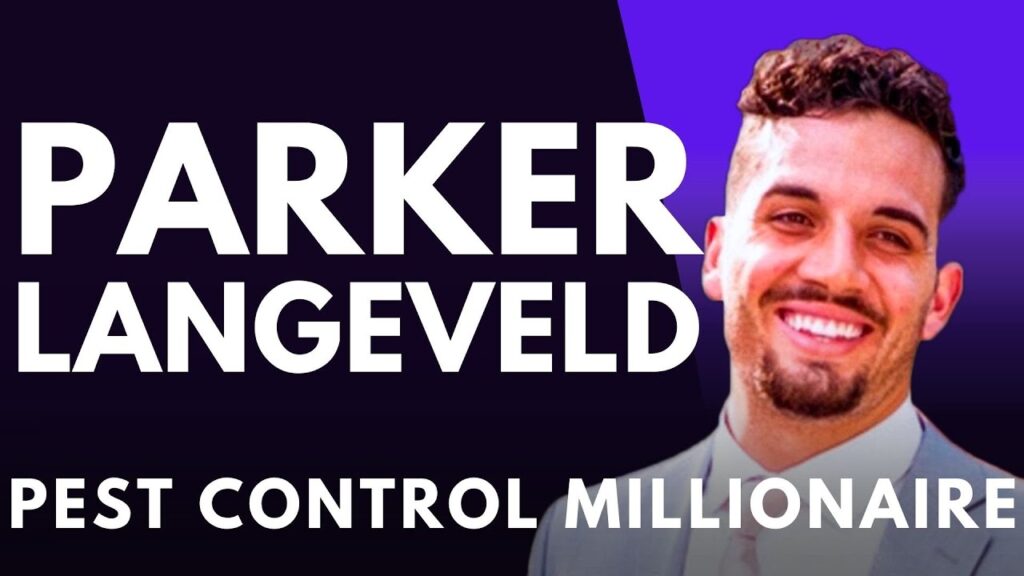
Parker Langeveld, the President of Sales at Hawx Pest Control, is the reason I know this business at all. This one was personal. Parker is the guy who taught me almost everything I know about this business. He flew out to Green Bay and Appleton in the early days, helped us launch Turf Badger, and was our first real teacher on the doors. We had one of the best in the whole industry showing us the ropes from day one. So sitting down to record with him, five years after I bought the Pest Control Millionaire domain while he was standing in my office, was kind of surreal.
He covered a ton of ground. Here’s what stood out.
If you want more on door to door done right, listen to my talks with Lenny Gray and Chad Louk, or find every episode on the Pest Control Millionaire podcast.
Table of Contents
ToggleHis why was never the money
Parker did not get into door to door for the cash. He was a full ride scholarship kid at the University of Utah, double majoring, with an internship lined up at a pharmaceutical lab. The plan was to be a doctor. When Scott Wilson, who owns Hawx, told him the job was door to door, Parker laughed and said no shot. He had just spent two years knocking doors on a mission in Chile. He did not want to do it again.
What changed his mind was not the paycheck. It was his mission president, a man he looked up to more than anyone, who later passed away from cancer. Parker watched this guy get people to drop their walls in 30 minutes. It took the rest of them weeks. Parker chalked it up to one thing: empathy. Real empathy that comes from living, not from reading. He decided he wanted that superpower, and that the fastest way to build it was to travel and meet people and learn why they think the way they think.
So when the owner said the job was in Texas, Parker flipped on a dime and asked where to sign. His why was empathy and travel, not money. He told me a line that has stuck with me ever since: “Your life is a story. Every chapter counts, and you can only ride it once.”
Here is the proof he meant it. When he counted the money, he sold worse. So he stopped looking. He did not even let his commission hit his own bank account that first summer. “I didn’t even have the money go to my account,” he said. “It went to my dad’s, because I understood that, 20 years old, you put $200,000 in my bank account, I’m gonna blow it.” Put up a barrier and protect yourself from yourself.
Talent gets you in the door, skill makes you elite
I asked Parker what makes a top one percenter different. He pushed back on the idea that you just work hard enough and you get there. He used himself as the example. No matter how hard he trains, he is never going to deadlift 1,100 pounds like the strongest man on earth. He does not have that build.
His point is that everyone walks in with a natural talent level. That is what you can do without even knowing why you do it. If you want to be elite, you build skill on top of that talent. For Parker, sales came naturally. He started at five accounts a day, built to seven by midsummer, hit twelve by the end, and can throw down 20 to 25 now. Recruiting was the part that was hard for him, and that is the part he had to grind to learn.
Bloom where you are planted
This phrase came up over and over. Parker’s whole early strategy was simple. He was 20, he did not know much, but if he gave everything he had right where he stood, it would open doors he could not even see yet. He watched it happen on his mission. The people who went all in opened up opportunities the half-in people never got.
He also lives by this rule. Until you are 40, say yes to most opportunities. Once you have made it, then you can be picky about saying no.
Do not buy a fancy car to recruit
Parker’s first run at recruiting is a great cautionary tale. Someone talked him into buying a 3 Series BMW to look the part. “I put 30,000 miles on it in three months, ran a ton of meetings, and I signed zero people,” he said. “No one.”
The fix was not the car. He came across Simon Sinek’s stuff and realized he was selling all the whats and hows and none of the why. He had lost the same intention that made him great on the doors. He brought that back and recruited 55 people over the next three months.
The bigger lesson behind it was this. He decided to keep going because he chose to, not because anything beat him. As he told me, “I’m an agent that acts, not an object that gets acted upon.” If he had quit while recruiting was kicking his butt, the loss would have led to another loss. So he refused to quit from a down position.
The summer that smashed him, and what it taught him
Parker’s second summer was a disaster, and he was honest about why. He went back to Dallas because he had a mental block that he could only sell there. That is the immature mindset: it is the market, not me. He told his team that if they could not sell 300 accounts they were half assing it. The problem is that 300 accounts as a rookie is well above average. He had set a bar nobody could hit and was over promising and under delivering without even knowing it.
He also led from the front on production but not on routine. He only knocked two or three hours a day and still sat on top of the leaderboard. But his guys saw it. You are not knocking the hours we knock. He lost everyone but three of those 55 people.
The lesson he pulled out is one I think about a lot. As a leader you have to do everything they do, plus your own stuff. You lead from the front on both performance and routine. One cannot come at the cost of the other.
The hardest part was personal. That summer he stopped knocking in August because he could not get out of bed. Blackout curtains, depression, bad habits. Before he opened Houston the next year, he spent real time with a therapist learning to manage his own emotions. That was always his actual barrier, not sales skill. As he put it, the man is whole. Everything outside of work was the thing holding him back at work. Once he handled that, Houston went off. He opened the market, did 1,500 accounts in 62 selling days, and the team set a record.
The four levers of management
This was the most useful stretch of the whole talk. Parker breaks management into four levers, and you have to pull all four at once.
Lever one is to lead from the front in both action and performance. Can you sell the best, and are you also doing all the things you ask them to do?
Lever two is to know what your guys are actually doing on the doors. Not what you assume. He uses audio recordings and shadowing. His line here is perfect: “If I’m a doctor and I prescribe before diagnosing, it’s malpractice.” So why would a manager give sales advice without knowing where the rep actually is? He gave an example of a guy who said he was struggling with the spouse objection. Parker listened to the recording and the real problem was nine steps earlier. The customer just did not like him.
Lever three is to know your guys’ certainty. He runs what he calls a certainty audit. First comes belief, which is that it is possible. Then comes certainty, which is that it is possible for me. There are four areas to check: the industry, the company and team and systems, the service and pricing, and yourself. He made a point that has nothing to do with sales technique. If a guy is not being a good partner at home, his certainty tanks and he will not sell well. Personal life and performance are tied together.
Lever four is congregation. Are you grouping up and meeting consistently? He says separation is deadly in this business.
On lever two, he made it a hard policy. Every rep sends two voice recordings before the morning meeting. No recordings, no meeting that day. Miss too many meetings and you are gone. He scans them at night, finds the patterns, and brings the real problem to the next morning’s training. That is how the morning meeting actually means something instead of being his guesses.
You only keep your downline if you mature with them
This is the part that separates the guys who build something lasting from the guys who flame out. Parker said your ability to keep your downline is your ability to grow ahead of them. The reason you get to lead someone and make money off them is that you are a few years ahead and you can help them get where you went, faster. The day you stop growing, they outgrow you and go find value somewhere else.
He laid out the ladder. First you teach them to sell. Then to recruit. Then to manage. Then to train all three so it duplicates. That gets you to regional. Above that, it stops being about sales at all. Now you are teaching them about credit, home loans, tax strategy, reading contracts, and investments. He pointed at Vivint, where the leadership conferences stopped being about sales pitches and started being about K1s and taxes and the other companies the leaders owned. That is how you end up with 35 year old managers who stay. Parker said he recently pulled over an $8 million downline just by showing them that a million dollars on a K1 beats a million dollars on a 1099 because of the tax side.
Private equity is not your friend, and that is fine
Parker has lived through the money side of this industry, and he was blunt. “They’re not your friends,” he said. “Private equity exists so that private equity can get a win.” But if you do it right and dot every i, you can ride it to a win you could never get on your own.
He walked through the Vivint story to show it. Goldman Sachs bought in and threw money around, then tightened the reins and made them run an efficient sales operation. It hurt. They had to cut the pay scale and figure out how to keep guys without the easy money. Then Blackstone came in with a war chest, paid big sign on bonuses, and took the company public. One of the original VPs told Parker that if he had cashed out at the Goldman sale he would have made $500,000. He rolled it. At the Blackstone sale it would have been $2 million. He rolled it again. At the IPO he made $25 million.
The big lesson Parker has learned over the last 18 months is that sales is just one part of the business. You have to get the business a win before you can get yours. The sales guys who think they can win at the expense of the business never duplicate what those Vivint guys did.
He also explained why so many CEOs leave within a year of selling to private equity. You lose control. You cannot ask for a favor anymore. You have to create a win for them every single time, and a lot of leaders are not built for that kind of pressure.
The door to door reality, from an owner’s seat
I asked Parker for the honest pros and cons of door to door at the owner level.
The pro is simple. It is the fastest growth engine there is. You will get more new customers door to door than anywhere else.
The cons are where the wisdom is. It is not a long term profit engine. You can keep profit high while you are flying under the radar, but once you are out there with everyone else, your margins get blown out. So Parker treats door to door as a way to acquire customers, then drives the real money through other verticals and lifetime value. On top of that, it carries a bad reputation. Most of Hawx’ negative reviews come from people who never even signed up. They were just annoyed someone knocked. Regulations keep getting tighter, HOAs keep trying to ban soliciting, and compliance gets very hard at scale. He dropped a fun fact here too. Aptive sued an HOA in Florida over a no soliciting rule and won, because banning solicitation like that is unconstitutional.
Three ways to lock down compliance
Since cancellations come back to bite owners, Parker gave three concrete fixes for the agreement problem, where customers later claim they thought it was a one time service.
First, use a welcome letter. The best version is someone in the office calling the customer and walking them through it. If you cannot do that at your scale, have the rep do it, but make the customer sign on their own phone, not the rep’s iPad. Now you have a second signed record on file, and you do not service the account without it.
Second, train your call center and retention team on what is actually being said at the doors. A lot of the time the customer claiming it was one time is really being switched by another door to door company that told them to say that. Teach your save team to see through the smoke screen and resell the service on the phone.
Third, set non negotiables your whole sales force knows. If they cross a line, they are gone, and you fire someone to make the example, no matter how well they produce.
A few things I am taking with me
Here is what I am walking away with after this one:
- Find a why that is bigger than money, because chasing the money usually makes you worse at the work.
- Talent gets you in, but skill built on top of talent is what makes you elite.
- Do not quit from a down position. Quit because you chose to, not because something beat you.
- Lead from the front on both performance and routine, never one without the other.
- Diagnose before you prescribe. Know what your guys are really doing before you coach them.
- You only keep your downline as long as you keep growing ahead of them.
- Sales is one part of the business. Get the business a win first.
Thanks to Parker for the time, and for everything he did for me back when we did not even have a contract in place. Talking to him is a reminder of why I started this in the first place.
