Christian Ludwig on Using AI in a Pest Control Business

Table of Contents
- Ask whether it hurts the customer
- AI can beat your CRM’s routing
- What 62% fewer miles buys you
- Knock new move-ins without leaving your truck
- Let AI do the reports so you can get in the field
- Do the one thing until it works
- One branch, built around the customer
- Leaders have to have been in the truck
- Frequently Asked Questions
Christian Ludwig was my first teacher in door-to-door. When I didn’t know a thing about it, I found him online, went out to North Carolina, and he walked me through his script and his price sheet and told me how to pay my reps. He went on to co-found Aruza, grow it fast and sell it to private equity.
When we recorded this in October 2026, a week before PestWorld, he was back in pest control with Nativa Pest Control in South Carolina, which he and his partner started in the dead of winter, about two weeks before Christmas. He also co-founded FirstKnock and Milecraft.ai. So I asked him the question I think is on every owner’s mind. How do I use AI in my pest control business?
I’ve always said we’re a customer service industry that happens to do pest control. Now I feel like we’re a tech company that just does pest control. Here is what stuck with me.
This episode is part of the PCM Podcast. For his story at Aruza, read Christian Ludwig on pest control brand, sales, and burnout.
Ask whether it hurts the customer
At Pest Badger, every AI tool has to pass two questions. Does it make us more money? Does it buy our A players more time? If the answer isn’t yes to one of them, we don’t do it.
Christian starts somewhere else. Does the decision have any tradeoffs that degrade the customer experience? “Saving money at the expense of customer experience and retention is not savings,” he said. I see retention as making the company money, so we end up in the same place. Even if a decision saves money on the P&L fast, if it hurts the experience and retention, it’s not a savings. “You just don’t know it yet,” he said.
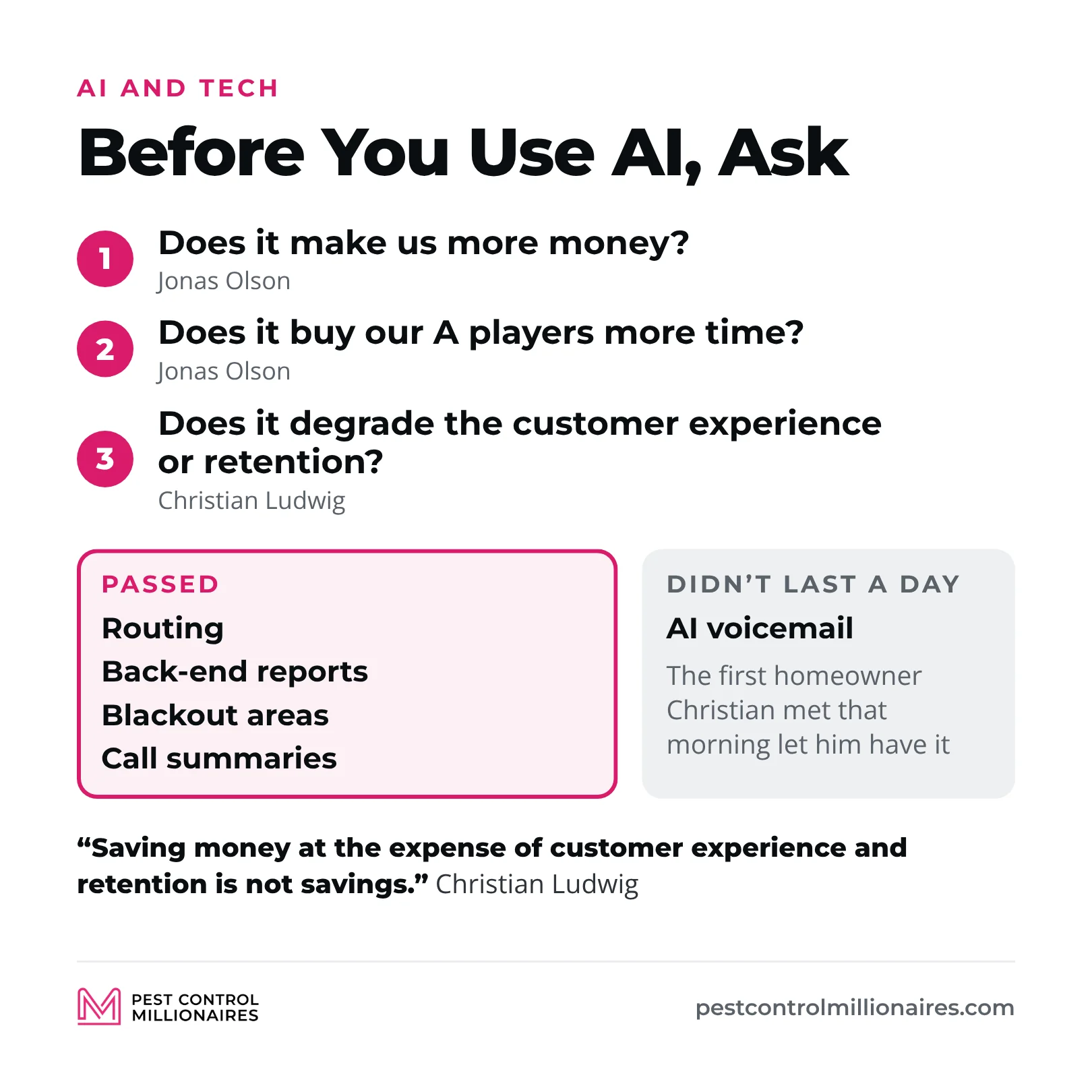
He proved it on himself. He turned on an AI voicemail for one day to see how people reacted. Christian sells by driving out to inspections, because he says it gets solid contracts and higher retention, and the first homeowner he met that morning let him have it for the AI voicemail. He turned it off.
We use AI on our phones only as a backup. Most people still talk to a person, and the ones who reach the AI get transferred back, so we call them anyway. “It’s a glorified voicemail,” Christian said. My rule for where AI fits on the phones is in how to automate your pest control business.
Where AI helps is after the call. Christian likes the AI call summaries, and we put our transcripts into AI to find the one big objection our team is hearing that week, and why, then train on it.
AI can beat your CRM’s routing
At Aruza, Christian was the finance guy and chief revenue officer, so Nativa was the first time he set technicians’ routes for the month. He has used FieldRoutes since Alterra, but he found its intelligent routing clunky. It limited him to a certain number of customers, and the map afterward didn’t always make sense.
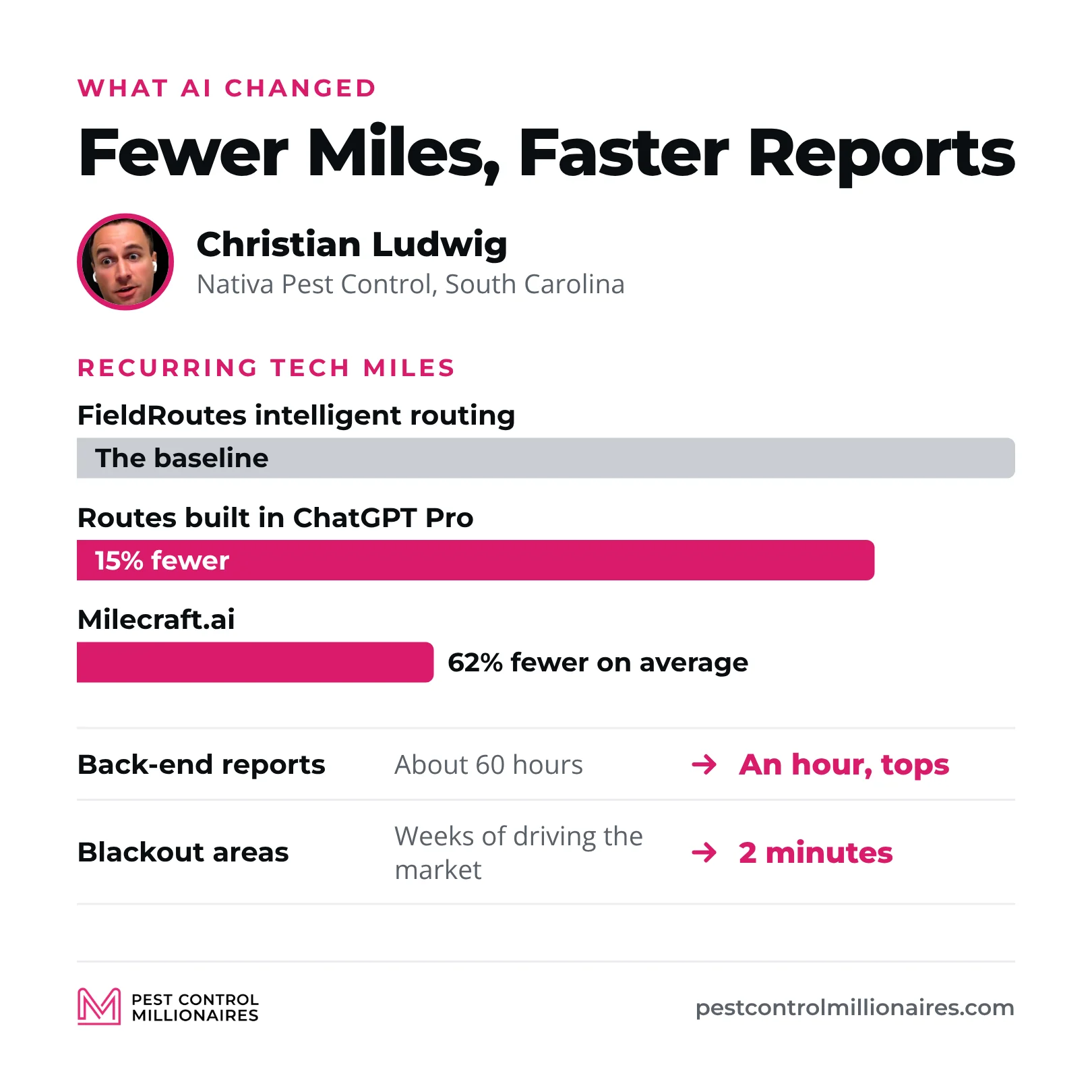
So for his first quarterly technician, he skipped it. He put his job pool into ChatGPT Pro, asked it for a month of efficient driving routes and entered them back in by hand. Five months later he ran an A/B test, a month of FieldRoutes intelligent routing against his ChatGPT routes, with a fresh chat comparing the two. His routes had 15% fewer miles.
“Anybody out there, you can go use ChatGPT or Claude right now, and you can save 15% on your recurring routes,” he said. The painful part is entering every appointment by hand.
Why is there that much room? For about 12 years, Christian said, we all assumed intelligent routing was the most intelligent routing possible, but the big CRMs’ math is based on bird’s-eye distance between homes, not road networks. And most owners give customers a service window of about a month either way, so someone due October 12 can be serviced from September 12 to November 12. “There are more opportunities to move customers around in a month, Jonas, than there are grains of sand on the earth,” Christian said. AI can run millions of those comparisons in minutes.
What 62% fewer miles buys you
The 15% got Christian thinking. He and his friend Nick, a developer who had worked for him at Aptive and Aruza, put AI on top of the routing algorithm they’d built for FirstKnock (more on that below). Over about four months they built Milecraft.ai. Their own algorithm, AI that learns from its own results and scheduling that runs week by week through the CRM’s API got them to an average of 62% fewer recurring tech miles when we recorded, across Nativa and two beta companies.
That’s base to base, from a tech’s home or the office in the morning all the way back, not just customer to customer. Driving less than half as much means about half the fuel bill and twice as long before you need new tires or vehicle maintenance. Christian said the bigger savings are the ones people don’t realize, like technician burnout, liability and insurance, and payroll and overtime. It also frees up two or three spots a day, which matters because, as he put it, every owner growing at a steady clip ends up without enough technicians for their starts.
The scheduling runs on its own. By the end of the day Friday, it locks in the following week’s recurring appointments, looking up to five weeks ahead (his setting) for the most efficient transitions, and a reschedule button moves a rain day into the following week. Dense routes matter just as much, which I cover in how to improve route efficiency.
He never set out to start a tech company. He built it for his own business, and once the savings were that big, he figured he was obligated to.
Knock new move-ins without leaving your truck
Christian started Nativa knocking doors in the middle of winter. At 32, with a family, he couldn’t be out getting sick every week, so he went after new move-ins. Door knockers call it hitting Redfins, knocking on homes that just sold. You hit fewer doors because you drive between them, but he says new homeowners are five times more likely to buy, because they don’t have their vendors for the new home yet. The problem is you don’t know who you’ve already been to or what happened, and you drive all over the place.
So he and Nick built FirstKnock. They spent about five months on its routing algorithm, with about 80 assumptions, like finishing every home on a peninsula before leaving it. It pulls every new homeowner in your market, with whatever lookback you want, into one efficient driving route. You drive to the next stop, pitch, mark the outcome and hit next.
He thinks the sweet spot for new move-ins is a three-month lookback, because by then they’re moved in and settled. He used a one-year lookback with thousands of leads and ran one big route a day. He sold over $300,000 of revenue that way and serviced more than half of those homes himself, without ever walking between doors. And it’s brainless, just like knocking. “If you sit in your car too long, you can talk yourself out of it,” he said.
Let AI do the reports so you can get in the field
Christian used to sit in a coffee shop for a week doing back-end reports for his door-to-door reps, about 60 hours of work. Now he connects AI to his CRM through what’s called an MCP and asks for the back-end report. Here’s what they’ve been paid, here’s their commission, pull the initials that were serviced and how many are still active. An hour, tops.
Branch managers used to drive their whole market for weeks to decide where to black out. He asks the AI to look at all his customers’ retention by cohort and tell him which areas to black out, and two minutes later it’s done. He also keeps a rolling cash flow for Nativa, fed with the bank statements and P&Ls, that has been 98% accurate on where the month’s cash balance ends up.
The biggest opportunity, he thinks, is better decisions. When a board makes a call, make the decision yourselves first, then give the latest AI model everything it needs and ask it for the tradeoffs, the negatives and the positives, and what you haven’t thought about. Making a higher percentage of better decisions is the biggest savings there is.
At Pest Badger, one scheduler runs 20 locations, because the scheduling runs through AI and she checks it every day. We could never have done that before.
Christian uses the time he gets back to go out in the field and make an impact. That’s the point. AI is awesome, and you have to use it. Just don’t spend four to six hours a day on it with no output afterward, which is what I told Joey Mantione when I audited his company.
Do the one thing until it works
Christian didn’t need to start another pest control company, and he could have put a lot of capital into Nativa and hired sales managers. He chose the hard way. He knocked doors in the middle of winter and had his best year ever for personal sales, at 32. When we recorded, he and his partner had over $1 million in active annual recurring revenue, $1.1 million, with 272 five-star reviews and only two four-stars, and he called it crazy profitable. His partner calls him the blueprint, because so much of it was copy and paste from Aruza.
He built his career on a Grant Cardone line, “Be obsessed or be average.” In his last two years at Aruza, his partner was CEO and Christian focused on recruiting, the one thing that returned the most, and when they sold, he didn’t put his hat in for CEO. “Success is ugly at the end of the day,” he said.
It hasn’t always been smooth. After the sale he moved his crypto gains into a mining company, the market didn’t play out, and he lost eight figures of gains. It’s part of why he missed pest control, where things are in your control.
I quote one line all the time. People are willing to do whatever it takes except for what it takes. Owners get to a million dollars and stop doing what got them there. They haven’t been in the office in eight weeks, or they start five other companies. Just do more of that thing, or something that helps that thing get better. Everything Christian built, FirstKnock and Milecraft included, helps him do his one thing better.
One branch, built around the customer
Christian grew up in Boone, in the Appalachian Mountains, and ever since a summer camp trip wakeboarding on a lake in South Carolina, his North Star was a lake house on that lake. When his partner kept pushing him to start another company, he said yes on one condition. It had to be where he was building that house, a five-year custom home project that was almost done when we recorded.
His plan is one branch, built up to a $10 million branch, the hometown hero. He brought up our book, Zip Code Kings. “We want to just be king of every single zip code we’re in,” he said. He has already done hyper-scaling, leveraging debt and selling to private equity, and it isn’t worth the stress for him.
Nativa is his experiment in being as customer-focused as possible, from what’s included in the service to the equipment and the service protocol. Within its first year, its top impression rate on LSA was 85% across his market, with 10 to 12 leads a day. He credits being so customer-oriented and having so many five-star reviews.
The name came from hours of brainstorming with ChatGPT. Christian says Nativa is Latin for “of the earth,” inspired by Alterra, the first company he worked for. The service is built on chrysanthemum-based products, and since most organic shoppers, and most of the people deciding on home services, are women, he built the brand around them. He sketched the logo and paid a professional designer $10,000 to finish it. More on that kind of thinking in pest control branding.
Leaders have to have been in the truck
Christian sees a big difference between leaders who have run a route or sold themselves and leaders who haven’t. “I think any pest control CEO had to be in a truck at one point. I think that’s a non-negotiable,” he said. Sales experience is a massive bonus. For an owner, I’d put selling first. If you can’t sell, you’d better be very good at marketing.
He thinks of a company as a stool with legs for finance, sales and operations. So much private equity money has come into the industry in the last five to 10 years that it’s more competitive than ever, and if you’re missing a leg, the stool tips over. I think that has made it a lot harder for small businesses to scale. “It has never been a better time to be in pest control, but there’s never been a harder time,” Christian said.
Frequently Asked Questions
Who is Christian Ludwig?
Christian Ludwig co-founded Aruza Pest Control and sold it to private equity. When his second PCM Podcast episode came out in October 2026, he co-owned Nativa Pest Control in South Carolina, which had over $1 million in annual recurring revenue within its first year, and he had co-founded FirstKnock and Milecraft.ai.
How can a pest control company use AI?
Start with the tests. Does it make you more money or buy your best people more time, and does it hurt the customer experience or retention? Routing, reports pulled from your CRM, call transcripts for training and checking big decisions with AI all pass. An AI voicemail didn’t make it through one day.
Can ChatGPT route pest control technicians?
In Christian’s A/B test, his ChatGPT Pro routes had 15% fewer miles than FieldRoutes intelligent routing, and he says anyone can get about that with ChatGPT or Claude. The catch is entering every appointment by hand. Milecraft.ai, which he co-founded, averaged 62% fewer recurring tech miles when we recorded.
Should AI answer the phones at a pest control company?
We use it only as a backup. Most people still talk to a person, and the ones who reach the AI get transferred back, so we call them anyway. When Christian turned on an AI voicemail for one day, the first homeowner he met complained about it, and he turned it off.
Full transcript
Every word of the episode, from the video captions
People are willing to do whatever it except for what it takes. And it drives me so crazy, dude. Why stop doing the that got you to where you already got? Stop. Just keep going. Like go all in.
Does this decision degrade the customer experience and retention? Because if not, it's not a savings. There are more opportunities to move customers around in a month, Jonas, than there are grains of sand on the earth.
Welcome back to another episode of Pest Control Millionaire. I'm actually really excited. I'm always excited to talk to Christian, but I had to pull it up, and Christian, you were episode 152, which was published December 2nd, 2025. So, you were on almost a year ago, and that one crushed. Did really, really well. Obviously, you have a big name in the industry. Your partner had a big name in the industry. Everyone knows who you are. Everyone knows your story. It's really, really cool. You come from you know, big pest control background, worked with the some of well, top five biggest companies in the...
Yeah, now top five. Yeah.
You've been in the game for a long time. You know pest control really well. You know door-to-door really well. And that that podcast crushed. That's not why we're getting back together today, but episode did really well. So, welcome to the show again. Welcome And you've obviously started a new pest control company, which we're going to tell everyone about today and if someone doesn't know. But you're out in South Carolina now, right?
Yeah, you're out in South Carolina, and you started Nativa Pest Control.
Yeah, yep. That's right.
That in the winter.
Yeah, in the dead of winter. About 2 weeks before Christmas.
So, we'll just we'll start back from the very beginning. Like how you got into pest control. Do that wrap up real quick. Just short, and we'll get into the new thing. But obviously, Christian Ludwig, welcome back to the...
Thank you, my friend. Always good talking to you.
Yeah, and for those who don't know the story, when I first got into pest control, first got into door-to-door, I saw Christian on Sam Taggart's Door to Door University. I'm like, "Dude, this guy's a stud. I need to learn from him." Me being who I am, I was like, "I got to find this guy." Found you online. I said, "Hey Christian, do you mind if I come out there?" And you were super nice right from the beginning. You're like, "Dude, you're welcome here anytime." I'm like, "Dude, I'll pay you to come out there." You're like, "Okay, cool." Sent you some money and next thing I know I was in North Carolina and you were teaching me how to do door to door So, this is how the whole thing got started. So, rewind 6 years ago, this is what happened. I was in I was in North Carolina and we in your offices and I had no no clue about pest control in or should I should say door to door in general. And you like walked me through the script. You showed me your price sheet. You like you told me how to pay my reps. Like you're very instrumental from the very beginning. So, I appreciate you.
I loved played that role. Tiny part, you've done you've done a lot since then, so.
For sure. So, let's let's rewind the clock back to how you got into pest control from the very beginning.
Yeah, so I wanted to get into sales in the college and little known fact about me, I'm actually a pretty big nerd. So, I've always been big into technology, I've been I've been deep into AI obviously. We're even going to talk about AI and pest control today.
Oh yeah, that's cool.
But, I wanted to get into technology sales. So, I wanted to get some like sales experience under my belt. And did an internship selling advertising business to business. Was top sales rep there for a single market sales rep. Then next summer had a corporate internship fall through and pest control was my backup option. So, drove to Atlanta. I team of Mormons. I was basically one of the first non-Mormons in the entire to sell pest control door to door. Let alone let alone recruit, right? And now the big thing in recruiting is recruiting outside of Utah and I kind of I'm not going to say I was the first to do it, but definitely one of the first pioneers to recruit heavily outside of Utah. So, I did well my first summer. I was top rookie rep there at Alterra during Alterra's last year. Signed Alterra paperwork for the next year and then surprise we're now So, I got to see that transition and that that sale go on.
Taught me a lot about acquisition in pest control and also kind of gave me an idea that it might be nice to own my own company one day. Started recruiting. Recruited 46 reps who finished the summer and then second year recruiting we had like 150 something finished the summer. And then as you know, that's when I broke off and started Aruza. That's when I think it's 2 years later you our headquarters at Aruza.
It's a sweet spot too. It was sweet spot. The office...
It was a really good It was that exciting startup period when you're just like you're just you're just Yeah, you're just entering hyper growth and like the energy's off the wall. You're still scrappy.
For real.
It's a really fun time.
If people like I'm sure Aruza was the same way dude. Like if people even knew know the stories like from year one like how scrappy we were and the that we pulled off like they'd be shocked.
It's unbelievable. It's unbelievable.
We have three door-to-door reps have never knocked doors in their life ever? They absolute murder it. Like they go out and sell like 400 to like 700,000 their first summer...
Like how does that like the in the crazy nights that we had like sleeping in Airbnbs like together like it was wild ride. I was I was I couldn't keep up like I had a service. I bought a van. Dude, they had a spotlight on my van. Cuz I was servicing from five like I'm not shooting you from 5:00 in the morning till like 10:00 at night, 10:30. Spotlights on houses.
Same thing. I was in the truck for I was in I was in the truck for a month that first summer at Aruza. And I told I said this on the last podcast, but I sold everything I had and then I got leveraged to the gills with all sorts of debt in my name. And then we were still running out of money and we were like doing all this creative stuff just to make it like switching payroll companies so that we could pay the other company back in like a week just literally doing whatever It's the definition of doing whatever it takes.
Or two. The hard part of that is like what people don't see is like everything you know, yeah, like the door-to-door commissions are high, but like us as the owner, it's all on it's everything is in our name. Like the trucks, the everything is in our name. And it's tough. So yeah, it's our risk, right? So when people talk about like giving equity way to partners, like I get it. Like I think there's a good place for time for that. Especially early on. And but I'd rather just give, you know, like a long-term incentive plan to make them stay longer. We've been through all this before, too, because it's your name. It's your risk. Like you put everything, your house, like you put everything on the line. So you should get the most reward, you know?
And yeah, you're trying to figure it out and you got leveraged quite a bit like you said in the last pod and it's tough Dude, it's hard.
Yeah. Yep. So we survived that first summer. I think you met me at the second summer. So you know, things are a little bit more stable. He's We didn't We barely Solomon, Jordan, and I, we didn't pay ourselves until we exited. We had like a 30 30,000 dollar a year salary just to just to make it. But other than that, we were, you know, racking up hard money loans to fund the...
And that was I remember you said this in the last podcast. That was probably the big the big mistake there, but you had to do you had no choice.
There were no mistakes looking back because the way we grew and the exit we had were a success. You know, you can't I think the only mistake was is that I kind of lost my baby. And my mainly my jobs. Like I need stimulation. I'm sure you're this way.
I can't be retired. I learned that very very quick. I just got way too bored. And I you know, ADHD kicked in, started multiple businesses, that kind of thing. And but I really I really miss pest control because there there are a lot of businesses you can start where you don't really interact with people. You don't have teams. You're not out in the field. That's what's beautiful about pest control. It's so dynamic. There's so much problem solving involved. It's so hands-on. You get to develop so many relationships with customers, vendors, your your employees. And I don't I really don't think there's anything better than owning a pest control company.
Yeah, there's a lot of moving pieces, but it's scalable. It's simplified, right? You can make it very simple. It doesn't have to be super complex. Like I have I have one of the companies too that are way more complex, way more moving parts, and it's not as fun, it's not as streamlined, it's not as not as scalable. So I agree that pest control is awesome. I love this industry. And there's other industries that are similar, but it's definitely one of the best ones in my opinion. Recurring revenue is killer. You know, there's some big profit margins. Big jobs that you can get. Like it's pretty cool. So like you said cuz you said that you lost your baby. You obviously meant the company was your baby. Looking back now, do you was it the still which I know the answer, but was it still the right decision to sell then? Or do you guys like do you have this gut feeling that you should have held on a little bit longer?
It was it was we had we absolutely had to sell. There wasn't There wasn't a Yeah, cuz the loans were being called and we needed There's not really There's like You can't list on one hand the amount of private lenders there are for pest control because there's no really no hard collateral in pest control. They basically the only collateral is like your customers. So, you got to have the There's so few lenders because they have no experience.
If they If as long as you don't have loans on them, you get up to maybe 50% of it.
Right. So, it's so boutique and it's so rare. So, really the only way to scale if you don't have the equity capital in the beginning is to at one point sell. Yeah, sell to private...
Yeah. And so, I don't I don't again I know the story, but just walk people through it. I know that everyone else sold out, but you stay on for a little bit longer.
Yes. Yes. So, I stayed on. My plan was to stay on forever, but you know, someone else rightfully owns the company. They paid a lot of money for it. They have their own way of doing things, their own So, just didn't work out and that hap- that happens a lot.
It does. And there's no there's no right or wrong answer there either. You had to do what you had to do. Ended up being a great success, which is awesome. Hold up. Quick pause. If you're on any pest control company or fertilization weed control company and you're not in our Facebook group, you're choosing the harder path. Every operator that's in there is saving years of mistakes cuz people are actually sharing what's working right now. So, stop trying to brute force your way through growth alone. Search Pest Control Millionaires on Facebook or click the link below. And now let's get back to it. So, then after that you sell and you I think you started to go to crypto and I remember seeing like you posting like on your socials like a bunch of like computers and like all like huge setups. Like walk me through all that.
Yeah. So, as as soon as I got out of pest control, the only thing I knew how to do is be a nerd essentially and just dive dive back into technology cuz it's so fascinating to And I've been in crypto since 2017, but got back into it. Got into some really good projects early on. Hit, you know, 10 20X. One was a 90X return on investment. The mistake I made was I sold a lot of that crypto and then I pushed it all into mining, which was that was the critical error.
I see.
I should have just cashed out cuz it was eight figures of cash out. But me me being an entrepreneur and ADHD, it's always like there there is no end. The regime never ends. It's like what's next? What's the What's the next play? What's the next risk? And for me that was the mining company because you get to write off I mean they're they're phasing out these tax laws, but you got to write off half of the depreciation. You get bonus depreciation on all that equipment you buy. So it's incredible tax write-offs to offset the gains of you know, the me selling the company, me making money selling crypto that appreciated within that year. So it was a good move on but the market just didn't play out the way it needed to for that business to be a success. And unfortunately, the downside was basically like losing all the gains that I had made.
Those those eight figures of gain. So it was a pretty wild ride. And that's why I say I miss pest control so much cuz it's hard to go on those sort of rides whether it be investments or a business and you're really just like all alone. Like talking about the difference between being like a solo entrepreneur and just doing tech stuff and then owning a business where it's crazy dynamic and you build relationships and you solve problems and you talk to people, and things are in your control.
The best pest control companies do not leave growth to chance. They build systems. They have a system for generating leads, system for answering the phone, system for servicing the customer, and systems for collecting payments. But, most companies still treat referrals like luck. They do a great job, hope the customer remembers to tell a friend, and maybe send an occasional text asking for a referral. That is not a system. Clicki Referrals turns your happiest customers into active, trackable sales channel for your business. Clicki automatically invites customers into your referral program, gives each person their own referral link, tracks the leads and sales they generate, and makes it easy to reward them when those referrals turn into business. And now, Clicki has launched Rewards Pass. Rewards Pass is a branded referral pass for your company directly inside your customers' Apple Wallet or Google Wallet. Think about that. Your brand can live on your customer's phone alongside their cards, tickets, and brands they already use every day. Their personal referral link is always one swipe away. You send push notifications, announce special offers, promote events, and stay connected long after the initial service is complete. This is not another app for customers to download or another login to have to remember. It's your company, your referral program, and your rewards living directly inside their wallet.
If you want more referrals, stronger customer retention, and a customer experience your competitors probably do not have yet, go to joinclicki.com/pcm. Book a live demo of Rewards Pass to get $350 in pay out credits. Tell them you heard about it on Pest Control Millionaire. That is joinclicki.com/pcm. Stop having your customers send referrals. Build a system that makes it...
You know, I remember you posting I don't I don't know how many It looked like computer modems. I don't know what they...
Yeah. Yeah, our warehouse our own the warehouse. Hundreds.
Yeah, hundreds.
See, I'm not crazy. I remember seeing I Again, that was a couple years ago at this point, and I still remember it.
Yeah. And it's funny it's funny because what crashed crypto was the upcoming AI boom. All the liquidity that people who would have normally invest in crypto, people who are young, tech entrepreneurs who have money, it all the liquidity just got sucked into AI. So, that killed that killed my business. But, obviously my attention went to AI as well. And especially starting my new pest control business, the question I mean, I don't think it's just my question. I think it's the question on every PCO's mind. How do I leverage AI in my pest control business?
Like again, like how you look at it. I've always said you're we're just a customer like we're we're we're going after they're like going after this customer avatar, right? And then it's like we're just a customer service industry that happens to do pest control. But, now it's like I still and I still believe that. Now it's like, okay, now I feel like we're a tech company that just does pest control. Like it's changing that fast. And so well, I'm sure we'll dive deep into this sure shortly, but like the amount of, you know, AI bots that we have working in currently is amazing. And the things that they can do and the different platforms that we run on are absolutely...
Yeah, it's been Yeah, you got to be on it to stay with the times and capture all the capability that's there right now. And a lot of PCOs are very behind or they don't know how to start.
Yeah. It's an old industry. So, like there's a lot of new guys coming in, too. But, yeah, it's just an old industry. And I said since day one that I want to flip an old industry upside down. I feel like we're making good headway on that. But, yeah, AI is awesome. There's so many tools and things that it can do for your company is from operations sales to marketing everything. It just makes everything like it's just like Yeah, there's two questions, right? Like I'm always talking. So, I feel like a month ago I was on a podcast with this kid. And he's like, yeah, I spend 4 to 6 hours love you, Jared.
I listened I listened to that I listened to that. And I was about to text you that this has been my favorite podcast of yours so far because it was a like a mentor mentee perspective.
And for some reason it was my favorite podcast of all of them just because of the format. So, I wanted to tell you...
I appreciate that. So, that's like a new format that I that I that I've been doing with the business breakdown. So, I'll probably launch one of these a week, one of those week, but they've been they've been blowing up like crazy like as far as like views and like that they're getting incredible. So, obviously the format works, but what I was saying is like, "Okay, you know, you have 4 to 6 hours of this time spent into this AI, which is great. I think you should be doing it. Like I don't want you to fall behind, but you're building out this I think he's building out like a funnel, right? Or something like that." I'm like, "Dude, you didn't have marketing to jump into the funnel. You're just wasting time. Go out there and build the thing first." So, where I was going with this is just don't get don't get put in a box of only doing AI. Like don't get stuck there, you know? Like but like the way I look at it So, the way I look at it currently with our with our company is does it make us more money?
And two, does it buy back our A players more time? If it doesn't answer yes to either of those, then we're not doing...
I think the question for me I think that was a consideration, but the main thing for me is does this decision have any tradeoffs that degrade the customer experience? Because saving money at the expense of customer experience and re- and retention is not savings.
Thousand percent. But also, you I see retention as making the company money...
Yeah, no, and that's exactly my point. But if you're going to make a decision, whether it's an AI-based decision or any sort of question is does this does this decision, even if it saves money on the P&L quickly, does it degrade the customer experience and retention? Because if not, it's not a savings.
You just you just don't know it yet.
Yeah. So, I made a video and I and then people responded to it and it's like I we tested out AI. We still use it. AI answers the phones. It's only for backup. Only for backup. And so, majority of the people still talk to a person, but it's like that or go to a live VA, which is fair. It does It does work, but they just get transferred back. We got to call them back anyway.
It's a glo- It's a glo- It's a glorified...
And it that's the perfect example of a trade-off. And yeah, and it's funny cuz I we use Qual for for our VoIP system. And I already knew I never wanted to use the AI voice message system, but I just wanted to try it out just to like see what the reaction was for a day. And it's so funny because I physically drive out my truck to inspections, and that's how we sell. Cuz we can sell solid contracts, higher retention, establish a relationship. And the first guy I show up to just absolutely shits on me for having an AI voicemail. I'm like, "You're not going to believe me, but I turned that on this morning." And I was like, "I'm going to turn it off because I didn't think it would happen this quickly, but you completed my thesis that this is a poor idea."
But like the coolest thing like with the with the new phone system is like you just like either wait on hold or they can just get an instant callback. So as soon as the CSRs hang up, like it's automatically feedback loop to that customer as soon as someone's off the phone. Like they're it's like they leave their phone number, just AI or AI makes it happen, and the CSRs are with them like within 3 minutes.
I think the best thing is for VoIP is the AI summaries of the conversation. You don't have to listen to the whole thing, you just see the summary.
But then you tell them that information and you put it into one of the AI softwares that you use, and it like transcribes everything. Then you can train your team. Like what is the one big objection that they're having this week or this week or this day this week and why? And you go back to on those things, you...
Yeah. So you talked about your podcast. Is the gentleman's name Joey, your okay. So the reason I love that so much is you talked about action.
I love Joey. Yeah.
You Grant Cardone calls it, massive action. And starting my sales career, those were the books I read as the 10X Rule.
And people just don't get it.
Be obsessed Be obsessed or be average. No, that That's what I built my whole career off is doing one thing very, very well, being obsessed, and not getting distracted. And Steve, and like, you know, with the reason when we sold the Solomon was CEO the 2 years prior. Cuz I thought he'd do a good job at it, and my focus was just recruiting. Cuz that's the one It's the one thing that that returns the most for the business. And even when we sold the business, I had I didn't want to put my hat in for CEO cuz I wanted to focus on the one And that's what was going to make the business succeed. It's not I need a certain title, or I need, you know, my PP to feel big. It's like, I want to do what's what's going to drive the most value to the business.
And I've lived by that. So, it's cool to see you teaching somebody that because I don't think there's any bigger lesson besides taking massive action on what matters the most. And it's going to be mundane. It's going to be boring. You're going to get You're going to get burnt out, but it's success is ugly at the end of the...
And I just don't think most people get Like, the sound of being an entrepreneur sounds super fun. Like, growing your company sounds super fun. It looks great on paper. It looks good on paper. Going out there and actually doing it with some of that is another thing.
So, that I think I'm the perfect example. Like, I didn't need to start another pest business. And when I did start the pest business, I could have goobles and gobbles of capital into it, and hired all these sales managers, and just paid people to do stuff. But, I chose to do it the hard way. I chose to go knocking on doors in the middle of winter. I had my best sales year ever for personal sales this year. I'm 32 years old, and I don't need to be doing this, but that's the best way to do it and I'm committed to doing the hard and our company is it's a huge success because of it. You know, me and my partner put on over a million dollars of active ARR now, 1.1. 272 five-star reviews and only two four-stars. Financials, retention's really healthy, but we're so tapped into...
And you've learned, right? You've learned a lot from your last company.
And it's crazy profitable.
Yeah. You can take all that everything that you learned from company one and the do's and don'ts and put it in the company two is like, oh, this just You know what I mean? Like...
Yeah, my Yeah, my partner he calls he calls me the blueprint cuz It's been effortless, but aside from the effort, it's been effortless if that makes sense. Aside from going out there and selling each person one by one and servicing them and then obviously scaling into technicians and such.
For real.
There hasn't been much thinking in how do I do this? It's copy and paste.
Yeah, agreed. The thing that I always say and I maybe I quote I quote this twice all the time. I don't know if I if I originated it, but it's like people are willing to do whatever it takes except for what it takes. And it drives me so crazy, dude. Drives me bonkers. So I talk to people, they get to that million dollar mark and they're like, yeah, I want to go grow this thing. I want to make it massive. I'm like, cool. They're like, yeah, but I haven't been in the office in like eight weeks. I'm like, hmm, imagine Cuz they get comfortable. Like, why stop doing the that got you to where you already got? Stop. Just keep going. Like, go all in. Do more like Alex says, just do more of that.
Yeah, that's all it is doing more of that that thing.
Yeah, but then at that million dollar mark I had I had a talk. I was on stage like two weeks ago. And I talked about the same thing. It's like just do more. Like at at that million dollars I see it all the time. The next thing you know they're starting like five other companies and like, bro, They're going to start this company and that company cuz we're entrepreneurs and we get, you know, like, yes, I get it. Like, just do more of that thing or something that helps that thing get better, right?
Yeah, so that's what I've That's the only other thing I've done is building things that helps me do that thing better.
Agreed. And if you can figure out if you can figure that out, that makes that one thing better, you can get help other people with that thing, then that makes sense.
Yep. So, for me, when Owen and I and shout out Owen cuz he just hit Golden Door. Super proud of my partner. When we started, we were just selling door-to-door in the middle of winter. Now, I'm 32. I have a family. So, I'm like, man, I can't I can't just be out here getting sick every week going door-to-door in the winter. So, I had the idea to just start going to new move-ins. I don't know if you've ever heard of door knockers, quote unquote, hitting hitting Redfin's.
Yeah. Yep. So, hitting Redfin's is where you go to Redfin, you look back at homes sold, whether it's, you know, a 1-week look back period, 3 months, or 1 year, just depending on your strategy. And you basically drive to that home and you knock on that door and they're five times more likely to buy. You don't hit as much cuz you have to drive between them, but they are five times more likely to buy because they don't have all their vendors for their new home And I asked myself, like, can I leverage AI to systematically go between these new move-ins in an efficient way where I can track the outcomes. Because with Redfin, you don't know who you've gone to already, you can't track the outcomes, you're just driving all over the place. So, I hit up my buddy Nick who worked for me at Aptive and at Aruza, and he was a salesperson and a So, he gets it. And this guy's a developer. So, I was like, "Hey, let's develop an app that takes us to these new move-ins and a mail carrier efficient driving route."
The big the big piece of that to develop was the algorithm for routing that makes it efficient. And we spent like 5 months developing the algorithm, and a lot of it's just giving certain assumptions. Like, okay, if I get onto a peninsula on a lake, obviously my next home can't be outside the peninsula. We need to get all homes inside this peninsula before we go outside of it. Or I'm going to enter a neighborhood this way, and I'm going to exit neighborhood this way. Or don't cross into other routes. Just 80 different assumptions that are used to code a fixed algorithm that makes an efficient driving route. So, we built it, and I used it the entire time, and I sold just as many just in my truck pulling up my truck selling somebody, servicing them on the spot as I could selling door-to-door and servicing on the spot.
The only difference is I didn't need to kill walking door-to-door, and I didn't need freeze my butt off in the winter, sweat my butt off in the summer. You know, win windows down, music loud. Then you go pitch, and then so on and so forth. So, built that. Then, you know, I started asking the question like, "How can I leverage AI in my business to improve it?" I had never run operations before. So, Solomon ran operations over at Aruza. I was the finance guy, and I was the chief revenue officer. So, I was in charge of growing the business, managing the sales force, and then in charge of capital raising and financing and P&Ls and stuff like that. So, this was my first experience learning to actually operate a pest control business. Now, it's a lot easier having owned your own company because you know who all the vendors are.
You know what tech what tech stack you need in place. Like, you know everything that's there. You've just never let it before. And we did a pretty smooth job scaling the company. I couldn't I can't look back at this past year and think of anything we could have done better. But, one thing I never had experience with was like setting the routes for the month.
You know, setting the technician's routes and I love FieldRoutes. I've used FieldRoutes ever since I was at Alterra, at Aruza, and then I chose it for my own new company. And this is the first time managing routes and I do the intelligent routing thing and then it immediately like limits me to a certain amount of customers. It's kind of very clunky and confusing and the it doesn't always output how it should. And then like you look at the map afterwards, you're like, how does that how does that why is this guy over here when he could be in this route kind of thing. So, I chose at the beginning of the business when I had my first quarterly technician to not do FieldRoutes intelligent routing. And instead, I used ChatGPT Pro.
Just being completely transparent and I threw my job pool into ChatGPT Pro and you know, there are a few extra steps I had to develop like getting geocodes and stuff like that. But, I said, make me, you know, efficient driving routes for this technician for the next month. And then I'd have to manually input them back in. That was the painful thing. But, I kind of circumvented all the that was that was the FieldRoutes Not not thinking I could save miles or anything like that. So, I did that for 5 months without ever thinking one time that huh, I wonder if this is more than FieldRoutes intelligent routing. And one day that question did pop into my head because I started hearing about AI solving all these math problems that have been around for 50 years and like it's the level at which it's society is crazy.
Like this week I'm reading about AI GitHubs that can reverse engineer anything. And this week the new theme is software is completely dead. There's no more moat with software anymore. So, you start hearing these things and you're like, okay, well, I want I wonder if what I'm doing is actually more efficient than FieldRoutes intelligent so, I just did an AB test. I did the FieldRoutes intelligent routing for the first time for the next month and then I ran my comparison. I got a spreadsheet of both and I just asked a new a new chat to compare both indiscriminately and see if there's a reduction in miles and it came back as a 15% reduction. I was like, wow, that's actually a lot. That's a lot of that's a lot less miles for your recurring technicians to be driving.
So, I never planned on starting Milecraft or like I never set out like I want to go start a tech business. It's just the value proposition was so huge. So, I went back to Nick who I developed FirstKnock with and at this point we have you know, about 12 customers using FirstKnock. Haven't really advertised. They're just helping us beta test and refine the routing algorithm. And I was like, Nick, what if we take our routing algorithm and put it into because all all AI is going to do is it does the work really well, but with something like routing you need you need your own code. You need your own algorithm. And then you can tell the AI to do the work in the back back end, but telling it what work to do is the secret...
Of course, that's with everything with AI, right? It's like the prompt Yeah. Well, and then it goes beyond that where some Yeah, that's in a nutshell, yes. It gets more convoluted. But, we integrated We started our own GitHub repo, so the code was ours, and we're not just using ChatGPT, which anybody out there, you can go use ChatGPT or Claude right now, and you can save 15% on your recurring routes. I'm going to tell you in a minute how our technology has gotten up to 62% reduction in recurring miles. But, anyone can go and do this. The only The only crappy part is you have to then go enter all your appointments manually, which I did for 5 months. So, we got another 30% savings with our own custom algorithm that we use for routing that we developed over a 5-month And then we got another like 15% savings asking a bunch of questions, kind of doing some recursive learning with the It's almost like the more experience your AI gets, if it's if it's your own custom AI in the cloud, it can start to recursively improve and learn from its own mistakes or learn from its own wins.
And then the last 4.9% mileage reduction we got to get to our 62% current average, we basically created API functionality to where the whole scheduling every single month is fully automated, and no one needs to do So, we're not replacing any CRM. Basically, like your team doesn't have to worry about recurring scheduling anymore. It just happens automatically on a week-by-week basis. And by by removing the upper and lower bound of scheduling 1 month at a time, you're able to and having an automated system that schedules 1 week at a time, you're able to save another 5% just by not having bounds on the beginning and end of each month. So, over the past 4 months, we've been developing Milecraft. And we've gotten to what is an average reduction in all recurring tech miles, it's a lot. And it kind of shows how much juice was left to squeeze in terms of how intelligent intelligent routing actually And it's just it's all due to the same mathematical power that's ca- that AI is capable of.
So, for instance, with with how we do our weekly scheduling that's all automated via API, I asked the AI if humans did this. Like, let's say if expert mathematicians, humans did this and scheduled the next month's job pool, how many people would it take? And it said it was like 50 people over a 10-year span. Yeah, so it's pretty it's pretty game-changing. Obviously, I've implemented it in my own business, and it frees it frees up like three spots for technicians a day because you're driving 60% less. I remember at Aruza, we almost lost our shirt because of like insurance liability. So, if you're on And this is the 62% reduction, Jonas, it's your tech's home or if they go to the office in the morning, all the way back there. It's not just customer to customer. So, they're literally driving less than half that they used to. Obviously, that means half the fuel bill, right? That means double the amount of time until you need new tires or you need to maintain your But, some of the big savings are that people don't realize is technician It is liability and insurance.
It's payroll and overtime. And as every pest control owner knows, everyone who's growing at a steady clip gets into the situation where they don't have enough technicians for their So, if you can free If you can free up production, if you can free up two spots per day without changing anything, without any tradeoffs, it's an amazing decision. So, we've been able to save our beta customers, including my own company, after our fee, about $28 per stop. So, if your average quarterly customer, that's a little over $10 in full economic impact of savings per year with zero tradeoffs. And that's after our fee. And then we also we've just now developed an AI chatbot that kind of looks similar to the ChatGPT format since we're already API'd into your CRM. It allows you to talk to your CRM, pull custom reports, pull cash flows.
Basically, it's like in a nutshell, it's AI connected to your CRM. So, you can talk to your AI as if you're talking to your CRM, which I think every pest control owner wishes they had. And that's all free and included in with your technicians, when they first started, were they on this from day one or did they Were they on two routes at first and moved to us?
That's awesome. With your...
So, yeah. So, they were never on FieldRoutes cuz I was just throwing it into ChatGPT.
Got you.
So, they had that 15% reduction from the beginning. And then, we've just kept them on the Milecraft API. So, now they're getting the 62%...
That's cool. But, like that the companies that you're beta testing there at Milecraft?
Yes. Yeah, with two other companies.
That's really cool. When they're taking missions got it. What do they think? Have you got any feedback from them yet?
Yeah, I don't I mean, they just they're just working less hours.
That a lot, right? Like they like my routes are so effed up. Like our routes suck. Blah blah blah blah blah. Like you hear that all the time. Cuz on a like if you have let's just say like you us as an example and you have like a you have multiple locations and everything looks good on paper like on a map. Like oh, it's only 8 in joy. Looks close. But, they just don't know like the economics of that location cuz like what looks really small on like on a location map, like that time of the day, like they may be traveling across town, but it's still taking 3 hours, right? So, if it looks good and if it looks good in routing,...
Yeah, so there's a couple pieces to miles. One is the actual routing itself and the mail carrier style how do we service customers as efficiently as possible who are in this group. But, the other is something called transition comparisons, which means you know, every PCO has a window in which their customer they allow their customers to get service. For most PCOs, it's a month, you know? Someone who's due on October 12th can be serviced as late as November 12th and as early as September 12th. So, it there are more opportunities to move customers around in a month, Jonas, than there are grains of sand on the earth.
For real.
So, that's where a lot of the savings comes from is AI's ability to do literally millions of transition comparisons within minutes. That would take humans years and years and years to...
Yeah, I think you said like I know you mentioned it already too is like there was like a math question that was like it would take a human like 70 years or something like that to figure out. The AI had it done within like I can't remember. I'm going to butcher this but it was like a so, yeah. So, that's it's completely relevant to what we do as pest control owners. At the at the end of the day, our businesses revolve around going to our customers as efficiently as possible and serving them and making sure they have a good experience.
Like a day or a couple of...
Yeah. So, when did you decide that this is going to be a good idea like hey, like this has been so beneficial to me like I'm going to roll this thing out for everyone.
Yeah. It really wasn't a thought. I was trying to just benefit my own company as much as possible. But I started telling my friends about it and they were kind of curious wanting to try and then usually with software it's never like a no-brainer. It's always okay, what are the features and benefits of the software and does the perceived value in my head make up for this cost? But when you have a tech stack that's actually able to be implemented into a company and save like hard concrete money that's and your fee is anywhere from like a fifth to a tenth that of the savings depending on how big the reduction is you kind of are obligated to start that business.
For sure. So, have you put it out there publicly this is the beginning. This is where we're going to go public.
This is the beginning of that. Yeah. So, this is it's a it's a brand yeah, hyper-efficient routing as a service is a brand new thing for pest control. Yeah, we're we're to be the first to do it.
Super awesome. Congratulations. I mean, I've [snorts] you know you know I talk quite a bit not quite a bit but we talk often enough so I knew it was coming in the pipeline. We've talked about it in the past. Yeah. Really.
Well, you said you said it yourself. You like you're the owner. Every owner they look at they look at their routes and scratch their heads sometimes cuz they're like this does not look right. And you can go to our our website that's milecraft.ai and we have a Nativa my company has a case study. You can go through multiple months and you can you can see the full month's route on a map. You can see the A and you can see the B and you can visually see where the savings are. It's just it's just a tighter map. It's just it just looks like tighter routes and there's less crossing over. And all these major CRMs this tech stack's been around for 10 years and another downside of it and another way we were able to ink out some some percent savings is all their math that they do is based off of bird's eye distance between homeowners. It's not based off of road networks. That's another way we're exploit able to exploit even more savings.
When I joined the industry my first year at Alterra they were switching to FieldRoutes because of intelligent And they saved you know, a lot of money probably something like this like 40% less miles 50 60% less miles because before intelligent routing came along everyone had to do it by hand which is the most inefficient thing possible. You have one you know, 6-year-old office lady who's trying to do the job that it would take you know, 10 mathematicians 10 years to do perfectly. So it's not going to be perfect. So intelligent routing introduced something a little bit more But the dawn of AI and just the raw power of compute, the beating the pencil harder and doing more math faster and opened the door for there to be another 60% improvement. So, I think everybody, including myself, these past 10 years, well, now it's been 12 years for me, believe it or not, that intelligent routing's been around with these major CRMs, we all just kind of assumed it was the intel most intelligent routing possible, right?
But AI has changed that, just like it's changed many things.
Agreed. What do you think your onboarding would process look like? I know you have quite guys in beta, but how long did it take you to get them fully integrated?
Yeah, so it started out before we had the API ready as just like raw spreadsheet comparisons. But now we have the full API integration to where we can do we sign basically a con data confidentiality form. And then we do a route audit, where we just get your API keys to whatever CRM you have. And depending if we already API into your could take a little bit more for integration, a little bit longer. But we do a route audit, and then we show your routes, and then we show our outcomes. And we give you the exact percent reduction and mileage that you would have for that month. We can even compare a few months, so that there's more of a cohesive average and there's no outliers. But at the end of the day, we just the proof is in the pudding. We connect, we audit, we compare, we show you the comparison, we show you what your actual savings would be, and then if the light is green, then we basically just turn the on switch on, and it starts scheduling your recurring routes automatically each So, by the end of the day Friday, it's schedules the next week and it locks those recurring appointments in place.
And then for the week after the one that's locked, it's already looking out however far you tell it can. Like I allow five weeks of buffer. So, it can pull up appointments five weeks into the future. And it's basically scheduling the whole five weeks, but it's just locking in week by week to make it as efficient as possible so there's as many opportunities for efficient transitions between customers and weeks as possible.
What about rain days?
So, we have a reschedule feature. So, when there's a rain out or a technician takes off, there's a reschedule button. And it'll basically reschedule it into the next week before Friday comes And those customers are guaranteed to be in that next week. But they're going to be scheduled efficiently with all five weeks of customers coming down into the next week. So, you still have that tight efficient as good as you could possibly get it with one click of the button for a...
That's really cool. I like that. I mean, cuz that's I feel like that's going to be the most operators are like, "What happens if someone calls a reschedule? What are we going to do? What happens if it rains? What are we going to do there?" Because I'm sure there's going to be some manual input too, you know.
Yeah. That's what's been nice about being a PCO who never never intended to start this as a company is I built this for my pest control business. So, I what PCOs are looking for.
Yeah, I agree. I'm going to circle back cuz at that your brand for Nativa is really cool. And I you know I have talked about brand in the past, but how did you come up with that brand? I mean, it looks super it looks it looks really good.
Yeah. Well, the name AI, of course, I spent hours and hours beating ChatGPT to death for for names. Nativa came up in one of the pools I did and I knew instantly. It wasn't even a question. I called my partner, I said the name. He's like bingo, this is it. And then I drafted concept I had in my head because Nativa is Latin for of the earth and I kind of prompted ChatGPT to do it cuz my inspiration was the first company I worked for, Alterra. I love that brand. I absolutely love that brand because it was just a beautiful name and it's a beautiful concept and it had meaning behind it. It meant to be derived from earth. And Nativa means Latin to be rooted So it's the same kind of concept and we the base of our service is we use chrysanthemum base products.
So we and obviously we can do full organic, we can do some of the tougher stuff for like spiders and roaches and stuff like that. But at the end of the day I wanted to lean into plant base and I understand that the majority of organic shoppers and even in my experience the or the majority of direct to home decision makers are the women. I kind of built the brand around that. I designed the logo and I did take it to I paid $10,000 for a professional designer to I had my sketches, right? And the ideas of the of the house with the with the chrysanthemum flower around it and then had a professional do the visuals.
Yeah, have you ever heard of a flywheel company flywheel?
Yeah, of course.
Yeah, I think I think what you're doing is kind of you know, creating a company flywheel for you. So, like the listeners who don't know, just look up company flywheel like in Patrick Bet-David talks a lot and a lot of people do. Just look up company flywheel and think of how you could be different than every other PC out there like create a flywheel for yourself. So, I'm going to circle back just to a little bit with Nativa too. Like you went from zero to a million ARR which is really cool. Mostly it was through door knocking but it sounds like you did some office stuff too and then you obviously had your app. Will you tell me a little bit about your first app that you created too? Yes, so for anyone who's ever knocked doors sometimes people get lazy and they just like go hit Redfin homes. So, there's nothing that explains...
So, it just pulls all the data from that Redfin would and just optimizes your...
Yeah, it's like it's like a it's So, we don't pull from Redfin. That would be you can't do that. They block that. But, we pay for data and it has all the new homeowners in your with any lookback period. So, if you want to go hit brand brand new home move-ins or maybe they're not even moved in yet, you want to leave a door hanger, you can pull up for your entire market every new homeowner within 1 week and you can go send a guy who doesn't even know sales in a car to run that route. Might take him a few weeks cuz it's going to be a thousand people and he just to put up a door hanger or leave a laminated flyer or something like that. If you want to go I think the sweet spot for knocking brand new move-ins is a 3-month lookback period cuz they bought the house, they're usually in by a month, they're settled.
The way I did it is I did a 1-year lookback period and there were thousands of leads throughout my market. Did one big driving route every day. I just open up my app. Say go to the next stop. It opens up Apple Maps or Google Maps on your phone. You just drive to it. You go pitch them. You mark the outcome if you sold them, if you didn't sell them, if it's a callback. And then you just click next. It opens up your GPS again and you just drive to the next one. So what I like about it is it's brainless just like knocking is. With knocking if you sit in your car too long, you can talk yourself out of it. But if you're just hitting doors, it's brainless. And the problem with Redfin knocking was like it's just a map with these homes on it and you don't know who you've been to. You don't know the outcome. So you just kind of lost and you start questioning yourself, well what should I do next? Yada. Have I even been to this person before?
I'm driving all across town. This isn't efficient. So FirstKnock it's firstknock.io on the on the web and you get a certain number of homes free if you want to try it out by the way. Sh- shameless plug. But it kind of ch- it changed the Redfin game and I crushed it, man. I sold over 300,000 of revenue and I more than half those homes myself. And I never left my vehicle. Never once walked between doors. And we have we have other other reps for other companies including door-to-door companies who have found this tool. And I can send you text messages. They say they're selling more each day than door knocking. Slightly more revenue each day.
That's really cool. And then how did you end up in South Carolina?
So I went to a summer camp near here at the bottom of North Carolina. I'm from a town called Boone in the Appalachian Mountains. I know I don't look like it. I'm from the country. I don't look or sound like it. But I am very much from the country. Like seeing meth lab get busted on my way to school type of country.
Yeah, so I wasn't too far away from South Carolina. I went to a camp and we went wakeboarding one time. This beautiful lake in South Carolina. And from that point all that was like my North Star to work toward was to have a lake house on this lake in South Carolina. And then I went to my partner, he was badgering me about starting another company. I didn't want to. He just literally kept hitting me up incessantly. And I was like, "Man, this sounds fun." It just brought back all the nostalgia and the memories. So I'm like, you know, screw it, let's do it. But I said it has to be where I'm building this lake house. I'm going to make this lake house my permanent home. So we've lived in a town home for a year. The house is almost done being built. Been like a 5-year custom home project. And just going to live here forever and run my one branch up to goals, you know, $10 million dollar branch. And I want to make it customer oriented.
Just basically as successful as one branch as possible is the idea. Just like the hometown hero. It's like, you know, your book Zip Code It's like we want we want to just be king of every single zip code we're in and then I've already done the grow hyper scale, leverage debt, sell to private equity. I've already done that. So it's not...
Not exciting.
It's not as exciting for the trade-off of stress that it brings. And I'm really enjoy I'm really enjoying being like crazy customer oriented and I don't know any pest control company that does the level of service that we in terms of you know, what's included in the service, the types type of equipment we use, the service protocol. It's almost Nativa's almost an experiment for me to say if you're as far customer leaning as possible, like what are the effects of that in terms of retention, organic traction. For for example, we have 85% market share for LSA in our entire market within our first year. You know that top impression rate So, ours is 85%. So, we're just basically eating all the leads in our Get like 10 to 12 in per day. And I think that's because of being so customer oriented and having so many amazing reviews, being five stars.
I think people underestimate the importance of that.
Agreed. Awesome. Cool, man. Well, I You're going to be at PestWorld, right? Next week already?
That's so cool.
First time.
Oh, really?
That's wild. I did not know that.
Yeah, very first time. I've always, you know, like we talked about, just do the one thing as much as possible. I've always omitted any possible type of I remember Yeah, I would never go to PestWorld. I probably made my the PE people who bought my business upset cuz I didn't want to go to their their conference, which I mean, I would be upset if I were them, too, but my reasoning was like, "No, I'm locked in. Any minute I'm not doing the one thing is detri- is a [snorts] is moving backwards in the business." So, this is the first time where I've had a real reason to go.
I have to go. Like, I just have to. So, I don't love being there all the time, but I don't I just like being away from my kids in general. I don't travel a lot as it is, so I'll go for a few days. It'll be fun, but I'm looking forward to it. Like, I When I get there, I always have a lot of fun. You know, like, as long as I can learn one golden nugget hanging out with all you guys and other members of the of the group in the house, like, I always learn something, which is good. So, that's the way I look at it. If I can go learn one golden nugget, it's worth the trip, you...
Yeah, while we're on the subject of AI, So, obviously, you know, essential service-based businesses are one of the last businesses that should be taken over by AI and robotics. Cuz at the end of the day, someone's coming to their home. They're doing a very detail-oriented service. Pest control is extremely detail-oriented. And even if you had robots that were capable of being so precise with chemicals, I feel like the ag department It'd be like the last thing an ag department approves of. Is people doing structural pest control with robots?
Yeah, so I talked to a guy at Ford 3 years ago, and he was over like the robotics department. He said that they already have robots that could do our job now. But the By the time that it gets to mainstream, like into the real world of using robots every single day, we're we're quite a far away, I think.
Yeah, so but you know, robotics is further out than AI is already here. What do you What do you see as the next transformations with AI inside of pest control businesses?
Oh, man. That's a really good question. And we use a lot from from ops to...
Do you have an MCP? Just like we offer at Milecraft as a bonus, like an MCP that basically reads all your Okay. So, I think that's the biggest current opportunity along with mileage along with with hyper-efficient route savings in terms of mileage because you can make better decisions. It's almost like when you get your board you pull whatever you need from from your CRM, and you ask the latest model, you give it all it needs to know, and you say, "What decision would you make here?" And I think any board should basically mandate not not doing what the AI says the decision should be, but making your decision as a board, and then running it through the AI to see what are the tradeoffs, what are the negatives, what are the positives? What have we not thought about before we green-light this decision?
Because I think that's the biggest opportunity for savings is when you can a higher percentage of better decisions as a business.
So, if I circle back to like the very beginning of this conversation, like does it make us more money or does it buy our A players more time? So, that's the question we always ask ourselves. So, like the efficiency that my core leadership is right now is absolutely through the roof. And the thing is that they can accomplish in a day are pretty crazy. And so, like we did all this like back then with our scheduler like last year. It's like one scheduler is running 20 locations because it's all through AI. Like we could have never done that before, and it's super efficient. But it came with some like we had to learn, you know, obviously. Inputs are good. And so, like it actually schedules all on her own already, too, which is really cool. And she's just there like making sure it's accurate and just going through and check every day. And you know, if someone calls in to reschedule or needs to move the appointment, it does that. That's one of the questions I was going to actually ask you. Like, does yours go off of like a like a like a window? Like of how many jobs it can schedule per day? Like if it's like a two-hour window...
Yeah, you give it a cap, and you give it the time windows that the maximal allowable time per customer. Where where we've really created a competitive advantage is any anyone can use Claude or our ChatGPT Pro, but you're only going to eke out about a 15% reduction. It's having custom-coded algorithms and a process. It's just having a really good routing and true triples that.
But it's like even in the marketing side, like it'll go like a bot will go out there and find all the leads that people are mentioning pest control or on any platforms. They go scrape those leads, have them text to us within a minute. Like it is wild.
Yeah, it's actually I was Yeah, I was Mary the other day that I used to sit for a week in a coffee shop and do back ends for 60 hours.
Dude, I know. For real.
And now I just you I use my MCP and I just say make make the back end report. Here's what they've been paid. Here's their Pull pull their initials that were serviced. Give me how many are still active and create a report.
It's Dude, it's crazy.
Hour tops.
Like three days, right? With two people is like It's so cool. So like there's so many pieces of puzzle that we use it for.
No, and I use that time I use that time to go out in the field and make an...
Absolutely. Couldn't agree more. Yeah, but it's great. So that's what I say. AI is awesome. You have to use it. Just don't spend 4 to 6 hours on it that doesn't have any output afterwards. Yep. I'm just I'm curious what you think are the next like, you know, surprise AI use cases like the hyper efficient routing. I just know I just know there's going to be other...
I think on the marketing side, it's going to be a game changer. Like just having it go like scrape every every winning lead offer that's out like those are game changers like how you can create the best offers in the marketplace. How do you stand out? Like those are going to be game changers. Like there's so many pieces of the puzzle. As far as what's next, I wish [snorts] I could tell you. I don't know. Like it's it seems like I learn something new every single day.
It's made it's made running a pest control business more enjoyable and less less of a tedious headache. That's what I mean.
Yeah, because [clears throat] like it like I said, like all the things that used to take your A players so much time to get lost in the weeds like pulling reports. Like it got done in such a short time now. And so like I just got We just got a project done. It took a full day. We got 101 pages is of report that we went that we went through on Friday and it's...
Or you think back to like when branch managers used to have to go drive their entire market just to look look at how the homes look to create blackout area. And now I can use my MCP in 1 minute and say look at all my customers, look at their retention numbers per month per customer month per cohort and tell me which areas I need to blackout. Boom. 2 minutes later. Done. That took branch managers weeks just as it took me weeks to do back...
Right. That's what I'm saying. So anything that buys your eight players more time is just what you need to use it as your as the company's growing, single operators just go sell. Like their like main job right now.
Or like create if you're raising money, creating a deck. That was something that took me weeks of time. Or creating a cash flow report. I've I have like a rolling cash flow for Nativa that's been 98% accurate in terms of how the month cash balance actually ends. And I just I just feed it like obviously I have the API connection, but I feed it all the bank statements, I feed it all the P&Ls and it's just like this living...
It'll be interesting to see what AI does the regular platforms like FieldRoutes and all the big I just don't know what that future looks like. I don't know what the future looks like for pest control, but I just really really Cuz my mentor told me like 3 years ago CRMs probably won't even be a thing. They're just going to be open data sources that you just have pools like...
So I think there's a there's a pretty there's been a pretty big signal recently for where that's headed. You know what the largest CRM in the world is, right? Try to Salesforce. No one uses it in pest control, but Salesforce the largest CRM in the world. They recently did a partnership with Claude called Claude Force. And the only reason Mark Benioff chose to do that is because he knows at one point in time CRMs are basically going to they're going to have no moat. You know, you're going to be able to build your own CRM using AI. And you're going to be able to mainly operate it via that chatbot, which now we can do with right now we can do with MCPs connected to your current CRM. But he went ahead and did that partnership. So now anyone who operates Salesforce can do it through Claude, and the majority of users are actually not using Salesforce platform, they're using be essentially API into into it. So he basically created a Claude Salesforce MCP waving the white flag and like just giving in to Claude cuz that's the only way he could not get ran over by them.
So if that tells you anything of where things are headed, I do think, you know, these top CRMs are extremely robust. And very meticulous, and there's a million different functions on them. So I don't see people just using AI chatbot as a CRM. I think these MCPs, the connection between your chat and your CRM will will steady be around another 5 to 10 years. But it's super nice because you can create automations, you can pull any data, create any type of report. You can tell it to do things and have it right back into into your CRM. [snorts] It's just...
But even if you're down to like the technician level, right? Like your technicians might not be a like might not know what every bug insect is out there, right? They can just take a quick and say, "What is this?"
Exactly. But the craziest thing right now that's happening in AI and software is there are now reverse engineering softwares. Where people I'm watching this happen live on Twitter this week. People have reverse engineered Netflix and Hulu and they can watch any movie and show for free. They reverse engineer their their AC split unit so that they create their own app to be able to control it. It's like basically software is completely dead and anyone can use a reverse engineering software to say, "Hey, copy this CRM for me." They can literally make a one-to-one version of it. So, it's really fascinating and kind of The Yeah, the question is where do these big CRMs like what's next because basically as of this week anyone can reverse engineer anything fully. And that's not my goal with Milecraft or MCP. We actually want to we don't want to replace anyone's CRM. We want to we don't want to replace anyone's current process for how they do something. We're just we're a tool.
We're a tool to make...
We're living I honestly think that we're living in one of the best times that one home service business ever.
It's incredible, man. It's actually it's...
So efficient. Yeah. But you need you need to have had to have your roots here. And you have to have sold by yourself. You've have to I see a pretty big dis- disparagement in terms of leaderships for companies who have never ran a route themselves or sold themselves and then leadership where that's different. I think it's very valuable to start from the ground floor. Specifically be a technician more so than have sales...
Yeah, I just think that is if you're like the owner, CEO, or whatever you want to call yourself, like you have to like the number one skill set in my is you have to be able to sell. Or be very very good at marketing, so your skills skills can lack a little bit where you still get so many leads you can push through them, but you just have to be able to sell.
Yeah, I think any pest control CEO had to be in a truck at one point. I think that's a non-negotiable. And then sales experience is just the a massive bonus.
Cuz like when I started I was doing the same thing you're doing this year, like I was selling and servicing. Selling service that's all I could do. The second year all I could have time to do was service. I couldn't keep up. We couldn't get tech We couldn't one we couldn't get the trucks we were doing COVID. Right after. And then we couldn't get the technicians cuz it was just a really hard time to hire. Like no one was no one was moving around. So yeah, like so I learned valuable lesson there. Which are both good.
Yeah, but doing that just teaches you the absolute core of what you do. Because there's nothing like a home service business. There's so much minutia that you don't know if you don't know it. Versus like you know, let's take you know, FieldRoutes for example. They're software. They were acquired by a private equity company and then they were sold to ServiceTitan. The private equity company successfully exited, sold it to That's one thing where you buy a software stack, you trim back on the customer support so your profit margins are 99% and you just let it ride and you pray your your attrition's only 2% a year and then you sell it to the next buyer, right? But if you come into a pest control company or home-based service company, it's not that simple.
It's like you need leadership in place who who know all the minutia of the service aspect, of the finance aspect, of the sales aspect. And it's getting it's very competitive. It's more competitive than ever, so I it's I think it's a requirement to be excellent at all three stools of the...
Oh, it's brutal.
Yeah, cuz like you said, there's been so much PE money that's come into our industry in the last 5 to 10 years.
Yeah, so it's like, you know, you think about it like standing up a stool, you have three or four legs, you know, finance, sales, operations, etc. Now it's getting to the point where if you're missing one of those legs, you're you're still tips over.
Yeah, I think it's I think it's I think it's made it a lot harder for small businesses to scale.
Yeah, and you like look at look at stock, for example.
It dropped.
Down. It dropped hard, and they missed earnings, and they said that, you know, organic sales are way down, and the CEO pointed out that the only thing that was keeping their organic sales at a acceptable level that was even way off of earnings was some of the companies they own that...
Or do or do like partnerships with builders who are building big communities. So, it's almost like the only thing that's working right now is relationship-based So, you need leadership who knows how to do that. Or else, you're literally going to have no organic traction cuz there's so many companies for people to choose from. And the buyers are so discerning now on what they want and what's acceptable that you the days of like starting a pest control company or acquiring one and just sitting back and expecting to grow via organic sales is it's dead.
Yeah. And so, like with the story that's the reality. Yeah, I know Nick and I talked about this on a podcast a few months ago. It's like that with them missing their earnings, like we're going to see that affect us, too. Like the rate at what we sell for be matched at that rate, right? Like so we'll we'll sell for less going forward, but that could change. But that's just the market in general, it changes all the time, but that will affect all of us for sure. There's no doubt about it.
Yeah. I just it's it has never been a better time to be in pest control, but there's never been a harder time a harder time, but a time that beams very like a lot of talent on the leadership team.
I think like I think like just with with AI and AEO and GEO and all that that's come out of the market too with the things that have changed with like Google and LSA, how Google is like going to like the customer won't be like calling the like us anymore as a business. It'll...
I've answered some of those. I've answered some of those calls and it's no, I've only It's hit here and I've answered a few of them and basically it's just helping the customer gather information and then they can still say you can still call them or message them.
How's that going? It hasn't It hasn't...
Got you.
So I just answer all the information then I just I just call them or send them another text based off what they'll allow.
Right. Right. So that that'll be interesting to see how that how that scales up too. Cuz like right now like it would be really really hard to build lots of value and I don't know. I'm just speculating. Hard to create lots of value and overcome any objections all they get is a AI asking them a few questions to them. Make a little...
Exactly. It's just it's a it's a race to the bottom with price. I just hope I just hope it doesn't dilute LSA into becoming like Angie's List or Nextdoor where it's just a race to the bottom with price, but I don't I don't think so. And if they if they allow if they allow you to respond back after the AI probe, it won't matter anyways.
I hope not either.
Yeah, I'm hoping that's the case. All right, brother. Well, I got to jump off here. I have another interview in 5 minutes. But, good chatting with you. I'll see you next week. Excited for what you have coming in the future. I'm excited for the team.
Appreciate it, man.
Everything else. But, yeah, I'll see you a couple days.
All right. I'll see you soon.
Hey guys, thanks for listening to another episode of Pest Control Millionaire. We don't charge any money for this show, but the podcast isn't free. Please like and subscribe. Give us a five-star review on your favorite podcast app. This makes a huge difference for us. If you have any specific questions about your business or your personal life that you'd like answered by me or any of my podcast guests, please send an email to And if you want to get in touch with me about our marketing class, we do a live version every Thursday night. Check out our website at Thank you guys for listening. I'll see you guys in the next one.
Watch the PCM Podcast on YouTube