Skye LaJaunie on Recreating Yourself From $1M to $12M

Table of Contents
- What got you here has to go
- The $1 million to $3 million black hole
- Betrayal is the cost of admission
- Integrity is keeping your word to yourself
- Visionaries resist EOS until it works
- Track every lead source or you are guessing
- Learn from people who have done it
- Build it to sell, even if you never sell
- Frequently Asked Questions
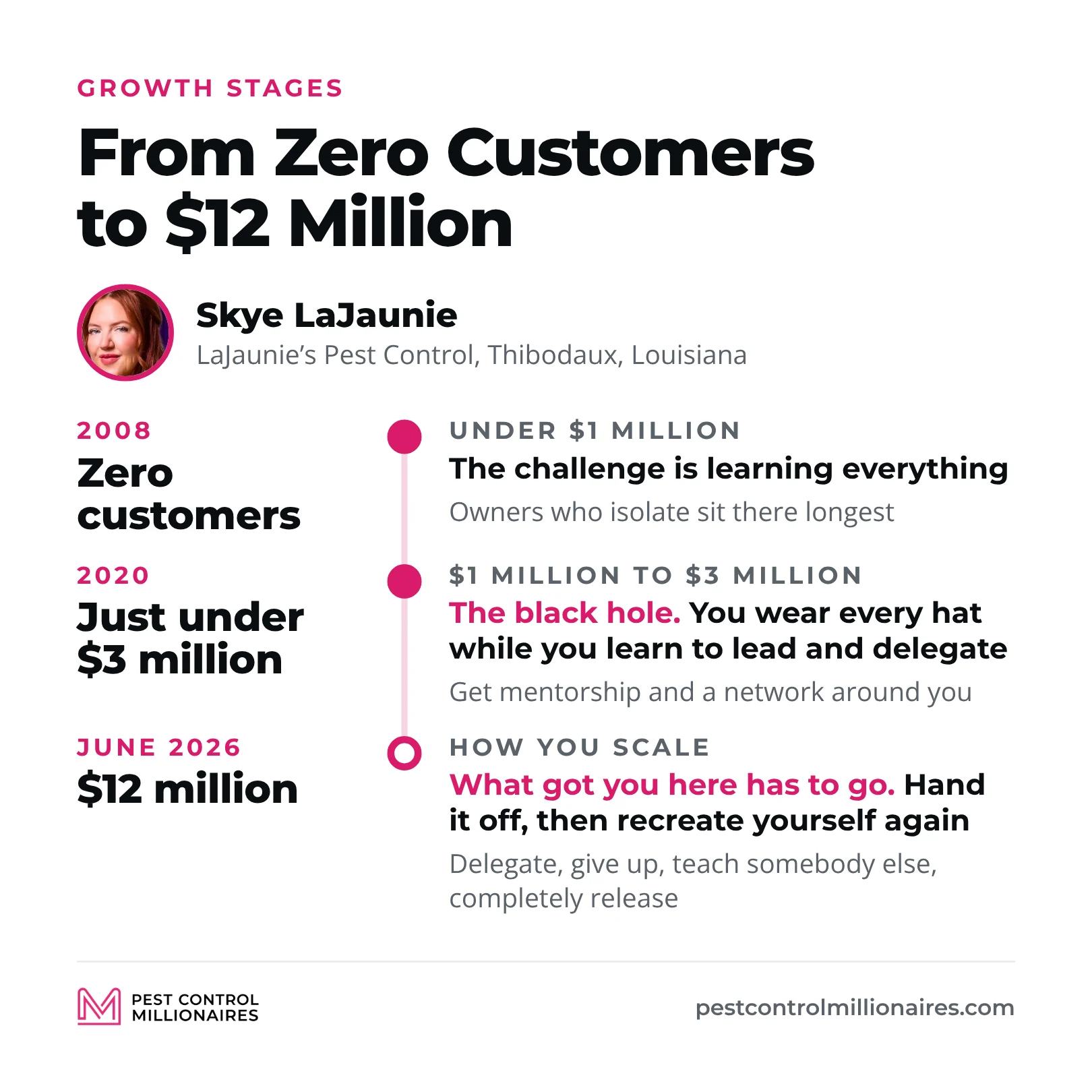
Skye LaJaunie is the CEO of LaJaunie’s Pest Control, which she and her husband, Jared, started in Thibodaux, Louisiana, in 2008. They had zero customers. They put in their life savings and traded the family vehicle for the first service truck. With no babysitter, their two little boys came along to knock doors after school, one parent and one kid on each side of the street. By the time this episode came out in June 2026, LaJaunie’s was a $12 million company, and Skye was also running peer groups for other owners in our industry.
We had walked past each other at a bunch of events, and once we finally sat down, we talked for 20 or 30 minutes before I said we had to hit record. This one is less about tactics and more about what growing a company does to the person running it. Here is what stuck with me.
This episode is part of the PCM Podcast. For Jared’s side of the story, read my conversation with Jared LaJaunie.
What got you here has to go
Skye talks about neuro-imprints, the early wins that wire an owner’s brain. When something brings you money and success, you hold on to it. That can push you forward or become your bottleneck, and over a career it often does both.
Her example was a friend with a six, seven, maybe eight million dollar pest control company. Selling is what got him past a million, so he never built a real sales team, and he had a harder time getting to eight figures even though it was all there for him.
So write down every major breakthrough that got your business where it is, and get ready to hand it off. If you have a $2 or $3 million company and want a $6 million company in two to three years, “everything that you did to get the $2 million company, you will have to delegate, give up, teach somebody else, completely release, and then recreate yourself again. And that is how you scale a business,” she said.
I think you have to recreate yourself about every six months, and it’s the same lesson I wrote about in why companies get stuck at a million. Every month I write down one lesson from a failure and one breakthrough, and I go back through them at the end of the year.
The $1 million to $3 million black hole
Under a million, Skye says, the challenge is learning everything, and owners who isolate sit there longest. One to three million is what I call the black hole, and she thinks it may be the hardest stage mentally. You can see how much you don’t have the bandwidth to do, but you can’t afford to hire everyone, so you wear every hat while you learn to lead and delegate. It’s also where most people in home services sell. “This is where we separate the girls from the women,” she said.
It’s where she sees owners get divorced and stop taking care of themselves, too. She says she became very overweight in that season. She gave up sleep, and she was there for her boys physically but not always mentally, because work was always buzzing in the background. She doesn’t think those sacrifices were necessary. She just didn’t have the know-how or the support.
“Your energy is the foundation of everything you do,” she said. So if you’re in the black hole, get mentorship and a network around you, and lean into a level of discipline you’ve never had before. You’ll get through it faster.
Betrayal is the cost of admission
Skye wanted to talk about the hard parts successful people skip on podcasts. Almost every new owner hires friends and family first. She did too, and it often ends in strained relationships. Her youngest son runs one of her offices, but he doesn’t report to her directly, and they agreed their relationship always comes before the business.
Then she said the thing nobody told her. “Betrayal is the cost of admission to success,” she said. “Someone will steal from you. Someone will disappoint you. Someone will double cross you. Someone will sue you for a false reason.” She has had people steal from her, start a competing business and go after her customers, more than once. All of it has happened to me too. “Resiliency is a muscle,” she said. Expect it, learn from it, get back up and swing your axe again.
It also means deciding for the company, not for your loyalties. I had to fire my own brother, and I always ask whether a decision is in the best interest of Pest Badger. Skye called that a bit of an ego death. As a million dollar leader, every time someone quit it disturbed her peace. At her level, she’s unfazed. “You have to be okay with not being liked,” she said.
Integrity is keeping your word to yourself
LaJaunie’s hires and fires on its core values. Integrity means doing the right thing when no one is looking, which matters when 70% of Skye’s workforce works alone and unsupervised every day.
The problem, she said, is that everyone has their own definition. So in interviews she asks, “What is integrity to you?” She is very clear about hers. It isn’t morality or your personal code. “Integrity is keeping your word to yourself,” she said. If you sign the handbook, say you’ll do the job and then don’t even try, that’s where integrity breaks. Mistakes are fine, as long as you own the failure.
Another core value is passion. Skye would rather have the team member who cares enough to argue than the one who sits quietly in the meeting and gossips later. When one of her techs walked into her office at a branch to tell her to change the pay schedule, “I thought I wish he would get out of here. And then I thought at least he cared,” she said.
Visionaries resist EOS until it works
Skye is the integrator. “I’m a Virgo. I like order,” she said. Jared is “a flaming visionary who just runs all over and creates the chaos that creates business growth.” She picked up Traction and ran her first EOS meeting in a little attic office at one of their first locations, and the team told her it was the best meeting they’d ever had. Jared hated it, which he admitted when he was on the show. Visionaries usually resist EOS at first, she said, and buy in once the results come.
For LaJaunie’s, meeting quality, communication and accountability all went up, and she can’t imagine running a multi-unit business without it. If you’re between $500,000 and $3 million, read the book, then hire someone to help you implement it, because under $3 million you wear too many hats to pull it off alone. We self-implemented at Pest Badger and run mini EOS meetings for every branch.
Around 2020, an implementer ran a vision exercise with her leadership team in her living room, with her Great Dane on the coach’s lap. The men in the room said the company could do $5 million or $10 million. Skye said $25 million in five to six years. She isn’t there yet, but she has a 2031 goal.
Track every lead source or you are guessing
For Skye, the breakthrough was learning inbound sales, creating inbound leads and building a scalable sales process around them. In the two or three years before we recorded, she had to rebuild that process completely, because technology changed and so did the way customers want to communicate. When LaJaunie’s launched, the phone book still mattered, and it was the first privately held pest control company in its market with a website.
Her most expensive mistakes were marketing that didn’t work and no good tracking to show which channels did. She calls it the cost of her education. “I have a multi-million dollar education in it,” she said. One of mine was $80,000 in hotel rooms when I first started Pest Badger.
She sees other operators make the same mistake a lot. They don’t attribute their leads or track close rates, and I’d add that they quit too early to know if a channel works. Track every source, whether it’s Meta, LSA, pay-per-click or door hangers, with leads, cost and closes for each, or you’re wildly guessing. Here are the marketing numbers I watch every week. What works depends on your market too, so have four or five vehicles taking you there.
Learn from people who have done it
Everything Skye has learned about business came from her own mistakes or from someone sharing their experience, and the second way hurts a lot less. That’s why she runs peer groups. A member of one once told her, “Skye, you know, I’m richer and smarter because of this group.” As she put it, you could find 5,000 classes on how to kill a cockroach and very little on how to grow as an entrepreneur.
In her groups, feedback is a gift. At the end of a meeting, members stand up and challenge each other, whether that’s to take your wife on a date once a week or to sell 800 new accounts in six months. You say “I accept” or “I don’t accept,” and you don’t explain.
Her rule on coaches is simple. Never hire one to teach you something they haven’t done. If you have a $5 million business, get a coach who ran a $10 million business. “If I ever made a mistake in the last few years, it was listening to consultants that didn’t know what they were talking about,” she said.
Then she gave me feedback, peer group style. I haven’t put Pest Badger on the PCT Top 100 because it bugs me that we won’t be top five. Skye decided in 2020, when LaJaunie’s was doing just under $3 million, that she would make that list, and when we recorded, LaJaunie’s was No. 88, up from 92 the year before. “Learning how to not be first and still be important is one of the best leadership lessons I ever received,” she told me. It’s still tough for me.
Build it to sell, even if you never sell
I get asked about my exit plan all the time, so I asked Skye. “I am always building and growing my business to exit it,” she said. That doesn’t mean she’s selling, and nobody has a crystal ball. But every business ends up sold or closed, an idea she credited to Alex Hormozi, so building to sell is the wise move either way. “If someone else thinks your business is valuable, it’s because it’s a good business,” she said. Get a valuation and learn what buyers would want. Nick Bartolo walked through how to get ready to sell on this show.
Skye was 45 when we recorded this. Her boys are grown, and being their mom is her proudest badge. Her biggest fear is missing the purpose of her life. She thinks enough is enough when you know you’re working at your highest potential. Neither of us is there yet.
Frequently Asked Questions
Who is Skye LaJaunie?
Skye LaJaunie is the CEO of LaJaunie’s Pest Control, which she and her husband, Jared, started in Thibodaux, Louisiana, in 2008 with zero customers. By the time her PCM Podcast episode came out in June 2026, it was a $12 million company, and she was also running peer groups for other owners in the industry.
Why is going from $1 million to $3 million so hard?
Skye thinks it may be the hardest stage mentally. You can see how much you don’t have the bandwidth to do, but you can’t afford to hire everyone, so you wear every hat while you learn to lead and delegate. Her advice is to get mentorship and a network around you and lean into more discipline than you’ve ever had.
Should a small pest control company use EOS?
Yes, Skye thinks so. Read Traction, then hire someone to help you implement it, because under $3 million you wear too many hats to pull it off alone.
Should you build your pest control company to sell?
Yes, Skye thinks so. Every business ends up sold or closed, so she is always building hers to exit, even though that doesn’t mean she’s selling. A business someone else thinks is valuable is a good business, so get a valuation and learn what buyers would want.
Full transcript
Every word of the episode, from the video captions
Building the business turns you into a different kind of human being.
Realize that failure is a part of the...
I think there's hope out there for all of us. For all of us. They say procrastination [music and singing] be the assassination of destinations. That's why we out here grinded with no association with haters and them other crabs [music] trying to put us down. Pest Badger's in the house. Boy, don't clown. Just keep your eyes on the prize and no giving up. You can do whatever you dream of. Keep your eyes on the prize.
All right, welcome back to another episode of Pest Control Millionaire. I think I've been working on this one for a hot minute. I've been reaching out really excited about today and I usually don't write intros. I usually just wing it, but I actually took some time before cuz I know that you're a researcher and I know you take a lot of notes and I know you have deep thoughts. So, in return, I did the same for you and I wrote you an intro. Most people know LaJaunie's Pest Control as one of the largest and fastest growing companies in the industry. What they may not know is the story behind building the company through hurricanes, economic uncertainty, and all the challenge that came with scale in the business. Welcome to the podcast, Skye LaJaunie.
Hi Jonas, thank you for having me and thank you for the kind intro and being so mindful of the research. I'm super excited to be here and have the privilege of like just getting to talk to you.
Yeah, it's pretty cool. We've we've probably been like walked past each other a bunch of times, a bunch of events. We just never got a time to connect. So, I think we sat there and talked for like the last 20 30 minutes and I was like, we just got to start hitting record. We're missing all the good stuff. So, but I always like to start the podcast the same exact way. The first question and it'll open up this way. Skye, if you and I were a sophomore or a junior in high school, who is Skye?
Oh man. Okay. I was I was a troublemaker. I was a [laughter] I was a borderline criminal. Just I'll be honest, [gasps] I put all the gray hairs on my on my dad's head for sure. Yeah. I was eccentric. Loud, rambunctious, a bit of a rebel. Definitely a rebel.
See, in a good way, though. It wasn't It wasn't bad. It was a good thing.
Oh, no. I don't know. I was kind of I really always loved take a risk.
And that really that like really like would would thrill me. I was kind of a risk junkie. And so, when you're young and stupid, that also can become self-destructive. Yeah. Yeah. So, yeah, that was definitely me. I, even though I was, even though I think like intelligence is one of my gifts, I was not a good student. I was undisiplined and I was bored most of the time. Even though I read books all the time and enjoyed the process of learning, I just was not interested in school at all. I felt like every exercise was so...
How do you feel? How do you feel now looking back at that? Do you still feel like those times where your kids went to school were pointless? Like during those...
I don't I don't know. I still why I've I do value education. I think it's very different today. I think knowledge is so accessible. And after employing people for the last 20 plus years and some with high levels of education, some with very little levels of education and seeing how that really didn't correspond to people's performance. I'm a little indifferent.
That's probably why I asked you the question because I'm the same way. I've hired people with large degrees, you know. I've lost you with military backgrounds and yeah, it doesn't always translate to being the best performer and then sometimes it does like I've had some studs who have. So, but I feel the same way. So, like my kids are in public school [snorts] and it drives me crazy and I've been trying to get them out of public school for a while. I can't really talk them out of it. My oldest is way too far gone. The next two we're getting closer. So, I'd love to get them, you know, stay at home, learn, and then spend the time traveling with them and learning experiences and figuring out what they want to do with their life and then really start honing on those skills early. My mentor had his oldest son out of school by the time like he's in seventh or eighth grade. Kid is an entrepreneur, but by 15, he's actually multiple businesses already. Kids a stud and that's what I love to do with my kids, too.
Yeah. Yeah. Both of my children had like non-traditional education. And they're 23 and 26. My 26-year-old is an entrepreneur. He's he's starting his third his third business. He had a couple of startups that that like went wayward and he learned he didn't do the traditional college route even though I had like saved money in case they wanted to do some sort of education. And he chose to use the money to start businesses and he's starting his third business. He's actually just launched it and I think he's going to have a great deal of success this time around because he's learned all the hard lessons. So he's an out-of-the-box thinker and I think the untraditional education and then him seeing me and his father live the untraditional life of an entrepreneur I think, you know, that affected him his mind and his idea of how to earn and have success and become independent. My youngest son works for me. He runs one of my offices. In fact, it's our fastest growing office that we have right now.
So, I'm super proud of that. And he also like he's 23 but the way he views life and his own level of accomplishment it you can tell when you see them sit with another group of their peers who had more of a traditional education you can see how the mind is moving a little different. So I think it does I think education traditional education is there to teach people how to become a...
I knew I knew what you were going to say before you even said it. I love that.
That's not a bad thing because we all know we need to work%...
I'm part of the workforce but I believe that I was designed and I'm going to live out my purpose through all right. So, let's fast forward a little bit. How do how do you find pest control or how does pest control find you, Skye?
So I've been an entrepreneur my entire life. I started my first business when I was 20. I was in the service industry. I did I was an aesthetician. So, I had a salon and spa.
And I built that up to have some success. And I had a business partner that I didn't want to have anymore. And so I sold my portion to her and then I was married to a pest control He started his career as a termite technician at one of the big brands in our industry and you know as is and he was 19 or 20 and he wanted to have his own business as well. And so I was like there we are. I'm married. I'm married to a pest control man by default. I am now the helper of whatever happens in the pest control business. And that and that led to the career of pest control, which no one ever wakes up and says, "I want to have a pest control business." But it is the best business in the world that has the best people.
It's a wonderful model. And I've also had an estate sale and moving company. And that was a good business, but pest control is still, in my opinion, one of the best service businesses that you could own.
I agree. I was 14 years old and I was making my dad pay me to cut his grass. And my dream at that time was to own a lawn care company in Green Bay, Wisconsin. [snorts] At that same day when I'm thinking this through. I look back in the day. I remember when my dad's truck was parked. I remember what I was doing and a pest control truck drove by me. Never seen like the pest control was never like on my radar ever. And it drove past me and I watched it. Has a little black Ford Ranger had the tank in the back and they pulled up to my neighbor's house. I think I was make my dad pay me like $15$20 cuz of grass. It took me like an hour, right? And then I was just being nosy and went over the neighbor's house, which is my aunt uncle, and they had just got done and they left and they were there for, like I said, not very long. They hung a plastic invoice in the dark on the door, opened up the invoice and said like $120. I'm like this was 25 20 years ago, 20 some years ago.
And I was like, "Dang, that that makes sense." So, I knew then pest control was like on my radar for the first time. Hold up, quick pause. If you're running a pest control company or fertilization we control company, you're not in our Facebook group. You're choosing the harder path. Every operator that's there skipping years of mistakes because people are actually sharing what's working right now. So, stop trying to brute force your way through growth alone. Search Pest Control Millionaires on Facebook or click the link below. And now, let's get back to it. I want to share a little a little nugget of what of what happened there. So they call that experience what you just described like a neuroimprint. And so this is a very interesting thing. I think so much about success is knowing thyself. And so and this happens to entrepreneurs all of the time. They experience these neuro imprints and it either propels them forward in a powerful way or it becomes a bottleneck for them. And oftent times it does one it does both at different times in their career. So what happened to you is that you were very young and the younger your brain is the more powerful your neuro imprints become.
So what happened to you is you saw you made a connection to wealth and the lawn care service and it was one of the first ways that you had ever thought about making money and becoming free through money. Like a connection happened and it fired. And then then that neuroimprint became really powerful because then you actually took action and got money from your parents and started to make actual money through that process. And then that just fully evolved and here you are, you know, one of the most successful service brands in the US scaling and building and creating all this opportunity. And so that was a very powerful neuroimprint that moved you into the service industry and in the service business. Now I'll give another example of this for that maybe some of our listeners can understand so they can apply the idea of neuroimprints to their own success.
So a way that a neuroimprint can be negative in an entrepreneur's life and I'll give an example of this. I have a friend who I know through some of my peer and he is very successful. Probably a six, seven, maybe an $8 million pest control company. And he's a great salesperson and he has a knack to get certain accounts in a certain way. And as a result he never scaled like a huge sales program in his And he always kind of had like, okay, I'm going to handle the selling and or this one or two other people are going to handle the selling and I'm never going to really scale an outside sales team or an inside sales team. I'm not going to do anything there. Because when he first began to make money and have success, he experienced the narrow imprint of I sold it and that brought me money and success and a breakthrough past the million-dollar market, right?
Past the big goal. And then you hold on to that because you go, "This is what I'm good at. No one else gets to do this. No one else gets to touch this." And then what happened to my friend is he never he had a harder time scaling to the eight figure mark to the 10 million point even though all of that was available to him because he had held on so tightly to the sales process because of this powerful neuroimprint of I sell the job, I make the money, I get past the seven figures. And so we all have that in our lives.
What was your moment like that? Oh yeah, I know. I still deal with these challenges and but...
Flip I got to flip the script a little was there was there a neuro moment like that for you though?
Oh my gosh.
You can remember...
Over and over again. Yeah. And what and once I kind of started to understand how the brain functions and it's this is these things are not individual to me but I understand them because I've experienced them and lived through them, right? Which is the power of mentorship and peers and listening to podcasts and having friends, right? Because you get to live the life and then you get to watch other people live the life and then all of the sudden you're understanding who you are and how to move this machine we call the body forward, right? So I have had to deal with those sorts of neuro imprints over and over again in my life. Having enough self-confidence, right? A huge neuroimprint for women and I and I'm I totally threw this one in the trash.
But like they think, "Oh, they don't like me because I'm a woman. I'm in a room full of men. I don't get the same respect." Like all of these stupid things that women tell themselves and if it's valid or not valid, it's it doesn't even matter because if you believe it, that's what gives it power, right? And so I oftentimes help women get past the neuroimprint that it's harder to be a woman in business. I've I have my own neuroimprint which is it is a tremendous benefit to me to be a woman in business and it has and I'm having more success because I'm a feminine power in the room and that makes me unique and it makes the way that I can operate and move through my life in a unique way and that is an advantage over my male counterparts.
It genuinely is. And so that's a neuroimprint that I had to get over and I help other women get over in business more specifically because I'm talking about mindset. But in business more specifically, and this is where it becomes really powerful, is you have to sit down and you have to write all of the things that were major breakthroughs for you in your business. Let's say you're sitting here and you're listening to this podcast. You're at $2 million and you want to be at $5 million and you want to go, okay, I want to be Jonas, right? I want to I want to I want to do this exponential growth in a very short time and you don't know why it's not happening for you, right? And you don't know what the next step you should do to create that because everyone has their own path to success. So, you have to forge your own.
You can learn from other people's mistakes, but the way you're going to get it is not going to be like me and it's not going to be like Jonas or any other of our powerhouse colleagues, right? You're going to forge your own journey. And so, in order for you to draw your own map, you have to go back and look at everything that brought you success to this point in your life. If you have a $2 million company or $3 million company and you want to have a $6 million company in the next two to three years, everything that you did to get the $2 million company, you will have to delegate, give up, teach somebody else, completely release, and then recreate yourself again. And that is how you scale a business.
I love it. I have so many questions in the future today about all this. It's going to be fun. I love it. What I'll say is that you mentioned something that I do a lot. So every single month in my notes, I write down two things. One thing that I learned through a failure that month and then one thing that was a breakthrough that month. And then at the end of the year, usually at the end of the month, I go back and look at the other ones, but at the end of the year, I collaborate all those things together and I'll work through them at the end of the year. And I've done that for probably three or four years now in my notes. And then what I do with those, I usually make YouTube videos, but that's just what I do.
I'm going to move on to the next question. It's actually still the first question. So, what did the business actually look like early on in that...
Oh my goodness. It was and I tell this story frequently, but like you know it was it was zero customers and a bootstrap and two young people with two young kids and no money risking risking everything. You know, we had a [laughter] we had a little small savings, our entire little life savings and traded in the family vehicle for the first service truck. I mean, it was it was pretty barren. And my youngest child's earliest memories was walking around with mom and dad in the afternoons after school and knocking on the neighbor's door and offering them pest control.
I love it.
And so that that's my son Kyle and Christian like they came with us because we didn't have a babysitter,...
Right? I had a prek and first grader and so I would take my youngest one and walk one side of the street and my husband would take the oldest one and walk the other side of the street.
Yeah. My oldest daughter spent many many nights and days working with me. Younger two, not so much cuz they're younger and business way more established. But back then when I was grinding out, she spent a lot of late nights, midnights, overnights in my...
Yes. Yes. And I also have fond childhood memories of sitting next to my entrepreneur father. He had a contracting company. He was a soloreneur. I lived better part of my life in his truck with him. But yeah, I so I'm not a doornocking company, but we I do have a doornocking route there.
That's awesome.
That was all we could do.
Was there a moment where you thought that it might not work?
No, it had to work. I felt the same way. I didn't have a choice. Yeah. There was no plan B.
There was no Yeah, it had to work. I never entertained the possibility of losing But that's how I am with with anything that I do. I'm either I'm either 100% in or I'm 0%. Like there's no in between tune with me. There isn't. Like it's like people ask me about the podcast like how did you do like how do you keep going? I'm like, I don't know. It's just who I am. I don't know how to explain it. It's just I love doing it. It's I get to learn every single time we talk about this. I take notes. Like, it's just how I am as a it's not healthy. [laughter] I never once mentioned that it's healthy.
I don't think it's healthy, but it's but it's the same thing with the gym. Like, it's two it's two workouts a day every single day. Like, meals are all the same thing. I'm all I'm just all in. There's no half in half out. But what we're really talking about here is we're really just talking about right. And that is the difference between entrepreneurs that keep going and the ones that don't like and I and I meet people a lot like this that that maybe have a million dollar business or $2 million business and they're stuck there or they or they don't have the desire to keep going because business is very difficult. And when I say it's difficult and I and I and I intentionally said that I was going to talk about this with you because too many times I hear successful people have a platform and an opportunity to talk about their success and then they talk about how they how they never thought about giving up and then they talk about right the things that we're talking about because that's a very real part of success. But I think what entrepreneurs don't like to talk about on podcast that that prevents other people from being able to get value from their story is all of the terribly difficult hard that we go through.
Wait till my next question. If you don't I know I mentioned this before the podcast, but like I don't sugarcoat anything. I tell every single story that happened to me through a podcast or YouTube channel. I don't hide anything whether it's we had to let someone go or if you know we got into an accident, we total trucks. Like I'm just very transparent. Like I've talked about my DUIs on here. Like I just that's just who I am. I have nothing to hide. Like everything that I've done in the past has made me who I am today and I learned from them...
Yes. Yes. Because resiliency is a you're not you don't have it built in.
It is.
You just ha you just keep having more difficult things and then your ability to rebound becomes easier and easier and...
And it's like solving problems like we're probably both so good at because we've been through them so many times. So when something happens where people make it a 10 to us it's like a one or a two. People like to make things that are two or eight or nine. It's like no calm down. This is not an eight. This is a two. Let's leave it a two. Like just some people are like that. There's some people who bring a like probably like yourself, you probably bring a 10 to a two, you bring it back down. Temperature in the room. What was the hardest...
You know, I think every level of business has its own challenges. And I and I actually talk about this a lot with my peer groups and different people I mentor within the industry. And you know it's really really terrible to break the million-doll mark cuz you don't really know anything especially if you're a bootstrap or you're a technical person that's just launching a business like you got to learn everything right you only maybe you know how to technically perform a service or maybe you know how to sell a service. So the first sub 1 million is just the challenge of learning and you'll go through that slower or quicker depending on the level of mentorship you have and the level of skill you have, right? So people who isolate or have low skills sit at the sub 1 million for a longer than other people. It's not that they can't do it, they just it takes you a long time to figure it out.
Once you get past a million that one million to three million. Oh god. I think that this may be the most difficult mental.
It's a black hole.
Yes. I've heard. Yeah. It's like mentally this is the hardest part. This is the part of regret. And this is also statistically if you look at home service industries this is also where most people sell their business.
They sell like as of I think I saw the statistic as of last year 70% of the businesses that sold maybe was higher maybe 76 were between one and three million. I talked about that in the podcast a lot.
Yes. Yes. It's where people tap out, man, because you have all of this work and all of these things and then you understand you have a level of understanding when you're there and you understand how much you don't have the bandwidth to do everything and you also understand how you don't have enough money to hire everyone, right? And so that is so difficult because then you have to be the multiple hat wearer, right? And you have to stretch yourself into places that you never thought you would. And then then you also have to learn how to lead people and delegate through that. And all of those things mentally have to happen at the same time. And I find that's where you really separate your the people that go, I'm never going to give up. Right? This is this is where what do they say? You separate the men from the boys.
It's a funny analogy for me to use as a woman, but this is where we separate the girls from the women. [laughter] yeah. So, if you can press past that and if you're and if you're there and you're listening to this podcast, I will tell you get mentorship, get a network of people who will support you because this is also where I see get a divorce. I see them have mental Yeah. Have mental like a like a whole like mental shift or mental strain or like sacrifice. I see sometimes I'll see them get very overweight or kind of stop taking care of themselves because they're so...
And trying to get past it. Right. This happened to me. I became very overweight in this season.
Yeah. I was almost 90 pounds overweight because I just...
You're working, you're fast,...
You're going to fast food, you're going to the quick trip or gas station, you're eating garbage. You don't take care of yourself, you don't have any time, you're dealing with two young kids, like...
And so, and if you if that happens to you or you have interpersonal relationship problems or whatever within your family, if that happens to you have then you live there longer because the your energy is the foundation of everything you do. And so if you're unhappy professionally or physically or in your home life, then that depletes your energy and then that depletes your ability and speed to move, think, and make good decisions. And so if you're if you're there in the black hole, as you call it, take do the thing, lean in to a level of discipline you've never experienced before, and you'll go through it faster. I did not understand that at that time and I sacrificed too much and I didn't have to.
It's so funny because the next question on this list is what sacrifice did people never see?
Oh god.
Putting you on the spot today, Skye.
Yeah, I did some good research.
I'm not that proud of I'm not that proud of Yeah. Not sleeping.
I still have that problem. It just doesn't shut off.
Yeah. Not not proper self-care. And again, I don't think that these were necessary sacrifices. I think I just I just didn't have the knowhow or support to manage it. And that's part of why I do the peer groups because I'm really passionate about helping people have better experiences of climbing the mountain of entrepreneurship because I think it's a joyful and wonderful process if we have a community around us. But yeah, I definitely think just not taking care of myself for me too. Definitely...
Sacrificing time with my children. Although I have great relationship with both of my boys and we talk every day and they're both the apples of my eye. I...
Yeah, I have a lot of regrets about being mentally present. Like I was there but maybe not mentally or emotionally present as I could be because I was always buzzing about work in the background. So not having good separation there because I was so and I think the other thing we don't like to talk about but I find is a pretty universal entrepreneurial experience is loss of friendships and isolation. So the first thing everyone does that's a green entrepreneur when they start a business is they hire their friends and family universally I can even go don't freaking do that and they...
Every time still do it.
It's like it's like a right of passage and by the way I also did it. So because you think well why I'm just going to give all of my friends and family a wonderful job and right and they're going to work for me and then what happens as a result of that often is fail failure and failed relationships or andor strained relationships right I mean so the toll it takes if you work with your spouse it takes a toll it's it puts an additional weight or strain on the relationship if you work with your children it's the same thing my son and I he does not report directly to me. I do not directly mentor him. And you know we have an we have an agreement a spoken agreement that this is not going to you know our personal relationship supersedes business always and that and that those those are two separate things and so you know you have to have good rules and boundaries. But I have lost many with friends and people through the through through the process.
And then also just the betrayal, you know, betrayal is the cost of admission to success and nobody told me that. So let me go ahead and tell everyone who's ever wants to have success or if you've had success, betrayal is coming. Someone will steal from you. Someone will disappoint you. Someone will double cross you. Someone will sue you for a false reason. All of those things are part of the entrepreneurial experience. They're part of having resiliency, but then also it's what you sacrifice something because there's no way that those things and experiences do not have an emotional right? Or an emotional effect. So the two things that those things do to you as a human being, one they make you tougher and they exercise the resiliency muscle. But two, it can make you be more guarded, become jaded, right? And so I do a lot of things. I'm very intentional now to do things to serve people, be around great people, have good community and have good experiences.
And when you have, let's say you have 50 employees and you have three that were stealing from you and treated you really badly and opened up a business to compete against you and solicited your customers and Right. I can't tell you how many people have that story. I have that story time in multiples. Okay.
Same here. Everything that you mentioned, it's happened to me. Of course. Yes. And if we normalize if we normalize this in entrepreneurial community and say, "Look, this stuff and it sucks and it's painful, but it is also the cost of it. It's the price of admission to the next door." And so what happens is we think we have we have dumb expectations and we think that those things shouldn't happen. Those are outlier experiences and we're never ready for them when they come, right? So what if we just we just said, you know what, it's normal when you experience it and it comes, learn, get back up and swing your axe again and keep chopping the tree down. Love it.
And so like I think that's also the power of mentorship community, the podcast that you're doing, and getting around people that are doing what you're doing or aspiring to what you're aspiring to or people that are ahead of the road on you. And then you then you can set your expectations to...
I always say that you should have three mentors. One that's been there and done One that's roughly the same size that's going to push you every single day. And then someone who's young and smart can keep you up at the time with technology.
Yes, that's excellent. Yeah, that's actually biblical too, Jonas.
Is it really?
Yes, it is. It is. It talks about in the Bible, it talks about making sure that you have someone an elder, right? Someone be someone better and wiser, right? And then you need to have like a comrade, a person that's next, that's right alongside. And then you have to be a giver and you should be mentoring someone else.
Yeah. And so if so that those those three types of relationships will keep you into a balance.
Great. What changed in your leadership between one and 10 million? Probably a lot. But...
Oh my gosh, I'm much nicer. [laughter] I don't know if all of my team would agree right now, but I that not very few people's that work for me at a million still work for me past 10. So,...
It's just again, it's the cost of doing business, too. And it's unfortunate because like what you said early on is like one of the first mistakes I you see young companies use to hire friends and family. The other thing that I see is they think their first technician is going to be their general manager. Like, it's just not reality. Okay. Does it happen from time to time? Yes, it does. But odds are very, very slim to none. I'd say about 1%.
This guy, he's I'm going to give him equity. He's we're grow. No, do not do yeah. Yeah. I know. I see that all the time. I because I think creating things and creating entrepreneurial success and money is it's so scary and difficult that it'll force people to become codependent.
Please do not do that.
I see that a lot. They'll become codependent on a manager or they'll have a an unmmerited amount of right, to someone who who didn't abandon them when everyone else did.
So, and I'm not saying that that's wrong or right. And I'm not saying that's justified or unjustified, but in you have to make decisions for what's best for the company and the overall success of the organization and not your individual loyalties,...
Right? I even early on like looking back like I struggled with that too. I the business was established and I hired my brother. He was having some issues and I told my dad I'd try to help him out even though I knew better. It didn't last very long. I had to fire my brother because it was for the greater good of the company and I still have those things. You work with someone for three, four or five years, you build a good relationship with them. You spend more time with them than you do your family usually and then just to have to part ways is and especially as entrepreneurs were people people and so it's tough for us. And so it's just again it's the cost of doing business and at the end of the day I always ask I always ask myself the one question is like is this in the best interest of Pest Badger and if the answer is always yes then I made the right decision.
Yeah. Yes. It's a bit of an ego death to do that. It...
Yeah. You have to be okay with not being liked. And I think essentially I'm really comfortable with people not liking me. [laughter] And when when I was a $1 million leader, I really I really every time someone quit or every time someone was displeased, it really disturbed my peace. And I can say with a whole heart I am unfased at this at this level. I'm like, you know what? As as long as we keep going and the business is having success and we're doing the right thing and following our core values, that's all that matters. And so, I don't get too worked up when someone else is unhappy because no one's going to be happy all the time.
Never. It's just not. If you find a perfect if you find a perfect organization, and I tell this to my team members. I said, if you find a perfect workplace, don't go work there because you'll mess it up.
It's funny. What was something that you had to do personally to get the company to grow? [sighs and gasps]
I think for me, and I talk about this pretty openly, for me, the best thing that really broke ice on on, growth strategy was learning and honing the skills of inbound sales. And creating inbound leads and having a really masterful scalable sales process And by the way with with the way that cuz I've been growing our business like that for you know the last 10 years. But in the last two or three years I've had to completely and totally recreate that process because of this and change in technology and consumer behaviors and how they want to communicate and so I think that that's been the biggest you know that was part that like you know I talked earlier and about creating your own path to success that was part of my path to success was understanding how to do that and it matched my skill levels and my abilities really well.
And so that's been that's been a big focus of my career and growth in the business.
Yeah. Because back even let's go five maybe seven years ago, maybe not even that far, everyone just like to call in talk to someone. Now no one wants to really talk in the phone. Everything has changed. Like I'm probably the same way. Like if you call me, I always if I know you, I'll call you back. But you just text me, you'll get faster response.
Yeah. Yeah. I call I call people sometimes and I go I'm doing that weird thing where where old people call you. [laughter] And then just now with like the whole new roll out of Google and like the AI agents going to start calling you now instead of like the actual customer calling you. AI agent is going to call two to three companies get a quote and give the information back to the consumer. Like you guys have to be prepared for this. If you're again if your website is not be able to be read by you know like one of the large language models and you don't have a lot of good video content like asking all the questions that people are going to want want answered to give the large language models the answers to the questions you guys are going to be falling behind.
So just make sure that you have these things locked in because I'm the same way. I use ChatGPT for everything or Claude or something. I don't even use Google search anymore.
And so that's just the way that the world's evolving and operators that are listening to this, thank you for listening like because you're hopefully you'll learn something here and be prepared for it. That I said last week that the Yeah, last week that marketing hasn't changed in the last 40 years up until last year. Now everything's changing.
See, I'm I might I might throw a little wrench in that because I'm...
Do it. I'm a little older than you, just a little. [laughter] And I remember when when launching LaJaunie's and founding co-founding LaJaunie's, the phone book was still important. And I kid you not, we were the first in our market, we were the first privately held pest control that had a website. That was like what 200...
I would say 2008 2010 if you were early if you're an early adopter with technology which you were...
And you were one of the first people on the internet and you were running Google ads you absolutely crushed.
Yes. And so...
The com era and I feel like that's what that's what the new AI version is going to be of that.
Yes. Yes. So I so I don't know that wasn't 40 years ago. So I think that was that that was the largest shift. That was the largest shift that...
We I experienced in my career was of like physical print into digital movement and then and doing everything digitally and now I'm going through another movement where hey the whole way that consumers are going to search and make buying decisions has now changed and how how do we move forward through that and then also I think the biggest disruptor that our industry is going to see in the next 5 to 10 years is probably some regulation against calendar application pest control. So like right now the whole entire industry is based on hey I'm coming on a quarterly cadence, monthly cadence, whatever you do and I think that the pre preventative application of pest pesticides is going to be heavily regulated and we're already seeing that in other in other parts of the world. So I think that's coming next.
I do too. And so like and that's why people they'll ask me they you probably ask the same question every day like what's your exit plan? We'll get into that. It's like I would like I said when I started this thing I was going to go on a 20-y year run. I'm 5 years in we'll start of our sixth year. But I they're like well when are you going to sell? I'm like I don't know the answer to that cuz I just don't know what the future of pest control looks like. Well I think pest control will always be around. Yes. I just don't know what it looks like. Do I think the people with the most customers still wins? I do believe that because that's what people are going to want to buy.
You have access to people. You have a big customer list. I just don't know what that looks like. I wish I did.
I don't know. So I've heard two story, two schools of thought. One is that, oh gosh, that'll increase profitability in a massive way because...
You can still keep people in a subscription based.
Yep. And then if something happens, you go out there and take care of we already do that.
We've been selling that way for the last two years. Like that's one of the options that we have. They sign up for a U program and they get so many services a year. You call us when you need us. Does it make scheduling a little bit more challenging? Yes. But is it great? Absolutely. It's the insurance model that we run.
I recently did a meeting with a man from South Africa who has a has he has a home maintenance platform, an online platform that basically takes care of like rentals and SDRs and all of that. And he provides services and contracts and one of them is pest control and he does no calendar application. It's like everyone, he has over 300,000 subscribers on the platform that are landlords and our property managers and he charges them all like 10 bucks and he has a reactiononly subcontract agreement with you know whatever local pest firms in his country you know regulations very different there but I found that very interesting and he was wildly successful of course I think we'll more of that...
And but it's Like you said, we're as entrepreneurs, we're we're always going to have to pivot. You always have to recreate yourself. Every six months, probably recreate yourself. It's just how we have to be. What are your non-negotiables as a so we have core values and we hire and fire on them. So I can quickly default to that as a non-negotiable. We're reliable. So and we have definitions for these. So integrity is we do the right thing when no one's looking. Which is absolutely essential in the sense that 70% of my workforce goes out on works unsupervised every day alone in a vehicle. We're reliable and that just means that we show up and do what we say we're going to do when we say we're going to do it. And if we don't, we communicate.
So those are those are two off the top of my head. Passion is another one which is unusual. And it makes for a very interesting company because a lot of our meetings and [snorts] just people and interaction. But passion is a non-negotiable for me. If you're there for a paycheck or you just feel nothing or you feel like your job is a monotonous drain like I don't want you around me because I believe I believe I believe in energy and I believe in the power of synergy and in people who have like-mindedness and passion.
So someone is like maybe a little bit combative maybe that's a bad word but they're not a yes man would you consider that as passionate? Sure. Yeah. Yeah. Absolutely. Because if you just cared enough to argue.
Exactly. I'm always I'm always I'm always up for a good debate. That's why I ask.
I'll take I'll take the team member that that cares enough to stand up and assert themselves for an issue within my company. I'll take that person over the other person who will passively sit in a meeting and then gossip gossip later or not even care at all. Just go home and eat pie and watch watch their their department or their situation or their responsibilities burn to the ground and say nothing. That's the most dangerous people, right? Not the not the ones that...
Usually not the A and B players, it's that C player. They do just enough.
Now, with that being said, I also would think what in the heck I can't even believe that person said that. I also had internal conversation frequently. I had [laughter] I had one of my technicians come in my office. I was visiting one of my branches and he came in my office yesterday and asked me why I had a why why I had a bimonthly pest why I had a bimonthly pay schedule and started to tell me why I needed to change my pay schedule. And I thought I wish he would get out of here. And then I thought at least he cared,...
Right? [laughter] At least he's he cares enough to be laying awake at night thinking about the pay schedules at the business he works at, right? Yeah, passion is super important.
I love that. Which kind of ties into my next question. What behaviors do you know immediately will cause someone to fail at your organization? You kind of said like not showing up on time, not caring.
Yeah. Unreliable, unintagorous. Yeah, that drives me crazy. I'm I feel like I'm Okay, I'm Maybe this comes off bad. Not that I'm easy to work for, but I'm not hard to work for either. Do I have a high expectations? Absolutely. Am I a driver? But like, it's not that hard either. Like you show up on time, you do a good job, you're good with customers, and you keep my trucks clean. We're probably going to have a good relationship. It's pretty like see like we have this thing that we do for our customers, too. Where it's an integrity thing. Like just do one thing that's nice for the customer or and I don't care if they never see it. That's not what it's about. It's that we're out there making a difference, making an impact on our customers in an easy way. And that could be picking up a toy in the yard, whatever. Just something easy. If they see that the garbage was taken out at the end of at the end of the driveway and they saw their garbage man come, just pull it out to the house for them.
Just something very simple. I don't care if they never see it. It's simple things like that. I think I think Jonas I think the problem with with people having integrity and having those values, it isn't that people don't want to have it. It's that they don't understand what integrity is. And I and I do this experiment with people a lot when I interview. I'll be like, "What is integrity to you?" because people have very different definitions of what that is and because you will there's very few people you will meet in the world and they will be they will just look at you and be like you know what I don't have any lie I'll just do whatever benefits me before anything else. Like they'll you won't meet people like that. And so everyone thinks they're integris but everyone has their own definition of it. And so I'm very clear about the definition of integrity. And I tell people all the time, integrity is not morality. It's not your moral code. Because when you start to have your own code about what integrity is, I mean, your code could be you know, yeah. I can Yeah, I can I can cheat on my spouse as long as they don't find out, right? I can, right? Like everybody has their own code, right? And every every human being has met someone like this and but they're living to their own code. Integrity is keeping your word to yourself.
You didn't steal this week.
If you come and you work in my organization and you sign a handbook and sit here and tell me you're going to perform your duties and you say that you're going to strive to accomplish whatever level or goal we set out and then you don't do it and you don't even try to do it and you like there's just no again and that stacks back into passion then you don't have integrity you know where where is the integrity and then I and I'm not so tough that you can't make a mistake or have a failure but I think you have to if you have integrity you own the failure right...
Going back to what I said earlier and I tell my leadership team this all the time like you don't have to come to me for everything obviously you're here for a reason and if you as long as you make the decision whether it's right or wrong but is in the best interest of pest you made the wrong choice. So be it. I'll never be mad. You made it. You made a decision cuz so many people don't even make a decision. I'm going to switch cuz I know you love this. But I read somewhere online that you're a certified EOS integrator. Is that true?
Yes. Yes, I love EOS. I run the EOS in my business and yeah, I'm a master integrator. I took the certification. I got to meet Mark Winters, which is huge deal for Yeah. And spend some time there with them.
Yeah, I think we've been running EOS for I was in Park City, Utah. The first time I ever heard of it. We had to read the book Traction for one of our one of my M or mentorship programs that I was in. And but back then, I think it's like 10 or 11 12 somewhere. I don't remember the exact date, but there was like no implementers close by. Like the closest one was like Oklahoma and he had to fly from Chicago and then drive from Chicago to meet us in Milwaukee. I'm like, "Yeah, that just doesn't work." So, we self-implemented. Could we be improved? For sure. But then I've talked integrators or on the phone. They, you know, ask us questions, run a meeting for us here and there. They don't Yeah, I don't know. I think we're doing a pretty good thing. But I love it, too. So, what we decided to do is we've altered a few things, made it our own, and then we run like mini EOS meetings for all of our branches, too. Do you do something similar?
We do we have some altered formats that we use because once once your organization gets past 100 people, not everything in EOS is going to fit,...
But since a vast majority of all businesses in the US are sub 100 people, it is a wonderful blanket...
Do you use all the online tools like 90.io things like that still or you just kind of roll through?
I do. So, I use I use Ninety.io to run my pest control company and I also use that to run my peer groups and peer group yes. So, it's cool because one, it's just a fantastic tool.
That's cool.
And two, I love to do it in my peer groups because everyone gets the benefit of learning how to interact with that software and then it can bring them value within their business.
What made you guys adopt us? Where did you guys come across it?
Oh gosh, we started doing I found EOS cuz I like order. [laughter]
I'm a Virgo. I like order. I like...
To run on time and I like rhythm and my business partner is a flaming visionary who just like runs all over and creates the chaos that creates business growth. But I had to do something to move the business forward. I had the operator role of the business for many years. And so I want to say I found the book traction maybe through like I was just looking Amazon and I was like okay I'll read it.
How many times have you read it now?
So many times but it is the driest read.
It is. I love it though. It is so dry and so a lot of people pick it up and don't make it through because it's just to the point. But it's so fantastic. I usually have to drag my leaders through reading it and yeah, once once I started that I had I got the big like white Post-it notes and like I had them all over my office. I have some pictures somewhere and where I'm like teaching everyone what does ids mean? What is what is what [laughter] is what does it do? Right? And like and I remember running the very first EOS meeting in my little upstairs attic office in our one of our first first locations. And afterwards everybody on the team's eyes were like this big and they were like that was the best meeting we've ever had and that was it. Maybe that was one of those neuro imprints I told you [laughter] and now I'm just hooked on EOS forever.
Yeah. Yeah. Was there any resistance from the team early on or they kind of bought in right after that first meeting?
Yeah. My [clears throat] business partner hated it. Jared hated it.
Probably probably because he had to sit him down for an hour. Yes. Yes. And then and then there was a process and Yeah. Usually people who are really creative visionaries kind of resist it at first and then once once the results come then you get the good buy in you know.
And I was the visionary who just loved the book. I maybe because I read through it so fast and like I could see like the writing on the wall what it could do. I'm like I love it. But at first when it was presented to me and we were going through the book I'm like oh the like this shit's so boring. Like I don't want to sit in this class for eight hours. I was bored out of my mind in Park City, Utah. Bored out of my mind. The guy was a dick, too. So, that didn't help. But then it just but then I read the book on my own on the way home like the plane. I think I started reading it on the way home and I was hooked to the book like, "Okay, I like this. I could I can get with this." What was the biggest impact that it made on LaJaunie's?
[sighs and gasps] I think I think meeting quality and communication quality went up. Accountability of execution for sure...
With your rocks is just it's simple. Yeah. I love that part of it. Yep.
Yes. Yeah. You know, it's pretty it's pretty cut and dry and yeah, just organization overall. I mean, I couldn't I couldn't even imagine having a multi-unit business and not having that at this point.
Agreed. We couldn't do it without either. If somebody's listening, let's say doing 500k to 3 milish, where would you say that they start?
Yes. I mean, of course, read the book. And then I am a tremendous advocate of hiring someone to help you implement, especially if you're if you're leading operating within a business and you're sub 3 million, get an implementation without someone coming on board and helping you is very very low just because of the amount of hats that one must wear at that stage business, you know. Thousand% agree with that. I probably already know the answer to this, but because you we talked about it kind of before the podcast started, so I know the real reason, but why did you start The Eagle's Nest?
I started The Eagle's Nest because I wanted to live out my purpose in a container of helping other I wanted to create a community where other people won and I got to win with them and we got to celebrate each other's wins. And also everything that I've really ever learned about business I either learned through making a mistake or I learned because someone shared their knowledge or experience with me. And it was much less painful to learn through knowledge and experience of another person than it was through my mistakes. And so I feel like it's my way of helping bring a little bit more success and a little less pain into the lives of entrepreneurs. And I really am a huge fan of anyone who's brave enough to start a business. And you know entrepreneurship and business ownership has transformed my life not just financially but has transfor transformed who I am as a human being and I think it's spiritual work to do that to become better and to become and reach your highest potential and strive for something and so I think I had said earlier you know you cannot give what you don't have and you cannot have what you can what you don't of right and so that's really the mission behind facilitating those peer groups and I facilitated my own peer group and we it was just a group of other pest control operators and we just became dear friends and I just happened to be the integrator in the room and everybody else was visionary and I was like all right let's bring order to this and then I started facilitating the group and I had I had as the as all of our businesses grew and we all achieved new levels of success and the group started to fall apart.
And someone told me one day that had was part of that group. They said, "Skye, you know, I'm richer and smarter because of because of this group and you know, the work you did and leading the group." And I thought, I really liked that. I think I'm going to do more of that. I want to help other people become richer and smarter. And then and then to your point when we were discussing before we went on air, you know, you get the benefit of talking to all the people in your podcast. You're helping other people and you're also learning and that's also happening for me as well.
Did you see a gap in the industry?
Yes. I and I and I certainly don't like to throw throw shade on anyone, but there is a lot of groups, our local organizations, national organizations that are involved in our industry that do not help people in business. So, like I could probably find 5,000 classes on how to kill a cockroach and if I could go there, it would be full of pest control company owners, right? Or I could find a class on you know, like just things that don't actually result in growing or scaling your business or helping people get their dreams. You know, there's all that says it was just an influx of technical trainings and in regulatory trainings and nothing about helping people in our industry or very little about helping people in our industry actually grow as entrepreneurs and business people.
Yeah. And I agree. I think you're doing what you're doing is phenomenal. And I only know a little bit of bits and pieces that I hear through the industry and I know who you are as a person. And I think it's super awesome what you're doing. And [snorts] I feel like for myself, coaching will always be there for me one day. Like if I want to be a coach, when I'm done with this thing, I will do it then. But right now, it's just not the cards aren't there for me. Like I just have one focus right now. It's growing Pest Badger. And of course, I jump on calls here and there to help. You know, we have our marketing program that's that people can join to teach them how to do their own marketing, how to build their own inside sales team, things like that. But as far as like consulting and coaching, I just don't have the time. And I feel like this is just me personally, like not show throwing shade to anyone either.
I just feel like I haven't done with my life yet to go teach someone else what to do. And I that's just how I feel.
I think you're underelling yourself pretty gravely.
But I just that's just how I feel personally. Like I just feel like I have so much more to prove to myself.
Absolutely. And you know, I think that's why I like the format of peer groups over like onetoone coaching or anything like that. I...
The group is powerful.
Yeah. We're I'm not there to fix anyone's business. We're we're there sitting at the table as as equals and with mutual respect and pushing each other forward and sharing collective genius, right? So, I don't know. I kind of agree with you on the coaching mode, but and I will also say this. I have a rule where I don't really like to hire consulting consultants or coaches. And I learned this the hard way because I've invested a lot of money over the years in consulting, coaching, and professional development for myself and my team. And I and I also have this beautiful rule that my wealth advisor gave me that I'm implementing in my life right now where she says you should spend 5% of your topline revenue on your own personal and professional if as as a CEO and as an owner.
And I think that's such a wonderful role and I'm doing that now. But I will say that you should absolutely have a community, have a network, and you should never hire a consultant or a coach to come and teach you something that they themselves have not attained. And some some people will argue, they're like, "Well, you know,...
You know, you know, Nick Saban didn't necessarily quarterback, you know, a college you know, championship team, right?" But Nick Saban has won college championships. So, he therefore is qualified to do it. And I think when when you're translating those lessons into business coaching, if you're going to get a business coach and you have a $5 million business, get a business coach that ran a $10 million business. If you have a $10 million business, get a business coach that took a $10 million business to a $100 million And don't make the mistake of hiring and listening to people. If I if I ever made a mistake in the last few years, it was listening to consultants that didn't know what they were talking about.
Yep. I agree. And again, it's not throwing shade, but I see so many of them out there. I'm like, I just there's a there's places for them. I get it. You know, people that are running sub1 million dollar companies, coaching, like I get it. Like there's places for them for the people who are just starting out. I'm sure they can save them a lot of time. So, I'm not throwing shade. I get it. I just feel that's just how I feel personally. I'm just not there yet. And I just know that my number one focus has to be Pest Badger. And then people will say, "Well, then why do you do the podcast?" Like because I'm learning. And it the podcast started out as me interviewing my friends cuz we were all in that peer group together. And then my our coach mentor sold this company and that mentor the coaching program went with it and he had a non-compete for like 5 years. Couldn't do it. And so like I just wanted to keep my friends here like someone should start a podcast. So I literally was sitting in this basement here on just my laptop was unfinished.
There was no studio and I was just interviewing my friends hitting record. That's just how it started. And then I was like, "Oh, this is pretty cool. Like I'm learning." And then I just kept interviewing my friends and posting online. And I didn't expect it to turn into this, but here we are.
Yeah. Yeah. And there you are. You're giving you're giving knowledge and sharing information with others and you're gaining it yourself.
Yeah. If I actually wrote this question now and I think it's a good one. If I sat in the room at the ego's nest, what conversations would I hear that I wouldn't hear anyone else anywhere else? [laughter] well, I think the way that we speak to each other is very different. So, I we have values and guidelines that we follow within our meeting formats that you've probably never experienced anywhere else. So, one of the things that we practice is feedback as a gift. And we do this exercise that is very uncomfortable at first, but it becomes very easy and loving and affirming as you practice it and continue to be part of the group. But we look each other square in the eye and we give succinct and simple sentences of feedback to each other. And we also practice an exercise called challenge where we stand up and we look each other in the face and when we conclude the meeting and we challenge each other to do things to better ourselves.
We challenge each other to overcome things that we've been using as excuses. And those challenges and those feedbacks aren't just limited to business. They're they're also about personal development. You know, I've heard men stand I've heard men stand and challenge another man to begin to take his wife on a date once a week. I've heard I've heard people stand and challenge someone and go, "Hey, I challenge you to sell 800 new accounts in the next six months." And you can say, and this is what I love. You can say, "I accept or I don't accept." And you don't get to say why you accept or why you don't. That's the rules. You just state what you're going to do or what you're not going to do and you sit in the in the comfort of not giving an and so it's a mental practice and a mental exercise. That's some of the things that that we do, the way we operate within the group.
That's awesome.
So and entrepreneurs don't have that. Bosses don't have that because no one challenges you or tells you anything or tells you're not doing a good job or tells you that you're playing small or tells you that you actually really could do that and you're and you're just avoiding something, right? And so that's the gift of the formats of our groups. They're intense. They're not for everyone. They're for the people who really really want to come and quickly break into the next level of their lives. That's super awesome. One of the it was probably the very first thing my mentor ever told me. I think that looking back, he saw I had a lot of potential, but I was from a really small town. So, he talked about it a lot, not to my face, but to the group as a whole about just like, you know, you might think like, "What's wrong with me? What's wrong with me? Like, I should be growing faster." like a lot of it just where where we live. But he said the first thing he ever told me was to think bigger. And every time that I feel like I'm thinking bigger, I'm not thinking big enough.
And I find myself 3 years later like, dang, like why was I thinking like I look back at my I have this [snorts] goals that I write down every single morning, every single night. And I'll look back to like last year like why was I thinking that? Like you know to think bigger like and I don't know when big is big enough. I'm not really sure, but I haven't got there yet. What is the most expensive mistake that you've made and that you see other operators make?
I've made so many expensive mistakes. I got to go back in my file box and see which one has the biggest number.
It's funny because me too. Like I could I right off the top of my head when I first started Pest Badger, I spent 80 grand in hotel rooms.
That was terrible.
Yeah, it's not great. I didn't really know what I was just whatever. I was all in and then looking back like, "Oh, yeah, that's not smart."
I spent the most money and as far as just like price tag on on marketing with things that didn't work and not having good tracking systems, you know, what channels were really performing. But even that I do not put into the I don't put it down as a waste on my list because it was just the cost of my education.
Yeah. He would go spend $100,000 a year on college for four years. So half a million dollars in or more and then they come out making $200 $300,000 a year.
Yes. And let me...
Yeah. When I go I am better. I am better and I can say this only because I'm saying this from real life experience like any any marketing graduate that is coming out of college today. I know eons of more information about how to market grow and build out a marketing system digitally and creatively. Like I mean I'm going to call myself the PhD of that. And I have a multi-million dollar education in it. So, and I have no piece of paper, but I but I definitely spent the stupidest things. I guess if you would call them stupid, but I paid for I paid for my lessons there. And I see other operators make that mistake pretty commonly. They don't have good attribution to their leads. They don't track their close rates, you know,...
Or they don't do it long enough, right? They don't they don't do it enough or long enough to know if it's working or not. They give up way too way too...
Yes. And most and most people that don't have that are that are sub the three million are just maybe they're lacking a little bandwidth. But they and they also over complicate it.
They do. And you like said just have an attribution for every single source channel too, right? Not just overall, but like where should I put more money cuz this thing's working whether it's Meta, LSA, pay-per-click, whatever, or maybe it's door hangers or maybe it's EDM. But if you're not tracking every single source and know the how many leads you get for each, what you're paying, you know, cost per click and you close on every single platform, like you're wildly guessing.
Yeah. Yeah. No, it's very true and I'm look I guess...
Yeah as you know it could be market dependent too, right?
Yes. Yes. What works in one market might not work in another. Case in point, Yelp Yelp is works so well to generate leads in certain markets. And I mean Yelp is terrible and...
Yelp's not even a thing here, you know, like no one uses it. People in California have grown multi-million dollar companies off Yelp I you know I think there's opportunity That's so funny how how you can how you can meet an entrepreneur that creates a whole business off of a lead source that you would go and try to throw a rock in that pond and you couldn't get a...
As one of our good mentors would say, Alex, he says that's key channel risk though. Don't get so dependent on one channel because that channel that goes away like with this AI agent thing and you're solely dependent on Google and things change up, you better have a backup plan.
So true. I you need to have when you're when you're growing your business, you need to have four or five vehicles that are taking you there.
Love that. Impostor syndrome. I've wherever I was reading I can remember it was I heard you mention that. Do you still experience it that at all today?
No, I don't I don't know if I've ever declared imposttor syndrome over myself.
I mean I maybe early I could say maybe early on that I did like really early. I don't feel like an impostor. I feel like I'm doing exactly what I was built and designed to do. And I also think I'm really good at my job and I'm really good at...
What I'm Yeah. I And I genuinely feel that way. Like I don't like I never go, "Oh man, I mean, but I do also experience rejection. Why did that person leave my team? How did I fail? How can I improve? I mean, I experience those emotions, but I never wake up and go, "Is this really who I am?" Or, "Wow, did I really show up? Am I really the leader?" Like, how did that happen? Like, I never have conversations. I'm like, "I am the leader and this is what I've always wanted." [laughter]
Yeah. I think maybe for like I look back like maybe super early on like in my first business in my first location maybe then because like I was from a small town like that's what I would hear small town stuff like you're from a small town any do here blah blah blah blah blah like you knew everyone you just all that so like maybe that maybe I listened to that way too much at that time and then I went proved it again in another market I'm like okay I am pretty goddamn good at this thing yeah and I was like Okay. Well, I get it. Yeah. I always thought I was a really good oper obviously was a really good operator. But again, I thought I did have it maybe easier than most. I don't know cuz I was from a small town. I had lots of opportunities. I had lots of a big network here with small town. But then when I went to and did it somewhere else, I'm like, "Okay, it's not just that." When did you finally start believe that the company could be something really really big?
I always believed it would be. I always believed it would be. I remember we were it was maybe 2020 and we were we were implementing EOS and we I was work we were working with an implementer and we had our leadership team we were meeting in my living room because we couldn't get a venue and the coach is in there and I got my big Great Dane sitting on the coach's lap [laughter] and he's in there talking to the leadership team and he says okay we need to make a vision we're going through a vision exercise And he goes around the room and he asks all the men in the room. I'm the only lady in the room as usual. And he asked, you know, my husband, business partner, what do you think the revenue could be in this company? And he and then he asked my sales marketing guy, what do you think the revenue could be? And he goes through the room and he gets to me last. And I and I had the number in my head before anyone else said their number.
And they had said, "Oh, it could be 5 million. It could be 10 million." I think I think my husband said, "It's going to be 10 million." And I just looked at them and I said, "You know what? I believe for 25 million. I think I think in we have the potential to have a $25 million operation you know in the next five to six years which that was you know it's I'm not there yet but I do have a 2031 goal but you know and now if you ask me that question today I have an even larger...
Yeah. And so my goal when I started this thing was 100 and now I feel like we're closing that gap so fast. I said my goal like again like I just said like why was I thinking that two years ago? Why is it so small? But to me at that time was still big. I was like, we're closing that gap so fast. Like that that goal is way too small now.
You know how many times I ask people at entrepreneurial events, if you if you come and talk to me because I'll talk to you. I'm very friendly. But I you know the first thing I like to ask people and they don't have to be business people. I'll ask people this all the time. I'll say, "What's your vision for your life?"
It's super weird though. Like I'll like close my eyes whether it's laying down or whatever and like I see the future of this thing already and I don't know why like I like I saw where I look at my like five year goal from 5 years ago through EOS and like what I wanted like I could see it then and like I look back at that today we blew that thing out of the water and so I look at it today and I like I just closed my eyes. I can literally see what it looks like already. It's a weird thing. I don't know how to explain it. It's super strange though.
Yes. But that is very powerful.
Yeah. It's weird.
Most of the people I ask, they do not have a vision. They don't have one. And I'm like blown away by that. And I'm like, "Oh, you what's your vision for your business?" A lot of times they don't have one. Or I'll even ask people I'll ask I'll ask people, "What's your vision for your family, for your kids, for your spouse?" you know what are you doing and they go so I always like to respond with that well well let well let's talk about that you need to create a vision because what you envision is what is it'll it'll be the driving force just like you said that power of closing your eyes and knowing what you're creating leaders create outcomes that otherwise would have never...
You got to let you got to let the now right the future yeah you got to let the future predict the outcome of today. It's like you got to use the today, right? To set future. Like I'm looking at my vision board sitting right here from the last three years. Like I go through this every every single New Year's Eve instead of going out and partying like I used to do back in the day. Like I'll take New Year's Eve every single year and I'll create a vision board that night for the for the next year. That's just what I've done the last four years.
That's awesome. I celebrate and I make a vision board. [laughter] I used to celebrate too much. That's the problem. I'm going to do a rapid fire to end this thing up.
I have one question first and then I'll give you mine, too, cuz I'm just transparent. What keeps you up at night...
I think what I think would probably There's a lot.
Oh, there's a lot. It depends on what night of the week it is. I think I think the biggest thing I worry about if I worry or my biggest fear maybe might be a better definition of it is missing the mark of the purpose of my life. So I'm 45 and I've raised my boys. They're great. They're great young men. I'm very proud of them. I've accomplished that mission. Best work of my life. And now I'm looking into into what am I creating? I'm at the midpoint,...
Yeah. And where is my life of impact? Because one of my highest values is contribution. I want to contribute everywhere I go. I want to add value. I want to make the room better. I want to make the people rise in the room. I don't know. That's I feel like that's like part of my purpose. And I think my I feel I feel like I could have more impact. I should be further. And I think about how I can become more excellent in that mission. And so it bugs me when I have a little failure of discipline or a failure of consistency or oh man, I wish I would have showed up better in this way in that leadership situation. So, I kind of think about that and just improvement overall and how that directly corresponds to me giving everything that I had and reaching my highest potential and really making an impact on the world. And as as the older I get, the more like urgency I feel behind that because life is so short and it's going by so quickly.
Yeah. It doesn't slow down either. No.
My daughter just graduated her sophomore year. And she's like, "Thankfully." I said, "You say that now, but there will come a point in the next few years that you wish that you were back there." So, just enjoy it while you're there.
I said there's not a day goes by that I mean, I really don't want to be back in high school. Honestly, I had zero interest in that. But I wish I would have enjoyed those years maybe a little bit more than I did because I didn't. I constantly worked. I worked all my summers away. I went out of school to work. Excited to work half the day and I because I like a lot of things but just enjoy it and like I don't want her to have a job like I she's a hard worker whether it's a wrestling or sports or education she's smart she works super hard I just enjoy the ride you know like and like you and I talked about where we struggle is that we both have the same issue of not be able to celebrate wins that's really hard for me cuz I feel like my vision is so [snorts] big and my goals are so big that what we're doing now feels like so meaningless in a way.
I struggle with that every single day. So you said you have to be very very diligent at making those things happen and I'm not good at it. So my team thankfully is and that's just not who I am and they do a really good job. But if I don't like schedule something to get done like in the future, it's not going to happen which is weird. Yeah. Celebration is important for your mental, but also for all of the people around you. Yeah. Yeah. It's a it's a it's a key it's a key part of leadership.
Yeah. So, we do like we do our offsets, we do some leadership retreats, you know, we go on vacations with our teams or we do things, but that's not because I did them. Maybe it was my idea, but they put it all together for sure. I have a great team. Rapid fire real quick. Favorite business book. I mean, I'm going to say traction.
I knew it was coming. It's very dry, but it's so good.
It was most impactful. And then I'm gonna go I'm going to go and say that the execution factor. It's a very very close second.
Very, very close second. Yeah.
Best investment under $1,000.
I'll probably say most recently, I love my Plaud device. I really, really love my Plaud and it was under 500 bucks. It's on It's on the back of my phone. Yeah, it's my It does. It has this feature I love. It's called mind map.
Records everything, right? For your that you're talking about. Yeah, because I mostly just sit in meetings all day now and talk.
It's our That's our life these days, though, right? On on Thursdays, I wake up at Well, I don't wake up, but my first meeting starts at 8 a.m. And my last meeting gets done at 8:00 p.m. It's draining. That's our life, though. That's cool. Those are really, really cool. I liked them a lot.
Worst business decision I can't talk now. Worst business decision?
I'd probably say making the wrong hire, but even worse than that was letting the wrong person stay too long.
Oh, yeah. Cancer.
Yeah. Not firing fast enough is probably the first one. And then a very close second would be bringing the wrong one...
Yeah. I think that it's super cliche to say this, but it's true. It's like the old adage of, you know, higher slow, fire fast. Super cliche, but it's so true. Like when you're in the thick, be like, "Oh I knew better." Like you like I don't know. It's hard to explain. Like you can just feel it.
Yeah. I don't know. Even when I go to different branches, right? Maybe you're the same way. If you feel like culture like you walk into like one of your offices, can you feel like a culture shift or if something's off?
Yes. And it is intuitive and sometimes I may think it's one thing, but then the right person leaves and then I go, "Oh god, it was that person. How did I miss that? How did I miss that?" Yeah. And...
But that's how you learn your intuition is by missing it.
For sure. What is the good one? Best hire ever.
I mean, I guess that's like asking me my best employee, right?
I know. I know.
My I my number one one of my best team members directs my administration and I she started working for me as a scheduler and a manager of production and she's just absolutely integrous and high execution and just amazing. Yeah, I think I think I think as you scale and grow your business, having a really powerful administrator on your team with high followthrough. H man, that's like cool drink of water in the desert.
Do you track like Kolbe score or anything like that? Do you do that?
You know, I've done the Kolbe score with my with my leadership team a few years ago. But my whole entire leadership team has turned. So, it's probably time to do another one because I did find it very valuable. I you mentioned that one word. It's high follow through like ah she must do Kolbe at some point. I like that. We do that with all our leadership to be super smart. Cost $50. Go to Kolbe I think it's called the Kolbe A Index, right? Yeah. Go in there, take the test. It's not really a it's not really a not really a test. It's just kind of a questionnaire. There's no right or wrong answer and you'll always have the perfect score. So should do that.
Everyone gets a trophy.
They do. Yeah. Most underrated metric.
I have two answers to this. Operationally, I think it's I think the technician's effective dollar per hour rate or EDA.
I think that tells the story, man.
Sure does.
If you're doing good or not. And I think as an owner I think you need to know your EBITDA and that tells a story about who you are as an owner.
A lot of people don't like you don't even know what EBITDA means earning before interest tax amortization and your email was like something out accounting.
What's that about? Is that like is that the role you sit on?
I have I well I wore a financial hat for many many years. Worn every hat. I've done everything.
We all have. Yeah.
Like any of the companies like I've answered the phones of the CSR, I answered the sales calls. I've knocked the doors. I've done the technician work. I've literally done it all. I've done the marketing. I've done all of it. Finance, you name it, I've done it.
I have a full-time financial person in...
Me, too. That was one of my favorite hires. Thank gosh.
Yeah. And I'm actually completely rebuilding all of my financial systems in my business as we speak because as I scaled it does it absolutely demanded that. And but I accounting actually on my email. It's funny you bring that up. It doesn't really have a financial I it started out as a financial thing but I've kept it because I keep keep [laughter] an account. Yeah. I had to take myself out of our company email. Like it drove me bonkers. Do you find yourself are you still like highly involved in the email or you just stay out of it? I feel like it's good to just kind of keep a pulse on it, but I was like addicted to it.
Jonah, if I have a bottleneck, I'll tell you it's me being overly involved.
Yes. I And I own it. I'm self-aware. I gota I'm elbows deep every day in it. I talk to my people. I talk to my technicians. I visit my branches. I...
I had to I had to get myself out of the email because there was like an bad addiction that I had my I was like...
I need a full-time person to manage my email and I don't have...
Yeah. And then just like I think like as you grow and you know like having dashboards that are up to date on a whether it's hourly or by the minute basis is so important. And if you don't have the KPIs tracked every single minute, every single technician, sales rep, like you guys aren't there yet with cloud, everything, you guys can build these yourself. It's super important.
I'm building out a PowerBI dashboard.
Yes, we have to. It's so awesome.
Have I have some I have some people I contracted to do that. So, I'll...
It's so awesome. You will absolutely love it. Like we have like all of our marketing dashboards built out for every location, for every source, for everything. And it's like with a click of a button, you can see live data all the time. And...
You do did you use a firm to do that or you did that in-house, Jonas?
Both. We did a lot of it in-house. Then we hired a firm, too. The firm Well, I hired someone full-time to come in and do it. That's what he went to school for. And he just wasn't self motivated. Maybe it's not the bad word, but something like that. He just he couldn't lift it off the ground. I had the idea. He just couldn't I was the visionary. He just wasn't a good implement, I guess. Maybe it was maybe some of my fault, too. So, then we hired we hired a company. They then they then they built it for us, which is awesome. That was probably like a year ago. And then now he just tax on the back end of it, which is really really cool. But it's you are going to absolutely love it. Like just down to like the technician level and NPS scores and Google like everything's right there like down to the route by the technician. It's pretty awesome. See how many stops you're doing per day live. Like it's just really cool. You can pretty much put whatever you want on there.
It's fantastic.
Yeah. And then same thing on the marketing side which is where I live in the sales and marketing side. I have all that data live, not having to sift back and forth through, you know, through our Google LSA and then Facebook platforms. It's all right in front of me. Live data all the time. I can see like every dollar spent live all the time. What's working? So, we can go back and we ask ourselves three questions at the end of each week, like what worked, what didn't work, and what are we working on to improve for next week. What are we testing? Pretty much the four questions that we ask every single...
It's so nice. The data being pushed is so nice. One of the reasons I'm investing in that right now is because I had a I had a the terrible experience of someone cooking my data. Yeah. Make themselves look better.
For sure. And so like rewinding the clock down like we talked about like Alex, right, when I first we started before the podcast, Alexi and a year ago, that's one of the first things that he said when he went to that thing was having the right data. And I brought my CFO with me and it's like, yeah, we're we're definitely lacking on that part. We had the data, but it wasn't all in one spot. And so now that we have all the data in one spot, so we started working on that, a year, I don't know, it's been now, a year and a halfish, last September. Yeah, something like that. A year and a half. [snorts] was the first time like, "Okay, we have the data. We just don't have access to it live all the time." [snorts] And so that was like having him there with me, he's like, "Okay, I know you're talking about let's do that." So it was really cool. That's when he's like, "Okay, let's spend the money to go do it." What it was like that was really cool.
What excites you most about the next five years I don't know for yourself.
For our industry or just in general? I think what excites me the most about LaJaunie's in the next 5 years is the just being able to expand to other being able to scale and become more excellent, create more opportunities for the people that work in my business. Every year we have an initiative to improve something for the people that work in the business. It might be more time off or more contribution to 401k, whatever that is. We're always looking to improve. So, I get really excited about opportunities for others. That's really my heartbeat and my passion. Is just getting to create a better life and a better world for the people that come and contribute every day to my business.
That's awesome. Last question and I'll let you run because I've had you for like two hours now. What are you and I probably already know the answer to this too because you've mentioned it already, but what are you most proud of?
Oh my gosh. Yeah, I'm most proud most proud of my children.
I knew that was coming.
Yes. Same here. Gosh, the both of my sons are just such incredible good and good men. I mean, they're not perfect, but they're just good human beings and they're and they're going to do great things and they're doing great things. So, I think I think my motherhood is my proudest badge. And then and then after that, I would definitely say you know, what I've been able to do in LaJaunie's is right behind that. Yes. And in the leader accomplishment there...
For sure. And then congratulations on the PCT top 100.
Thank you. I'm number 88. I know that's still low on the list. But for me, I'm going to take a moment to celebrate myself, Jonas, just like we...
And so another thing that I struggle with personally, like yes, we'd be on there, too. I just can't get myself to put myself on there yet. I don't know why.
Yeah. Why? Why don't you?
Cuz it bugs the out of me that we're not going to be like the top five.
Oh, no. No. You're not looking at it in the right way, Jon.
I know, but that's just Yeah, I don't...
And in peer group Eagles Nest fashion, I would say at this point, Jonas, may I give you some feedback [laughter] for you're you're more than welcome to.
Let me give you some feedback there. Learning how to not be first and still be important is one of the best leadership lessons I ever received.
Yeah, that's tough. I appreciate the feedback, but it's tough for me because I've always been so good at everything that I've touched, whether that's sports or, you know, like I know what are you missing out on by not reporting? Because then, you know, you get to Well, no, you get to go to certain events.
I don't know. I don't know.
Yeah. Mingle with her. Yeah, I get it.
You get to you get to network. You get and you know and PR and those sorts of things are becoming more and more important now that AI...
It's going to pull Yeah. Yeah. I a thousand% agree with you. I do agree with you.
You're letting the ego super...
It's definitely an ego thing. I'm not I'm not even going to lie. Like I'm just honest and I know that's what it is. And you know, like even, you know, we always do like the other stuff like the Inc. 5000, but all it really turns into is just like a marketing ploy. Then my email gets blown up by millions of people and it drives me crazy. So that's another part that I don't like. And then we're like now the PE firms are they're already all over us and now like it's just more reason for them to contact us and it's like just I just kind of want to be left alone at the same time too. Like let us do our thing. I don't know. That's part of it...
I could I could have been on the Inc. 5,000 list more times. But after I had the experience, I was like, "Ah, yeah, I don't know where the in that."
And that's probably like where like the whole PCT top 100 is, it's for me, it's just kind of the same thing. I'm like, whatever. You know,...
There's so many companies that I know that are massive companies that are on there. You know,...
It was such an important goal for me like in 2020, I decided I the business was doing right under three million. And in 2020, I was like, I declare that I'm going to be on list, okay? And I just decided in my brain and that was part of my vision and I was like 92 on the list last year and I was so excited about that because I did what I said I was going to do and I kept integrity with myself and this year I didn't even know that I like I reported it but I didn't even know the list came out and I had moved up to 88 and like I didn't even realize it or think about it and someone text me congratulations but I felt I felt more gratific ification was just placing on the list for the first time because to your point none of that really matters...
Right I guess that's how I feel in a way I don't know...
In the big scheme none of it really matters but you know what my team feels personal pride in it's again it's the celebration factor right...
Yeah I understand that side of it I do yep I already hey I already told you I struggle there...
What happens when you go to the gym and someone lifts more weights than you,...
It doesn't happen a lot, [laughter] but I'm older now, so it's okay. I don't lift as heavy as I used to.
I It doesn't bother me. It just doesn't.
You've You've let it go.
Yeah, cuz I just realized like I just like there's young kids that are in there that are way bigger. Like I'm definitely not like not going to be able to grow anymore. Like I'm big as I'm ever going to be. Like now for me it's just maintaining what I have, just staying healthy, living for my kids. Like so many people say that I'll do anything for my kids. I'll die for them. Yet they're massively overweight. It's like I always say, why don't you live for them now? And they don't like when I say that, but it's the truth. And I told you before, like that's just who I am. I'm not a jerk, but I don't always tell people what they like to hear either. Cuz I feel like even my best friend, like he'll call me and he's having a relationship problem, but he calls me because I know that I'll tell him the truth. I'm like, "Yeah, no, dude. You're wrong. Go fix it." It's like that's why I called you. That's why that's why she tells me to call you because you would have said it straight. And I'm not always in her side, but just tell him where he's wrong. You know, I feel like that's what best friends should do or leaders should do.
Yeah. No, I agree. So I So I'll translate that you're So you're you're really into lifting weights and you're highly competitive, but you've also accepted as you've gotten older, you're in your peak state and you're satisfied with your peak state and you're getting the outcome of your good health, which is what you're doing it for, right? If you were to have a similar conversation with how you feel in what would that sound like for you?
That's a great question. Obviously, doing well. We're larger than most but going going back to like my goals and my dreams where where it's going to be in like the next five years. Yeah. It's probably where I struggle the most right there. Like where like I don't know. I don't know. It's hard to explain. Like that's just where my brain's at. And I don't know. Great question. But obviously we're doing really good and we're growing fast. Everything's really good. We have a great team. They probably deserve to be on the PCT 100 for sure because they've earned it. But even if I asked them, they're just like a lot of them like that'd be really cool. And like I had I had one text me last week or whenever it came out two weeks ago like hey like when are we going to go on this list like well we've already made it two years ago but I'm just no interest like oh that's cool you know hey I just want to see where we'd be you know so I've had people mention it but they've never asked to be on there or say why can't we be on there but they've asked about it so they're watching now.
Yeah. Okay. I don't think I still don't think I answered your question Well, I yeah, I mean the question you're answering it you're answering the question through the how I think I might get on the list next year by your respon is that I feel like that's how you...
I mean maybe there it's the possibility like I see the value in it too like from a marketing standpoint right from AI standpoint driving traffic credibility right if we launched the next part of our business would it be helpful for sure people will see us on there, we're credible. Like, I get all that side of it. I really do. But then there's that ego thing that bothers me.
So, one of my most important mentors told me something that really helped me with my competitive streak and my ego. And he told me, he said, "The only person you're competing against is And so I tell myself that every time compet the comp competitive feeling rises because I do think competitive feelings while they can be great drivers are also diverters of energy especially if you're performing at a top level which you are and if we're going to use terms of revenue we could say I am right is we're top 001% of income earners and revenue producers and all of this stuff if you go look at the statistics but the answer is you feel okay about going to the gym in your physique and someone else being stronger than you or some young 20-year-old guy lifting more than you or whatever.
You're cool with it because you've acknowledged that you've done everything you can to reach your highest level of potential in your physicality, right? I'm in peak state and so therefore I'm satisfied and I accept that this is my peak state and my peak state will change as I age. Right? And you've accepted that as a as a term. And so I would say we had an interesting conversation which may or may not have been recorded where we talked about when is enough enough.
It was not recorded.
When is enough enough is what we were talking about pre and now as I've talked to you and I enjoyed this conversation and you've brought me into so many deep deep thoughts and areas of my life, you know what? I think enough is enough.
And we don't know the answer either of...
I think enough is enough when you realize that you're functioning at your highest peak potential as an entrepreneur and a business person. And that looks very different for everyone else. It looks different. You know, what I could accomplish in business and what you may accomplish in business may be two very different things.
So then I like then I ask questions like look at Charlie Munger or look at Bezos anyone of their caliber like they're still in it. Elon still in it getting to Mars whatever the thing may be like is it ever enough? I don't know like Charlie's passed away but was he his peak state? I don't...
Did you think he fulfilled his highest...
Probably not. And neither have we then.
Yes. And so I think you'll find satisfaction when you realize this is my highest potential. This is my peak performance. This is my peak state of what I'm going to create or produce. Right. And so I think until you feel like you're there, you don't want to celebrate. You don't want to take a day off. You don't want to acknowledge yourself on the list because you still feel like you're not who you are.
Agreed with all that. Agreed with all that. What is what is your what is your exit strategy or what's the plan in the next I know you said like maybe five 10. I get asked this question all the time. Do you have one or is it not even a thought in your mind?
I am always building and growing my business to exit it.
Built to sell. Yep.
It doesn't mean that I'm going to sell and I don't and I have no idea what the future will hold as far as sales and exits and mergers and to your point, no one has a crystal ball of what's going to happen next. But I'm always building my business to sell. That is always my intention and my strategy because regardless if you want to sell your business or if you want to make it a multi-generational thing. All businesses come to an end. I believe this is Hormozi. He says all businesses will either be sold or they will close right? They're all going to come to an end and those are the two ways they're going to end. It's kind of like we all know we're going to die, right? We don't like to think about it, but our lives will end eventually. And the lives of our businesses will come to an end and our involvement in them will eventually come to an end. And so if you build your business to sell, that is the wisest thing that you can do even if it's not your intention.
Because by the way, if someone else thinks your business is valuable, it's because it's a good business. And if you have a good business, then you have a good income, you have more peace, you have more...
How often do you get hit up by PE? You know, not as often as one would think. Not as often as one would think. I don't know. I You know, [laughter] well, I don't know. Like, maybe [clears throat]
It's all it's all going to change now that you're on the top 100, though.
May maybe it's my response when people call me. [laughter]
See, like I always So, good good friend of mine, good mentor. He's like, I'm not selling, but I always take down their information and I always put it in a file. I'm like, lesson learned.
Yeah. Maybe I should be doing that.
See, lesson learned. Take down the information because you never know.
Yeah. If you're if you're But I do I just think it's a good wise thing. Always build your business. Sell. And it's And it's even good to have a valuation and talk and understand what buyers, potential buyers of your business would want. I thought that podcast about market and valuation was so good. What was the name of that person? I didn't get I started listening to it the other day when I was exercising. So good. But yeah,...
I think you should understand if you own a own a business, you should understand what makes your business valuable and then build your business to make it...
I know Paul talked about it a lot. Nick talked about it a lot. There's Yeah, we've had so many conversations, but yeah, there's some great ones out yeah, you have you'll have to. But there's some really good ones out there. I know that Paul talked about a lot.
I'm going to I'm going to text it to you. Yeah.
There's been so many. I don't even know what episode we are this close on 200 somewhere in there. I don't know. Somewhere in there. But you're like the third or fourth female only, which is really, really awesome.
Well, thanks. I appreciate that. And every female that I've had on here, this is a bad word, but are absolute gangsters. Like, they're so knowledgeable. They're so smart. And I love seeing women in the industry. My COO, she's a female. She honestly, she runs the company. She's a rock star. Like, there needs to be more women in this industry for sure.
Yeah. Statistically, you know, C female CEOs are more successful.
You're believing proof, right? That that's not that's not like me being biased to my sex like that. There's a lot of extensive research on it. While while female CEOs are minority in business, all of them are proportionately far more successful than their male counterparts. I think it's something about the way the female brain likes to multitask.
Could be. I have no idea. You're all you're all very strange regardless.
Oh, [laughter] we are. I will. We're all so different. It's funny. All right, Skye. Well, I'll let you go. It was a pleasure finally getting to talk to you and you've been in the industry a long time longer than me. It's finally good to connect.
We ran we run in the same circle, but we never actually got down to talk sit down and talk for a period of time. So, it was really good to connect and get to know you. I love what you guys are doing. I love watching it from afar. So, best of luck to you and the whole LaJaunie's team and just keep killing it there. And with the Eagles Nest, for all you females, males that are looking for a great mentorship program, I think you guys should definitely reach out, talk to Skye, see what they have going on, get involved as much as you can, and just start learning from some of the greatest people in the industry. So, Skye, just keep doing what you're doing.
Thank you, Jonas. I thoroughly enjoyed talking with you. I appreciate you. Thank you for the kind words and just letting me bring some value today. We appreciate you.
Yeah. See you.
Hey guys, thanks for listening to another episode of Pest Control Millionaire. We don't charge any money for the show, but the podcast isn't free. Please like and subscribe. Give us a five-star review in your favorite podcast app. This makes a huge difference for us. If you have any specific questions about your business or your personal life that you'd like answered by me or any of my podcast guests, please send an email to And if you want to get in touch with me about our marketing class, we do a live version every Thursday night. Check out our website at Thank you guys for listening. And I'll see you guys in the next one.
Watch the PCM Podcast on YouTube