Mason Metzger on Year-Round Pest Control in a Small Town

Table of Contents
- Spring and fall sprays are why winter goes dead
- There are bugs in winter
- Double the one-time price and drop the guarantee
- $600 a year is the floor
- Fill your own town before you expand
- Get it in writing, but skip the contract
- Keep the window cleaning out of the pest control books
- Start with LSA and the people who know you
- Frequently Asked Questions
This was another live business breakdown. Mason Metzger owns Exodus 8 Pest Control in West Central Minnesota. His town has about 3,500 people, and his whole county has about 9,000. He also runs a small gun shop, so when people ask what he does, he says, “I like to kill stuff.”
The name came to him in church. Mason had been running the numbers on bird or rodent control for a big dairy near him, and the next day in church he was still daydreaming about it. He wanted the company to give God the glory, so he opened his Bible at random and read that God killed all the flies. It was Exodus chapter 8. He got goosebumps, and the name was settled.
Exodus 8 turned two in August 2026. Minnesota requires a license, so Mason started out under another company’s license and passed his master pest control test that April. Leaving out the window cleaning he also does, the company brings in about $35,000 to $45,000 a month, with big months in May and August and a lot less the rest of the year. His goal is $700,000 to $800,000 a year, about double. I think he can get there without leaving his town, but first we had to fix the foundation.
This episode is part of the PCM Podcast. For another live breakdown, read Joey Mantione on doubling a $250K pest control company.
Spring and fall sprays are why winter goes dead
Mason sells very few one-time services. He has 300 to 400 accounts on spring and fall service, treated as soon as it warms up and again about 90 days later. Farms get monthly or bimonthly rodent work, and a lot of homes get quarterly rodent control.
That’s what everybody around him does. It’s very common with old-school guys who never changed how they do pest control. The operator north of him is 70, still uses a truck-mounted sprayer and does 95% of his business spraying between May and the end of September. But the products last 90 days at best, so a May spray lasts until July. Who covers the rodents in the fall and winter? And it’s why Mason asked me how to stay busy in the winter.
About 60% of his spring and fall customers also get quarterly rodent control. He adds up all six services, say $1,000, bills a quarter of it four times a year and sprays while he’s there for the rodents. That’s really a quarterly visit, and it’s fine. The other 40% get two sprays a year, and that’s the plan I’d take off the menu for new customers. If it’s not on the menu at McDonald’s, you can’t order it. I bought a company that sold the same thing, and we converted over 60% of its customers to recurring.
Existing customers don’t have to switch. Grandfather them in, then call or stop by in the slow season and offer the quarterly plan. Mason knows most of them personally, and some don’t even know he offers it.
There are bugs in winter
Some customers will tell you there aren’t any bugs in the winter. There are. We get hundreds of calls for ants in the middle of winter, in our cold markets too, plus bed bugs and fleas. If insects died every year, we’d never have any in the spring. They want somewhere warm with food and shelter, and that’s inside the customer’s house.
I have an office in Minnesota and a branch in Michigan, so I know the winters. We don’t spray then. The winter visit is inside. Treat the interior, the basement and the garage, wipe everything down and check the rodent bait stations outside, which somebody has to do anyway. When that first warm day hits in late February and things start popping, the house is ready instead of behind, carpenter ants included. If a customer wants to skip the winter visit, fine. They still get three or four applications a year.
Then stagger the cycles. A customer you sell in May is due again in August, and one you sell in June is due in September. As the recurring base builds, every month has work on the routes, and winter stops being a big drop. You’re the professional, and customers don’t know any different. It’s just customer education. More on that in how to keep your pest control business busy in the winter.
Double the one-time price and drop the guarantee
Mason prices by the linear feet of the house. A one-time starts at about $150, and quarterly general pest is about $120 a visit, or $120 to $140 with insects and rodents bundled. He talks over 90% of the people who sign up, closer to 95%, into some kind of recurring plan, which is killer.
For the other 5%, I’d double the one-time price tomorrow. If a quarterly visit is $150, I wouldn’t do a one-time for less than $300. You still send a tech, but you and your techs will be a lot happier at $300 than at $150, and it pushes people toward the plan. Even next to a twice-a-year customer at $240, a $300 one-time makes you more money.
And I wouldn’t guarantee a one-time, ever, not even the 30 days some companies give. Mason doesn’t charge for callbacks at all. A customer pays $120, calls you back out, you send another tech, and you’ve lost money on that account. There’s not enough skin in the game. On a quarterly plan, that summer callback is a paid visit.
$600 a year is the floor
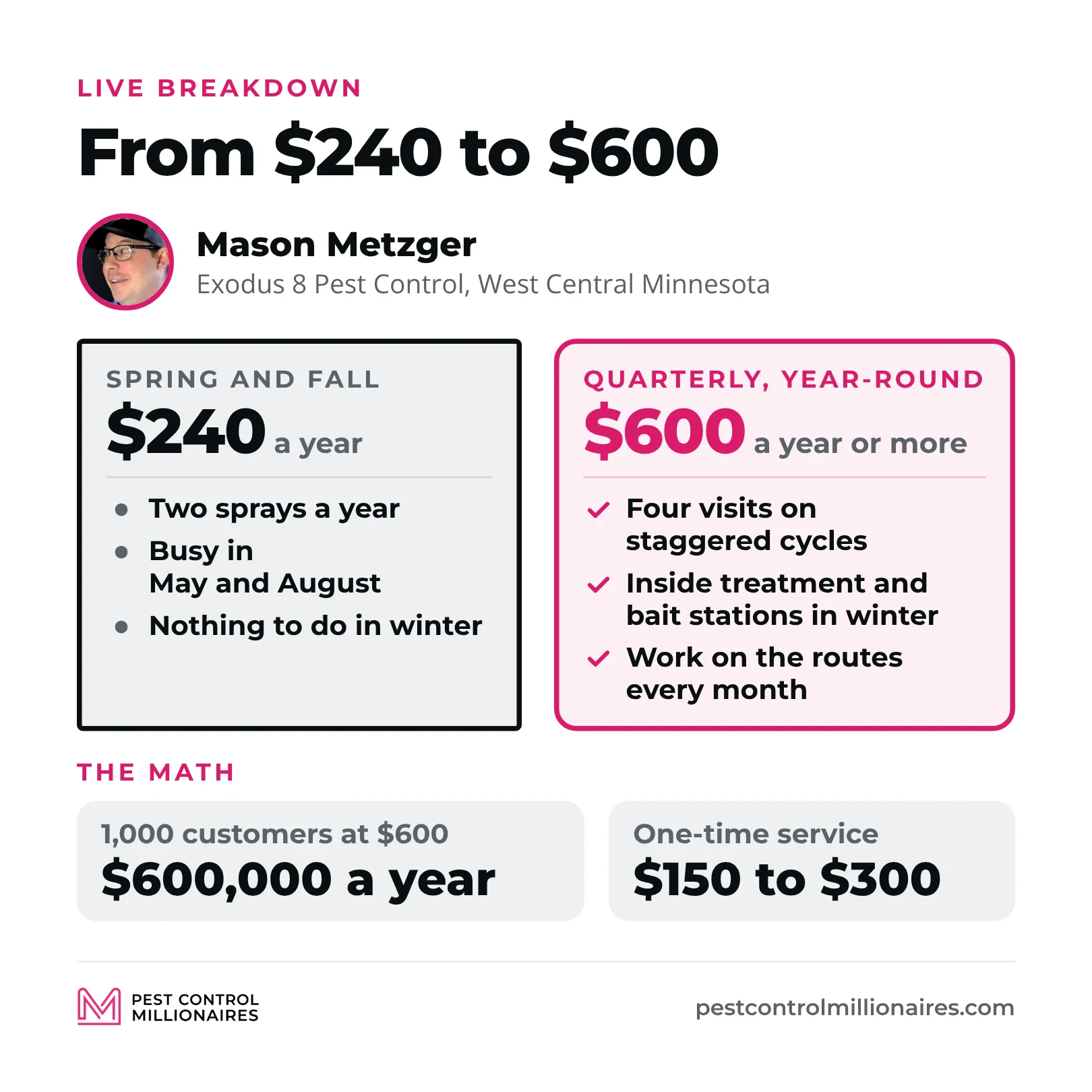
Here’s the real problem with twice-a-year service. Two sprays at $120 is $240 a year, and there aren’t enough people in Mason’s market to double the company at $240 a customer.
At a very minimum, I want an average contract value of $600 a year, and even that’s low to me. That’s $150 a quarter, like bait stations and pest control four times a year. A thousand customers at $600 is $600,000 in revenue, with two or three techs working year-round instead of wondering what to do in the winter. So every new customer goes from $240 to at least $600, $360 more a year, with the bird work and the one-offs for bed bugs, fleas and ticks on top. And recurring revenue is where the value of the company comes from when you sell.
Fill your own town before you expand
There are about 1,300 homes in Mason’s town, and he has a couple hundred, somewhere around 10% to 15%. I wouldn’t expand until you’ve fully penetrated the market you’re in. My hometown has about 13,000 people, and our branch there does over $1.5 million. I’ve heard of companies getting 40% market penetration. Hit your market as hard as you can until it starts slowing down, and you’ll know when it’s time to move. I go deeper on that in what I wish I knew before opening a second location.
Mason is boxed in for now anyway. He has a verbal agreement with the operator up north, whose license he worked under until he got his master’s, to stay out of that territory for another two or three years. The town to the south has 30,000 to 40,000 people. Keep it on the horizon, because eventually you have to branch out to keep growing. But if he’d rather stop at 1,000 or 1,500 customers with good cash flow, there’s nothing wrong with that. An $800,000 company putting out $300,000 to $400,000 of profit a year is a great lifestyle.
Mason had an idea of his own. Several companies from outside his area drive in, with gas at four and a half bucks. Should he call and ask what it would cost to buy their customers in his county? I like to own customers, not subcontract, but make the call. All they can say is no, and one might be looking to get out and sell you the whole thing.
Get it in writing, but skip the contract
Mason doesn’t do contracts, and he doesn’t need the kind with a cancellation fee to get out early. But every single customer should sign an agreement. It says you’re coming out four times a year, here are your terms of service and here’s how they pay, and it’s their OK for you to come onto the property. Look into what your state requires and fix it right away. A lawyer can set one up for a couple hundred dollars, and Mason can probably build it into Housecall Pro. He doesn’t have to get every existing customer to sign, though spring is a good time to ask.
It matters when you sell, too. A buyer isn’t going to read your agreements. They’re buying cash flow, and they want to see recurring revenue. Keep it above 80% if you can. 70% is fine, and higher is better. Nick Bartolo gave the same range when he walked through how to prepare to sell your pest control business.
Keep the window cleaning out of the pest control books
Mason also cleans windows. His techs would spray a house and miss the windows, and in his first year about half his customers asked. It’s a great add-on, and it’s technically a separate company, but it runs through the same Housecall Pro account and bundles get invoiced with the pest control.
Say in five or 10 years he wants to sell Exodus 8. The odds of selling a pest control company that does windows to another pest control company are slim to none. He’d have to find a buyer who wants both or pull the data apart, and then the company isn’t as big as he thought. I went through this with an owner in Wisconsin who couldn’t get anyone to buy his company for that reason. So keep pest control in its own CRM, or do what Mason suggested and move the windows into his home services company. I make the same point in the pest control service stack.
That home services company does inspections and handyman work on the dairy’s houses, and Mason wants to add more services and tie it all back to the pest control. I told him a story. A good buddy of mine had a company doing over $5 million, then opened a bunch of small businesses like plumbing, car detailing and car restoration. He didn’t make it a year. He kept taking money from the business that made him all his money and stopped focusing on it. We all like shiny objects, but you get really good by staying focused on one thing for a long time. Even 30% of your time somewhere else is 30% taken away from the one thing. Mason was working 50 to 80 hours a week on Exodus 8 and wanted more time at home.
Start with LSA and the people who know you
From the outside, Mason’s marketing looks good, with about 97 five-star Google reviews and a clean website. About half his leads come from online, mostly Google, plus yard signs, and half from people who know him or his techs. The one other pest control company right in his area had six reviews until about a month before we recorded, then 40 or 50. He has to stay ahead of them.
He wasn’t on Local Services Ads, and that’s where I’d spend his first marketing dollar. He doesn’t need a crazy budget, and it’s pay per lead. With two companies around and more reviews than the other one, he should get most of the people searching for pest control near me. Ask every customer for a review, the ones from LSA included, keep adding photos to his Google Business Profile, team photos too, and answer every call, because Google sends fewer leads to companies that don’t. His dad has time to help with the phones. I’d expect five to 10 leads a week, more in spring and summer and a spike going into rodent season. The setup is in our guide to Google Local Services Ads for pest control.
Then there’s his mom, who has a sales background like his dad. Mason’s wife bought a little beetle suit on Amazon that looks like a ladybug so his mom could take his son around knocking doors. Mason hadn’t let her yet because he was busy with the rush, and he admitted he didn’t have a good reason. If I had the time, I’d knock doors with her in the spring. In a small town, everyone knows who you are.
Fix those things and I think Mason can get to $500,000 to $700,000 in his hometown within a year or two, without opening a second market. Our goal is $700,000 in the next couple of years.
Frequently Asked Questions
Who is Mason Metzger?
Mason Metzger owns Exodus 8 Pest Control in West Central Minnesota, which turned two in August 2026. When he came on for a live breakdown, the company brought in about $35,000 to $45,000 a month in pest control, and his goal was $700,000 to $800,000 a year without leaving his town.
How do you keep a pest control company busy in the winter in a cold market?
Sell quarterly service instead of spring and fall sprays. The winter visit is an interior treatment plus checking the rodent bait stations, and staggering each customer’s quarterly cycle puts work on the routes every month. Customers who skip the winter visit still get three or four applications a year.
How much should a one-time pest control service cost?
At least double a quarterly visit. If a quarterly visit is $150, I wouldn’t do a one-time for less than $300, and I wouldn’t guarantee it, because a callback on a $120 one-time loses money on that account. A high one-time price also pushes people toward a recurring plan.
What should a pest control customer be worth per year?
At a very minimum, I want an average contract value of $600 a year, and even that’s low to me. That’s $150 a quarter. A thousand customers at $600 is $600,000 in revenue, with two or three techs working year-round.
Full transcript
Every word of the episode, from the video captions
Right now you're doing like 40,000 a month. So roughly between 3400,000. Got a couple texts in the road, but the ultimate goal is to get to like 78 800,000. That's what you told me, right? You basically have to double this thing, but I actually think you might be able to pull it off in your one market. You want to push them to reoccurring. You don't want to push them onto a one-time service. If you own a pest control business, want to grow, this show is for you. We break down how to get more customers, build your team, and scale your company. I've grown my own pest control company to million dollars a month and helped over 400 pest control companies grow over to 100K a month. All right, so welcome back to another episode of Pest Control Millionaire. Today we're doing another business breakdown. Got a good friend of mine here on the podcast. We chatted last week, Mason. Real quick, Mason, why don't you just kind of introduce yourself and then we'll kind of just roll right into it.
Yeah. So, my name is Mason. I'm from West Central Minnesota, kind of middle of middle of nowhere out here. I own and operate Exodus 8 Pest Control. August was 2 years, so pretty pretty fresh to the game. And yeah, I just I like to tell I probably see I got a some taxiderermy in the background. I also run a small gun shop. So, I just people ask what I do. I just say I like to kill stuff. So, yeah. Kind of.
It's awesome. So give me kind of a rundown of you how you got into the industry real quick and then just kind of like your background. I said you've been here two years, but how did you get into the...
Yeah, so I'll give you the short version. Speaking of the gun shop, it was me and Buddy. We were just kind of hanging out. He helped me clean some guns at the time. We were just looking at different ways to expand revenue in the shop and there's a pretty large dairy by us and I was like, "Oh man, we should like go over there and take care of their bird control or rodent control or something." So, I pulled out my phone. I started running the numbers on. I was like, "Oh, wow. There's something to this." And the next day in church, I was like sitting there, shouldn't have probably been listening, but I was daydreaming, you know, can't help myself. I still think about this pest control thing. And I was like, "Well, if I do this best control, I want to give God the glory in some way, whether verse on the back of the card or name the company something, I don't know." And I was like where was Moses fighting with Pharaoh in the Bible and I go to reach for my Bible and I was like I just sat back. I was like I can't find anything without Google, you know, terrible with that.
I was like I might as well try. So I grabbed my Bible and I just opened it and I looked down and God killed all the fleas and God killed all the flies. I was I was just shaking at that point like just goosebumps. I was like freaking out.
Yeah. And was chapter book Exodus chapter 8. And I just knew that like if that if I ever started a pest control company that would that would be the name. I wouldn't have to worry about the name. So yeah, I started looking into it. Turns out in Minnesota you got to have a license so you can't just go do pest control. So one thing led to another. I started working for a local guy. That ended up not working out very well. And then I got licensed through a different company and started my own pest control. And then here in April, I took my master pest control and then test and got licensed that's awesome. And then you started it two years ago as of August.
In the house.
And give me a rundown of where revenue is sitting right now about monthto depends upon the month. So we also I guess I didn't mention we do window cleaning as well. So we come in spray the houses and usually miss the windows and it seemed like the first year is like half of the customers are like you going to come clean my windows and it's like no. And now it's like yep we sure do that. So, if you take out the window revenue, we're probably hitting that 35 to 45 a month, right? Right in there. I would say August and May are really good months. So, we'll hit above that in those months, but the rest of the months when we aren't full on spraying as heavy or doing insect treatments, then it's a lot less.
Yeah. And what And what [clears throat] CRM are you using?
We use Housecall Pro. [snorts] I don't know that very well, but I know enough. To be dangerous, but I know it's really I think it's owned by I know who it's owned by too. It don't matter. [sighs] but so like kind of walk me through your packaging of you know your bundle service for like a past rodent window al...
Yep. So, we offer one time, which I don't do too many of them, and then, I was actually watching one-year deals. So, I readjusted all my pricing last winter to inflate that one time price. Like, if someone does want truly just a one time, it's going to cost them a lot more. And then try to push them into either a spring, fall, or a quarterly package. So we probably do 3 400 accounts where it's spring fall. So we'll treat as soon as it warms up and then about 90 days later we'll treat again. And then we also do monthly rodents on a lot of farms, bimonthly rodents on farms, and then a lot of quarterly rodent control on homes, residential homes.
And then we kind of bundle that in. So you get different levels of discount depending upon frequency and also on what of the three services you pick,...
Right? And you're running all the services for pest control and window cleaning through Housecall Pro. The window cleaning technically is separate. It gets but it gets invoiced through house pro.
Gotcha. So, you have two separate companies. Gotcha.
Two separate companies together. Two separate companies,...
But they're all in Housecall Pro that you run the CR the same CRM.
Gotcha. So I would definitely recommend pulling that out of there if it's a separate service line.
It makes sense.
The window thing it because you b if you bundle it gets invoiced with the pest control. So, it's not invoiced separately. Yeah. So, here's here's my thinking behind the window cleaning thing. It's a great add-on service. I totally understand where you're coming from with it. However, let's just say in five years you decide you want to go sell Exodus 8 Pest Control. The odds of you trying to sell that pest control company to another pest control company and you do windows is probably pretty slim to...
So, I would just make that separate. Put it in a separate CRM or just maybe start a different CRM for your pest control company and just keep those separated completely because again if you go to sell this thing in 10 years Exodus 8 Pest Control and you have window cleaning then you got to try to find someone or you got to extract the data and then it's just not as big as you thought it was then trying to find someone to buy a pest control that does window cleaning is just kind of tough. So I actually went through this with another person from Wisconsin kind of ran into the same issue. He went to go sell his company and he couldn't get anyone to buy it because of that reason. So like my goal here is to fix the ground the foundation of Exodus 8 Pest Control. So going forward just I would just keep that in mind. That's what I would do and that's what I'd recommend to you. Fair enough.
Okay. I'm going want to talk you through these one-time services. I want to talk to you through the spring and fall and quarterly services next if that's okay. So let's just say someone calls Exodus 8 for a onetime pest control. What is the pricing for a onetime pest control?
So we go off linear feet of the house. So, it depends. We anywhere from 120 all the way up to I mean it can go up to whatever it needs to, but 120 or no for one time 150 would be our base for a one...
Okay, fair enough.
Okay, so 150 is roughly base for a one time. And let's just say your quarterly visit for a the same size res residential home. I'm not holding you to the fire on this. Just give me a rough idea. What would you charge for like a quarterly visit?
So [snorts] if we do quarterly general pest, we're at probably...
For general pest. If we bundled the insects and rodents, it's yeah, it's between that 120 and 140, I would say.
So I'm break this down a little bit further. So, the quarterly pest control that includes rodent or doesn't?
No, not necessarily. The quarterly probably would be a rodent control...
Gotcha. I'm following you. Hold up. Quick pause. If you're on a pest control company or fertilization we control company, you're not in our Facebook group. You're choosing the harder path. Every operator that's in there is skipping years of mistakes because people are actually sharing what's working right now. So, stop trying to brute force your way through growth alone. Search Pest Control Millionaires on Facebook or click the link below. And now let's get back to it. Cuz yeah, I'll get there in a second. Okay, so let's just say someone calls in and you do just pest control, right? And it's a quarterly treatment. How much are you charging? What is your average contract value worth of as a customer quarterly, would you say?
I would say my average falls about 140.
Okay, cool. But that's because I have some farms averaged into that. Quite a few farms. I would say 50 50% of our customers are farmers, I would say.
Yeah. No, I understood. I know we talked about that on the on our first call. So, here's how I'd break this down for you. So, let's just say someone calls in for a quarterly pest control, right? And wanted a one time. So, let's just say the quarterly, let's just say it's 150. If it was me and I was doing a onetime service, I wouldn't do it for less than because you want you want to push them to reoccurring. You don't want to push them onto a onetime service. Like right now, you're pushing them almost for a one time service. So, when people call in, I haven't got that far yet, but I'm assuming do most people push for the one...
No. I usually talk them into getting some kind of reoccurring. I would say probably over 90% that do sign up. At Sprite closer 95% that do sign up, we do talk into some kind of...
Cool. So, if they if the other 5% though that only want one time, let's say you close to 95% which is awesome. Good for you. That's killer. But the other...
I would definitely raise those prices. Like I would just double them tomorrow like $300 for a one time visit if people want it. Again. That way it pushes obviously you're going to send a tech there,...
But if you're making $300 instead of 150, like you'll be much happier. 120, whatever you send,...
You'll be much happier, right? And your technicians will be much happier too cuz they're getting paid. And also I'm going to break that down a little bit further too with the reoccurring because you said that some of these people go for like a by-early service like a spring and a fall. Where did you come up with that? Just as something like your other pest control company that you work for did.
Yeah, that in our area I guess that's kind of what everybody does. I was just talking with a guy up bigger town about an hour away last week. U just chatted with him for a while and he's he's doing the same thing and like unrelated to the guy that I was with and...
But the guy that I worked for. Yeah, that's it's pretty common in this area.
It's very common for old like a bunch of old school dudes for sure. That's just very very common and they just they've never changed their way of doing pest control. And so where I'm going with this is like one of the questions that you asked me is like what do like how do how do you guys stay busy in the winter, right? And so then you told me that your your August and May and then I think you said one other month in the fall was pretty busy, right? But then the other months you slowed on quite a bit.
So when you sell a quarterly pest control, it is four times a year, right? So if they start in May, you're going to service them in May, August, October, like December roughly.
January, right?
So then you sell them in June, it's the next month.
After each of those services. So the way to sell this, Mason, is like when they're on quarterly visit, you're going to treat year round. Again, you don't want to push them to two services a year. Yes, I totally understand. This is what they all the guys used to do and it's super common in most areas.
Mhm. Like especially you come from a small town. Trust me, you have just as many. You probably have more people than I do. I think we're at 12,000. You're like at 9,000, right?
Our town has like 3,500. Our whole county is 9,000. [snorts]
The best pest control companies do not leave growth to chance. They build systems. They have a system for generating leads, system for answering the phone, system for servicing the customer, and systems for collecting payments. But most companies still treat referrals like luck. They do a great job. Hope the customer remembers or tell a friend and maybe send an occasional text asking for a referral. That is not a system. Clicki referrals turns your happiest customers into active trackable sales channel for your business. Clicki automatically invites customers into your referral program, gives each person their own referral link, tracks the leads and sales they generate, and makes it easy to reward them when those referrals turn into business. And now Clicki has launched Rewards Pass. Rewards Pass was a brand referral pass for your company directly inside your customer's Apple Wallet or Google Wallet. Think about that. Your brand can live on your customers phone alongside their cards, tickets, and brands they already use every day. Their personal referral link is always one swipe away. You send push notifications and add special offers, promote events, and stay connected long after the initial service is complete. This is not another app your customers have to download or another login they have to remember. It's your company, your referral program in your rewards living directly inside their wallet.
If you want more referrals, stronger customer retention, and a customer experience your competitors probably do not have yet, go to joinclicki.com/pcm. Book a live demo of rewards pass to get $350 of payout credits. Tell them you heard about on Pest Control Millionaire. That is joinclicki.com/pcm. Stop having your customers send referrals. Build a system that makes it happen. Yeah. [snorts] So my town's pretty small too. All that just to say that is very very common. A bunch of the old school pest control guys. That's all they ever did and they've never changed their way. So I actually purchased a company in Appleton that did the same exact thing. We converted over 60% to reoccurring. Right.
So, yes, like the products just don't last that long, right? They're going to at best they're going to last 90 days,...
Then like for rodents in the in the fall time, rodents in the winter, who's covering their service then and then the busy season and you know, let's just say you spray them in May, right? At best, it's going to last till July. You're not going to want to go back there till fall...
So, I put So, I would start selling these. I would I would 100% recommend getting away from buy monthly service or buy annual services right now.
So are you so when they do I ask this what are you doing for service then in the in the winter months? Are you still spraying?
No, we don't spray. So like we'll go inside, we treat the in we'll treat the interior. We'll do the basement, the garage, wipe everything down. Then of course you still have your road and bait boxes outside that someone has to address address, right?
So bundle those two services together and then service them year round because we're in a cold market.
Yep. And you're still...
That's what we do. Yeah, I would say...
It's probably Oh, how how would the split be...
Of the spring fall insects that we spray? Probably 60% of them are set up on quarterly rodent control. So, we're we're treating in the warm months for insects and then we are there two other times in the winter for for rodent control,...
But we don't do the inside insect.
Yes. Like you're saying...
And you don't and you don't have to do the inside, but if you're going there in the in the winter time to do quarterly, but break that down as far as billing goes, like how do you build those two services together or separate?
Yeah. So, we take we would add all six services together. So, let's say it's a,000 bucks. And then we divide that by four and we bill them four times throughout the year, so, you're basically doing a quarterly visit, but you're going there six times.
The same price.
We would well when we're there doing the rodents in the spring and fall, we'll spray while we're there. So we're we're...
Okay. So it technically you're still doing a quarterly visit.
But I would put everyone on that service, not not just do some that are because you still have 40%. So you close about 60%, they all have reoccurring, but the other 40% are all on sprays, I'm assuming, right? Buy or buy sprays.
Y. So I would just say going forward, I just wouldn't offer that anymore.
I would put it all on quarterly. Again, the customers don't know any different. They have no idea. Like you're the professional. You're you're the one with all the knowledge and you explain to them and you tell them exactly how this thing works. It's just customer education.
Again, that way when you're selling things in June, you'd be serious in October. Right.
And then again, September.
Yeah. So, off top of my head, off top of the dome, September. October. November. December and then March, right? So, as you start building this reoccurring up, it starts to fill up those routes every single month.
That way when it comes to winter time, you're not having a big drop in demand for service.
You're going to have some people who will push back, but if they have road and bait stations, who's going to check those? Like that's what you have to go...
Right? So, as much push back like in Minnesota, especially we're getting two feet of...
So, I have a you know that I have an office in Minnesota, too.
Yeah. So you understand that. So it's like when they when the customer goes, "Ah, there's no bugs in the...
There isn't. There isn't. There's not bugs. Like there Well, I should rephrase it because there is. Like, do you know how many calls that we get in the middle of winter for ants?
I don't. Yeah.
Hundreds. Yeah. But I mean, it's not just it's in the cold markets, too, or it's bed bugs or it's flea or it's fleas ticks, but fleas or whatever. There's there they have to go somewhere. If insects died every single year, we would never have insects again in the spring. They're looking for somewhere warm that has, you know, food and shelter basically. And that's right inside their house.
And as long as you treat the interior, you know, once a year, the products can last up to 12 months because they're not getting hit by the sun. So, you can just do that one service in the winter, you know, spot treat the inside, wipe everything down, make it look really good. That way, it's ready for spring. And then as you know in Minnesota, Michigan's the same way. We have a branch out there. There's that one day in like late February where it like all of a sudden turn 80 degrees and things are just start popping.
And if you're already behind the eightball, if you haven't gotten treated by then, like you're already you're already behind and bugs are starting to get in. Carpenter ants, too. You know what I mean?
So, just sell the quarterly visit and you'll you're not going to want to like cancel as a customer, right? Because they didn't want that service. They want to push off, so be it. Right? You can like say, "Okay, you can skip this visit. We'll be there in the spring." But you're still going to get three to four applications throughout the year. I'm just saying like right now, you're going there six times when you could just go there four times and build the same thousand.
So, you're technically doing like a bimonthly service almost in the summer.
Yeah. Well, we do the we do four of the six services on two...
Right. Right. So, it's those technically are a quarterly visit, which is fine, but the other 40% I would just I wouldn't offer that by yearly service at...
Because if they don't if you don't offer it's kind of like a menu, right? If it's not on the menu at McDonald's, you can't really order it,...
Just giving you an example. So if they it's not on your menu like if it's not on your menu menu and you only sell quarterly visits are one times...
Right that's what I would do and so like right now you're selling one times for...
120 so at best right say right now at 120 but if you said hey like or they maybe they maybe they convert to a by yearly so right now they're 240 right...
You could do that one one time pest control and double your rates so that 300 and you're still making more money doing that Right. Right.
And again, that pushes them more towards you reoccurring. Yeah. You can either pay $1,000 for the year or $3.99 for a one time. Would you rather? You know what I mean?
So, this will help with margins obviously for yourself and your technicians and then you'll start building that reoccurring so you have work all winter long.
Yeah. So, then do you do that with the existing spring falls? Do you call them all up and go? I would call. Yeah, I would call. So, you could either call them all up or in the springtime or in the slow season, just go to their house and talk to them.
You can call them and I'm sure at this point you probably know most of them personally, I'm guessing.
Yep. Quite a few. Yep.
Right. That's what I figured. And I would just you might not convert all of them just but if they don't know that you even offer that and I don't know if you guys run into call backs during the summer or not.
If you Yep.
Do you charge for the call back or do you just go do it? Just go do it...
Right. So now, right, you're pushing them into that summer service that June or July or whatever it is. Right now you're now they're getting charged for that visit, not just doing a bunch of because you did it one time. Like I wouldn't even guarantee the one time at all.
Like sometimes I heard people doing like 30 days, but even at best like I just wouldn't I wouldn't guarantee it one time ever. Yeah.
Because now you're going back for a one time that you paid they paid $120 for. You send another technician. You lost money in that account.
Yeah. No, definitely there.
There's just not enough skin in the game. So double that's why you like if you do a one time and you and you also do a guarantee over for 30 days, I'm assuming. I'm just guessing. If you doubled it, at least if you had to do a call back, you're covering that call back. You know what I mean?
Right now it doesn't sound like you have call backs built in at all. They're just you're getting a onetime service and if you call you have a wasp master we just come back there and take it down and you send another technician and you literally lost money in that account.
Yep. Yep. So explain to me right now who's actually in the field.
So I got a full-time guy that's in the field doing the insects and the rodents. I'm in the field in the busy season and then I got a part-time guy that is strictly does rodents rodent work on and he's part-time on farms.
Okay, cool. And then you already kind of walk. My next question that I was going to ask was that I had...
I guess I got I got a guy helping me part-time answer the phones and that would be my father.
That's your father, right? Yeah. So, talk me through that. Is he a partner in the business or how does that work or is he just work there?
Oh, yep. Just works there. Helps me out. Tell me about your...
Tell me about your other businesses real quick and how much time Exodus gets versus the other six companies.
So, I got the gun shop that straight shooters called that. If you're in the area, stop by. No, I'm just kidding. [laughter] that takes probably Oh, it used to take a lot more. I got a guy to help me with that with a lot of like the gun cleaning and service. So that used to be 15 20 hours a week. That's probably down to five hours a week, I would say. Not a lot. It's more or less just answering calls and texts and then when people come in to pick up their gun, just working with them on that. So that that fluctuates. And then we got Genesis One Home Services, which I'm trying to I'll definitely push that window thing into that.
That's a good idea.
And then...
That way you can build and reoccur into that company,...
Right? Yep. Exactly. Yep. And then that does for that big dairy I mentioned right away, that does inspections and handyman work on their off-site homes in the county that I'm in. And then the goal would be they got a couple different counties they operate in to grow into that and expand that into residential homes and then tie that back with the pest control. So then you could offer like a whole service. And then the goal with that one would be do other home services, right? Car brake cleaning, window cleaning, handyman work, plumber, electrical, like whatever. That would all just get tied into that so you can tie as many things in as possible. I know that's like a lot. That's really big picture.
I got a I got a good story on that.
What's that?
I have a really good story on that yeah. So I think I probably with [snorts] Genesis I probably spend 5 to 10 hours a week on that one right now. In the winter that's going to go up. But...
Oh boy.
Because it drops off in the pest control...
Right? Yep. I'll just focus more on that in the winter.
Okay. And then what about the other businesses? Is or is that pretty much...
That? That's the ones I'm active in.
So that leaves you with about roughly 25 hours a week on Exodus.
I mean, if you're working a 40-hour week, which I'm sure you probably got that in by Wednesday.
Yeah, I figured. So, how much time do you actually spend on Exodus per week, would you say? Like does like the majority of your time?
Yeah, vast majority of my time is on is on Exodus on the pest control.
How many hours a week would you just roughly give me?
On the low end probably 50 I would say. On the high end I'm 80 somewhere in there.
Too much probably. I just had...
That's just curious. So, it just trying to spend some more time at home. I think if I can do that would be a good...
Yeah, I get it. So, I know you're in a town of like you said like or county of 9,000 people. When you were on the phone, we chatted about you know, at some point we're going to have to expand, right? And the whole the whole the whole reason one of the reasons for this call is like before we expand we got to fix the foundation of the company, right? Mhm.
And so I know we can go south, which is like a town of roughly 30 40,000. Then we can go north, which is a town of roughly 34,000. But why right now what's stopping you from expanding north of Highway 94?
So the guy that I used his license so I till I could get my masker, he's up north and I just have a verbal agreement with him.
That's cool. So he So he helped you. You obviously you work for him. You got your license through working for him and then you guys have a verbal agreement that you can't just go into his territory for x amount of time.
And does he have a pest control company up there currently?
Okay, cool. And they just do...
They do like 5% of their business is rodents and 95% of their company is spraying between May and the end of September and that's all he does. Like that's it.
Yeah. That is I'm assuming that he's older guy.
Yep. He's 70.
Yeah. Does he still use truck mount It's so classic. It just it this is just what they all did. Like the company that we bought, they actually like wore these big old like white like sombrero hats and these overall big coverall jackets. I'm like this is dangerous. Like I don't even want to it's wild...
Yep. [snorts]
Because they just have product going spraying the entire house from top to bottom. Like this is not good.
Yeah. So that's okay. So that's a good question. So I have because that's how I was trained. I have a power sprayer in the back of my rig. My part-time guy, I switched him over to the flow zones like you talk about a lot.
And then I started running that too.
And if I get call backs, it's from jobs with that I was using those backpack...
I like if I use my power sprayer, I don't get a call back. So, I would probably push back a little bit because it I think it depends on the person who's applying it and where it was applied because the power spray although it puts out more volume, it's not like that much more is going to stick to the house,...
So, the flow zones are...
The flow zones are calibrated to put out the same basically amount of output for the most part. Like, and if you read the label, you can't spray. Like, you're supposed to stop spraying until runoff. So, if you're spraying with a power sprayer, in my opinion, there's usually a ton of runoff.
And so, like, if you follow the label super closely, you can't go like depending on which product we're using, but typically it's like one foot or three feet up.
And then people will spray the entire house. And that's just not that's not on the label. Like, you cannot do that.
We do three feet out. Feet up.
Three, three feet up and then we [snorts] go around doors and eve lines and gutters.
Beautiful. So again, so I think it's just like the person who used the backpack sprayer probably just hit that spot or call backs do happen too, right? They just it's just common. So it's not like you're never going to have a call...
So you can't go we can't go north because we got the guy. How many years is that agreement is like forever?
Another two or three years I think.
Okay, that's fair enough. But then we can go south, right? Which is a town roughly 30 40,000 people.
Cool. How how many more customers do you think you can get in? And I don't know if you've done the math here. Do you think you can get in your current market? Are you pretty tapped out already or do you think there's more?
No, there's more. Yep, there's more. I would say...
Oh, that's a good question. I was just looking at it the other day. I was counting homes. [laughter] There's like there's like 1,300 homes in the town that I live by. And I would say we're at probably couple hundred.
Less than 10%. I mean, we're let let's just say we're at 10 15%. So, there's growth there for...
Go ahead. But that's just in your hometowns. There's obviously more houses within that hour radius, whatever. And then so that room...
And I would say don't even I wouldn't even expand until you fully penetrate the entire market.
Like when I tell you that this my hometown has 13,000 people in my this little branch does over 1.5 mil just shows you what can be done in a small town if you do it the right way.
So I did a entire YouTube video on expansion. Like I just say hit that as hard as you can until it starts slowing down and you'll know when you have to move. You get to I mean I've seen companies that I've heard of companies getting like 40% market penetration...
And so yeah so it is it's it you can do really really well in a small town.
So I wouldn't worry about expanding but I would just keep that you know that second town like on the horizons. Eventually you're going to have to branch out if you want to keep growing.
And if you don't want to grow a company, if you have like a thousand or 1500 customers there and you want to stop there and you're making good cash flow, there's nothing wrong with that. Don't even worry about going to their market. That's just ultimately like your like your decision at the end of the day. Like you don't have to build some massive company. You can have a $800,000 company, you know, pumping out 300 $400,000 profit every sing year year. You can have a great lifestyle.
So, here's a question for you. I don't know if put this in recording or what, but...
There's several companies that travel into our area would it be worth a call to th those owners and be like, "Hey,...
That aren't from our area. Gas is four and a half bucks. What would it cost to buy your clients in Stevens County?
Would it be worth like for that?" I would say I thought you going to take the route of like, "Hey, I'll go sub these out and I don't like be a subcontractor. I like to own the customers. But yeah, if you want to call them and ask them, all they can do is tell you no, yeah, I'm pretty sure they are going to tell you no. But you never know. You never know. You might you might stumble upon Well, I don't want to sell just a few, but I'll say the whole thing.
Right? That that was my thought.
That guy that's up north, and I know he's he said he's 70, right?
Have you guys started talking about what his exit plan will be up there?
He's got his son is helping him. He his son's probably in his 40s. I would assume that's their plan.
Okay, cool. Just curious. But like yeah, if you if you reach out to these customer or companies already and ask them to sell their customers in that area, they might. Odds are they're probably not, but they might. They might. You never know. So I would definitely make the phone call. It's not going to hurt anything. I do tell you no. And again, you might just run into a deal like ah we're actually looking to get out...
XYZ. If anything, you're building a good relationship going forward. You know what I mean?
Yeah, for sure. No, that's a good idea.
Yeah, I like that. Tell me a little bit more about your parents.
I know.
What is their background like?
Dad's over here laughing right now.
I see him. I see him. I see him back...
So, they both have sales backgrounds. My mom sold, eyewear, throughout her career. She's worked at school. She's a people person through and through as well as my father is. He did sales the vast majority of his career. His sales are a little different. More long form sales, not quick sales. Mom's more used to quick sale. But yeah, both sales backgrounds and they're both dad dad likes to say he's retired from corporate. So he's not retired. Either of them like saying that, but retired from corporate. So he helps me out by keep him probably busier than than he wants to be. So...
Love it. And then what about your mom? Didn't she say that she was willing to go out and knock some doors for you?
Yeah. Yeah. So she works for a local company just part-time doing some cooking stuff. She enjoys that just to keep her busy more or less. And I actually my wife had the idea went on Amazon and bought this little beetle suit. Looks like a ladybug. And I was gonna put my son in there and have my mom card him around and knock doors.
That's funny. So, what stops you from letting him try?
Dad, is it dad?
I don't know. [laughter] Great question. Timing. I don't know. I just in my mind it's like I'm so busy right now just trying to get through this rush. I don't know that I want like a pile more customers, especially if it's going to shut off. I don't know. I don't have a good reason to be honest.
Yeah, but maybe you could play in it for springtime when you're ready for the...
Yeah. No, I think some of it's education, too. Like she has no idea what we She's like, "Oh, you kill bugs." Like, "Yep, that's...
Of course. Yeah. Yeah, for sure. But if she just went talk to enough people, I'm sure she'd sell a few."
Nope. She's got the knack. She could. I can almost guarantee you she...
Yeah. It's But again, it's just it's just going out there. It's like as little kids, right? We just we go make friends and that's what it's about. Just going out there you guys and you guys probably know majority of the town that you live in I would assume.
Yeah, we do.
So you have a lot of connections.
Yeah, we do.
So that's cool. I think I think I like if my mom asked me to go do it, I'd be like let's run it. [laughter] that's like okay fine. Go do it.
I just let her go try. Yeah. So to me it kind of sounds like right now it's really not your territory yet and you probably grow a decently sized company in there because like right now you're doing like 40,000 a month so roughly between three 400,000 got a couple techs in the road but the ultimate goal is to get to like 7 800,000 is what you told me right...
So we basically have to double this thing but I actually think you might be able to pull it off in your one market you know what I mean but you have to but you have to utilize what you have currently...
As long as you right so like you can't keep putting customers on on a buy service for 240 bucks. It's going to take you for you don't have enough people in your market to get there.
Yeah. You just you just have to get your customer cost higher or your customer revenue higher.
Your ACV your contract revenue. Yeah. So you're you're going to try to get like at a minimum at a very very minimum I want my ACV at a minimum to be 600.
How much that that 600 a year and that to me that's even low.
Okay. So that's basically 150 a quarter, so if you have let's just I'll use that as an example again. I feel like it's too low for me. The average quarterly pest control across the United States, there was a study done like a year ago between like 250 customers was $5 and...
Yeah. Yep. [snorts]
Per year.
That per year,...
Per quarterly visit. But to me, that's way too low. So I'm using 600 as just like a benchmark.
Of your one of 150. Yep.
It could be, you know, bait stations and pest control. You go four times a year. That's 600 bucks.
So, at a minimum is 600. So, if you have a,000 clients, right, which at 1 th000 clients, you're going to be running like you'll have you'll start running out of people probably. Maybe maybe not. It's just me guessing because I've actually seen the math so I shouldn't misspoke. But have a,000 customers that 600 bucks to the 600,000 in revenue right there. You know what I mean, And that way you have you have those two three technicians that are working year...
Right now you're one of your biggest drawbacks is like when we get to winter what do I do for work? Yes. You have the farms which keeps you know your rodent guys busy.
You do some bird work in the summer I'm assuming shooting some birds. So there's some extra there's some extra revenue, right? And you're going to have those one times. You're gonna have like butt bugs and fleas and take some all that jazz for for oneoffs. But you want to start building that reoccurring. That's where the that's where the evaluation your company is going to come into play, right?
Yep. So, no, that's a great followup to that. So, I don't do contracts.
If you Go ahead. Pretty much everything...
Yeah. You don't you don't have to like do a contract per se.
Right. Like I don't So, you should have something in writing that basically an agreement that just says, "Hey, we're coming out here to do this service." You're going to want that in your terms of service anyway. So, if you don't have that, I would it doesn't even have to be like I think I think the first one the first time you ever service a home in Minnesota, it has to be signed.
You could probably set that up in Housecall Pro. And it when you say a contract, it could just be an agreement, right? And a like if you say contract though, it means like typically that if you want to get out early, you're going to have to pay like a cancellation fee. You don't have to do that.
Hey, this is just the agreement. I'm going to come out there four times a year. This is our terms of service. This is how you pay, etc., etc., right?
You want to have that all built out.
So that way,...
You would highly recommend getting getting signed something.
Absolutely. 100%. Every single customer. So if you don't have that, you can build it out at Housecall Pro. I'm almost positive. Same thing with the cleaning company. They you have to do this for their first service typically, especially if you're using products on their on their house and around their house, things like that. So, I would definitely look into that and I would fix that immediately.
And you don't have to go back and have everyone sign it. Although, it's probably a good idea if you're coming in springtime like, hey, you know, blah blah blah blah blah, you know, to say, hey, this is what we're doing this year. Let's get something new. Blah, it'll be fine. You know what I mean? Customers are super cool. Like, how many times...
Yeah. If you were to wait Yep.
Yeah. How many times does do you get like a like a new thing from let's just go with like one of your like your Facebook account like their terms of service is renewed every single year and you just go through click a few buttons and it's over and done with. You know what I mean? You don't read through it. It's the same thing, so the point the point of the contract is more or less for if I want to resell. So the there's like if someone comes in they go okay this is contracted at this value...
Or what is the point of the...
It's just it's basically there's a couple reasons to do an agreement. It's like hey it's just kind of like almost like you said like a verbal agreement like you allow us to come on your property to do these services...
Yep. And so I'm 99.9% sure in Minnesota you have to have this on file to go service their home by the state.
And then you have to have like which products you use on there, how much of the product you use on there.
Yep. We do all that.
Okay. Your technician, all so all that stuff's good. So again, on your invoices, that has to be on there. But there should be an agreement in place. And you might want to talk to I can set you up one of my buddies. He's the lawyer. He can help you. It's relatively inexpensive. I couple hundred dollars to get this set up. You know what I It's not a big deal,...
But just get it in place so you have it going forward. So that way...
It's not the time to anything. It's just like, hey, they're they're allowing us to come out there and do this service. Y...
And [snorts] yeah, if you go to sell like they're they're not going to say like they're not going to look through the contract say, oh, you don't have contract signed. It's not like that. Like they're buying cash flow, right?
They want to see that there's reoccurring revenue in there. And I would say I would keep your reoccurring revenue above 80% or more. 70% is fine. 80% the higher basically the better the reoccurring revenue because that's what the pest control companies are looking for to purchase. You know what I mean?
Okay. Y...
So with everything that we kind of just talked through today, I'm just going to go through a breakdown of what I would fix that that's probably one of the first things is just make sure you have an agreement in place coming for next year.
Stagger your quarterly billing cycle. So like when you sell them in, you know, you know what I mean? May, June, July, August, and then you sell them in June, they'll have September. So you're when you sell it, they're getting not put get on new they're getting put on a new quarterly cycle. Does that make sense?
So that way you're selling services that are year round.
I would drop the by like the by-early thing. And I know this is you're probably questioning me on this one, but just trust me. [laughter] I've been through it before. I've seen it so many times. And this is just it's really old school pest pest control, right?
And so it's going to be a big change for you. It's be a big shift in your mindset, but trust me on this one. You're going to go from $240 to a minimum of 600 with all your new customers. You don't have to go back and, you know, force everyone on quarterly. You don't have to do that, but you can just grandfather those customers in. But going forward, I would just sell one time or quarterly or by monthly. Yep.
But you can obviously offer it to them,...
Like you're doing now. I know you said you wanted to, you know, reassign the 55-year-old tech to just do residential, right?
Just do farms.
Just do farms. Okay, cool.
It'd be nice to get some some young young blood in there because that's all he wants to do is the rodent work.
To run the backpack and just yep. Yep. He would prefer that.
Yeah. So, do you have enough rodent work to keep him busy year round? Not yet. He's probably yeah. And then you want the new guy, you know, doing the backpack spare, doing the residential homes.
So then you then you want the new guy. Cool. I like that. That would be one thing you can talk to your mom about is just maybe trying the door to door. Like I This is just I think it'd be fun experiment for you guys. Like I think it'd be fun. I'm not telling you to go do that, but I like if I if I was you and I had the time, I'd probably go up there with her and just go talk to people. You know what I mean?
Yeah. Where are most of your leads coming from currently? I know I looked at your your Google My Business and you have like 97 five star reviews. It's really good. Your website, it's clean. Must be new. Looks pretty good. But where do most your leads come from Is that where your leads come from?
What's that from? The website.
Well, this summer I would say 50% of our leads at least came from online in some way. Either yard signs or online which I would assume I would say the vast majority of them are from from Google just seeing it. The other 50% are from either me or technicians knowing somebody talking to somebody...
For sure. Cool. And then with Google My Business like I didn't look at other competitors. How many competitor like how many how many other pest control companies are in your area?
Specifically in this area just one other one. How many reviews does he okay, we were in a good spot...
He had six up until a month ago and now he must be focusing on them because I think he's up to 40 or 50 now.
Okay. So, we just got to stay ahead of him, right?
Are you spending any money on marketing currently on on your LSA or Facebook or anything like that yet?
Yeah, I Well, I got a person that I pay [snorts] a couple hundred bucks a month that just kind of manages all that. Posts a couple times a week. And...
Are you spending any money on LSA at all...
It's probably the first place honestly where I'd start. You don't have to have a crazy budget. You can spend $500 to $700 a week. But it's pay per lead.
And because there's only so many pest control companies in your area, if someone's in and someone's searching pest control near me on your in your town and you have more reviews, you're probably going to get the majority of those leads, honestly.
So LSA will push my account.
It will. Yep.
Google will. Yes.
So then every time that you run, you know, you know, get a pest control lead to there, it gets recorded on like a Google phone call, phone recording. And then try to get a review from that customer that came through their Google LSA and they'll just keep giving you more leads.
And then just with your LSA, you're doing a good job with your Google My Business. Just keep adding more photos...
And they look really good, just add some team photos and just keep adding them, you know, once a week, twice a week, or once a month or whatever. Just keep adding more photos. So, you can just keep a stockpile of videos and photos on there and keep driving business to that Google My Business page. LSA is pretty is pretty awesome because it's just pay per lead through Google. So, you're not paying anything until they actually call and as long as you answer the phone, you'll be in a really good spot. No, you're just your dad can help out that with that in sales and he's got sounds like some availability answer the phone because what will happen if you don't answer those calls and I don't know the exact number but I think you have to stay above 80% answer rate otherwise they'll start docking you not giving you as many leads.
Got it.
But I think in your area it's only two companies roughly around. So I think you get the majority of those leads if people search on online like I'm jumping on Google say pest control near me you're just going to show up at the top.
Yep. So that's a if I was going to spend any money on marketing, that's where I would spend my money first with you.
That and have your mom run their knock some doors and you can run with her. But I think I think ser like fixing all those things in your hometown, you could get to that 5 to $700,000 range by next year, honestly.
Everyone knows who you are. You have a big network out there. It's a small town. You don't have much competition. And so at some point, like you said, there's other companies that are started coming in there already.
So like at some point they're going to be coming stronger because there's just not a whole lot of people there. And so I would definitely start because they might be spending money on there currently on their Google. So I would start spending some money on Google like I said $500 a month and just getting those leads because your Google My Business I think only goes or LSA only goes within like 30 miles of where your office is at.
Oh, so that's for that.
Yeah. So it's like directed directly to so if those companies are a little bit further out like you're they're going to go come to you first.
Yeah. Okay. That's interesting. I didn't know that.
So that's the first spot that I would start spending money in marketing and you can start getting you know probably you know five to 10 leads a week especially in the summertime. You probably get more than that or in the springtime spring and summer time you'll get more than that and going into rodent season you know you'll see a spike there too. So...
Definitely start there. Your website looks good. I don't know if it sounds like you have someone doing some SEO stuff for you too. So, but everything else that I see from the outside looks really good. But I just want to fix the fundamentals with you. So, that way you're we can quadruple basically or double your, yeah, basically like triple or quadruple your ACV. So, that way you don't have to expand outside your own market that you could probably get to that $500 to $700,000 and like said by next year, the year after just by in the town that you're at. And by separating, you know, pest control and the other home services like window cleaning just makes your book super clean for pest control. So if in five years you said, "Hey, you know, I'm done with this. I'm going to go sell it." It'll be easy to much easier to sell for you.
Yep. Yeah. Because if anything, well, you had your your full home service story you said you had to share, but if anything, you could tie the I could reverse that. Instead of running the window thing through the pest control, I could run the pressure absolutely like a home service thing.
You could absolutely do that. And so I have this story I have a friend [clears throat] good buddy [snorts] of mine had a really big company like 5 million plus doing really good things and decided that he was going to run that same playbook go open up all these small he plumbing car detailing car restoration and so he had this whole plan of doing the same thing he didn't make it a year it had and the whole business the whole thing went just spread himself too thin or what...
Yeah. Just like that that one business can only support so much. You know what I mean? And so he just kept taking money from the business that was making him all the money and got focused on too many other things and didn't focus on the thing that was making him money...
And just got too distracted. And as entrepreneurs, that's just what we do. Like we like the shiny object syndrome, right? We like to go chase new things. But how you get really good is staying focused on one thing for a long period of time.
And if even if it's the other companies that get 30% of your time, it's still 30% of the time that's taken away from the one thing. I don't know what it is. Just give an example. Like for myself, I'll use myself an example. If I spend 30% of my time on something else, right? Then the one thing is generating me lots of wealth, it doesn't make a whole lot of sense to me. So I just got to stay ultra focused on this one thing.
So that's my that's my story.
Yeah. No, it makes sense.
Cool. All right, brother. Well, do you have any questions for me before I jump...
Nothing I can think of off hand. I'm sure I'll come up with something...
Later. Well, again, our goal is to get you to 700K in the next couple years. So, again, I think we give you a really good playbook to go run with. And we'll stay in touch over here the next couple weeks. And I know that we have our Thursday night call with Pest Control Millionaire, so I'm sure I'll see you on there as well.
Hey guys, thanks for listening to another episode of Pest Control Millionaire. We don't charge any money for this show, but the podcast isn't free. Please like and subscribe and give us a five-star review in your favorite podcast app. This makes a huge difference for us. If you have any specific questions about your business or your personal [music] life that you'd like answered by me or any of my podcast guests, please send an email to And if you want to get in touch with me about our marketing class, we do a live version every Thursday night. Check out our website at Thank you guys for listening. I'll see you guys in the next one.
Watch the PCM Podcast on YouTube