
How to Collect Payments From Pest Control Customers Without Chasing

Table of Contents
- Take a Card on File Before the First Service
- Set Up Pest Control Autopay So Nobody Has to Bill
- Choose Pest Control Billing That Brings the Cash In Early
- What to Do When a Card Fails
- Work Past Due Accounts Every Week
- When to Pause Service for Nonpayment
- Finding a Collections Agency for a Pest Control Business
- Frequently Asked Questions
The way to collect payments from pest control customers is to take a card or bank account on file before the first service and let your software charge it the moment the job is done. Bill quarterly or prepaid instead of monthly, run a short text, email and call sequence the day a card fails, and stop servicing any account that hits 60 days unpaid. A collections agency is the last step, not part of your billing system.
Billing is where a lot of good companies quietly bleed cash. I once got off the phone with an owner who had to take out a $5,000 loan because he had $250,000 to $300,000 in accounts receivable. No matter how big or small you are, you can’t grow a business off AR. We’ve built Pest Badger to over $20 million a year, and we still watch ours every week.
Getting paid is the floor under every lever in my guide on how to grow a pest control business. Here’s the whole payment ladder.
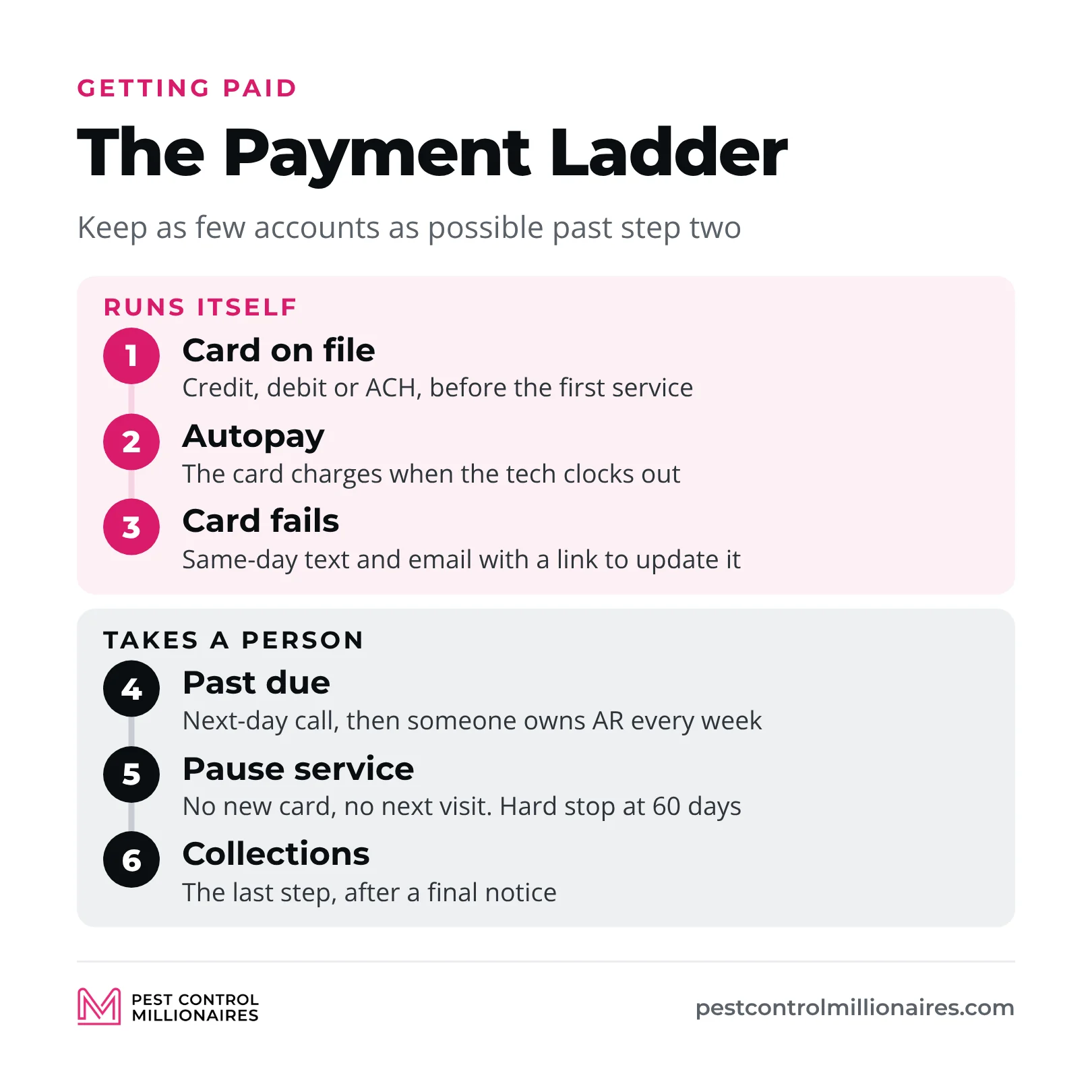
The first three steps run themselves. The last three take a person, so you want as few accounts as possible making it past the second one.
Take a Card on File Before the First Service
Every account gets a credit card, debit card or ACH on file before a technician pulls into the driveway. Get it on the call when the customer books. If someone isn’t home and there’s no card on file, my rule is simple. Don’t do the job. Call them first.
Owners skip this because they think asking for a card adds friction to the call. Yogesh Tulani of Sani IQ told me exactly that in a live breakdown, and I told him it won’t. You can’t fill up at a gas station and pay next week. People buy things online all day, so they know they have to pay.
My script is short. “Mr. Customer, you’re going to love it here.” Then, “Would you like to use credit or debit?” If someone pushes back, send a link to their customer portal so they can pay before you get there. And if someone flat out won’t give you a card, ask yourself whether they were ever going to pay you.
Tony Carder made this change around 2012, before it was common. He stopped taking customers without a credit card on file or a year paid up front, and every month his deposits land within 97% of his production. “I’m not chasing money,” he told me. It’s one of the habits behind how Tony built a $24M pest control company twice.
Set Up Pest Control Autopay So Nobody Has to Bill
A card on file only helps if it charges itself. The setup I teach is simple. The tech clocks in, does the job and clocks out, and the card charges automatically.
Your CRM should do this for you, and my breakdown of pest control business software covers what else to look for. Ask your software company one more question. The software we use at Pest Badger doesn’t automatically give you a customer’s new card when the old one is replaced, and that’s one reason past-due accounts pile up.
Then track your pest control autopay rate like any other KPI. Eric Bassett held his inside sales team at Natura Pest Control to it, and told me on the podcast in 2023 that you should be striving for the high 90s. He called it one of the easiest numbers to hit.
Choose Pest Control Billing That Brings the Cash In Early
How often you bill decides how fast cash comes in and how many customers cancel. Alex Hormozi’s team looked at over a billion dollars of revenue and found monthly subscriptions canceled at about 12.5%, quarterly billing at about 6% and prepaid at 2%. I checked that against our own customers at Pest Badger and moved every new customer to quarterly billing the same day.
From the PCM Facebook group
Do you charge customers monthly, quarterly or something else?
21 of 40 owners in the PCM Facebook group bill monthly and only 1 bills residential customers quarterly, so quarterly billing like Pest Badger's is still the exception.
On 1,000 customers, those rates work out to about 125 cancellations on monthly billing, 60 on quarterly and 20 prepaid. Billing is one of the reasons in my guide on why pest control customers cancel. Monthly is also the slowest to pay you back. At $70 a month, you wait until about the third month to get back what you spent on the lead and the first service, while quarterly brings in a $240 initial on day one. The full side by side is in my guide to pest control offers.
So prepaid for the year comes first and quarterly second. Charging the card on file as soon as each service is done works too. Make the prepay offer at the last service of the year, while customers are happy. One of our branches consistently gets half its client base to prepay.
If switching feels risky, Jared LaJaunie made both of these changes, monthly to quarterly and asking for a card on file, and each one felt scary at the time. He told me fear is a liar.
What to Do When a Card Fails
Cards fail even when you do everything right. They get hacked and replaced, debit cards get shut down for fraud, cards expire, and customers don’t always answer an email or a text. A declined card doesn’t make someone a bad customer, so the goal is to get the new card fast without anyone chasing it by hand.
The answer is an automated sequence that sends a text, an email and even a phone call to capture the updated card, so nobody is chasing credit cards around. Here’s a simple version built from those pieces.
| Step | When | What happens |
|---|---|---|
| 1. Text and email | The day the card fails | An automatic message with a link to update the card in their customer portal |
| 2. Phone call | The next day | A call to get the new card, and the payment, while you have them on the phone |
| 3. Your team | That week | Whoever owns AR calls anyone who still hasn’t updated |
| 4. Pause | Before the next service | No new card, no next visit |
Keep the tone friendly at every step. We had a customer cut off our AI agent on a collections call. It answered, “Well, pay your bill,” and the customer called the office to ask for a manager because that person was rude to him.
Work Past Due Accounts Every Week
Some accounts slip past the sequence anyway, and the bigger you get, the more there are. Our executive team at Pest Badger looks at accounts receivable every week, branch by branch, at 30, 60 and 90 days. The targets are 90% or more of serviced revenue collected (commercial work can pull it lower) and AR near zero. Zero isn’t realistic, so make sure someone owns it.
Both are on our free KPI scorecard and in my full guide to pest control KPIs.
At Pest Badger, that used to be people on the phone. We had two or three CSRs spending most of their day calling receivables, and a CSR can only reach so many people so many times a day. So we turned on an AI agent for accounts receivable. It calls past-due customers, talks with them like a regular person, follows up by text and email, and takes the payment while they’re on the phone. Anything over 90 days gets steady follow-up. It collected about $80,000 in its first 30 days.
Two cautions if you try something like it. Keep cancellations and upset customers with people, the way we do on our service line. And talk to your lawyer first. The FCC ruled in 2024 that AI-generated voices count as an “artificial or prerecorded voice” under the Telephone Consumer Protection Act, so those calls need the prior express consent of the person you’re calling unless an exemption applies (FCC declaratory ruling).
When to Pause Service for Nonpayment
Here’s how one failed card turns into a year of free service. Nobody follows up, and the tech goes back out anyway. Then you’re two services behind, they still haven’t paid, a whole year goes by, and you’re never going to collect that money.
So pause service as soon as the sequence runs out, and treat 60 days unpaid as the hard line. Once someone is two months out and still hasn’t paid, stop servicing them until they pay.
A pause isn’t a cancellation. Tell the customer their service is on hold until the card is updated, and the day it is, they go back on the route. The ones who never update are the accounts that end up at the last step.
Finding a Collections Agency for a Pest Control Business
A collections agency comes after the sequence, the pause and a final notice that the account is going to collections. By then you’ve probably lost the customer. What you’re deciding is whether the balance is worth handing to someone else, with your name still on it.
Know the law first. An agency collecting for you is a debt collector under the federal Fair Debt Collection Practices Act. According to the CFPB, the FDCPA covers debts that are mainly for personal, family or household purposes, which a homeowner’s pest control bill usually is. It doesn’t cover business debts, so commercial accounts fall outside it, and it generally doesn’t cover you collecting your own money. Most states have their own collection laws, and some cover the original creditor, so check yours.
Under the FDCPA, a collector generally can’t contact your customer before 8 a.m. or after 9 p.m., can’t harass them and can’t post about the debt publicly on social media. It also has to send validation information, including an itemization with any interest, fees, payments and credits, and the customer gets 30 days to dispute it in writing (CFPB). So your records have to be clean.
Before you send an agency a single account, go through this list.
- Pull your records. The signed service agreement, service dates with the tech’s notes or photos, every invoice, payment and credit, and every text, email and call in your sequence.
- Ask how they get paid. Know what they keep.
- Ask how they contact people. Their hours, their scripts and how often they reach out. Your former customer will remember your name, not theirs.
- Ask whether they report to the credit bureaus. The Fair Credit Reporting Act covers that, and your former customer can dispute what’s reported.
- Look them up. Search the agency in the CFPB consumer complaint database, and if your state licenses collection agencies, ask to see theirs.
- Agree on direct payments. Decide what happens when the customer pays you instead of the agency.
Part of why I won’t lock customers into contracts is that angry customers leave one-star reviews and tell their friends you’re a scam. A collector that leans too hard can do the same damage, and on a small balance, writing it off may cost you less than the review.
None of this is legal advice. Talk to a lawyer in your state before your first account goes to collections, and have them look at your service agreement too. My guide to selling pest control subscriptions covers why it should be an agreement, not a contract.
Frequently Asked Questions
How do pest control companies collect payment from customers?
Take a credit card, debit card or ACH on file when the customer books and have your software charge it automatically when the tech clocks out. If someone isn’t home and there’s no card on file, don’t do the job. Call them first.
Should pest control customers be on autopay?
Yes. With autopay nobody has to remember to send a bill or chase a payment. Eric Bassett of Natura Pest Control tracked autopay as one of his inside sales team’s numbers and told me on the podcast in 2023 that you should be striving for the high 90s.
Is it better to bill pest control customers monthly or quarterly?
Quarterly, or prepaid for the year if they will. In data from Alex Hormozi’s team, monthly subscriptions canceled at about 12.5%, quarterly billing at about 6% and prepaid at 2%. We bill new customers quarterly at Pest Badger. In a September 2026 poll of the PCM Facebook group, 21 of 40 owners said they bill monthly, so quarterly billing is still the exception.
What should I do when a pest control customer’s card is declined?
Send a text and an email with a link to update the card the day it fails, call the next day, and have whoever owns accounts receivable call that week. If there’s still no new card, pause service before the next visit.
When should a pest control company stop service for nonpayment?
Don’t go back out on an account that hasn’t paid for the last service. Pause as soon as your follow-up sequence runs out, and treat 60 days unpaid as the hard line.
Do collection agencies have to follow the FDCPA?
Yes, when they collect consumer debts like a homeowner’s pest control bill. The CFPB says the Fair Debt Collection Practices Act covers debts that are mainly for personal, family or household purposes, not business debts, and generally not a business collecting its own money. Most states have their own collection laws too.