
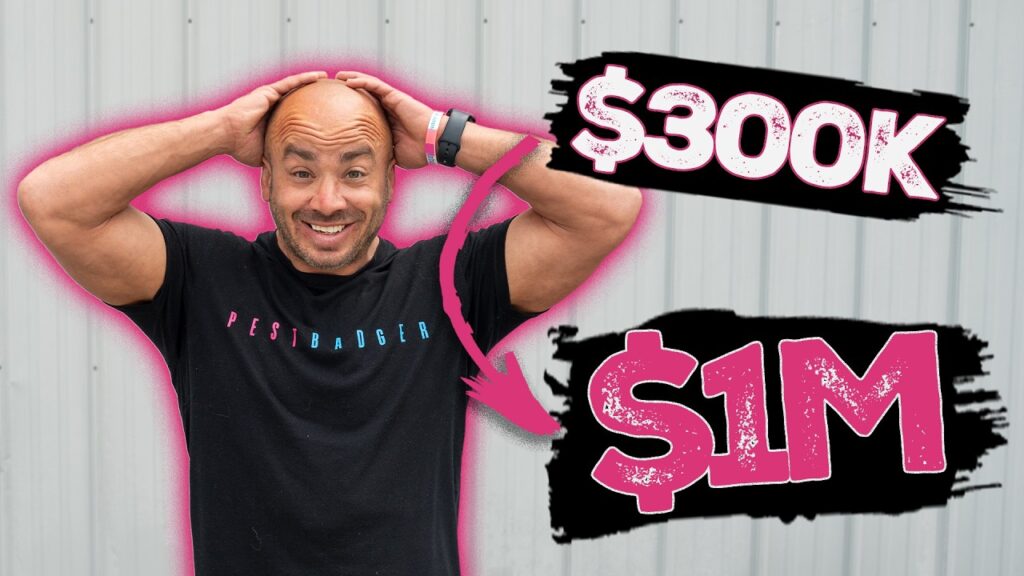
We bought a pest control company doing just over $300,000 a year. Then we imported the customer data into our CRM, and within five minutes it showed more than $850,000 in annual recurring revenue.
The crazy part is that I already knew we were sitting on a goldmine before we ever moved the data. I had seen the P&L. I had looked at the active customer list. I had asked a handful of questions. And the numbers just didn’t make sense to me. A company doing $300,000 a year shouldn’t need eight to ten technicians and a manager. But a company with over 800 active customers shouldn’t only be doing $300,000 a year either.
Today I’m going to show you exactly what we found, what we fixed in the first 90 days, and how the company ended up doing over a million dollars in revenue in its first year under us.
I’m Jonas Olson, the founder of Pest Badger. I’ve been in the service industry for 17 years, and over the past five years we’ve grown a pest control company from one location to 20 locations across nine states. I use this blog to document how I think about building service businesses and what’s actually working for us. I wish my mentors had documented their journey, so I’m documenting mine for you.
Table of Contents
ToggleHow the Deal Found Us
We were sitting in Arizona at a leadership retreat when one of my guys came up and said his dad knew of a mosquito company for sale, sitting in one of his storage units.
I asked what the revenue was. He told me about $300,000. My first thought was honestly that I wasn’t interested. At that size it’s not really a company, it’s a route. And the work it takes to buy a small company is the same work it takes to buy a big one. Same paperwork, same questions, same everything. At least when you’re buying a bigger company, the effort is worth it.
But the deal had one thing going for it. Two of our guys were from that hometown. So I looked at my CFO and said let’s just look at it. It doesn’t mean we have to buy it. Maybe we’ll learn something. Any time you get the chance to look inside another company, you get smarter about your own.
The Brand We Bought: Mosquito Crush
The company was called Mosquito Crush, and it was originally started by a marketing professor. It was actually a really good-looking brand. The trucks were bright orange. The name was memorable. The website was solid. And every time they signed a new customer, they dropped a six-pack of Orange Crush on the front doorstep. From the outside, like any good brand, you would have thought the company was much bigger than it actually was.
Eventually the professor sold it to the owner we bought it from. That owner also ran a much larger construction company, which sounded pretty messy from my conversations with him, and that’s where most of his attention went. He had never run a service company before. He bought Mosquito Crush as passive income and just kept running it the way it had always been run. He trusted the old model.
The Red Flags That Were Actually Green Flags
During due diligence, the first thing that jumped out at me on the P&L was the COGS. It was sitting around 60 percent. If you’re not in the industry, that’s really high for any service company and extremely high for a mosquito or pest control company.
So naturally, I started asking questions. How many technicians do you have? How many stops a day are they doing? What are customers paying?
Every answer explained more of what I was seeing on the P&L. Eight to ten technicians plus a manager. Techs running ten to twelve stops a day. Customers paying anywhere from $50 to $75 at the top end per service, and most of those prices probably hadn’t changed since the company opened.
Then I started walking the shop and asking about equipment. They had six vans. They had 18 mosquito foggers. They had product absolutely everywhere. We closed on the company in April and didn’t have to place a meaningful product order until August.
Most buyers would have seen the revenue, seen the 60 percent COGS, and walked away. I just kept digging to see what I’d find.
The CRM Moment
The next thing I asked for was access to the CRM. I opened it up and found over 850 active clients.
I’ll be honest, this is where I got excited, because 850 clients could obviously be worth a lot more than $300,000. At that point I stopped looking for reasons not to buy it and started thinking about how to make the deal work, and about what the business could become. Right then and there, I knew we were buying it. I looked at my CFO after going through the P&L and the data and told him we were sitting on an absolute goldmine. He agreed. The owner just didn’t realize what he had.
A few weeks later, after everything was signed, we imported the whole book into our CRM. It showed more than $850,000 in annual recurring revenue. Pretty close to what we expected it to be.
And as I’ve said a million times, the downside was covered before we started. Even if we lost half the customers and doubled the price on everyone who stayed, we’d be doing the same revenue with fewer stops, tighter routes, and way better margins. No matter which way it went, it was going to be good.
Fix One: Standardize the Program
The first 90 days started with the program itself. And honestly, calling what they had a program is being generous.
Customers were basically choosing how many applications they wanted per year. Some wanted one. Some wanted three. Some wanted six. On top of that, some customers were paying as little as $40 an application.
You cannot build efficient routes around that. Round one you have 850 customers. Round two you have 300. Round four you have 700. Round five you have 100. I’m throwing out numbers, but that’s what the year looked like. It’s not scalable that way at all.
So one of the first things we did was standardize the entire program. Everybody moved from one or two or three applications to a six-application schedule. This wasn’t just about increasing revenue, although that was part of it. It made the entire operation easier to run. Scheduling got easier. Routes got tighter because the same customers show up every round. Technicians got more efficient. And every customer got the same service level, because here’s what happens with a one-time mosquito service: two or three weeks later the mosquitoes are back, the customer calls unhappy, and now you have a scheduling nightmare on top of a service problem.
When everyone is on the same program, you can project everything. Revenue. Product orders. Hiring. The whole year becomes something you can see in advance instead of something that happens to you.
Fix Two: Pricing
I’m covering the exact pricing framework in its own article, because it deserves one. But for this story, here’s what matters.
When we imported the customer base, it showed more than $850,000 in annual recurring revenue. We never expected to keep all of it. Some customers weren’t going to like the new program. Some weren’t going to like the new pricing. If you tell someone they’re going from one application at $50 to six applications at $80 or $89, some people are going to cancel. That was expected and planned for.
Once we reached out to every customer and everything settled, recurring revenue landed around $700,000. Every customer on the same program, at the right price, on routes we could actually build around.
Fix Three: The Rebrand (and When You Shouldn't)
Another thing we did pretty quickly was rebrand the company. Now, before everybody runs to the comments, I do not recommend this for every acquisition.
If you’re buying a company with thousands of accounts, thousands of reviews, and a strong local reputation, changing the name can be a big mistake, and I’m a big advocate for not making that change. I watched somebody in my own local market buy a really reputable company and slap their name on the side of it. In my opinion, that’s an ego move. We like our name, we want to see our name on things. But why fix something that isn’t broken? If the brand is already working, let it roll and keep growing it.
That just wasn’t the case here. The branding looked good and the orange vans were cool, but they only had maybe 22 to 25 reviews online, and they weren’t doing any marketing because there was no money to do it. There was no real brand equity. Pest Badger had the stronger reputation, the stronger brand, and way more equity. Rolling everything into Pest Badger just made more sense.
The transition itself was cheap. We brought in two new trucks that had Pest Badger on them from day one. The invoices, the letter, and the email that went out to every customer were Pest Badger from day one. Two of the old vans were garbage anyway, so we pulled them out of service and used them for parts. The remaining vans got a sticker on the side that said Mosquito Crush, a Division of Pest Badger, and that carried us through the end of the year until we re-wrapped them.
You don’t have to spend a ton of money rebranding everything overnight. You just have to make sure every customer knows.
Fix Four: The Operation Itself
This is where the 60 percent COGS came back into the conversation.
The technicians had been doing it the same way for a long time. They weren’t bad technicians and they weren’t the problem. The operation was. When eight to ten technicians and a manager are producing $300,000 a year, the math just doesn’t math for anyone. Trucks were going out with two people on them, running eight to ten stops, and putting out about $1,000 a day. Way too much windshield time, way too much driving in general, and way too much labor.
So we rebuilt the routes, tightened up the territories, and grouped the customers together so every round has roughly the same stops in the same neighborhoods. Yes, you lose some and you add some, but round one through round six now look basically the same. Density went up, drive time went down, and the same trucks with the same customer base started producing way more.
Then, once the routes were tight, we switched the technicians to pay for performance. The cost of goods came down drastically, exactly like we expected.
Fix Five: Sell to the Customers You Already Have
Here’s where I think a lot of owners would have made the wrong move at this point. They would have started spending money trying to generate more leads. And again, nothing wrong with marketing. But in our growth framework, the order matters. Before we spend money acquiring new customers, we look at the customer base we already have.
We had more than 850 people who already trusted this company enough to buy from it and stay with it. Most of them were mosquito-only customers. All we had to do was offer them pest control.
We didn’t do anything complicated. No big marketing campaign, nothing expensive. We simply started solving another problem for customers who already trusted us. Our two acting managers, both with sales backgrounds, introduced themselves at the start of the season as the new partners, walked customers through the service, and upsold pest control into the mosquito program.
During that first year, that alone added more than $250,000 in new pest control revenue from the same customer base.
How the Million Happened
So walk through how the whole thing played out. We bought a company doing just over $300,000 a year. The customer base showed more than $850,000 in annual recurring revenue once it hit our CRM. We standardized the mosquito program, corrected the pricing, and then added over $250,000 in pest control revenue to the same existing clients.
That’s how the business crossed a million dollars in revenue in its first year.
The Lesson: Look at Every Deal
The biggest lesson I took from this acquisition is to look at every single deal. I heard $300,000 and I anchored on $300,000. It wasn’t until I started asking questions that I found the 850 active customers underneath it.
Getting customers is one of the hardest parts of this business, and somebody had already earned those customers for us. They just needed a better operating model.
Here’s how I think about it now, after buying a few service companies. The P&L tells you where the business has been. The customer list tells you where the business can go. So don’t stop at revenue. Start with the customer base, do your due diligence, and work backwards from there.
This is Part 2 of the Mosquito Crush acquisition series. Part 1 covers what happened to the team after the paperwork was signed. Part 3 breaks down exactly how we raised prices from $50 to $129 per service.
