

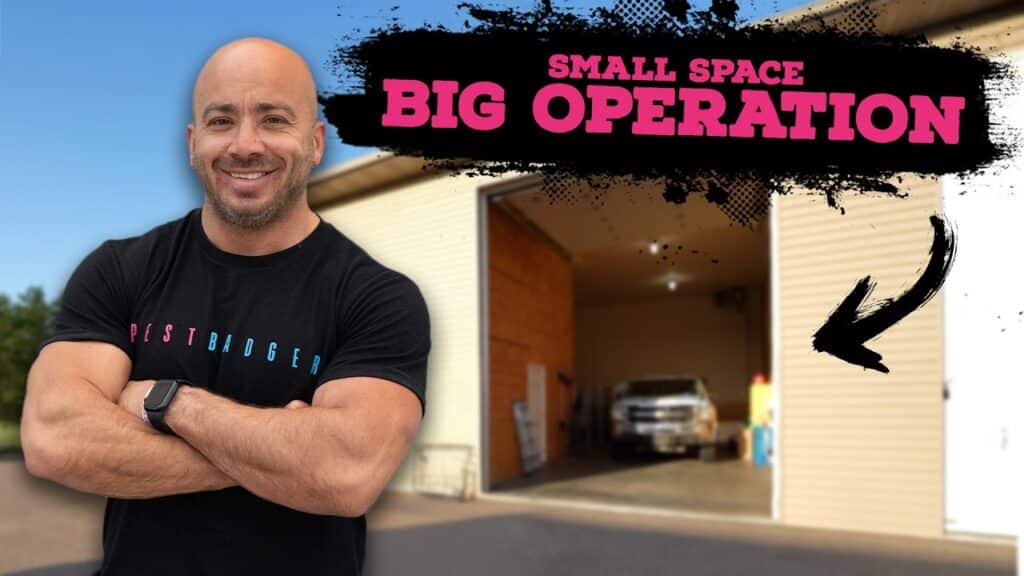
Most people think you need a big, extravagant shop to run a multi-million dollar pest control operation. I used to think the same thing. I’m guilty of it. But after opening four locations with my partner James Roost, I can tell you from experience: that’s just not true.
We recently toured our fourth location in central Wisconsin, a branch that pumps just shy of $2 million in revenue per year. And the building? It’s tiny. Less than $1,000 a month in overhead. Let me walk you through exactly how we make it work.
Table of Contents
ToggleYou Don't Need a Big Shop. You Need a Smart Setup.
The main purpose of this shop is simple: product storage and a meeting spot for the sales team. That’s it. We have seven trucks out on the road every day, but our technicians take their vehicles home at night. So we don’t need bay after bay of garage space. We just need somewhere to keep products locked up, a place for the sales guys to meet every morning, and enough room for techs to come in twice a week to clean out their vehicles and restock.
Every Tuesday and Thursday at 7:30, the techs show up, clean their trucks inside and out, and grab what they need. Other than that, they might pop in to fill a water tank, but a lot of the time they just fill up at home with a garden hose.
That’s one of the cool things about pest control. You can fill up at the customer’s house, at home, wherever. We’ve even offered customers a $5 discount to use their water in a pinch. It’s very common in the industry. I know guys running $5 million operations who never fill up at a shop. They always use the customer’s hose.
What We Actually Look For in a Shop Space
When we go looking for a location, the checklist is short. We need one office area and somewhere to store product. That’s it. The trucks go on the road and home with the technicians. So we’re really just looking for a place where the sales team can meet and where we can keep pallets of product locked up and climate controlled.
That climate control piece matters. Products can’t be freezing in the winter or cooking in the summer, so all of our locations are climate controlled.
The majority of our shops, besides the two original ones, are storage units. This one here and the one at our other location are both storage units. For $1,000 a month, it’s incredibly efficient.
I stayed with Dylan last week, and he doesn’t even have a shop. He runs everything out of his garage. Products locked up in there, techs take their trucks home. Very, very simple. My mentor built a $20 million company using only storage units. So I figured, why not take that same philosophy and apply it? And that’s exactly what we’ve done.
Keeping Trucks Clean is Non-Negotiable
One thing James and I are both sticklers about is clean equipment. We should be able to grab any of our vehicles at any time of the day, any time of the year, and trade them in as if they were brand new.
It’s not just about pride. The technicians feel better working in a clean environment, and it’s customer-facing. If a customer walks by and sees stuff falling out of a truck, they’re going to think you don’t have your act together.
We used to have more issues with it, but now it’s built into the system. Vehicle cleaning shows up on the tech’s schedule twice a week. They clock into it like a job. They spend about half an hour cleaning inside and out, and then our branch manager double-checks every truck before anybody leaves. It’s made a huge difference.
Brand Recognition Compounds Over Time
This is our third full summer at this location, and the brand recognition is starting to really kick in. James has been hitting garage sales and community events around town, and people are starting to recognize Turf Badger everywhere.
He told me a story that stuck with me. He walked into a garage sale just down the road from our shop, and the first thing the lady said was, “Oh, you work for Turf Badger? I thought you were going to try to sell me some bug stuff.” Turned out she’d been a customer since day one and loves the service.
That kind of organic recognition comes from having wrapped trucks on the road every single day. The more trucks you have out there, the more people see them, and it just compounds.
The Branch Manager Role Changed Everything
Hiring a branch manager for this location was a massive game changer. He came in with prior experience, learned our systems, and we were able to take some of his ideas too. We made it all one big thing.
On a daily basis, he handles a lot. Product ordering runs through him (he clears it with James first, then greenlights it). He manages scheduling, making sure everybody’s routes are set for the next day and that any incomplete jobs from the day before get moved. He does a lot of customer service work, especially when something goes sideways. Just last Saturday, James called him to go talk to a customer, and he made them super happy.
One of the biggest things he does is what we call ghost inspections. He’ll show up behind a technician after a job, greet the customer, and make sure everything was done properly. This has been huge for retention.
We even had an instance last week where one of the techs was maybe having an off day, not quite on his A-game. The branch manager went behind him, communicated with the customer, and retained them. Made them happier than they were before, even though they were already happy. Sometimes people just want to be heard.
Retention is the Real Game
This is something we’re obsessed with. We run a deep retention audit every single year, digging into where our churn is, why it’s happening, and how to fix it.
One of the biggest reasons people were canceling? Not getting the same technician they had the first time. We do a really good job with those first-service start texts, introductions, all of that. But then the quarterly service comes around with a different person, and the experience feels different.
You have to think of it like McDonald’s. No matter which location you’re at or which employee is working, you should get the same exact service in the same exact way. That’s a training thing. Since everybody at this location was trained by the same person, the consistency is there.
The biggest mistake I see people make in this business is they funnel customers in really fast and then stop caring after the sale. That’s why customers leave. You have to keep treating them like they matter, making sure they’re happy, asking for five-star reviews, and running those audits at the end of the year to really understand what’s going on with your business.
Revenue Split and Growth
For this location, the revenue split is about 75% pest control (including mosquito) and 25% lawn care. We lead with pest control and upsell lawn care services, especially during the winter months. But the lawn care side has been growing fast over the last year.
Inside the product cage, it’s straightforward. One shelf for pest control products. Two shelves for lawn care, since that requires more bulk storage for the bigger products. Branded bait stations come in by the pallet. We’ve got all the basics: T-zone, spreader sticker, bait blocks, B&G sprayers, extra hose, and a spare 100-gallon tank just in case. Nothing fancy. Nothing crazy. Just what the team needs to do the job.
The Department of Agriculture Visits
The Department of Ag stops by at least once or twice a year. And honestly, it’s a good thing. They’re not out there to get anyone. They’re just making sure everybody is following the same guidelines. It makes us a better company when they come through.
The Real Secret to a Successful Shop
And last but not least, there’s one more thing that’s an absolute must when you’re looking for a shop for your pest control company. There has to be enough room for a basketball hoop. I’m serious. We have a basketball hoop at every single location. It’s the number one key to success.
Although, fair warning, James rolled his ankle six weeks ago playing pickup before work. So there are some risks involved.
The Bottom Line
You don’t need to spend millions of dollars on a shop to build a very successful pest control business. We’re running a $2 million branch out of a storage unit for less than $1,000 a month. That overhead savings goes straight to the bottom line. It’s how we stay profitable across all of our locations.
Keep it simple. Keep the trucks on the road. Keep your team tight. And maybe invest in a basketball hoop.
