

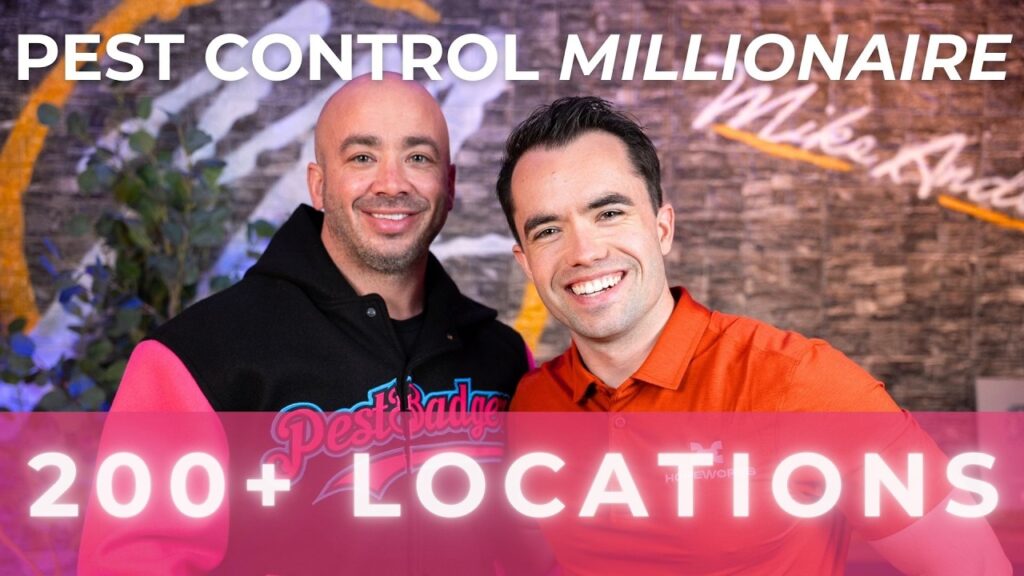
I drove out to Augusta HQ in Washington to sit down with Mike Andes, who runs Augusta Lawn Care. They have 214 locations now, and in 2024 they did $54 million. He wants to hit 1,000 locations and take the company public.
But the numbers are not the part that stuck with me. What stuck was how he got there. Mike built three businesses at once: media, a franchise, and software. Each one almost broke him in a different way. Here are the lessons I walked away with.
This is part of the Pest Control Millionaire podcast. For more from Mike, see the earlier conversation on how Mike Andes built 150 locations and what he taught me.
Table of Contents
Toggle1. Sometimes the first turnaround is you
Mike does a show where he flies out and fixes broken businesses, but the first business he ever fixed was his own.
Back when Augusta was doing $700,000 to $800,000, he had no systems and was in the truck every day. One day he was dumping cobbles at a job site. The cable that ran the dump bed had broken, so he had been crawling under the cab to engage it by hand.
That day his hoodie got caught and the machine pulled him in. His arm got stuck, which is the only reason he did not get spun around. The fabric wrapped his neck and shredded it. They rushed him to the hospital because they thought his neck was broken.
It was not, but he could not work for a couple weeks. And in that bed, it hit him. As Mike put it, “everything I learned in my MBA I have not implemented in my business.”
He was lying there FaceTiming his crew about the next job, because they had no training videos. So he wrote down every choke point in the business, every spot where the work could not happen without him. That list became his first content. “The first turnaround was me,” he told me.
2. Every business has its own flavor of hard
Mike runs three kinds of business, and people always think one of them is the easy one. He says none of them are.
Media grows fast and has high margins, but it hits a wall. There is no real company to sell at the end of it. Franchising is the opposite. It grows slow, it is a grind, and the margins are thin. But people already want lawn care, so he does not have to create demand. Software is its own kind of pain. He says it is hell for years until you figure out what people will pay for.
So when someone tells him software is easy, he has a question for them. Do you want to lose a million dollars a month? And when they say franchising is easy? As Mike put it, “do you want to live in a closet so you can avoid private equity?”
That last one was not a joke. More on it next.
His big point landed with me. As Mike said, “everyone has their version of hard. It’s just a different flavor of hard.”
3. The first 100 locations almost don’t make sense
This was the part I made him explain twice. Augusta charges a flat monthly fee per location, with no royalty. So under 100 locations, the math is brutal.
Here is what he means. His own first location made about $300,000 in profit on $1.5 to $1.7 million in revenue. But he was charging franchise owners around $1,200 a month back then. So to make the same money one location made him, he needed about 20 franchise locations.
And he had to build support for 100 locations while getting paid like he had 20 or 30. Command center, software, coaching, training, all of it.
That is why he lived in the closet of his studio and every dollar went back in. He had people lined up to hand him private equity money, and he turned it down. Instead he told his owners the truth: if we make more money, I make this better for you. That honesty is how he kept control of the company.
4. He franchised so he could wear the same uniform
Mike spent two or three years making YouTube videos to teach lawn care owners. After all that, he had about 2,000 subscribers, and almost nobody listened.
So he figured out why: you cannot change someone’s business from the outside. As Mike put it, “the whole reason we franchise is because I wanted to wear the same uniform as the people I was talking to.”
When owners wear his uniform, they trust that he wants them to win, so they actually follow the systems. That is the whole idea behind getting to 1,000 locations. At that size he can stand next to almost anyone in the industry as an equal.
5. Most people can’t diagnose their own problem
Mike wrote a book with the 13 principles he uses on every turnaround. Good book, but it had one flaw. The owner had to figure out their own problem first.
He compared it to medicine, which he used to work in. People go online and self-diagnose, and doctors hate it. Mike found the same thing with his book. An owner would think he had a sales problem when the real issue was something else.
So he built software instead. He used to call it CoPilot, and now it is Homeworks. The point is simple. As Mike said, the software “will tell you what your problem is, what problem you have, and what to fix how to fix it.” No guessing, and no waiting for him to fly out.
6. Batch your content and aim for quality
This one is for anyone making videos for their business. Mike lives where winters bring 10 to 20 feet of snow, so he cannot film turnarounds then. That is why he batches.
Before fall ends, his team films a bunch of turnarounds at once. They even did an RV trip across the country: ten turnarounds, eight owners, all in a row. That gives them content to release all winter long.
He is also done chasing volume. A small company and a big company take the same effort to film. Same flights, same time. But the big messy ones get ten times the views. So he cut back to one or two turnarounds a month and went after the better stories.
The line I keep thinking about
Near the end we talked about life, not business. Mike got married recently, and he told me he was glad he waited. He splits his life into three phases: grind, build, and thrive. He did not want to be married during the grind, when he was fighting to make payroll.
But the real unlock was something his coach helped him see. He used to think his wife had to be his business partner too, and then he let that go. As Mike said, “I don’t need her to be everything to me.”
That is good business advice and good life advice. You do not need one thing to be everything. Not your wife, not one business, not one product. Mike built three businesses partly because he knows each one can only carry so much.
That is what I took from the day. Thanks to Mike for having me out.
