

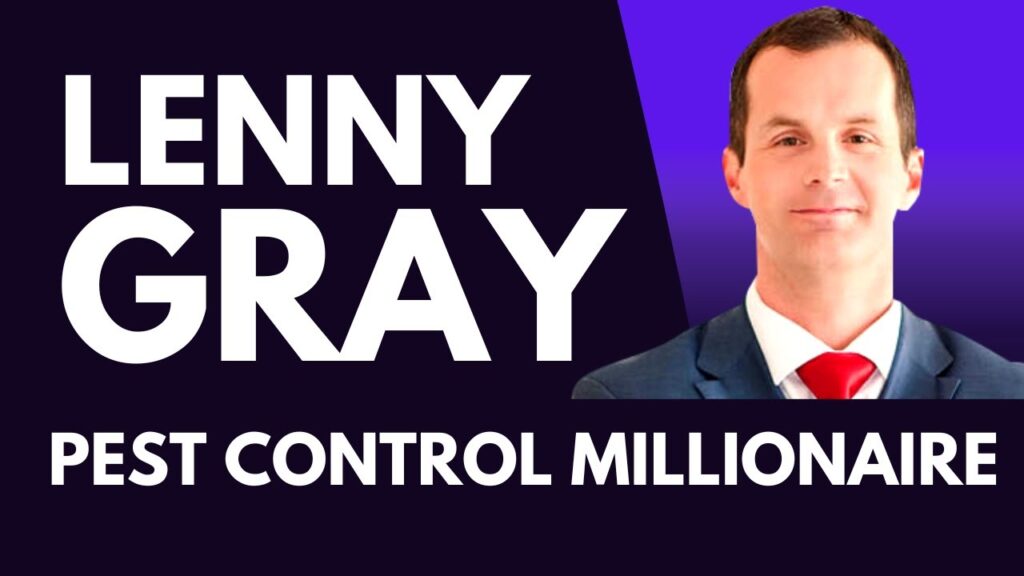
I have been looking forward to this one for weeks. Lenny Gray was a mentor of mine before he even knew he was a mentor. I followed him closely for three or four years before we ever talked, and now we connect every month or two. He wrote Door-to-Door Millionaire and More Door-to-Door Millionaire, he runs the D2D Millionaire training company, and he owns Rove Pest Control. The guy has been doing this for 25 years. So when he sat down with me, I just tried to soak up as much as I could.
Here’s what stood out. For more on going door to door the right way, see my conversations with Parker Langveld and Chad Louk, or browse every episode on the PCM Podcast.
Table of Contents
ToggleDoor to door is not dead, no matter what people say
I asked Lenny straight up if door to door is dead. “It’s totally dead, I’d never do it,” he joked. Then he made his real point. As he put it, “There’s still a lot of greenfield out there to just go crush it.”
He told a great story to prove it. He had a call set up with a guy who was sure door to door was a dying thing and there were no markets left. The weekend before their call, a door to door solar rep knocked that same guy’s door. The guy lives in Puerto Rico, of all places. And when he mentioned Lenny, the rep said oh yeah, I know Lenny Gray, I have read his books. So even the guy who thought it was dead got a live demo on his own doorstep.
By the way, the company name has a fun story too. Rove Pest Control is named after the Rove Beetle, a bug that hunts and eats other bugs. They had already picked the name. Then on a trip to Kenya, Lenny and his partner were brushing their teeth at an outdoor sink one morning, and a Rove Beetle walked right through the sink between them. They took it as a sign they named it right.
Why it has a bad name, and why that is unfair
Lenny was honest that door to door has earned some of its bad reputation. Any business that can pay people really well attracts some greedy and dishonest folks. He has even had competitors lie about his company. One rep went around telling Lenny’s own customers that Rove had been sold, so they just needed a signature to keep service going. Total fabrication.
But his take is that the bad apples are the loud minority. He used a referee analogy I loved. “You don’t know a referee’s name until the referee really messes up,” he said. The good ones just do their job and nobody thinks twice. Door to door is the same. The honest reps, who are the majority, go unnoticed. The problem now is that we live in a tighter, more connected world. One bad rep gets caught on a doorbell cam and shared to the whole neighborhood group in minutes. The good stuff never gets posted.
The upsides owners overlook
I asked Lenny for the real benefits at the owner level, and two stood out.
First, it opens up an untapped market. Everyone is fighting over the same leads from TV, radio, billboards, and SEO. Door to door reaches people who were never going to call you in the first place. Different customers, less competition for them.
Second, and this is the one I see every day, route density. With online leads you might get five calls in one morning spread across five different cities. With door to door you can work for a few hours and get five sales within a block of each other. We have neighborhoods where we just park the truck all day and never move it. That is huge savings on fuel, wear and tear, and windshield time.
You cannot switch a customer who feels taken care of
This was the heart of the switchover conversation. Lenny said price is not even close to the main reason people switch. As he put it, it’s “top five, it’s not like the top one.” What keeps a customer locked in is the relationship and the service.
He painted it perfectly. If a customer tells him they have been with their company ten years, their tech Joey is the best, and they can call the office and Nancy always picks up, he is not switching that account. He could offer it for free and they would tell him to take a hike. So the way Lenny trains it is not the rookie move of walking up and saying your company stinks, we are cheaper and we do more. That is elementary. Instead his reps ask good questions to find out what kind of experience the customer is actually having. If they love their company, great, leave the door open for later. If they do not, now you have something real to work with.
And it does not matter if the customer is with a big franchise or a small mom and pop. What matters is whether their technician and their customer service are good. A company that nails both is hard to switch, big or small.
How to handle a do it yourselfer
Most reps blow this one. They tell the DIY homeowner that their time is too valuable, so they should hire it out and go spend time with their kids. The problem is that a lot of those people actually enjoy doing their own yard or pest work. It is a hobby. If you try to take away something they like doing, you have already lost.
Lenny’s approach is to supplement, not replace. He tells them to keep doing what they love, and he will just add to it with products or techniques they cannot get on their own. As he put it, “I’m not going to come in saying hey, take off the overalls, I’m your guy now.” He is going to compliment the work they are already doing.
Roots before branches
Lenny had a sharp way of describing the teams that flame out. They go in guns blazing, blast on as many accounts as possible, and their branches end up outweighing their roots. Put on too many accounts too fast and the service quality drops, retention tanks, and now you have to keep selling like crazy just to replace what you lost. He called it a drug, and spinning your wheels in the mud.
His own approach to entering a market is holistic. Not 40 reps and nothing else. A mix of door to door, acquisitions, and traditional marketing all at once. He used the legs on a chair idea. One leg will not balance. Grow several ways and you have stability if one thing gets taken away. He also pointed out that an established company can add door to door years down the road. Just hire two to five reps and aim them at the neighborhoods where your routes have gaps. It cleans up your routing and fills in the holes.
What good retention actually looks like
Lenny broke down the numbers plainly. Attrition is the accounts you lose. Retention is the accounts you keep. Rove keeps well over 80 percent of their door to door accounts after the first year, and some years they have hit the 90s. He has heard horror stories of companies down under 50 percent, even 25 or 30. At those numbers the economics just do not work. You are paying through the nose for accounts you cannot hold.
The difference comes down to how the reps were trained. If they sell a one year agreement, you get the customer for a year. If they sell a real relationship, the customer stays. He made a point I had not thought about. In door to door you are often creating a need the person was not even thinking about. That is harder to retain than an inbound lead, where the person called you because they already have a need.
There is no magic market
I asked Lenny about traditional markets like Texas and Florida versus non traditional ones like Wisconsin and Minnesota. He said retention does not have to be any different. It comes down to the same thing every time, relationship and service. He has clients in Canada doing it well.
What changes is the objection. In a traditional market, almost everyone already has a service, so you better be great at switchovers. In a non traditional market, the pushback is we do not need it, we do not have bugs, so you better be great at handling that. He said there is no perfect market out there with a built in need and no competition. That place does not exist. It is always one of the two, and often both. We do not need it, or we already have it.
Hire four to keep two
I told Lenny my rule is never hire one rep, always hire two, so they push each other. He raised me. Hire four so you can keep two. These reps are often young, 18 to 25, and they can be fickle. Bringing on friends and a little competition helps, because success breeds success. When one guy sees another sell six in a day, it lights a fire.
On where to find them, he goes where his demographic is. Colleges, job fairs, anywhere he can reach people with summers free. That includes high school seniors, college kids, and even teachers, who have summers off and tend to be good communicators. Then he looks for the right type of person. Mentally tough enough to take rejection without folding, good at communication, and committed. A lot of that can be taught, but the tough and committed part is the foundation.
And here is the myth he killed. You do not need church mission kids or guys with door knocking backgrounds to win at this. He once had a team out of a Michigan university where nobody had done a mission and nobody had sales experience. They were his top office. They just took the training to heart and worked harder than everyone else.
Beware the recruiter who promises the world
Lenny has seen 25 years of this, and he says nothing has really changed. Same complaints every era. I did not get paid my back end. I was over promised and under delivered. His warning is that the best recruiters are dangerously good. They know exactly what a 20 year old wants to hear, and they will promise all of it, because they get paid on overrides whether you ever see your back end or not.
So his rule is simple. If all you are hearing is how glorious and fun and easy it will be, you are being over promised. When Lenny recruits, he paints the realistic picture. This is hard. You might want to quit. If you bail early, you may not get your back end. Most recruiters will never tell you that. He also called out the ugliest mindset in the industry, the companies that treat each year’s new reps as fresh suckers to burn through. That is trash, but it is real.
Sales forces fail at the top
When I asked where most sales teams break down, Lenny did not hesitate. Leadership. They are either led by the wrong person or by nobody at all. Your first few reps need someone in the field guiding them, with daily training meetings six days a week to keep the motivation and the skills up. Without that leader, you fail.
He told a story from his own start that explains why he teaches the way he does. His first training was a 15 to 20 page manual. He memorized it in a couple of weeks and flipped through it between doors. He was promised a VP of sales would come knock with him. He waited through all of May and June, outselling his own managers, with no idea if he could be doing better. The VP finally showed up in July, met him in the parking lot with a video camera, and said he actually did not have time because he had a flight to catch. He just wanted to record Lenny answering a door. Lenny thought, I am supposed to be getting trained here, not the other way around.
His point is that back then there was almost no information. Today there is no excuse. Between his books, a blog he has run for over a decade, his newsletter, and a YouTube channel with hundreds of videos, a company would have to actively fail to leave its reps in the dark.
Fail forward
Lenny is not scared of failing, and he had the stories to back it up. His third year knocking in Jacksonville, he sold around 700 accounts. To show how he sells for the long haul, he sold 684 that summer and got paid on about 672 of them. That is incredible retention. As he put it, “The only way somebody’s going to cancel from an account that I sell is they’re either going to move, lose their job, or die.”
But even in that monster year, he had four days with zero sales, one in each summer month. That is the mental toughness piece. Sales are all over the board. Nobody actually sells five a day every day. Some days you get zero, some days you get 23.
On the business side he has hired the wrong people, entered markets he should not have, and once lost a lot of money in what turned out to be a Ponzi scheme. He does not call any of it failure. He calls it learning, as long as you do not repeat the same mistake. He compared it to cooking. A flopped recipe does not mean you stop cooking. You adjust the ingredients until you find the one that works.
What separates the elite reps
I asked Lenny what makes a 15 to 20 deal a day rep different from a two or three a day rep. His answer surprised me. It is not work ethic. It is reading non verbals and qualifying fast, so you do not waste time on people he calls Mission Impossible.
He gets told no more than anyone, and he does not care. His reps will see him get rejected and act shocked that someone told him no. But that is the point. Once he qualifies a person and gets them on the hook, he closes better than almost anyone, because he knows he is talking to someone who is actually sellable. As he put it, “I don’t sell the unsellable. I’m not Houdini.” He just qualifies quick, closes, and moves to the next door. And he was clear that this is not about cherry picking the easy sales. There are only so many of those in a day anyway.
A few things I am taking with me
Here is what I am walking away with after talking to Lenny:
- Door to door is far from dead. There is still wide open ground for anyone willing to do it right.
- You cannot switch a customer who feels taken care of, so ask about their experience instead of trashing their company.
- Put roots down before you grow branches. Too many accounts too fast kills retention.
- There is no magic market. It is always we do not need it or we already have it.
- Hire four to keep two, and look for tough and committed over experienced.
- If a pitch is all sunshine, you are being over promised.
- Leadership is where teams live or die.
- The elite reps are not working harder. They are qualifying faster.
Thanks to Lenny for the time and for everything he has taught me over the years, most of it before he even knew he was teaching me.
