Paid Directory Reviews for Pest Control: Why Your Yelp Rating Is Lower Than Google


Table of Contents
- Ask for Reviews on the Platform Where They Found You
- Always Respond to Reviews
- Don’t Use Generic AI Responses
- Negative Reviews Are More Important Than Positive Ones
- Match the Energy of the Review
- Reward Your Team for Reviews on Every Platform
- Reviews on Other Platforms Help Your Google SEO
- ChatGPT Doesn’t Care About Google
- Reviews Are Digital Real Estate
- Start Building Your Review Profile Today
- Keep Growing Your Business
- Frequently Asked Questions
- Related Resources
- Related Articles
Paid directory reviews for pest control are the biggest factor in whether your listing generates calls or gets ignored. Managing pest control reviews on paid directories like Yelp and Angi requires a different strategy than Google. Your pest control directory review strategy can make or break your ROI on these platforms.
Here’s something most pest control owners don’t realize: your reviews on paid directories like Yelp, Thumbtack, and Angi matter just as much as your Google reviews. Maybe even more in some cases.
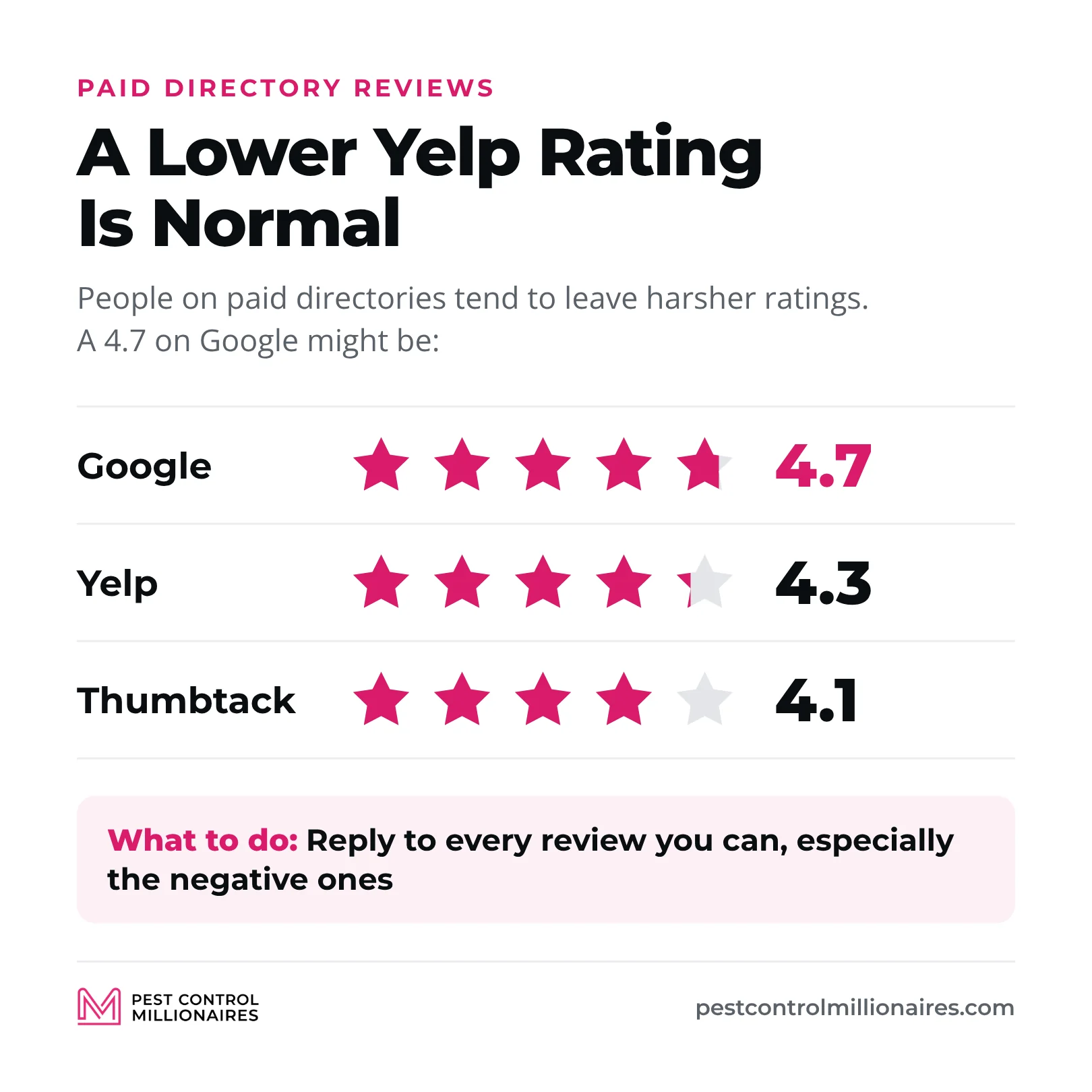
But here’s the catch. If you have a 4.7 star rating on Google Business Profile, you might have a 4.3 on Yelp and maybe a 4.1 on Thumbtack. There’s something about the nature of people using paid directories that leads to harsher ratings.
I run Pest Control SEO, and I’ve helped hundreds of pest control companies build their online reputation across all platforms. Today I want to show you exactly how to get reviews on paid directories, how to respond to them, and why this matters way more than you think.
Ask for Reviews on the Platform Where They Found You
On every platform that lets you ask, the best way to collect reviews is the same. Ask in person.
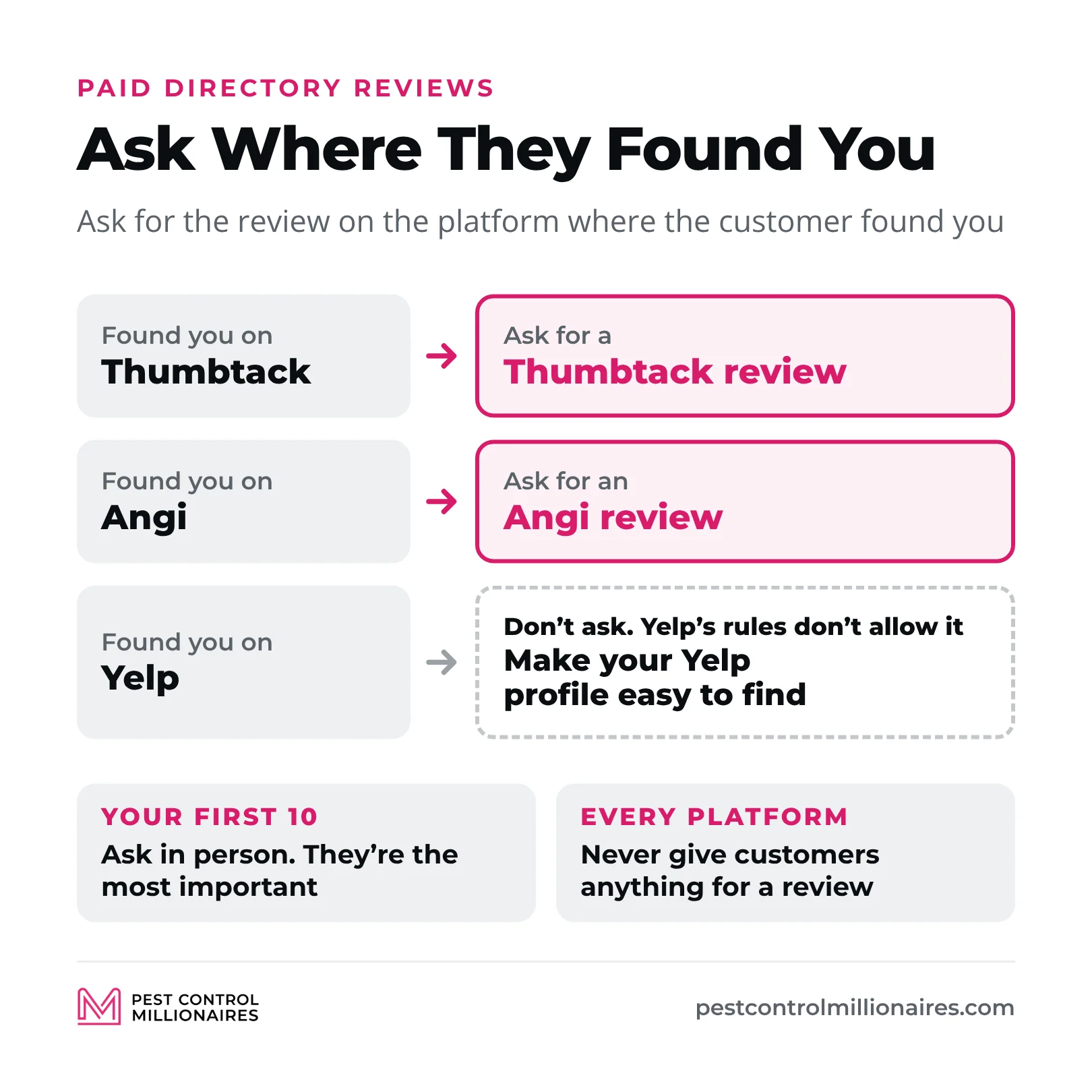
You can set up fancy automation sequences if you want. But especially for your first 10 reviews, which are the most important, you need to ask customers face to face. There’s something psychological about the number 10. Once you hit that threshold, you separate yourself from companies with just three or five reviews.
Here’s the simple strategy that works: ask for a review on the platform where the customer found you.
If they found you on Thumbtack, ask for a Thumbtack review. If they found you on Angi, ask for an Angi review. This makes it feel natural instead of weird. Yelp is the exception, because its rules say not to ask for reviews at all.
A lot of pest control owners get confused here. They think, “Well, I don’t want to ask for reviews on all these different platforms. I feel like I’m asking too much. Why would I ask a random customer to leave a review on Yelp if they didn’t even find me there? They found me on Google.”
But if you think about it logically, it’s actually perfect. Wherever you got that customer, get the review on that platform, as long as the platform allows asking. It’s a natural, easy sequence.
Always Respond to Reviews
You should be responding to reviews on paid directories just like you do on Google Business Profile.
Now, not all platforms let you respond to reviews. There are so many paid directories out there. Yelp, Angi, Thumbtack, HomeAdvisor, Houzz, Bark, Porch, Patch. Not all of them allow review replies. But for the ones that do, you absolutely should respond.
This isn’t really a ranking factor. It’s more of a conversion factor. People can see you interacting with your customers in real time, or at least they can see the interaction happened. They see you engaging with the people you serviced.
Let’s say your technician does a great job and gets a five star review. The customer says something like, “Oh my God, it was so awesome working with Jake from Green Day Pest Control. Such a great experience. They got rid of my termites completely.”
Why wouldn’t you respond to that? You should acknowledge that they did something really nice for you. Sure, you did the service, and that’s great. But they paid you to do the service. You’re actually obligated to do a great job because they paid you. If you go to their house, they pay you, and you don’t get rid of the pest, that’s literally your whole job.
But the review? They aren’t obligated to do that. So when they take the time to leave one, show some gratitude.
Don’t Use Generic AI Responses
Here’s what other customers want to see when they’re shopping around between different pest control companies on paid directories: they want to see that you’re genuinely nice to your customers.
Take a minute to write out a real response. Don’t just use a typical ChatGPT generated template. Make it personal.
Maybe you say, “Thank you so much, Amy. It really means the world to me. I take so much pride in my service.” Then add something specific. “Your dog was so cute, by the way.” Or “You have a really great house.” Or “I saw the kids jumping on the trampoline. It’ll be so cool watching them grow up.”
These little personal touches matter. And by the way, this also ties into retention. I’ve never seen studies on this, but I would assume that leaving really great review replies helps you keep those customers for longer. It’s part of building that relationship.
Negative Reviews Are More Important Than Positive Ones
Now let’s talk about the hard part. Dealing with negative reviews on paid directories.
First, you need to know something. Statistically speaking, you are more likely to get bad reviews on paid directories compared to Google Business Profile. If you have a 4.7 on Google, you might have a 4.3 on Yelp and a 4.1 on Thumbtack.
There’s something about the quality or nature of people using these paid directories. I’m not saying one thing or the other. That’s just how it tends to pan out. These platforms usually get worse reviews, or at least a worse average star rating, than Google.
So how do you deal with negative reviews? You need to publicly acknowledge them. Assuming you can reply to the review, which is ideal, you absolutely should.
Honestly, it’s more important to acknowledge the one star reviews than the five star reviews. This is how you show people how your company deals with a bad experience.
No one is perfect. No company is perfect. You are going to have bad experiences sometimes. People don’t want to admit that, and they don’t want to see it. But they still intuitively know it’s true.
Even if you work with the most name brand companies, the ones with the biggest and best reputations, they’re still going to screw up sometimes. So instead of denying it and trying to get rid of all your bad reviews or pressure customers to change them, just publicly acknowledge those reviews.
Say something like, “Hey, we’re really sorry. I can’t believe John did that. However we can make this right, please let us know.” Whatever makes sense in that specific situation.
Match the Energy of the Review
Here’s something I recommend for review replies, whether positive or negative: there should be some reciprocation and symmetry.
Think about it like you’re responding to a comment on a post or sending a text message. If someone sends a page long review complaint, you might want to send a third of a page or half a page back. You don’t have to go a whole page, but give them something substantial because they’re really frustrated and having a bad time.
The same way, if they leave a really, really great review, show your gratitude with a meaningful response. Match their energy.
Reward Your Team for Reviews on Every Platform
Should you care about reviews on these platforms too? Yes. Absolutely.
People are more used to thinking about Google reviews, and they wonder if they should even worry about the paid directories. I think we absolutely should.
If you give your technicians a bonus for the reviews they earn, count every platform where you’re allowed to ask, like Thumbtack and Angi, not only Google. Yelp is the exception, because Yelp doesn’t allow asking. But don’t think of Yelp as worthless. A Yelp review a customer leaves on their own is just as valuable.
Two rules keep you safe. Never give customers anything in exchange for a review, on any platform. And on Yelp, don’t ask for reviews at all, because Yelp’s rules don’t allow it. Instead, make your Yelp profile easy to find so happy customers can leave one on their own.
Reviews on Other Platforms Help Your Google SEO
Here’s something most people don’t know: getting reviews on other platforms actually builds your SEO and overall reputation with search engines and large language models.
Google actually likes to see that you get reviews on other platforms. Obviously they prefer their own platform, Google Business Profile. But they still want to see you getting reviews elsewhere.
You may have seen this on your own Google Business Profile or others. Google will actually show a little snippet on your GBP if you get a good amount of reviews on other platforms and it’s clear it’s your company.
It might say something like, “Green Day Pest Control has 1,000 reviews on Google,” and then below that, “You also have a 4.7 on Angi and a 4.5 on Facebook.”
I don’t think that’s a huge ranking factor, but it is a great conversion factor. People can see, wow, you’re not only crushing it on Google but also on Angi, Facebook, and everywhere else. It differentiates you from the competition.
ChatGPT Doesn’t Care About Google
As large language models like ChatGPT get bigger and more influential, this becomes even more important.
ChatGPT isn’t biased towards Google like Google is. ChatGPT is going to pull reviews from everywhere. So if you build up all these platforms, you have no bias working against you. You can actually out-compete people because most companies might have 10 or 20 reviews on Yelp.
If you can stand out and be the highest reviewed company on Yelp in your area, that’s actually a really big advantage. That can totally separate you from the competition and bring in a lot more revenue.
Reviews Are Digital Real Estate
Here’s my closing thought on reviews: you will never regret getting more reviews. They’ll be there forever.
Your Yelp reviews will be there forever. Your Google reviews will be there forever. Your Facebook reviews will be there forever. Facebook isn’t going anywhere. Google isn’t going anywhere. This is digital real estate.
Getting reviews is a high leverage activity. You ask the customer for a review one time, and that review gets you infinite yield. Sure, each individual review has relatively small impact. But they all build and compound on top of each other.
And here’s the thing: the more reviews you get, the more reviews you’re likely to get. There’s a literal compound effect. People want to review companies that have a lot of reviews. It’s the bandwagon effect.
You don’t want to be the first reviewer of a pest control company. That feels weird. You almost want to ask some customers you’re really close with to leave those first reviews, on the platforms that allow asking.
But once you have five reviews, people feel comfortable. And wow, if you have a thousand reviews? Now people think, “Yeah, sure, I’m part of the whole team that all loves this company.” They want to jump on board.
Start Building Your Review Profile Today
Don’t wait on this. Start building reviews on paid directories today. Ask in person for those first 10 on the platforms that allow it. Respond to every review you can, especially the negative ones. Reward your team for the reviews they earn on every platform.
This isn’t just about looking good. It’s about building digital assets that will pay you back forever.
Keep Growing Your Business
Want to connect with over 5,000 pest control business owners who are all focused on growth? Join our free facebook group. We share strategies, answer questions, and help each other succeed every day.
And if you want the complete playbook for dominating your local market, grab a copy of Zip Code Kings. It’s the pest control marketing bible, and it’ll show you exactly how to build a review strategy that crushes the competition. Now get out there and start collecting those reviews.
Frequently Asked Questions
How do reviews on paid directories impact pest control lead generation?
They’re the biggest factor in whether a directory listing brings in calls, and they matter just as much as your Google reviews. Being the highest reviewed company on a platform like Yelp in your area can separate you from the competition and bring in a lot more revenue. And reviews compound, because people want to review companies that already have a lot of them.
How do I respond to negative reviews on pest control directories?
Respond promptly, professionally, and empathetically. Acknowledge the customer concern, apologize for their experience, offer to make it right offline, and provide your direct contact information. A well-handled negative review can actually build trust with prospective customers.
How many reviews do pest control companies need on directories?
Get your first 10 first, on the platforms that allow asking. Those are the most important, because 10 separates you from the companies with three or five. Most companies might have 10 or 20 reviews on Yelp, so you don’t need Google-level numbers to stand out. After that, keep going. You’ll never regret getting more reviews.
Why is my pest control Yelp rating lower than my Google rating?
It’s normal. People on paid directories tend to leave harsher ratings, so a 4.7 on Google might be a 4.3 on Yelp and a 4.1 on Thumbtack. Reply to every review you can, especially the negative ones, and make your Yelp page easy to find so happy customers can leave a review on their own.
How do I get more pest control reviews on Yelp specifically?
Earn them instead of asking for them. Yelp’s rules say businesses shouldn’t ask customers for reviews, so complete your Yelp profile, link to it from your website and invoices, reply to every review and give great service. Reviews from customers who already use Yelp are the ones its filter tends to keep.
Related Resources
From Pest Control Millionaires:
- paid directory optimization for pest control
- tracking paid directory ROI for pest control
- paid directory leads for pest control
External references:
- Yelp content guidelines — Yelp official content & review guidelines
- Angi reviews FAQ — how reviews work on Angi
Read the Ultimate Guide: paid directories for pest control
Related Articles