Chester Buczynski: From Crane Operator to Lawn Care CEO

Table of Contents
- He skips the coffee meeting and goes to the gym
- He waited until $1.5 million to go full-time
- His building makes money, and the refinance makes more
- His big acquisition was a “B minus”
- He gave every new worker a raise on day one
- Finding people is a belief system
- Leadership is the real ceiling
- Nose in, hands out
- The million-dollar mark is a black hole
- He does not want the 4-hour work week
- What I took away
I just spent a day with Chester Buczynski, who owns Big Lakes Lawn Care near Detroit. He also runs a group called Green Industry Masterminds. We have known each other for about 10 years, and we met at the same academy when we were both around $200,000 in revenue. He has come a long way since then. He has done acquisitions, bought a 10-acre commercial property, and he still shows up to work every day.
We did not meet for coffee, we went to the gym. That was his idea, and it set the tone for the whole day. Here are the lessons that stuck with me.
He skips the coffee meeting and goes to the gym
Chester gets asked to lunch and coffee all the time, and after a while it wears you out. You can only eat so many lunches. So now he says no and offers something better instead. He invites people to work out so he can get a sweat in and build a little bond at the same time. It works with customers, vendors, and people he might hire.
We trained for about 65 minutes, three of us rotating fast. By the end the blood was flowing and the ideas were better. Most people have never been asked to train together, and that is exactly why it works.
He waited until $1.5 million to go full-time
Chester started the business in 2015 while he was still a crane operator. He hired a guy, bought a truck, bought door hangers, and went to work. He kept his day job for years and did not quit until the company hit about $1.5 million in 2018.
His plan was simple. He wanted to get to a million so he could pull $100,000 out and finally leave the crane job. That is exactly what happened. He ran the company from outside the trenches and only came in once it could pay him well.
That is the opposite of how most owners do it. Couri Leuschner went full time early and then spent two years stuck in the truck before he hired, which is the part he would change.
His building makes money, and the refinance makes more
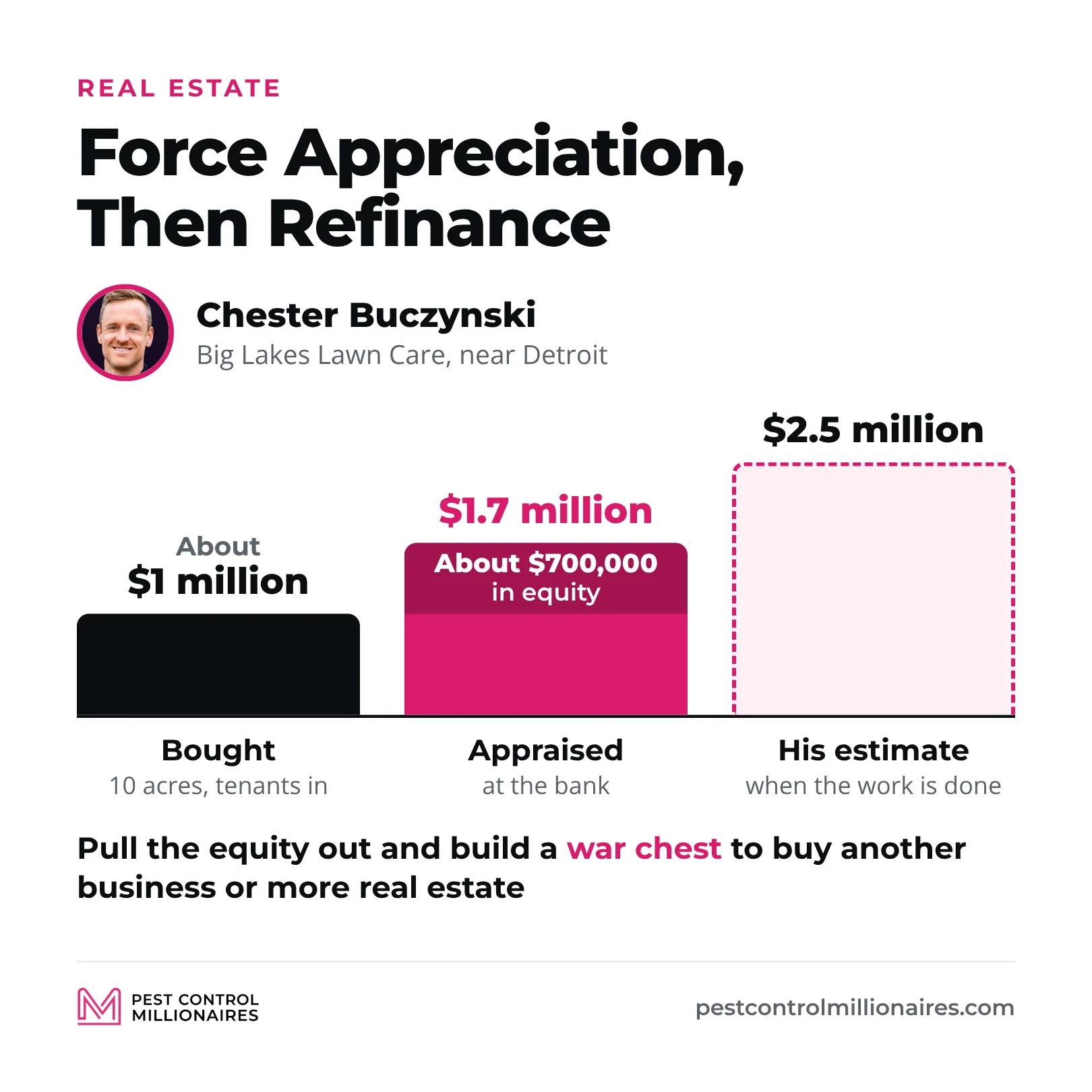
Three years ago he bought a 10-acre commercial property for about a million dollars. The first thing he did was get tenants in, and now it pays him cash every month.
Then it got interesting. He went to the bank and it appraised for $1.7 million, so he has about $700,000 in equity sitting in there. Now he is pouring concrete, painting, and building, and he thinks it will appraise for $2.5 million when the work is done.
Here is the part I wrote down. As Chester put it, “if you can force appreciation in real estate and then refinance it, you can peel a lot of that equity back out.” His plan is to pull that money out and build a war chest so he can buy another business or more real estate.
His big acquisition was a “B minus”
Last year Chester bought a company doing about $3 million, split a third maintenance, a third snow, and a third install. He found it in a lucky way. They lost their only fertilizer tech and called him in a panic to take the work, and he took good care of the accounts. One thing led to another, and the owner offered to sell him the whole thing.
He ran the deal himself, start to finish, and he bought well. But he is honest about how it went. As he told me, “I would rate it a B minus in terms of execution.” The price was great, but the integration was the hard part.
His biggest miss was people. “I underestimated the significance of the relationships that those clients had with those employees that worked at that business that left,” he said. He thought he could step right in and keep those clients himself, but the ties went deeper than he expected. Next time he would pay key people to stay longer through the change, and he would also hire a pro to help with the integration.
He gave every new worker a raise on day one
In a deal like this, most of the crew leaves, and Chester says it is normal to lose half to 70% of the staff. New owner, new pay system, lots of fear. So he did something simple on the very first day.
He met every field worker in person and shook every hand. Then he gave each of them a raise on the spot, whether that was fifty cents or a buck fifty. The message was clear: welcome, and I want you here. That small move buys a lot of goodwill when everything else feels uncertain.
Finding people is a belief system
The seller leaned on a visa worker program, and that did not transfer in the deal. So Chester had to staff a $3 million book of work locally in a rough hiring market, and he says it comes down to belief.
He has a trick for the hard days. He drives home and looks around, and as he said, “all this grass is cut. All these shrubs are trimmed. Somebody’s doing it.” If there were no workers left, it would all be overgrown, so the people are out there and you just have to go get them.
He also calls out the lazy version of this problem. People say hiring is their biggest bottleneck, then they post one Facebook ad and one Indeed ad and stop. That is barely any effort. The math is simple, because a good tech might bill you $200,000 to $250,000 a year. Would you spend $5,000 to find one? Of course you would.
Leadership is the real ceiling
I asked Chester what he is studying these days, and the answer was one word: leadership. He believes it is the lid on the whole business, so to grow the company he has to grow himself first.
We talked about an idea from Alex Hormozi that hit home. Could your team from five years ago run your company today? No chance. So the people you hire now are your future talent, and you have to hire ahead of where you are.
He has also learned to listen more than he talks. He asks his people how they see things, and he says he can feel it working.
Nose in, hands out
This is Chester’s favorite line, and he says it a lot: nose in, hands out. He stays close to the work without grabbing it. When someone brings him a problem, he wants a solution to come with it, because if you only bring problems, you become the one solving everyone’s problems. Then you are babysitting forever.
He even lets his guys fail on purpose sometimes. He used a bike to explain it, and as he put it, “the kid falls on the bike. Get him up, dust him off, put him back on the bike, send him again.” You do not take the bike away, because that is how people learn.
The million-dollar mark is a black hole
We both see the same trap with smaller operators. They hit a million, then stop showing up, then wonder why they are stuck. Chester calls that spot dangerous, and he compared it to a small fire.
At that size the fire is fragile, with a little kindling and a little flame. You have to keep feeding it fast or it dies out. So a million is not a finish line. It is the moment to add more wood, as fast as you can.
He does not want the 4-hour work week
Chester is not chasing balance the way people sell it. He loves the work, so it does not feel like work. His best line on this really stuck with me, when he said, “if I had $100 million in the bank right now, I’d be doing this exact thing.” When you find that, you stop counting hours.
He is honest about the bad days too. About 10% of the month is rough, maybe three or four hard days out of 30. But looking back, he asks, was it really that bad? Usually not. He is still healthy, he still has his family, and he is still above ground.
What I took away
Chester is 35 and swinging for the fences, with more acquisitions in the works. His goal is to be a leader he would not want to compete with, and after a day with him, I believe it.
For a very different read on where lawn care leads, Kirk Slack built one to $3 million and then sold it and started over in pest control for the better margins.
If you are grinding toward your first million, take his lead. Find your bottleneck, keep feeding the fire, and go find the people. They are out there.
Watch the PCM Podcast on YouTube