

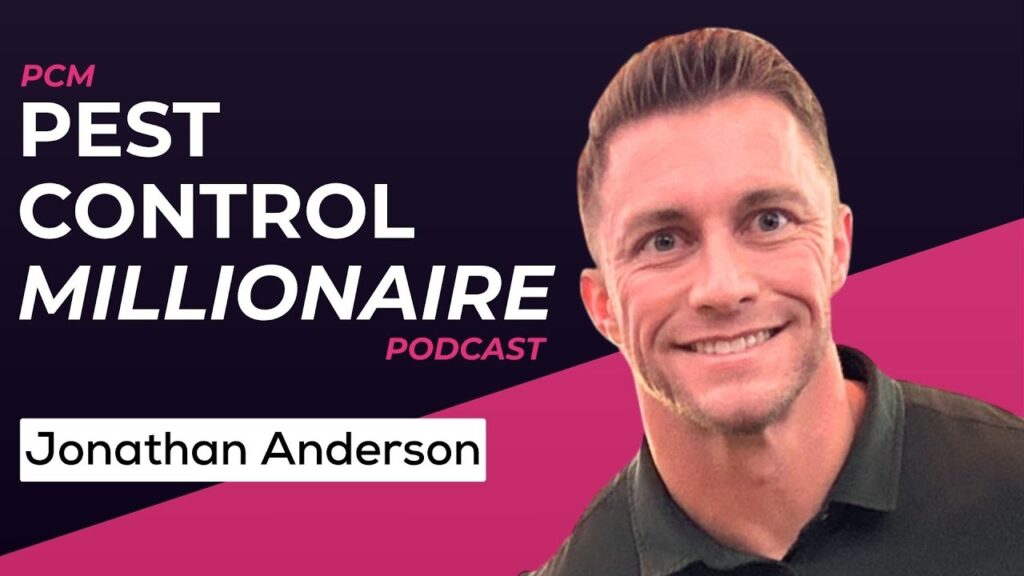
I just got back from Arizona, where it was 115 degrees the whole time. I sat down with Jonathan Anderson, who runs Green Home Pest Control out in Phoenix. We toured his shop, met his techs, and watched a service before we talked.
Jonathan has been in this game a long time. He knocked doors for years and ran a company in San Diego before he started Green Home. Here’s what stood out.
For more conversations like this with top operators, check out the Pest Control Millionaire podcast.
Table of Contents
ToggleOwn your accounts instead of selling them off
Jonathan started in door-to-door sales back in 2004, doing pest control first and then home security for five or six years. He was good at it, but he came back to pest control. The reason came down to ownership.
In home security, you sell the deal and then hand it off to someone else. As Jonathan put it, “I didn’t love how you would just sell that account right away to like ADT or Monetronics and just kind of sell it off. There was no real ownership.”
Pest control works the other way. You hold your own accounts and build recurring revenue that stays with you. That is the whole point of the business.
Sell what you actually believe in
Jonathan said something simple that I keep thinking about. “At some point in sales I think you really have to believe in what you sell.”
He liked home security fine, but he felt better selling pest control, and the reason is real. A customer might never turn on their alarm, but pest control does the work for them. He had more conviction in it, so he sold it better. That holds true for anything you sell.
Slow growth can still beat fast growth
In San Diego, Jonathan ran a door-to-door team and grew fast. Then he moved to Arizona, started over, and made a different choice. He went all in on his website and SEO instead, knowing he would grow slower.
Here is the cool part. After two years in Arizona, he beat his two-year numbers from San Diego. He just barely did it, but the customers were better too. His attrition was lower and the clients were steadier.
Door routes can be tight and full of new movers, and those folks churn fast. His online customers were spread out and they stuck around. He likes that stability, and so do I.
Don’t live in fear of competition
Phoenix is one of the most competitive pest markets in the country, with around a thousand companies by his count. That used to stress him out, but not anymore. “I used to worry about competition a lot,” he told me. “I don’t stress about it as much anymore. There’s plenty to go around.”
It’s a huge market with heavy bug pressure, so there is room for everyone. His advice is to stay with the core things that make you who you are. Do that and you can win in any market.
Get out of your own way
Jonathan is the only owner of Green Home, with no business partner, so for a while everything ran through him. He was the bottleneck, and it was holding the company back.
Then he read the E-Myth, the HVAC version of it, and it woke him up. “I was definitely hurting my business by staying the bottleneck,” he said, because everything had to go through him.
It’s your baby, so you start it and hold on too tight. But you have to let go and delegate, and you have to work on the big picture instead of putting out fires all day. On hiring, he lives by an old saying: hire slow, fire fast. Take your time to get the right person, because it’s still a gamble even when you do.
The sprayer switch nobody talks about
We don’t cover this much on the show, so I asked him about it. Jonathan moved his whole fleet off power sprayers and onto Flowzone backpack sprayers, and he was one of the first in the valley to do it.
The math is good. A backpack saves you two or three grand over a power sprayer on every truck, which helps a lot when you’re building one out and trying to grow. The power is there too. As Jonathan explained, “the PSI that it sprayed with was almost identical to a power sprayer.” He could also mix fresh at every home, which matters in Arizona for scorpions and deep cracks.
His techs pushed back at first, since it was old dogs and new tricks. But once they tried them, they liked not dragging a hose around someone’s yard. He even put electric reels on his trucks so the guys weren’t reeling hoses by hand in the heat. He worried about how customers would see it, but that worry was bigger than it needed to be, and the results spoke for themselves.
Handle the heat head on
It was 115 degrees while I was there, so I asked how his techs survive it. His answer starts in the interview, where he tells people up front what the day looks like. Fourteen homes in 110 degree weather will wear you out, and he wants them to know what they’re getting into before they sign up.
Then he takes care of them with incentives in the summer, baseball games, and lunch on the company. Little things like that break up the grind. They’re mostly residential, so the guys get back in the AC fast between stops.
The family trade-off
Jonathan has five kids, and he’s honest that his business could be a lot bigger. “My business could be probably like twice the size, but I probably would miss out on my kids growing up, too.” He’s not willing to do that, so he picks balance over max growth. That’s a real choice, and I respect it.
