

I get to travel across the country and check out some of the best operations in the industry. Today I’m in Oklahoma City with Brandon Peterman at Elite Lawn Care, and honestly, this is one of the best operations I’ve ever seen.
Brandon started this company 21 years ago. Today they’re running almost 30 trucks. He was kind enough to let us come in, walk the shops, look at the trucks, sit in on a morning rollout, and really dig into how this thing runs. So let me walk you through everything.
Table of Contents
ToggleThe Overflow Shop
Our first stop was their secondary location, which Brandon uses for overflow trucks and training. This building actually used to be set up as an office with everything running out of one end, but now they’ve converted it. The far end is a training area, and the rest is packed with vehicles.
The Isuzu NPR Spray Trucks
Brandon has about 15 Isuzu NPRs in his fleet. Five of them are set up for acreage work, and the remaining nine or so are configured like the first one we looked at. This particular truck runs a four-tank system: 200, 200, 200, and 100 gallons in the back. The whole idea behind the four-tank setup was simple. Four tanks means four different services, four different line items on the invoice. It’s basically a super truck.
When they first built these out, they were running a weed-and-fert tank for Bermuda, a weed-and-fert tank for fescue (they’re in the transition zone down there, so they deal with both grasses), a soil conditioning tank, and a pest tank.
Here’s where it gets interesting though. Brandon told me he doesn’t love that setup anymore. The problem was twofold. First, pay-per-performance didn’t work well with it. Second, the technicians were getting absolutely crushed. Instead of spending 12 to 20 minutes on a property, guys were out there for 45 minutes to an hour pulling four separate hoses from four separate tanks. He said they had a stretch about two years ago where it was over 100 degrees for 100-plus days, and the techs were coming back to the shop completely wiped out. Seven or eight jobs in that kind of heat with no AC break in between was just killing them.
So they’ve simplified since then. Now each hose is color coded to its tank. Tank one, tank two, tank three, tank four. Dummy proof. Fresh water on the side. They keep it clean and simple.
When Brandon first started putting these NPRs together, they were running about $60,000 to $65,000 each. The last one he bought about a year ago came in at $107,000.
The Aeration Setup
They also have a couple of trucks set up strictly for core aeration with a ramp rack, a riding aerator, and a push unit. Down in Oklahoma, they start aerating around the first part of April and can go all through the growing season until about September 1st because of those transition grasses.
The Training Area
Upstairs they’ve got a training space with a couch (Brandon joked it was a casting couch for interviews), a TV, and room for a projector. They try to do company-wide or technician-specific training once a month. Topics rotate with the seasons: transitioning from pre-emergent to fertilizer and post-emergent, shifting back to fall pre-emergent, pest control updates, whatever the crew needs.
What really stood out to me is that Elite has a full-time agronomist and a full agronomic support team. They’ve actually been through two agronomists already, and each one taught the team so much that they started handling a lot of the work internally. Then they hired another guy who Brandon says is OCD about all that stuff. Anytime a technician has a question about lawn care, they can send the agronomist out for a soil test. That’s a serious competitive advantage.
The Acreage Trucks
Brandon runs five trucks dedicated to acreage work, which means anything over 17,000 square feet. Below that threshold, they send a spray truck. Above it, they send a ride-on. The logic is all about efficiency. At 17,000 square feet, it’s faster to pull hose and push a spreader. Above that, pulling hose takes way too long, so you need a ride-on machine.
He uses a mix of Toro Z-Sprays and Steel Greens. I think he said they’ve got about nine or ten machines across five trucks. I already knew what his answer would be when I asked about picking a brand, but I asked anyway. “I could give two shits,” he told me. He doesn’t care about brand loyalty. What he cares about is service department access, how fast he can get a part, and how quickly he can get a machine fixed. He just doesn’t want to steer too far from the stand-on style because that’s what everyone’s trained on. No steering wheel machines.
The acreage trucks carry at least one machine, all the fertilizer bags hand-loaded from pallets at the main shop, two tanks (one for pest, one for soil conditioning), and a refill tank for the ride-on machines.
Here’s the production comparison that blew me away. An acreage truck can cover about 7 acres in a day. A hand-spray truck does about 3 acres. More than double the output in the same 8-hour window.
Fleet Tech: Ravens and Body Cams
Every truck in Brandon’s fleet has a Raven unit installed. But what really caught my attention is that all of their employees wear body cams. Every single one. Audio, video, inside and outside. That’s a move I haven’t seen many companies make, and it’s smart for accountability and liability.
Brandon's Biggest Lead Source
This one is worth the entire article. Brandon’s number one lead source, above everything else, is yard signs. They put a sign in every single yard, every single time they service a house. He told me that at least 50% of their leads and 50% of their customers come from that one thing.
This year they had about 4,000 leads and picked up 3,000 customers. Out of those 3,000 customers, 1,000 came from yard signs. Let that sink in. Half his business comes from a little sign in the ground.
The Main Shop and Office
We headed around the corner to their primary location, which houses the main office, the sales operation, and about 25 trucks. Brandon showed me his office, complete with his accolades on the wall and a poster he strategically tried to get into the background of our podcast recording.
His admin and CSR team sits right outside. On the wall there’s a big map of the entire city. That’s how they used to run routes back in the early days. A few trucks just chasing each other around the city for eight-week cycles. Not anymore. Now they work in quadrants, running 20-plus trucks, which makes a whole lot more sense than having them all crisscross the metro.
They just hired a social media person and set her up right next to their sales and marketing manager so they can collaborate nonstop. Brandon moved out of his old office into a front-facing desk to be closer to the action, and they converted his old office into a conference room.
Moving from EOS to Breakthrough Academy
Brandon ran EOS (Entrepreneurial Operating System) for two years. He had pros and cons to share but ultimately moved to Breakthrough Academy, which is based out of Canada. He’s been at it for about six months.
The way he described it, EOS felt like you were trying to figure life out yourself, brainstorming what you need to do for the next 90 days. Breakthrough Academy has six pillars that all connect: sales, marketing, hiring, and so on, with goal setting and review as the sixth. The system automatically tells you what your 90-day priorities should be based on where you are in each pillar. You don’t have to guess.
They meet weekly. Every two weeks is a one-on-one coaching session, and every two weeks is a group session, so it ends up being weekly contact.
The Pantry That Pays for Itself
Brandon stocks a full pantry for his guys. Snacks, drinks, everything. It looks like a small convenience store.
Here’s the backstory. Before they had on-site fuel, technicians would leave the shop every morning and drive out of their way to their favorite gas station. Some would go three, four, five miles off route and sit there for 30 to 45 minutes buying food and hanging out. When Brandon ran the numbers on the labor cost (they were hourly at the time, not pay-per-performance like they are now), he found the pantry cost about 50% of what they were losing to gas station detours.
Today they spend almost $50,000 a year on food for the team. And it saves the technicians money too.
The Shop Floor
The main shop is where the trucks park at night, where the guys clock in, eat breakfast, and see their scorecards. Brandon has pay-per-performance data posted so every technician can see what revenue they produced per day and what their paycheck looks like. They look at it every single day.
Guys clock in on their phones now, but one of their KPIs is working within a certain number of hours, so tracking is still tight. There’s ice, waters, and ice chests in every truck.
The shop has a dumpster strategically placed for end-of-day trash runs, a fuel station, and a product refill bay. At the end of the day, every truck pulls in, gets gas, dumps trash, refills product, and parks. That’s the routine. The on-site fuel tank is 1,000 gallons and they fill it twice a week. Imagine 28 trucks trying to hit the local gas station. They tried it. It didn’t work.
The Shift to Ford Mavericks and F-250s
Brandon is moving away from the NPR setup and leaning toward smaller trucks. The four-tank, four-service NPR was overcomplicating things and burning out technicians. Between that and pay-per-performance considerations, they decided to break it back to just two services per truck.
With only two services, they don’t need the big NPR anymore. The newer trucks cost about $54,000 each. He bought seven this year. Paint, wrap, super springs, tent, two tanks, and a spreader. Quick turnaround. He takes them to Mako for about $600 and $300 to slap a sticker on it.
He also showed me his original two trucks. Truck number three was his first work truck, purchased as a mowing truck. Truck number 16 was his second. They picked those numbers on purpose so people would think they had a bigger fleet. Brandon laughed and said he told himself he’d never actually have 16 trucks. Now they’re pushing past 28. He’s keeping both originals. They’re nostalgic. He’s even thinking about putting a lift kit and semi wheels on the old F-550 and turning it into a show truck.
Elite also just started a pooper scooper company this year. They’ve got three trucks for it, one fully active with the other two ramping up. Brandon’s playing with it to see if it can grow. I love that kind of experimentation at scale.
Inventory and Fleet Value
At any given time, Brandon has about $150,000 in product inventory on hand. It can spike to $350,000 or $400,000 depending on the time of year and what they’ve pre-bought. They run through two and a half to three semis of fertilizer every month. This year alone, they’ve already bought about 10 semis and are about to order three more.
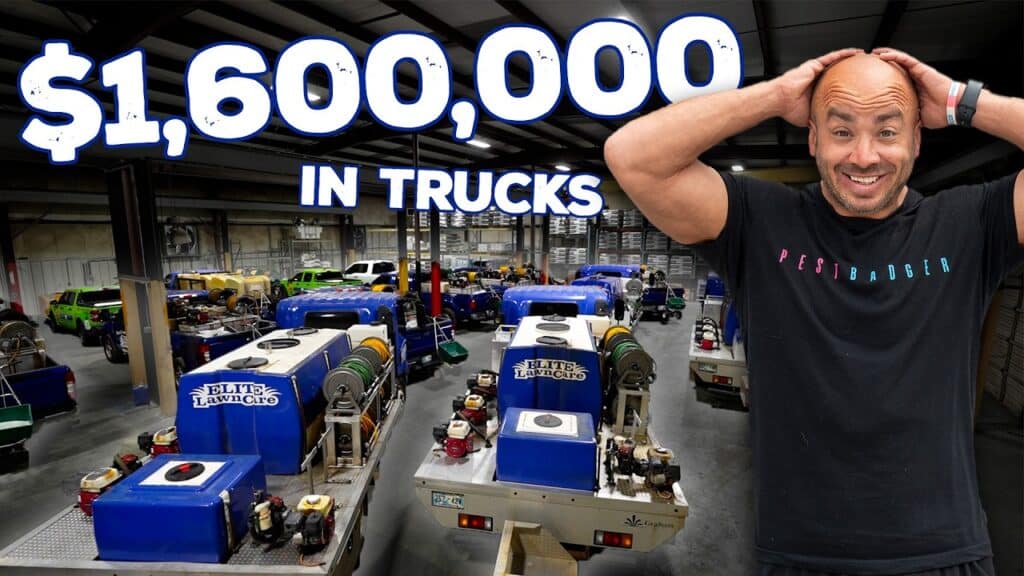
As for the fleet, he owns over $1.6 million in trucks. About a million worth was sitting in the main shop alone the day we visited.
The Outdoor Training Ground
This might be one of the coolest things I’ve ever seen at a lawn care company. Brandon has a full mock property painted on the concrete outside the shop. There’s a simulated front yard with a sidewalk, a mailbox, a boulevard strip, a driveway, a walking path to the front door, and a backyard section behind a gate. The whole thing.
When they’re getting ready for pre-emergent season (they spray blue), they train every technician out here for up to a month before they ever touch a real property. They start with plain water, work on technique, timing, accuracy, and hose management. They time every tech per thousand square feet. They station people at corners to make sure hoses aren’t dragging through gardens or rubbing against brick.
Only after a tech nails it on concrete do they put blue in the tank and head to an actual lawn. That level of training discipline is rare and it shows in the quality of their work.
The Morning Rollout
We got to watch the morning rollout, and it was dialed in. Every truck lines up at the gate. An inspector checks tires, tread wear, tank leaks, truck organization, spreaders, and equipment. Quick visual rundown. They also communicate with each tech about anything specific on their route for the day, like a client who needs a certain time window or a pest job that requires a specific product.
They’ve been doing this daily inspection for about four months. Before that, they were getting too many flats in the field from worn-down treads nobody caught. Now the tech holds the company accountable for getting repairs done, and the company holds the tech accountable for reporting issues. It’s a good system.
Profit Numbers and Philosophy
Brandon knows his numbers cold. Last year they hit about 16% profit, which he called a bust because he was experimenting with a lot of new things. This year they’re aiming for 20% and currently sitting around 21 to 22%.
But here’s what I found really interesting. He’s more focused on COGS than profit percentage right now. They want COGS under 28%, which includes all labor, damages, and materials.
His profit philosophy is different from what you usually hear. He doesn’t want to be at 25 or 27% profit because in his mind, that means he’s wasting 5 to 7% of the company’s money. It could have gone toward growth, a better hire, or something else that builds the business. His comfort zone is 16 to 20%. If it creeps above that, he feels like there’s money on the table he should have deployed. He mentioned a mutual friend of ours who targets 15% growth and 15% profit as their sweet spot. Brandon’s version of that same idea is 16 to 20%.
From the operations to the truck setups to the training to the facility itself, Elite Lawn Care is running one of the most well-thought-out operations I’ve ever walked through. Twenty-one years in, and Brandon is still iterating, still testing, still improving. That’s what it takes.
I hope you guys found this as valuable as I did. If you want to become a Pest Badger partner, click the link below, fill out the form, and we’ll reach out to you. See you in the next one.
