
Before I get into the list, I want to say something upfront: don’t get stuck on the regulatory side of things. Yes, you need to get your licenses. Yes, every state is different and there are nuances. But it’s pretty straightforward to look up your state’s Department of Agriculture, do some research, and go get it done. Don’t let that be the thing that holds you up. There’s never going to be a perfect time to start. Ever.
Now, there is some nuance here. If you’re trying to launch a pest control company in a cold market and it’s October or November, that’s probably not the best timing. If you’re in a warmer market, it might not be a bad idea at all. But the biggest thing is to just start now. Start today.
So here are the top five things you need to focus on when starting a pest control company in 2025.
Table of Contents
Toggle1. Marketing
This is the number one skill you need to learn as a business owner, especially when you’re first starting out. From zero to a million dollars, nobody knows who you are. Even if you’re in a big metroplex, you could be doing $15 or $20 million in revenue and still only have a small share of the market. You have to get good at marketing now, not later.
You also have to do a lot of testing early on. And I know what you’re thinking: “I don’t have a big budget.” That’s exactly why I want to walk through some things you can do with $500 to $1,000, or even for free.
Door knocking. This is how I started both my companies. Early on in lawn care, I was just knocking neighborhoods. I was probably underpriced, but as a young kid, people were signing up because I was out there pushing the lawnmower, cutting grass, keeping it relatively inexpensive. It still worked. When I started my second company, I obviously had more skills at that point in my career, but in pest control and lawn care, it’s the same thing. Knocking doors is a great way to generate leads and sales. And it’s free. Doesn’t cost anything but time.
Postcards and door hangers. If you have $1,000, go spend a couple hundred on each. Like Alex Hormozi says with the law of 100: pass out 100 postcards, hang 100 door hangers, knock on 100 doors. The more you do it, the better you get. Maybe you already have some jobs, so start working those neighborhoods.
Social media. Facebook, Instagram, TikTok, Snapchat. All great sources for leads, and they’re all free. You can go through your contact list and reach out to friends and family to ask who needs pest control or lawn care. Pick up your iPhone. Start creating content. Take still pictures with captions. Make short videos. Get yourself a tripod. Hire a friend or a family member to hold the phone for you. These kids are pretty good at phones these days, even at six years old like my daughter.
Start posting on Facebook, Instagram, Snapchat, TikTok. You can even edit your videos inside TikTok now. It’s all free, and it’s an easy way to generate a lot of leads. Just remember: your content has to be shareable. Make it fun, make it engaging. Be crazy, be goofy, have fun with it. Jump on the trends that are working right now. Add the music that’s working right now. You want people to share it.
And as you get customers, always ask for referrals. We’re still talking about marketing here. These are all things you can do for free. You have to start getting really good at offers and testing what works and what doesn’t. You might have a door hanger that crushes it on one street and totally flops on another. Flip them around. Keep testing.
Marketing Books Worth Reading
Here are some books, in no particular order, that will give you a strong foundation: $100M Leads by Alex Hormozi. Tons of valuable information on how to generate leads. $100M Offers by Alex Hormozi. Really great book on creating offers, like the ones you’d put on your door hangers. Jab, Jab, Jab, Right Hook by Gary Vaynerchuk. Fantastic book on social media. It’s older, but still very relevant. Guerrilla Marketing by Jay Conrad Levinson. I love this book. Lots of guerrilla-style marketing ideas in there. Magnetic Marketing by Dan Kennedy. He’s the OG. Great book. No B.S. Direct Marketing by Dan Kennedy. Another solid one. The Ultimate Sales Machine by Chet Holmes. I know I have this book somewhere, I just can’t find it. But it’s a great read.
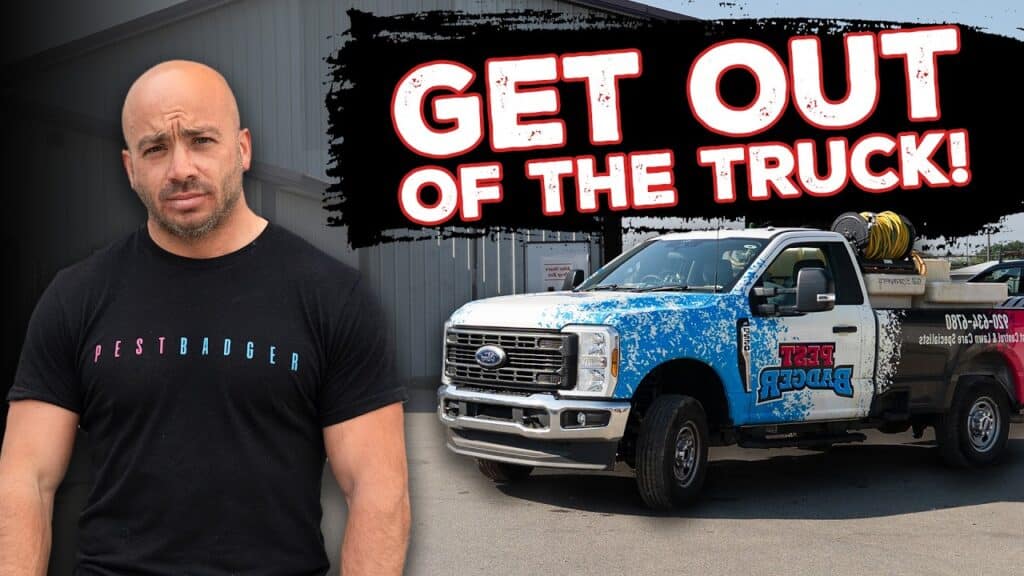
2. Get Out of the Truck
This is more of a mindset than anything else. Your number one job is marketing, and your number two job is sales. You have to get out of the truck as fast as possible.
Earlier in my career, I wasn’t great at sales. I’m not saying I’m the best now. I’m still evolving. But sales is a skill I had to learn. Once I started figuring out how to sell, I got really good at marketing. And once I figured out the sales side, I went from a 20 to 30 percent close rate all the way up to 50, 60, 70 percent just by getting better at sales. At that point it was like, “Oh, I’m creating all these leads, and now I’m actually closing them.”
I have a whole other video series on how to get out of the truck and what revenue you should be at before you do it. But as a mindset, just keep this at the front of your brain: get out of the truck as fast as possible and keep being a marketing machine and a sales machine.
3. Know Your Numbers
This isn’t going to happen overnight, and I’m not saying it needs to be your number one focus. But it’s something you have to learn to understand. You need to know how to read a P&L. You need to know how to read an income statement. Maybe just start by learning the benchmarks in the industry.
Obviously you’re going to hire a CPA and an accountant to help with this stuff. But even then, you should know some key numbers. Things like your COGS percentage, overhead, direct labor, indirect labor. How to calculate profit. Whether you should have a line of credit. How to manage debt. What interest rates look like.
This is stuff I had to learn, and I’m still constantly learning and trying to get better at it every day. I have accountants that work for me, I have big firms, I have a full-time CFO who teaches me a lot. But you have to start learning how to read these statements so you can track your numbers.
Another good one that just popped into my head: know your break-even point. Know how much you’re making on each job just to break even, and then add your profit from there.
4. Software
You have to have software. I get it, I started on Google Sheets back in the day. But you guys have no idea. I literally talk to hundreds of companies, and I know a lot of people in the industry running big businesses with no software. They’re still on Google Sheets. I’ve seen the craziest things: note cards in baskets, pins on maps. Yes, it works, and I understand it. But they’re losing so much time and energy doing it that way, and trying to pull any meaningful data out of all that is damn near impossible.
Make sure you have a good CRM. One that can handle your routing, your sales, your marketing, your finance. Something you can tie back to QuickBooks for job costing analysis and reports whenever you need them. Off the top of my head, some good options: Gorilla is going to be up there, FieldRoutes is going to be up there, and for lawn care maybe Service Autopilot.
Make sure your software is scalable. I cannot stress this enough. Switching software is a nightmare. I’ve done it three times and it’s not fun. Find one that’s built for your industry, that can grow with your company. If you buy the cheap one, you’re going to get cheap results and you’re going to end up having to build a lot of your own workarounds. Pay a little more for something scalable. That’s the bottom line.
And I know people will say, “Well, it’s $500 a month.” Okay. But how much time are you spending in Google Sheets trying to build out all this stuff in the back end? That’s a pain in the butt. Every software is going to have its quirks, and none of them are going to be perfect for you. But just find one and make it work.
5. Build a Team
This ties back to getting out of the truck. I have another video about your first hire, which I believe should be a CSR. You need someone answering those phone calls. I see it so many times. I’ll talk to someone who wants to grow, and I’ll ask how many calls they get a day. They’ll say four, five, six calls. But they’re up in an attic, or they’re servicing a house, or they’re in a basement doing a foundation exclusion, and they can’t answer the phone. They’re missing four to five calls a day. That’s roughly $2,400 in revenue, just off the top of my head.
So hire a CSR first. Have them manage your calls and your routing. Get super efficient. It buys back your time. Let’s say you’re spending 40 hours in the field and 20 hours answering phones. Now you can take those 20 hours and put them back into servicing, generating income, and scaling the company.
Then you’re going to hire technicians, and you’re going to spend a lot of time training both your CSR and your techs. You need to build SOPs. There’s cool software out there like Trainual that helps with that. Record videos teaching them how to do the service, how to talk to customers.
Building a team is an ever-evolving skill. No matter where you’re at in business, you’re always going to be building teams. Even at the executive level, you have to learn how to interview executives. But early on, you have to learn how to hire technicians, CSRs, salespeople, and everything in between. Eventually some of that will come off your plate, but right now, building the team has to be a top priority. It’s always going to be one of your number one jobs as a CEO.
Just Get Started
Those are the top five things you need to focus on when building a pest control company in 2025. And my final word is this: don’t get stuck. There’s never going to be a right time.
I have a buddy who, and if you’re watching this, I love you, but he sat there for a year. I kept telling him: just get started, just get started, just get started. You’ll figure all this stuff out as you go. But he waited 8 months, 12 months, a full year. Now he’s finally launching his business and he wants to go faster and faster. But this whole time, he could have been servicing jobs and getting new leads while he figured out the rest.
So stop waiting. Start now.
