
If I were starting a service business in 2026, I’d do fewer things than most people. Not more. I wouldn’t run a bunch of ads on different platforms. I wouldn’t offer 10 services. And I wouldn’t try to cover an entire city.
I put hard limits on what I’m allowed to focus on because constraints force better decisions. When you remove options, execution gets simpler and growth stops feeling so chaotic.
I’m going to walk you through the exact framework I’d use to build a service company that will actually scale in 2026. If growth has felt messy for you, this is how you simplify it. Let’s start with the first decision, because everything else builds on top of it.
Table of Contents
TogglePick the Right Model
Growth gets easy or hard based on the model you choose. The wrong model forces you to start over every single month, every single year. The right model compounds month after month, year after year.
If I’m starting over in 2026, I’m choosing a service with recurring revenue built into it. That’s just what I like. The customer naturally just needs you. Pest control, fertilization and weed control, cleaning, pool services, HVAC, maybe garage doors with memberships.
The reason they work is because it’s predictable revenue. Let’s say your average customer is worth $1,000 a year. You only need a thousand customers to build a million-dollar business. Not an entire city. Just a few neighborhoods. If you pick the right model, everything else literally gets easier.
I have two friends that are great examples of this. One owns a big landscaping company. The other owns a really big wildlife company. They both crush it. They have lots of cash, great businesses, and they live really good lives. But every single year it’s the same story. They sell a couple million dollars worth of work, and then every single year they have to start over from zero. Those conversations almost take the wind out of their sails, and then they have to get motivated again to go do it all over.
I’m not saying you can’t build a wildlife model that has recurring revenue built into it. I’m just saying pick a model that has the recurring revenue built in from day one. When you go sell a million dollars in your first year, maybe you start year two with $800,000 already on the books. Pick the right model and everything else gets easier year after year because it just compounds.
Branding Matters More Than You Think
Going into 2026, I don’t care what people say. Branding matters. People will judge what they see before they judge what you do.
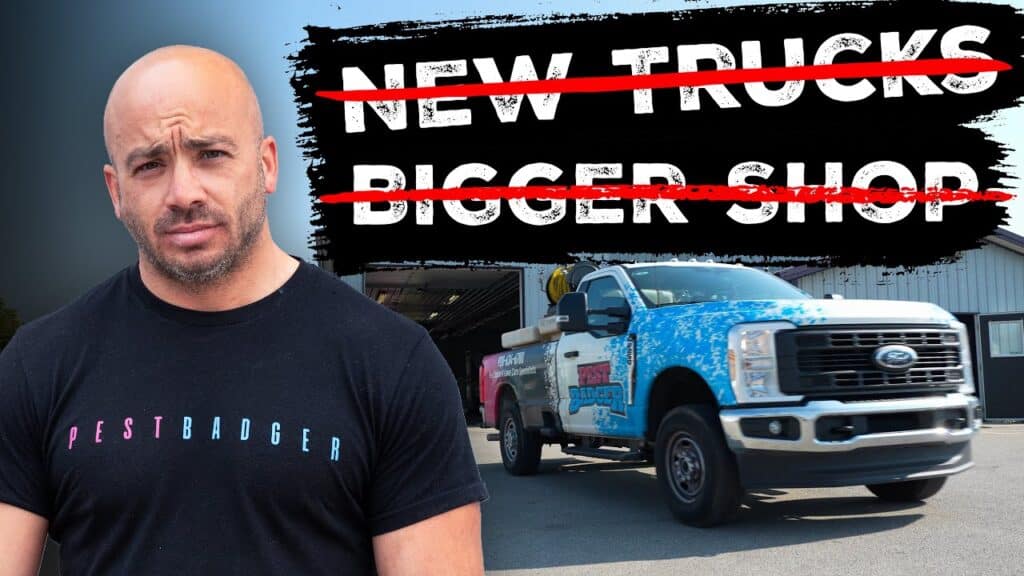
If I’m starting over in 2026, I’m building a professional brand even if I only have one truck. And it’s four simple things: a really good business name, a clean modern logo, a wrapped truck, and a simple one-page website that converts. You don’t have to spend $10,000 on this thing. Just make sure it’s built to convert. Drive traffic to it, convert at a high rate, and bring in good leads that turn into new customers.
Brand creates trust. And trust affects your pricing. It affects your hiring. It affects referrals. It even affects how fast you grow. If you look small, you get treated small. If you look legitimate, people just assume there’s a competent person or team behind the brand.
Now, recently I’ve gotten a lot of pushback on the wrapped truck thing. People say they haven’t seen a better ROI from a wrapped truck versus one that’s not wrapped. And there are thousands of cases out there that show differently. But almost every single time I see this pushback, it comes from a door-knocking company. If 90% of your leads come from door-knocking, maybe you don’t need a wrapped truck. Maybe you just need your name on the side. But if you’re really good at marketing and you want to show up everywhere, from door hanger campaigns to EDM campaigns to wrapped trucks, all this stuff works together and you’ll see a massive increase in ROI.
Easy example. If you see three white trucks coming down the road with names on the side, they kind of just blend in. That’s common sense. But if you see a bright blue truck with green lettering, or a big orange truck with white lettering, fully wrapped with your name and logo on the side, you’re just going to stand out. If you’re in a neighborhood and people see a white truck, they drive by and don’t even look twice. But that same orange truck? It’s a head turner.
I don’t care what anyone says. To all the door-to-door companies, this isn’t a knock on you. You guys are awesome at what you do. But maybe you’re not so great at marketing. And I’ve had so many door-to-door companies come to me to learn marketing for exactly that reason.
Our number two lead source in 2025 was referrals. And referrals start with your brand and your truck. It all works together.
Mindful Marketing
Now let’s get into marketing for 2026. This is also where I see a lot of operators, especially early on, really mess up. They try to do everything at once. They spread themselves thin. They burn money. And they don’t know what worked and what didn’t.
Here’s the rule: diversify on organic attention and focus on paid attention.
If I’m starting from zero, I’m going to show up everywhere I can for free. Facebook, Instagram, TikTok, YouTube Shorts, Google Business Profile, local paid Facebook groups. Everywhere you can possibly show up for free. Maybe spend a little money on door hangers and EDM, but almost all of it is free. This just builds familiarity, and familiarity builds trust. They say someone has to see you almost 21 to 24 times in 2026 before they’ll even buy from you. So if they’ve seen you everywhere for free, that just lowers your acquisition cost naturally.
But for paid ads, I choose one channel. Just one. Here’s why. When you have a small budget and you split it up, you split your data. You learn slower. You’re constantly guessing. One channel lets you learn fast, optimize fast, and scale with confidence.
I see so many people who tried Yelp, tried Google, tried Facebook, and they say nothing worked. That’s because they had a small budget and split it across three platforms. They didn’t let any of them work. They didn’t go all in on one. And then they’re frustrated with the platform or frustrated with the marketing company, saying nothing works.
Stick to one service and one platform. If you have emergency-type calls like pest control, HVAC, or plumbing, Google’s probably the place to be. If it’s more story-driven, maybe Facebook. If you’re selling to a younger audience, maybe TikTok. If you’re going into dense neighborhoods, maybe direct mail. But choose one channel, one focus. After you hit a million, then you can expand. Not before.
LTV to CAC Is the Game
One of my favorite topics going into 2026. LTV to CAC has always been the game and always will be the game.
Before I spend money on ads, I want to understand one thing. And I want you to understand this one thing too. How much is a customer worth versus how much does it actually cost to get them? That’s LTV to CAC. LTV is lifetime value of the client. CAC is customer acquisition cost.
Here’s the simple breakdown. If a customer is worth $1,000 and it costs you $100 to get them, that’s a really great business. If it costs you $400 to get that same $1,000 customer, that’s a very stressful business. I want my lifetime value to be several times higher than what I’m paying to acquire a customer. That’s why I stick to one channel. That’s why I care about retention. That’s why I care about recurring revenue. Because when the math works, it just works.
Let’s use pest control as an example. The average customer is worth $1,000 and they stay with you for five years, and you paid $100 to get them. That’s a 50-to-1 LTV-to-CAC ratio. That’s an extremely good business. Let’s say they stay three years and you paid $100. That’s 30-to-1. Still really, really good. But in any service you choose, I like to see a minimum of 20-to-1.
Once the numbers make sense, everything else gets so much easier. If I know I have a machine in front of me and every time I put in $100, it spits out a customer worth $1,000, how many times do you put that $100 in? You just keep turning that money over as fast as you possibly can.
Route Density Is Where Profit Shows Up
This is where I see a lot of operators lose a lot of money without even realizing it. They try to cover the entire city. They feel like they’re growing, but it’s literally killing their margin.
If I’m starting over in 2026, I pick two or three zip codes and I dominate them. Just like I talk about in the book.
Early on, I made the same exact mistakes. I was selling everything to everyone because it seemed like it made sense and it felt like I was growing. I was driving all over, chasing every single job. But the result was long days with no money.
Pick a service that has route density and it changes everything. If you’re driving 20 minutes or an hour between stops, you might do four, six, eight jobs a day. But if you’re driving three minutes between stops, you can do 15, maybe 20. It’s the same truck, same tech, same hours, but completely different income and completely different stress level.
I see this happen all the time. People run Google search ads, which are great. They’re getting leads and selling jobs. But the jobs show up all over the place. They’re driving from one side of town to the other and only getting three or four jobs a day. Five years later they have a bunch of jobs scattered across the whole city and they’re losing so much time driving between them.
Narrow down your marketing on any platform. Get super focused on route density because that’s where profit really shows up.
Keep Sales Simple
Most service businesses over-complicate sales. They explain way too much. They talk about things the customer does not care about.
Sales in 2026 should be super simple. We’re not trying to pressure anyone. We’re not trying to sound clever. We’re just guiding the conversation in the right order.
Here’s the process. Clarify why they’re calling in. Confirm their problem. Understand what they’ve tried in the past. Explain your solution. Stack the value of your guarantees. Create urgency. Handle their concerns if they have any. Get the card on file and schedule the job.
Same order, every single call, every single time. Don’t make this complicated.
When sales are simple, conversions just go up naturally. I’m not offering 10 different services or 20 different packages. That makes everything so hard. One, maybe two services that are easy to sell. Make it easy for the customer. Solve their problem, sign them up, and go take care of it. That simple.
Speed Is Massive Leverage
In 2026, speed wins almost every single time. Speed is one of the biggest advantages you have right now.
Customers expect fast responses. Not later. Not tomorrow. Now. The days of not answering your phone, not calling someone back, not responding to a text message or an email, those days are long gone. The days of fulfillment taking one to four weeks? Also gone.
Here’s the truth. Speed beats better ads. Speed beats better branding. Speed beats better pricing. The first company to respond almost always wins. If you tighten up response time alone, you’ll outperform bigger companies with bigger budgets.
Here’s a good example. Last year, my heat went out in my house in the middle of winter. Picked up the phone, called the first company. They didn’t answer. I didn’t even bother to leave a message. Called a second company from Google. They didn’t answer. Left a message. I think they called me back the next day. The third company actually answered the phone and said, “Hey, we’re really busy right now. We can’t get someone there for a week.” At least they answered. Called the fourth company. They said, “Hey, we can get someone out there today.” I didn’t care what it cost. I had no heat. They got someone here the same day. They answered their phone and came and solved my problem.
That’s what people are looking for. It’s 2026. People don’t want to wait. They want the problem solved. Especially if it’s HVAC, plumbing, a bad pest problem, bed bugs, whatever. They want it handled now. If that first company could have gotten someone out the same day or the next day, I would have chosen them. I was just looking for someone to solve my problem right then and there.
Retention Is Almost Everything
Getting new customers is getting harder, obviously. But keeping them is almost everything.
Retention buys you time when ads slow down or when seasons change. Simple things matter. Check-ins. Follow-ups. Referral systems. Basic appreciation. A company that keeps customers doesn’t have to panic. They don’t have to start over every single year.
Here’s a good example. I have a friend with a really good company. Every single year, his churn rate was 50%. So every year he’d have to start over, grow by 50% more just to break even from the previous year, then grow another 10 to 20% on top of that just to have actual growth. He really, really had to focus on retention.
There are some really good books out there that’ll help you with attrition. Stay ultra focused on not just getting new customers, but creating a system inside your business that rewards current customers so they want to stay longer. Because that is the game.
If you can sell a million dollars in year one and show up in year two starting with $800,000, $900,000, $950,000 already on the books, that’s a great business. Average churn in our industry is typically 20%. If you’re under 20%, you’re doing really good. I’ve seen some companies at 5%. Get focused on attrition. It’ll help you long-term and could save you hundreds of thousands, if not millions, of dollars going forward.
Culture Is Your Recruiting
Technicians in 2026 are getting harder and harder to find. Harder to find than even customers. But you have to remember that your culture is your marketing.
People want to see what it’s like to work for you. If no one knows your culture, you won’t attract good people. Show the team. Show the growth. Show the opportunity from day one. Show them the road map for how to get from point A to point B. Maybe from a starting technician to a certified technician to a branch manager to maybe even a partner or owner. Show them the road map from day one. Sell them the dream.
Hire Before You Think You're Ready
Waiting too long to hire keeps owners stuck. I see it over and over again.
If I’m starting over in 2026, I’m probably going to hire at 50% capacity. Let’s say a route is worth $300,000. Once I hit $150,000 in revenue, I’m going to hire and buy back my time. That gives me time to go sell, time to market, time to build systems, and time to lead my technician.
If you have a little capital, you could probably hire right away. But for those who don’t, that’s where I’d pull the trigger. My time is best spent getting new work to fill that first route, then starting to fill the second one.
Revenue Per Technician Matters
When picking your service business, make sure you have good revenue per employee or per technician.
HVAC and plumbing can be half a million dollars per tech, maybe more. Pest control is $300,000 to $400,000. Lawn care with fertilization and weed control is around $300,000 to $400,000. No disrespect to lawn mowing, but if your revenue per employee is $200,000 for two people, that’s $100,000 to $125,000 per person. At that point you’re just hiring more people to make less money.
Make sure you’re picking a service business with really good revenue per technician.
Get a CRM
I’ve said it a million times in a million videos and a million podcasts. Just get a CRM set up. You don’t have to break the bank. Spend a couple hundred bucks. But you need a place to keep your customers, automatic billing, routing, maybe a weekly scorecard, your marketing calendar. Track the basics.
Then get some automation set up. It’s not optional. This way you don’t have to hire a bunch of people right away. You can automate all the boring stuff. Billing, follow-ups, reviews, reminders, lead responses. Just spend the money.
I talk to so many people who are trying to run everything off Google Sheets and they say, “I just can’t afford the $299.” I promise you, you can’t afford not to spend the $299. I’ve talked to people with big businesses and small businesses whose lives are chaotic because they don’t have a CRM. From day one, bite the bullet and get a good one. It’s that simple.
Document the Journey
If I’m starting over in 2026, I’m documenting the entire journey. People buy from people. They buy from people they know, like, and trust.
I’m literally going to film everything. And here’s the key: it doesn’t have to be good. It doesn’t have to be perfect. You just have to be consistent. You all have phones. Start recording. Buy yourself some better glasses or a couple hundred bucks worth of used gear. Get a cheap GoPro. Film everything from behind the scenes to what you’re doing on the job.
People will get familiar with you. They’ll see you in all the groups, see you on Facebook. You’ll naturally get more clients, more trust, more people who like you. And they’ll want to go along on the journey with you.
You can get a VA to edit or do it yourself, but just get the content out there. I think Gary Vee said by 2027 or 2028, if you don’t have any video content, you’ll be dead in the water. You’ll be obsolete. Start focusing on that right now. It’s never too late.
Scaling Is Just Repetition
Once you see all of these things work, you literally just repeat it. Another technician. Another truck. Another zip code. Scaling is repetition. You don’t have to reinvent the wheel every single time.
Pick a model. Do the simple things that work. Repeat over and over until you get to one, two, three, five, ten million in revenue. And just keep repeating.
If I had to start over in 2026, this is exactly how I’d do it. Clear constraints. Simple decisions. Consistent execution. That’s how you build a real service business from scratch in 2026.
Frequently Asked Questions
What’s the best service business to start in 2026?
Recurring-revenue residential services with a tight playbook: pest control, lawn care, pool service, HVAC tune-ups, window cleaning. Each has $500K-$1M owner-operator potential within 24 months and a clear path to acquisition exits. Avoid one-time-job businesses (handyman, junk removal) unless you have a strong path to recurring.
How much money do I need to start a service business?
$15K to $50K depending on equipment intensity. Pest control runs $25K-$40K, lawn care $30K-$60K with mowers, window cleaning $5K-$15K. Add 3-6 months of operating cushion on top — undercapitalized starts kill more service businesses than bad operations.
Should I quit my job before starting a service business?
No. Run the business nights and weekends for 60-90 days to validate demand and prove you can sell. Quit when you can match 30-50% of your current income from the side business. Most failed service businesses started with full-time commitment before validated demand.
What’s the fastest way to get customers for a new service business?
Door knocking + Google reviews + Google Local Services Ads. Door knocking pays the bills in week one, reviews unlock free organic visibility within 90 days, and LSAs deliver inbound leads as soon as you’re verified. Skip Facebook ads and SEO until $200K — they’re too expensive at startup scale.
What service business is hardest to scale?
Cleaning services and handyman work, because labor is the entire product and turnover is brutal. Pest control, lawn care, and pool service are easier to scale because the customer relationship is recurring and the tech work is teachable. See our scaling comparison.
