

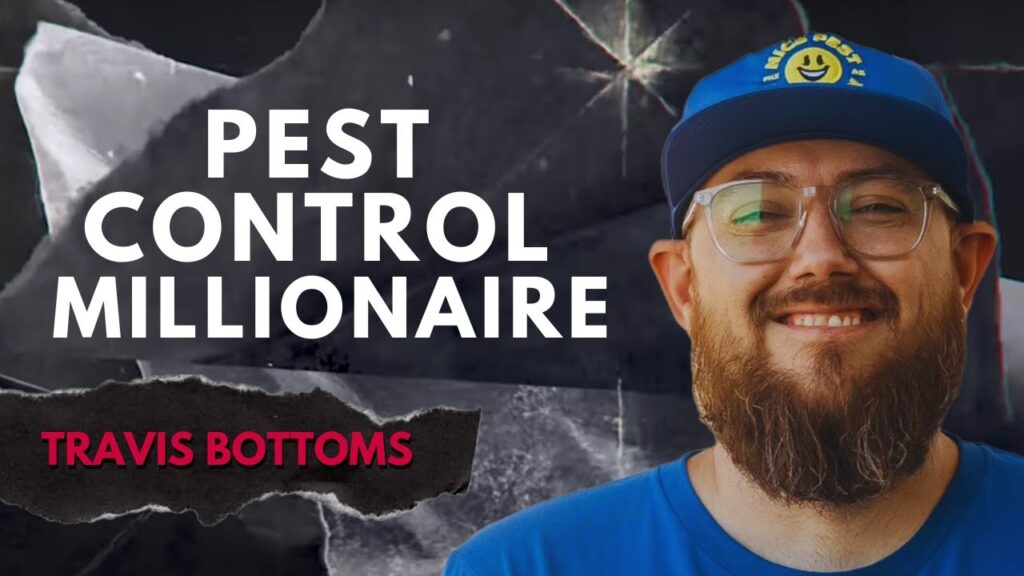
I met Travis Bottoms a few months back, and after that I saw his name everywhere. He owns Nice Pest Control out in Mesa, Arizona, and he showed up to our talk straight from his truck, still out grinding. I loved that.
Travis launched Nice in September, and by the time we talked he had over 500 accounts, all of them online with no door knocking. Before that he spent years working his way up to COO at a big company. So he has seen pest control from the tech seat and the top seat.
Here’s what stood out.
This interview is part of the PCM Podcast. For another fast first-year build, read how Ashton Walden built a $700K pest company in year one.
Table of Contents
ToggleHe picked his company name from data
This was my favorite part, because Travis didn’t guess his brand. He dug into the numbers instead.
At his old company he pulled the customer data and found that 82% of their customers were women. Then he read the reviews and counted the words people used the most. “Nice” was number one, “courteous” was two, “polite” was three, and “friendly” was four.
So he named his company Nice and pointed the whole brand at one group: women between 25 and 45. The colors, the voice, and the videos are all built for them.
As Travis put it, “if that’s something that that demographic values I want that to be the automatic thought when somebody sees me.” Most of us pick a name we like, but he picked a name his customers already loved.
He learned the whole roadmap before he started
Travis went from technician to COO in about five years, and he ran a $20 million business for someone else. That gave him the full map before he ever opened his own doors.
He told me each level felt like the same job at a bigger size. As a service manager he trained techs, and as a regional manager he did the same thing with branch managers. As COO he did it with department heads. The meetings, the KPIs, and the P&L were all the same, just bigger.
So when he started Nice, he didn’t have to ask a forum when to hire a service manager, because he already knew. He built a full plan with hiring marks at each stage, and that head start is huge.
Door knocking didn’t fit his brand
Travis is not against door to door, and he knocked his first month and brought in 40 accounts. Then he stopped for good.
Part of it was retention, since door sold accounts cancel more. The other part was the brand, because his logo says Nice in big letters. He said it plain: “if somebody comes up and pounds on a door at 7:00 at night with a big freaking nice across their chest… are we really nice?”
It didn’t match, so he found another way.
His top three if he started over today
I ask every marketing guest the same thing: if you started fresh today, where do you spend? Travis gave me three answers.
One was branding, and as he said, “if you have a crappy brand it doesn’t matter how great your service is.” Two was Clicky for referrals, which has pulled over 250 referrals since September on its own. Three was content on social media.
Then he said something I agree with hard. On Instagram there’s a like button, a comment button, and a share button, and most owners say like or comment matter most. Not Travis. “For me it’s share,” he said, because he makes content people want to send to a friend, and that share turns into a referral.
For free reach he leans on influencers, paying them through Clicky and giving them free service. Right now he has 25 of them, and as he told me, “my market reach in my area is over a million followers.” For paid, he only runs Instagram retargeting ads.
He hires the person, not the resume
Travis has hired plenty of smart people who couldn’t connect with a customer, and he stopped doing that. Now he hires on personality.
His logic is simple, because pest control is an easy job to teach but being a good human is not. In his words, “I can teach you how to spray bugs but I can’t teach you how to be a good person.” That one stuck with me.
Train all ten steps or it falls apart
Travis shared a training rule I’m going to steal. Say you have a ten step process, and you only train eight of them because you don’t believe in the last two. Now your trainee does six, and the person they train does four. It drops every time you skip a step.
This is also how he fixed attrition at his old company, which lost 36% of its accounts every summer. He made small changes, like keeping one tech in one area, and he got it under 20%. Small things made a big difference.
Stickers and balls for the kids
Travis hands out little smiley balls and “Tech in training” stickers at every stop, and it sounds small but it works.
His customers are mostly moms, and what makes a mom happy is happy kids. So he makes the visit great for the kids, and mom remembers him for it. It’s the same idea as the book Unreasonable Hospitality. We all spray the same bugs with the same products, so the experience is how you stand out.
Stop overthinking and do the work
This is the one I want every owner to hear. Travis sees people stuck in analysis paralysis, where they read and plan and never move.
He sees it with influencers, where people try three, give up, then ask why it didn’t work. Meanwhile he started with a handful and is chasing 100. He sees it with reviews too, and when Google pulled 11 of his, he didn’t panic. He posted about it, asked his fans for help, and got four new reviews in a day.
His point is blunt. Stop staring at the problem and go get more customers, because the rest sorts itself out.
Where he’s headed
Travis has big goals for the year, with 1,500 new accounts, over 2,000 recurring customers, and a million in recurring revenue. In five years he wants to be in five states, with Texas first.
Watching him work, I believe him. He’s still in the truck, he still hands out smiley balls, and he built a real brand on purpose instead of by accident. That’s the takeaway. Do the work, and build it on purpose.
