


Last updated: April 2026 Understanding your pest control target market is the foundation of every successful marketing strategy. If you want to grow your pest control company, you need to understand exactly who you’re marketing to.
I’m not talking about saying “homeowners” and calling it a day. I mean really understanding the people who are calling you. What keeps them up at night? How should you talk to them?
After building Pest Badger into a $10 million pest control company, I’ve learned that your branding is only as strong as your understanding of the target market for pest control services in your area. Let me break down the pest control customer demographics and explain exactly who’s buying pest control services and how to position your company to win their business.
Defining and dominating your target zip codes is the foundation of the Pest Control Millionaires program.
Table of Contents
ToggleThe Residential Demographic: Who's Actually Calling You
Here’s something most pest control owners don’t realize: most home services are bought by women. In our company, 60% of the people reaching out to us are women. This isn’t a small difference. It completely changes how you should be marketing.
Our target demographic is women between 35 and 55 years old. Upper middle class. Typically in the $300,000 to $600,000+ household income range.
A lot of them are dual income families with kids and busy lives. Think soccer moms running from practice to practice, managing fundraisers, juggling work and family responsibilities.
We also serve very affluent one income households, but these are usually people who run businesses themselves and just don’t have time. They’re looking for peace of mind.
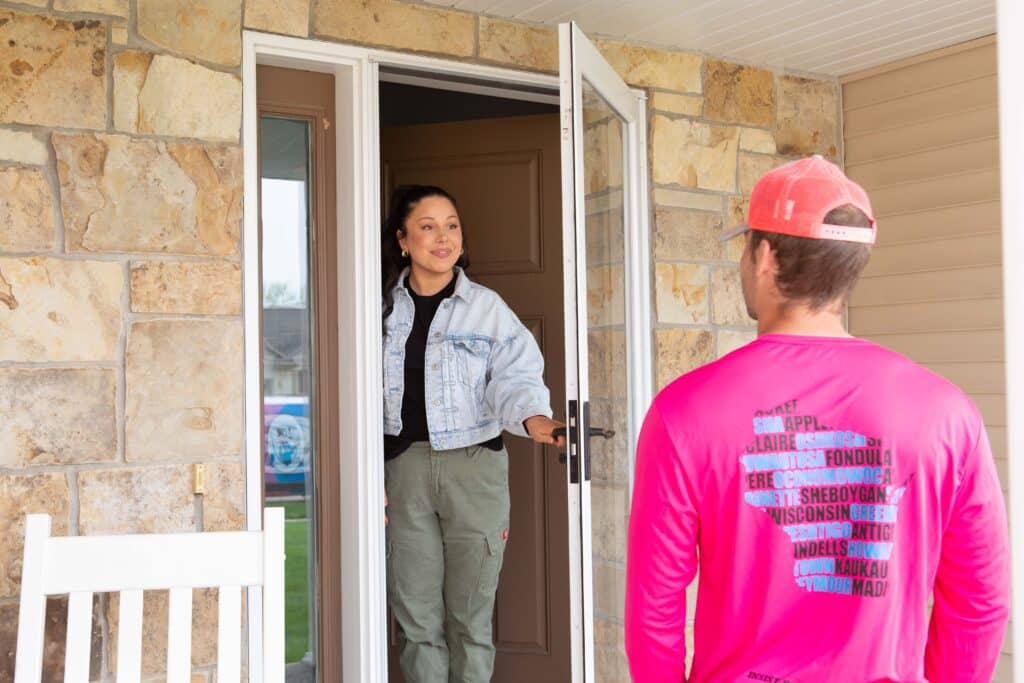
Picture this: Sally Jones down the street. She lives in a really nice neighborhood, somewhere between 35 and 55 years old, has a couple of kids, and lives a busy life. That’s our target market. That’s who we’re speaking to in all our marketing.
Commercial Is a Different Beast
On the commercial side, the demographics flip almost completely. About 80% of our commercial contacts are male, and about 20% are female.
Most commercial properties are managed by a maintenance director or someone who owns that division of the company.
We do have some properties like HOAs that are run by women, but the majority of facility managers are men. This matters because your messaging needs to be completely different between residential and commercial, and between male and female buyers.
What Actually Keeps Your Customers Up at Night
Think about the mom who’s the caretaker of the household. She’s responsible for keeping her kids and pets safe. Here’s what she’s worried about:
- Mosquitoes that could carry diseases and ruin outdoor time
- Roaches that are disgusting and embarrassing if guests see them
- Bed bugs that could infest her kids’ rooms
- Termites eating away at her family’s biggest asset (their $300,000 to $600,000 home)
- Lawn and landscape pests destroying the expensive landscape they’ve invested in
Her home is her number one biggest asset, and she wants it protected. She wants to enjoy her outdoor oasis without bugs ruining it. She also wants to keep up with the Joneses next door. If her neighbor has pest control, she’s going to want pest control too. It’s about curb appeal, presentation, and making sure the house looks good.
The Income Sweet Spot: Upper Middle Class
I like targeting the upper middle class more than the super affluent. Here’s why: the extremely wealthy households often have someone else managing all their services. You’re dealing with a property manager or household manager, not the homeowner.
These ultra affluent people are never home. They’re always traveling. It’s hard to market to someone you can’t reach.
The upper middle class is home more often. They’re busy, but they’re reachable. They’re moms running fundraisers, working, managing households. They just don’t have time to deal with pest problems themselves, and they want to make sure their house, pets, and family are safe.
Commercial Psychology: It's All About Budget
When it comes to commercial clients, the psychology is completely different. Most commercial decision makers are looking at cost first because they have a budget they need to work within. This is one reason I don’t love doing a ton of commercial work. It’s harder to command premium pricing.
The commercial clients worth pursuing are the ones willing to spend a little bit more for premium service. Those are the ones we go after.
Want help applying this to your company?
Join the Pest Control Millionaires Facebook community where 3,800+ owners share what’s actually working in their businesses right now.
Crafting Your Messaging: Find the Real Pain Points
Here’s a strategy I use that most pest control companies miss: research the specific pain points in each neighborhood you’re targeting.
Even within one area, different neighborhoods have different concerns. Here’s how to find them:
- Jump into ChatGPT and ask it to look up the average income in specific neighborhoods you’re targeting
- Ask it to pull all the one star reviews from pest control companies in those areas
- Analyze the data. What are people complaining about?
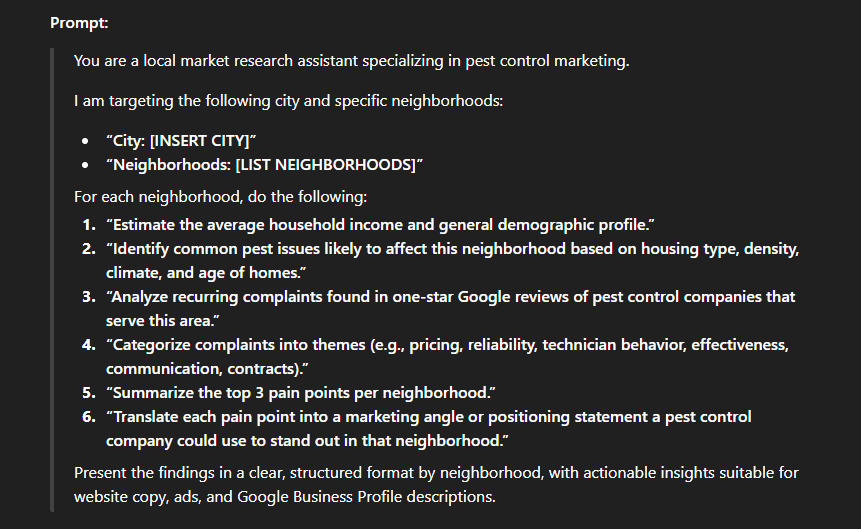
In one neighborhood, the one star reviews might all complain about door knockers. In another area, it might be technicians leaving gates open. Create your messaging around those specific pain points.
This level of specificity in your branding makes you stand out. You’re not using generic pest control marketing. You’re speaking directly to what matters in that specific market.
Where Your Customers Actually Spend Their Time
Our customers today (and this might change as younger generations age up) are primarily on Facebook. They’re in mom groups, scrolling through their feeds, staying connected with their community.
Yeah, they might be on TikTok or Instagram, but they’re usually just scrolling mindlessly, not looking for services. Facebook is where they’re actually engaged and where they’re more likely to see and respond to your marketing.
What Happens When They Finally Call
Here’s the reality: calling a pest control company is a necessary evil for most people. They don’t want to have to make that call. They don’t want to need pest control at all. But when they have an issue, they need it solved, and they need it solved fast.
The biggest frustration I see from consumers is that pest control companies don’t answer their phones. They don’t go to voicemail. They don’t respond to emails. Customer service is terrible. Technicians don’t lock gates. Companies don’t communicate when they’re coming out. They just show up unannounced.
Here’s what wins customers over:
- Answer your phone. This is the biggest one.
- Tell them you can be there within 48 hours (or whatever your realistic timeframe is)
- Let them know they’ll get a text message before you arrive
- Send a picture of the technician who’s coming
- Have the technician knock on the door and introduce himself
- Find the problem, take pictures and videos
- Solve the problem right then and there
- Show the customer what you accomplished at the end of the service
You solve their issue and move on to the next one. Simple as that.
Communication: The Secret Weapon Most Companies Ignore
Communication is the number one thing customers are looking for in the service industry. Not just pest control, but across the board. It’s also the number one area where companies fail.
If you communicate well and solve their problems, you won’t have any issues. It’s really that simple.
Most of your competitors are terrible at this. If you can master communication (confirming appointments, sending updates, showing up when you say you will, following up after service), you’ll immediately stand out in your market.
The Bottom Line
Understanding your target market isn’t just about knowing they’re homeowners who need pest control. It’s about knowing Sally Jones is 45, has two kids, lives in a $400,000 home, spends her time on Facebook in mom groups, and worries about termites destroying her biggest asset.
When you understand your customer at that level, your branding writes itself. Your messaging becomes specific, resonant, and effective. You stop throwing generic marketing at the wall and start speaking directly to the people who are ready to buy.
If you want to dive deeper into building a brand that dominates your local market, Jake, Danny, and I wrote our book, Zip Code Kings. It’s essentially the pest control marketing bible. We cover everything from branding to SEO to paid ads to building systems that scale.
And if you’re looking for a community of pest control owners who are actively implementing these strategies, join our owner community. We’ve got over 3,800 active pest control owners in there asking questions, sharing what’s working, and helping each other grow. It’s the best place to get real time feedback and learn from people who are in the trenches with you.
Read the Ultimate Guide: the pest control branding breakdown Mastering pest control target market is one of the most impactful things you can do for your business.
Frequently Asked Questions
Who is the ideal target customer for a pest control company?
The ideal pest control customer is a homeowner aged 30-65 with household income above $60,000 who values their property and prefers professional services over DIY solutions. Targeting this demographic yields higher close rates and better lifetime value.
How do I identify my pest control target market?
Analyze your best existing customers by demographics, property type, neighborhood, and service frequency. Look for patterns in who stays longest and spends the most. Use this profile to target similar prospects through your marketing channels.
Should pest control companies target residential or commercial customers?
Most pest control companies should start with residential customers for faster sales cycles and consistent recurring revenue. Add commercial services once you have reliable systems and capacity, as commercial contracts require more specialized expertise and longer sales processes.
How do I identify the most profitable pest control customers in my market?
Start with route density data. Pull addresses of your most profitable accounts, drop them on a map, and look for ZIP codes where you already have 5+ customers. Those neighborhoods are the cheapest to service and easiest to dominate. Cross-reference with median household income above $75K and homes built before 1990 — older homes have more pest pressure and homeowners with budget. See our pest control executive KPIs guide for the metrics that prove profitability.
What is the average lifetime value of a pest control customer?
A residential quarterly customer typically runs $400 to $700 per year and stays 3 to 5 years, giving you $1,200 to $3,500 LTV. Commercial accounts can hit $5K to $50K annual revenue with 7+ year retention. Push LTV higher with annual prepays, mosquito add-ons, and bundled wildlife or termite — operators using bundles see LTV jump 40 to 60%.
