Top 10 Things I Wish I Knew Before Starting a Pest Control Company

Table of Contents
Hey guys, my name is Jonas Olson. I’m the CEO and founder of Pest Badger. We went from zero to an eight-figure business with 20 locations in just six years. And looking back, there are a handful of things I really wish someone had told me on day one.
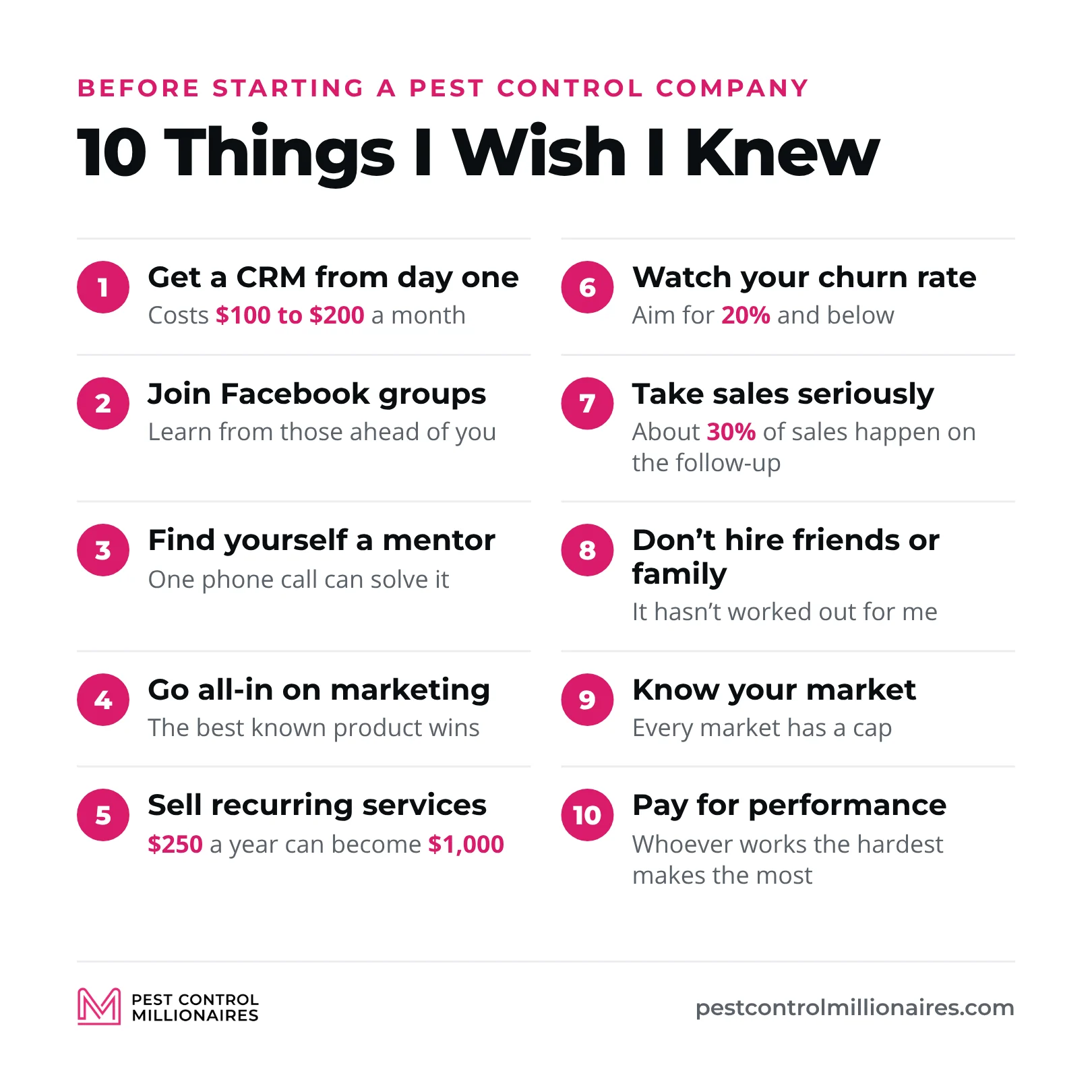
So here are the top 10 things I wish I knew before starting a pest control company.
1. Get a CRM From Day One
There are so many things you’re missing out on without a CRM: accurate data, customer retention, and a simple way to track and invoice all your customers so you’re not leaving money on the table.
I know what you’re thinking. A hundred, two hundred bucks a month sounds like a lot when you’re just getting started. I get it. I started the same way, on Google Sheets, trying to figure out how to route all my customers, handle billing, all of that. And it got to the point where I was beating my head against the wall because I couldn’t schedule people accurately. They’d call in wanting to reschedule, I’d push them to the next day, and then after work I’d go back into my Excel spreadsheet trying to move everyone around.
One night I was online and had the thought: there has to be something better out there. And there was. CRMs have been around for 20 years, and I’ve been using one for a long time now. But even so, I still talk to people today who are running their businesses off Microsoft Excel or Google Sheets.
It’s not just about scheduling, either. Scheduling is great functionality, sure. You can move people around, you’re not missing any customers, and you’re billing everyone. That’s a huge one right there: billing your customers on time, preferably the day of service, and getting all credit cards on file. Think of it from the customer’s perspective. If you haven’t charged their card in a while and then suddenly invoice them two quarters later for $300, they’re going to be upset. I’ve actually had people cancel because I wasn’t billing them on time.
And then there’s the marketing side. With a CRM, you have all this data you can use to go back and resell old jobs or upsell customers on the next service. One marketing campaign can pay for the entire year of your CRM.
Early on in the business, you don’t think about these things. You’re in the truck all day doing the work. You come home at night, start billing, forget some things, and it’s just hard. Long days. A CRM buys back your time. It’s going to cost you $100 to $200 a month, but it’s very simple: you can’t afford not to use a CRM.
2. Join Facebook Groups and Find Your Tribe
Having the same type of business-minded people around you is huge. Early on, I didn’t have a lot of these groups available. But as they started to become popular and I got into them, I started to grow.
You can learn a lot from what other operators are doing out there. If you’re not already in some of these groups, make sure to join. There are some really good ones. Just learn from the people who are already doing it, who are already ahead of you.
3. Find Yourself a Mentor
Find someone who’s been there and done it. Someone who’s built the company you’re trying to build. Reach out to them. A lot of these business owners love to help and give back. If you reach out, the odds of them actually answering are pretty high. Me included. Get their email, contact them on Instagram, Facebook, DM them.
When I found my first mentor, I had joined a CRM that had a mentorship program, and I got lucky and found one of the best mentors in the country.
A good mentor can save you so much valuable time and money just with their experience. I can think of a few examples where I was having a really rough time trying to figure out a problem, banging my head against the wall. You make one phone call, one text to that person, and they have it solved because they’ve been there and done it. They know the black holes of the business and how you can improve. They typically know the KPIs you should be hitting. You can match your KPIs to theirs and try to hit those goals.
And if you find the right person, they’re going to know about marketing, sales, lead generation, hiring, recruiting, all of it. Even if you have to pay them $1,000 or $1,500 or $3,000, maybe even $5,000 a month, if you find the right person, it could change your business, your mindset, and everything. Literally with one phone call.
4. Go All-In on Marketing
If you’re under a million dollars in revenue, the only thing you should be doing besides servicing is getting your name out there. Make sure every single person in your neighborhood and your city knows who you are.
You can have the best service in the world. This is what my mentor told me. But if no one knows about you, it doesn’t matter how great your service is. It’s not the best product that wins. It’s the best known product that wins. That was a mindset shift I had to make.
Here’s what that looks like practically:
Wrap your trucks from day one. Early on, I didn’t do this right out of the gate. I should have. It’s literally a rolling billboard that every customer and every person driving by is going to see. You look professional immediately.
Lawn signs. Have a sign at the end of the curb for all your customers. People driving by can see that you service the property. They might not know you yet, they might not trust you yet, but if they know their neighbors, they’re going to trust their neighbors, and that trust transfers to you.
Door hangers. Super simple. Have your technicians or yourself do nine rounds: two houses to the left, two houses to the right, and five across the street. Target every single one of your customers’ neighborhoods. If you have 100 customers and you do nine rounds and pick up just one new customer each time, that’s an additional 100 customers.
It’s simple stuff, but you have to do it consistently.
5. Sell Recurring Services, Not One-Time Jobs
Early on, I fell short on this too. I was selling one-time jobs and quarterlies. Probably 95 to 100 percent of our services were all one-time, whether it was spring, summer, or fall. We’d have a thousand people on the front end getting summer sprays and a thousand on the back end getting fall sprays. So each customer was only paying us about $250 per year.
When you put them on a recurring service where they’re getting treated every quarter, or monthly, or bimonthly, that customer goes from $250 a year to potentially $1,000 per year. Your lifetime value more than triples from year one.
Today, I’d say 99% of our services are on a quarterly or bimonthly program depending on the location. That way you’re not constantly scrambling to find new customers. Even though you’ll still be looking for new ones, having that base of customers who stick around makes everything easier. Which brings me to my next point.
6. Watch Your Churn Rate
A lot of people don’t watch churn, and this is something I learned probably too late. But I’m glad I learned it.
Churn rate means how many customers drop off per year. If you have 100 customers and 20 of them leave by the end of the year, you’ve got a 20% churn rate, or 80% retention, however you want to look at it. Keep that number as low as possible.
I have friends with 50% churn. That means every single year, they have to replace half their customer base before they can even start growing. That’s brutal. You want to be at 20% and below. I’ve heard of companies doing 3, 4, 5%, depending on location. If you’re in a market with a lot of turnover or heavy door-to-door competition, your churn might run a little higher.
There are a lot of ways to improve churn, and a lot of it comes down to the onboarding process. Set the right expectations up front: whether they’re going to see bugs or not, what the first service is going to look like, what it looks like after. Follow up with the customer the day after service or a couple days later. Check in at certain touch points throughout the year to keep them engaged. Make sure your technicians are doing a great job. Provide great service.
You can’t stop people from moving. You can’t stop people from losing their jobs. There are things in the marketplace you just can’t control. But keep an eye on that number every single year and come up with ways to improve it.
7. Take Sales Seriously
This is probably one of my favorite topics to talk about, and it’s what I missed early on. You as the owner are probably always going to be the best salesperson because you’re super convicted in yourself and in your product. The challenge is teaching others to do that alongside you.
Having a script for every single CSR or salesperson makes it super easy and scalable. That’s something I wish I had learned early on.
About 30% of your sales will happen on the follow-up. So having a solid follow-up process is critical. And then having scripting up front for every one of your CSRs, technicians, or sales guys to follow can take your close rate from 30 or 40% up to that 50, 60, 70% range where it should be in pest control.
Because here’s the thing: it doesn’t matter how many leads your marketing agency gets you if you can’t close them. That’s not their fault, even though it’s easy to say, “I’m just getting crappy leads.” You have to go back and listen to your sales process. Get real trainings in place so you can start scaling.
8. Don’t Hire Friends or Family
I had to learn this the hard way. I’ve had to fire family members. It’s not fun. My mentors told me not to hire friends and family. I did it anyway.
I think as entrepreneurs, these are the first people we go to because we know them, we trust them, and we think, “Hey, we’re going to build this thing together.” We hire friends and family to come in and run the office, run the sales team, run the service side. But through time, it never works out. There are a lot of conflicts, and sometimes the business grows bigger than what they’re willing to grow. You eventually have to let them go.
Not all the time. But from personal experience, I would never go back and hire friends and family again because it hasn’t worked out well for me.
9. Know Your Market
Every market has a cap. Know the service you’re going to offer and know the market you’re in. I had to learn this the hard way too.
I’d see my friends growing faster than me and I couldn’t figure out why, because I felt like I was just as good or even better than they were. I kept asking, what’s wrong with me?
Every time I talked to my mentor, he wouldn’t say it directly, but he’d bring it up as an example: there are some really good operators out there who are just in the wrong market or selling the wrong service. If you put that same person in a different market, they could do bigger things.
That’s exactly what happened to me. My market was tiny. When I say tiny, I mean my town was like 14,000 people. It was maxed out. So I had to put myself in a tough situation and move into a new city two hours away. And it gave me a whole new opportunity with hundreds of thousands of people to go shine. I put myself in a market with way more potential, and the business took off like a rocket.
10. Pay for Performance
This one is a big one for me. Early in my working career, I worked at a union job making really good money. But there were people who had been there a lot longer, were supposedly more skilled, and made way more than me. I outworked them by 10x. And it drove me nuts that they got paid more than I did.
So my philosophy became: I don’t care if you’ve been here a month or two years. Whoever works the hardest makes the most money.
Pay for performance does exactly this. It also controls your labor costs. You don’t have guys driving around randomly, sitting on the clock, watching YouTube between jobs, because they’re not getting paid for that. They’re getting paid per job. Every time they go out, complete a service, and clock out, they earn a percentage of that job. And if they mess it up, they go back and fix it on their own time.
When we first started pay for performance, we did lose some employees. But those were the bad eggs anyway. What we also found is that we kept our best technicians, and the incentives pushed them to perform even better. Our customers got better service. Our techs did a better job. Our technicians started making more money than ever. Ultimately, it set the tone for Pest Badger to scale at a whole new level.
Those are the top 10 things I wish I knew before starting a pest control company. We’re going to deep dive into each one of these topics, so make sure to follow along so we can help other operators just like you.