

Last updated: April 2026
Most pest control owners think the only way to grow is grinding it out with door-to-door sales, spending more on ads, or slowly building one customer at a time. They’re missing the fastest growth strategy in the industry: acquisitions. One operator did 10 deals to build an $11M company. If you want to learn how to buy a pest control company (or really, how to buy pest control company assets, customers, and crews the right way) and shortcut years of organic growth, this is the playbook covering everything from sourcing to integration — including pest control acquisitions, pest control mergers & acquisitions strategy, working with pest control acquisition advisors, and even the pest control business succession planning conversations that often kick off these deals.
I’ve bought several pest control companies. Some deals went really well. Some were disasters that taught me expensive lessons. But every single one taught me something about what works and what doesn’t when buying a pest control business.
Here’s what nobody tells you about acquisitions: buying a company is easy. Buying a company at the right price, integrating it properly, and actually making money from it? That’s the hard part.
I’ve seen people overpay by hundreds of thousands of dollars because they got emotionally invested. I’ve watched deals fall apart in the final week over negotiations. I’ve seen companies lose half their customers and technicians within 60 days of closing because they didn’t have a plan for integration.
I’ve also seen people buy a $600,000 company, integrate it in 90 days, and double their revenue overnight. Buying a pest control company at the right price can be the single fastest way to scale. I’ve watched owners buy into new markets for pennies on the dollar compared to what it would cost to build from scratch. I’ve helped friends structure deals where the seller finances everything and they bought a million-dollar company with almost no money down.
The difference between success and failure in acquisitions isn’t luck. It’s knowing what to look for, how to structure the deal, and how to integrate without losing everything you just paid for.
In this guide on how to buy a pest control company, I’m going to walk you through the complete acquisition playbook. When to buy, how to find deals, what to look for in due diligence, how to structure the offer, and how to actually integrate without destroying what you just bought. Let’s get into it.
The acquisition framework is laid out in detail in Zip Code Kings, the pest control growth book.
Table of Contents
ToggleWhen Is the Right Time to Start Acquiring Companies?
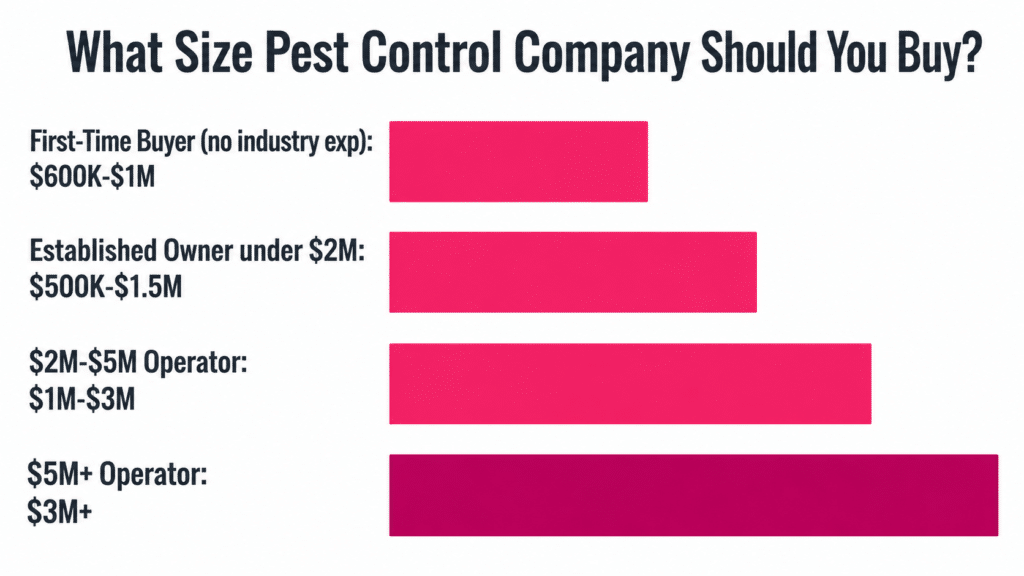
This is different for every company and where you’re at. But even if you maybe have a little bit of money set aside and you want to get into the industry, I would definitely start looking.
I’m looking at $600,000, $700,000 plus at this point. That’s kind of where I would start. But again, if you’re just getting into the industry and you want to buy your way in, you want to buy a million-dollar company, there’s nothing wrong with that either.
Why Buy Instead of Build?
Why would you buy a company instead of just growing your own? I mean, it’s super fast. It could be the most expensive way depending on the kind of deal you got, but it’s fast.
Maybe they’re in your current market and you can gain route efficiency. You like their routes, add them with your routes, you have less drive time. Your technicians are making more money. You have more brand awareness. There’s a lot of good things that come out of buying a company.
Or if you want to buy, say you’re established well in one market but you want to break into another market, the easy way to break into another market is to go buy a company over there in a new market.
What Size Should You Actually Buy?
Is there a size that’s too small? I’d say yes, because a lot of people post that they’re selling their company and they have a route. There’s nothing wrong with it. It is a company. There is some value.
But the problem is they see all these things online that say three times revenue. They keep seeing that online. So they think their $200,000 company is worth $600,000. That’s just not reality.
They tell you three times revenue, but at the end of the day, it’s all based off EBITDA or your cash flow or your profit. It has nothing to really, I mean it does to a point at scale, but revenue doesn’t really matter. It’s just more about profit.
At $250,000, to be honest, I really don’t want it unless I can almost get it for free.
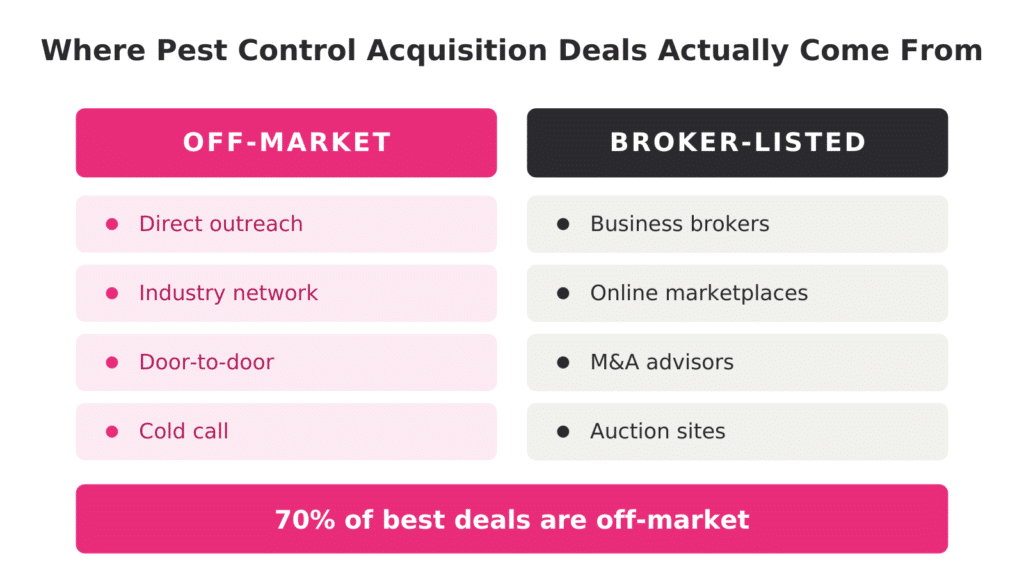
Finding Acquisition Targets: Off-Market Deals Are King
How are you starting to find these acquisition targets? Is it just people you’re familiar with in the area?
In a perfect world, I’m looking for off-market deals. Not deals that got posted by a broker. I paid for deals with brokers. They hardly sell any of these deals because their goal is to obviously get the most for it, but they don’t even want to work with anyone else. There’s a lot of nuances there.
I’m looking for off-market deals first. Connecting with other business owners, connecting with other business owners in the market, having a good relationship with those guys. Maybe I have a mentor, an older guy that’s ready to retire. Having those relationships and networking well in the community with these guys.
How I’ve Personally Found Deals
How have you personally approached that? Are you finding them in person? Are you just reaching out on social media?
I think a few have actually found me. They see me as an heir. They’re ready to retire. They’re a decent-sized company and they just wanted to hang up the hat. There’s nothing wrong with that. A few have found us.
We went into a new market recently in Minnesota and we started an office there already. The storage unit that we were going to rent, one of our guys owned. A pest control company was already in there and they were getting ready to sell. They had told the owner of the storage company, which happened to be one of my guys’ dads. That’s how it got back to me.
I was like, “Well, let’s look at it.” We looked at the financials, which is the most important thing. I said, “Okay, this is where we’re going to base our offer off of.” That’s how we got that deal.
They have found me. I’ve found them. I’ve reached out to people. I’ve sent a lot of direct messages to other people. If you’re listening to this, you’ve probably got LinkedIn messages from me. It’s not really me. It’s a VA doing it for me.
Some of my friends have sent out letters in the past. I’m always trying to look for deals offline.
Why Sellers Come to You
Some of the people are actually coming to you. What would you say the reason for that is? Is it that you have a great brand?
It could be. I’m not positive. Maybe they just heard of us and they heard we were buying or however it might be.
One that I personally reached out to, he actually told me no the first time. Then two years later, he ended up wanting to do the deal.
Another one, kind of the same scenario. He got connected with me. This one took like six months to actually sit down and come to terms and get to know each other one-on-one.
All the deals that I’ve tried to get, a lot of them have fallen through too. Not all of them have worked out the greatest. I’m always learning something through every single one that I’ve done.
The Door-to-Door Acquisition Strategy
Just like doing door to door, like any other sales, I’ve actually walked into people’s offices and asked them face to face if they’re ready to sell.
It didn’t always work out. I didn’t get asked to leave or anything. They were nice about it, but they were just not interested right now. Just like anything else, all they can do is say no. Just putting that in their head. Maybe they’re getting a little older, planting that seed now.
You’re building that relationship so when they do want to exit, you’re the first one they think of.
The Buying Process: From First Call to Closing
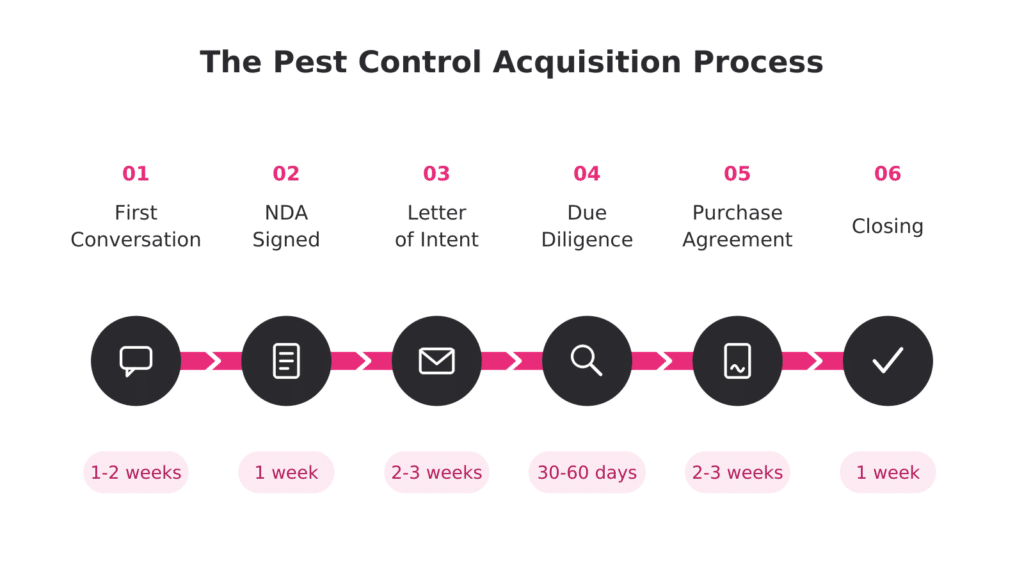
Now you’ve found a company that you want to acquire and there has been some agreement in place. You guys are actually actively talking and it seems like this thing might actually happen. What does that process look like from talking to actually closing this deal?
The First Conversation
The first thing I’m going to do, and I do this myself, is sit down with that person. I want to figure out what their goals are after they retire. What do they want to do for fun? I want to get them thinking about what they’re going to do without this business in their hands. What are they going to do with the money? What are they going to invest in?
All these things I want to know the answers to so that I get them thinking, get them excited about getting rid of this thing that they’ve had for 10, 20, 30 years.
I want to sit down and get to know them personally. Again, I want them to get to know me, my plan for the company, whatever it looks like, my vision for it, and make sure that they feel comfortable with who they’re sitting down talking with.
The Team You Need
What documents or financial records or whatever do you need and should you request?
The first thing that I recommend: obviously get yourself an attorney, like a business lawyer that does this kind of transaction. Not just any attorney. And then the same thing with an accountant. Someone who’s really good at financials, a CFO that does this specific thing, like acquisitions. Not just some random accountant.
They can tell you the numbers, but there’s a lot more nuances to pest control and your industry specifically. Find those two people.
The NDA and Letter of Intent
From there, send them an NDA, just a non-disclosure agreement. It doesn’t really protect you, but it’s basically saying I’m not going to talk about anything and you’re not going to talk about anything. Make them feel comfortable.
Without signing an NDA, they’re probably not going to want to send you this stuff. Get the NDA signed.
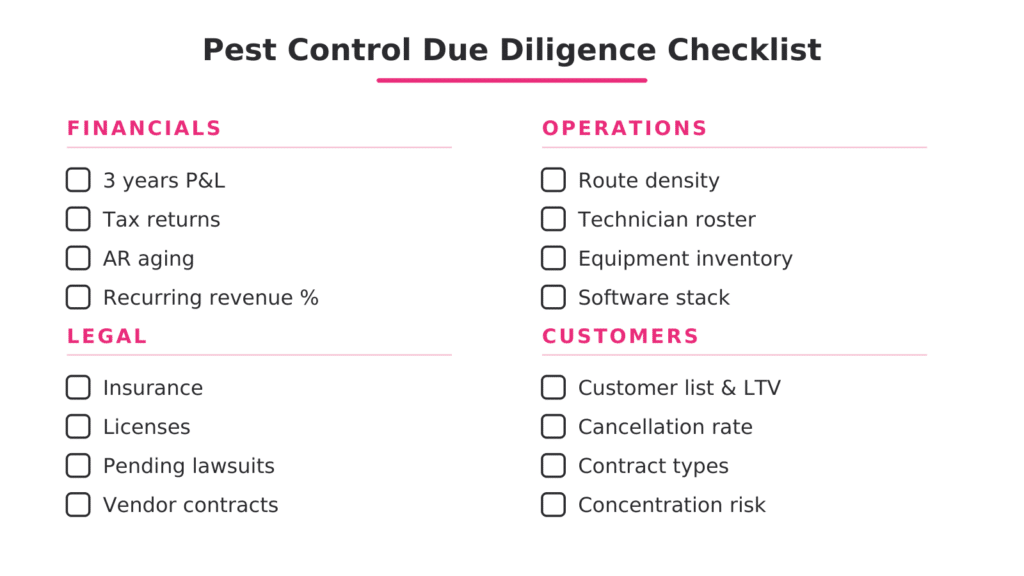
I have a whole list of things that we ask for them. It’s a pretty extensive list, all the things that we’re looking for. We send out the list. We help them go through it if they need help. Have them send over all that data.
It’s like a checklist basically — really, a checklist to prepare a pest-control company for acquisition that the seller fills out so we can underwrite the deal. Once we have the data, then we can send that to our accountant to look at the financials, kind of look through it, see what our offer is, see what we’re thinking there. Again, tying it back to what his long-term goals were.
From there, we’re going to send a letter of intent.
The Due Diligence Checklist
Can you mention some of the things you’re looking for?
Just top of mind: license. Make sure that their company’s licensed. Make sure that they’re insured. Pictures and registrations and VIN numbers of other vehicles. Pictures of all their trucks or equipment, things like that.
Obviously you’re going to want to go look at this stuff in person too, but basically there’s a lot to it.
You’re going to want logins to their lead management software. You want to see how many clients are recurring versus non-recurring. Are they 80 percent recurring? Are they 20 percent one-time? Are they 80 percent one-time versus 20 percent recurring? This is the data that we want to know.
We have to see profit and loss, how much money’s in the bank. There’s a whole checklist that we go through.
At the end of the day, we’re buying their financials, we’re buying their book of business, we’re buying their trucks. You want to see all their equipment. You want to see if they have a CRM. You’ve got to go in there and see actually how many customers there are.
You know, what was the average customer worth? Are they doing all one-times or what do their programs look like?
I think as business owners, we’re always super optimistic saying, “They have 5,000 one-time clients. We can convert all these to quarterly.” It’s just not realistic. We overshoot. Less than half will probably move or whatever.
There’s a lot of nuances to all this. At the end of the day, just be careful of what you’re buying. I’ve been through some good stuff and I’ve been through some bad stuff. We kind of learned a lot of things you need to watch out for.
Red Flags in Due Diligence
When you’re looking at some of this data, some of the financials, what are some red flags?
Lots of AR, accounts receivable. Maybe they’re not really good at their billing. That’s not the end of the world. It’s something you can fix, but just things that could be red flags there.
Obviously they’re not making any money. There is no profit there. That’s obviously a red flag you don’t want.
If they’re all one-times, is it something that you really want to get into? Does it fit your model?
Customer base. Are they older, younger? Where are they at? Actually go in and call some of those customers. Check in on them, see how they’re doing. Go watch some services. There’s a lot of things that you can do.
The Critical Metrics
At the end of the day, really what’s the right way to think about it? I’ve heard some people just say you’re literally just buying their customer list. Is it that simple?
Yeah, really it’s that simple. At the end of the day, there’s a lot to unpack, but basically that’s what you’re buying. It’s mostly goodwill. The whole customer list and then you have some trucks and equipment to go along with it. The majority of what you’re buying is those recurring subscriptions.
Key Risks to Evaluate
There are so many elements that go into evaluating a deal. What are the top things you need to look at?
Revenue growth over the past year, last three years. Are they growing still? Is there room to grow? Have they not been growing and why?
Retention’s another big one. Having a retention clawback in there too. If all these customers leave because the owner’s gone, can you get some of that money back? That’s a payment structure there. That’s a really big one that you want to have and that you want to look at.
What’s the retention look like year to year? Is it 80 percent or greater? That’s what you’re looking for. I think average is about 20 percent churn. If it’s 80 percent retention, you’re in a good spot.
EBITDA margins, like profit margins? That’s a big one.
Key man risk. Let’s just say they have a branch manager and the whole company relies on this branch manager. Is he going to want to stay? Could you lose him? Is there a key man risk? That’s a big one.
Key client risk. Is this whole company based around five or six clients? Maybe this client’s worth a hundred grand, this is a hundred grand, this is a hundred grand. They’re 300 grand for three clients and they’re only doing $600,000 revenue. If you lost those three clients, is there some key risk there?
Single channel risk. Are they getting all their work from customer referrals? From one Facebook platform? If that one thing dried up, would it be gone? Could it not grow anymore?
Market risk. Is there potential for a company to come in and knock on doors? Whatever that thing might be. Is the market still growing? Is it shrinking? Is there a risk there?
Data. Do they have a CRM? That’s a good one. Do they have these things in place? Is it easy to do payroll? Is it easy to manage? Would it be easy to integrate them into your software?
Branding. Has the brand been in the market for a long time? Does it carry any weight? Is their website worth anything? Is their name worth anything? Are you going to rebrand? What does that structure look like? Is it worth rebranding?
Do their vehicles need to get upgraded because they’re all from 2000 and they have 200,000 miles on them? Is it going to take another $200,000 of cash to replace all the vehicles? All the things you’ve got to talk about during negotiations.
The Closing Process
What about the closing process? Before the deal is actually closed, what goes on in that last month?
This is where things get usually a little tense. This is kind of where I let the team go from here. I’m building the relationship, but at the end of the day, it’s really about the numbers.
I want to buy them all, but financially it has to make sense and I don’t want to overpay for things. The people who are really good at this type of thing make the deal happen for you. It’s not their money, so they have to be tighter than if it’s your money.
People who are really good at negotiating, this is their job. I wouldn’t say necessarily beat them up, but just show them the flaws in the company. Those are some tough conversations. I’ve been in those too, but these guys are the experts at that for sure.
Getting a financial plan together for what the offer’s going to look like, what the payment’s going to look like. Is there any add-backs from maybe the owner’s pay?
There’s a bunch of different models that they have to go through to get an evaluation of the company. Most companies, people over-evaluate themselves. They think they’re worth a lot more than what they are. That’s just a tough one. They’ve had this business for 20, 30 years. It’s just a tough conversation for sure.
What Causes Deals to Fall Apart
What would cause a deal of acquisition to fall through? Just in negotiations. You don’t want to pay over a certain price and they’re not willing to budge. Sometimes you just got to walk away.
There was a big deal that I was super excited about and we just couldn’t get there. You don’t want to offend them. It’s hard because even though the company was big, he was over-evaluated and no one would have paid him.
PE companies might pay big multiples, and like Orkin and Terminix, they’re going to pay a premium for a premium company. But there’s a lot of nuances to that too.
We get too emotionally invested in these things and we want to buy them because it looks good in our heads, sounds good in our heads. But on paper we know it’s probably a bad move. We still move forward with it because we’re already invested. We’ve already put this much time into it.
Maybe it’s the competitiveness that doesn’t want to say no and walk away from the deal. We get too emotionally invested and we overpay, honestly.
How Long Does This Take?
What would be the standard duration? Is six months standard or what should you expect?
I think every deal is different. I’ve had people, not me personally, but friends under LOIs for a year and a half. Six months, a couple of years, depending on the size of the company.
If a PE brings an entire team to sit next to your team and does a deep dive into everything about your business and they stay there for six months, they put a lot of time and effort into this thing.
We’ve had deals close in three months. We’ve had deals close in six months. We’ve had deals close in a year. I think every offer is a little bit different.
Want help applying this to your company?
Join the Pest Control Millionaires Facebook community where 3,800+ owners share what’s actually working in their businesses right now.
Integration: Where Most Acquisitions Actually Fail
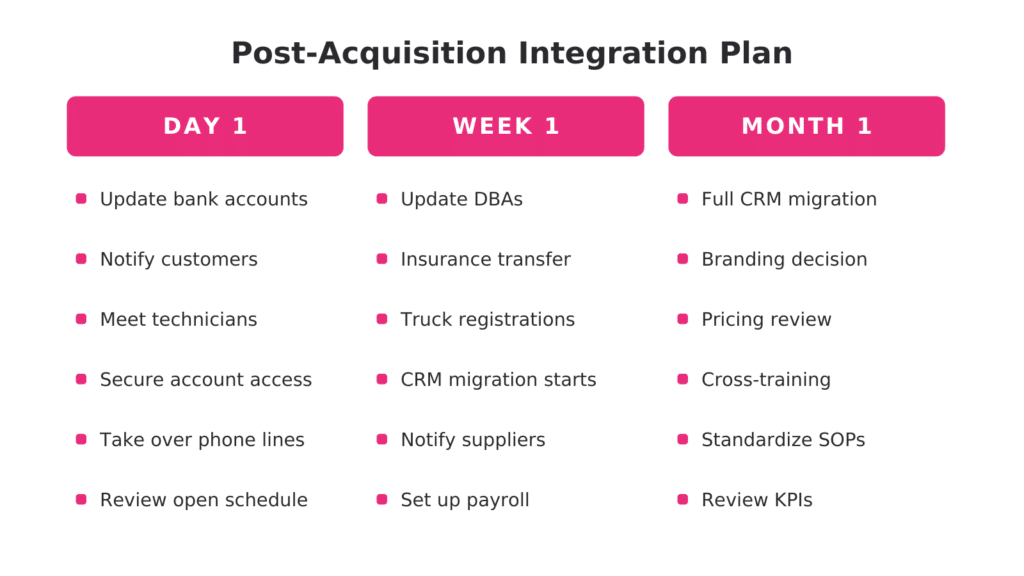
We finally bought the company, we’ve gone through the process. Now, what does that even first week or month look like? What are the things we’re doing?
There’s so much. We have over a hundred things on our checklist that we get through.
Just off the top of my head: think about bank accounts and think about name changes, DBAs, insurance, registration on the trucks. What software are they using? Do you need to change it? Do you want to run different softwares? Technicians, trucks. There’s so much here.
The Branding Decision
Does it make sense to rebrand the companies that you acquire? I say it depends because it just depends how much that brand carries weight in that area.
There’s one instance where I learned probably the hardest: not rebranding right away. Our brand carried way more weight than theirs did. I wish I would have done it sooner.
When I learned that, then I did the next acquisition and ripped off all the band-aids from day one. It was so much smoother than trying to slowly phase it.
But again, that’s not the rule either, because there are some big companies that are out there doing millions and millions of dollars that you just don’t want to change the name. They’ll rebrand with their name underneath it or as a division. It just depends how much weight that thing carries on the brand.
Really, I think the goal should be that you build such a strong brand yourself that it’s the no-brainer to rebrand.
It depends. Every deal has been different. We’ve rebranded all of them up to this point. But I’m sure there’s going to come a point where the brand is so strong in that market that maybe we’ll think about just slow branding over six to 18 months.
The CRM Migration
CRM is obviously a big one. Every company should have a CRM. That’s where we’re managing all of our leads and customers. Are we combining the CRMs or how do you go about that?
For us, we’re just going to rip off the band-aid here too. It’s not fun. I get it, but neither is running multiple CRMs.
In a perfect world, they’re already using the same CRM that you’re using. In a perfect world. It’s just not always perfect.
We’re going to migrate from their CRM to ours. Of course, it’s a challenge too, especially if it’s the middle of springtime, which I don’t recommend.
One deal I can think of just happened to fall right in the middle of May, like busy season. That just put a challenge on everything. Now we have to mass call all these people because it’s springtime. The way they ran their business was just a little bit different. Now we have to try to convert the customer that’s been there for 20 years into a new way.
It’s a lot of customer education too.
The Technician Problem
Next thing is technicians. Are those technicians going to stay? If so, how long have they been there? What’s the team look like? Do they want to stay?
Most of them don’t, honestly. They’re used to running the business one way. They don’t like change. Most people don’t like change. They won’t even give it time. They’re just like, “This is not going to work.”
They’re all mad because the owner didn’t tell them they were selling. In most of the cases, the owner’s not allowed to because they signed an agreement. Then one day they sold. You’ve got to go in and tell the entire team what just happened.
Half of them are pissed off. Half of them are nervous. They wonder if they still have a job. Are they going to get cut? What’s the management team look like? Are they going to get cut because you already have a manager?
There’s just a lot of things to think about. When companies usually get bought out by a big company, most of them don’t stay. I’d say half, less than half will stay at the company.
There’s a lot of things there too. Maybe the pay is different. Maybe they could make more with your company, but they don’t even give you the opportunity to show them how pay-for-performance works. They’re like, “I’m not doing that. I like their way.”
“Okay, well, it’s not going to work for me.” You’ve got to replace them. You’re already under pressure from doing all this. Your executive team is stressed out trying to manage all this stuff.
That’s why I have a checklist to go through every single thing. There are so many small details that you don’t think of that you just can’t miss.
Just transferring credit cards alone is a pain. There’s so much here.
Limiting the Damage
You’re losing techs, you might be losing customers. How can we limit the damage?
I think just trying to have a conversation. Get the technicians all together. Show up to that first meeting. Be there when they tell them.
Sit them down and show them what you’re trying to do. Sell them the dream. Show them what you’re trying to build. Bring a couple of technicians with you that already work for your company so they can meet them. Buy them lunch and sit them down.
With the customers, again, it’s not really like there isn’t going to be some damage control. You’re still going to have people churn out because the owner was friends with 30 of them and they’re all friends and family getting good deals.
The Pricing Conversation
That’s another thing I didn’t talk about: pricing. Making sure that you go in and make sure what does the customer profile look like? What is the average ticket? Is there room to upsell and cross-sell them into the next thing?
What packages are they on? Are they recurring or one-time? What is the price of that package? Is there a way to upsell them into the next thing? Do they only offer pest control? Do they offer any ancillary services?
There are opportunities there too. Should we hold off on pricing changes a little bit or should we just rip off the band-aid?
I had to learn this the hard way too. Rip off the band-aid right away. I said this many times: I lost half the customers but still doubled the per-ticket average.
For every service I do, we double the cost and lose half the customers. Still do the same amount of revenue with less clients. I’m okay with that.
Does that happen? No. Are you going to raise prices that much? Typically not. But you’re going to want to go in there and just make sure that the pricing is at least close.
If you’ve got to raise it $80, $90, or $100 per service, the odds of them staying aren’t very good. This all happens in the due diligence process. These are things you definitely got to look at.
You can raise prices a little bit. Maybe it’s 20, 30 percent at a time. To do 50 or 100 percent, it’s not going to happen. They’ll just fall off.
Training During Integration
Do you now have to train the new techs and the new CSRs on all of your material?
Train the techs, train the CSRs, train the customers. It’s not like overnight. Again, this business has been a business for 20 years. You’re not going to change these customers overnight. They’ve been built this way for the last five, ten, twenty years.
It’s a slow process there too.
The Biggest Integration Mistakes
During this integration phase, what are some of the biggest mistakes in pest control M&A? Probably thinking that we could transition them faster. That we could get them to move from one-time to quarterly faster.
I learned this the hard way. Then the next company that I bought, there was no ifs, ands, or buts. This is what we’re doing. It worked out so much better. Just force them to it.
If they lose customers, they’re probably not the customers you want anyway. They can go find another company that wants to do it one time. If they want it one time, we’ll offer it to them at double the price and they’re probably going to say no anyway. We don’t want to necessarily lose customers, but that’s just not our target customer anymore.
Getting the technicians or branch managers to understand this too is hard because they’ve been doing it the same way for so long.
Going back to the service, they’ve been servicing the same house or the manager’s been there for five, ten years or the technician’s been there for that long. Getting them to service a different way is hard.
Maybe they’re really used to using power sprayers and then you’ve got to convert them to backpack sprayers. Now the customers are used to getting their whole house sprayed, which is obviously illegal, we all know that. Then they show up with a backpack spray and you’re spraying the foundation. What are the customers going to think?
There are so many things we can talk about here that people don’t think through that you just need to think through before buying a company.
Make sure you do ride-alongs with the technicians. Talk to the technicians. See how much involvement the branch manager had, how much involvement that owner had. What was it like working for him?
Show the technicians that you care. Go with them for a day and show them how you service from start to finish. Show them the training. Get them bought in.
Again, there’s so much that I’ve learned through this. Upgrading the equipment. There’s a lot to it.
When to Sell Your Own Company
Let’s flip this around. When is the right time to sell your pest control company? Is there a certain threshold?
I don’t think so. That’s totally up to you at the end of the day as the business owner.
I think when you just don’t have any more passion or you’re not excited about it, you don’t want to go to work anymore. But even then, maybe you still want to keep it because it’s making you so much money. Hard to say. I think for everyone, it’s just a little bit different.
What Makes Your Company Valuable
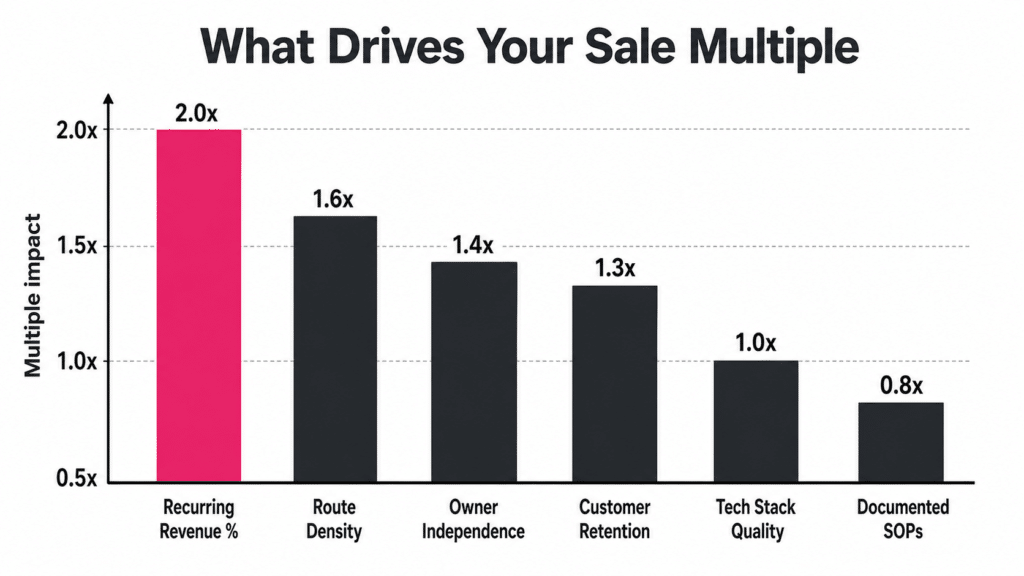
Let’s really dive into some of the things that make your company more valuable. Obviously you sell at a multiple. You’re going to want as high of a multiple as possible. How do you get a high multiple when selling?
I think it starts from day one when you’re starting your company. It’s hard to think of your exit plan, but there’s a really good book called Built to Sell. Start there. That’d be some good advice.
The second piece of advice is when you’re starting to think about it, go find a sell-side company that this is all they do. Have them start coming up with a plan for you.
What should you start really focusing on in the last few years in business? What metrics are people looking for? What kind of multiples would you get if you sold now versus in three years?
The market could be tanked. It’s hard. There are so many nuances. There are a lot of things that could affect it too. Maybe now would be better than selling in three years, or maybe holding up for three years would be better than selling now.
Maybe just meeting with a sell-side agent who, this is all they do and all they focus on. Don’t post it online yourself.
Any business owner that says they want to sell their company in one of the groups, I’d say that’s just not a savvy business owner at all.
Go find someone who’s going to make sure that you get the best financial situation at the end of the day. They’re going to put your company up for bid and they actually do it properly to get you the highest return.
It’s going to cost you money to pay someone like that, but they’re going to give you the best return on your money.
The Multiple Reality Check
Let’s talk about multiples. What are realistic multiples to get? Are you just getting a 1x? When can you get a 2 or 3?
There are so many numbers out there. There’s also different types of buyers. There’s PE firms, there’s strategic buyers. There are people in the market that are willing to pay more for a good brand.
But at the end of the day, there are so many numbers out there that I see all the time. Three or four times revenue, which I understand, but it’s not based off revenue. It’s all based off EBITDA at the end of the day. People are over-evaluating their companies all the time.
We talked about all the risks: key man risk, key vendor risk, key account risk. Then having all the other things I talked about in place. Making sure your revenue is growing, make sure your revenue growth is growing year after year. Make sure your retention is really good year after year. Obviously making sure EBITDA is really good year after year.
Maybe if you’re thinking about selling, maybe you slow down growth a little bit and you pack more to the bottom line.
Right around zero to a million dollars EBITDA, not revenue, you’re going to get like a one times multiple. One times EBITDA.
For people that don’t know, EBITDA is basically your profit at the end of the day. It’s just a fancy word for profit. Earnings before interest, tax, depreciation, and amortization. It’s just a fancy word for profit.
From zero to a million dollars in EBITDA, you’re looking at a one-time multiple. These are just standard numbers. Strategic buyers might pay more.
I’ve seen 12, 14, 16 times for big, big companies. But one to three million EBITDA, you’re looking at two and a half to maybe three times EBITDA. Five to ten, now you’re looking at five times EBITDA. Ten plus, you’re right on that six times EBITDA.
But again, there are so many multiple ways to get bought out. Private equity, big buyers that want to buy into the market and want to overpay because they know what they can do with it.
PE firms, if they do, they buy you as the platform company. Then they’re going to roll up other pest control or lawn care companies into that. They’re going to invest some money and keep that company for three, five years and invest more and keep rolling up to build something really big and sell it off again in the next seven years.
Whether you want to keep some money in it, you want to roll some money, you’re going to get equity. There’s a lot of nuance to it, but these are the kind of multiples that I see and these are the people who are willing to pay that 12, 14, 16 times for $20 million companies.
Different Types of Buyers
Explain to me the different kinds of buyers. You might have just a standard local business or there’s big private equity companies. What are the differences?
There’s private equity companies that are looking for usually a bigger-sized company as a platform company. Maybe smaller too, but usually it’s like that five to ten million dollar market. They need a platform company around ten million.
But they’re still going to buy up a five million dollar company to add to their platform company.
There’s strategic buyers. Maybe it’s a big company in the market. Maybe you own a three to five million dollar spot that they can’t tap into because your brand carries so much weight. They’re willing to pay more for that because they want to buy into that market. They know they can make that money up in drive time and things like that, offer more services.
Then you just have the regular guy like you and I that aren’t going to overspend. That’s just going to make it make sense financially.
Maybe that owner doesn’t want to sell to those guys. Maybe he doesn’t want to see someone big buy it. Maybe he wants to see someone like you take over that’s young and hungry, and he wants to pass the torch. He’s willing to give you a good, decent deal where he’s going to make good money and you get to help grow the thing.
Easy Ways to Increase Valuation
Are there any easy ways to increase your valuation and/or multiple?
Although we’ve talked about this a lot, of course you want a CRM. You have to. Some people say they can’t afford it and they’re not selling anywhere anytime soon, but you just have to. You can’t afford not to.
That CRM will make you so much money day after day, save you so much time that it’ll make you money. Profit is a big one. Having managers in place. Having good clients. Obviously good churn rates. Obviously profitability has to be high. The higher the profitability, the more you’re going to get.
The Point System
All of those are fairly difficult. You have to build them all. It’s based on a point system. If your churn rate is over 20 percent, you’re going to get valued at maybe a half a point less. There’s a point system for everything.
Same thing with, let’s say you’re not growing. Let’s say you’re actually declining. It’s probably not a great time to sell because you’re going to get less money because it’s not growing.
Same thing with EBITDA. If you’re not showing a lot of profit, you’re not going to get paid as much. If you have key man risk, you’re going to have a point or a point less for all these little things that factor into all these multiples.
Not just one thing that really matters or sticks out. It’s all of them collectively.
Making sure all the things that I listed out earlier, you can go through and make sure, “Hey, I don’t have key man risk.” Every single company out there has key man risk unless you’re huge. You’re always going to have that key man risk.
But key client risk? Is your business only a few clients that make up all your revenue? When someone looks at it, you’re probably going to get a little bit less of an evaluation because of that.
Keeping the Owner On
Something else I’ve seen with acquisitions is when you buy a company, the owner might actually stay on as the manager. Talk to me more about that.
Having them maybe keep some equity or roll out equity. Maybe they’re willing to take on seller financing. Maybe they’re willing to provide you the loan itself. It’s hard to say. Every deal is different.
Maybe you have a different exit plan. If he helps you grow it, he gets a portion of the exit too. There are really cool things you can do there too.
There are way smarter people out there than me that help you with this stuff. There are literally a thousand different ways to make deals happen.
The Expert Team You Need
Who, not like a specific person, but a specific kind of person, who do you need to consult with?
Mergers and acquisitions expert. There’s companies that this is all they do, and they’re specifically sell-side, not sell and buy. Some companies, all they do is help sell companies. That’s their whole job.
Then it’s talking with a wealth management guy. What are you going to do with your money? How could you save some taxes? This is not my realm, but I know the people around me that I can connect with.
Then there’s specific lawyers that just do business transactions. Make sure you hire specific people. Yes, it’s going to cost you more money, but it will save you a lot of money in the long term too.
The Biggest Mistakes
Any mistakes of preparing your company to sell or just things that you should really be thinking about from the start to the end?
Most people don’t want to grow their company and that’s okay. There’s nothing wrong with that. Just know that you took a hundred thousand dollars a year out of the thing for the last 20 years and you go to sell it and you didn’t grow it. It’s just not going to be worth a whole lot.
You might have to just hand that off to a kid or barely sell it or not make much money out of it. You sucked all the money out of it versus, “Hey, I need to grow this thing to where it’s producing $400,000 worth of cash.” You’ll get some good money for that company.
You have to keep reinvesting and ultimately be looking to that long term. Instead of selling this thing for a million, let’s sell it for five million.
All those things that we talked about all factor in. You’ve got to have them all in place. You’ve got to be working on each one. There’s a lot to it. Not just one thing.
Those are some mistakes: not knowing what to look for, not doing enough homework early on, not having a clear vision where you want the company to go, and just not growing the company overall.
The Acquisition Playbook That Actually Works
Here’s what most people don’t understand about buying pest control companies. It’s not just about finding a deal and writing a check. It’s about finding the right deal at the right price with the right structure and integrating it properly.
I’ve bought companies that were home runs. I’ve bought companies that taught me expensive lessons. The difference wasn’t luck. It was doing the homework upfront, not getting emotionally invested, and having a real plan for integration.
If you’re thinking about buying a company, start looking now. Build relationships with other owners. Walk into offices and ask if they’re thinking about selling. Send LinkedIn messages. Have coffee with the older guys in your market who might be thinking about retirement.
When you find a deal, hire the right people. A business attorney who does acquisitions. A CFO who knows pest control. A sell-side advisor if you’re selling.
Do real due diligence. Not just looking at the P&L, but understanding the risks. Key man risk. Key client risk. Single channel risk. Market risk. What the customer base actually looks like. What the retention really is. Whether the brand carries weight.
Structure the deal right. Don’t overpay because you’re emotionally invested. Have retention clawbacks. Consider seller financing. Think about whether you want the owner to stay on.
And for God’s sake, have a real integration plan. Don’t just assume it’ll work itself out. Have a checklist. Have a timeline. Have a plan for the technicians, the customers, the CRM, the branding, the pricing.
The companies that win at acquisitions aren’t the ones who buy the most companies. They’re the ones who buy the right companies, at the right price, and integrate them properly.
If you want to connect with other pest control owners who are buying and selling companies, join our free facebook group. We’ve got over three thousand active members sharing what’s working.
And if you want the complete blueprint for building a pest control business that’s worth buying or selling, check out our book Zip Code Kings. It covers everything we just talked about and a whole lot more. Now go buy your next company the right way.
Frequently Asked Questions
How much does it cost to buy a pest control company?
Pest control companies typically sell for 2-5x annual revenue or 4-8x EBITDA, depending on size, recurring revenue percentage, customer concentration, and growth trajectory. Small companies under $500K revenue may sell for 1.5-3x, while larger companies with strong recurring revenue command premium multiples.
What should I look for when buying a pest control business?
Key factors include recurring revenue percentage, customer retention rates, technician tenure, route density, reputation and online reviews, condition of equipment, chemical inventory, existing contracts, and any outstanding liabilities or legal issues.
How do I finance a pest control acquisition?
Common financing options include SBA loans covering up to 90% of purchase price, seller financing where the seller carries 10-30% as a note, conventional bank loans, and for larger deals, private equity or investor partnerships. Most acquisitions use a combination of these.
What is the due diligence process for buying a pest control company?
Due diligence should cover at least 3 years of financial records, customer lists and retention data, employee contracts and certifications, vehicle and equipment condition, insurance and licensing, outstanding warranties, and any pending legal matters or regulatory issues.
Should I buy an existing pest control business or start from scratch?
Buying is generally faster and less risky if you find the right opportunity. You acquire immediate revenue, trained staff, established routes, and brand recognition. Starting from scratch costs less upfront but takes 2-3 years to reach the revenue an acquisition provides on day one.
How do I value recurring revenue when buying a pest control company?
Recurring revenue is valued at a premium because it is predictable and has high margins. A company with 80% recurring revenue might command 4-5x revenue, while a company of the same size with only 40% recurring might sell for 2-3x. Retention rates directly impact the value of recurring revenue.
What multiple do pest control companies sell for in 2026?
Residential routes trade at 1.0 to 2.0x annual revenue or 4 to 7x SDE. Commercial-heavy books and termite-included routes can hit 7 to 9x SDE. Smaller deals under $500K SDE typically come in lower; deals over $3M SDE attract private equity and push multiples higher. See our acquisition process guide for the full framework.
How long does a typical pest control acquisition take from LOI to close?
60 to 120 days. Letter of intent through purchase agreement runs 30 to 45 days, financing approval another 30, and due diligence + close another 30 to 45. Deals fall apart most often during due diligence — get your CPA and attorney involved before signing LOI to avoid surprises.
If you are serious about how to buy a pest control company, start implementing these strategies today.
