What makes a good offer? And why is that important to a pest control company?
Most pest control companies are throwing marketing dollars at the wall and hoping something sticks. They’re missing key components that make offers actually work.
After building Pest Badger into a $10 million company and studying the best marketers in the world, I’ve learned there’s a specific framework for creating offers that convert. It’s not rocket science. But you have to know what pieces to include.
Let me break down the exact components of a great offer and how to use them.
The Alex Hormozi Framework
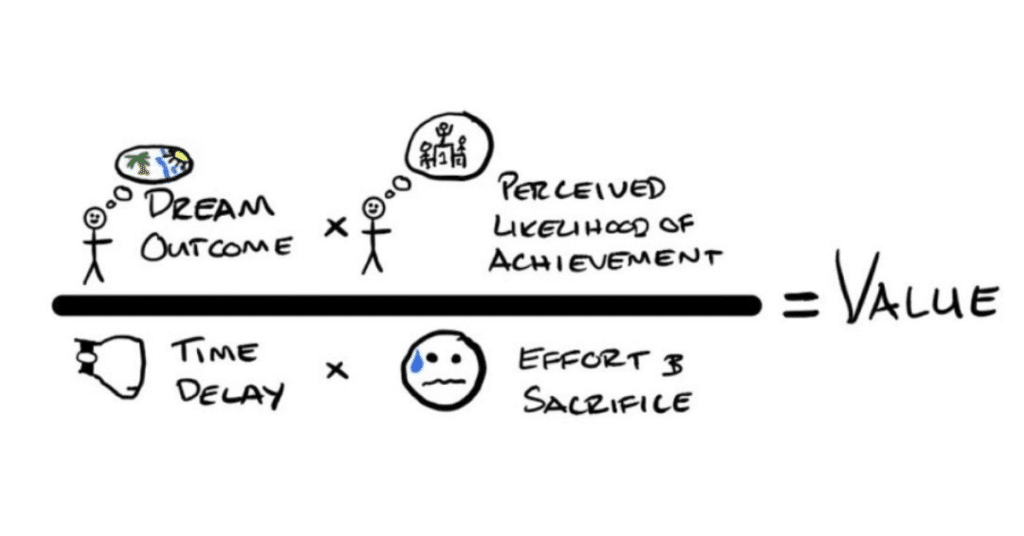
For all the people who don’t know who Alex Hormozi is, you should definitely watch him. I’ve read all his books multiple times. I’ve also read all the Dan Kennedy books. Old school magnetic marketing. All the really good stuff.
The framework is basically the same, but I really like how Alex phrases it. He brings it home in a different way.
Here’s the framework: Dream Outcome divided by Likelihood of Achievement, over Time Delay times Effort and Sacrifice.
Let me break that down for pest control.
What’s the customer’s dream outcome? They have zero issues with any bugs. Zero pests. Ever.
What’s the most likelihood of that achievement happening? Over time delay times effort and sacrifice.
What are they going to have to do? Hopefully nothing. Hopefully go to your website, book a call, or maybe schedule right through your website without talking to anyone. Then you just show up.
How long is it going to take them to have no bugs? In a perfect world, looking at their dream outcome, it’s like, “Hey, we’re going to show up today. Then you’re never going to have bugs again.”
The most likelihood of that ever happening is probably slim to none. There’s always going to be bugs out there. But we can reduce them seeing any issues by 90 to 95%.
I love how Alex broke that down so simply. It just hit my brain. I love how he phrased that.
The Core Components of a Good Offer
Going back to what makes a good offer, you have to have these components:
1. A Great Headline
Dan Kennedy says that if you’re spending a dollar on marketing, 80 cents of that dollar is all in your headline. That’s how important it is.
It’s the same thing with knocking doors. You get three seconds right away. Three seconds before someone kicks you out the door.
So having that really good opening line, the headline that addresses what the customer’s having issues with and how you can control it, is critical.
2. A Clear Offer
From there, you have to have whatever your offer is. Whether it’s the multiple offers we talked about in previous posts, you need to make it crystal clear what you’re offering.
3. Social Proof
What’s social proof? Reviews.
The best reviews you can have more than one of. Obviously you’re going to have a bunch on Google. But let’s say you’re doing marketing campaigns, postcards, or even on Facebook. Have reviews tied to it, tied to that specific area.
So let’s say it’s “XYZ Pest Control did our service. It’s amazing.” Then her name and then “Chicago, Illinois.”
I love that part of it. You have to have a lot of social proof to get people to buy in.
4. Follow the Crowd Mentality
People follow the crowd. If Mrs. Jones is doing it, and you have 1,000 five star reviews, they’re like, “Dang, this company is pretty good.”
5. Urgency and Scarcity
Next, you have to have urgency and scarcity.
Urgency is a reason to buy now. And there’s always, always, always a reason to buy now. No matter what. If there’s not, make one.
Scarcity is pretty easy. Maybe there’s only two slots available today. Or maybe you’ve already taken seven people on their block. Or maybe you’re only taking the next three customers in their area. Or maybe it’s the first 50 homes in their neighborhood.
Make it so there’s a reason to call and there’s scarcity. It’s like, “I want to get on this list. This is a really good offer. I know my neighbors are doing it. Some of my neighbors already did it. I need to get on this now.”
6. A Clear Call to Action
The next thing is a call to action, which is one of the most important parts.
Customers or people in general are trained to follow directions. So having a clear, concise way to tell them what we want them to do to move to the next part of the sale is critical.
Whether that’s “text this number” or “click this button” or “watch this video,” whatever it may be, always have a call to action.
We’re not big enough companies to spend brand awareness dollars. We’re just not. All of our marketing has to have a very high return. We need to track all that.
So having a call to action that’s easily trackable is essential.
These Components Work Across All Marketing
Again, we’ll get into actual marketing tactics in later posts. But these are all the components of an offer that I like to see on anything. Whether that’s digital marketing, print marketing, or even business cards. It doesn’t matter.
I like to see all these things on there to make sure you have a very valuable marketing piece.
You’re going to have to switch headlines. You’re going to have to switch pictures. We can talk about this all day long in different marketing videos. But this one specifically, you have to have all these things in there.
You can rotate them and play with them until you find that winning headline, that winning ad. And also, you can run that ad forever until it kind of burns out, whether that’s online or offline.
You can keep using the same postcards, same door hangers. As soon as you find something that converts, milk that thing.
But these are all the things that I see that make up a really good offer.
Again, I didn’t make any of this stuff up. A lot of this I learned from Alex or Dan or Russell Brunson. All those big marketing guys that I followed. And obviously, it works.
Use These Components Across All Platforms
You can use these components on all your platforms. Whether that’s a flyer you’re going to hang inside of a marketplace on a bulletin board, Facebook ads, Google ads, any form of marketing, print, Every Door Direct Mail (EDDM), postcards, door hangers.
All of them follow the same structure.
We’re going to break down each one of these individually in future marketing posts. From email to door hangers to Every Door Direct Mail. But for now, this is the actual structure I like to see on every piece of marketing.
And every, every, every piece of marketing that goes out always has to have an offer.
Do Other Companies Use These Components?
Very, very, very few.
ChatGPT has helped, right? It helps them write ads. But you still have to prompt those ads correctly.
I see people say, “Hey, write me this ad.” All of a sudden you see 6,000 emojis. I know what wrote that. It’s ChatGPT.
I’m not saying not to use ChatGPT. But ChatGPT is very noticeable these days. So be very intentional about what you’re prompting it to do.
AI takes good prompting. If you’re not great at asking really good questions or telling it exactly what format you want it in, it’s not going to give you what you need.
What I see in the marketplace is people are getting better. They’re using AI and AI is helping them. But it looks too AI to me. And they’re still missing a lot of the key components.
How to Use ChatGPT for Offers Without Sounding Like AI
So if you’re going to use ChatGPT to build your offers, how do you make sure it has your voice and your message?
You can tell ChatGPT the exact framework I just gave you, word for word. It’s going to give you a pretty good response right away.
From there, it’s about detailing. ChatGPT is really good for the most part. But even when it gives you a response, it just doesn’t quite hit home.
So you always got to play with it. Keep prompting and keep prompting and keep prompting until it’s just right.
I usually talk to ChatGPT for quite a while. It knows my voice, knows my tonality, knows what I’m looking for. So it knows when I talk about marketing, I have a whole folder just for the marketing side with the exact verbiage that I want.
You can literally tell it to do like, “I want David Ogilvy” or “I want Alex Hormozi” or “Russell Brunson. I want to sound like them. Act like them.” Whatever you want it to be.
Or say, “I want it to sound like me. I don’t want it to be AI written.”
Ask questions like, “What am I missing on this? What can make it better? What can make it convert 1% more?”
Asking all these questions through ChatGPT to help you write them out is definitely helpful.
I still like to write my own ads. I use ChatGPT to guide me, but I still like to actually write my own ads.
Guarantees and USPs: How to Stand Out Without Being Generic
When you’re looking at those different components, are you combining your core services with add ons? Are you doing any guarantees with these offers?
I think guarantees have kind of gotten played out. What you want to do instead is make sure you have a unique selling proposition (USP) on there. Something that makes you different than anyone else.
You can basically guarantee something, but in a different format. There’s no risk to the person signing up.
Let’s go back to the old analogy of “100% satisfaction guarantee.” Okay, cool.
But you could say, “You’ll have no weeds in the next 30 days or I’m going to come back and do the service for free.”
Which sounds better? “100% satisfaction guarantee” or “If you see any weeds in the next 30 days, we’ll come back out and service it for free”?
Or “If you have any more chinch bugs, we’ll come back out there. It’s our fault. We’ll service your entire property for free.”
It’s much more clear and specific.
You’re not saying “I include 200% money back guarantee” or “I’ll pay you.” That stuff’s all played out.
But how can you rephrase that to make sure the customer knows you’re going to guarantee it without actually saying those words?
“Hey, if you’re still seeing issues in the next 30 days, we’ll come back out there and service it for you.”
That’s a guarantee without using the word guarantee.
Tailoring Offers for New vs Existing Customers
How are you tailoring different offers for first time customers versus your current customers?
Offers apply to your current customers too, not just first time customers.
Are your tailored offers different for each one? Yes. Different for each spot on the pipeline that they’re in.
If they’re already a customer, they’re going to get a totally different campaign, totally different offers.
Also, when they’re your customer, they already trust you. You don’t have to give them discounts. Just tell them what they’re missing out on.
Right now, I’m mostly talking about new customers and creating new ads. But you’re still going to create ads and campaigns for internal customers that are already there.
It’s structured roughly the same, but it’s just a different model.
The Best Time to Market: When Pain Points Are High
When I’m doing upsell stuff, it’s more about knowing the pain points I know customers are dealing with. And every single market is different.
Whether it’s lawn care and they have grub issues this time of year, or chinch bugs this time of year, mosquitoes, Asian lady bugs, termites, whatever.
The best time to market is when you know that pain point is going to be high.
As soon as the issues hit, that’s when you want to be marketing. If you’re thinking about what’s happening right now, you’re already behind the eight ball.
You want to have a game plan. You want to have a marketing calendar laid out for the entire year. That’s just automated.
The Power of Real Stories in Upsell Campaigns
Here’s one of my best upsell campaigns. This is a true story.
I was doing an outdoor walk around my block. I’m writing this email campaign about how I’m literally getting attacked by mosquitoes as I’m walking around.
I’m on my walk and I’m kind of in a hurry to get back because my daughter had wrestling at 9 a.m. that morning.
So I’m writing this email campaign. I got it finished, sent it off to my team. And it absolutely crushed.
I tied it into an actual real story that I personally had. We all have these stories we’ve been dealing with for years. That was just one of mine.
I’m walking around my block. Getting attacked by mosquitoes. If I’m getting carried away by mosquitoes and I don’t have pest control or mosquito control at my house, then everyone else is too.
So I tied that story back to a relatable thing that was real. It’s a pain point that hits home. People are like, “Oh man, I’m dealing with that too.”
It also makes sure you’re a real person. I have my daughter. We’re going to wrestling.
Within like a minute, I had a response. “You’re going to your daughter’s wrestling this early?” I’m like, “Yeah.” And it was funny because I was still on my email at the time. I said, “Yeah, actually we had to leave here in the next 15 minutes.” This was middle of summer because she went to wrestling camp or something.
Use real stories. That’s how I like to see my upsell campaigns.
Offers Die Out: Switch Them When They Stop Working
I had someone running a pest control company in Kansas City. They were having trouble getting people through their pipeline. Their Facebook ads were killing it in previous months. Then for some reason, the offer wasn’t working anymore. It died out.
They were milking that offer for a really long time and it was working very well. But then it died.
They looked at Google to see what people were talking about. A lot of people were talking about stink bugs. So they made a stink bug offer.
It absolutely killed it for another month to two months.
That’s why I said if you’re thinking about what’s coming out this week or next week, you’re probably behind the eight ball.
Think of every season you’re going to go through this year. Think of every issue people are going to have that you’re going to have to solve. Start creating campaigns now for next year.
How to Build Components of a Great Pest Control Offer
If I were building offers from scratch today, here’s exactly what I’d do:
- Use the Alex Hormozi framework – Dream outcome / likelihood of achievement over time delay times effort and sacrifice
- Write a killer headline – 80% of your marketing dollar is in the headline
- Include social proof – Reviews from specific areas, names and locations
- Create urgency and scarcity – Give them a reason to buy now
- Have a clear call to action – Tell them exactly what to do next
- Use USPs instead of generic guarantees – Be specific about what you’ll fix
- Tailor offers by customer type – New customers get different offers than existing
- Market to pain points seasonally – Plan a year in advance
- Use real stories – Personal experiences convert better than generic copy
- Test and rotate – When an offer dies, switch it based on current pain points
Every piece of marketing you send out should have these components. Door hangers, postcards, Facebook ads, Google ads, emails. All of it.
We talk about offer building strategies like this all the time in our free Facebook group, Pest Control Millionaires. Over 2,000 active pest control owners sharing what works, asking questions, and helping each other create offers that actually convert.
And if you want the complete guide to building a pest control company that dominates your local market, check out Zip Code Kings. Danny, Jake, and I break down everything from offer components to seasonal marketing to creating campaigns that drive real results. It’s the pest control marketing bible.
The bottom line? If you’re not using these offer components, you’re missing out on a lot of money. Build your offers the right way and watch your conversion rates skyrocket.